Droits
de l'Homme / Human Rights
La
Turquie condamnée pour tortures lors
d'une garde à vue
Trois ressortissants turcs, dont une femme, ont obtenu 15.000 euros
chacun pour dommage moral après avoir été
torturés par des policiers de
la section antiterroriste de la sûreté d'Istanbul, dans un
arrêt de la
Cour européenne des droits de l'Homme.
Pendant dix jours, en juin 1995, les trois personnes,
soupçonnées
d'appartenir à un parti communiste léniniste marxiste,
avaient subi
pendaisons palestiniennes (par les bras), électrochocs sur les
parties
génitales, jets d'eau et privation de sommeil, destinés
à leur arracher
des aveux.
Le gouvernement turc a soutenu que les blessures décrites dans
les
rapports médicaux avaient été infligées aux
requérants lors d'une
bagarre contre les policiers qui les arrêtaient.
Mais la Cour européenne a relevé que les
requérants n'avaient pas été
examinés par un médecin pendant leur détention.
Elle juge probable en
conséquence que ces tortures "particulièrement graves et
cruelles" ont
été "infligées délibérément
par la police dans le but d'arracher aux
requérants des aveux ou des informations".
Les juges européens se sont en outre irrités des
"importants retards"
qui ont entaché l'enquête et ont finalement
entraîné la prescription de
l'affaire.
"Les principaux auteurs des actes de violence ont joui d'une
quasi-impunité en dépit des preuves à charge",
déplore la Cour
européenne, soulignant en outre que la justice turque n'avait
lancé des
poursuites contre des policiers d'Istanbul qu'après avoir
été avertie
qu'une requête avait été déposée
à Strasbourg.
Les trois requérants, âgés aujourd'hui de 49, 37 et
35 ans, résident actuellement en Allemagne et en Suisse.
(AFP, 31 mai 2007)
Police
Regaining Vast Powers in Turkey
The provisional law has evoked strong reactions by MPs, trade unionists
and lawyers. It would give security forces unprecedented, and many
claim unrestricted, powers.
The acceptance of the provisional law was commented on by an MP from
the People's Republican Party, Yüksel Corbacioglu, who said that
it
represented "one-nil for the police state against a judiciary state".
Justice and Development Party (AKP) MP Hakki Köylü complained
that the
new law would allow the police to shoot anyone who "smacked someone in
the face twice and ran away".
Protest by trade unionists
The Trade Union Confederation of Public Workers (KESK) has called for a
rejection of the law, saying that "our country does not need more
pressure, more police force, but more democracy. We call on all parts
of society who support democracy, human rights and freedoms to oppose
this law".
It went on to say: "This law, which foresees questioning in the
streets, arrests without establishing identities, taking everyone's
fingerprints and preparing files on them, unlimited authorization to
search, random pressure put on syndicates and mass organizations, and
using violence without warning, includes many practices that are
incongruous with democracy. "
On the way to a police state
Lawyer Ali Koc has claimed that such a law would create a police state
and that it represented a set-back in the progress previously made with
laws conforming to European Union standards. He summarised the law as
follows:
"Everyone, everywhere, could be stopped, searched as a suspect, could
be exposed to gun use and violence. And the only restraint would be the
'good will' of the police officer in question. The police would be able
to search all kinds of buildings, including homes." (BIA News Center,
May 30, 2007)
TIHV Reacts to Law Enforcing the Police
The Turkish Human Rights Foundation (TIHV) has reacted to the
passing of an amendment by the Parliamentary Justice Commission.
Increase in powers
According to the foundation, the "Proposal to Change the Law on Police
Duties and Authorities" would allow the police the following:
* To stop people and their cars, to ask for IDs and ask questions "in
order to prevent crimes"
* To take fingerprints and photos of a person and keep this information
* To do body searches, searches of cars, private property and documents
* To use truncheons, handcuffs, pressurized water, tear gas or powder,
and to use violence against physical barricades like cars
* To use guns and to fire them non-stop in self-defense
* To force people to identify others
Should this law be passed, the TIHV argues that in the name of crime
prevention everyone would become a potential criminal. The foundation
emphasized that formulations in the law made it dependent on the
disposition of the police how far the freedom of people, associations,
foundations, syndicates and similar organizations would be restricted.
(BIA News Center, May 31, 2007)
Trade Unionist Teacher Killed
The trade union Egitim-Sen has announced that its Deprem Sarikas, a
high school literature teacher and member of the union, was killed in a
"planned and professional manner".
The union suspects that he was murdered for his progressive, democratic
views. The union called the District Directorate of Education, the
police department, the Ministry of Education, the Ministry of the
Interior and the governor's office to investigate the case.
Sarikas was murdered on 24 May in Ankara on his way to school. Two days
before he had been attacked by a group with knives.
Sarikas had brought cases of racist attacks at schools and universities
to the attention of teachers' boards before and had lobbied for
prevention of such attacks.
The union spoke of a "normalisation" of violence in Turkey in general,
and at schools. This meant that murder became easier to commit and that
both teachers and pupils were in danger. (BIA News Center, May 28, 2007)
Police to be given "terror authorization"
A draft bill handed to the Turkish Grand National Assembly yesterday
aims to expand police power following a bomb attack in Ulus, Ankara
that killed six and injured more than one hundred. The draft bill
proposes the following amendments to the Regulations for Police Duties
and Authorities:
-Authorization of use of all types of human and technical resources and
intelligence activities, including the use of cameras, voice recording
facilities and the internet, to survey possible criminals. It was
explained that this could also mean the ability to listen to telephone
conversations without obtaining any prior permission.
- The police will be able to obtain fingerprints from anybody applying
for a gun license, driving license or passport.
- The police will be able to carry out body searches and searches of
cars, personal documents and personal effects after obtaining authority
from the civil authorities.
- Use of force such as physical force, handcuffs, a baton and
pressurized water will be authorised in that order on persons refusing
cooperation. The officer will say ‘Stop’ before using their gun. If the
person continues to run, the officer must first fire a warning shot
before shooting to disable their escape. (Hurriyet, May 27, 2007)
AI
Say Human Rights Situation in Turkey Froze in 2006
In its annual world report on human rights, published on its website
yesterday, Amnesty International also evaluated the state of Turkey.
Further restrictions
According to Amnesty International (AI), a revision of the Law to Fight
Terrorism has widened "the scope and number of crimes punishable as
terrorist offences". Furthermore, freedom of expression was still not
guaranteed, as the controversial Article 301 was used to try
"journalists, writers, publishers, academics, human rights defenders
and students".
Kurds facing repression
AI mentions the trial of 56 mayors from the pro-Kurdish Democratic
Turkey Party (DTP), which is based on a letter they wrote to the Danish
Prime Minister, urging him not to close to pro-Kurdish television
channel Roj TV based in Denmark.
AI also criticises the "excessive use of force" by security forces
policing the funeral of four PKK members in March 2006, at which 10
people were killed, including 4 children.
More bomb attacks
An armed group calling itself the "Kurdish Freedom Falcons" claimed
responsibility for bombings in different cities last year, resulting in
9 dead and many injured. An armed attack on the higher administrative
court in Ankara, carried out with religious motives, resulted in the
death of one judge. Related to this case, the Kemalist newspaper
"Cumhuriyet" faced three bomb attacks of its premises last year.
Torture
Although there has been a decrease in reports of torture by law
enforcement officers, many detainees stil report mistreatment.
Furthermore, security forces are stil able to act with impunity, both
in torture cases and in militia activities. AI quotes the Semdinli case
as an example.
Conscientious objectors
AI draws attention to the fact that conscientious objectors face prison
for their decision, as there are no civilian alternatives. They quote
the imprisonment of objector Mehmet Tarhan
Protection of women insufficient
Women's groups continue to lament the lack of women's shelters for
victims of domestic violence. The Prime Minister has however called for
measures to curb domestic violence and stop the so-called "honour
killings". (BIA News Center, May 24, 2007)
La Belgique épinglée par Amnesty pour
la loi anti-terrorisme
Enfermement des mineurs dans les centres fermés, surpopulation
carcérale, vols secrets américains sur le sol belge, loi
anti-terrorisme trop vague, la Belgique n'est pas
épargnée par le
rapport 2007 d'Amnesty sur la situation des droits humains dans le
monde.
"La question de la lutte contre le terrorisme a également des
répercussions chez nous", explique Philippe Hensmans d'Amnesty
Belgique. "La loi anti-terrorisme est beaucoup trop vague et les peines
sont démesurées par rapport aux faits reprochés",
ajoute-t-il. Amnesty
dénonce ainsi les peines lourdes appliquées pour
"appartenance à un
groupe terroriste". En ce qui concerne les militants du DHKP-C, Amnesty
s'inquiète des accusations de mauvais traitements durant la
détention
et se félicite qu'un nouveau procès ait lieu.
Autre point noir mis en avant par Amnesty: la question du droit d'asile
et surtout celle de l'enfermement des mineurs dans les centres
fermés.
"Cela reste une préoccupation importante d'Amnesty", souligne
Philippe
Hensmans.
Par ailleurs, Amnesty met en avant la persistance de violences à
caractère raciste, citant notamment l'assassinat raciste commis
à
Anvers en mai 2006. (Advalvas avec Belga, 23 mai 2007)
Une
explosion fait six morts et près de 80
blessés à Ankara
Six personnes, dont un Pakistanais, ont été tuées
et près de 80 autres
blessées mardi à Ankara à la suite de l'explosion
d'une bombe . Le chef
du gouvernement a indiqué devant les caméras de la
télévision, sur les
lieux de la tragédie, que quatre turcs et un pakistanais avaient
été
tués dans l'explosion. Selon l'agence semi-officielle Anatolie,
un
homme grièvement atteint, a succombé à ses
blessures une heure environ
après l'intervention du Premier ministre.
Citant des sources policières, l'agence a fait état de 79
personnes
blessées par l'explosion, dont huit ont été
hospitalisées dans un état
grave. Huit des blessés seraient des Pakistanais, qui se
trouvaient à
Ankara pour un salon international de l'industrie de la défense,
qui
s'est ouvert mardi matin, selon Anatolie citant l'attaché
militaire du
Pakistan à Ankara. Leurs jours ne seraient pas en danger, selon
ce
responsable.
Le dîner officiel de cette foire de matériel et
d'équipements
militaires, qui accueille près de 500 firmes de 49 pays, devait
débuter
à 19h00 (16h00 GMT) au Musée des civilisations
anatoliennes, qui se
trouve à quelques centaines de mètres du lieu de
l'explosion.
Selon un policier, interrogé par l'AFP, la bombe avait
été "placée à un
arrêt d'autobus" sur l'avenue Anafartalar, située dans un
quartier très
commerçant de la capitale turque, à une heure de grande
affluence.
L'explosion s'est produite vers 18H50 locales (15H50 GMT) devant un
centre commercial d'Ulus.
Des experts en explosifs devaient encore déterminer le type
d'engin
utilisé et enquêtaient sur l'éventuelle implication
d'un kamikaze, ont
indiqué à Anatolie des sources policières. (AFP,
23 mai 2007)
La
conférence de Zarakolu et Özkoray
sur le militarisme
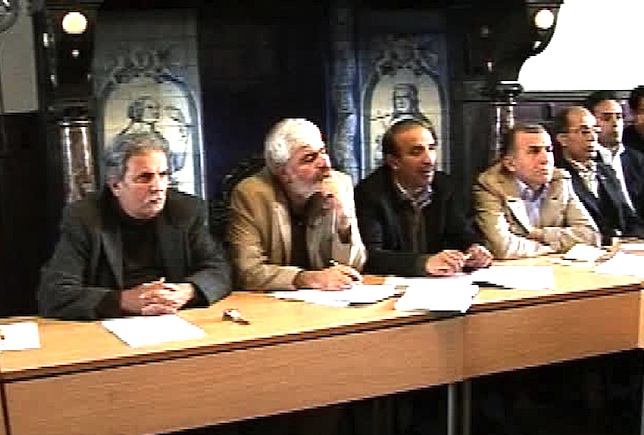
Özkoray, Özgüden,
Zarakolu et Kimyongür
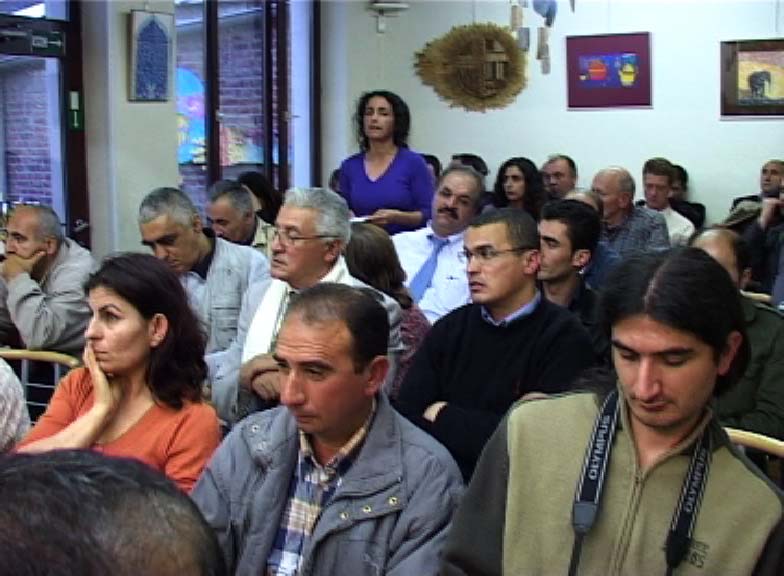
La conférence a été organisée par
l'Association des Arméniens
Démocrates de Belgique, les Associations Assyriennes de
Belgique,
l'Institut Kurde de Bruxelles et la Fondation Info-Türk.
L'interprétation des interventions a été
assurée par Bahar Kimyongür,
qui a lui-même été victime de la violation de la
liberté d'expression
en Belgique sous la préssion du régime militariste turc.
A l'ouverture de la soirée, le président de la Fondation
Info-Türk,
Dogan Özgüden, a attiré l'attention sur l'importance
de la tenue de
cette conférence dans une période où
l'armée turque trompe une fois de
plus l'opinion publique en se présentant comme défenseur
de la laïcité.
Après la présentation de deux orateurs, Ragip Zarakolu a
fait un exposé
historique sur le militarisme dans le monde et plus
particulièrement en
Turquie. Il a mis accent sur le statut dominant de l'Armée non
seulement dans les affaires militaires mais également sur les
plans
politiques, économiques et de relations extérieures.
Attirant l'attention sur le fait que la liberté d'expression a
toujours
été violée en Turquie par l'Armée, soit
directement lors des périodes
de guerre et de loi martiale soit indirectement par l'exercice de la
pression sur les instances politiques, Zarakolu a dit: "L'assassinat de
Hrant Dink est une conséquence directe du militarisme en
Turquie. Il
avait invoqué, dans un de ses écrits récents,
l'origine de la fille
adoptive d'Atatürk. Pour cela, l'Armée a mobilisé
toutes les forces
répressives et subversives contre lui… "
"Le militarisme, à l'heure actuelle, constitue l'obstacle majeur
dans
le processus d'adhésion de la Turquie à l'Union
européenne. Le
militarisme ne veut pas abandonner sa position
hégémonique sur la
société turque. C'est la raison pour laquelle
l'Armée a mobilisé depuis
deux ans toutes les forces ultranationalistes.
"Actuellement la Turquie se trouve dans une crise profonde. La presse
internationale la décrit comme un conflit entre des Islamistes
et des
Laïcs. 'Nous constituons le front de défense de l'Occident
contre le
fondamentalisme et la réaction islamiste,' disent-ils. Dans le
passé,
le militarisme avait utilisé 'la menace communiste' pour
justifier sa
domination. Aujourd'hui, elle parle des menaces islamiste ou
kurde…
"On peut trouver très pessimiste le tableau que je viens de vous
présenter. Quand même il y a une lueur d'espoir aux
élections du 22
juillet. Je pense que face à la mobilisation des forces
ultranationalistes, tous les démocrates, progressistes,
socialistes,
révolutionnaires et tous les citoyens de sensibilités
différentes
doivent se mobiliser. Ainsi les candidats indépendants
démocrates
peuvent faire leur entrée à l'Assemblée nationale.
Depuis vingt ans se
développe en Turquie un potentiel de votes de protestation.
Valoriser
ce potentiel de protestation pour qu'il devienne un véritable
alternatif, c'est un devoir qui incombe aux forces démocrates,
progressistes et socialistes."
Zarakolu, en réponse à une question concernant le
passé et
les
perspectifs de la gauche en Turquie, a mis accent sur le rôle
important
du mouvement national kurde:
"Le militarisme a toujours pris comme cible principale les
révolutionnaires et les intellectuels quelles que soient leurs
origines. C'est la
raison
pour laquelle, à chaque intervention militaire, les
révolutionnaires
et les intellectuels ont été sauvagement
écrasés dans l'oeuf.
Par exemple, l'opération
génocidaire contre le peuple arménien par l'Armée
en 1915 s'est
déclenchée avec l'arrestation des leaders du
mouvement révolutionnaire
arménien et plusieurs intellectuels arméniens. En effet,
dans un document officiel publié en
1916, le
gouvernement ottoman affirmait que le responsable principal des
évènements de 1915 aurait été des
révolutionnaires arméniens.
"Il était le cas aussi dans la justification des coups
d'état de 1971
et 1980. Toutefois, l'Armée turque a subi un echec important
lors
de son régime répressif après le coup
d'état de 1980. Il s'agissait de
la naissance du mouvement de libération kurde en
résistance contre la
répression militaire. Actuellement, la seule force qui pourra
préparer
l'écroulement du régime militariste est l'alliance de
toutes les forces
démocratiques et progressistes du pays avec le mouvement de
libération
kurde."
Erol Özkoray, à son tour, a fait un exposé
précis sur les mécanismes de la domination militariste en
Turquie:
"Le véritable pouvoir en Turquie est l'Armée. Le
gouvernement n'est
qu'un organe pour la gestion des affaires courantes. L'armée
exerce son
pouvoir grâce à plusieurs instruments comme la
Constitution de 1982, le
Conseil national de la Sûreté ou le Document politique
pour la sûreté
nationale, qui est appelée également la constitution
confidentielle de
l'Etat.
"Un autre moyen qu'utilise l'Armée est de provoquer et
déclencher, si
nécessaire, des crises externes ou internes. Le prétexte
de créer une
crise est la nécessité urgente de combattre les ennemis
internes et
externes. Les ennemis internes sont des Kurdes ou des Islamistes. La
crise externe est en général liée à la
Grèce.
"L'Armée, depuis 1908, a fait 31 interventions dans la vie
politique,
soit en forme de coups d'état ou tentatives de coup
d'état soit en
forme d'envoi d'un mémorandum au gouvernement ou en organisant
un
défilé de blindés dans la ville. La
dernière intervention était la
diffusion d'un mémorandum sur le site de l'Etat-major.
"En dehors de ces interventions ponctuelles, la Turquie vit dans un
système de coups d'état permanents. Chaque réunion
du Conseil national
de la Sûreté constitue en soi un nouveau coup
d'état.
"En ce qui concerne la liberté d'expression, l'article 90 de la
Constitution actuelle stipule que les conventions internationales comme
la Convention européenne des droits de l'Homme
prévaillent sur les lois
nationales. Ainsi, tous les articles répressifs comme l'Article
301 du
code pénal turc sont d'office caducs. Malgré cela, ces
articles
répressifs sont pleinement utilisés contre tous les
opposants et aucun
tribunal ne conteste l'application de ces articles. Tant que la
domination militariste sur la société turque se poursuit,
il est
impossible d'attendre une véritable démocratisation et un
respect total
d e la liberté d'expression en Turquie."
Le texte complet des interventions sera prochainement publié par
la Fondation Info-Türk.
*) Voir l'article profond
d'Özkoray sur le militarisme en Turquie: "L'Armée
turque au coeur du pouvoir"
Conférence-Débat
Le journaliste-écrivain
Ragip Zarakolu
Directeur de la maison d’édition Belge
et
Président du Comité de la Liberté de Diffusion
de l’Union des Editeurs de Turquie
Militarisme et
liberté
d’expression
en Turquie
Mercredi 16 mai
2007, à 18h
Ateliers du
Soleil
Rue de Pavie 53 – 1000
Bruxelles
Organisation :
Association des Arméniens Démocrates de Belgique,
Associations Assyriennes de Belgique,
Institut Kurde de Bruxelles,
Fondation Info-Turk
Tél: 02 215 35 76 – 02 736 78 95
E-mail : Collectif1971@scarlet.be
Entretien avec Me Eren Keskin, défenseur
des droits de l'Homme
[Eren Keskin est l’une des avocates les plus connues en Turquie. Ses
clients sont des hommes et des femmes persécutés, des
minorités
opprimées, des Kurdes, des Arméniens, des gays, des
transsexuels. Mme
Keskin s’est engagée aux
côtés des associations pour la défense des droits
de l’homme.]
Que signifie un travail comme le
vôtre en Turquie ?
Cela veut dire que je passe la majeure partie de mon temps à me
défendre. Après chaque intervention, en public ou
à l’université, je me
retrouve accusée, la dernière fois pour avoir
parlé du génocide
arménien. Malgré tout, le lent processus de rapprochement
vers l’Europe
a apporté quelques changements… Dans le système dominant,
rien n’a
changé et de toute façon, à chaque étape
importante, l’armée continue
d’intervenir. Il y a eu des améliorations pour les femmes : le
viol
vient enfin d’être criminalisé et l’amnistie pour les
crimes d’honneur
a été abolie. Sur la torture en revanche, le débat
se poursuit, les
changements sont purement formels. On débat de la liberté
d’expression.
On débat, mais il y a la torture, et pas de droits de l’homme.
Les
juges civils se sont substitués aux militaires, mais leur
mentalité est
militaire. Les prisonniers de gauche continuent à mourir – on
compte
122 victimes – dans les cellules d’isolement des prisons de type F.
L’Europe représente-t-elle
une issue ?
C’est l’état-major des forces armées qui commande et qui
tient d’une
main les armements et de l’autre les capitaux. L’armée est
propriétaire
de 38 usines. Les militaires ne veulent pas perdre le pouvoir, ils ne
passionnent pas pour l’Europe et ce qu’ils demandent à l’Union
Européenne c’est un statut spécial pour la Turquie.
L’Union Européenne
y semble disposée. Si les choses évoluent dans ce sens,
les changements
seront de pure forme. C’est à partir de nous, de la dynamique
sociale
que doit partir un processus de changement. Mais une partie de
l’opinion a intériorisé l’Etat autoritaire.
Il y a une semaine, plus d’un million de personnes ont manifesté
à
Istanbul contre le risque que les islamistes puissent occuper les plus
hautes charges de l’Etat. Il n’y avait pas seulement des partisans des
militaires, mais aussi des membres de la société civile.
Comment
voyez-vous cette protestation ?
C’était une manifestation inspirée par une association
qui se réfère à
la pensée d’Atatürk, et qui est présidée par
un général qui participa
au coup d’Etat du 12 septembre 1980. Son objectif est de renforcer la
militarisation, en propageant la peur de l’islamisme. Naturellement je
n’y ai pas adhéré. Il est vrai que certains membres de la
société
civile étaient présents, mais ce qui dominait,
c’était la turcité, la
patrie et le drapeau national.
Avez-vous participé à
la manifestation du 1er mai ?
Nous étions présents en tant qu’observateurs, nous avons
été témoins et dénoncé la terrible
violence policière.
Vous ne voyez donc qu’une seule
menace, celle des militaires ?
Nous vivons écartelés entre deux menaces :
l’autoritarisme des laïcs et
celui des islamistes. Notre démocratie est prise en étau
sous des
pressions énormes qui nous empêchent même de parler.
Assiste-t-on à une diffusion
et à une radicalisation de l’islamisme en Turquie ?
Le danger existe, comme dans tout le Moyen Orient, mais je ne crois pas
que la Turquie se dirige vers un Etat de type iranien. Ce qui
m’inquiète davantage, c’est cette peur de l’islamisation
propagée par
les militaires, qui en font une arme pour renforcer l’oppression de la
société. Après le coup d’Etat de 1980, l’islamisme
s’est développé, les
cours de religion à l’école sont devenus obligatoires et
de nombreuses
écoles coraniques se sont ouvertes. La réaction à
ce processus a été
instrumentalisée à des fins répressives.
Est-il vrai que ceux qui refusent
de se faire enfermer dans les casernes ou les mosquées n’ont pas
de représentation politique ?
C’est évident, avec une loi électorale qui impose un
seuil de
représentativité de 10 % pour avoir des sièges au
Parlement. Nous
aurions besoin d’une Constitution civile, qui nous libèrerait
enfin de
celle qui fut rédigée suite au coup d’Etat de 1980. Nous
devons faire
émerger cette demande au sein de la société, mais
pour l’heure je ne
vois pas de progrès. (Il Manifesto-yevrobatsi.org, 6 mai 2007,
traduction de l’italien par Georges Festa)
Declaration of 500 Leading Figures against the
Military Ultimatum
500 people issued a declaration against the ultimatum published on the
website of the Chief of Staff of the Army on 27 April. 'Citizens’
Declaration' have been signed by numerous artists, doctors, reps of
civil society including 35 lawyers, 132 academics, 48 professors, 67
journalists. Adalet Agaoglu, Prof. Dr. Eser Karakas, journalist Aydın
Engin and actor Mahir Günşiray are among the signatories:
The declaration states that "The ultimatum of the chief of staff of the
army published on 27 April 2007 damaged our already restricted
democracy".
Declaration said: "The intervention of military bureaucracy to the
political scene, normalisation of politics being run under the shadow
of guns, political life being under military tutelage can not be
accepted. The ultimatum of the chief of staff is an open threat to
democracy and is a crime. We undersigned clearly refuse the ultimatum.
What underlies under today’s problems is the constitution of 1980
military regime. Turkey must get rid of that constitution to get out of
the crisis... We believe that the secular republic can be protected by
more democracy not by military ultimatums. Our answer to those who can
say: 'Those who do not say I am happy to be a Turk are our enemies' is
this: We are sensitive and responsible citizens of this country and we
are not at all happy in this situation. We declare that as citizens
determined to protect a free, democratic and secular Turkey we have the
right to resist all interventions aiming to destroy democracy."
(antenna-tr.org, May 15, 2007)
Explosion sur un marché en Turquie: 1
mort, 14 blessés
Une personne a été tuée et au moins 14
blessées samedi matin par une
explosion apparemment d'origine criminelle sur un marché
à Izmir, dans
l'ouest de la Turquie, selon des sources officielles.
Cette explosion s'est produite la veille d'une grande manifestation en
faveur de la laïcité prévue à Izmir,
troisième plus grande ville de
Turquie.
Les explosifs avaient été cachés dans un sac
laissé sur un vélo qui
avait été garé la veille derrière des
étals du marché, situé dans le
quartier de Bornova, a précisé le gouverneur d'Izmir,
Cahit Kirac.
"Les matériaux utilisés pour la confection de la bombe et
les raisons
pour lesquelles elle a été placée" à cet
endroit "ne sont pas encore
connus", a ajouté le gouverneur.
"Il s'agit d'une attaque visant délibérément
(à tuer) des gens, à faire
un massacre", a estimé le maire de Bornova Sirri Aydogan.
Un homme grièvement blessé a succombé à
l'hôpital, selon des sources
médicales citées par l'agence Anatolie.
L'explosion s'est produite en début de matinée alors que
les vendeurs
préparaient leurs étals, a déclaré un
policier joint au téléphone par
l'AFP. La plupart des blessés sont des vendeurs, a-t-il
précisé.
"Le vélo et le sac ont été réduits en
morceaux. Mais nous n'avons pas
vu celui qui a laissé le sac", a déclaré un
commerçant du marché, Hasan
Bakan.
L'explosion a également provoqué des bris de vitres sur
plusieurs
bâtiments voisins et des voitures, selon Anatolie.
Le gouverneur d'Izmir et le maire de l'arrondissement de Bornova se
sont déclarés persuadés que l'explosion ne
dissuaderait pas les
manifestants de participer au rassemblement prévu dimanche en
faveur de
la laïcité.
Selon le gouverneur, 3.000 policiers seront mobilisés pour la
manifestation. Si besoin est, l'ensemble des forces de
sécurité du
département d'Izmir seront mobilisées, a-t-il
assuré.
Deniz Baykal, dirigeant du Parti républicain du peuple (CHP),
principale formation de l'opposition, ainsi que les présidents
d'autres
partis devraient participer à la manifestation, à
laquelle sont
attendues plusieurs milliers de personnes. (AFP, 12 mai 2007)
Enquête
contre Erdogan pour avoir critiqué la
cour
constitutionnelle
Un procureur turc a ouvert vendredi une enquête
préliminaire contre le
Premier ministre Recep Tayyip Erdogan en raison de ses remarques
acerbes après l'invalidation par la cour constitutionnelle du
premier
tour de l'élection présidentielle, a rapporté la
chaîne d'information
CNN-Türk.
L'enquête fait suite à une plainte déposée
par un juriste d'Ankara
estimant que M. Erdogan avait violé plusieurs articles du code
pénal en
désignant lors d'un discours devant son groupe parlementaire
mercredi
le verdict de la cour comme "une balle tirée contre la
démocratie".
Le juriste accuse M. Erdogan d'avoir "créé la peur et la
panique dans
le public", "incité ouvertement au crime", "incité
ouvertement à la
désobéissance civile", "abusé de ses pouvoirs" et
"porté atteinte à la
justice", selon CNN-Türk.
Le procureur en charge de l'enquête devra décider au terme
de cette
enquête préliminaire s'il y a lieu d'ouvrir une
instruction judiciaire
-auquel cas il devrait demander au Parlement la levée de
l'immunité
parlementaire dont bénéficie M. Erdogan.
Dans son discours, M. Erdogan a déclaré: "Nous respectons
la décision
de la Cour constitutionnelle, (mais) elle sera abondamment
débattue du
point de vue légal".
"L'élection d'un président par le Parlement a
été bloquée, l'élection
de présidents par les futurs Parlements a été
désormais rendue presque
impossible. (...) C'est une balle tirée contre la
démocratie", a-t-il
poursuivi.
La Cour constitutionnelle a immédiatement réagi aux
propos de M.
Erdogan en les qualifiant d'"irresponsables" et en estimant qu'elles
"transforment l'institution en une cible".
Peu après, M. Erdogan a affirmé qu'il n'avait pas
utilisé cette
expression contre le verdict de la Cour constitutionnelle, mais pour
qualifier l'attitude du dirigeant du principal parti d'opposition,
Deniz Baykal.
C'est le Parti républicain du peuple (CHP) de M. Baykal qui a
réclamé à
la cour l'annulation du premier tour de l'élection
présidentielle,
vendredi au Parlement, au cours duquel le chef de la diplomatie
Abdullah Gül a manqué à dix voix près
d'être élu.
La cour a annulé mardi l'élection pour vice de
procédure, amenant le
parlement à convoquer des élections législatives
le 22 juillet. (AFP,
4 mai 2007)
La Turquie
condamnée jeudi dans une trentaine
d'affaires
La Cour européenne des droits de l'Homme (CEDH) a
condamné jeudi la
Turquie dans une trentaine d'affaires pour des violations de la
convention européenne des droits de l'Homme, parmi lesquelles
des
violations de la liberté d'expression.
Les juges de Strasbourg ont, entre autres épinglé, la
Turquie pour
avoir condamné à cinq ans et six mois de prison en 1999
les acteurs
d'une troupe de théâtre, jugés coupables
d'"incitation à la haine" à
l'occasion d'une pièce qui n'a été jouée
que huit fois dans différentes
villes de Turquie.
La Cour a notamment observé que la dureté des peines
infligées n'était pas "nécessaire dans une
société démocratique".
La CEDH a également condamné Ankara pour avoir interdit
en 1999 la
pièce d'une troupe kurde en arguant que ses acteurs avaient eu
des
liens avec les séparatistes du Parti des travailleurs du
Kurdistan, ce
qui constitue une ingérence dans leur droit à la
liberté d'expression.
Le rédacteur en chef d'une revue trimestrielle, dont des
exemplaires
critiquant l'intervention des forces de l'ordre dans les prisons
avaient été confisqués et saisis en 2002 par la
justice turque, obtient
également gain de cause devant le CEDH qui y voit encore une
violation
de la liberté d'expression.
Dans de nombreuses autres affaires, la CEDH a notamment relevé
jeudi la
durée excessive ou l'inéquité de procédures
pénales en Turquie. (AFP,
3 mai 2007)
Violente
répression de la manifestation du 1er Mai en Turquie
La police turque a arrêté près de mille personnes
qui tentaient de
manifester dans le centre d’Istanbul à l’occasion du 1er-Mai,
date
marquant en outre le 30e anniversaire d’une fusillade sur la place
Taksim. La police anti-émeutes a affronté des
manifestants à l’aide de
grenades lacrymogènes et de canons à eau. Des milliers de
policiers ont
été déployés mardi dans toute la ville. Des
stations de métro ont été
fermées, des liaisons par ferry et autocar suspendues et la
circulation
entre les deux rives du Bosphore a été limitée.
Des centaines de milliers d’opposants ont manifesté dimanche
à Istanbul
et les célébrations du 1er-Mai pourraient être
l’occasion de nouveaux
rassemblements.
Mardi est aussi le 30e anniversaire d’une fusillade survenue en 1977
sur la place Taksim, lorsqu’un assaillant non identifié avait
tiré sur
la foule, provoquant la mort de 34 personnes, tuées par balles
ou
piétinées dans le mouvement de panique.
Les autorités ont seulement autorisé une poignée
de dirigeants
syndicaux à déposer des gerbes d’oeillets rouges sur les
lieux de la
fusillade. Plusieurs centaines de manifestants se sont par la suite
rassemblés sur la place avant l’intervention de la police.
La direction de la Santé d'Istanbul a fait état de 23
personnes
blessées ou indisposées par du gaz lacrymogène,
dont 22, faiblement
atteintes, ont quitté l'hôpital.
Ces violences surviennent dans un contexte politique tendu, quatre
jours après un premier tour de scrutin présidentiel
marqué par une vive
passe d'armes entre le gouvernement et l'armée.
Mardi, 17.000 policiers avaient été
déployés pour empêcher les
militants syndicaux d'accéder à la place de Taksim,
l'esplanade la plus
fréquentée de la rive européenne d'Istanbul,
interdite aux
manifestations et où ceux-ci voulaient commémorer la mort
de 34 de
leurs camarades 30 ans plus tôt.
Le 1er mai 1977, des tireurs non identifiés (des groupuscules
d'extrême
droite ont été soupçonnés) avaient fait feu
sur la foule venue célébrer
à Taksim la Fête du Travail, provoquant un mouvement de
panique qui
avait causé la mort de 34 d'entre elles.
Après avoir repoussé à coups de canon à eau
et de grenades lacrymogènes
les premiers groupes de militants syndicaux tentant d'approcher la
place de Taksim, la police a négocié avec leurs
dirigeants la
permission pour un petit millier de manifestants d'organiser une petite
cérémonie sur l'esplanade.
Les manifestants ont déposé des oeillets rouges à
l'endroit où de
nombreuses personnes avaient été piétinées
en 1977 et scandé: "Côte à
côte contre le fascisme" et "Longue vie au 1er mai".
Les violences ont cependant repris en d'autres points de la ville,
où des groupes tentaient de forcer les barrages de police.
Dans le quartier de Harbiye, proche de la place de Taksim, des
policiers ont tiré en l'air à plusieurs reprises pour
disperser un
groupe de manifestants qui leur jetaient des pierres.
Plus au nord, dans le quartier populaire d'Okmeydani, où des
groupuscules d'extrême gauche et kurdes défient
régulièrement la
police, un à deux milliers d'agents anti-émeutes ont
affronté un nombre
équivalent de manifestants une heure durant, a constaté
un
correspondant de l'AFP.
Les manifestants, armés de bâtons, de pierres et de
cocktails Molotov
ont été dispersés à l'aide de grenades
lacrymogènes et de canons à eau.
Sur la très passante avenue Istiklal, débouchant sur la
place de
Taksim, les policiers ont chargé à plusieurs reprises sur
un millier de
jeunes manifestants et fait usage de grenades lacrymogènes avant
de
prendre position sur l'artère avec un blindé.
Le gouverneur d'Istanbul Muammer Güler a affirmé que la
police avait saisi des cocktails molotov et des armes à feu.
Guler a été critiqué pour ce renforcement des
mesures de sécurité,
alors que la Turquie est plongée dans une crise politique entre
le
gouvernement issu de la mouvance islamique et l’opposition laïque,
le
tout sous la surveillance de l’armée.
Au moins une personne a été sérieusement
blessée dans les violences, a
indiqué le syndicat d'ouvriers DISK, qui a précisé
dans un communiqué
que six dirigeants syndicaux font partie des personnes
arrêtées.
"Nous ne méritons pas ça, la Turquie ne mérite pas
ça. Vous donnez une
image honteuse de la Turquie: celle des coups d'Etat de 1971 et 1980",
a déclaré devant la presse Dogan Halis, dirigeant d'un
syndicat des
travailleurs de la santé, avant d'être arrêté
par la police.
"Nous n'avons pas vu une telle répression depuis l'époque
de la loi
martiale", a déclaré aux journalistes le président
du DISK Suleyman
Celebi, faisant référence aux routes bloquées, aux
stations de métro et
de ferry-boats fermées par les autorités pour
empêcher les déplacements
des manifestants.
La circulation reprenait ses droits en fin de journée.
Des heurts opposant des groupes de manifestants rivaux ont
été signalés à Ankara et Izmir.
(Reuters-AFP, 1er mai 2007)
"Vive réprobation" des syndicats
européens
La Confédération européenne des syndicats (CES) a
exprimé mercredi "sa
plus vive réprobation" après l'arrestation de dirigeants
syndicaux
turcs et de syndicalistes lors du défilé du 1er mai
à Istanbul.
"Il est inacceptable que la police ait arrêté des
syndicalistes venant
manifester pacifiquement et qu'elle ait dispersé des centaines
d'autres
manifestants à coups de gaz lacrymogène", a
commenté le sécrétaire
général de la CES, John Monks, dans un communiqué.
La CES compte parmi ses affiliés des syndicats turcs et elle
"s'inquiète de l'orientation politique actuelle que prend la
Turquie".
Les célébrations du 1er mai ont donné lieu
à des heurts violents mardi
à Istanbul entre des manifestants de gauche et des policiers qui
s'efforçaient de leur interdire l'accès d'une place
symbolique de la
ville.
Près de 900 personnes ont été placées en
garde à vue, a indiqué le
gouverneur d'Istanbul Muammer Güler. La direction de la
Santé
d'Istanbul a fait état de 23 personnes blessées ou
indisposées par du
gaz lacrymogène. (AFP 2 mai 2007)
Pression
sur les médias / Pressure on the Media
5th
Istanbul Meeting: "No Article 301 Exists in Europe"
Human Rights Association (HRA), Association for Human
Rights and the
rights of the Oppressed (Mazlumder), Turkish Human Rights Foundation
(TIHV), Helsinki Citizens Assembly (HYD), AI- Turkey and Lawyers
Association from Turkey and also representatives of civil society from
Bulgaria, Greece, Cyprus (south and north), Iraq, Iran, Armenia and
Georgia introduced issues.
Regional forum was followed by the screening of two documentaries one
by journalist/director Tony Agnastiniotis “Looking for Selden” and the
other by Sergé Avedikian “Return”.
36 guest from 36 countries attended the conference as well as the
representatives of rights defending organisations from Turkey where 12
people appeared as witnesses of rights violations. International PEN,
Human Rights Watch, Swedish PEN, PEN Committee for Writers in Prison,
Freemuse, International Publishers Association and Persian Green Relief
Institute representatives discussed the developments.
The meeting began
with a press briefing at the Maiden Tower in Üsküdar.
Alexis Krikorian, representative of the International Publishers
Association (IPA) Sara Whyatt, Secretary of the PEN Committee for
Writers in Prison, and Andrew Gardner, researcher for the Turkish Desk
of Amnesty International (AI) called for the abolishment of Article 301.
Whyatt said that these kind of laws needed to be abolished everywhere
because of their potential of abuse in periods of instability, while
Krikorian claimed that no publisher in Europe had been taken to court
under an Article similar to 301.
Gardner said that freedom of expression was a problem internationally,
but that Article 301 was a priority.
According to Whyatt, only a few European countries, such as Poland,
Italy and Germany had legislation that foresees punishment for
"insulting ministers, state institutions and the nation", but that
these laws had not been applied for the last 10 years.
She nevertheless called for their abolition, as "today's most modern
countries" may start applying them in periods of instability. In
Turkey, she added, it was not the case of one, but of about a hundred
prosecutions, and the murder of journalist Hrant Dink, who had also
been prosecuted.
Whyatt added that in her time at PEN since 1990 she could not remember
any European court trying anyone under an article similar to Article
301. (BIA News Center, May 28, 2007)
Journalist for "denigrating armed forces" in
article
The weekly magazine "Nokta" was forced to close in April 2007. It now
faces a court case under Article 301 for an interview with security
expert Lale Sariibrahimoglu and a follow-up article, both of which
criticised the involvement of the army in domestic affairs.
Ahmet Sik, the reporter who conducted the interview, and Lale
Sariibrahimoglu are being tried at a penal court in Bakirköy,
Istanbul.
The prosecution is demanding up to three years' imprisonment.
There had been discussions about changing the controversial Article
301, but in the current election fever the government has quietly let
the issue drop, allowing it to continue to serve the purposes of the
armed forces' general staff and the general command of the gendarmerie.
Journalist Ali Bayramoglu from the "Yeni Safak" newspaper commented
that Article 301, (formerly Article 159) allows for the demonstration
of authority in a legal framework. He evaluated the latest trial under
Article 301, saying that as long as the activities of "Nokta"
encountered army antagonism, the army would try to prevent any
questioning of its institutions.
In light of the recent warning to the government, which the armed
forces' general staff published on its website, Bayramoglu considers
this trial a sign of more authoritarian behaviour on the part of the
army.
When journalist Sik appeared in court on 22 May to give a statement, he
was notified by prosecutor Hasan Basri Zamanis that he was being
prosecuted because of a complaint from the general command of the
gendarmerie. He and Sariibrahimoglu are accused of "decreasing the
respect for the army among the people" and "denigrating the state's
armed forces".
In her interview with "Nokta", Sariibrahimoglu commented on the
pictures that emerged in the press after journalist Hrant Dink's
murder, and her comments are being used as the basis for the
prosecution. The young man accused of shooting Dink was photographed as
a hero at the police station, and many police staff and officers wanted
their photos taken with him. Sariibrahimoglu commented that "while the
police were taken off active duty, the soldiers were only transferred
to other places. If we look at this scenario, it is not just a case of
protecting personnel, but of protecting a mentality . The Dink
investigation has shown once more that all three institutions [police,
army and gendarmerie] are in need of cleaning up."
According to the BIA media observation desk, around 100 people have
been tried under Article 301 in the last two years. (BIANET/IFEX, 28
May 2007)
Prix du scénario décerné à
"De l'autre côté" de Fatih Akin
Le prix du scénario du 60e Festival de Cannes a
été décerné au film De
l'autre côté du cinéaste allemand d'origine turque
Fatih Akin. En
recevant son prix, Fatih Akin, 33 ans, a voulu adresser "un message
à
la Turquie" en lançant : "Il faut rester unis, sinon nous
tomberons!".
Au lendemain de nombreuses manifestations pour la défense de la
laïcité
en Turquie, le cinéaste a fait explicitement
référence aux élections
législatives anticipées, programmées le 22 juillet
dans ce pays. La
fameuse interprète des films de Fassbinder, Hanna Schygulla,
mène le
remarquable casting de De l'autre côté, qui mêle
comédiens allemands et
turcs, et constitue le deuxième volet d'une trilogie
entamée avec Head
on, couronné d'un Ours d'or au festival de Berlin en 2004.
Dans son cinquième long-métrage, Fatih Akin, né
à Hambourg en 1973,
montre deux familles, l'une allemande, l'autre turque,
rapprochées par
le deuil et par leur double culture. Chaque personnage reflète
à la
fois un aspect de la personnalité du cinéaste et le
chemin emprunté par
des générations d'immigrants turcs en Allemagne, venus
occuper des
emplois non qualifiés, et dont les enfants font aujourd'hui
partie des
classes moyennes, a expliqué Fatih Akin. Le film avait
déjà obtenu le
prix du jury oecuménique samedi. (7sur7.be, 28 mai 2007)
Number of
Imprisoned Journalists in Turkey: 24
According to data of Solidarity Platform of Imprisoned
Journalists (TGDP), 24 journalists of whom 8
are authors have been imprisoned
in Turkish prisons as of 26 May 2007.
Necati Abay, spokesman of Solidarity Platform with Imprisoned
Journalists, gave the following facts at the 5th Istanbul Meeting For
Freedom of Thought, held on May 26, 2007, at the Bilgi University's
Dolapdere Campus in Istanbul:
"Of 24 journalists, 20 were detained after Anti-Terror Act (TMY) which
was put in to effect on September 2006.
"First hearing of those who were detained according to TMY on 21
September 2006 was held on 13th of April, 7 months after, at Beşiktaş
Judicial Court. 10 people, including Halil Dinç who is the
News
Director of Ozgur Radio, were released. Release of more than half
of
17 people proves arbitrariness of detentions and that the indictment is
feigned.
"Date of first hearing of journalists and opponents against the system
including also İbrahim Çiçek, chief editor of Atılım
Newspaper and
author, Sedat Şenoğlu, vice chief editor of Atılım Newspaper and
author, Ziya Ulusoy, author of Atılım Newspaper and Füsun Erdoğan,
General Broadcasting Manager of Özgür Radyo who were detained
according
to Anti-Terror Law on 8th of September 2006, have not been appeared
yet. And they do not know what they are accused with, and
their
indictments are not prepared yet.
"First hearing of Hasa Cosar, author of Atılım Newspaper, who have been
imprisoned for 8 months since September 2006 shall be held in Ankara
11th Assize Court on 30th of May. We wait your participation to
the
hearing.
"Hearing of Hacı Orman, who is Head of BEKSAV Executive Board and Chief
Editor of Sanat ve Hayat (Art and Life) Magazine in Istanbul Beşiktaş
Judicial Court on 29th of May. We wait your participation to the
hearing.
"Erol Zavar who is the owner of Odak Magazine and author, is bladder
cancer. Despite it has been demanded that he should be treated
outside
of the prison with medical report, he is still detained in F Type
Prison."
List of the journalistes in the prisons of Turkey:
Ibrahim Cicek, Atilim, prison type-F in Tekirdag
Sedat Senoglu, Atilim, prison type-F in Edirne
Füsun Erdogan, Ozgür Radio, special prison in Gebze
Emin Orhan, Atilim, prison type-F N°2 in Tekirdag
Hasan Cosar, Atilim, prison type-F in Sincan
Ziya Ulusoy, Atilim, prison type-F in Tekirdag
Bayram Namaz, Atilim, prison type-F N°1 in Edirne
Hatice Duman, Atilim, special prison in Gebze
Suat Kolca, Ozgür Halk and Genç Bakis, prison type-F in
Edirne
Yasar Duman, Ozgür Halk and Genç Bakis, prison
type-F in Edirne
Selahaddin Sumeli, Ozgür Halk and Genç Bakis, prison
type-F in Edirne
Mahmut Bozdag, Ozgür Halk and Genç Bakis, prison
type-F in Edirne
Cem Sahin, Ozgür Halk and Genç Bakis, prison type-F in
Tekirdag
Sinan Kara, Egenin Sesi, prison of Batman
Kemal Aydeniz, Odak, prison of Bayrampasa
Erol Zavar, Odak, prison type-F in Sincan
Mustafa Gök, Ekmek ve Adalet, prison type-F in Sincan
Baris Acikel, Isci Köylü, prison type-F N°1 in
Kandira
Behdin Tunç, DIHA News Agency, prison type-D in
Diyarbakir
Faysal Tunç, DIHA News Agency, prison type-D
in
Diyarbakir
Sabri Adanır, Journal Gündem, prison type-E in
Diyarbakir
Mehmet Karaaslan, Journal Gündem, prison type-E in Mersin
Ali Bulus, DIHA News Agency, prison type-F in Mersin
Sami Gök, Alinteri, prison type-F in Sincan
The Platform of Solidarity With Imprisoned Journalists (TGDP)
Communication: Necati Abay, Spokesman of TGDP; GSM: +90 0535 929
75 86
e-mail: tutuklugazeteciler@mynet.com
Journalist
Emin Karaca to be Retried Under Article 301
The Supreme Court of Appeals had sentenced journalist Emin Karaca to
five months in prison, later converted to a fine of 900 YTL, for
criticizing the army. Now he is to be retried.
Karaca had written an article in the magazine "Yazin" which appears in
Turkey and Europe, remembering the anniversary of the execution of
three leftist militants, Deniz Gezmis, Yusuf Aslan and Hüseyin
Inan.
In his article printed in the April 2002 issue of the magazine, Karaca
had written about the execution of the three young men 30 years
earlier. He accused the army of being involved in murders since the
1960s.
Karaca had been tried under Article 301/2, for "insulting and deriding
the armed forces". In the trial, which had begun in November 2002,
editor Mehmet Emin Sert had been acquitted.
However, because of a procedural error (a missing
signature), Karaca
will be retried. The new trial is to start on 20 June, in a penal court
in Istanbul.
Dogan Özgüden, Chief editor of Info-Türk,
was also indicted in the same trial under Article 301 because of his
article criticizing Army generals for their criminal repression after
the 1971 Coup. His trial has not been concluded
because he lives in Belgium, but the court delivered an
arrest warrant against Özgüden with the purpose to take him
to the tribunal if he enters Turkish territories.
Reporters Sans Frontieres had written a letter
to the then-Minister of Justice, Aysel Celikel at the time of the first
trial to protest against the case. (BIA News Center, Erol ONDEROGLU,
May 25, 2007)
RSF
criticizes the new law censoring Internet in Turkey
Reporters Without Borders regrets that a bill passed by parliament on 4
May 2007 allowing the authorities to block websites with content deemed
to have insulted the memory of the Turkish republic's founder, Mustafa
Kemal Atatürk, was signed into law by President Ahmet Necdet Sezer
on
22 May.
"Legal restrictions now extend to the Internet," the press freedom
organisation said. "Resorting to criminal penalties to punish Internet
users is excessive. It shows the authorities want to force website
editors to censor themselves. The possible consequences of this law are
very disturbing. Will subversive content also be banned from chat
forums? How far does the government want go to impose its control on
online dissent?"
Article 8 of Law 5651 on the "Prevention of crimes in the computer
domain" calls for content to be blocked if it violates a 1951 law on
"crimes against Atatürk." The article says: "When there is
sufficient
evidence of the improper aspect of content (. . .) access must be
blocked." As well as punishing "crimes against Atatürk," Law 5651
also
punishes "inciting suicide" (article 84), "sexual abuse of children"
(article 103), "prostitution" (article 227) and "inciting drug use"
(article 190).
Internet Service Providers are themselves supposed to take the
initiative to block access to content, which they then show to a judge
who decides whether or not the blocking should continue. It will be the
job of a "Telecommunication Council" to identify those responsible for
the content. A complaint will then be submitted to a "Communication
Presidency," which, like the "Telecommunication Council" is an entity
specially created to ensure the new law's implementation.
An Istanbul court ordered the national telecommunications company Turk
Telecom to block the video-sharing site YouTube on 6 March because of
content regarded as "insulting" to Atatürk. Access was restored
two
days later after YouTube removed the offending video. Reporters Without
Borders put out a release at the time urging the judicial authorities
to act with moderation. (RSF/IFEX, May 24, 2007)
A Writer and Four Journalists on Trial
On 23 May, Fatih Penal Court of First Instance No 2 concluded to hear
the case against writer Mehmet Parmak and publisher Hamza Türkmen
launched in connection with the book of Parmak entitled "Kemalism,
Secularism, Martyrdom (Kemalizm, Laiklik, Sehidlik)"
The court acquitted Hamza Türkmen, but sentenced Mehmet Pamak to
15 months' imprisonment. The sentence was suspended.
On 24 May, Istanbul Heavy Penal Court No 11 concluded to hear the case
against against former DEP MP Hatip Dicle, Ihsan Dörtkardes,
correspondent with the daily Radikal, editor-in-chief Hasan
Çakkalkurt
and owner of the daily Aydin Dogan launched under the Article 7/2 of
the Law on Fight Against Terrorism (making propaganda of illegal
organization). The court acquitted the defendants.
Dicle was prosecuted in connection with a speech he made in January
2006 during a meeting organised in People's Houses in London under the
title "Turkey Resisting Democracy and Kurds in the Struggle for
Democracy" for making propaganda of an illegal organisation (Article
7/2 of Anti-Terror Law), while the journalists were prosecuted in
connection with the news about Dicle's speech published on 25 January
2006.
Earlier, Public Prosecutor in Bakirköy (Istanbul) launched a court
case
against Ahmet Sik, correspondent with the journal Nokta, and Lale
Sariibrahimoglu in connection with the interview appeared in Nokta on 8
February under the title "The army should not deal with interior
security". The indictment wants the defendants to be sentenced
according to the Article 301 TPC.(Gündem-Atilim-Milliyet-TIHV, May
24,
2007)
Weekly Magazine Nokta Tried Under Article 301
The weekly magazine Nokta was forced to close last month. It now faces
a court case under Article 301 for an interview with security expert
Lale Sariibrahimoglu and a follow-up article, both of which criticised
the involvement of the army in domestic affairs.
Ahmet Sik, the reporter conducting the interview, and Lale
Sariibrahimoglu are being tried at a penal court in Bakirköy,
Istanbul.
The prosecution is demanding up to 3 years imprisonment.
There had been discussions about changing the controversial Article
301, but in the current election fever, the government has quietly let
the issue drop. Thus it still serves the purposes of the Armed Forces'
General Staff and the General Command of the Gendarmerie.
Questioning the army is not
legitimate
Journalist Ali Bayramoglu from the "Yeni Safak" newspaper commented
that Article 301, which was formerly Article 159, allows for the
demonstration of authority in a legal framework. He evaluated the
latest trial under Article 301, saying that as long as the activities
of the Nokta magazine met with army antagonism, the army would try to
prevent the questioning of army institutions.
Particularly in the light of the recent warning to the government which
the General Staff published on its website, Bayramoglu considers this
trial a sign of more authoritarian behaviour on the part of the army.
Prosecution comes as a surprise
When journalist Sik appeared at court today to give a statement, he was
notified by prosecutor Hasan Basri Zamanis that he was being
prosecuted, based on a complaint by the General Command of the
Gendarmerie. He and Sariibrahimoglu are accused of "decreasing the
respect for the army among the people" and "denigrating the state's
armed forces".
Sariibrahimoglu: All institutions
need to be "cleaned"
In her interview, Sariibrahimoglu had commented on the pictures that
emerged in the press after journalist Hrant Dink 's murder, and her
comments are being used as the basis for the prosecution. The young man
accused of shooting Hrant Dink was photographed as a hero at the police
station, and many policemen and officers wanted their photos taken with
him. Sariibrahimoglu had commented that "while the policemen were taken
off active duty, the soldiers were only transferred to other places. If
we look at this scenario, it is not just a case of protecting
personnel, but of protecting a mentality. ...The Dink investigation has
shown once more that all three institutions (here she is referring to
the police, the army and the gendarmerie) are in need of cleaning up".
According to the BIA Medya Observation Desk, around 100 people have
been tried under Article 301 in the last two years. (BIA News Centre,
Erol Onderoglu, May 22, 2007)
President Sezer Endorses Internet Law
Yesterday President Ahmet Necdet Sezer ratified Law No. 5651 on "the
preparation of Internet publications and crimes connected with these
publications"
Under the new law, it will be a punishable offence to provide web space
to encourage suicide, sexual exploitation of children, pornography,
prostitution or gambling, or to facilitate the use of drugs or the
supply of dangerous substances.
The same law will also obstruct internet publications criticising
Ataturk, the founder of the Turkish Republic.
Critics have claimed that the law is an unsuccessful patchwork of
former laws which will cause confusion and excessive censorship. (BIA
News Centre, May 23, 2007)
More Trials Under Article 301
The trial of journalist and editor Umur Hozatli, who is in court for
two articles written in the leftist, pro-Kurdish "Ülkede
Özgür Gündem"
newspaper, continued on 16 May.
Hozatli, the former editor-in-chief Irfan Ucar and the journalist Sinan
Kara are being prosecuted in five cases, all under the controversial
Article 301. Awaiting questioning of the newspaper's owner, Hasan
Bayar, the case has been postponed until 29 September.
In another case, the President of the Father Christmas Foundation,
Muammer Karabulut, has been acquitted. He was tried under Article 301
for claiming that the Greek Orthodox Patriarchate was being controlled
by the court and by the Regional Directorate of Foundations.
Right to criticise
Attending the hearing of his case at a penal court in Istanbul,
journalist Hozatli explained that he was being accused of degrading the
Turkish Armed Forces and the Turkish Police Force.
He said, "It is my right to criticize a state institution which makes
blatant mistakes and which uses double standards in its treatment of
citizens, and I will continue to criticize. This is a responsibility of
humanity and conscience."
Journalist Uçar is being tried for his article "Number 301"
which was
published in "Ülkede Özgür Gündem" in 2005. In the
article, Uçar had
criticised the prosecution of Aram Publications for a book that
discusses the disappearance of journalist Nazim Babaoglu.
Meanwhile, journalist Kara is facing court for writing articles titled
"Cadre of Killers" and "The Party of the Barracks" in 2006.
Acquittal for Karabulut
The President of the Father Christmas Foundation, which had been closed
by court order, has been acquitted. A sentence of up to three years
imprisonment had been demanded for Karabulut. (BIA News Center, Erol
Onderoglu, May 21, 2007)
Press
freedom in a dilemma – the case of Özgür Gündem
For decades Turkish governments have been struggling to balance the
national interest and security on a scale where freedom of speech and
thought are placed on the other side.
This is understandable that in a country that has not yet reached its
100th anniversary and throughout that period has found itself beset
with enemies and potential enemies.
Now that Turkey is faced with having to change its laws and practices
to meet the conditions of the European Union, it also has to solve this
dilemma. How free can speech and thought be against security and the
national interest? Other countries have gone through the same dilemma.
But they have had many more years, decades and even centuries to settle
this issue than Turkey.
No sooner does the Turkish government try to change its law (Article
301 of the Turkish Penal Code), there are many who find fault with it.
In fact it is doubtful whether or not anyone will ever be satisfied
even if all restrictions are removed. There will always be people who
are unhappy with absolute freedom.
Özgür Gündem caught
in a dilemma
Seventeen newspapers in 17 years is the history of one newspaper in
Turkey, Gündem, that has survived closure, suspension,
confiscation,
fines, searches, court cases and the imprisonment and even murder of
one of its staff. Its mistake? The newspaper has taken political
stances that are judged to be pro-Kurdish.
Nurettin Fırat, news editor of Özgür Gündem, said to the
Turkish Daily
News, “One of the sine qua non conditions for the peaceful solution of
the Kurdish problem is announcing policies, opinions, suggestions and
reviews, attitudes and patterns of behavior with a multi-lateral,
objective and realistic news mentality. Our Gündem newspaper has
such a
mentality.”
The editor went on to say that it was unfortunate that his newspaper
was not represented at the general assembly of the International Press
Institute that was being held in Istanbul. He pointed out that some of
the IPI leaders would remember how Yaşar Kaya experienced attacks on
the paper when it was first published in 1992. Kaya had even become a
member of IPI, which was engaged in the fight for press freedom.
“However, Yaşar Kaya who today finds himself in political exile in
Germany could not attend the IPI meeting because Turkey denied him
entry,” Firat concluded.
Özgür Gündem and its past
Censorship was applied to newspapers in 1995 and Ülkede
Gündem (Agenda
in the Country) was shut down by the State Security Court in 1998. In
the case of Özgür Bakış (Free View), the distribution of the
newspaper
in regions under emergency rule was prohibited.
The number of investigations and court cases against newspapers
increased as time went on. Gündem started publishing again on
January
17 of this year and went on for 50 days before being suspended for a
month. Yaşamda Gündem (Agenda in life) came out on March 9 for
three
days and Güncel (Contemporary) made it from March 19 to 31 before
being
suspended for 15 days. The government was able to name three reasons
for the suspensions. Pressure was also put on the distributor, a
company owned by Sabah newspaper, to not circulate Güncel.
There is confusion about the suspensions because in a number of cases,
articles that were criticized were published with impunity in other
newspapers. In another instance, there is the puzzling instance of two
courts delivering two different verdicts over the same case.
Azadiya Welat, the only Kurdish language newspaper in Turkey has again
been suspended, this time for 20 days. The decision was taken on March
23, 2007 by the fifth Serious Crimes Court in Diyarbakir on the grounds
that the newspaper was openly encouraging the Kurdistan Workers' Party
(PKK) by publishing statements issued by executives of the PKK and
praising crimes it had committed. Gündem newspaper reopened for
publishing on April 7 and was closed down one day later by another
court decision for 15 days. (TDN, May 15, 2007)
Radio Station Contests Closure
According to representatives of the Radio Station "Anatolia's Voice",
which started broadcasting in 1999, the administrative court in Ankara
has not reversed the decision of the Supreme Council of Radio and
Television (RTÜK) to revoke the station's broadcasting license.
The
radio station says that the court has affirmed RTÜK's decision,
and
that financial losses of the station due to closure have been ignored.
In the statement by the radio station, it was said that "the court has
chosen to affirm a decision by RTÜK, which is known for its
injust,
biased and anti-democratic decisions. RTÜK allows a lot of
degenerate,
insulting broadcasts, but the life of dissident radio stations is made
difficult. RTÜK cannot bear to hear alternative voices, and sets
random
limits to democracy and freedom." The radio station had been closed
indefinitely on 9 February.
In 2006, RTÜK had initially decided to close "Anatolia's Voice"
for
thirty days because of broadcasts from 2003. A song by Ahmet Kaya, a
deceased singer who had been outspoken about Kurdish language rights, a
broadcast related to the Kurdish issue, comments on a prison
intervention to stop hungerstrikes, and critical remarks about the then
Minister of Justice, Hikmet Sami Türk, were all shown as
justification
for closure.
"Anatolia's Voice" was closed for a total of three months between 2000
and 2001, and members of the management board have faced numerous
trials. After each closure by RTÜK, the station was taken to court
for
"spreading propaganda of an illegal organisation" and "inciting
hatred". (BIA News Centre, May 18, 2007)
Trial
on E-Mail Threats Sent to Academic
Prof. Dr. Baskin Oran is a former member of the Prime Ministerial Human
Rights Consulting Committee which prepared a "Minority Report" for the
government in 2005. Oran and a co-author, Prof. Dr. Kaboglu, were
subsequently tried, but then acquitted, for "inciting hatred" and
"degrading Turkishness, the Republic, the state and state organs".
Four people from different parts of Turkey have now been charged with
sending e-mails containing insults and threats to Prof. Dr. Oran, and
the trial has begun at a court of peace in Ankara, Turkey's capital.
After Oran had filed a complaint, the culprits were identified through
their Internet Protocol (IP) addresses. All four accused deny the
charges.
At yesterday's hearing, Oran, two of the suspects and their lawyer Oya
Aydin were present. One of the accused, Dursun Kaya, is a night
security guard at the General Directorate of Agricultural Enterprise
(TIGEM), while Figen Arslan is an office worker in the Directorate's
Secretariat of the Commercial Ministry. Defense lawyer Aydin rejected
the charges. Two of the accused have yet to make statements.
The accused rejected the court's offer of a settlement, and Prof. Dr.
Oran said: "I cannot settle with people who have threatened me with
death". (BIA News Centre, May 18, 2007)
Government Forgot 301; NGOs became "scapegoats"
Prime Minister Recep Tayyip Erdogan answered the quetions as he left
International Press Institute’s (IPI) Congress. Erdoğan said that
article 301 would not be lifted and blamed non governmental
organisations for lack of reform. Erdoğan said that the article could
be amended but did not say when.
Erdogan held NGOs responsible for “not producing healthy proposals” and
added "If a healthy proposal is made we can work on it." Erdoğan argued
that the similar articles are in force in other countries such as
Poland and Germany and said that he was against the removal of the
article.
In the meanwhile many people are still being prosecuted under article
301
Journalist İrfan Uçar and the responsible editor of "Ülkede
Özgür
Gündem" daily Hasan Bayar will appear in Beyoğlu primary court num
2
over a news report published on 13 December 2005. Another ongoing case
is in Batman Primary Court. The case is over a report prepared by IHD,
Mazlumder and Bar Association on the death of Mizgin Özbek aged 11
due
to fire shot by security forces. (BIA News Centre, May 16, 2007)
IPA
Freedom Prize-Special Award to Hrant Dink
Publisher Ncube of Zimbabwe receives 2007 IPA Freedom Prize for his
exemplary courage in upholding freedom of expression. IPA also awards a
special posthumous prize to Hrant Dink of Turkey and Anna Politkovskaya
of Russia.
During the opening ceremony of the 2nd Cape Town Book Fair on 15 June
2007, Zimbabwean publisher Trevor Ncube will be receiving the 2007 IPA
Freedom Prize in recognition for exemplary courage in upholding freedom
of expression and freedom to publish in his country and internationally.
The board of the International Publishers’ Association (IPA) selected
Trevor Ncube as Prize-winner from among many highly commendable
candidates, nominated by IPA members, individual publishers and human
rights’ organisations.
Ana Maria Cabanellas, President of IPA, declares: “Trevor Ncube’s work
as a publisher and his wholehearted support of freedom of expression
have often brought him into conflict with Zimbabwean authorities and
endangered his personal safety. Despite repeated threats of violence
and attempts to strip him of his Zimbabwean citizenship, Trevor Ncube’s
newspapers have persistently continued to expose corruption and human
rights abuses in Zimbabwe, thus encouraging healthy dissent and
criticism both in the public and private sectors.
We award this Prize to Trevor Ncube in deep respect for his courage as
a publisher and as a salute to the passion, the integrity, and the
steadfastness that he so marvellously demonstrates”.
On the same occasion, IPA will be awarding the “2007 IPA Freedom
Prize—Special Award” to Hrant Dink and Anna Politkovskaya. Hrant Dink,
a Turk of Armenian descent, was the editor-in-chief of the
Armenian-Turkish weekly newspaper Agos, which sought to provide a voice
for the Armenian community and create a dialogue between Turks and
Armenians. In October 2006, he was convicted and given a six-month
suspended sentence for the crime of “insulting Turkishness” under
Article 301 of the Turkish Penal Code. On 19 January 2007, he was shot
dead on the street in front of his Istanbul office at the age of 52.
Anna Politkovskaya was the special correspondent for the Russian
newspaper, Novaya Gazeta, who documented the horrific crimes committed
in the war in Chechnya. She was also an outspoken critic of Vladimir
Putin and of the Kremlin’s role in Chechnya. She was shot and killed in
her apartment building in Moscow on 7, October 2006, the apparent
victim of a contract killing. She was 48.
Bjørn Smith-Simonsen, Chair of IPA’s Freedom to Publish
Committee,
says: “The murders of Dink and Politkovskaya were vile. In giving them
the ‘2007 IPA Freedom Prize—Special Award’, we rise to celebrate their
courage, their humanity, and their witness. We rise to celebrate the
free word in the face of oppressive regimes. We also hope that this
special award will remind the Russian and Turkish authorities that full
light must be shed on all the aspects of these two cases”.
More about Trevor Ncube, recipient of the 2007 IPA Freedom Prize:
Born and educated in and outside Zimbabwe, Trevor Ncube became Lecturer
in Political Science at the University of Zimbabwe. He left to become
Deputy Editor of the financial weekly, 'Financial Gazette' before
joining 'The Zimbabwe Independent' as Editor. He later bought the paper
as well as its sister weekly, 'The Standard'. After a few years he also
acquired the South African based regional weekly, 'The Mail and
Guardian'. Ncube is currently the Chief Executive of the three
independent weeklies, the only private and critical newspapers still
published in Zimbabwe.
More about the IPA Freedom Prize and the Cape Town Book Fair:
Created in 2005, the IPA Freedom Prize is awarded for exemplary courage
in upholding freedom of expression and freedom to publish. It is
intended to honour, normally each year, a person, organisation or
institution that has made a notable contribution to the defence and/
promotion of freedom to publish anywhere in the world. The prize-winner
receives the sum of 5’000 CHF (approximately 3’000 EUR or 4’000 USD).
The IPA Publishers’ Freedom Prize will be presented during the opening
ceremony of the 2nd Cape Town Book Fair on 15 June 2007 by IPA
President Ana Maria Cabanellas. For more on this event, whose theme for
2007 is “More than Black on White”, please see: www.capetownbookfair.com
More about IPA:
The International Publishers Association is the global non-governmental
organisation representing all aspects of book and journal publishing
worldwide. Established in 1896, IPA's mission is to promote and protect
publishing and to raise awareness for publishing as a force for
cultural and political advancement worldwide. It is an industry
association with a human rights mandate. IPA promotes intellectual
property, fights against censorship and
IPA currently has 65 member associations in 53 countries.
For further information, please contact:
Alexis Krikorian
Director, Freedom to Publish
International Publishers Association
3, avenue de Miremont
CH - 1206 Geneva
Tel: +41 22 346 3018
Fax: +41 22 347 5717
E-mail: krikorian@ipa-uie.org
Artist
on Trial for Remarks on Kurdish Issue
Izmir Public Prosecututor's Office filed a case against artist Ferhat
Tunç on allegations of "propagation of the illegal pro-Kurdish
guerilla
group PKK", based on a speech he made during a concert in Alanya last
year.
"Guerillas who loose their lives are sons of this country just as the
soldiers who die. My heart bleeds for each soldier and each guerilla
who gets killed...", he said during a concert on July 22, 2006.
The first sitting of the court is scheduled for June 6, at İzmir 10th
High Criminal Court.
If convicted, Tunc faces between 1,5 and 15 years of imprisonment, as
foreseen at the Prevention of Terrorism Law (TMY).
Tunc still faces two other legal investigations related to an article
he wrote at Ülkede Ozgür Gündem daily and for
participating in the
initiative, which met private Coskun Krandi on his release from the
guerillas who abducted him.
Known for his critical approach regarding the Kurdish issue in turkey,
Tunc has received death threats from radical nationalist groups. He's
also known to be warned by the security forces "to be cautious". (BIA
News Center, May 15, 2007)
“Hostility”
Charge against Eren Keskin for saying “Kurdistan”
İstanbul branch chairwoman of Human Rights Association (HRA) lawyer
Eren Keskin is charged over a speech where she criticised sexual
harassment of women prisoners.
2,5 years after she delivered the speech a case is opened against her
under former TPC 312/2 in Viranşehir Primary Court.
Indictment quotes Keskin’s words: "...Do we react the same way when
same thing happens in İstanbul, İzmir, Usak?... Or why do we call it
honour killing yet we call it custom killing when it happens in
Kurdistan.... If we look at the perpetrators of sexual violence exerted
by officials in Turkey and Kurdistan most of them are soldiers... The
reason is the war in Kurdistan... " (antenna-tr.org, May 15, 2007)
Journalists Organize Despite Entanglement
Three journalists working at the Merkez Media Group -which includes the
Sabah daily and ATV- and have been fired while Turkey's Journalists'
Union (TGS) speeds its organizational efforts at the premises.
The Savings Deposit Insurance Fund (TMSF) had seized the Group in
April, as a secret partnership between its former and current owners
surfaced. As of know, the TMSF is legally bound as employer for workers
contracted to the group.
TGS claimed that the recent firings constitute a breach of Turkish
Criminal law, as it's aimed at intervening with the right to organize.
Sabah editor Cengiz Erdinç and ATV reporters Ozan Pezek and
Burak
Ersemiz were left unemployed on claims of "low performance".
TGS lawyer Güven Ergin told bianet that they would file complaints
against the directors who administrated the firings.
Claims of "low performance" should be based on concrete evidence, he
said and added that will demand the restitution of posts for the three
journalists.
Furthermore, TGS chair Ercan İpekçi condemned the threats by the
media
group's directors which claimed that they have the names of those who
inscribed to the union, implying they would also be sacked.
The union noted that its efforts to organize at the media group in
questioned gained momentum following the change of administrative
structure.
On the other hand, TMSF chair Ahmet Ertürk said he has no
knowledge of
the firings and objected to any efforts to disorganize the workers.
TMSF confiscated 63 firms belonging to the Merkez Media Group on April
3. The fund plans to sell the group and seize the amount given as
payment for its owner's public debts. (BIA News Center, May 10, 2007)
Police
Pressure After Critical Article
Editor-in-chief of the local Emirdag daily, Mustafa Koyuncu is on trial
with regard to claims of "insulting a public officer" in an article.
He criticized police officers on duty at the local station with an
article titled "Should we enter the EU like that? They misuse their
authority", that appeared on the issue of March 12, 2007.
Following its publication, the journalist had been arrested during a
random traffic control and he stayed in prison for a week.
He denoted the incident as follows: "The traffic control stopped our
vehicle and the officer told me to 'vanish for 180 days'".
Koyuncu quoted the incident at his newspaper, adding other claims of
abuse and bad treatment at the local police station
Several police officers complained against Koyuncu and he will face the
court on May 24. (BIA News Center, Erol Onderoglu, May 10, 2007)
Article 301 Makes No Discrimination...
The reform of article 301, the controversial law which has landed
Turkish writers and academics with court cases for "denigrating
Turkishness", is not being tackled by the government in this election
year. Thus, it continues to target people from varied backgrounds, in
this case a journalist, a prosecutor and a politician.
The trial of Osman Tiftikçi, writer of "The Evolution of the
Army from
the Ottoman Empire to Today", and its publisher at Sorun Publications,
Sırrı Oztürk, has been postponed after a decision to summon
Tiftikçi,
who lives abroad.
Oztürk: Government
Slackening on 301
Publisher Oztürk claims that the government has lost its
drive to
reform article 301, and in an evaluation for bianet said that "Just as
the government has slackened on 301, so a change of 301 is not on the
public agenda anymore".
When on duty in the Hazro district of Diyarbakır nine years ago, state
prosecutor Mustafa Turhan was tried because a Kalashnikoff gun in
safekeeping of the court was found in his home. He too is appearing in
court to be tried under article 301.
Mahmut Alinak, the Kars Province President of the Kurdish interest DTP
(Democratic Society Party), has been sentenced to ten months in prison
for a speech made at the opening of the DTP Ardahan Province
headquarters. In his speech he referred to events in Semdinli (province
of Hakkari) in November 2005, when a bookshop was bombed. The bombing
brought to light the involvement of the army's secret military
intelligence unit (JITEM) in illegal partisan activities.
Court Waiting for Tiftikçi,
Oztürk Waiting for Justice
The prosecution of writer Tiftikçi and publisher Oztürk for
"degrading
the army" in accordance with article 301 paragraph 2 was continued
today (8 May) at the Istanbul 2nd Criminal Court.
After a change of lawyers for the publisher was announced, the case
will be continued on 4 July 2007, 9:30 am.
Publisher Oztürk argues that the judiciary makes decisions
according to
the political situation and says that "as long as we criticize the
legislation, [these kind of court cases are] a reality. Without a
consistent democracy and efforts from the government these kinds of
court cases will always turn against us. The sound of fascism's
footsteps can be heard".
Tried for Saying: "I have Never
Trusted Justice"
Mustafa Turhan, who was sentenced to four years imprisonment when state
prosecutor in Eruzrum and who was barred from his profession by the
Board of Judges and Prosecutors, is also being tried under article 301,
paragraph 2. He is on trial for saying "I have never trusted Justice"
last year, and possibly faces between six months and two years in
prison.
10 Months for DTP Politician Alinak
DTP politician Alinak has been punished for claiming that "Şemdinli was
bombed by the government's counter-guerrilla gunmen". It is argued that
he "insulted the military forces and the Turkish parliament". According
to news agency DIHA, Alınak, who was sentenced at Ardahan Criminal
Court, will contest the sentence.
Alinak's claim that "that gunman was a government counter-guerrilla
gunman, of course the regime will protect him. In the end, they have
protected him and set him free". (BIA News Center, Erol
Onderoglu, May 10, 2007)
Zarakolu
Acquitted, Translator Face Charges
Istanbul 2nd Court of First Instance acquitted Belge Publishing House
owner writer Ragıp Zarakolu on allegations related to George Jerjian's
"Reality Shall Set Us Free".
Instead, the court stated that the book's translator Atilla Turgun has
the responsibility regarding the alleged crime of "degrading and
insulting the atate and the Republic" as well as "insulting
Atatürk's
legacy".
On another account, Zarakolu faces 6 years in prison for publishing
McGill University staff Prof. Dora Sakarian's "An Armenian Doctor's
Memoirs-İzmir Diary of Garabet Hacerian".
This trial is postponed to June 26 in order to take the testimony of
its translator H. Zafer Korkmaz. The allegations rest on "insulting
Turkishness" and "degrading and insulting the military" on this case.
Both books undertake the Armenian issue with relation to Turkey's
official approach towards it.
Finally, Prof. Atilla Yayla's case where he's tried with "insulting
Ataturk", the founding father of the modern Turkish Republic, with
regard to his statements in a conference last November continues.
The trial has been postponed to July 2. Yayla faces 4,5 years in prison
if convicted. (BIA News Center, Erol Onderoglu, May 10, 2007)
La
Turquie
condamnée pour un livre sur Yilmaz Guney
Un éditeur d'Istanbul qui avait dû verser une amende pour
avoir publié
une biographie sur le grand cinéaste kurde Yilmaz Guney a obtenu
jeudi
à Strasbourg de la Cour européenne des droits de l'Homme
la
condamnation de la Turquie pour violation de la liberté
d'expression.
En 2000, Saïm Üstün, aujourd'hui âgé de 40
ans, avait publié dans la
petite maison d'édition dont il était propriétaire
à l'époque une
réédition d'une biographie politisée du
cinéaste mort en exil à Paris
en 1984 et Palme d'or au festival de Cannes en 1982 pour "Yol", un film
interdit pendant 15 ans en Turquie.
Alors que la première édition de ce livre en 1992 n'avait
rencontré
aucun problème, l'éditeur fut accusé après
la réédition de disséminer
de la propagande séparatiste et condamné en 2003 à
payer une amende
équivalant à environ 1.700 euros.
Bien que cette condamnation ait été annulée
quelques mois plus tard en
Turquie et l'amende remboursée, la Cour européenne a
jugé que la
liberté d'expression de l'éditeur avait été
violée en raison d'une
ingérence injustifiée de l'Etat dans cette publication
sans "nécessité
démocratique".
La Cour de Strasbourg a souligné que le livre en question
n'incitait ni
à la haine, ni à la résistance armée, ni
à la violence, même si son ton
hostile et engagé politiquement était indéniable.
Les juges européens ont également souligné
l'incohérence des poursuites
dirigées contre l'éditeur pour la réédition
de la biographie, que les
autorités turques ont été incapables d'expliquer.
Ils ont alloué 2.000 euros au requérant pour le tort
moral subi. (AFP, 10 mai 2007)
Une nouvelle loi pour bloquer les sites Internet en
Turquie
Le parlement turc a adopté vendredi une loi permettant à
l'Etat de
faire bloquer les sites internet jugés offensants pour la
mémoire du
fondateur de la République turque, Mustafa Kemal Atatürk, a
annoncé
l'agence de presse Anatolie.
La loi autorise également le blocage de l'accès aux sites
internet dont
le contenu est jugé criminel, comme la pédophilie et la
prostitution.
La compagnie de téléphonie Turk Telecom avait fait
bloquer au mois de
mars sur décision de justice l'accès au site You Tube
à cause de la
mise en ligne d'un clip vidéo jugé insultant pour Kemal
Atatürk.
L'accès avait été rétabli deux jours plus
tard, après que You Tube eut
retiré le vidéo clip incriminé. (AFP, 4 mai
2007)
L'écrivain
Orhan Pamuk fait docteur honoris causa en Allemagne
L'écrivain turc Orhan Pamuk, prix Nobel 2006 de
littérature, sous le
feu des critiques en Turquie pour ses positions sur le conflit kurde et
la question arménienne, a reçu vendredi le titre de
docteur honoris
causa de l'Université libre (FU) de Berlin.
Le maire social-démocrate de la capitale allemande, Klaus
Wowereit, lui
a rendu hommage. Les ennemis de Pamuk, a-t-il lancé, "sont aussi
nos
ennemis et les ennemis de l'entrée de la Turquie dans l'Union
européenne", "des fanatiques idéologiques qui
méprisent la démocratie
et la tolérance". La ville de Berlin, a-t-il dit, a vocation
"à
accueillir les écrivains menacés".
Après avoir annulé au dernier moment et sans explication
un voyage en
Allemagne en février, le romancier avait décidé de
s'y rendre pour une
tournée de lectures jusqu'au 8 mai.
L'auteur de "Neige" et du "Livre Noir" refuse d'être perçu
par la
presse comme un romancier qui jette des ponts entre l'Occident et
l'Orient. "Mon travail ne consiste pas à expliquer la Turquie
aux
Européens et l'Europe aux Turcs mais à écrire de
bons livres", a-t-il
encore dit mercredi à Hambourg, lors de la présentation
de son nouveau
livre, "Istanbul".
Devant l'Université libre de Berlin, il a déclaré
ne pas se faire de
soucis pour sa sécurité en Allemagne. Relevant qu'on ne
cesse de
l'interroger sur les menaces de mort le visant, il a observé:
"cela
donne sans doute plus de poids à la chose qu'elle n'en
mérite".
M. Pamuk est régulièrement la cible des critiques des
milieux
nationalistes turcs. Il a été poursuivi dans son pays
pour "dénigrement
de l'identité nationale turque" après avoir
affirmé dans un magazine
suisse en février 2005: "Un million d'Arméniens et 30.000
Kurdes ont
été tués sur ces terres, mais personne d'autre que
moi n'ose le dire".
Les poursuites ont été abandonnées début
2006.
M. Pamuk a aussi été menacé de mort par l'un des
suspects dans le meurtre du journaliste turc d'origine
arménienne Hrant Dink.
L'oeuvre d'Orhan Pamuk lie les traditions narratives de l'Orient avec
celles de l'Occident, relève la FU dans un communiqué.
Le professeur de littérature allemand, Gert Mattenklott, a
souligné que
son oeuvre expose la transition de la société turque du
20e siècle au
21e siècle, "dont il n'est ni le chroniqueur, ni le
propagandiste ni
l'adversaire".
Le vice-président de l'université, Klaus Hempfer, a
observé: "C'est la
qualité esthétique des textes, qui vous a
élevé au statut d'instance
morale. Et cependant vous êtes un auteur politique".
Dans une interview publiée cette semaine par le magazine Der
Spiegel,
Pamuk a exprimé son agacement face au "cliché" qu'on lui
colle de
"pont" entre les cultures. "Parce que je suis traduit en 45 langues, je
passe pour le représentant de la Turquie. Je ne veux pas
l'être. Je
suis écrivain", a-t-il affirmé. "C'est une chose de
s'exprimer sur la
politique, d'ouvrir la bouche, quand on est furieux d'une
évolution
(...) Mais je refuse de me laisser imposer la politique". (AFP, 4 mai
2007)
EFJ
protests against Turkish authorities assault
against media
The following is a media release of the European Federation of
Journalists (EFJ), an IFJ regional group:
European Journalists Condemn Attacks on Media at May Day Demonstration
in Turkey
The International Federation of Journalists (IFJ) and its European
group, the European Federation of Journalists (EFJ), today condemned
the attacks on journalists on May 1st and the arrest of Turkish trade
union leaders and trade union activists commemorating the 30th
anniversary of a deadly May Day attack on demonstrators in Istanbul
that left 34 dead.
At the demonstration on Tuesday the government banned live transmission
by media of the events taking place in Taksim square.
"It is unacceptable for the police to prevent journalists from
fulfilling their duty and to arrest peacefully demonstrating trade
unionists by using tear gas and other forms of violence", said Arne
König, chair of the EFJ. "Several journalists have been beaten and
seriously injured by the police. This is completely unacceptable and we
ask the Turkish government to take the responsibility."
The EFJ's affiliate in Turkey, the Türkiye Gazeteciler Sendikasi
(TGS),
condemned the attack and is concerned and deeply frustrated by the turn
political events seem to be taking in Turkey at the present time.
The EFJ is considering a proposal to send another mission to Turkey in
order to analyse the media situation in the country and to give support
to journalists and its affiliates there.
"Today, on World Press Freedom Day, we are calling on the Turkish
government to allow the media to work freely and independently so that
they can keep the public well-informed about events in the country,"
König said.
The EFJ represents over 260.000 journalists in more than 40 countries.
(IFJ/IFEX, May 3, 2007)
Le nombre des journalistes emprisonnés
s'élève à 23 en Turquie
A l'occasion de la Journée Internationale de la Liberté
de Presse, la
Plateforme de solidarité avec les journalistes
emprisonnés (TGDP) a
annoncé que le nombre des journalistes emprisonnés en
Turquie s'élève à
23 à la fin du mois d'avril 2007.
La grande majorité de ces journalistes avaient été
arrêtés lors des
opérations lancées en vertu de
la loi anti-terroriste
contre les publications considérées proches des
organisations de gauche
illégales.
Voici la liste de 23 journalistes se trouvant acutellement dans les
prisons turques:
Ibrahim Cicek, Atilim, la prison type-F à Tekirdag
Sedat Senoglu, Atilim, la prison type-F à Edirne
Füsun Erdogan, Ozgür Radio, la prison spéciale
à Gebze
Emin Orhan, Atilim, la prison type-F N°2 à Tekirdag
Hasan Cosar, Atilim, la prison type-F à Sincan
Ziya Ulusoy, Atilim, la prison type-F à Tekirdag
Bayram Namaz, Atilim, la prison type-F N°1 à Edirne
Hatice Duman, Atilim, la prison spéciale à Gebze
Suat Kolca, Ozgür Halk et Genç Bakis, la prison type-F
à Edirne
Yasar Duman, Ozgür Halk et Genç Bakis, la prison
type-F à Edirne
Selahaddin Sumeli, Ozgür Halk et Genç Bakis, la prison
type-F à Edirne
Mahmut Bozdag, Ozgür Halk et Genç Bakis, la prison
type-F à Edirne
Cem Sahin, Ozgür Halk et Genç Bakis, la prison type-F
à Tekirdag
Sinan Kara, Egenin Sesi, la prison de Batman
Kemal Aydeniz, Odak, la prison de Bayrampasa
Erol Zavar, Odak, la prison type-F à Sincan
Mustafa Gök, Ekmek ve Adalet, la prison type-F à Sincan
Baris Acikel, Isci Köylü, la prison type-F N°1
à Kandira
Halil Dinç, Ozgür Radio, la prison type-F
N°2 à Tekirdag
Sinan Gerçek, la prison type-F N°2 à Tekirdag
Ozge Kelekçi, Atilim, la prison spéciale à
Gebze
Mustafa Naci Toper, Atilim, la prison type-D à Diyarbakir
Mehmet Güzel, Atilim, la prison type-E à Gaziantep
Serdal Işık, Atilim, la prison type-D à Diyarbakir
Behdin Tunç, DIHA News Agency, à Sirnak
Faysal Tunç, DIHA News Agency, à Sirnak
Sabri Adanır, Journal Gündem, à Sirnak
Mehmet Karaaslan, Journal Gündem, à Mersin
Ali Bulus, DIHA News Agency, à Sirnak
La TGDP appelle toutes les organisations de la presse et des droits de
l'Homme à participer dans la campagne pour la lutte contre les
lois
liberticides et à envoyer des messages de
solidarité aux
journalistes en prison.
e-mail: tutuklugazeteciler@mynet.com
gsm: 90-535929 75 86
Fax: 90-212-514 68 77
BIA
Media Report: A Sober Press Freedom Day in Turkey
The 2007 1st Quarterly Media Monitoring Report prepared by the
BIA²
Media Monitoring Desk and covering the months of January, February and
March has been released.
This year the Turkish media celebrates the World Press Freedom Day on
May 3, grieving and protesting the brutal murder of their colleague
Hrant Dink, the Turkish-Armenian journalist who had been murdered on
January 19 after being targeted by a series of trials with reference to
the infamous article 301 of the Turkish Penal Code.
The three-monthly report discloses that 12 new cases have been launched
against journalists and activists. Media Monitoring Desk's 2006 annual
report listed 293 people subjected to freedom of expression cases.
Four new article 301 cases
During this period, Ethem Açıkalın from Turkey's Human Rights
Association Mersin branch and pro-Kurdish Ozgür Gündem
daily reporters
İrfan Uçar, Sinan Kara and Umut Horzatlı have been tried with
article
301, which has been rendered a political issue to which the government
turns a blind eye.
The growing list of trials from article 301, which denotes crimes such
as "insulting Turkishness", since the adoption of the new Turkish Penal
Code just 22 months ago reached more than a hundred activists and
journalists.
18 attacks and eight threats in
three months
Following Hrant Dink's murder, numerous journalists, activists and
websites have been targeted with threats from nationalist circles and
groups.
Prof. Dr. Baskın Oran, Prof. Dr. İbrahim Kaboğlu, journalist Can
Dündar, Aziz Ozer and Necati Abay, singer Ferhat Tunç,
activist Eren
Keskin and Ozgür Radio had received death threats via e-mails.
During the first quarter of 2007, nine media outlets -among them two
websites- have been attacked. In 2006, 26 journalists and two media
outlets had been attacked while seven journalists had been threatened.
Three more blamed for "instigating
people to hatred"
Milliyet editor-in-chief Tahir Ozyurtseven and Cem Dizdar with
writer
Tarhan Erdem are alleged to "instigating a part of the people to
hatred" with reference to the article 216 of the Penal Code, following
a series of articles titled "Who are we?" based on a public survey that
revealed the ethnic, religious and other affiliations of the Turkish
people.
The same article laid ground for 35 cases in 2006.
Two new "Ataturk" cases
Gaining force with the increasingly polarized political scene in the
country, allegations of "insulting Ataturk" -the founder of modern
Turkish republic- have increased. Prof. Dr. Atilla Yayla and translator
Atilla Tuygan are on trial with such accusations.
In 2006, four writers and journalists have been acquitted in cases
related to this article; publisher Ahmet Onal is still on trial.
Judiciary hard on the Kurdish issue
Remaining silent faced with discriminatory content for years now, the
Turkish judiciary increased pressure on pro-Kurdish publications while
the government continues to press towards a deadlock on the issue.
During March, Ülkede Ozgür Gündem, Azadiya Welat,
Güncel and Yaşamda
Gündem newspapers have been temporarily shut down, from 15 days to
one
month with reference to the Prevention of Terror Law.
Discretion for "news sources" just
on paper
In the south-eastern city of Şırnak, the public prosecutor's office led
a raid into the offices of the local Dogan News Agency, confiscating
tapes of reporter Emin Bal, thus violating the journalist's right to
not reveal his/her sources.
"Terrorist propagandation" cases
continue
The prosecution refuses to reveal the charges against Ozgür
Radyo
programmer Füsun Erdoğan and Atılım newspaper editor İbrahim
Çiçek,
taken under custody during a police operation targeting the illegal
Marxist Leninist Communist Party (MLKP) seven months ago.
The recent changes in the Prevention of Terror Law and the Code of
Criminal Procedure provide the ability to the prosecution to keep such
information from the public.
University student Mehmet Emin Demir, who commented "I'm Kurdish.
(Pro-Kurdish guerilla group) PKK is a result, not a cause" during a TV
programme has been condemned to 20 months imprisonment for
"propagandation of the terrorist organization".
Furthermore, journalists Sinan Kara and Mustafa Koyuncu have been
arrested on grounds of "defamation via press", which is more and more
penalized with damages in European Law.
Disproportional action against
cyber crimes
Faced with allegations of crimes in the cyber space, Turkish courts
ruled for disproportional cautions, such as banning access to a whole
website for several controversial lines.
Turkish internet users' access to the video sharing portal YouTube had
been temporarily blocked by court order following a video allegedly
insulting Ataturk. Several other websites such as 8sutun.com or
alinteri.net had also been blocked on different grounds.
Antalya public prosecutor's office's decision to seize the March 22
edition of the Hurriyet Akdeniz newspaper before it was dispatched met
with protests from journalists' associations on grounds it wasn't a
lawful action.
And there're good news...
9th criminal chamber of the Supreme Court of Appeals rejected the
claims for the trial of journalists Zihni Erdem of Radikal daily and
Derya Sazak of Milliyet daily as well as responsible Hasan
Çatalkurt
and main opposition People's Republican Party (CHP) MP Esat Canan by
the Ministry of Justice with regard to Şemdinli events where a
provocation by armed forces had been revealed.
In accordance with the declining number of applications, The European
Court of Human Rights (ECHR) condemned Turkey to just 18 thousand YTL
(around 10 thousand euros) in contrast with the amount ruled in 2006
(398 000 YTL or around 200 000 euros). (BIA News Center, Erol
ONDEROGLU, May 1st, 2007)
* For more information, please contact BİA² Media Monitoring Desk.
Tel:
0090 212 251 15 03, Fax: 0090 212 251 16 09, e-mail: hukuk@bianet.org
A new
court case against Lawyer Eren Keskin
Public Prosecutor in Beyoglu launched a court case against former
Chairwoman of IHD Istanbul branch Lawyer Eren Keskin in connection with
the statement she made for the killing Hrant Dink and published on the
daily Birgün on 26 April under the title "Teskilati Mahsusa
(Secret
Service of the Ottoman Empire) At Work". The indictment wants Keskin to
be sentenced according to the Article 301 TPC. (BIA-TIHV, May 1st, 2007)
Academic
staff on trial for insulting Atatürk
On 30 April, Izmir Penal Court of First Instance No 8 started to hear
the case against Prof. Atilla Yayla on charges of "insulting
Atatürk"
launched in connection with the speech he made on 18 November 2006
during the panel "Social Impacts of EU-Turkey Relations" organized by
the Youth Wings of the AKP in Izmir.
The indictment wants Yayla to be sentenced according to the articles
1/1 and 2/1 of the Law on Crimes Committed Against Atatürk (Law No
5816) and Article 53 TPC for insulting Atatürk.
Atilla Yayla testified at the hearing to the effect that he did not
used the expressions quoted by a paper, on the other hand he said that
Kemalism does not move forward, but refers some kind of retrogress. He
also added that he does not remember whether he said anything about
Atatürk.
Yaylas's Lawyer Murat Cengiz stressed that the speech of his client was
not in the CD of the panel. He also added that his client was the
victim of slanders by a paper and they launched a compensation case
against the correspondent of the paper who made the news. The court
adjourned the hearing to 2 July. (Yeni Safak-TIHV, May 1st, 2007)
Kurdish
Question / Question kurde
En
Irak, les Kurdes sont "fiers" de pouvoir
défendre leur patrie
Le foulard rouge noué autour du cou et les mains gantées
de blanc, les
peshmergas paradent dans Erbil. Les bottes claquent et les
baïonnettes
se lèvent sur fond de marche militaire kurde.
Le drapeau kurde, un soleil sur trois bandes verte, blanche et orange,
est cousu sur les manches des uniformes.
"Nous sommes si heureux et si fiers. Cela faisait si longtemps que nous
attendions ce jour. C'est en soi une sorte d'indépendance, une
grande
source d'espoir", s'exclame le colonel Shadman Ali.
L'hymne kurde retentit. Les officiers se lèvent et font le salut
militaire.
Le gouvernement régional du Kurdistan vient d'obtenir des mains
des
Américains la responsabilité de la sécurité
dans les trois provinces
kurdes d'Erbil, de Dohouk et de Soulaimaniyah, dans le nord de l'Irak.
Depuis juillet 2006, l'armée américaine transfère
la responsabilité de
la sécurité des provinces irakiennes aux forces de
sécurité nationales.
Ce nouveau transfert porte à sept, sur dix-huit, le nombre de
provinces
irakiennes gérant leur propre sécurité.
Mais pour la première fois, cette responsabilité n'est
pas attribuée au gouvernement central, mais à une
instance régionale.
"A travers ce transfert, nous reconnaissons que le gouvernement kurde
peut gérer sa propre sécurité", explique le
général Kurt Cichowski,
adjoint au commandant des forces américaines en Irak, David
Petraeus.
Alors que l'Irak sombre dans la guerre confessionnelle, le Kurdistan
est en effet largement épargné par les violences qui
ensanglantent le
reste du pays.
Les peshmergas filtrent l'entrée dans les provinces kurdes et
tout
Arabe qui veut s'y installer doit présenter des garanties. Plus
sûr que
le reste du pays, le Kurdistan attire les investisseurs
étrangers et
l'économie locale explose.
Sur le fond cependant, ce transfert ne fait qu'officialiser la
situation existante.
"C'est le fruit de 16 ans d'expérience", se félicite le
Premier
ministre du gouvernement régional kurde, Nechirvan Barzani.
Depuis la
fin de la guerre du Golfe en 1991, le Kurdistan est autonome et les
peshmergas, "ceux qui sont prêts à mourir" en langue
kurde, y assurent
la sécurité.
La police kurde compte environ 20.000 membres mais il est beaucoup plus
difficile d'estimer le nombre de peshmergas, les chiffres allant de
20.000 à 100.000. Si l'accord de transfert prévoit une
future
coopération entre les forces kurdes, l'armée irakienne et
les
Américains, il reste encore à définir le nombre de
peshmergas qui
intégreront les forces régionales kurdes.
Disposant déjà de son propre Parlement et de son propre
gouvernement,
avec sa propre armée, le Kurdistan jouit désormais d'une
autonomie
renforcée. Et pour beaucoup de Kurdes, c'est un pas de plus vers
l'indépendance, même si les autorités de Bagdad ne
veulent pas en
entendre parler.
"Les forces kurdes sont des forces irakiennes", dit sèchement le
conseiller national à la sécurité irakienne,
Moaffaq al-Roubaïe.
"C'est un problème supplémentaire" reconnaît le
général Cichowski,
"mais je suis confiant" dans la bonne coopération entre les
Kurdes et
le gouvernement central.
"Nous avons fait le choix du fédéralisme, nous ne le
regrettons pas",
assure de son côté le Premier ministre kurde. Avant
d'appeler une
nouvelle fois à un référendum sur le rattachement
de la province de
Kirkouk, riche en pétrole, jadis occupée par les Kurdes
mais victime
d'une politique d'arabisation forcée sous le régime de
Saddam Hussein.
Aujourd'hui, les Kurdes sont de nouveau majoritaires à Kirkouk
et les
résultats du référendum, promis par la
Constitution irakienne adoptée
en octobre 2005, sont quasiment acquis à la cause kurde.
L'intégration de Kirkouk renforcerait considérablement le
pouvoir des
Kurdes d'Irak, au risque de provoquer une intervention de la Turquie
voisine, inquiète du sort de la minorité turcomane de la
ville et des
aspirations à l'indépendance des Kurdes vivant sur son
territoire.
(AFP, 31 mai 2007)
Quatre
militants kurdes abattus
Quatre militants kurdes ont été
tués jeudi dans
des accrochages avec l'armée dans l'est et le sud-est de la
Turquie,
ont indiqué les sources de sécurité et les
autorités locales.
Un premier incident au cours duquel trois militants
ont trouvé la mort s'est produit près du village de
Ciçekli, dans la
province de Tunceli (est), un des théâtres de combats
entre les membres
du Parti des travailleurs du Kurdistan (PKK) et les forces de
sécurité
turques.
Les heurts se poursuivaient jeudi matin dans la zone, selon les
autorités.
A Hakkari, près de la frontière avec l'Irak, un
quatrième militants, expert en mines, a
été abattu par les soldats, a annoncé le
gouvernorat local dans un communiqué. (AFP, 31 mai 2007)
Deux
morts dont un soldat dans le sud-est
Un soldat turc a été tué mercredi dans le sud-est
de la Turquie par
l'explosion d'une mine et un militant kurde a été abattu
au
cours d'un affrontement, a rapporté l'agence de presse Anatolie.
La déflagration qui a tué le soldat s'est produite alors
que l'armée
menait une opération de ratissage contre les militants du PKK
dans la province de Hakkari, selon
Anatolie.
Un militant a été tué au cours d'un affrontement
mardi soir avec une
patrouille de l'armée dans cette province, frontalière de
l'Iran et de
l'Irak, a annoncé l'état-major turc dans une
communiqué publié sur son
site internet. (AFP, 30 mai 2007)
Dix
militants kurdes tués dans l'est du pays
Dix militants du PKK ont été tués dans des
accrochages avec
l'armée dans l'Est de la Turquie, on indiqué mardi des
sources locales.
Sept militants ont été tués lors de combats dans
une zone montagneuse
de la province de Siirt, ont indiqué les services du gouverneur
de
Siirt.
L'accrochage est survenu alors que l'armée mène une vaste
opération de
ratissage depuis la mort, la semaine dernière dans la province
voisine
de Sirnak, de sept militaires dans l'explosion d'une mine posée,
selon
les autorités, par le PKK.
Des sources de sécurité à Diyarbakir, la
principale ville du sud-est
anatolien à la population en majorité kurde, avaient fait
état plus tôt
mardi de trois autres militants abattus tard lundi à Muradiye,
dans la
province de Van, près de la frontière avec l'Iran.
Un opération d'envergure de l'armée est actuellement en
cours dans
cette zone, ont-elles ajouté. (AFP, 29 mai 2007)
Deux militants tués dans l'est, un attentat
contre la police déjoué
Deux militants kurdes ont été tués lundi matin
dans des accrochages
avec l'armée dans l'Est de la Turquie tandis qu'un attentat
à la bombe
visant la police a été déjoué dans le
Sud-Est, ont indiqué des sources
de sécurité locales et les médias.
Le premier incident s'est produit près de Cemisgezek, une
localité de
la province de Tunceli, théâtre de combats entre forces de
sécurité
turques et le PKK ont précisé ces sources.
Un opération d'envergure de l'armée est actuellement en
cours dans cette zone, ont-ils ajouté.
Le week-end dernier, un membre des milices gouvernementales et un civil
ont été tués dans des violences avec le PKK dans
le Sud-Est anatolien.
L'armée a lancé des opérations dans plusieurs
provinces pour traquer
des membres du PKK à un moment où le dégel
favorise leur infiltration
en Turquie à partir de leurs bases dans le nord de l'Irak.
A Gaziantep (sud-est), la police a saisi une bombe et
arrêté deux
militants kurdes présumés, soupçonnés de
préparer une attaque à la
bombe contre un poste de police, a rapporté l'agence de presse
Anatolie.
Agissant sur dénonciation, la police anti-terroriste a
arrêté un
autocar dans lequel ils ont retrouvé l'engin dissimulé
dans une
bonbonne de gaz, selon l'agence.
Le chauffeur du véhicule a un fils combattant dans les rangs du
PKK, ajoute Anatolie. (AFP, 28 mai 2007)
Le gouvernement turc hésite d'agir dans
l'immédiat
La Turquie est "à bout de patience" au sujet des
activités des
séparatistes kurdes de Turquie en Irak mais n'a pas l'intention
d'agir
dans l'immédiat contre leurs bases situées dans le nord
de l'Irak, a
déclaré vendredi le chef de la diplomatie turque Abdullah
Gül.Tout comme M. Erdogan, M. Gül a
souligné qu'un mécanisme de
coopération trilatérale --Turquie, Etats-Unis, Irak--
était toujours
opérationnel pour tenter de détruire les bases
arrière du PKK en Irak.
Les dirigeants turcs accusent depuis longtemps Washington d'inaction
dans la lutte contre ce groupe considéré comme une
organisation
terroriste par Ankara et Washington. Washington a enjoint Ankara de ne
pas lancer d'opération unilatérale
transfrontalière, estimant qu'une telle action pourrait
déstabiliser le
nord de l'Irak et aggraver les tensions entre la Turquie et les Kurdes
irakiens.
"Notre patience est à bout (...) mais le timing est important.
Ce qui
est important c'est d'obtenir des résultats" dans une
intervention
éventuelle, a dit M. Gül en réponse à une
question de la chaîne
d'information NTV sur une attaque dans le sud-est anatolien, qui a
tué
jeudi six soldats turcs et blessé dix autres.
L'armée turque avait jugé le mois dernier qu'une
intervention contre le
PKK dans Kurdistan irakien n'était pas nécessaire pour
arrêter les
infiltrations de rebelles en territoire turc avec des armes et des
explosifs.
"Il n'y a pas de divergences entre le gouvernement et l'armée.
Le
parlement soutiendra sans aucun doute toute opération, toute
action qui
produira des résultats", a affirmé le ministre.
Il a toutefois souligné que son gouvernement n'avait pas
l'intention
dans l'immédiat de demander au parlement une autorisation pour
une
opération transfrontalière contre le PKK en Irak.
Mercredi soir, le Premier ministre turc Recep Tayyip Erdogan a
affirmé
que son gouvernement soutiendra l'armée si celle-ci cherche
à
intervenir dans le Kurdistan irakien.
Un feu-vert du parlement turc est en principe nécessaire pour
l'envoi de soldats à l'étranger. (AFP, 25 mai 2007)
Ocalan vu par des experts du CE dans sa prison turque
Une délégation du Comité pour la prévention
de la torture (CPT) s'est
rendue les 20 et 21 mai à la prison turque d'Imrali pour y
examiner
l'état de santé du seul détenu de
l'établissement, le leader du PKK
Abdullah Öcalan, a annoncé vendredi à Strasbourg le
Conseil de l'Europe.
La visite a eu lieu à la suite d'une longue grève de la
faim de Kurdes,
à Strasbourg, visant à obtenir l'envoi d'experts
indépendants auprès du
leader emprisonné du Parti des Travailleurs du Kurdistan qui
souffrirait, selon ses avocats, d'un empoisonnement.
Ces derniers avaient rendu public, début mars à Rome, les
résultats
d'analyses faites sur des cheveux du prisonnier établissant,
selon eux,
qu'Öcalan souffre d'un empoisonnement, vraisemblablement dû
à
l'ingestion de métaux toxiques.
Les autorités turques avaient alors chargé un groupe
d'experts
d'effectuer des analyses sur le prisonnier qui ont, selon la justice
turque, établi que les allégations d'empoisonnement
étaient "sans
fondement".
Dimanche et lundi derniers, la délégation du CPT a
examiné l'état de
santé d'Öcalan ainsi que ses conditions de détention
et la mise en
oeuvre pratique de son droit à recevoir des visites. Elle a
rencontré
mardi le ministre turc de la Justice, Fahri Kasirga, et lui a
communiqué ses observations préliminaires, indique le
Conseil de
l'Europe sans autre précision.
La grève de la faim des Kurdes avait duré 39 jours et
s'était terminée
après la promesse du CPT d'entreprendre "les actions opportunes
à cet
égard".
Le 12 mai, plus de 14.000 Kurdes avaient manifesté leur soutien
aux
grévistes dans la capitale alsacienne. Une pétition
lancée en Europe
avait rassemblé 103.000 signatures et reçu le soutien
d'eurodéputés.
Öcalan purge depuis 1999 une peine pour "séparatisme".
La Cour européenne des droits de l'homme a confirmé en
appel, en mai
2005, le caractère inéquitable du procès qui lui a
été fait en Turquie
et a recommandé que M. Öcalan soit rejugé. (AFP, 25
mai 2007)
Rafle de la police turque visant le PKK à Konya
Vingt-six personnes, pour la plupart des étudiants
d'université, ont
été arrêtées tôt vendredi par la
police à Konya (centre de la Turquie)
au cours d'une opération d'envergure contre le Parti des
travailleurs
du Kurdistan (PKK), ont annoncé les médias.
La rafle est intervenue à la suite d'un attentat ayant fait sept
morts,
dont le kamikaze présumé, mardi à Ankara. Il a
été imputé par les
autorités au PKK. De son côté, le PKK a
démenti avoir joué un rôle dans
l'attentat.
Huit des personnes interpellées vendredi par la police
antiterroriste
sont des femmes, précise l'agence de presse Anatolie. (AFP, 25
mai 2007)
Erdogan promet de soutenir une incursion en Irak
Le Premier ministre turc Recep Tayyip Erdogan s'est engagé
à appuyer
une incursion militaire turque en Irak pour sévir contre le
parti des
travailleurs du Kurdistan (PKK) après un attentat meurtrier
à Ankara,
imputé par les autorités, au mouvement séparatiste
kurde interdit.
Il s'exprimait mercredi soir sur une chaîne de
télévision privée,
quelques heures après que les autorités ont pointé
du doigt
l'organisation pour son implication présumée dans
l'attentat à la bombe
qui a tué sept personnes, dont son auteur, mardi soir à
Ankara.
Jeudi, six soldats ont été tués et 10 autres
blessés dans l'explosion
d'une mine dans la localité de Bestler-Dereler de la province de
Sirnak, à une quarantaine de km de la frontière avec
l'Irak.
Interrogé sur la position de son gouvernement si l'armée
lui demandait
une autorisation pour intervenir en Irak, M. Erdogan a dit: "Nous
ferons le pas nécessaire le cas échéant, sans
délai".
Un feu-vert du parlement est nécessaire pour l'envoi de soldats
à l'étranger.
M. Erdogan a insisté cependant sur le travail d'un
mécanisme de
coopération trilatérale mis en place entre la Turquie,
les Etats-Unis,
et l'Irak, tout en admettant qu'il n'avait pas donné les
résultats
escomptés.
En avril, le chef d'état-major turc, le général
Yasar Büyükanit, avait
appelé à une intervention militaire dans le nord de
l'Irak pour écraser
la guérilla du PKK.
Washington a exhorté Ankara à ne pas lancer
d'opération
transfrontalière unilatérale, estimant qu'une telle
action pourrait
déstabiliser le nord de l'Irak et aggraver les tensions entre la
Turquie et les Kurdes irakiens.
La Turquie a lancé plusieurs opérations d'envergure
contre le PKK en
Irak dans les années 1990, mais sans y déloger l'ensemble
des rebelles
qui, selon Ankara, jouissent de la bienveillance des Kurdes d'Irak,
alliés des Américains.
Ankara appelle l'Irak et l'Europe
à intervenir contre les militants du PKK
D'ailleurs, la Turquie a appelé jeudi son voisin irakien
à prendre des
mesures urgentes contre les militants kurdes du PKK basés en
Irak après
un attentat suicide qu'elle impute au mouvement séparatiste et
qui a
fait sept mort, dont le kamikaze, mardi à Ankara.
Le ministère turc des Affaires étrangères a
également invité les pays
européens à interdire des organisations affiliées
au Parti des
travailleurs du Kurdistan (PKK) auquel l'auteur de l'attaque aurait
appartenu.
Cet appel est intervenu après que le Premier ministre turc Recep
Tayyip
Erdogan s'est engagé mercredi à appuyer une incursion
militaire turque
en Irak pour sévir contre séparatistes kurdes de Turquie,
qui se
replient souvent dans le pays voisin. (AFP, 24 mai 2007)
Alliance
Démocratique des Kurdes condamne fermement l'attentat
L'alliance Démocratique des Kurdes en Turquie condamne fermement
l'attentat perpétré le 22.05.2007 à Ankara, qui a
fait plusieurs morts
plus de cent blessés. Il s'agir d'un acte criminel contre les
innocents.
A cette occasion il convent de signaler que cet attentat risque de
servir de prétexte à l'Etat turc pour entreprendre un
projet préétablit
pour envahir le Kurdistan irakien.
En effet le Chef de l' Etat Majeur des armées Yasar Buyukanat ,
a
annoncé le 14.04. 2007 que l'armée souhaite attaquer le
Kurdistan
Irakien et qu' elle s'est préparée pour l'accomplir avec
succès. Le
chef d'opposition parlementaire Deniz Baykal et d'autres dirigeant
politique turcs ont également, à plusieurs reprises,
demandé
l'intervention militaire turque au Kurdistan irakien.
Le lendemain de cet attentat Recep Tayyib Erdogan , premier ministre
turc et le président d' AK parti a fait savoir que si les forces
armées
demandaient d'intervenir au Kurdistan irakien, le gouvernement et le
parlement sont prés à répondre favorablement. Tout
les partis politique
turcs ont en suite affirmé leur attention de soutenir
l'intervention
militaire au Kurdistan irakien.
En réalité le but de cette intervention est
d'empêcher le référendum
prévue par l'article 140 de la constitution irakienne sur le
rattachement ou non de la ville kurde Kirkuk au Kurdistan
fédéral.
Nous demandons aux autorités turques de ne pas utiliser cet acte
provocateur comme prétexte pour accroître la
répression contre les
Kurdes ou pour attaquer le Kurdistan irakien sous prétexte de
combattre
le PKK.
Une telle attaque ne peut que aggraver la situation et elle risque de
provoquer une déstabilisation généralisée
dans la région.
Dr. Musa Kaval
l'Alliance Démocratique kurde en Turquie
8. rue St. Marc , 75002 Paris
Tel: 0033140284054
GSM : 0033685063675
Mail : hevbendi@gmail.com
KKK: We have
absolutely no relation with the explosion in Ankara
BEHDINAN - The
Chairmanship of the General Council of Koma Komalen Kurdistan (KKK) has
declared that they have no relation with the explosion occurred
yesterday in Ankara.
KKK
has stated: "After the explosion in Ankara, Turkish
media tried to show
as it was made by the PKK, even if there was neither evidence nor
information about it". KKK has even stated that the attack was brought
against all nationalities, in order to cause provocations and
reactions
among Turks and Kurds: "These statements, made by
Turkish authorities
and by Turkish press, are all big lies and provocations".
In
the KKK statement is even told like this: "Turkish
authorities, as it
is already known, even before, intended to put pressure on the
US and
the Government of Iraqi Kurdistan, so that they fight the PKK
guerrillas. Chief of Staff Buyukanit has said that it's possible
another attack in metropolitan cities; by this way,
he means to make
people afraid, and bring them to a situation in which they are
forced
to do what military authorities want. Anyway, the Chief of
Staff must
explain to the whole people what he knows. There is another important
aspect: the Turkish Coordinator for Actions concerning
PKK, Edip
Baser, was fired from his role just the day before. It's so
clear, then, that Turkish press and high military
officers are trying
to render us as the main suspect, even if
they don't have any
precise information. The aim behind their statement
consists
in preparing the way to a situation in which, by a
war, they can attack
and massacre our moverment and our people"
DTP,
EMEP, ÖDP, SDP: "This attack was a provocation ahead of elections"
The chairmen of Democratic Society Party (DTP),
Workers' Party (EMEP), Social-Democratic Party (SDP) and Freedom and
Solidarity Party (ÖDP) have made a joint press statement. In the
statement they made considerations about the explosion occurred in
Ankara: "This attack was a provocation ahead of parliamentary
elections".
Ahmet
Türk: “We condemn the cruel attack against
civil and innocent people.
Whoever are the authors of the attack, it's meaningless for us. We've
always condemned such attacks, therefore we condemn even this one. We
want that it could emerge who are the people behind the attack in
Ankara. We live a pre-electoral climate. It's possible, during the
process conducting to elections, that such things occur. To start a
democratic and peaceful electoral process, we want everyone to be
sensitive and acting responsibly".
Police
argues that one of the persons involved, Güven Akkus,
was the one who
acted, and committed suicide, too. According to the
police, Akkus was a
member of Turkish Revolutionary Communist Union. This group was
unknown beforehand, so there are many doubts unsolved, that it leaves
behind.
Short time
ago, in Semdinli, an explosion occurred; after that there
were many
explosions in a row. After the throwing of a grenade in the Umut
bookstore, two members of Turkish Army were
captured and recently the
trial against them has been transferred to a military court. (kurdish-info.net, translated by Giovanni, May 23, 2007)
Kurdish
singer on trial in Turkey for song praising
Kurdish leader
A prosecutor on Tuesday demanded that a Kurdish singer be sentenced to
five years in prison for performing a song that praises imprisoned
Kurdish rebel leader Abdullah Ocalan, the government-run Anatolia news
agency reported.
Zulfu Kizildemir, also known as Xemgin Birhat, was detained in March
after performing his Kurdish-language song "Mezin Apo," or "The Great
Apo," at a spring festival traditionally used by Kurds to assert
separatist demands. Apo is short for Abdullah.
In the opening trial on Tuesday, the prosecutor asked that Kizildemir
be sentenced to five years in prison on charges of engaging in
propaganda in favor of Ocalan's banned Kurdistan Workers' Party, or PKK.
Kizildemir rejected the charges and said because he had lived in
Germany for the past 30 years, he was not aware of Turkey's
anti-terrorism laws, Anatolia reported.
The trial was adjourned until a later date, the agency said. Court
officials were not immediately available to confirm the report or give
additional information.
Ocalan is in isolation on a prison island in the Sea of Marmara, near
Istanbul. He led the insurgent Kurdistan Workers Party, or PKK, until
Turkish agents captured him in 1999 in Kenya, where he was seeking
refuge.
He remains a symbol of Kurdish separatism and several Kurdish
politicians are being prosecuted for allegedly praising him in recent
speeches.
The politicians say they are victims of a campaign against them ahead
of general elections in July when their Democratic Society Party seeks
to circumvent the 10 percent election barrier by fielding independent
candidates who would then regroup as a party after winning seats.
The conflict between autonomy-seeking Kurdish guerrillas and the
government has claimed the lives of tens of thousands of people since
the guerrillas took up arms in 1984.
Kurds are not recognized as an official minority in Turkey and are
denied rights granted to other minority groups. Under EU pressure,
Turkey recently granted Kurds limited rights for broadcasts and
education in the Kurdish language, but critics say the measures do not
go far enough. (AP, May 23, 2007)
La
Turquie renvoie son envoyé spécial
chargé de la lutte contre le PKK
Ankara a démis de ses fonctions lundi l'envoyé
spécial turc chargé de
coordonner la lutte contre les rebelles séparatistes kurdes,
après
qu'il eut affirmé que le processus de consultation avec les
Etats-Unis
ne fonctionnait pas.
Le général à la retraite Edip Baser a
été démis de ses fonctions car
certaines de ses récentes déclarations étaient
susceptibles "d'affecter
défavorablement" la lutte menée par la Turquie et les
Etats-Unis pour
tenter d'éradiquer les bases des séparatistes kurdes dans
le nord de
l'Irak, a indiqué dans un communiqué le service de presse
du Premier
ministre turc.
Selon ce communiqué, "la Turquie poursuit de façon
prioritaire" ses
efforts avec les Etats-Unis et l'Irak contre le Parti des travailleurs
du Kurdistan (PKK), considéré comme une organisation
terroriste par
Ankara et Washington.
M. Baser a été remplacé par l'ambassadeur Rafet
Akgunay, sous-secrétaire aux Affaires étrangères,
précise le texte.
M. Baser avait été nommé l'année
dernière aux côtés du général
américain à la retraite Joseph W. Ralston, envoyé
spécial de Washington
pour la lutte contre le PKK dans le nord de l'Irak.
La Turquie estime que des milliers de rebelles du PKK ont
trouvé
refuge dans les montagnes de l'Irak du nord, qu'ils utilisent comme une
base arrière pour lancer des opérations contre la Turquie.
En avril, un chef de l'armée turque, le général
Yasar Büyükanit, avait
appelé à une intervention militaire dans le nord de
l'Irak pour écraser
la guérilla du PKK.
Washington a enjoint Ankara de ne pas lancer d'opération
transfrontalière unilatérale, estimant qu'une telle
action pourrait
déstabiliser le nord de l'Irak et aggraver les tensions entre la
Turquie et les Kurdes irakiens. (AFP, 21 mai 2007)
DEP deputies determined to enter Parliament
Four former Kurdish DEP deputies who plan to run for Parliament as
independent candidates in the upcoming elections set for June 22 have
decided to disregard a warning by the Supreme Court of Appeals that
they have criminal records. They reportedly are considering to apply to
the European Court of Human Rights if they cannot get a ruling through
domestic means.
Former DEP deputies Orhan Dogan, Hatip Dicle, Selim Sadak and Leyla
Zana will run for Parliament as independents.
Outgoing Chief Prosecutor of the Supreme Court of Appeals Nuri Ok
warned that these former deputies have served jail terms and their
membership to the pro-Kurdish Democratic Society Party (DTP) should be
dropped.
Former DEP deputy Orhan Dogan reacted to the the warning stating that
this would mean their goal to participate in the political activities
in the Turkish capital is barred. He said the fact that they had been
sentenced to prison terms by a court in Ankara did not man a thing.
"The appeals process is continuing so they cannot say we have criminal
records."
He said the Supreme Elections Board (YSK) will decide whether the
Kurdish deputies can become candidates or not. "If we get a negative
response then we can take the issue to the European Court of Human
Rights."
"The warning lacks legal basis," Dogan told the ANKA news agency adding
that this reveals that the legal system in Turkey is dramatically
politicized. He asked "if we are not allowed to undertake political
activities in Turkey where can we be involved in politics. Do we have
to become politicians in the Kandil Mountains in northern Iraq?"
Meanwhile, former DEP deputies Hatip Dicle and Selim Sadak were asked
to comment on the warnings of Ok.
"There is no legal barrier for our goal to run for Parliament," Selim
Sadak stated. "This warning is not legal but political," added Hatip
Dicle. (The New Anatolian, 21 May 2007)
Un soldat turc et un militant kurde tués lors de
combats
Un soldat turc et un militant kurde du PKK ont été
tués lors de combats
dans le sud-est anatolien à la population majoritairement kurde,
a
rapporté samedi l'agence de presse Anatolie.
Le militaire a été tué dans une embuscade
dressée par le PKK dans une
zone montagneuse proche de la localité de Lice, dans la province
de
Diyarbakir, a indiqué l'agence semi-officielle, qui a
également fait
état de quatre soldats blessés.
Le militant kurde a quant à lui été
"neutralisé" par les forces de
sécurité dans une zone montagneuse de la province de
Sirnak, riveraine
de l'Irak, ont indiqué les services du gouverneur de Sirnak,
cités par
Anatolie. (AFP, 19 mai 2007)
18 Kurdes mettent fin à leur grève de la
faim à Strasbourg
Suite au rapport d’analyse d’un éminent toxicologue
Français, Pascal
KINTZ, faisant état d’un empoissonnement vraisemblablement
dû à
l’ingestion de métaux toxiques, mettant en péril la
santé et la vie
Abdulhah Ocalan, Président du Parti des Travailleurs du
Kurdistan,
emprisonné depuis le 15 février 1999 dans l’île
–prison de haute
sécurité d’Imrali, dans des conditions d’isolement
particulièrement
cruelle, une émotion très forte, teintée de la
colère et d’inquiètude,
ressentie dans l’ensemble de la population Kurde et des cercles amis,
s’est traduite par des manifestations, notamment à Strabours et
Rennes,
et par une pétition internationale, récoltant plus de
100.000
signatures, demandant au Conseil de l’Europe d’intervenir auprès
du
Comité pour la Prévention de la Torture (CPT) afin
d’envoyer une
délégation de médecins indépendants sur
l’île-prison d’Imrali pour
procéder à un examen médical complet d’Abdullah
Öcalan.
D’autre part, depuis le 11 avril, 18 Kurdes, parmi les quels Remzi
Kartal (qui fut député kurde du parti DEP) et d’autres
responsables
d’organisations kurdes en Europe, observaient à Strasbourg, dans
la
Maison des Kurdes, une grève de la faim, accompagnés par
près de 500 de
leurs compatriotes qui se sont relayés
régulièrement, tous les 5 jours.
Les Contacts furent nombreux, durant cette période avec les
députés
européens, des membres du Conseil de l’Europe et des
responsables du
CPT, pour demander d’agir en vue d’envoyer une délégation
à Imrali.
Prenant acte des déclarations du Secrétaire
Général du Conseil de
l’Europe,Terry Davis, assurant que le "Comité pour la
Prévention de la
Torture (CPT) suit de près l’affaire" et qu’il "entreprendra les
actions opportunes à cet égard", et à la demande
d’Öcalan, lui-même qui
souhaite "qu’ils résistent vivant" , refusant "qu’ils mettent en
péril
leur santé" , les grévistes de la faim ont
décidé de mettre un terme à
leur action.
"Les promesses obtenues, durant la grève, conclue le
communiqué du 19
mai 2007 des grévistes de la faim de Strasbourg, tant des
parlementaires européens avec qui nous avons eu des contacts
directs ou
indirects, que du Secrétaire Général du Conseil de
l’Europe, les
messages encourageants du CPT ainsi que l’attitude positive de la
Préfecture de Strasbourg ont renforcé notre conviction
qu’une
délégation sera envoyée au plus vite à
Imrali, et nous attendons, à
présent, des actes concréts de tous les
intéressés, conformément à
leurs promesses et leurs messages optimistes. Nous serons, à cet
égard
extremement vigilants. " (André Métayer, 18 mai 2007)
Leyla Zana pourrait être écartée
des prochaines élections générales
Le procureur de la Cour de cassation turque a ordonné jeudi au
principal parti kurde du pays d'exclure quatre
ex-députés, dont
l'activiste Leyla Zana, en raison de leur casier judiciaire, une
décision qui pourrait les empêcher de participer aux
élections
générales, le 22 juillet.
Le ministère public a indiqué au Parti pour une
société démocratique
(DTP) que les quatre politiciens ne pouvaient pas être membres de
la
formation dès lors qu'il ont été condamnés,
a déclaré à l'AFP Sedat
Yurttas, un vice-président du DTP.
"En conséquence, notre parti a annulé leur inscription au
parti, ainsi
que celles de 116 autres membres également condamnés pour
différents
crimes", a ajouté M. Yurttas.
Mme Zana, qui a reçu en 1995 le prix Sakharov des droits de
l'Homme, et
ses collègues Hatip Dicle, Selim Sadak et Orhan Dogan sont
entrés au
Parlement en 1991 sur les listes d'un parti social-démocrate
mais ont
été condamnés à la prison en 1994 pour
collaboration avec un groupe
séparatiste kurde armé.
Ils ont été libérés en 2004, après
10 ans d'emprisonnement.
Accusée d'avoir fait l'apologie du séparatisme, Mme Zana
est à nouveau poursuivie et risque jusqu'à cinq ans de
prison.
Son avocat, Yusuf Alatas, a dénoncé un "signal indiquant
aux autres
institutions que ces gens ne doivent pas être autorisés
à participer
aux élections législatives".
Le principal destinataire de ce message est selon M. Alatas le
Comité
électoral supérieur, qui doit donner son approbation aux
candidatures
des quatre politiciens s'ils souhaitent, à l'instar des autres
représentants du DTP, se présenter comme candidats
indépendants.
Le DTP a annoncé la semaine dernière qu'à
défaut de pouvoir franchir le
seuil électoral de 10% des voix requis au niveau national pour
pouvoir
disposer de députés au Parlement, il présenterait
des candidats
indépendants. (AFP, 17 mai 2007)
DTP
eyes securing up to 53 seats in Parliament
The 142-page report prepared by DTP Deputy Chairman Osman
Özçelik is
based on the assumption that "there will not be a positive or negative
surprising change" in the votes cast for the party or that its
predecessors got in general and local elections. After elaborating on
these results, the report suggests that the party should enter 62
candidates across just 40 constituencies, including some western cities
like Bursa, Kocaeli and İzmir. "Apart from these 40 constituencies
there should be no candidates and all cadres, members and sympathizers
should be directed to these areas immediately. Although in some of the
these constituencies the votes gathered in the previous elections are
not enough to win parliamentary seats, since concerns related to the
elections threshold n longer exists, it is realistic to expect that in
these areas there will be an increase in voting," the report claimed --
referring to the DTP's decision for its candidates to enter the
elections as independents.
This decision was based on the party's former experience in failing to
pass the 10 percent threshold for parliamentary representation, despite
the its success in garnering a high number of votes in certain cities
with predominantly Kurdish populations.
The recent amendment to the election law, whereby the names of
independent candidates will now be on the same ballot paper as all
those from the established parties, was also elaborated upon in the
report. Previously independent candidates' names appeared on separate
voting slips. DTP Chairman Ahmet Türk claimed at a press
conference
last week that these amendments aimed to harm the DTP. However the
report suggests that with good planning these changes may become a
positive element.
The report notes that invalid votes for their party are very high and
that participation in elections is low in the areas where the party is
strong. However because of the amendments to the law, there were likely
to be fewer problems with ballot papers, while the computerizing of the
electoral role will also benefit the party.
The reasons for previous failures are categorized under the headings of
election fraud, psychological factors, economic shortcomings,
prevention, propaganda against the party and lack of effective
organization. The report examines the situation and the possibilities
of the suggested 40 constituencies one by one. For example, for Adana
the report says that if the threshold has been passed by three parties
-- the Justice and Development Party (AKP), the Republican
People's Party (CHP) and the Democrat Party (DP) -- then DTP votes will
still be good enough to give two independent candidates seats in
Parliament. For İstanbul, especially in certain neighborhoods such as
Küçükçekmece and Bağcılar, the DTP hopes for at
least two wins. The
report estimates a best result of four seats and a worst of three in
İstanbul. DTP stronghold Diyarbakır, where in the 2002 elections 56.1
percent of the city voted for DTP predecessor the Democratic People's
Party (DEHAP), will send five DTP deputies to Parliament.
The report also suggests at worst among these 40 constituencies, cities
like Ankara, Antalya, Bursa, Hatay, Kırşehir, Malatya, Muğla and
Kahramanmaraş the vote will not be strong enough to put through the DTP
candidates but that the party should still put forward candidates in
these cities. As a final analysis the report suggest that the DTP
should nominate 62 candidates across 40 constituencies, with the worst
case scenario being 37 seats in Parliament, the best 53 and the average
-- but still positive -- 50. (Zaman, May 16, 2007)
Leyla Zana Again On Trial for Her Speech at Newroz
A court case was launched against Leyla Zana, Former DEP MP, for the
speech she made during Newroz celebrations on 21 March in Diyarbakir.
Zana said in her speech that there were there leaders of Kurds
referring to Iraq President Celal Talabani, Kurdistan Democratic Party
leader Mesud Barzani, and Abdullah Öcalan.
The indictment wants Zana to be sentenced according to Article 7/2 of
Anti-Terror Law for "making propaganda of an illegal organisation".
(Radikal-TIHV, May 17, 2007)
Six
militants kurdes abattus depuis le début du
mois selon l'Armée
Les forces de sécurité turques ont tué six
militants kurdes du PKK lors
de combats survenus depuis le début du mois, a indiqué
lundi
l'état-major dans un communiqué.
Le document, diffusé sur le site internet de
l'état-major, indique que
les "terroristes", selon l'expression employée par les
autorités
turques pour désigner les militants du PKK, ont
été abattus entre le
1er et le 11 mai, mais ne précise pas où.
Les médias ont fait état ces derniers jours d'une
intensification des
opérations de l'armée dans le sud-est anatolien à
la population en
majorité kurde.
L'état-major mentionne également l'arrestation de 14
militants et la reddition de sept autres. (AFP, 14 mai 2007)
Manifestation de soutien aux grévistes
de la faim kurdes
Des milliers de Kurdes venus de plusieurs pays d'Europe ont
manifesté
samedi à Strasbourg (est) leur soutien aux grévistes de
la faim qui
réclament l'examen d'Abdullah Ocalan, détenu en
Turquie depuis 1999, par des médecins indépendants.
Munis de drapeaux à l'effigie du leader kurde et de pancartes
indiquant
"Liberté pour Ocalan" et "Paix en Kurdistan", les
manifestants --14.000
selon la police, 40.000 selon les organisateurs-- ont commencé
à
défiler en fin de matinée près de la gare. Ils
devaient rallier les
abords d'un stade où était prévu un meeting.
"Nous sommes ici pour soutenir les dix-huit grévistes et pour
demander
l'envoi de médecins indépendants sur l'île
d'Imrali" où est détenu Ocalan, a expliqué Dogan
Fidan, du Comité de soutien
aux grévistes. Les
manifestants, a-t-il précisé, viennent "d'Allemagne, de
Suisse,
d'Italie, de Belgique, d'Autriche, des Pays-Bas et de France".
Les grévistes, qui en sont à leur 32e jour de
jeûne, réclament que le
Comité pour la prévention de la torture (CPT) du Conseil
de l'Europe
envoie une "mission indépendante" en Turquie afin d'examiner
Ocalan.
En mars, les avocats du leader kurde ont publié les
résultats
d'analyses établissant selon eux que leur client souffrirait
d'un
empoisonnement. Des allégations "sans fondement", selon la
justice
turque.
Le secrétaire général du Conseil de l'Europe Terry
Davis a exprimé
jeudi son "inquiétude au sujet de la santé des
grévistes" de la faim,
dont une partie a dû être hospitalisée. Il a
assuré que le CPT
examinait "attentivement et sous tous ses aspects la situation de la
détention" d'Ocalan. (AFP, 12 mai 2007)
Des
eurodéputés remettent une pétition pour Abdullah
Ocalan
Des eurodéputés communistes et Verts ont
déposé vendredi au Conseil de
l'Europe une pétition internationale de 103.417 signatures
demandant
l'examen du chef rebelle kurde Abdullah Ocalan par une commission
indépendante de médecins, a-t-on appris auprès de
la délégation.
Les communistes français Francis Wurtz et allemande d'origine
kurde
Feleknas Uca, à l'initiative de la pétition lancée
le 26 avril avec
quatre autres eurodéputés, se sont rendus au
Comité pour la prévention
de la torture (CPT) pour remettre les classeurs à son
secrétaire
général exécutif Trevor Stevens.
"Il y aussi bien les signatures de simples citoyens que de
députés,
d'intellectuels, d'artistes et d'étudiants de l'Union
européenne, de
Turcs, d'Arméniens, de Kurdes de Turquie, de Syrie et d'Irak",
s'est
félicitée Mme Feleknas.
Une douzaine de Kurdes observent une grève de la faim depuis
cinq
semaines à Strasbourg, soutenus par une soixantaine de
sympathisants,
remplacés tous les cinq jours.
"Nous devons défendre ce que demandent nos concitoyens et
obtenir des
garanties pour les grévistes, à savoir l'envoi d'une
commission
indépendante, ce qui n'est pas trop demander", a expliqué
à l'AFP la
député européenne. (AFP, 11 mai 2007)
Le
parti
pro-kurde DTP présentera des candidats
indépendants
Le principal parti pro-kurde présentera des candidats
indépendants aux
élections législatives du 22 juillet faute de pouvoir
obtenir les 10%
des voix nécessaires pour avoir des députés, a
indiqué mercredi son
président.
"Nous avons décidé de participer aux élections
avec des candidats
indépendants", a déclaré Ahmet Türk, chef du
Parti pour une société
démocratique (DTP), cité par l'agence Anatolie.
Il s'exprimait à l'issue d'une réunion du parti à
Diyarbakir, plus
grande ville du sud-est anatolien à majorité kurde,
destinée à définir
la stratégie pour les législatives anticipées.
Le parlement turc compte de nombreux députés kurdes mais
les partis
préconisant plus de droits pour les Kurdes n'arrivent
généralement pas
à réunir 10% des voix, même s'ils sont majoritaires
dans le sud-est et
y remportent généralement les élections locales.
Selon la presse, Leyla Zana, lauréate 1995 du prix Sakharov des
droits
de l'Homme du parlement européen, pourrait être l'un de
ces candidats.
Elle avait été élue députée en 1991
avec d'autres Kurdes sous
l'étiquette d'un parti de centre-gauche, mais ils avaient perdu
leur
siège en 1994 car le parti pro-kurde qu'ils avaient rejoint
avait été
interdit pour lien avec le PKK. Avec trois autres
députés, Mme Zana a passé dix ans en
prison.
Le DTP, créé en novembre 2005, a succédé
à toute une série de partis
pro-kurdes interdits. Il prône un règlement pacifique de
la question
kurde. (AFP, 9 mai 2007)
Les Kurdes entament leur 5e semaine de grève de la
faim à Strasbourg
Une douzaine de Kurdes, accompagnés de sympathisants, sont
entrés dans
leur cinquième semaine de grève de la faim à
Strasbourg pour réclamer
l'examen par des "médecins indépendants" du chef rebelle
kurde
emprisonné en Turquie Abdullah Ocalan, a indiqué
mercredi un
porte-parole.
Les 12 grévistes, parmi lesquels se trouvent cinq femmes, se
sont
engagés à observer ce mouvement pour une durée
indéterminée, tant que
le Comité pour la prévention de la torture (CPT) du
Conseil de l'Europe
n'aura pas envoyé de "mission indépendante" en Turquie, a
précisé le
porte-parole à l'AFP, à trois jours d'une manifestation
qui doit
rassembler plusieurs dizaines de milliers de personnes samedi à
Strasbourg.
Une soixantaine de sympathisant, remplacés tous les cinq jours,
soutiennent le noyau dur des grévistes dont fait partie
Remzi
Kartal, l'un des membres fondateurs du Congrès national du
Kurdistan
(KNK).
Six personnes en grève depuis la première heure, le 11
avril,
connaissent des problèmes de santé importants et ont
été brièvement
hospitalisés, selon la même source.
Les avocats d'Ocalan ont rendu publics en mars les
résultats d'analyses
faites sur ses cheveux établissant, selon eux, que le leader du
PKK détenu dans l'île-prison d'Imrali
souffre d'un empoisonnement vraisemblablement dû à
l'ingestion de
métaux toxiques. Ces allégations ont été
jugées "sans fondement" par la
justice turque.
Des représentants du Conseil de l'Europe ont à plusieurs
reprises rendu
visite à Ocalan et trouvé son état de
santé satisfaisant, mais ont
recommandé un allègement de son isolement.
Une délégation de six eurodéputés, parmi
lesquels se trouvent le
Français Francis Wurtz (PCF) et l'Allemande d'origine kurde
Feleknas
Uca (PDS), doit se rendre vendredi au CPT pour remettre une
pétition de
plus 100.000 signatures recueillies dans toute l'Union
européenne,
selon le porte-parole.
Samedi, entre 30.000 et 50.000 Kurdes d'Allemagne, de Belgique, des
Pays-Bas, de Suisse et d'Italie sont attendus à Strasbourg pour
une
manifestation et un meeting de soutien aux grévistes à
l'appel de la
Fédération des associations kurdes en France (FEYKA),
selon la même
source.
Le 25 avril, une centaine de Kurdes avaient déjà
manifesté devant le
Parlement européen pour le même motif.
Parallèlement à Strasbourg, des grèves de soutien
à Ocalan sont
également observées en Grande-Bretagne, en Suède,
au Kurdistan turc et
au Kurdistan syrien, selon la même source. (AFP, 9 mai 2007)
The Army launches anti-PKK operation in Southeast
Turkish troops backed by helicopters have launched an operation against
Kurdish guerrillas, security sources said on Monday, after two soldiers
and five rebels were killed over the weekend.
They said thousands of soldiers were taking part in the operation
involving Cobra and Sikorsky helicopters against PKK militants in the
valleys of mountainous Sirnak province, near the Iraqi border.
Fighting escalates in the spring as the snow melts and rebels cross the
border from mountain bases in Kurdish-ruled northern Iraq, where Ankara
continues to urge the United States to crack down on militants.
The sources said security had been stepped up along the border with
Iraq, which was being monitored by F-16 warplanes during the day and
thermal cameras at night. (Reuters, May 7, 2007)
DTP
Members on Trial in Different Courts
On 30 April, Diyarbakir Heavy Penal Court No 6 continued to hear the
case against Ayhan Karabulut, DTP Chair for Batman, launched for the
press announcement he made after the incident in Diyarbakir during the
funerals of PKK militants in March 2006. In his summing-up the case the
Public Prosecutor wanted Karabulut to be sentenced for "being member of
an illegal organisation" and ""damaging public properties".
On 30 April, Erzincan Penal Court of First Instance No 2 continued to
hear the case against Hüseyin Bektasoglu, DTP Chair for Erzincan,
for a
press announcement on 2 December 2006 in connection with cease-fire
decision of PKK on 1 October 2006. The indictment wants Bektasoglu to
be sentenced for "praising crime and criminals" and the court decided
not to be responsible with case on the grounds that the case has to be
heard at Heavy Penal Court. The files were sent to Erzurum Heavy Penal
Court.
Public Prosecutor Van launched a court case against Nursel Aydogan,
member of DTP Party Assembly and former Chairperson of prisoners'
relatives association TUHAD-FED in connection with the press
announcement made on 10 December 2006 for Human Rights Day. The
indictment wants Aydogan to be sentenced for "making propaganda of an
illegal organisation".
Public Prosecutor Tunceli launched a court case against Hidir
Aytaç,
DTP Chair for Tunceli, for "making propaganda of an illegal
organisation" in a press announcement in connection with cease-fire
decision of PKK on 1 October 2006. The case would commence at Malatya
Heavy Penal Court No 3. (Gündem-TIHV, May 1st, 2007)
21ème Jour de la Grève de la Faim pour la
Santé d'Ocalan
Le communiqué du
Comité de Soutien avec les grévistes:
La grève de la faim qui est entamée par les
représentants des
organisations des Kurdes en Europe continue. Depuis le 11 Avril 2007
cette grève de la faim continue avec la participation des 75
Kurdes,
dont 18 pour une durée indéterminée à
Strasbourg dans les locaux de la
Maison des Kurdes, Rue d’Obernai 13 à Strasbourg.
Le but de cette action des représentant des Kurdes est de
demander au
Comitê pour la Prévention de la Torture (CPT) l’envoie
d’un comité de
médecins indépendants, qui peut faire un examen
médical de la situation
de santé de Monsieur Ocalan.
Nous voulons rappeler que l’état de santé des deux
grévistes de la faim
pour une durée indéterminée s'est, le 26 Avril,
subitement aggravé et
que depuis le 28 avril, l'état de santé d’une femme
gréviste est
critique. Nul ne peut dire aujourd'hui si l'un ou l'autre
gréviste de
la faim n'est pas en danger de mort.
Nous nous permettons de souligner que cette action est soutenue par le
Congrès National du Kurdistan, la Confédération
des Associations Kurdes
en Europe et toute la communauté kurde en Europe. Depuis le 11
Avril,
le nombre de Kurdes qui demandent à participer à
cette grève de la
faim est tel que nos efforts pour en limiter le nombre, eu égard
à
l'exiguïté des locaux du Centre Culturel Franco-kurde, n'a
pas été
couronné de succès et c'est toujours 55 grévistes
qui se relaient tous
les 5 jours et qui accompagnent Remzi Kartal, ancien
député kurde du
DEP, et 17 autres grévistes de la faim qui ont entamé
cette action pour
une durée indéterminée,
Nous tenons à rappeler que, jusqu’à maintenant nous
n’avons toujours
pas de réaction favorable de la par des institutions
européennes. C’est
pourquoi le Comité de Soutien avec les grévistes
demandent aux milieux
démocratiques européens et aux institutions des droits de
l’homme de
soutenir cette action des Représentants Kurdes.
Nous appelons à la presse indépendant et à
l’opinion démocratique de ne
pas rester silencieuse concernant cette action des Kurdes.
(farasin@hotmail.com, 1er mai 2007)
Minorités
/ Minorities
Le
cinéaste retourne sur les traces de son
grand-père arménien
Avédis, le grand-père du cinéaste et acteur Serge
Avédikian, n’aurait
sûrement jamais imaginé que son petit-fils insisterait
tant à raconter
son histoire : celle d’un Arménien de l’empire ottoman qui, en
1915
prend le chemin de l’exil pour échapper à la mort. Et
surtout
renouerait un dialogue avec les habitants actuels de Sölöz
(où vivait
le grand-père), un village autrefois arménien,
près de Bursa, ville
turque d’un million d’habitants.
Mais comment parler d’un passé aussi douloureux que le
génocide
arménien alors que le sujet reste un tabou en Turquie ? Comment
les
Turcs qui habitent aujourd’hui à Sölöz
perçoivent ce passé dont ils ne
connaissent que des bribes ?
Avec son film Retourner, Serge Avédikian explore ces questions.
Le
réalisateur est invité dimanche à Istanbul pour
une projection spéciale
du film. Une première en Turquie où d’autres films
évoquant le génocide
arménien avaient été censurés dans le
passé. « Le film a une histoire
incroyable, confie le réalisateur dont les parents sont
nés en France.
En Arménie, il a été accueilli avec beaucoup
d’enthousiasme. Les gens
ont saisi l’originalité de la démarche : ne pas
être dans une logique
de demande des comptes, mais essayer de comprendre. »
Retourner montre comment les habitants de Sölöz ignorent le
sort
réservé aux Arméniens en 1915. Ils croient,
sincèrement, qu’ils ont
simplement été déplacés ailleurs, comme
eux-mêmes ont dû quitter la
Grèce en 1922. Mais l’amnésie n’est pas le seul mal qui
touche la
Turquie. Le pays souffre aussi d’un nationalisme violent qui a
coûté la
vie au journaliste arménien Hrant Dink, assassiné en
janvier. « Nous
devons trouver un moyen de dialoguer, on ne peut plus tourner autour du
pot, déclare Serge Avédikian. Les milieux nationalistes
se sentent en
danger, c’est pour cela qu’ils sont aussi violents. Mais la
démocratisation du pays est en cours. Le processus
d’adhésion de la
Turquie à l’UE doit continuer pour cette raison. »
(Ouest-France,
Burçin GERCEK, 25 mai 2007)
Rakel Dink Receives Peace Prize
The Istanbul Chamber of Doctors has decided to give its Peace Prize to
Rakel Dink, widow of the murdered journalist Hrant Dink. The
prizegiving ceremony will take place in Istanbul this evening.
In a eulogy she called "Letter to my Beloved", Rakel Dink had addressed
the huge crowd of mourners who had gathered to accompany Hrant Dink's
coffin to his burial place on 23 January 2007. She awakened great
admiration for her forgiving words, when she talked about the young
triggerman: "Whoever the assassin may be, whether he was 17 or 27 years
old, I know that he was once a baby. My brothers and sisters, one
cannot accomplish anything without first questioning the darkness that
creates an assassin from such a baby"
Peace Prize Remembers Murdered Doctor
The Peace Prize of the Chamber of Doctors is given every year in memory
of dentist Dr. Sevinc Özgüner who was murdered in 1980. Her
daughter's
lawyer says that previously she had been receiving threats, her car had
been damaged, and the door to her house had been broken. She applied to
the governor for protection, but two days later she was killed.
Although two suspects were arrested, they were acquitted and her
daughter was not informed about the trial. Because 20 years have
passed, a new trial is impossible now. (BIA News Centre, May 23, 2007)
More Questions in Hrant Dink Investigation
The media has brought to light the fact that in the investigation of
the murder of journalist Hrant Dink several people are being kept out
of the case.
It has been revealed that they either have contacts with the suspects
or had dozens of telephone contacts with O. S., the young man who was
arrested for shooting Hrant Dink on 19 January 2007.
New connections emerging
According to a news programme on NTV, the prosecutor conducting the
investigation has ordered a list to be made of the telephone contacts
between the triggerman O.S., the suspects accused of organizing the
crime, Erhan Tuncel, Yasin Hayal, and other suspects.
The list brought to light that a certain Coskun Igci, who is the
brother-in-law of suspect Hayal and describes himself as a gendarmerie
intelligence officer, had telephone contact with the accused O.S. 68
times before the murder. However, he has not been questioned in
relation to these phone calls.
According to the list, the suspect Tuncel had most telephone contact,
but he never had direct contact with the accused O.S..
Another news item in the "Radikal" newspaper last week claims that
there were three telephone conversations between the accused Tuncel and
a police officer with the code name "Memduh". These conversations took
place two hours after the murder, but there is no mention of them in
the case file.
In a statement to the State prosecution and the police, Igci claims
that he found out in July 2006 that his brother-in-law Hayal wanted to
kill Hrant, and that he was asked for a gun. Igci claims that he
informed the gendarmerie intelligence unit and was told to delay Hayal.
He claims that he did so until September, when he returned the money he
had been given for a gun by Hayal. He also says that the intelligence
unit told him that they did not believe that Hayal would commit the
murder, and that they were surveilling him.
68 phone conversations with murder
suspect
According to the prosecutor's list, Igci himself talked to the accused
O.S. 57 times on a mobile phone and 11 times on a land line. These
conversations were not recorded. It is noteworthy that Igci was not
asked any questions as to the content of these conversations when he
made his statement. But the connection between Igci and O.S. suggests
that the gendarmerie knew about O.S.
Calls after the murder
As for the suspect Tuncel, his telephone conversations had been
listened to since 2005, claims "Radikal" newspaper. However, of 5,000
recordings, only 46 have entered the Dink case file. The calls that
were made between Tuncel and the police officer with the code name
"Memduh" two hours after the murder are not to be found in the file.
It is claimed that "Memduh" is in fact an intelligence officer, and
that a telephone recording from 2006, which mentions him, is in the
file. (BIA News Center, May 21, 2007)
Appeal of Hrant Dink's Widow for Investigation on
Murder
Rakel Dink, the wife of journalist Hrant Dink who was murdered on 19
January this year, has called for the murder to be investigated by the
Prime Ministerial Review Committee. In a letter she sent to Prime
Minister Recep Tayyip Erdogan on 18 April, she writes that the
investigation has so far been unsatisfactory, and that the Review
Committee should be charged with investigating the exact circumstances
of her husband's murder.
Rakel Dink wants to avoid her husband's murder being compared to other
extra-judicial killings. One of the Dink family's lawyers, Erdan Dogan,
complained to bianet that although the letter was sent to the Prime
Minister before the indictment had been made public, the widow has
received no answer.
According to Dogan, the request for the investigation to be pursued by
the Prime Minsterial Review Committee is based on the desire to leave
in Turkey in peace and to bring to light the truth about Dink's murder.
The indictment, which was published after Rakel Dink's letter, proves
her worries to be right.
A trial against 18 people, many of them from the Black Sea city of
Trabzon, will start at an Istanbul Heavy Penal Court on 2 July. Because
the young man accused of killing Hrant Dink is under age, the press
will not be admitted. (BIA News Centre, May 18, 2007)
Le
Parlement basque reconnaît le
génocide des Arméniens
Le Parlement Basque a promulgué le 11 mai la résolution
de
reconnaissance du génocide des Arméniens votée le
20 avril. Il demande
également que la Turquie lève son blocus exercé
contre l’Arménie.
En exécution de la résolution adoptée par la
Séance plénière ordinaire
tenue le 20 avril 2007, et conformément aux dispositions de
l’article
97 du règlement en vigueur de la Chambre, la présidence
ordonne sa
publication dans le Bulletin officiel du Parlement basque.
La Séance plénière du Parlement basque, dans la
session tenue le 20
avril 2007, a approuvé une déclaration à
l’occasion du 92º anniversaire
du génocide arménien.
Texte de la résolution:
"Voilà 92 ans en 2007 qu’a été accompli le premier
génocide
scientifiquement prévu, organisé et exécuté
dans l’histoire de
l’humanité, perpétré par le régime
dénommé des Jeunes Turcs et
l’idéologie du panturquiste à l’encontre du peuple
arménien, lequel
s’est traduit par le meurtre de presque deux millions de personnes. Des
crimes de cette nature doivent être dénoncés pour
empêcher qu’ils
soient répétés, ainsi que pour restituer les
droits humains et
nationaux des victimes et condamner les coupables. Le crime de
génocide
doit doit être condamné par le peuple basque et de tous
les peuples du
monde. Le peuple basque et ses institutions ont rejeté la
discrimination ethnique, religieuse ou politique, et ce Parlement a
toujours dénoncé tous les actes de génocide,
considérant que le temps
écoulé ne saurait justifier l’oubli. Les
dénonciations de notre
Parlement des génocides commis en Bosnie, au Kosovo, au
Kurdistan
iraquien, la famine artificielle ukrainienne de de 1932-33, etc., en
constitue des exemples clairs. Au moyen de cette déclaration
institutionnelle, ce Parlement unit sa voix à à celle
d’autres
institutions et de Parlements comme le Parlement Européen, le
Conseil
l’Europe et de la multitude de Parlements étatiques et
régionaux, ainsi
que les institutions internationales et humanitaires qui ont
dénoncé
ces faits."
En accord avec ce qui précède, le Parlement basque :
1.Rappelle avec douleur le 92º anniversaire dugénocide
contre le peuple
arménien mené à bien par le gouvernement de la
Turquie, qui a entraîné
le meurtre de plus de deux millions de personnes.
2. Considère, conformément à la résolution
du Parlement européen de
juin 1987, réaffirmée par des résolutions
suivantes (28 février 2002 et
1 avril 2004), que les faits endurés alors par la population
arménienne
constituent un génocide authentique, en accord avec la
Convention des
Nations Unies pour la prévention et la punition du crime de
génocide,
adoptée en décembre 1948.
3. Dénonce la politique développée par la Turquie,
qui nie
systématiquement l’existence du génocide et en interdit
toute évocation
dans sa législation pénale qui considère le
traitement des questions en
rapport avec l’Arménie ou Chypre comme des menaces contre ses
intérêts
nationaux fondamentaux.
4.Rejette le blocus frontalier et économique à auquel la
Turquie soumet
la République de l’Arménie depuis son indépendance
de l’URSS en 1991.
5. Partage avec le Parlement européen le principe selon lequel
un pays
qui en voie d’adhésion à l’Union européenne doit
aborder et reconnaître
son passé, et il demande à la Turquie d’établir
avec l’Arménie des
relations diplomatiques de voisinage bonnes et harmonieuses et de
résoudre ses conflits frontaliers de manière pacifique.
6. Exrime sa
sympathie au peuple arménien, et soutient ses efforts pour
consolider
son processus démocratique et affirmer dans la région du
Caucase un
espace stable de coopération et de liberté.
7.Par conséquent, et en accord avec des résolutions
précédentes de ce
Parlement, le Parlement Basque incite au gouvernement et les
institutions basques à coopérer avec les autorités
et les sociétés des
pays de l’ex-URSS à travers les Fonds de Coopération au
Développement
dont ils disposent pour la réalisation de ces objectifs
généraux. Cette
déclaration sera remise aux présidents des Parlements
turc et arménien,
ainsi qu’à leurs ambassadeurs respectifs." (armenews.com, 6 mai
2007)
Le
journal d'Hrant Dink, Agos, en ligne sur Internet
Après de longs mois d’efforts, Agos-Internet, le site web du
journal
Agos est enfin en ligne en turc et en anglais avec sa toute nouvelle
présentation. Désormais des lecteurs des quatre coins du
monde vont
pouvoir suivre l’actualité politique et culturelle de la Turquie
et
accéder à des informations, dossiers et commentaires sur
la vie des
Arméniens de Turquie grâce à Agos-Internet.
Le principal objectif d’Agos-Internet, accessible depuis l’adresse
http://www.agos.com.tr , est tout d’abord de mettre à la
disposition de
ses abonnés le contenu du journal hebdomadaire Agos
publié en Turc et
en Arménien (la version anglaise étant disponible
à l’adresse
http://www.agos.com.tr/eng/index.php). Les pages d’actualités,
les
pages société, les pages culturelles, toutes les pages
intérieures, les
articles des rédacteurs permanents ou invités, les pages
d’histoire et
de cinéma ainsi que tous les dossiers traités seront
publiés sur le
site internet. Les abonnés pourront également
accéder aux pages en
Arménien du site.
Néanmoins, Agos-Internet ne sera pas seulement le reflet sur
internet
du journal papier, mais il s’est fixé comme objectif de
créer sa propre
identité conforme à une publication en ligne. Toujours
dans ce but,
tout au long de la semaine, il va s’efforcer de diffuser non seulement
une vision de l’actualité, de la vie politique et culturelle des
Arméniens de Turquie mais de toute la Turquie voire du monde
entier. Le
site sera également le représentant dans le cyber espace
des valeurs du
journal Agos que sont la paix, l’humanisme et l’universalité.
Les abonnés du site pourront accéder aux archives des
anciens numéros
du journal et pourront effectuer des recherches à partir de
mots-clés.
Actuellement, les archives contiennent déjà les
numéros parus entre le
25 mars 2005 et le 30 mars 2007. La procédure d’archivage est en
cours
et tous les numéros parus depuis la création d’Agos en
1996 seront
disponibles sur le site internet dans les plus brefs délais.
Frais d’abonnement :
Agos-Internet en Turc
6 mois 55 YTL / 30 EUR / 40 USD
1 an 90 YTL / 50 EUR / 65 USD
Agos-Internet en Anglais et en Turc
6 mois 110 YTL / 60 EUR / 80 USD
1 an 180 YTL / 100 EUR / 130 USD
Contact : nuran.agan@agos.com.tr
Fax : +90 212 247 55 19
Pour s’abonner en ligne : http://www.agos.com.tr/eng/uyelik.php
Meurtre
de Hrant Dink: le procès s'ouvre le 2 juillet
De lourdes peines de prison, dont deux à vie, ont
été requises contre
18 Turcs accusés d'être impliqués à des
degrés divers dans l'assassinat
du journaliste turc arménien Hrant Dink, et leur procès
doit s'ouvrir
le 2 juillet, a indiqué lundi une avocate de la partie civile.
Hrant Dink, 52 ans, s'est attiré la haine de cercles
ultra-nationalistes pour avoir dénoncé le génocide
arménien de
1915-1917, que la Turquie nie catégoriquement,
préférant parler de
massacres. Il a été abattu le 19 janvier devant le
siège de son journal
bilingue Agos, en plein centre d'Istanbul.
Les deux instigateurs présumés de l'assassinat risquent
la prison à vie
et celui qui a appuyé sur la gâchette une peine allant de
18 à 24 ans
de prison, selon Fethiye Cetin, une des avocates de la famille de Hrant
Dink.
Outre la réclusion à perpétuité, Erhan
Tuncel, un étudiant, risque une
peine allant de 22,5 à 48 ans de prison notamment pour avoir
dirigé une
organisation terroriste et Yasin Hayal, 26 ans, une peine
supplémentaire de 18 à 30 ans de prison pour la
même raison mais aussi
pour avoir fourni l'argent et l'arme du crime.
Entre 18 à 24 ans de prison sont requis contre Ogün Samast,
un jeune
chômeur de 17 ans vivant à Trabzon, bastion nationaliste
du nord-est du
pays, qui a reconnu avoir tiré contre Dink. Il encourt une peine
supplémentaire de 8,5 à 18 ans de prison pour
appartenance à une
organisation terroriste et port d'arme illégal.
Des peines allant de 7,5 à 35 ans de prison ont
été requises contre les
15 autres accusés, tous originaires de Trabzon, pour
complicité de
meurtre et appartenance à un groupe terroriste.
Hayal est également accusé d'avoir menacé le prix
Nobel de littérature
2006 Orhan Pamuk, poursuivi en justice pour avoir déclaré
à un journal
suisse qu'"un million d'Arméniens et 30.000 Kurdes" avaient
été tués en
Turquie mais dont le procès a été interrompu pour
des raisons
techniques.
Me Cetin a indiqué qu'Orhan Pamuk était cité
à comparaître au procès en qualité de partie
civile.
L'avocate n'était pas immédiatement en mesure de
confirmer si le procès
allait se tenir à huis clos en raison de l'âge d'Ogün
Samast, mineur,
comme l'a affirmé la chaîne d'information CNN-Türk.
Des avocats cherchent des descendants de victimes du
Génocide arménien
Des avocats américains qui ont obtenu en 2005 de l'assureur
français
Axa une indemnisation de 17 millions de dollars pour les descendants de
victimes du génocide arménien ont appelé lundi
à Paris d'éventuel
héritiers à se manifester pour des indemnisations.
Lors d'une conférence de presse, les avocats californiens
d'origine
arménienne Mark Geragos, Vartkes Yeghiayan et Brian S. Kabateck
ont
rappelé qu'ils avaient obtenu en octobre 2005 cette
décision après une
médiation menée en Californie entre AXA et ces
descendants qui avaient
lancé une action judiciaire civile en nom collectif ("class
action").
Aux termes de cet accord, Axa devait verser notamment trois millions de
dollars à des organisations caritatives arméniennes en
France et 11 M
USD dans un fonds d'indemnisation des descendants des victimes qui
avaient souscrit une police d'assurance.
Les avocats ont précisé que la liste des noms de
personnes ayant
souscrit une police d'assurance-vie avant le génocide de 1915
est
publiée sur internet depuis le mois dernier
(www.armenianinsurancesettlement.com).
Les descendants de rescapés du génocide ont jusqu'au 1er
octobre pour se manifester, ce qui ouvre droit à une
indemnisation.
Les montants des indemnités peuvent varier en fonction de la
police
souscrite à l'époque, "des petites polices", selon les
avocats.
Un accord similaire a déjà été signé
avec la compagnie américaine New York Life en 2000 pour 20
millions d'euros.
Par ailleurs, les trois avocats présents lundi à Paris
ont indiqué
qu'ils devaient se rendre à Berlin mardi pour y rencontrer un
responsable du gouvernement allemand pour discuter d'une autre
procédure visant la Deutsche Bank.
Dans cette plainte déposée à l'origine en 2004
à Los Angeles, les
avocats qui représentent des Américains d'origine
arménienne demandent
à la Deutsche Bank la restitution d'argent déposé
sur des comptes en
banque avant 1915 et ayant appartenu à des victimes du
génocide. (AFP,
7 mai 2007)
Compromis sur le génocide arménien
à l'exposition de l’ONU
L’exposition sur les leçons du génocide au Rwanda s’est
ouverte lundi,
trois semaines après que la Turquie ait forcé à
son ajournement en
raison des références au génocide des
Arméniens.
Ces dernières vis-à-vis de l’histoire arménienne
ont été changées.
Ainsi « l’Empire Ottoman » a remplacé la
référence « Turquie » tandis
que le nombre de victimes a également disparu des panneaux de
l’exposition qui incluent des photos, des rapports et des
témoignages
vidéo.
Il n’y a eu aucune réaction immédiate de la part de la
Turquie mais la
délégation arménienne présente le jour de
l’inauguration ainsi que
l’association britannique à l’origine de l’exposition se sont
déclarés
« satisfaits du compromis ».
L’exposition affirme désormais : « en 1933, l’avocat
Raphael Lemkin, un
juif polonais, a invité la ligue des nations à
reconnaître les
atrocités de masse contre un groupe particulier comme un crime
international. Il a cité les massacres de masse des
Arméniens dans
l’Empire Ottoman lors de la Première Guerre Mondiale et d’autres
massacres de masse dans l’histoire. Il a été
ignoré. »
Le sécrétaire général de l’ONU Ban Ki-moon
a ouvert l’exposition
consacrée à la commémoration du 13ème
anniversaire du génocide au
Rwanda, durant lequel 800.000 personnes, principalement des Tutsis et
des Hutus modérés, avaient été
massacrées par des Hutus en avril 1994.
Ce dernier a indiqué que l’objet de l’exposition n’était
« pas
d’essayer de faire des jugements historiques sur d’autres questions.
».
Il a ajouté que les Nations Unies « n’ont pris aucune
position sur les
événements » qui ont eu lieu avant la
deuxième guerre mondial date de
la naissance de l’organisation.
L’Ambassadeur d’Arménie à l’ONU Armen Martirosyan a
déclaré pour sa
part que la référence reflète toujours la
vérité : « dans une certaine
mesure. C’est une version turque de l’histoire qui n’est pas acceptable
pour nous, mais pour éviter davantage l’ajournement de
l’exposition,
nous avons opté pour le compromis. ».
David Brown, le porte-parole de Aegis Trust, a déclaré
que son
organisation considérait toujours « que la
référence est tout à fait
forte. » « L’ampleur de l’événement est
toujours claire dans la
nouvelle formulation » a ajouté David Brown : « Nous
sommes tout à fait
heureux du résultat ».
Dans une déclaration, James Smith, directeur
général d’Aegis Trust, a
dit que le débat sur la représentation du génocide
autour du monde est
un processus continu. « Le livre ne se ferme pas avec une
exposition,
mais nous croyons que les discussions au sujet de cette exposition ont
été utiles dans la compréhension de cette question
et que c’est en soi
une contribution à la cause et au processus de connaissance
».
Le porte-parole de l’ONU Farhan Haq a déclaré lundi que
l’objection
turque vis-à-vis de l’exposition n’était pas la seule et
que d’autres
soucis avaient dû être réglés avant son
ouverture. Il a refusé d’être
plus précis : « les dernières trois semaines ont
servis à ce que tout
le texte dans l’exposition soit historiquement inattaquable ».
(armenews.com, 3 mai 2007)
L'action
négationniste des députés bulgares d’origine turque
Le parti des Bulgares d’origine turque « le Mouvement pour les
droits
et les Libertés (MRF) » a crée la polémique
au Parlement de Sofia quand
ses membres ont refusé d’accepter le terme de génocide
arménien.
Le parlementaire Rupen Kirkoryan, membre du mouvement national de
Simeon II (SIINM), a suggéré que la mémoire des
citoyens arméniens
massacrés en 1915 soit honorée d’une minute de silence.
Alors que le Parlement était plongé dans le silence, tous
les
représentants du MRF ont collectivement quitté la salle.
Leur acte a
exaspéré l’opposition et Boyko Vatev de l’union nationale
bulgare a
indiqué que le génocide devrait être reconnu ainsi
que les massacres
qui ont suivi le soulèvement d’Ilinden en 1903.
Boyko Vatev a indiqué que l’adoption d’une telle
déclaration créerait
un climat européen dans les rapports bilatéraux entre la
Bulgarie et la
Turquie. Il aiderait également la Turquie à avancer dans
ses plans
d’accession à l’UE.
Le chef des nationalistes du parti d’Ataka a invité le parlement
à
reconnaître officiellement les événements de 1915
comme un génocide
comme 9 pays européens l’ont déjà fait. « Ce
génocide doit être accepté
par le Parlement bulgare, mais je doute que la majorité fasse
cela » a
déclaré Volen Siderov. « Il y a une partie dans la
majorité au pouvoir
qui protège les intérêts de la Turquie et cette
partie est le MRF »
a-t-il ajouté constatant « Les représentants de ce
parti ne sont pas
ici et n’ont pas honoré la mémoire des un million et demi
Arméniens"
La chef du MRF Lutfi Mestan a essayé de déplacer le sujet
avec une
suggestion pour une déclaration montrant la « compassion
avec la
tragédie de tous les nations et groupes de personnes qui avaient
été
des victimes de la violence ». Lutfi Mestan a indiqué que
le Parlement
de la Bulgarie n’a eu aucun droit de « donner à des
évaluations
historiques sur des événements qui ne sont pas
consensuels ».
Il a ajouté que la Turquie et l’Arménie étaient
maintenant dans un
dialogue pour découvrir la vérité historique des
événements. Ses mots
et sa tonalité ont conduit tous les représentants de
l’opposition a
quitté salle du parlement. (Stéphane/armenews, 3 mai 2007)
Jeux parlementaires en Bulgarie
pour empêcher la reconnaissance du génocide
Ce mercredi, l’opposition bulgare (conservatrice) a boycotté la
session
du Parlement après que le gouvernement (socialiste) ait
interprété à sa
guise le règlement de la Chambre afin d’empêcher le vote
d’une
résolution de reconnaissance du génocide des
Arméniens.
Traditionnellement, l’ordre du jour de la première session
mensuelle
est fixé par l’opposition qui projetait cette fois de porter aux
voix
une telle résolution. Face à ce projet, Mme Maya Manolova
(Parti
Socialiste), la représentante de la majorité a
allégué du fait qu’un
tel projet avait déjà été
présenté pour le supprimer arbitrairement de
l’ordre du jour.
L’opposition a dénoncé le « comportement
totalitaire » par lequel la
majorité escamote – sur ce point comme sur d’autres – tout
débat
démocratique en Bulgarie.
Selon la presse, 45 intellectuels bulgares demandent par ailleurs la
reconnaissance par leur pays du génocide des Arméniens,
ainsi que la
reconnaissance des « atrocités bulgares » commises
par l’Empire ottoman
en 1876.
Ce projet de reconnaissance avait déjà provoqué un
esclandre de la
fraction nationaliste des Turcs de Bulgarie – un parti ayant obtenu 13%
des voix aux dernières législatives – qui avait eu
l’indécence de
quitter l’hémicycle lors de la minute de silence à la
mémoire des
victimes du génocide le 24 avril dernier.
La Fédération Euro-Arménienne rappelle que le
soutien des députés
nationalistes turcs est essentiel au maintien de la coalition au
pouvoir à Sofia.
« La position du gouvernement n’est tenable, ni moralement, ni
même
politiquement, car le peuple bulgare est dans sa totalité
favorable à
cette reconnaissance. Nous attendons maintenant que le gouvernement
fasse marche arrière et accepte de reconnaître ce
génocide » a-t on
commenté du côté des responsables de la
communauté arménienne de
Bulgarie.
La Bulgarie qui a elle-même souffert de terribles massacres
perpétrés
par les Turcs a été un témoin
privilégié du génocide des Arméniens dont
elle a accueilli les rescapés par milliers dans les
années 1920.
« Nous condamnons la bassesse du gouvernement de Sofia qui
sacrifie une
position morale qui fait consensus au sein de la société
bulgare à son
alliance de circonstance avec un parti d’extrémistes turcs
» a déclaré
Laurent Leylekian, le directeur exécutif de la
Fédération
Euro-Arménienne. « L’exemple bulgare montre clairement
que, là où la
Turquie avance, la démocratie recule. A la lumière de cet
exemple, qui
peut raisonnablement soutenir que nos libertés et notre
sécurité seront
préservées lorsque Ankara prendra les décisions
à Bruxelles ? » a
ajouté Laurent Leylekian.
La Fédération appelle le Parlement européen et les
Parlements des onze
Etats-membres de l’Union ayant déjà reconnu le
génocide des Arméniens à
presser le Parlement bulgare de satisfaire au standard européen
de
reconnaissance de ce génocide. (contact@eafjd.org, 3 mai 2007)
Politique
intérieure/Interior Politics
Le Parlement adopte le suffrage direct pour la
présidentielle
Le Parlement turc a adopté jeudi une réforme
controversée de la
constitution prévoyant l'élection du président au
suffrage universel,
un projet très cher au parti au pouvoir qui avait
échoué à faire élire
son candidat à la présidence par le Parlement.
La réforme a été adoptée par 370 voix pour,
21 contre et une abstention lors d'un vote final sur son ensemble.
La disposition la plus importante mais aussi la plus
controversée du
paquet d'amendements est l'élection du président au
suffrage universel
à deux tours pour un mandat de cinq ans renouvelable une fois,
au lieu
d'un septennat unique actuellement.
Le chef de l'Etat sortant, Ahmet Necdet Sezer, qui avait rejeté
le
projet du Parti de la justice et du développement (AKP, issu de
la
mouvance islamiste) après une première adoption par les
députés le 10
mai, a désormais deux options devant lui: il peut soit le
promulguer,
soit convoquer un référendum.
Dans le deuxième cas de figure, plus plausible selon les
observateurs,
il y a de fortes chances que le projet soit avalisé par les
électeurs
turcs.
Cependant, la menace d'un verdict judiciaire qui pourrait gâcher
une
victoire politique de la majorité gouvernementale plane sur
l'ensemble
du projet.
En effet, une dispute a éclaté entre l'AKP et le
principal parti
d'opposition, le CHP, qui s'oppose à la réforme, au
début du vote sur
la majorité nécessaire pour faire adopter la
réforme quand le premier
article du paquet a été adopté par 366
députés, les deux parties
interprétant différemment une clause de la loi
fondamentale.
Le CHP a avancé que la majorité des deux-tiers des
députés, soit 367
voix, était indispensable pour faire passer le projet car il a
été
rejeté par le président.
L'AKP en revanche a fait valoir que 330 voix suffisent.
Le président de l'Assemblée, Bülent Arinc, membre de
l'AKP, a décidé
d'aller de l'avant avec le vote mais un cadre du CHP, Ali Topuz, a
immédiatement déclaré qu'ils pourraient saisir la
cour
constitutionnelle.
L'AKP du Premier ministre Recep Tayyip Erdogan avait fait rapidement
adopter les amendements après son échec à faire
élire par la voie
parlementaire son candidat à la présidence, le ministre
des Affaires
étrangères Abdullah Gül, figure influente de la
mouvance islamiste et
dont l'épouse est voilée.
M. Gül, seul candidat en lice, s'était retiré de la
course électorale
au Parlement, car il ne parvenait pas à obtenir le quorum de 367
députés nécessaire pour lancer un vote.
L'armée, qui a fait tomber quatre gouvernements en cinquante
ans, était
en outre intervenue, lançant une mise en garde corsée,
menaçant le
gouvernement d'intervention contre toute atteinte à la
laïcité.
Le gouvernement a riposté en rappelant les
généraux à l'ordre.
Mais la crise politique a contraint l'AKP à avancer les
élections législatives, initialement prévues en
novembre, au 22 juillet.
Des millions de Turcs ont manifesté à travers le pays
pour affirmer leur attachement à la laïcité.
Le mandat de M. Sezer s'est achevé le 16 mai, mais il restera en
poste jusqu'à l'élection de son successeur.
Le CHP et une grande partie de la société civile sont
opposés aux
réformes, estimant qu'elles avaient été
proposées sans débat préalable.
Selon les récents sondages, l'AKP part favori dans le prochain
scrutin
législatif. Les alliances annoncées des deux
côtés de l'éventail
politique pourraient cependant lui gâcher la fête.
Lors des précédents législatives en 2002,
plusieurs partis n'avaient
pas dépassé le seuil des 10% des voix au niveau national
requis pour
pouvoir siéger au parlement.
Ce système a gratifié l'AKP de près des deux-tiers
des sièges (363 sur 550) avec 34% des voix. (AFP, 31 mai
2007)
Constitutional
Court threatens complaint against PM Erdoğan
Constitutional Court Chief Justice Tülay Tuğcu expressed anger
yesterday at Prime Minister Recep Tayyip Erdoğan for slamming a verdict
issued by the court as "shameful."
On Tuesday Erdoğan criticized last month's court annulment of a
parli-amentary vote to elect a new president because there were less
than 367 deputies -- representing a two-thirds majority -- in
attendance. "The debate over this decision is not over yet," he said in
remarks broadcast on television, noting the presence of a two-thirds
majority had never been a requirement of past presidential elections.
"It is very unfortunate and a shame for the judiciary," he commented.
Tuğcu, speaking at a press conference organized specifically to respond
to Erdoğan's comments, accused the prime minister of showing the court
as a target. "We will file a criminal complaint [against the prime
minister]," she told members of the press.
The head of the top court said she felt obliged to make the statement,
being “faced with an increasingly higher dosage of criticism and
statements that go beyond the limits of respect and constitute an
insult to our court.”
Tuğcu emphasized that Article 9 of the Constitution ruled that the
authority of the court lay with an independent judiciary who would
adjudicate in the name of the Turkish nation.
“The Constitutional Court has issued a verdict on the minimum number of
legislators needed in a presidential vote, something that was brought
before it for the first time and something that falls under the scope
of its jurisdiction. Although it is possible to criticize this decision
at a scientific level from a legal point of view, statements made that
go beyond the framework of the Constitution are unacceptable, since the
powers and responsibilities of all agencies in a modern democracy are
clearly laid out. … It is impossible for them to work together with
such rivalry and hostility,” Tuğcu responded.
The ruling Justice and Development Party’s (AK Party) presidential
candidate withdrew his bid after Parliament failed to convene in the
presence of at least 367 deputies as opposition parties again boycotted
the vote.
Prosecutors in Ankara began deliberating early in the day, examining
Erdoğan’s remarks from Tuesday to decide whether they amounted to an
insult of judicial institutions. Erdoğan had previously described the
court decision annulling the first round of the presidential vote as a
“bullet fired at democracy.” He later backtracked on that remark,
saying his criticism targeted the main opposition Republican People’s
Party (CHP) for filing the complaint over the 367 quorum with the
Constitutional Court. (Today’s Zaman, May 31, 2007)
L'élection
du
président au suffrage universel
rejetée par Sezer
Le chef de l'Etat turc Ahmet Necdet Sezer a rejeté vendredi la
nouvelle
loi instaurant l'élection du président au suffrage
universel et a
renvoyé le texte de la réforme au Parlement.
Le président a jugé dans une longue argumentation que "le
changement de
régime visé (par la réforme) n'a pas de
justification ni de raison
acceptable", selon le texte de sa missive au parlement diffusé
par ses
services de presse.
Le paquet d'amendements rejeté par le président Sezer
prévoit en outre
des élections générales tous les quatre ans, au
lieu de cinq
actuellement.
Les modifications à la loi fondamentale avaient
été préparées par le
parti de la Justice et du développement (AKP, issu de la
mouvance
islamiste), au pouvoir, et adoptées le 10 mai.
Si le parlement adopte à nouveau le texte sans le changer, M.
Sezer ne
pourra s'y opposer une deuxième fois. Il peut cependant
convoquer un
référendum.
M. Sezer estime que les modifications ont été
adoptés sans aucun débat
sur le sujet, un argument développé par le principal
parti de
l'opposition au parlement et par une grande partie de la
société civile.
M. Erdogan avait annoncé que si le président rejetait la
loi, son parti lui renverrait le texte sans modifications.
Mais selon les observateurs politiques, l'AKP aura des
difficultés à
faire adopter une nouvelle fois le texte de la réforme en raison
du
calendrier électoral serré.
L'AKP du Premier ministre Recep Tayyip Erdogan avait fait adopter les
amendements instaurant le suffrage universel pour l'élection du
chef de
l'Etat après son échec à faire élire par la
voie parlementaire son
candidat à la présidence, le ministre des Affaires
étrangères Abdullah
Gül, figure influente de la mouvance islamiste. L'épouse de
M. Gül
porte d'ailleurs le foulard, signe ostensible de l'appartenance
à
l'islam politique.
M. Gül, seul candidat en lice, s'était retiré de la
course électorale
au Parlement, car il ne parvenait pas à obtenir le quorum de 367
députés nécessaire pour lancer un vote.
L'armée, qui a fait tomber quatre gouvernements depuis 1960,
était en
outre intervenue par le biais d'un communiqué accusant en termes
à
peines voilées le gouvernement de ne pas faire assez pour
défendre la
laïcité et avertissant qu'elle était prête
à le faire elle-même le cas
échéant.
Le gouvernement a rappelé les généraux à
l'ordre, mais la crise
politique a contraint l'AKP a anticiper les élections
législatives,
initialement prévues en novembre, au 22 juillet.
Des millions de laïcs ont manifesté dans les grandes villes
pour
affirmer leur attachement à la laïcité,
instauré par le père fondateur
du pays, Mustafa Kemal Atatürk. (AFP, 25 mai 2007)
DTP to
strenghten position in large cities by
working with left-wing parties
The Democratic Society Party (DTP) aims to harmonize with small parties
on the left in large cities during the general elections, a party
official said yesterday.
The party has already decided to run with independent candidates and
announced its withdrawal from the elections as a party. Confident of a
good performance in southeastern Anatolia, the party now seeks ways to
do the same in Istanbul, Ankara, İzmir, Konya, Manisa, Muğla, Kocaeli,
Antalya, Bursa and Denizli.
A DTP official told the Turkish Daily News that co-leaders of the DTP,
Ahmet Türk and Aysel Tuğluk discussed cooperation with Ufuk Uras,
leader of the Freedom and Democracy Party (ÖDP), Osman Kavala,
member
of Turkish Economic and Social Studies Foundation (TESEV) and
Gençay
Gürsoy, chairman of Turkish Doctors' Unity (TTB). The TDN has
learnt
that DTP is also in contact with socialist parties like the Labor Party
(EMEP) and the Socialist Democracy Party (SDP).
According to the offer, the DTP, these parties and nongovernmental
organizations will determine the independent candidates together in the
mentioned cities. In return the DTP requests support for its
independent candidates in southeastern Anatolia. Türk and Tuğluk
are
holding meetings with some intellectuals, including Eşber Yağmurdereli,
to garner their support.
Meanwhile the DTP has received 247 candidacy applications for the
general elections. There are 28 women and nine former deputies amid the
applicants.
Tuğluk is likely to run from Diyarbakır and Türk from Mardin.
Former
deputies Leyla Zana and Hatip Dicle will run for office from Diyarbakır
while Selim Sadak and Orhan Doğan chose Şırnak as their
constituency.
(TDN Parliament Bureau, Göksel Bozkurt, May 25, 2007)
Turquie,
le retour des vieux démons
Alain Bockel et Ariane Bonzon*
On en croyait le temps révolu. Mais des bruits de bottes se font
de
nouveau entendre en Turquie. L’armée ne s’interdirait pas
d’intervenir
si elle jugeait que la situation le nécessite, faisait savoir un
communiqué militaire en date du 27 avril. Un formidable
déni à tous les
efforts engagés depuis 1999 pour rapprocher la Turquie de
l’Union
européenne.
Bruxelles jouait alors le rôle de levier et de garde-fou
vis-à-vis
d’une Turquie qui voulait rompre avec ses vieux démons. Une
sorte de
consensus semblait apaiser le pays, comme si c’était
désormais l’Union
européenne, et non plus l’armée, qui veillait sur la paix
civile,
protégeant les républicains contre les dérives
islamistes, comme aussi
bien les religieux contre l’intervention militaire. Les partis
"républicains" d’abord, puis le parti "islamique" au pouvoir
depuis
novembre 2002, commençaient à rejeter la tutelle
militaire et à
approfondir l’Etat de droit. Avec cet "e-coup" (le communiqué
menaçant
de l’Etat-major ayant été publié sur Internet),
les européens et les
europhiles turcs en sont pour leurs frais. Ils pourraient n’avoir plus
grande prise sur ce qui se passe en Turquie. Les vieux démons
sont de
retour.
Car la menace de l’armée signifie que l’on revient sur le
consensus. Le
respect des grands principes "kémalistes" redevient
l’impératif premier
: la laïcité, mais aussi et surtout le nationalisme, un
nationalisme
identitaire et autoritaire, auxquels tout doit être
subordonné. La
phase d’apaisement est terminée, l’armée reprend son
rôle de vigile.
S’il le fallait, le communiqué militaire enfonce le clou et
reprend le
fameux slogan kémaliste : "Ne mutlu Türküm diyene"
(combien est heureux
celui qui peut se dire turc), la phrase jouant sur le double sens de la
nationalité qui unit et de la race qui exclut. C’est un
nationalisme
plus ethnique que celui qui a fondé la République turque,
et beaucoup
plus anti-occidental. Et les actes de violence qui ont
ensanglanté le
pays ces derniers mois, avec l’assassinat de l’éditeur d’origine
arménienne Hrant Dink et le meurtre de chrétiens, ne sont
rien d’autre
que l’expression de la montée de ce sentiment nationaliste fort
et
intransigeant, parfois qualifié de "néo-nationalisme",
sur lequel
surfent les déclarations des militaires.
C’est donc que la "garantie européenne" a disparu, que l’on ne
s’y fie
plus. D’ailleurs cela est confirmé par l’effondrement des
sentiments
proeuropéens dans l’opinion publique. Les atermoiements de
l’Union
européenne et de ses principaux pays membres ont fini par
décourager
une attente qui fut très forte, et déjà se
répand l’idée que la Turquie
doit trouver son destin en elle-même.
LA FIN DU RÊVE EUROPÉEN
Mais alors c’est le retour des extrémistes de tous bords : les
"islamistes" d’un côté, les "néo-nationalistes" de
l’autre, ainsi bien
sûr que les partisans de l’autonomie kurde. Ces groupes se
nourrissent
de l’inquiétude et des méfiances de la population. Leur
influence
s’était affaiblie avec la grande aspiration populaire à
l’entrée dans
l’Union européenne, qui unissait la majorité, pour des
motifs souvent
très diversifiés. La dissipation progressive du
"rêve européen" ramène
les gens sur terre, et l’approche des élections
législatives rappelle
au Parti de la justice et du développement (AKP) qu’il se doit
à son
électorat conservateur et religieux, qu’il convient de
remobiliser.
Le camp occidentalisé, quant à lui, voit ressurgir sa
crainte d’un
"agenda caché" des partis d’influence religieuse. Il n’a jamais
vraiment cru en la sincérité démocratique de ces
partis, dont les
écarts de langage, il est vrai, pouvaient parfois prêter
à équivoque,
et son inquiétude croît. L’armée, ou plutôt
son haut état-major,
dégagée de sa retenue "européenne", s’en fait
l’écho, et se met en
garde. C’est sur ce terreau que les mouvements extrémistes vont
prospérer et tenter d’instrumentaliser sentiments, aspirations
et
inquiétudes.
L’élection du président de la République va
être le révélateur de ces
tensions. Les kémalistes n’ont pu admettre que le poste de
président de
la République passe au camp adverse. C’est en effet une sorte de
verrou
: l’élection d’Abdullah Gül, le candidat
présenté par l’AKP,
correspondait à abandonner l’Etat à ce parti que l’on
présente comme un
parti islamiste. Inimaginable pour ceux qui se considèrent comme
les
propriétaires légitimes de cet Etat.
Il fallait l’empêcher coûte que coûte. On s’y est
employé, au prix de
ce que d’aucuns appellent un coup d’Etat constitutionnel :
l’armée a
élevé la voix, la rue a été
mobilisée, la Cour constitutionnelle a
couvert la manoeuvre. Ce fut peut-être nécessaire pour
faire tomber une
tension qui s’élevait dangereusement. Mais n’est-ce pas jouer
à
l’apprenti sorcier ? la Turquie s’engage dans un long processus
électoral aux enjeux capitaux : les élections
législatives anticipées à
la fin juillet, sans doute doublées d’un
référendum sur l’élection
présidentielle qui verra s’affronter les deux camps ; enfin,
logiquement, l’élection présidentielle au suffrage
universel.
Si, comme l’annoncent certains sondages, l’AKP franchit victorieusement
toutes ces étapes, sa victoire sera légitimée
démocratiquement.
Difficile de penser que ce processus inexorable de transfert
légal du
pouvoir entre les mains du parti AKP puisse se dérouler sans
heurts.
Mais cela se passera en Asie mineure, n’est-ce pas ? (Le Monde, 23 mai
2007)
* Alain Bockel est professeur des
universités d’Orléans
et de Galatasaray (Istanbul). Ariane Bonzon est journaliste à
Arte.
Election gimmicks against Kurds
People who are capable of any kind of wrong doings and who follow no
ethical rules what so ever are termed as “utterly shameless!”
I have never thought that I would use such terminology for my own
country.
Turkey reflects an utterly shameless image. I definitely exclude the
ordinary citizens of this country. But the rulers of this country, from
the government to the opposition, from the military bureaucracy, to
that of civilians do not recognize any rule of democracy, let alone of
morals or of conscience. Everyone interprets democracy, ethics and
conscience however they please and however these terms suit them.
On May 10, 2007 the Grand Turkish National Assembly ratified a
constitutional amendment by 403 votes. Due to this, the name of each
independent candidate will be written on the ballot paper.
A total of 456 MPs participated in the session and a record level of
affirmative votes, which was 430, provided that the independent
candidates will be included on the ballot papers. Only 20 deputies
voted against.
The ruling Justice and Development Party (AKP) and the opposition
Republican People's Party (CHP), who have been at each other's throats
for months, got together and created a united front.
Why? Due to the 10 percent national threshold the Kurdish Democratic
Society Party (DTP) has decided to participate in the elections through
independent candidates and that a united front was planned only for
curbing the entry of Kurdish DTP members to Parliament.
It will be quite difficult for DTP supporters to find the names of
their candidates on the ballot papers. Now we will sweat over how to
place the long ballot paper, perhaps filled out with fake independent
candidate names, into the envelope and then into the ballot box.
The message sent to Kurds on May 10 is obvious:
Do not head to the mountains but do not come down to the plains either!
If you are a Kurd, you do not have any right to engage in politics with
your own political organization anywhere, no matter if it is on earth
or in the sky!
A television debate I joined on the night of voting, May 10, (The 32nd
Day on Kanal D) I reflected my reactions against this and I am
announcing them through this article now once more.
I have followed the media since then. I have waited for a collective
reaction. But, there was none!
Being “utterly shameless” is the issue in this particular issue then!
I convey my heartfelt apologies to those who are excluded from this
description.
Turkish media are also acting unaware of the case here.
Papers or television channels defending AKP with the concerns that
“democracy is out of hand” or defending CHP with the concerns that
“Republic is being lost,” united for the first time on an issue, which
is to ignore the constitutional amendment!
They do not want Kurds who act together with their own political
organizations in Parliament. At the very least, they want
out-of-control Kurdish MPs to take part in Parliament as little as
possible.
Why? Because DTP and the outlawed Kurdish Workers' Party (PKK) have an
organic bond!
They are right in their judgment and I am awfully disturbed by that too.
It is difficult indeed to digest that the terror organization is trying
to infiltrate Parliament; the terror organization that has no policy
other than using brute force, that acts as the subordinate of big
states and that its mindset still functions as in the 1940s.
However, the most righteous way to save the DTP, democrat Kurds in
southeastern Turkey and above all to save Kurdish people from this
organization is to give a chance to express themselves in civilian
politics. The only way to prove that we do not see them as the “other”
is to include them among us.
Parliament trying to keep the Kurds out by forming an overwhelming
alliance and a united front and most Turkish intellectuals keeping
silent against it, is our common shame!
Do not head to the mountains but do not come down to the plains either.
Then, what will the Kurds do? (TDN, Cüneyt Ülsever, May 15,
2007)
Nouvelle
manifestation à Samsun contre le pouvoir AKP
Une nouvelle manifestation contre le pouvoir AKP a rassemblé
quelques
dizaines de milliers à Samsun. Les manifestants, qui
brandissaient des
portraits d'Ataturk et de nombreux drapeaux nationaux, ont
scandé des
slogans tels que "la Turquie est laïque, elle restera
laïque", égayée
par la présence de nombreux musiciens.
Sur la chaîne d'information NTV, un organisateur a estimé
la foule à 20.000 à 30.000 personnes.
"Unis, nous défendons la République", ont clamé
les manifestants,
saluant l'alliance scellée jeudi entre le CHP et le DSP, pour
contrer
l'AKP lors des législatives du 22 juillet.
Deniz Baykal, le président du CHP, et Zeki Sezer, son homologue
du DSP ont participé côte à côte à la
manifestation.
"Après ces manifestations, plus rien ne sera pareil en Turquie",
a
déclaré à la presse M. Sezer, cité par
Anatolie. "La Turquie a vécu des
jours difficiles, nous étions inquiets. Mais ces rassemblements
ont
montré que le désespoir n'avait pas sa place".
"Les attentes créées en Turquie par ces manifestations
doivent
maintenant trouver leur expression dans l'union de la nation lors des
élections", a commenté M. Baykal. (AFP, 20 mai 2007)
CHP
et DSP s'allient pour les élections législatives
Le CHP, principal parti
d'opposition représenté au Parlement, et une petite
formation de même obédience ont
annoncé jeudi qu'ils s'alliaient pour contrer l'AKP, le parti au
pouvoir issu de la mouvance islamiste, lors des législatives du
22
juillet.
L'alliance entre le parti républicain du peuple (CHP) de Deniz
Baykal
et le Parti de la gauche démocratique (DSP) de Zeki Sezer
intervient
dans la foulée d'une série de manifestations d'opposition
au
gouvernement, durant lesquelles les manifestants ont appelé ces
deux partis à
s'unir contre l'AKP.
"Nous allons joindre nos forces pour renforcer la Turquie en tant que
République démocratique et laïque", a
déclaré M. Baykal.
"La démocratie laïque est menacée (...) Nous devons
être forts aux élections", a complété M.
Sezer.
L'accord prévoit que le DSP ne se présentera pas en tant
que parti aux
élections législatives mais disposera de candidats sur
les listes du
CHP.
Le DSP n'est pas représenté au Parlement mais jouit aux
yeux de
l'électorat de gauche d'un certain prestige hérité
de son ancien chef,
l'ex-Premier ministre Bülent Ecevit, décédé
en novembre.
L'accord a été annoncé une première fois le
7 mai avant d'être remis en
cause du fait de désaccords sur le nombre de candidatures
réservées au
DSP.
Le CHP a récemment joué un rôle clé dans une
crise politique qui a
conduit à l'annulation d'élections présidentielles
et la convocation
d'élections législatives anticipées,
prévues pour le 22 juillet.
En boycottant l'élection au Parlement d'un nouveau
président de la
République, il a empêché l'AKP de réunir le
quorum nécessaire pour
faire élire son candidat, le ministre des Affaires
étrangères Abdullah
Gül, qui a depuis retiré sa candidature.
Plusieurs sondages publiés après la crise donnaient l'AKP
largement en tête devant ses rivaux. (AFP, 17 mai 2007)
How
the CHP provoked the military intervention
By
Haluk Özdalga
(Former member of CHP Party
Assembly and Executive Board)
In these final days of the current Parliament, examining the political
path of the main opposition Republican People’s Party (CHP) is a
crucial step for helping democracy take root in our country.
The politics pursued by the CHP under its leader Deniz Baykal since the
2002 general elections have been based on two basic pillars. The first
has been, if possible and as a first choice, to bring down the Justice
and Development Party (AK Party) government under pressure from the
military, causing the party to split, and thereby bring the CHP to
power with the help of a new parliamentary arithmetic in Ankara.
Barring this scenario, a fallback goal was to limit the power of the AK
Party government, weaken its democratic authority over the
administration, and drive it into making mistakes, again by encouraging
heavy opposition from the civilian and military bureaucracy. What lies
behind this approach by Baykal’s leadership is a basic mentality which
is incompatible with democracy: Due to the so-called “natural” support
lent to the CHP by the civilian and especially military state
institutions, the real political power in Ankara, even if it doesn’t
the win elections, must belong to the CHP.
The second basic pillar of the Baykal opposition has been to follow a
political course meant to frustrate the ruling party, no matter what
this costs Turkey. This even included opposition to policy
implementations that would clearly be to the country’s benefit; if the
CHP sensed that the AK Party would emerge stronger from any
development, it would do everything in its power to block and oppose
this from ever happening. In political literature, this is known as
“destructive opposition.” Taking a cue from military history, one could
also call it “scorched earth.”
The CHP entered the 2002 elections believing itself the most likely
winner. With the catastrophic failure and collapse earlier that year of
the three-party coalition led by the late Bülent Ecevit, it
appeared
the party had no serious rivals. But the expectations of the party
leadership were far from agreeing with the choice of Turkey’s voters.
The CHP finished a distant second, capturing about only half the
Parliament seats won by the newly formed AK Party.
After the new government was formed, CHP officials began to focus on
the idea that in the face of military pressure, the AK Party
administration wouldn’t be able to stay on its feet for long. After
all, wasn’t that how Ecevit came to power in 1998? It didn’t take long
for this strain of CHP politics to come to light; it first spilled
forth from the walls of party headquarters and not long afterwards was
an openly known and followed tactic, even outside Turkish borders.
Whenever the commanders of the Turkish Armed Forces (TSK) would make a
statement which could be interpreted as interfering with political
affairs, CHP deputy leader Onur Öymen would begin making public
comments openly supporting and praising these statements, and even
trying to encourage and embolden the military. Öymen’s commentary
would
run along these lines: The commanders were right, their words hit the
mark -- in fact, they were actually understating things, given the
situation. It was quite clear that Öymen at times made such
commentary
at Baykal’s personal bidding. The CHP was openly goading the military
to interfere in the nation’s leadership and politics. Many even said
then that Öymen himself had had private meetings with some top
commanders. The personal journals of the retired Adm. Özden
Örnek,
excerpts from which were recently published (Nokta weekly, March 29,
2007), confirmed that these in fact had taken place, adding that during
the meetings Öymen used strong, unambiguous language to provoke
the
officers into taking action. According to Örnek’s journal,
Öymen told
the officers that then Chief of General Staff Gen. Hilmi
Özkök was
behaving like an AK Party loyalist (because he was blocking military
commanders who wanted to carry out a coup!), which, said Öymen,
was why
no one even expected anything anymore from the military. There can be
little doubt that as more retired commanders and officers start to air
their memoirs, the Turkish public will, sooner or later, learn even
more details about these meetings behind closed doors.
The most unforgivable thing that a politician can do is invite the
military to interfere in a democratic regime. This is why even the
right-wing Nationalist Movement Party (MHP) leader Devlet Bahceli
reacted so strongly to another revelation from the same journals,
namely that a former Parliament speaker from the MHP had also had
meetings with top commanders from the military (though the gatherings
were far more innocent than Öymen’s). Bahceli demanded that this
political figure cut all ties with his party.
But as for Baykal, it appears that his deputy’s unacceptable,
closed-doors meetings with top military commanders don’t bother him one
bit. Clearly, he had already been apprised of these meetings and they
were a part of his political games.
Here we may mention a 2003 incident that beggars belief, as related by
an ambassador from an EU country to Ankara. There was apparently a top
CHP deputy, someone very close to Baykal, who was going to visit the
ambassador’s country. In a meeting with the CHP deputy in the run-up to
the visit, here’s what he had to say to the ambassador: You should
please know that the AK Party administration won’t survive to the end
of its term because there’s going to be military interference, so this
government will go, and CHP willl be coming to power. The ambassador,
in describing this meeting, couldn’t hide his astonishment. Perhaps
most surprising was that a social democratic party had pinned its hopes
of coming to power on a military intervention.
Playing politics by using the military was nothing new for Baykal,
though. In the wake of the Feb. 28, 1997 “soft coup,” the CHP leader
had already made embarrassing statements in open support of the
intervention, saying things in admiration in a fully anti-democratic
spirit, like “The Turkish Armed Forces worked like a democratic mass
institution… “ and, “the General Staff followed a planned strategy. It
was in fact an open intervention, but without any need for issuing of
an official communiqué, the problem was solved.” (Milliyet,
March
2007). But in the end, the CHP’s dreams since 2002 that the military
would bring down the AK Party never came true. This is largely thanks
to the efforts of Gen. Hilmi Özkök, chief of general staff
during AK
Party rule until last summer, and to his loyalty to
democracy.
With this year’s presidential election looming, Baykal made a small
change in tack. He now focused all his energies on forcing the ruling
AK Party into a corner over the presidential election, engaging in
scorched earth politics again, and again pulling the military into the
fray. Neither Recep Tayyip Erdoğan nor Abdullah Gül was the real
target
of Baykal’s new presidential poll-focused opposition; it didn’t matter
who was at the helm of the AK Party, as Baykal’s stance would have been
the same. In a way, this recalled a similar campaign in 1989 against
the then presidential candidate Turgut Ozal when Baykal was secretary
general of the Social Democratic People’s Party (SHP). This year
Baykal’s new tactic was to rely on his “power in Ankara” to put the AK
Party in a tight spot and so get the support he was unable to win at
the ballot box.
Baykal this time undertook the project personally, probably because
Öymen, the deputy he once assigned the task to, proved unable to
bring
about a military intervention. His election-run-up rhetoric was
calculated, aimed largely at goading the military into action. For
using this tack, Baykal could well be the subject of a huge “black
book” on the history of democracy. (todayszaman.com, May 17, 2007)
Women Pushed to The Bottom in Election Lists
The women branches of the ruling Justice and Development Party (AKP),
the main opposition Republican People's Party (CHP), the Motherland
Party (ANAP), the True Path Party (DYP), the Nationalist Movement Party
(MHP) are doubtful if there will really be an increase in women
candidates.
No women will be placed in the first three positions. Some have
commented bianet that there is no hope of "positive discrimination" by
placing women to the top of lists or waiving the application fees.
Okuducu of the CHP told bianet that the "Republican Rallies", to
protest against the religious government, which have recently swept
major Turkish cities, had made women visible. Ogüş of the AKP
claims
that the party is aiming at raising the status and participation of
women, while Eser of the MHP "has never seen so many women candidates",
and ANAP's Yaldiz emphasised that the party is not asking for
application fees from women.
CHP is charging women candidates
The president of the CHP women's branch Güldal Okuducu claims that
they
will not try to match the AKP's aim of 25 women MPs; rather, that they
are trying to make women visible in those constituencies where they
have a chance of election. While the party had waived the fee for
female applicants in the previous general elections, this time women
are required to pay 500 YTL.
No women at the top in the DYP
The DYP women's branch president Ayşe Sayli claims that thanks to the
"Republican Rally" in Çaglayan (İstanbul), women have been
encouraged
to apply. She states that up to a third of the applicants for
candidature are women, including the eastern regions. The DYP is
charging female applicants 500 YTL, a reduction compared to the charge
of 2,000 YTL leveled for men. Sayli regrets that "male prejudice" makes
it impossible for women candidates to be given preferred treatment and
placed at the top of electoral lists.
In the MHP, "candidature based on merit"
The secretary of the MHP's women's branch, Aysel Eser, speaks of the
interest women have displayed in candidature. Like in other parties,
they will be charged 500 YTL, and they will not be represented in the
first three places.
Motherland party waives fee
The President of the ANAP women's branch, Ebru Kurban Yaldiz, states
that a third of their candidates are taken from the ranks of women and
the young, and that fees are waived for female applicants.
AKP frowns on positive discrimination
Ögüs of the AKP believes in electoral equality of men and
women, and is
committed to "elevating the status of women and increasing their
representation in decision-making positions. Ögüs does not
believe in
positive discrimination, and the application charge for women is 500
YTL. However, the party is aiming at sending 25 women into parliament,
and this may be achieved by placing women first in certain
constituencies. (BIA News Centre, May 16, 2007)
Izmir: Troisième
manifestation contre le pouvoir AKP
La troisième grande manifestation organisée par des
groupements
nationalistes sous l'impulsion de l'Armée contre le pouvoir AKP
s'est
déroulée dimanche à Izmir, la troisième
plus grande ville de Turquie,
située au bord de la mer Egée, avec la participation des
centaines de
milliers de personnes portant des drapeaux turcs. Un haut responsable
militaire, s'exprimant sous couvert d'anonymat, a affirmé que le
rassemblement avait attiré plus de 1,5 million de personnes.
Des centaines de manifestants étaient également
installés sur des
bateaux naviguant à proximité de la côte,
décorés du drapeau national
rouge et blanc, tandis que d'autres s'étaient installés
sur les balcons
et les toits des immeubles pour crier des slogans.
Environ 3.000 policiers avaient été mobilisés pour
surveiller les
manifestants dans la ville. Le trafic aérien a été
interdit au dessus
de la ville et des navires des garde-côtes patrouillaient au
large
d'Izmir.
"La Turquie est laïque et le restera", criaient les manifestants
en
reprenant les slogans des précédentes manifestations de
masses
organisées à Ankara, Istanbul et à Manisa, dans
l'ouest du pays. "Unité
contre la bigoterie", "Suivons la voie d'Ataturk", proclamaient les
banderoles des manifestants.
Les leaders du Parti républicain du peuple (CHP,
centre gauche) et du Parti de la gauche démocratique (DSP)
étaient
présents à la manifestation, mais ont deçu leurs
partisans qui
espéraient de les voir la main dans la main devant ce grand
public. Des
rapprochements entre ces deux partis sont en cours
afin de parvenir au seuil des 10% indispensables pour être
représenté
au parlement.avaient décidé
de former une alliance en vue des législatives, qui
précéderont donc la
présidentielle.
La tentative du Parti de la Justice et du Développement (AKP au
pouvoir) de faire élire le chef de la diplomatie Abdullah
Gül, un
ancien islamiste, à la présidence de la république
avait déclenché des
dernières semaines de vives protestations des milieux
laïques turcs.
L'armée avait menacé dans un communiqué
d'intervenir en cas d'atteinte à la laïcité du
régime.
Faute de quorum en raison d'un boycottage de l'opposition, M. Gül
s'est
retiré de la compétition et le parlement turc a
adopté jeudi une
réforme controversée de la constitution prévoyant
l'élection du
président au suffrage universel.
Mais, selon Dogu Ergil, professeur à l'université
d'Ankara, de nombreux
jeunes ne se sentent pas représentés par ces partis. "Ils
ne savent pas
pour qui voter. C'est là un défi pour l'opposition",
souligne-t-il.
Selon les derniers sondages d'opinion, le parti aux racines islamistes
est encore en mesure d'obtenir le plus de suffrages lors du scrutin de
juillet, mais il pourrait cette fois ne pas atteindre la
majorité
absolue et être contraint à former une coalition.
Les récentes manifestations montrent en effet que la
société turque
reste largement divisée entre les tenants du laïcisme et le
parti au
pouvoir, soupçonné de vouloir revenir sur les acquis
"sociétaux"
d'Atatürk, ce dont l'AKP se défend. (AFP-Reuters-AP, 13 mai
2007)
Le premier rassemblement électoral d'Erdogan
à Erzurum
Le Premier ministre Recep Tayyip Erdogan a été
acclamé samedi par des
milliers de ses partisans à Erzurum, dans l'est de la Turquie,
où il
tenait son premier rassemblement public depuis que des élections
législatives anticipées ont été
convoquées sur proposition de son parti.
Au moins 80.000 personnes s'étaient rassemblées sur la
place centrale
d'Erzurum pour entendre le discours de M. Erdogan, qui inaugurait de
nouvelles infrastructures dans cette ville, ont déclaré
des
responsables de son parti AKP cités par la chaîne
d'information
télévisée CNN-Türk.
"La Turquie est fière de toi", a scandé la foule,
interrompant
fréquemment le discours de M. Erdogan, transmis en direct
à la
télévision.
Sur proposition du Parti de la justice et du développement
(AKP), issu
de la mouvance islamiste, le Parlement a décidé la
semaine dernière que
les élections législatives se tiendraient le 22 juillet,
avec plus de
trois mois d'avance, afin de sortir la Turquie de la crise politique
entraînée par l'incapacité des
députés à élire le nouveau président
turc.
En boycottant les séances électorales du Parlement,
l'opposition a
empêché par deux fois, faute de quorum, l'élection
du candidat unique
présenté par l'AKP, Abdullah Gül, ministre des
Affaires étrangères et
bras droit de M. Erdogan. M. Gül a ensuite retiré sa
candidature.
Le boycottage des séances du Parlement s'inscrivait dans une
vigoureuse
campagne de l'opposition contre la perspective que le
représentant d'un
parti d'origine islamiste accède à la présidence
turque.
Des centaines de milliers de Turcs ont défilé dans les
rues pour le
maintien de la laïcité, et l'armée a menacé
d'intervenir si ce principe
fondamental de la vie politique turque était mis en cause.
Toutefois, deux sondages publiés cette semaine ont montré
que l'AKP
restait le parti le plus populaire de Turquie, avec une large avance
sur une opposition notoirement divisée.
Dans son discours d'Erzerum, M. Erdogan est revenu sur la
récente crise
politique en critiquant l'attitude de ses opposants. "Nous savons tous
comment les présidents étaient élus jusqu'à
présent (...). Mais quand
il s'est agi de M. Gül, ils ont dit non. Ils ont mené le
pays au
blocage", a-t-il déclaré.
"Mais si Dieu le veut, le peuple prendra à présent la
meilleure
décision", a poursuivi le Premier ministre. "Nous continuerons
à nous
tenir aux côtés du peuple contre ceux qui sous-estiment la
volonté du
peuple."
Gül affirme que sa
candidature à la présidence reste d'actualité
Le ministre turc des affaires étrangères Abdullah
Gül a affirmé
vendredi qu'il restait candidat à la présidence de la
République en
dépit de l'annulation du scrutin au Parlement et de l'opposition
des
milieux attachés à la laïcité, a
rapporté l'agence de presse Anatolie.
Interrogé par des journalistes au cours d'un déplacement
sur ses
intentions en cas d'entrée en vigueur d'une réforme
constitutionnelle
votée la veille par le Parlement et prévoyant
l'élection du président
au suffrage universel, M. Gül a répondu, selon Anatolie:
"Notre
candidature continue".
Cette réforme intervient après deux échecs au
Parlement pour élire le
nouveau président, le quorum de deux tiers des
députés n'ayant pas été
atteint en raison d'un boycott de l'opposition.
A la suite de ces échecs, M. Gül, unique candidat, s'est
retiré
formellement de la compétition, dans l'attente
d'élections législatives
anticipées, convoquées pour le 22 juillet. (AFP, 11-12
mai 2007)
L'alliance islamiste et militaro-atatürkiste
au Parlement turc contre le peuple kurde
Une alliance islamiste et militaro-ataturkiste au Parlement turc,
malgré leurs divergences sur l'élection du nouvéau
président de la
République,
a adopté jeudi tout ensemble un amendement constitutionnel
qui vise à
empêcher
l'entrée de candidats indépendants pro-kurdes aux
prochaines élections
législatives prévues le 22 juillet.
La disposition votée à une large majorité, 429
pour, 12 contre et deux
abstention, stipule que tous les candidats indépendants d'une
circonscription figurent sur un même bulletin de vote, une mesure
qui
devrait compliquer, selon les observateurs, la tâche des
candidats
pro-kurdes.
L'électeur turc ne faisait jusqu'à présent que de
glisser dans
l'enveloppe un bulletin où était inscrit le nom d'un seul
candidat
indépendant.
Les auteurs du projet comptent apparemment sur la confusion
créée dans
l'esprit de l'électeur qui doit choisir l'un des nombreux noms
notamment dans le sud-est peuplé majoritairement de kurdes, une
zone où
le taux d'analphébetisme est le plus élevé du pays.
Le projet du parti majoritaire de la justice et du développement
(AKP,
issu de la mouvance islamiste) a été soutenu par
les partis
d'opposition (CHP, ANAP et DYP) également contre
l'élection de
parlementaires indépendants pro-kurdes.
Le principal parti pro-kurde (Parti pour une société
démocratique, DTP)
avait annoncé mercredi qu'il présenterait des candidats
indépendants
aux prochaines élections faute de pouvoir obtenir les 10% des
voix
nécessaires pour avoir des députés.
Le parlement adopte
également le suffrage universel pour la présidentielle
Jeudi, le parlement a adopté une réforme
controversée de la
constitution prévoyant l'élection du président au
suffrage universel,
après l'échec essuyé par le candidat du parti au
pouvoir lors du
scrutin au parlement.
La réforme a été adoptée par 376 voix pour
et une contre, lors d'un vote final sur son ensemble.
La disposition la plus importante mais aussi la plus
controversée du
paquet est l'élection du président au suffrage universel
à deux tours
pour un mandat de cinq ans renouvelable une seule fois, au lieu d'un
septennat unique actuellement.
Le projet du parti de la justice et du développement (AKP, issu
de la
mouvance islamiste) apparemment soutenu par un petit parti de centre
droit et par des parlementaires indépendants, --l'AKP ne
totalisant que
351 voix sur 550--, prévoit en outre la tenue d'élections
législatives
tous les quatre ans au lieu de cinq.
Le paquet d'amendements avait été adopté en
première lecture mardi.
Il devra encore être soumis à l'approbation du
président sortant Ahmet
Necdet Sezer qui devrait le rejeter, estiment les observateurs.
Le président Sezer, hqui a déjà renvoyé
plusieurs fois devant
l'Assemblée des lois votées par l'AKP, a 15 jours pour
promulguer une
loi ou y mettre son veto. S'il rejette ce projet, le Parlement devra
à
nouveau voter le texte dans le mêmes termes, le président
ne pouvant
plus alors s'opposer à sa promulgation. Mais il a encore
l'ultime
ressource de convoquer un référendum.
Le principal parti d'opposition (CHP) est contre cette réforme,
à
l'instar de la puissante organisation patronale Tüsiad,
estimant qu'un
débat au sein de la population est indispensable avant de
modifier les
équilibres institutionnels.
Cette réforme qui est arrivée à l'ordre du jour du
parlement il y à
peine une semaine, à la surprise générale,
intervient après deux échecs
au Parlement pour élire le nouveau président, faute de
quorum en raison
d'un boycott de l'opposition. L'unique candidat, le chef de la
diplomatie Abdullah Gül, s'est du coup retiré de la
compétition.
La perspective de voir un ancien islamiste comme M. Gül
accéder à la
magistrature suprême avait déclenché de vives
protestations des milieux
laïques, dont l'armée, qui avait menacé dans un
communiqué d'intervenir
en cas d'atteinte à la laïcité du régime.
Pour sortir de l'impasse, l'AKP, qui n'a pu faire élire son
candidat
malgré sa majorité à la chambre, a convoqué
des législatives anticipées
le 22 juillet.
Deux sondages ont révélé jeudi que l'AKP
était le grand favori de ce scrutin, crédité de
29% à 41% des voix. (Info-Turk et AFP, 10 mai 2007)
L'élection
du président par le parlement
officiellement terminée
Le processus d'élection du chef de l'Etat par le parlement s'est
terminé mercredi en Turquie, le seul candidat en lice, Abdullah
Gül,
ayant officiellement notifié qu'il se retirait de la course,
après deux
échecs.
M. Gül, ministre des Affaires étrangères et
numéro deux du parti de la
Justice et du développement (AKP, issu de la mouvance islamiste)
au
pouvoir, a remis à la présidence du parlement une lettre
confirmant son
abandon, annoncé dès dimanche, a-t-on indiqué de
source parlementaire.
Un nouveau tour de vote, initialement prévu mercredi, a donc
été annulé.
Cela met fin à un processus électoral laborieux qui a
débuté le 27
avril et provoqué une crise politique qui a poussé le
gouvernement AKP
à convoquer des élections législatives
anticipées pour le 22 juillet.
La perspective de voir un ancien islamiste comme M. Gül
accéder à la
magistrature suprême avait déclenché de virulentes
protestations des
milieux laïques, dont l'armée, qui avait menacé dans
un communiqué
d'intervenir en cas de remise en cause du régime laïque.
Dans l'incapacité d'élire le nouveau président
à l'Assemblée nationale,
l'AKP a proposé un paquet d'amendements constitutionnels qui
prévoit
notamment l'élection du président au suffrage universel.
Malgré le refus de l'opposition, la réforme a
été adoptée mardi en
première lecture par le parlement et doit être
débattue une deuxième et
dernière fois jeudi.
En cas d'adoption définitive, il devra encore être soumis
à
l'approbation du président sortant Ahmet Necdet Sezer qui
devrait le
rejeter, de l'avis général des observateurs.
Si, comme en première lecture, les députés
l'adoptent avec moins des
deux-tiers des voix (365 sur 550 députés), la reforme
sera soumise à un
référendum.
Outre l'élection du chef de l'Etat au suffrage universel
à deux tours
pour un mandat de cinq ans renouvelable une fois -au lieu d'un
septennat unique actuellement-, le paquet de réformes
prévoit la tenue
d'élections générales tous les quatre ans au lieu
de cinq. (AFP, 9 mai
2007)
La confusion totale malgré le vote pour la
modification constitutionnelle
Dans l'incapacité d'élire le nouveau président de
la République en
raison d'une crise entre le gouvernement et les milieux
pro-laïcité,
les députés turcs ont adopté lundi en
première lecture une réforme de
la Constitution prévoyant l'élection du président
au suffrage universel.
La session a débuté par des débats houleux entre
membres du parti au
pouvoir et ceux de la principale formation d'opposition, ces derniers
estimant inopportun de modifier précipitamment les
équilibres
institutionnels alors que des élections législatives
anticipées ont été
convoquées pour le 22 juillet.
Fort du soutien d'un petit parti d'opposition, le Parti de la
mère
patrie (ANAP, centre-droit), le Parti de la justice et du
développement
(AKP, issu de la mouvance islamiste) du Premier ministre Recep Tayyip
Erdogan a néanmoins adopté l'amendement par 356 voix
favorables contre
69 défavorables et neuf votes blancs, nuls ou ne se
prononçant pas.
Outre l'élection du président au suffrage universel
à deux tours pour
un mandat de cinq ans renouvelable une fois -au lieu d'un septennat
unique actuellement-, le paquet de réformes prévoit la
tenue
d'élections générales tous les quatre ans au lieu
de cinq.
Le projet, voté en première lecture, devrait être
réexaminé en deuxième
lecture par le Parlement mercredi ou jeudi, selon des sources
parlementaires.
En cas d'adoption définitive, il devra encore être
présenté au président sortant Ahmet Necdet Sezer
pour approbation.
A l'instar de nombreux juristes, la puissante association patronale
TÜSIAD s'est exprimée lundi contre la réforme.
"Le système parlementaire dans notre pays est la
résultante d'un
processus historique. Tenter de modifier l'essence de ce système
va
ouvrir la voie à l'incertitude dans notre système
politique", a affirmé
la TÜSIAD dans un communiqué.
Le président Sezer a 15 jours pour promulguer ou mettre son veto
à une
loi nouvellement votée. S'il rejette le projet de réforme
constitutionnelle, le Parlement devra à nouveau voter le texte
dans le
mêmes termes, le président ne pouvant plus alors s'opposer
à sa
promulgation.
La plupart des commentateurs s'attendent à voir M. Sezer, un
partisan
affiché de la laïcité, mettre son veto à la
réforme constitutionnelle.
Les travaux parlementaires interviennent après un second
échec
consécutif du Parlement à élire le nouveau
président, conduisant
l'unique candidat, le chef de la diplomatie Abdullah Gül, à
se retirer
de la compétition.
La perspective de voir un ancien islamiste comme M. Gül
accéder à la
magistrature suprême avait déclenché d'intenses
protestations des
milieux pro-laïcité, dont l'armée qui avait
menacé dans un communiqué
d'intervention en cas d'atteinte au régime séculier.
Le Parlement a tenu le 27 avril un premier tour de scrutin au cours
duquel M. Gül a manqué à 10 voix près
d'être élu.
Les partis d'opposition ont boycotté l'élection et la
cour
constitutionnelle l'a ensuite invalidé, considérant qu'un
quorum des
deux-tiers des députés était requis, conduisant le
gouvernement à
demander la convocation d'élections législatives
anticipées, fixées au
22 juillet par le Parlement.
Le quorum n'a pas été atteint non plus dimanche,
empêchant le parlement de tenir un vote.
L'opposition appelle à présent à avancer les
législatives, évoquant la
date du 24 juin. Mais les autorités électorales ont
déjà indiqué que le
22 juillet était la date la plus proche possible pour
l'organisation du
scrutin, initialement prévu en novembre.
L'AKP a dit souhaiter la tenue du premier tour de la
présidentielle en
même temps que les législatives mais a reconnu lundi que
cela pourrait
ne pas être possible si la réforme n'était pas
adoptée rapidement.
"Il y a des difficultés dans l'organisation des deux scrutins le
22
juillet", a déclaré le président du groupe
parlementaire AKP Salih
Kapusuz, cité par l'agence Anatolie. "L'attitude du
président sera très
importante". (AFP, 7 mai 2007)
Deuxième alliance des partis d'opposition (CHP-DSP)
en vue des législatives
Le principal parti turc d'opposition représenté au
parlement, le parti
Républicain du peuple (CHP), a décidé de s'allier
pour les législatives
du 22 juillet avec une autre formation, le parti démocratique de
gauche
(DSP), ont annoncé leurs dirigeants lundi.
Ce regroupement vise à contrer le parti au pouvoir de la Justice
et du
développement (AKP), issu de la mouvance islamiste, qui a
convoqué des
législatives anticipées après une crise
provoquée par l'élection du
président de la République.
"Nous nous sommes mis d'accord pour coopérer avec le DSP aux
élections
(...) Nous voulons renforcer le mouvement social-démocrate", a
annoncé
Deniz Baykal, président du CHP. Le DSP devrait présenter
ses candidats
sous l'étiquette CHP.
Le CHP a joué un rôle essentiel dans la crise ouverte par
la
candidature à la présidence de la République d'un
membre de l'AKP, le
chef de la diplomatie Abdullah Gül, qui a fini par retirer sa
candidature. L'armée était également intervenue
avec un communiqué
mettant en garde le gouvernement.
Le DSP avait été exclu du parlement faute d'avoir franchi
la barre des
10% requis aux dernières législatives de 2002. Il avait
pourtant eu ses
heures de gloire par le passé et son dirigeant charismatique
Bülent
Ecevit, décédé l'an dernier, a notamment
été Premier ministre de 1999 à
2002.
Deux autres partis, de centre-droit, avaient annoncé samedi leur
décision de fusionner --le Parti de la juste voie (DYP) et le
Parti de
la mère-patrie (Anap). Comme le DSP, aucun des deux n'avait
franchi le
seuil des 10% aux dernières législatives.
La disparition du parlement de ces formations avait avantagé
l'AKP,
arrivé en tête avec 34% des voix mais qui avait du coup
obtenu près des
deux-tiers des sièges.
L'Anap et le DYP ont toutefois entre-temps réussi à
réunir 24 députés,
qui ont tous fait défection d'autres partis
représentés au parlement,
la plupart de l'AKP. (AFP, 7 mai 2007)
Après
l'échec de Gül, à quand un
nouveau président turc?
Après l'échec dimanche du vote au parlement turc
pour désigner le
prochain président, faute de quorum, et le retrait du seul
candidat en
lice, le suspense sur l'identité du successeur d'Ahmet Necdet
Sezer
risque de durer plusieurs semaines, voire plusieurs mois.
Le président du Parlement Bülent Arinç a
procédé à deux décomptes des
députés présents dans la salle pour pouvoir ouvrir
le scrutin dimanche.
Mais 356 et 358 députés seulement étaient
présents lors des deux
décomptes, a-t-il dit.
Un premier tour de scrutin, le 27 avril, avait été
annulé par la Cour
constitutionnelle, faute de quorum, quatre jours après une
intervention
sous forme de communiqué de l'armée, hostile à
l'élection d'un ancien
islamiste à la tête de l'Etat turc laïque, ce qui a
provoqué une crise
politique.
Le mandat de M. Sezer expire le 16 mai. Il a déclaré
qu'il resterait à
la tête de l'Etat tant que son successeur n'aurait pas
été élu, comme
le prévoit la Constitution.
L'unique candidat, le chef de la diplomatie Abdullah Gül, membre
du
parti de la Justice et du Développement (AKP) et ancien
islamiste,
s'est retiré de la course après avoir essuyé son
deuxième échec.
"En l'état actuel, je renonce à ma candidature pour
l'élection
présidentielle", a déclaré M. Gül. "Vue la
situation, un deuxième tour
de scrutin (prévu initialement mercredi) n'a pas de sens",
a-t-il
souligné.
M. Gül, numéro deux du Parti de la Justice et du
Développement (AKP), issu de la mouvance islamiste, était
l'unique candidat.
"Même si j'ai renoncé à ma candidature, le
processus pour désigner le
chef de l'Etat se poursuit", a-t-il ajouté, sans expliquer
néanmoins
comment les députés pourraient se prononcer en l'absence
de candidat.
La tenue d'un nouveau vote au parlement, au départ prévu
pour le 9 mai, semble donc plus que compromise.
Parallèlement, le Premier ministre Recep Tayyip Erdogan s'est
lancé
dans une course contre la montre pour faire adopter par le parlement,
avant la tenue des législatives anticipées fixées
au 22 juillet, une
réforme de la Constitution prévoyant l'élection du
président au
suffrage universel.
Il a dans ce but déposé une série d'amendements,
qui ont été adoptés
dimanche en commission et pourraient être débattus
dès lundi.
Ces amendements ramènent le mandat présidentiel à
5 ans avec la
possibilité d'un second, contre un mandat unique de 7 ans
actuellement.
Leur adoption nécessite une majorité des deux-tiers des
députés, soit
367 voix, que l'AKP (352 députés) peut réunir
grâce au soutien que lui
a apporté sur ce point un petit parti d'opposition, le parti de
la Mère
patrie (Anap, 20 députés).
S'ils sont adoptés, l'AKP souhaiterait que l'élection
présidentielle au
scrutin majoritaire à deux tours se déroule en même
temps que les
législatives.
Pour l'heure, nul ne savait avec certitude, dimanche, quand et comment
le prochain président turc serait élu.
Deux manifestations avant un
nouveau vote pour la présidence
Des manifestations contre la candidature de Gül se sont
déroulées samedi dans plusieurs villes turques, avec en
ligne de mire
le parti au pouvoir issu de la mouvance islamiste, à la veille
d'un
nouveau tour de vote au Parlement pour désigner le chef de
l'Etat.
A Manisa, petite ville de l'ouest, quelque 80.000 manifestants, selon
la police, venus des villes voisines, ont dénoncé le
Parti de la
Justice et du Développement (AKP) et ses agissements
anti-laïques,
selon eux, en scandant "la Turquie est laïque et le restera".
"Nous ne voulons pas de l'imam Erdogan (ndlr: le Premier ministre Recep
Tayyip Erdogan) et de son protégé Abdullah Gül", le
ministre des
Affaires étrangères qui a échoué de peu
à être élu président, le 27
avril au Parlement, expliquait une jeune femme.
En choisissant Manisa, les organisateurs du rassemblement entendaient
s'en prendre au président du parlement, Bülent
Arinç, député de la
région et figure influente de l'AKP, considéré
comme une menace au
régime laïque.
Il avait provoqué une controverse en déclarant que le
prochain président serait un "croyant".
Deux autres manifestations réunissant respectivement 25.000 et
7.000
personnes, selon les chaînes de télévisions, se
sont déroulées au même
moment à Canakkale (nord-ouest) et Marmaris (sud-ouest).
Ces manifestations s'inscrivent dans la lignée de celles d'avril
à
Ankara et Istanbul, qui ont réuni à chaque fois un
million de personnes.
Une nouvelle manifestation est prévue le 13 mai à Izmir
(ouest), troisième ville du pays. (AFP, Burak AKINCI, 5 mai 2007)
Fusion
de deux partis de centre-droit à l'approche des
législatives
Deux partis turcs de centre-droit ont annoncé samedi leur
décision de
fusionner avant les élections législatives
anticipées de juillet en
Turquie dans l'espoir d'envoyer ainsi des représentants au
parlement.
Le Parti de la juste voie (DYP) et le Parti de la mère-patrie
(Anap)
vont participer aux élections sous le nom de Parti
démocrate (DP), a
indiqué le chef de l'Anap, Erkan Mumcu, devant la presse.
"Nous ne ferons plus qu'un pour participer aux élections et
poursuivre
ensemble notre chemin", a précisé Mehmet Agar, le
président du DYP.
Ces deux partis discutaient depuis plusieurs semaines de
l'éventualité de fusionner pour attirer
l'électorat conservateur.
Aucun des deux n'avait réussi, aux législatives
précédentes de 2002, à
franchir le seuil des 10% des suffrages nécessaires pour pouvoir
siéger
au parlement, ce qui avait favorisé le parti de la Justice et du
développement (AKP, issu de la mouvance islamiste) qui a du coup
raflé
les deux-tiers des sièges après avoir obtenu 34% des voix.
L'Anap et le DYP ont toutefois à eux deux 24
députés, qui ont tous fait
défection d'autres partis représentés au
parlement, la plupart de l'AKP
du Premier ministre Recep Tayyip Erdogan.
Pour sortir de la querelle avec le camp laïc, dont l'armée,
provoquée
par l'élection présidentielle, le gouvernement a
convoqué des élections
législatives anticipées pour le 22 juillet. (AFP, 5
mai 2007)
Le Monde: "La bataille continue entre ex-islamistes et
kémalistes"
En entérinant, jeudi 3 mai, la tenue d'élections
législatives
anticipées à un tour le 22 juillet, le Parlement turc n'a
pas encore
mis fin, comme beaucoup l'espéraient, à la crise qui
secoue le pays sur
fond de conflit entre les deux ailes du pouvoir - l'armée et les
institutions laïques d'un côté, le gouvernement
"post-islamiste" de
l'autre. Car les deux parties continuent à profiter de certaines
dispositions peu démocratiques inscrites dans la Constitution en
vigueur, conçue par les militaires, auteurs du coup d'Etat de
1980.
Le Parlement a ainsi également voté jeudi, en
première lecture, le
premier amendement constitutionnel déposé par le parti du
premier
ministre Recep Tayyip Erdogan, le Parti de la justice et du
développement (AKP), dont le noyau dur est issu de la mouvance
islamiste.
Bloqué dans sa tentative d'accéder à la
présidence de la République
grâce à sa majorité parlementaire, l'AKP est ainsi
passé à la
contre-attaque. L'amendement abaisse à 25 ans l'âge
d'éligibilité des
députés qui était de 30 ans et, par ailleurs, ce
qui est bien moins
anodin, rend plus difficile l'élection de députés
indépendants.
AMENDEMENT MAJEUR
Cette disposition vise en premier lieu les députés kurdes
du DTP - un
parti soupçonné d'être la vitrine légale des
"terroristes du PKK"
(Parti des travailleurs du Kurdistan, indépendantiste) qui
espérait,
par ce biais, entrer enfin au Parlement. Pour être adopté,
l'amendement
doit être voté une seconde fois, ce qui est prévu
dimanche, jour où le
numéro deux de l'AKP - le ministre des affaires
étrangères, Abdullah
Gül - sollicitera à nouveau les suffrages du Parlement pour
être élu
président de la République. Avec des chances toujours
aussi faibles car
l'opposition devrait, de nouveau, boycotter la séance.
Mais dès vendredi, les députés doivent examiner le
projet d'amendement
majeur de l'AKP, visant à faire élire le chef de l'Etat
au suffrage
universel. Et ce, alors que le juriste auteur de l'argument ayant
permis d'invalider le premier tour d'élection au Parlement du
candidat
de l'AKP a déjà souligné qu'aucun amendement
constitutionnel ne pouvait
être voté lorsque des élections législatives
sont prévues.
D'autant que le principal parti d'opposition, le Parti
républicain du
peuple (CHP, celui du père de la République laïque
Mustafa Kemal, dans
sa version figée actuelle), est tout prêt à saisir
une nouvelle fois la
Cour constitutionnelle, autre fief des kémalistes.
POLARISATION FORCÉE
La bataille est donc loin d'être close, malgré les paroles
lancées
mardi par M. Erdogan devant son groupe parlementaire : "Nous avons pris
les décisions qui mettront fin à toutes les discussions
inutiles, et
rendront la parole au peuple." Or ce peuple pourrait être, encore
une
fois, bien mal représenté.
Le système électoral imaginé par les militaires,
avec son seuil de 10 %
des voix nécessaires à un parti pour entrer au Parlement,
a laissé, en
2002, près de la moitié des votants sans
députés, au grand bénéfice de
l'AKP qui, avec un tiers des suffrages, a remporté près
des deux tiers
des sièges de députés. Le CHP en a profité
accessoirement et ces deux
partis, qui dominent l'Assemblée, ne comptent pas renoncer
à ce seuil,
le plus haut de tous les pays du Conseil de l'Europe, malgré les
appels
récurrents des démocrates turcs à l'abaisser.
De même que ces partis ne sont pas prêts à
réformer la loi qui les
régente, issue également des cerveaux militaires, qui
fait d'eux des
"satrapies" soumises au bon vouloir de leurs chefs. Situation
désastreuse au CHP, qui bloque toute évolution
démocratique de ce parti
supposé représenter la gauche turque, mais qui reprend
volontiers les
slogans de l'extrême droite nationaliste.
Le résultat de ces dysfonctionnements est la polarisation
forcée de la
société entre partisans de l'AKP et du CHP. Ce qui laisse
sur le côté
de la route, sans représentation ni direction politiques, les
milliers
de jeunes, souvent des étudiants, qui ont participé aux
grandes
manifestations kémalistes d'Ankara et d'Istanbul, mais avec leur
propre
slogan : "Ni charia, ni coups d'Etat, mais une Turquie
démocratique".
(Le Monde, Sophie Shihab, 4 mai 2007)
Sezer
dit qu'il restera président
jusqu'à l'élection de son successeur
Le président turc Ahmet Necdet Sezer, un défenseur
déterminé de la
laïcité, a affirmé jeudi qu'il resterait à la
tête de l'Etat tant que
son successeur n'aura pas été élu, a
rapporté l'agence de presse
Anatolie.
"Bien sûr que je vais (rester à la présidence).
C'est ce que la constitution a prévu", a-t-il
déclaré à des journalistes.
Le septennat de M. Sezer expire le 16 mai, mais le Parlement ne sera
sans doute pas en mesure d'élire un nouveau président
d'ici là, le
processus électoral ayant été retardé par
une décision de la Cour
constitutionnelle invalidant le premier tour de scrutin pour un vice de
procédure.
Le ministre des Affaires étrangères Abdullah Gül, un
ancien islamiste
se définissant aujourd'hui comme conservateur et
démocrate, était
l'unique candidat de cette élection.
La perspective de l'élection d'un ancien islamiste à la
magistrature
suprême a suscité une levée de bouclier des milieux
pro-laïcité, dont
l'armée, qui, après le premier tour de l'élection,
vendredi dernier, a
menacé d'intervenir si elle estimait la laïcité
menacée.
La cour constitutionnelle a invalidé le premier tour de scrutin
-durant
lequel M. Gül a manqué à dix voix près
d'être élu- au motif qu'un
quorum de deux tiers des 550 membres du Parlement n'avait pas
réuni.
L'AKP, qui ne dispose que de 351 sièges, contre 367 requis, est
resté seul dans l'hémicycle, l'opposition boycottant le
vote.
Un nouveau premier tour est prévu pour dimanche, mais les
chances de M.
Gül de réunir ce quorum, et un nombre identique de voix,
sont minces.
Pour surmonter la crise, le Parlement a convoqué jeudi des
élections
législatives anticipées pour le 22 juillet, soit trois
mois avant la
date prévue.
Certains responsables du Parti de la justice et du développement
(AKP,
au pouvoir) ont suggéré que le président du
Parlement Bülent Arinç, une
figure du parti, considéré comme proche de la mouvance
islamiste,
devrait assumer la fonction de président de la République
par intérim
après l'arrivée à expiration du mandat de M.
Sezer. (AFP, 3 mai 2007)
Législatives
le 22 juillet, nouveau vote présidentiel
dimanche
Le parlement turc a fixé jeudi au 22 juillet les
élections générales
anticipées visant à sortir la Turquie de la crise qu'a
provoquée
l'élection présidentielle entre le gouvernement issu de
la mouvance
islamiste et le camp laïque.
Les députés ont unanimement entériné une
proposition du Parti de la
Justice et du Développement (AKP, majoritaire) d'avancer les
législatives, prévues normalement le 4 novembre.
Les élections législatives anticipées
étaient réclamées par
l'opposition, les milieux d'affaires et la plupart des médias
pour
sortir le pays de la crise, qui avait atteint son paroxysme au soir du
premier tour de la présidentielle avec la publication d'un
communiqué
de l'armée.
D'autre part, l'AKP a reçu le soutien d'un petit parti
d'opposition à son projet de modification de la constitution,
qui
prévoit notamment l'élection du président au
suffrage universel, et non
plus par les députés.
Le projet de réformes prévoit de ramener à 5 ans
au lieu de 7 actuellement le mandat du président et rend
possible un second mandat. Il fixe à 4 ans au lieu de 5
actuellement la durée de la législature.
Le soutien apporté à l'AKP par l'ANAP, formation
de centre-droit, signifie que le gouvernement devrait pouvoir
réunir
une majorité suffisante, au parlement, pour faire adopter ces
mesures.
Mais des juristes se demandent si le parlement peut adopter des
amendements aussi importants en pleine période
électorale. Le parlement
turc est actuellement engagé dans un processus d'élection
du président.
Le Premier ministre Recep Tayyip Erdogan s'en est
vivement pris devant ses députés au verdict de la Cour
constitutionnelle invalidant le scrutin présidentiel.
"Nous respectons la décision de la Cour constitutionnelle,
(mais) elle
sera abondamment débattue d'un point de vue légal", a
déclaré M.
Erdogan.
"L'élection d'un président par le Parlement a
été bloquée, l'élection
de présidents par les futurs Parlements a été
désormais rendue presque
impossible. (...) C'est une balle tirée contre la
démocratie", a lancé
le Premier ministre, applaudi par les députés de l'AKP.
La Cour constitutionnelle a réagi aux propos de M. Erdogan en
les
qualifiant d'"irresponsables". "Des remarques telles que 'une balle
tirée contre la démocratie' (...)
sont irresponsables, vont au-delà de leur intention originelle
et
transforment l'institution en une cible", a déclaré la
Cour dans un
communiqué.
Peu après, M. Erdogan a affirmé à des journalistes
au siège de l'AKP
qu'il n'avait pas utilisé cette expression à l'encontre
du verdict de
la Cour constitutionnelle, mais pour qualifier l'attitude du dirigeant
du principal parti de l'opposition turque, Deniz Baykal, a
rapporté la
chaîne de télévision NTV.
Par ailleurs, le parti au pouvoir a fait voter au Parlement un nouveau
calendrier de scrutin présidentiel, dont le premier tour aura
lieu
dimanche à 08h00 GMT.
Celui-ci sera suivi le 9 mai d'un deuxième tour et de deux
autres tours
les 12 et 15 mai.
M. Gül, ministre des Affaires étrangères, a
indiqué qu'il n'insisterait
pas pour maintenir sa candidature s'il échouait à nouveau
à être élu au
nouveau premier tour dimanche, alors que ses chances semblent
très
compromises. (AFP, 2-3 mai 2007)
Elections: la présidentielle
annulée, la législative anticipée le 24 juin 2007
Le Premier ministre turc Recep Tayyip Erdogan a annoncé mardi
qu'il allait demander au parlement de convoquer des élections
législatives anticipées après l'annulation le
même jour, par la Cour constitutionnelle turque, du premier tour
de l'élection présidentielle.
"Nous allons demander tout de suite au Parlement, demain (mercredi)
matin, d'aller vers des élections générales",
a-t-il annoncé au cours d'une conférence de presse
après une réunion des instances dirigeants de son Parti
de la Justice et du Développement (AKP).
Il a indiqué qu'un nouveau calendrier pour l'élection
présidentielle interrompue serait fixé mercredi par le
parlement, mais il a également annoncé une réforme
prévoyant l'élection du président au suffrage
universel, après la crise provoquée par l'annulation du
premier tour.
"Aller vers la nation est la meilleure solution", a
déclaré M. Erdogan.
Mercredi, l'AKP a proposé au Parlement de fixer au 24 juin les
élections prévues jusque-là le 4 novembre. L'AKP a
annoncé églement qu'un nouveau scrutin
présidentiel aurait lieu le 6 mai, au lieu du jeudi 3.
D'autres tours de scrutin sont envisagés les 9, 12 et 15 mai
jusqu'à ce que Gül recueille assez de voix pour devenir
chef de l'Etat, a précisé Salih Kapusuz, responsable du
parti.
"Avancer les élections législatives réduira les
incertitudes", a dit à la presse un autre responsable de l'AKP,
Bulent Arinc. "(Cette décision) répondra à
l'aspiration de notre peuple à la confiance et à la
stabilité."
Le président du pays est actuellement élu par le
parlement unicaméral.
Le ministre des Affaires étrangères Abdullah Gül
était l'unique candidat à l'élection
présidentielle dont le premier tour a été
invalidé.
M. Erdogan a déclaré qu'il espérait soumettre
cette proposition d'élection présidentielle au suffrage
universel à la session actuelle du parlement, avant des
élections législatives anticipées.
Il a proposé un mandat présidentiel de cinq ans
renouvelable une fois, qui remplacerait l'actuel mandat unique de sept
ans.
Il a proposé en outre d'organiser des élections
législatives tous les quatre ans et non tous les cinq ans comme
c'est le cas aujourd'hui.
Il aussi demandé l'adoption rapide d'un amendement
constitutionnel abaissant l'âge d'éligibilité des
députés de 30 à 25 ans, et qui pourrait être
appliqué lors du prochain scrutin. Un porte-parole du
gouvernement avait déclaré que la seule condition
posée par l'AKP à des élections
législatives anticipées était un amendement
à la Constitution abaissant l'âge
d'éligibilité des députés de 30 à 25
ans. (AFP, 1-2 mai 2007)
La crise
politique en Turquie (CHRONOLOGIE)
La Turquie se dirige à grand pas vers des législatives
anticipées après
l'annulation mardi par la Cour constitutionnelle du premier tour de
l'élection présidentielle, qui a provoqué une
crise entre l'armée et le
gouvernement issu de la mouvance islamiste.
- 12 AVRIL: Le chef d'Etat-major des armées, le
général Yasar
Büyükanit, déclare lors d'une conférence de
presse qu'il souhaiterait
voir un nouveau président loyal aux valeurs
Républicaines, dont la
laïcité, "dans la pratique et non pas seulement en paroles".
- 14 AVRIL: Entre 500.000 et 1.5 millions de personnes manifestent
à
Ankara pour s'opposer à une éventuelle candidature
à la présidence du
Premier ministre Recep Tayyip Erdogan, un ancien islamiste et chef du
Parti de la Justice et du Développement (AKP, aux origines
islamistes),
au pouvoir.
- 24 AVRIL: Erdogan annonce que son bras droit, le vice-Premier
ministre et ministre des Affaires étrangères Abdullah
Gül, est le
candidat de son parti à la présidence de la
République. Gül sera
l'unique candidat.
- 27 AVRIL: Premier tour de l'élection présidentielle au
Parlement: Gül recueille 357 voix, sur les 367 requises pour
être élu.
Le Parti républicain du peuple (CHP, social-démocrate),
la principale
formation de l'opposition qui a boycotté le vote, dépose
devant la cour
constitutionnelle une demande d'annulation du scrutin, arguant d'un
vice de procédure.
Dans la soirée, l'armée accuse en termes très durs
le gouvernement
islamo-conservateur de ne pas défendre les principes
laïques de l'Etat
et rappelle qu'elle est prête à agir pour le faire.
- 28 AVRIL: Le gouvernement riposte fermement, rappelant les militaires
à l'ordre et soulignant que l'état-major "demeure sous
les ordres du
Premier ministre".
L'UE appelle l'armée turque à rester en dehors du
processus électoral.
- 29 AVRIL: Gül annonce qu'il ne se retirera pas de la
présidentielle malgré la sévère mise en
garde de l'armée.
- Un million de personnes manifestent à Istanbul pour
défendre les
fondements laïques de la République et contre
l'élection de Gül.
- 30 AVRIL: Dans un discours à la nation, Erdogan exhorte les
Turcs à l'"unité" et à la "solidarité".
- 1er MAI: La Cour constitutionnelle annule le premier tour de
l'élection présidentielle, jugeant que la séance
électorale au
parlement nécessitait 367 députés (sur 550) pour
être ouverte.
- Le gouvernement se dit prêt à organiser des
élections législatives
anticipées, réclamées par l'opposition, les
milieux d'affaires et la
plupart des médias.
- Erdogan annonce une réforme pour faire élire le
président de la
République au suffrage universel pour un mandat de cinq ans
renouvelable une fois. Il propose en outre d'organiser des
élections
législatives tous les quatre ans et demande l'adoption rapide
d'un
amendement constitutionnel abaissant l'âge
d'éligibilité des députés de
30 à 25 ans.
- 2 mai: L'AKP dépose une proposition de loi demandant que les
élections législatives, prévues le 4 novembre,
soient avancées au 24
juin. (AFP 2 mai 2007)
Forces
armées/Armed Forces
L'armée
turque évoque l'éventualité
d'attaques aux Kurdes d'Irak
Le chef de l'état-major turc, le général Yasar
Büyükanit, a laissé
entendre jeudi qu'en cas d'opération transfrontalière
contre les
rebelles kurdes turcs passés en Irak, ses forces pourraient s'en
prendre également aux Kurdes d'Irak du Nord.
Interrogé par des journalistes à la sortie d'une
conférence sur la
possibilité d'une telle opération pour déloger les
militants du Parti
des travailleurs du Kurdistan (PKK) de ses camps en Irak du Nord, le
général Büyükanit a rappelé que
l'armée était favorable à une telle
incursion, mais qu'il incombait au gouvernement de prendre la
décision.
"Les autorités politiques détermineront si, une fois
entrés (en Irak),
l'action sera menée seulement contre le PKK ou s'il se passera
aussi
quelque chose avec Barzani", a-t-il déclaré, faisant
référence au chef
du gouvernement de la région autonome kurde d'Irak, Massoud
Barzani.
M. Barzani a affirmé à plusieurs reprises son opposition
à une
intervention armée transfrontalière, alors que les appels
à une telle
opération se multiplient en Turquie depuis un attentat sanglant
imputé
au PKK, qui a fait six morts et 121 blessés la semaine
dernière à
Ankara.
"Je l'ai déjà dit le 12 avril à la Turquie et au
monde, nous avons
besoin de ça", a déclaré le général
Büyükanit au sujet d'une
intervention en Irak.
"En tant que militaires nous sommes prêts, mais tout militaire a
besoin
d'une directive", a-t-il dit, avant d'ajouter dans une attaque
apparente contre le gouvernement: "Je ne peux quand même pas
faire de
demande écrite, qu'attendent-ils de moi?"
Mercredi dernier, au lendemain de l'attentat, le Premier ministre turc
Recep Tayyip Erdogan avait affirmé que son gouvernement
soutiendrait
l'armée si celle-ci cherchait à intervenir contre les
militants du
PKK au Kurdistan irakien.
Le chef de la diplomatie Abdullah Gül a cependant
précisé deux jours
plus tard que la Turquie n'avait pas l'intention d'agir dans
l'immédiat
contre leurs bases en Irak.
La Turquie estime que des milliers de militants du PKK utilisent le
nord
de l'Irak comme base arrière pour leurs opérations dans
le Sud-Est
anatolien où la population est en majorité kurde.
L'armée a lancé des opérations dans plusieurs
provinces pour traquer
des membres du PKK à un moment où le dégel
printanier favorise leur
infiltration en Turquie à partir de leurs bases dans le nord de
l'Irak.
Les combats entre le PKK et l'armée turcs se sont
intensifiés depuis
quelques semaines.
Quatre rebelles ont été abattus jeudi dans l'est et le
sud-est turc.
Un forte activité militaire est observée ces
dernières semaines à la
frontière irakienne, mobilisation assez habituelle en cette
période de
l'année, mais qui coïncide avec le débat autour
d'une opération
transfrontalière, selon les médias. (AFP, 31 mai
2007)
L'armée
turque envoie des renforts à sa
frontière avec l'Irak
La Turquie a entrepris de dépêcher des renforts de troupes
et de
matériel militaire à sa frontière avec l'Irak
alors que le débat fait
rage dans le pays sur l'opportunité de lancer une offensive
transfrontalière contre les rebelles kurdes.
L'armée turque a expliqué que le renforcement de son
dispositif à la
frontière était une mesure habituelle durant la saison
estivale
destinée à empêcher toute infiltration des
combattants du Parti des
travailleurs du Kurdistan (PKK) depuis leurs bases dans le nord de
l'Irak.
Depuis des semaines, les chaînes de télévision
turques diffusent des
images de camions militaires se dirigeant vers la frontière avec
le
Kurdistan irakien et de trains acheminant des chars et des armes dans
la zone.
"Le PKK doit être éliminé en tant que
problème entre l'Irak et la
Turquie", a déclaré l'envoyé spécial turc
en Irak, Oguz Celikkol, lors
d'un entretien à la chaîne CNN-Türk. Le Premier
ministre turc Recep
Tayyip Erdogan a appelé mardi les Etats-Unis et l'Irak à
détruire les
bases du PKK dans le nord de l'Irak et n'a pas exclu une
opération
turque transfrontalière.
Par la voix de son porte-parole Levent Bilman, le ministère turc
des
Affaires étrangères a exhorté l'Irak mercredi
à prendre "les mesures
nécessaires pour arrêter les activités des
terroristes par tous les
moyens". A la question de savoir si les autorités irakiennes
avaient
été informées de la possibilité d'une
opération transfrontalière
d'Ankara, M. Bilman a répondu: "Une telle décision est
uniquement du
ressort de la Turquie. Nous n'avons pas à (en) informer qui que
ce
soit."
Ce type d'opérations a produit des résultats
mitigés par le passé, de
nombreux militants se cachant lors des incursions des troupes turques.
Selon Ankara, jusqu'à 3.800 rebelles sont basés en Irak
et jusqu'à
2.300 opèrent sur le sol turc.
De leur côté, les mouvements kurdes qui dirigent le nord
de l'Irak menacent de résister à toute incursion
militaire turque.
L'armée turque affirme avoir tué 10 rebelles dans le
sud-est de la
Turquie depuis lundi. Le conflit qui oppose les forces turques aux
séparatistes kurdes depuis 1984 a déjà fait
plusieurs dizaines de
milliers de morts. (AP, 30 mai 2007)
Armée
turque : Un Etat dans l'Etat
Il y a deux ans encore, alors que l'optimisme proeuropéen
régnait en
Turquie, le pouvoir y semblait en voie irréversible de
démilitarisation. Le 27 avril dernier, un communiqué de
l'armée,
menaçant d'intervenir dans la crise politique que traverse le
pays, a
suffi à ruiner cette certitude. Régulièrement, le
poids des militaires
dans la politique turque, plus léger en périodes de
stabilité,
s'alourdit en temps d'incertitudes.
Déjà sous l'Empire ottoman, que l'on définit
parfois par la formule
"une armée avant toute chose", il arrive aux janissaires
d'assassiner
et d'introniser vizirs et sultans. Mais c'est aussi le corps des
officiers ottomans qui tente de moderniser l'empire. Sur ses cendres,
le général Mustafa Kemal Atatürk, nourri de
l'idée que l'armée est
"l'âme de la nation", fonde la République moderne en 1923.
Le service militaire, créé en 1927, participe à sa
grande tâche :
inculquer au pays, au besoin par la force, la "civilisation" :
laïcité
et modes culturels occidentaux, sur fond d'exaltation de l'ethnie et de
la nation turque. Après la mort d'Atatürk, les militaires
font du
"kémalisme" un dogme et s'arrogent le devoir de veiller à
son respect
"éternel" pour s'immiscer dans la vie politique - ce que le
dirigeant
disparu n'admettait pas.
En 1950, après vingt-sept ans de parti unique, des
élections donnent le
pouvoir au Parti démocrate, proche des religieux. L'ouverture
économique et politique, avec adhésion à l'OTAN,
amène aussi désordre
puis autoritarisme. Au point que la prise du pouvoir par de jeunes
officiers radicaux, en 1960, renforce le prestige de l'armée,
perçue
comme facteur de stabilisation par une société
globalement respectueuse
de la hiérarchie. Les généraux en profitent : ils
rédigent une nouvelle
Constitution avec un Conseil national de sécurité (MGK),
sorte de
cabinet militaire de l'ombre, et se donnent, via le règlement
intérieur
de l'armée, le devoir de "protéger la République
telle que définie dans
sa Constitution".
Ce scénario d'un coup d'Etat militaire sauvant la
démocratie se répète
en 1971 et, sur un mode majeur, le 12 septembre 1980 : une quasi-guerre
civile ayant fait près de 5 000 morts est suivie par trois ans
de
dictature militaire totale, avec exécutions sommaires et
intégration de
nervis ultranationalistes dans les structures d'Etat. Les
séquelles de
ce "sauvetage" pèsent encore à ce jour. La Constitution
de 1982, écrite
par les putschistes et adoptée par référendum,
reste en partie en
vigueur.
Jusqu'en 2003, elle stipule que les "avis" du MGK sont "pris en compte
en priorité" par le gouvernement. Or ce conseil,
emblématique de ce que
le pays appelle "l'Etat profond", agit plutôt comme un politburo,
se
mêle de tous les sujets liés à ses yeux à la
sécurité, et impose sa
volonté aux cabinets successifs - surtout lorsque le
discrédit de la
classe politique s'accroît. Ce fut le cas après 1993 (date
de la mort
de Turgut Özal, qui avait su présider à une
décennie de mise en
veilleuse des militaires). Le 28 février 1997, le MGK pousse
ainsi à la
démission le gouvernement de coalition de l'islamiste Erbakan,
mais
sans recours aux chars. Le danger islamiste avait alors
supplanté, aux
yeux de l'armée, celui du communisme, alors qu'auparavant les
militaires favorisaient les religieux contre la gauche.
Mais c'est surtout le danger "terroriste" - la rébellion
armée lancée
en 1984 par le Parti des travailleurs kurdes (PKK) - qui
légitime le
poids des militaires, défenseurs de l'intégrité
territoriale du pays.
Et cela, malgré le cortège d'atrocités commises -
de part et d'autre,
même si la plupart des 40 000 morts étaient kurdes. Loin
de sceller
l'unité du pays, la guerre creuse le fossé ethnique,
gangrène le corps
de l'armée, dont certains chefs ont recours à des
escadrons de la mort,
à l'argent des trafics et aux manipulations en tout genre.
L'arrestation en 1999 d'Abdullah Öcalan, chef du PKK, freine ces
dérives. C'est l'année où la Turquie,
encouragée par l'obtention du
statut de candidat à l'Union européenne (UE), lance son
mouvement de
réformes. Les juges militaires sont d'abord retirés des
cours de
sécurité de l'Etat. En 2001, l'état de
siège est levé dans le Sud-Est,
et trois civils sont adjoints au MGK, dont les avis ne sont plus
"prioritaires".
Mais c'est le gouvernement Erdogan - "ex-islamiste" et mal-aimé
des
militaires - qui obtient le principal en juillet 2003 : un civil
devient secrétaire général du MGK, qui perd
(théoriquement) son accès
illimité à toutes les entités civiles, ce qui lui
permettait de veiller
à l'application de ses "avis". Son appareil de 700 personnes est
réduit
et ses réunions espacées de deux mois. La raison de ce
"miracle" ? A
l'époque, plus de 70 % des Turcs veulent entrer dans l'UE, et
celle-ci
insiste pour réduire le poids de l'armée, qui ne peut s'y
opposer sans
perdre son prestige. Toutefois, ses généraux
témoignent de leur
courroux en s'asseyant trois minutes, dans un silence total, devant la
presse et face à un président du Parlement coupable
d'avoir amené sa
femme voilée à une cérémonie protocolaire...
Or les rebuffades de l'UE ont fini par retourner l'opinion en Turquie,
et l'administration Bush, donc l'OTAN, est en crise. Les
généraux turcs
se sentent désormais libres de redonner de la voix. Ils
affichent leurs
plans de nouvelles invasions au Kurdistan d'Irak, relancent leurs
offensives contre le PKK en Turquie, sabotent les initiatives de
règlement à Chypre et multiplient les mises en garde
contre les
"manquements à la laïcité" prêtés au
gouvernement. Jusqu'à celle qui a
été postée le 27 avril sur le site Internet de
l'état-major. Cette mise
en garde a été qualifiée de nouveau "coup d'Etat
virtuel", car elle a
stoppé le processus d'élection à la
présidence par le Parlement
d'Abdullah Gül, le bras droit de M. Erdogan, même si les
formes furent
très imparfaitement préservées, par le biais d'un
jugement prononcé à
cet effet par la Cour constitutionnelle. (Le Monde, Sophie Shihab, 28
mai 2007)
Une puissance
financière et industrielle: OYAK
Le poids de l'armée turque tient aussi à la puissance
financière
autonome dont elle dispose. Elle possède en effet la
troisième société
holding du pays, l'OYAK (Mutuelle des forces armées),
créée à l'époque
du gouvernement militaire qui a fait suite au coup d'Etat de 1960. Elle
est présente dans la métallurgie ou l'immobilier, la
banque ou les
supermarchés, la haute technologie ou le tourisme, etc. Parmi
ses
fleurons, des partenariats avec des sociétés
étrangères comme Renault
ou l'assureur Axa.
Ces activités permettent à un universitaire turc, Taha
Parla, de
critiquer l'Union européenne (UE) et son peu d'insistance,
à
s'intéresser à cet aspect central du rôle dominant
des militaires dans
la politique d'un pays qu'elle critique par ailleurs. L'armée
est
également liée, selon M. Parla, par le biais d'autres
partenariats de
l'OYAK, aux deux premières sociétés holdings du
pays, celles des
familles Koç et Sabanci. La nomination d'officiers à la
retraite à des
postes de direction de sociétés privées fait aussi
partie de la
tradition et renforce les liens entre armée et monde des
affaires.
L'OYAK, qui repose sur une alliance des élites militaires,
d'affaires
et de la bureaucratie d'Etat, bénéficie de
privilèges comme l'exemption
d'impôts, l'organisme étant considéré comme
un fonds de pension. Plus
de 200 000 membres, tous militaires, lui reversent en outre 10 % de
leurs salaires. Dirigé par un civil, son conseil
d'administration
accueille une majorité de militaires et son président est
un général en
retraite.
Deux autres fonds similaires, le SSDF (Fonds de soutien à
l'industrie
de défense) et le TSKGV (Fonds pour le renforcement des forces
armées)
sont encore plus privilégiés et alimentent un important
fonds de
réserve, qui échappe au contrôle du Parlement. Ce
fonds est chargé de
diminuer la dépendance du pays à l'égard de
l'étranger en matière
d'armement, qui reste pourtant forte. Même si la Turquie essaie
de s'en
dégager, comme en témoignent les actuels conflits
à propos de la
maîtrise des codes électroniques des F-16
américains, fabriqués sous
licence par les usines de la TSKGV. (Le Monde, Sophie Shihab, 28
mai
2007)
International
War Industries Fair 2007 opens in Ankara
8th IDEF 2007 International Defense Fair was inaugurated yesterday in,
after an opening ceremony including a parade by the cavalry unit
carrying flags of participating countries.
The Fair was launched with a show by the Turk Yildizlari (Turkish
Stars), the Turkish Air Force air acrobatics team. Turkish Stars, which
are the only aerobatics team performing their displays with "eight"
supersonic NF-5 aircraft, won applause during a stunning air show.
Speaking at the opening ceremony, Prime Minister Recep Tayyip Erdogan
said "The Republic of Turkey, which has always paid great attention to
its independence and freedom, will surely continue to have a defense
mechanism to protect its territorial integrity and safeguard its
national and international interests."
Erdogan stated that defense industry is indispensable for every
country. "The defense industry will help in strengthening cooperation
and preserving international peace and stability as well as overcoming
challenges," he said adding that the defense industry has a strategic
role in providing utmost security for Turkey.
"I have confidence in peace and justice in the world. What we have to
do is to keep our faith in peace and justice," he said. "Our defense
industry taking its roots from the first years of the Republic, has
taken giant steps with the support of the state, dynamism of the
private sector and international co operations," he said adding that
Turkey is ready to share its experience and knowledge in defense
industry sector with other countries.
Erdogan also said that the synergy emerged with the help of IDEF will
contribute to the cooperation. "Enhancing the cooperation between
countries in defense industry will also help us to take joint steps in
protecting the international peace and stability. Moreover we can
transform problems we face into benefit," said Erdogan.
Defense Minister Vecdi Gonul also addressed the opening. Gonul said
that IDEF was the largest such event in Turkey's region and it is among
the five major defense fairs in the world.
"We have to keep our armed forces strong and well-equipped to safeguard
peace and security in a geography of conflicts," Gonul said.
Over 496 companies from 49 different countries will be displaying their
products at the IDEF Fair which runs through May 25.
The largest number of people that attended to the IDEF'07 is from
Turkey the host country, with 162 companies. Turkey is followed by
Germany with 59 companies, the U.S. with 31 companies, Italy with 27
companies, the U.K. with 26 companies and France with 20 companies.
China, Thailand and Moldova will attend the fair for the first time.
Israel is attending the fair with 13 companies, South Korea with 15
companies, Pakistan with 6 companies, Spain with 7 companies, Sweden
with 8 companies and Switzerland with 6 companies.
The Turkish Republic of Northern Cyprus, Iraq, Bosnia Herzegovina,
Moldova, Lithuania, Denmark and Kazakhstan are attending the fair only
at the embassy level.
The opening ceremony was attended by Prime Minister Erdogan, Chief of
General Staff General Yasar Buyukanit, Industry and Trade Minister Ali
Coskun, Land Forces Commander General Ilker Basbug, Naval Forces
Commander Admiral Yener Karahanoglu, Air Force Commander General Faruk
Comert, Gendarmerie Commander General Isik Kosaner, guest foreign
defense ministers, foreign chief of staffs and other top military
officials. Nearly all members of diplomatic corps were also present at
the ceremony. (The New Anatolian, 23 May 2007)
Conscientious Objectors Rallied for Peace
The Conscientious Objectors' Platform celebrated the International
Conscientious Objection Day (15 May) on Sunday, 20 May with a march
from Istanbul's Taksim Square to a nearby army base.
The demonstrators expressed their opposition to war, as well as their
support for imprisioned objector Halil Savda.
Ersan Ugur Gör drew attention to the fact that over 5 million
dollars
of Turkey's budget were spent on arms each year. Also, the Army Support
Institution, with its monopolizing structures, represents an "coup to
the economy".
He also repeated what he had said in 2004 when he decided to refuse to
go to the army: "I want a world without classes, borders, exploitation,
violence, hierarchy, and authority".
Özlem Mollamehmetoglu declared her objection at the meeting,
becoming the 13th woman in Turkey to do so.
"Among men, I am a woman, among heterosexuals, I am bisexual, lesbian,
gay, a transvestite, a transsexual. Among Turks, I am Laz, Kurdish,
Armenian. Let us insist on peace among those who see the solution in
fighting", she said. (BIA News Centre, May 22, 2007)
L'Armée
turque au coeur du pouvoir
Erol Ozkoray
Journaliste et éditeur de la
revue Idea Politika (1998-2002) (1).
Conseiller en communication
politique.
(L'article publié par Politique Internationale, N°101,
Automne 2003)
Éternelle candidate à l'Union européenne (UE), la
Turquie éveille les
passions, mais pose, aussi, de sérieux problèmes d'ordre
institutionnel
et politique. Aucun autre pays ne présente à ce point un
double visage.
D'un côté, une société civile
développée et dynamique ; d'un autre
côté, un Léviathan géant arc-bouté
sur le statu quo qui tire tout un
peuple vers le bas. D'un côté, une laïcité
militante ancrée au cœur
d'un républicanisme à la française ; de l'autre,
un gouvernement
islamique qui rêve d'anéantir l'espace public. D'un
côté, une société
qui, dans son écrasante majorité, aspire à la
modernité occidentale (80
% des Turcs souhaitent adhérer à l'UE) ; de l'autre, une
structure
étatique paranoïaque qui exploite les vieux démons
(l'impérialisme
européen, le Traité de Sèvres, l'encerclement par
la Grèce) pour mieux
asseoir son pouvoir. Le cas turc a, décidément, tout d'un
casse-tête
chinois.
La plupart des observateurs occidentaux estiment que les
problèmes
majeurs de la Turquie - les questions chypriote, kurde et
arménienne,
le conflit avec la Grèce, la crise économique, le
chômage, les droits
de l'homme, la liberté d'expression et la montée de
l'islam - se
régleront avec le temps grâce aux réformes
demandées par l'UE. Il ne
reste finalement qu'un seul obstacle sur la route de l'Europe :
l'armée
qui, vingt-trois ans après le putsch de 1980, continue de
détenir tous
les leviers de commande.
De l'armée du peuple à l'esprit de caste
Créée par Mustafa Kemal Atatürk, cette armée
est l'armée du peuple. En
remportant la première guerre d'indépendance nationale
contre les
puissances impérialistes (1919-1923), elle a jeté les
bases de la
Turquie moderne. La république laïque, à laquelle 90
% de la population
turque se déclarent attachés, est une valeur constitutive
de la nation.
Mais au lieu de se muer comme en France en une démocratie, cette
république laïque a emprunté un tout autre chemin :
trois coups d'État
militaires (1960, 1971 et 1980) l'ont transformée en
régime autoritaire
(2). Au fil des années, l'armée s'est de plus en plus
coupée du peuple.
Elle est devenue un groupe social à part entière
doté de privilèges
particuliers, replié sur lui-même. Bref, une caste vivant
en autarcie,
séparée du reste de la population.
Aujourd'hui, l'armée turque se livre à un travail de sape
systématique
visant à ruiner les efforts des pro-européens tout en
évitant de
prendre ouvertement position contre l'UE afin de ne pas se
dévaloriser
aux yeux de l'opinion publique. Bien décidée à
préserver le statu quo,
elle s'oppose aux réformes démocratiques qui remettraient
en cause ses
prérogatives si le pays accédait à l'UE. Comble du
paradoxe : l'armée
turque, qui fut le fer de lance de la modernité occidentale, se
réfugie
dans un conservatisme anachronique.
Le vrai problème de la Turquie n'est ni religieux, ni
économique, ni
même géographique : il est politique. Avec les
élections législatives
du 3 novembre 2002 qui ont porté les islamistes à la
tête du
gouvernement, le système a clairement montré ses limites.
Cette fois,
le peuple turc s'est trompé. Ce n'est pas la première
fois qu'un peuple
bascule dans l'extrémisme par désespoir. Comment peut-il
en être
autrement quand l'injustice et les inégalités atteignent
de tels
sommets, quand la classe moyenne frôle le seuil de
pauvreté, quand la
corruption gangrène le pays et réduit à
néant tout espoir de sortie de
crise ? Mais ce désespoir a aussi des causes structurelles : un
système
des partis qui rappelle étrangement la IVe République
française et,
surtout, l'entêtement de l'armée à vouloir
maîtriser ce système par le
biais de la Constitution de 1982 dont l'objectif est de
dépolitiser le
pays. Ceux qui avaient semé le vent avec le putsch de 1980 ont
récolté
la tempête le 4 novembre 2002 au matin. Ce coup de
théâtre était
l'aboutissement inévitable d'une dérive autoritaire et
oligarchique qui
a, peu à peu, permis à l'armée d'exercer la
réalité du pouvoir.
Le guet-apens du centre
La dépolitisation constitue la base même du système
des partis. Il
n'existe en Turquie aucun repère politique au sens occidental du
terme.
La distinction entre la droite et la gauche, sans laquelle il ne
saurait y avoir de véritable démocratie, n'a plus cours.
Or le
positionnement au centre conduit à l'autodestruction des partis
ou,
dans le meilleur des cas, à leur émiettement et à
leur déclin.
Si les généraux ont fait l'apologie du centre, c'est
qu'ils se
méfiaient autant de la droite que de la gauche, qu'ils
assimilaient aux
mouvements terroristes des années 1976-1980. Analyse
erronée qui osait
faire l'amalgame entre des forces démocratiques et des groupes
terroristes ! Après vingt ans d'application (1983-2003), ce
système est
aujourd'hui en faillite. Totalement déboussolés, les
Turcs ne font plus
aucune différence entre l'ultra-nationalisme, l'islamisme, le
libéralisme, la social-démocratie et le conservatisme.
De fait, dans un corps électoral majoritairement conservateur
(3), le
transfert des voix de gauche (par exemple, les partisans de l'ancien
premier ministre Bülent Ecevit et de son Parti de la gauche
démocratique (DSP)) vers les islamistes ou vers les
nationalistes
s'opère avec facilité. De scrutin en scrutin, les
électeurs oscillent
désespérément d'un parti à l'autre selon le
principe des vases
communicants, y compris lorsque ces partis sont idéologiquement
très
éloignés. Tout est bon pour sortir de l'impasse.
Après les islamistes
en 1995, ce sont les nationalistes qui l'ont emporté en 1999.
Des
libéraux conservateurs en 1987 (le Parti de la mère
patrie (ANAP) de
Turgut Özal) à la gauche en 1991 (le Parti populaire
social-démocrate
(SHP) d'Erdal Inönü), l'électeur turc a donné
sa chance à tout le
monde. Toutes sortes de coalitions ont été
expérimentées : entre la
gauche et la droite (1991), entre la droite et les islamistes (1995) ou
encore entre la gauche, les libéraux et les ultra-nationalistes
(1999).
Si l'on ajoute à cela une inflation galopante (+ 70 % par an en
moyenne
depuis vingt ans), une corruption qui a coûté au pays 100
milliards de
dollars en quinze ans et deux dévaluations, le tout ayant
débouché sur
une banqueroute économique (4) qui dure depuis avril 2001, le
citoyen
turc a de quoi se sentir désorienté. Les Turcs sont un
peuple très
patient. Plutôt que de se révolter contre leur
État, ils ont essayé
depuis quinze ans toutes les combinaisons politiques possibles et
imaginables pour réaliser finalement l'exploit, en novembre
dernier, de
déloger du Parlement l'ensemble des partis politiques qui s'y
trouvaient. Aucun n'a, en effet, franchi la barre des 10 % requise pour
être représenté à la Grande assemblé
nationale.
C'est une première dans l'histoire du parlementarisme
européen : la
totalité de la classe politique a été
éliminée. Le vainqueur des
élections de 1999, le DSP de Bülent Ecevit, est ainsi
passé de 24 % à 1
% des voix en l'espace de trois ans, du jamais vu dans une
démocratie
occidentale. Les électeurs ont utilisé la seule arme dont
ils disposent
- le bulletin de vote - pour prendre leur revanche sur le "
système
corrompu ". Il ne reste plus au Parlement que deux formations : un
nouveau parti qui participait aux élections pour la
première fois,
l'AKP (parti islamiste dirigé par Recep Tayyip Erdogan), et le
Parti
républicain du peuple (CHP, social-démocrate) de Deniz
Baykal qui, en
1999, avait été victime de la règle des 10 %.
Sur les 34 % de voix obtenues par l'AKP, 25 % au moins sont des votes
de protestation, l'étiage de ce parti se situant aux alentours
de 8-9
%. 66 % des votants ne se sont donc pas prononcés pour ce parti
sans
compter que, dans un pays où le vote est pourtant obligatoire,
12
millions d'électeurs (sur 41 millions) ont boudé le
chemin des urnes.
Si l'on tient compte de l'abstention, le score de l'AKP tombe à
24 %.
La victoire des islamistes est, aussi, le résultat de la
stratégie du
Parti républicain du peuple (CHP) de Deniz Baykal - un parti "
social-démocrate " qui, depuis le coup d'État de 1980,
n'a jamais remis
en cause le poids de l'armée sur la vie politique turque. Baykal
a
commis deux erreurs majeures lors de la campagne : 1°) il s'est
opposé
à ce que le seuil des 10 % soit abaissé à 5 % ;
2°) il a provoqué une
bipolarisation avec l'AKP, ce qui a eu pour effet de propulser les
islamistes vers la majorité absolue. Conséquence : un
raz-de-marée
islamiste (363 sièges sur 550), et un CHP à 18 %, score
catastrophique
par rapport aux capacités de la gauche turque.
" Démocrates islamistes " et république laïque : le
mariage impossible
Les Turcs n'aiment pas les mises en scène politiques, surtout
lorsqu'elles sont orchestrées par l'État. Ils n'aiment
pas non plus
qu'on s'en prenne à leur liberté de vote. Ainsi, en 1983,
lors des
premières élections générales
organisées après le coup d'État de 1980
sous l'œil vigilant de la junte militaire, ils ont voté en masse
pour
le Parti de la mère patrie (ANAP, libéral) de Turgut
Özal. Celui-ci a
remporté la majorité absolue, malgré la
présence d'un parti créé par
l'armée sur lequel les généraux fondaient de
grands espoirs. C'est une
réaction du même ordre qui s'est produite lors du dernier
scrutin.
L'interdiction des deux partis islamistes Refah et Fazilet, puis la
condamnation de Recep Tayyip Erdogan à dix mois de prison et
cinq ans
d'inéligibilité pour anti-laïcité ont
été ressenties par les Turcs
comme autant d'injustices qu'ils ont voulu réparer en votant AKP.
Le premier ministre Recep Tayyip Erdogan a bâti toute sa
carrière
politique sur l'islam. Le fait qu'il se positionne aujourd'hui comme un
" conservateur moderne " et qu'il se désolidarise de l'islam en
tant
qu'idéologie prouve quatre choses : qu'il veut éviter un
coup d'État ;
que la démocratie et l'islam politique sont deux notions
incompatibles
; que l'AKP est devenu - au moins en apparence - un parti comme les
autres ; et qu'il aspire à rester au pouvoir le plus longtemps
possible.
On a beaucoup dit en Turquie, mais aussi en Europe, que ce gouvernement
était composé d'" islamistes modérés ",
voire de " démocrates
islamistes ". Or, dans une république laïque, il ne saurait
y avoir de
place pour un islam politisé qui, tôt ou tard, est
appelé à entrer en
conflit avec les institutions de l'État. L'islam est une
religion
communautaire et un projet politique global dont l'aboutissement
naturel ne peut être que le totalitarisme. Des talibans afghans
aux
mollahs de Téhéran, les exemples ne manquent pas. Tirant
les leçons de
cette antinomie entre islam politique et république laïque,
Erdogan a
transformé son parti en parti attrape-tout afin d'éviter
une réaction
immédiate de l'armée.
Le sentiment d'appartenance à l'État-nation est un
élément essentiel de
l'identité turque. Selon un sondage d'opinion, 90 % des Turcs se
définissent d'abord comme turcs, la religion musulmane ne venant
qu'en
deuxième position. Dans tous les pays où l'islam est
fortement
implanté, on obtient généralement le
résultat inverse. C'est le miracle
de la laïcité turque. Dans ce contexte, dire que la Turquie
est un pays
musulman n'a aucun sens. Cela revient à définir la France
comme un pays
catholique ! Face à la laïcité turque, les
islamistes étaient
contraints de changer et de se normaliser. Apparemment, c'est ce qu'ils
commencent à faire. Comme quoi la république laïque
a dompté ses
islamistes !
Ce gouvernement continue néanmoins d'inspirer à
l'armée un grand
scepticisme. Celle-ci rêve d'un nouveau " coup d'État
postmoderne "
(5), comme en 1997, lorsque le parti islamiste Refah de Necmettin
Erbakan - figure historique de l'islam politique en Turquie - fut
évincé de la coalition sous la pression des militaires
qui surent
habilement mettre la société civile de leur
côté.
Dans les années 1970, cette armée ne s'était
pourtant pas privée
d'utiliser les islamistes pour diviser la droite, alors
représentée par
l'inamovible premier ministre Süleyman Demirel.
N'était-elle pas allée
chercher Erbakan, qui était à l'époque
réfugié en Suisse pour lui
demander de fonder son propre parti afin de faire pièce à
Demirel ?
Aujourd'hui, la stratégie de l'armée consiste de nouveau
à diviser pour
régner. Mais, cette fois, à diviser le parti d'Erdogan.
Ce faisant, les
militaires ne se rendent pas compte qu'ils renforcent l'AKP au lieu de
l'affaiblir...
Le " coup d'État permanent "
La Turquie est un pays en pleine décomposition. Comme il y a un
siècle,
elle est redevenue l'homme malade de l'Europe. Le cas turc
dépasse
largement le cadre réducteur d'une crise économique
liée à la mauvaise
gestion du pays. Il s'agit d'une faillite structurelle d'ordre
politique, dans laquelle l'armée joue le rôle principal.
Depuis
vingt-trois ans, le pays est gouverné de la même
façon : les problèmes
sont soit ignorés (la politique de l'autruche parfaite), soit
réglés
(s'il le faut vraiment et toujours au dernier moment) par des
méthodes
brutales. C'est un système où la concertation et le
dialogue n'ont pas
droit de cité. Le mot " concession " a disparu du vocabulaire de
l'État. L'État turc existe pour lui-même et par
lui-même et il se
confond avec l'armée. Quant au citoyen, il n'existe qu'à
travers l'État
et doit s'effacer quand les intérêts de celui-ci sont en
jeu.
La Turquie se présente donc comme une pseudo-démocratie
post-totalitaire. Kenan Evren, l'instigateur du coup d'État de
1980,
n'avait-il pas l'habitude de dire qu'une " démocratie ne peut
être
basée que sur l'unité et l'union nationale " ? Les Turcs
vivent dans un
univers orwellien, conditionnés et surveillés en
permanence par leurs
maîtres en uniforme.
Cette forme d'organisation de l'État est poussée à
son paroxysme dans
le sud-est et l'est du pays, peuplés majoritairement de Kurdes,
où
l'exécutif et la justice sont placés sous le
contrôle direct de
l'armée. Au niveau national, la réalité est plus
subtile : les Turcs
sont confrontés à un " coup d'État permanent ". La
base juridique de
l'État est la Constitution de 1982 et son instrument politique
le
Conseil national de sécurité (CNS). Le CNS, qui se
réunit une fois par
mois sous la présidence du président de la
République, est composé du
premier ministre, du ministre des Affaires étrangères, du
ministre de
la Défense, du chef d'état-major, ainsi que des chefs des
armées
(Terre, Air, Marine et Gendarmerie). L'armée se comporte comme
un parti
politique classique et remplit parfaitement son rôle. Sous la
direction
du chef d'état-major, les militaires qui siègent au CNS
définissent les
grands axes de la politique turque. La moindre initiative du
gouvernement islamiste est examinée lors des réunions
mensuelles du
CNS. L'accès du gouvernement aux services de renseignement est
limité.
Quant au fonctionnement de l'" État profond " (l'organisation
interne
du secrétariat du CNS en fait partie), il lui échappe
totalement.
Cette oligarchie militaire a mis en place un système complexe,
géré par
le secrétaire général du CNS. Mieux encore : ce
même secrétaire général
préside au sein du CNS une " cellule de crise " - un organe
d'exception
qui, au fil du temps, est devenu le véritable centre du pouvoir
exécutif. Le CNS mène depuis vingt ans une " guerre
psychologique "
contre la population turque, qui subit les conséquences
dramatiques de
cette politique autoritaire, sans que le gouvernement ne puisse exercer
le moindre contrôle.
De la défense nationale à la sécurité
nationale
À la question " Quels sont vos buts ? ", les cadets des
écoles
militaires turques ne répondent jamais, comme leurs homologues
occidentaux : " Défendre la patrie ! " Très fiers, ils
s'exclament en
chœur : " Diriger la Turquie ! " L'exercice du pouvoir fait clairement
partie des objectifs affichés par les généraux.
Cet état d'esprit a modifié les priorités de
l'armée turque qui, en
vingt ans, est passée du concept de défense nationale
à celui de
sécurité nationale. Elle est devenue une armée
idéologique dont la
finalité est de faire entrer dans le rang tous ceux qui
s'écartent des
normes politiques déterminées par elle. D'où
l'omniprésence du thème
des " ennemis intérieurs " (les Kurdes, les islamistes,
l'extrême
gauche, les nationalistes et, aujourd'hui, les partisans de l'UE),
incontournables auxiliaires des armées putschistes.
Cette paranoïa d'État fondée sur l'obsession de la "
sécurité nationale
" fournit une justification au surarmement de l'armée. Celle-ci
est
remontée, en quinze ans, du 17e au 9e rang mondial. Selon le
SIPRI, les
dépenses militaires de la Turquie ont augmenté de 53 % au
cours des
quatre dernières années (et de 71,3 % depuis dix ans). De
1996 à
aujourd'hui, elles sont passées de 6,6 milliards à 10,5
milliards de
dollars. Ces dépenses représentaient 5,4 % du PIB en 1999
contre
environ 3,5 % en 1990, soit une augmentation de 1,9 % en dix ans.
À
titre de comparaison, sur la même période, la Grèce
a enregistré une
hausse de 0,1 % et les États-Unis une baisse de 2,1 %.
Outre son poids politique, l'armée turque présente cinq
autres
caractéristiques : elle est politiquement irresponsable (le
ministre de
la Défense est soumis aux ordres non pas du premier ministre
mais de
l'état-major) ; la justice civile n'a pas compétence pour
juger des
crimes commis par des militaires (ils sont couverts par l'"
immunité "
et seuls les tribunaux militaires peuvent en connaître) ; elle
est la
seule institution qui échappe au contrôle de la Cour des
comptes ; son
budget ne peut pas être censuré par le gouvernement ; elle
contrôle une
bonne partie de l'économie turque par l'intermédiaire de
sa holding
Oyak.
Les militaires fixent eux-mêmes le niveau de leur
rémunération, sans
que le gouvernement n'ait la moindre idée de la ponction
opérée sur le
budget national, car ces chiffres ne sont pas publiés au journal
officiel. Selon une enquête récente, 32 % des Turcs
estiment qu'il
faudrait soumettre l'armée à un contrôle public.
Cela fait partie des
problèmes sur lesquels l'Union européenne devrait se
pencher.
Officiellement, le budget de l'armée ne représente que 11
% du budget
de l'État. Mais selon le SIPRI et l'IISS de Londres, cette part
est en
réalité plus près des 30 %. Pour dissimuler
l'ampleur de ses dépenses,
l'armée puise dans des fonds publics, par exemple le Fonds pour
l'industrie de défense, qui ne sont pas directement
intégrés dans son
budget. Il lui arrive également d'utiliser les subsides du
ministère
des Transports et du ministère des Travaux publics.
La normalisation du CNS
Les 800 000 hommes de l'armée turque cotisent chaque mois
auprès de
leur holding Oyak, l'un des trois plus puissants groupes du pays. Ce
géant financier et industriel est présent dans le secteur
automobile
avec Renault ; dans la finance avec AXA et la banque Oyak ; dans
l'industrie avec une dizaine de cimenteries ; dans la distribution,
dans l'alimentation et même dans la défense (c'est Oyak
qui fabrique
les F16). Il est, par surcroît, en train d'acquérir, par
le biais des
privatisations, une position dominante sur le marché des
télécommunications et de l'industrie
pétrolière. Tant que ce système
politico-militaire restera en place, la Turquie n'a aucune chance de
devenir une vraie démocratie. Car, comme on le sait, le
multipartisme
et l'organisation régulière d'élections ne
suffisent pas à garantir le
respect des droits de l'homme et des libertés essentielles.
Le Partenariat d'adhésion à l'UE, signé en 2000,
prévoit la "
normalisation " du CNS, c'est-à-dire sa mise en
conformité par rapport
aux normes européennes. En d'autres termes, il s'agit de le
rendre
caduc. C'est une condition sine qua non pour que la Turquie obtienne
enfin, comme promis en décembre 2004, la date de l'ouverture des
négociations d'adhésion.
Le gouvernement islamiste a essayé de se plier aux
recommandations
européennes en faisant voter, en août dernier, un certain
nombre de
lois sur le CNS. Des lois qui sont, hélas, restées lettre
morte : alors
que, désormais, le CNS doit être présidé par
un civil, c'est encore un
militaire qui vient d'être nommé à sa tête.
La loi lui impose de se
réunir une fois tous les deux mois, mais il continue comme
auparavant à
fonctionner à un rythme mensuel. Bref, l'armée ignore
ouvertement le
gouvernement qui se sent de plus en plus marginalisé.
Selon des sources bien informées, l'armée aurait
trouvé une parade à
l'offensive menée, depuis Bruxelles, contre le CNS. Depuis trois
ans,
le pouvoir politico-militaire se déplace du secrétariat
du CNS vers le
cœur même de l'état-major. Cette organisation politique
totalement
indépendante du gouvernement et qui fonctionne de manière
autonome
repose sur plusieurs institutions incontrôlables, dont même
le nom est
inconnu. Le gouvernement civil n'a aucun accès à ces
institutions et
peut-être en ignore-t-il les attributions précises. Un
nouvel État dans
l'État est en train de se constituer.
Pour l'heure, en Turquie, la vraie question n'est pas : " Les
islamistes ou l'armée ? " Le véritable choix de
société se situe entre
la démocratie, c'est-à-dire l'Union européenne, et
l'autoritarisme
oligarchique.
La politique de défense, ainsi que la politique
étrangère de la Turquie
relèvent du domaine exclusif de l'armée. Qu'il s'agisse
de la
participation d'Ankara aux forces multinationales de l'ONU en Irak ou
du règlement du problème chypriote, rien ne se
décide sans l'accord de
l'état-major.
La crise irakienne, qui s'est finalement soldée par un
échec cuisant
pour les militaires turcs, a mis en lumière leur
méconnaissance du
monde et des relations internationales. Ils ont voulu faire croire aux
États-Unis que les islamistes, et eux seuls, s'étaient
opposés au
passage des troupes américaines sur le sol turc, leur but
étant
évidemment de discréditer le gouvernement aux yeux de
Washington. Paul
Wolfowitz, secrétaire adjoint à la Défense, qui
sait pertinemment où se
trouve le vrai centre du pouvoir en Turquie, ne s'y est pas
trompé : il
a montré du doigt l'armée turque, lui faisant porter
l'entière
responsabilité de cette décision. À la suite de ce
coup de poignard
dans le dos, d'autant plus douloureux qu'il était
asséné par un allié
fidèle, l'équipe Cheney-Rumsfeld-Wolfowitz a
écarté la Turquie de son
projet de reconstruction du Moyen-Orient. À moyen terme, les
bases
militaires de Bulgarie et de Roumanie sont, en effet, appelées
à
remplacer les bases turques.
En réalité, l'armée turque se méfie des
États-Unis depuis
l'intervention chypriote de 1974, qui avait valu à Ankara des
mesures
de représailles. Elle craint que la Maison-Blanche ne donne son
accord
à la constitution d'un État kurde au nord de l'Irak et
est sincèrement
persuadée que l'UE pousse dans le même sens. Certains
militaires vont
jusqu'à poser l'équation : " Union européenne =
PKK ", ces deux
organisations ayant en commun, à leurs yeux, de vouloir diviser
la
Turquie !
Face à cette armée qui se déclare "
propriétaire du pays ", les
démocrates turcs n'ont pas la tâche facile. D'autant que
la presse ne
leur est guère favorable : 70 % du tirage national et la
totalité des
circuits de distribution sont entre les mains d'une seule personne,
Aydin Dogan, qui épaule l'armée dans son entreprise de
défense du statu
quo et empêche toute évolution intellectuelle du pays (6).
Mais cette
débauche de désinformation n'est pas parvenue à
endormir l'esprit
critique des citoyens : selon deux sondages récents, 55 % des
Turcs
pensent que l'armée bloque le processus d'adhésion
à l'UE et ils sont
90 % à juger que le système politique turc n'est pas une
démocratie (7).
Dans ces conditions, deux voies s'offrent à l'UE : soit
maintenir la
Turquie à sa périphérie tant qu'elle ne sera pas
normalisée,
c'est-à-dire tant que les militaires n'auront pas
été exclus
définitivement de la vie politique civile - ce qui demandera du
temps ;
soit accepter ce pays tel qu'il est et parier sur la dynamique
européenne pour le faire évoluer comme ce fut le cas pour
la Grèce,
l'Espagne et le Portugal. Il ne faut pas oublier, en tout cas, qu'une
Turquie frappée d'ostracisme et qui continuerait de se complaire
dans
un système politique anachronique totalitaire serait plus
dangereuse
pour la sécurité de l'Europe qu'une Turquie à
laquelle on offrirait une
chance d'évoluer vers plus de démocratie. Bref, si Ankara
finit par
emprunter la voie de l'Union, comme le désire son peuple, de "
grands
boulevards " (8) s'ouvriront alors devant elle - des boulevards sur
lesquels les Turcs chemineront pour construire une
société meilleure,
plus libre et plus juste.
haut de page
Notes :
(1) Cette revue a été
contrainte de suspendre sa parution après avoir
fait l'objet de plusieurs saisies et mesures d'interdiction de la part
des autorités turques. L'état-major des armées a
engagé contre Erol
Özkoray pas moins de huit procédures judiciaires. Il a
déjà remporté
deux procès. Dans les six procès en cours, le procureur
requiert au
total près de trente ans d'emprisonnement sur la base de
l'article 159
du Code pénal qui réprime les critiques contre
l'armée.
(2) Depuis la naissance de la
République, l'armée turque a mené une
trentaine de tentatives, réussies ou non, de coups
d'État, toujours
officiellement pour " sauver la démocratie ". Quand elle fait la
guerre, par exemple à Chypre en 1974, il s'agit d'une "
opération de
paix ". L'idéologie dominante cultive le paradoxe, brouille les
pistes
et joue sur la désinformation avec la collaboration de la presse.
En 1960, l'armée met fin au
pouvoir du Parti démocrate qui gouvernait
la Turquie depuis 1950. Les responsables de ce parti sont
emprisonnés
et le premier ministre Adnan Menderes est condamné à la
pendaison,
ainsi que deux de ses ministres (le ministre des Affaires
étrangères
Fatin Rüstü Zorlu et le ministre des Finances Hasan Polatkan)
au terme
d'un procès qui dure un an.
Le coup d'État de 1971
renverse le premier ministre Süleyman Demirel et
la Constitution de 1962 est amendée dans un sens autoritaire.
Les terrorismes de gauche et de
droite qui ravagent le pays entre 1976
et 1980, causant la mort de 6 000 personnes, finissent par provoquer la
réaction de l'armée qui intervient le 12 septembre 1980.
Le Parlement
est fermé, les partis politiques supprimés, leurs leaders
jetés en
prison. L'armée fait voter sa propre Constitution en 1982.
(3) En trente ans, et à la
suite de deux coups d'État (1971 et 1980),
le peuple turc est devenu conservateur. Le vote de gauche, qui
était de
l'ordre de 45 % en 1973, a chuté aujourd'hui à 30 %, y
compris les voix
du parti kurde DEHAP. Dans le même temps, le vote de droite est
passé
de 55 à 70 %, en incluant les voix islamistes et nationalistes.
Mais,
dans son immense majorité, l'électorat turc est ouvert
à la nouveauté
et est attiré par toutes les innovations contemporaines. Ce qui
explique son adhésion au projet européen.
(4) Le total de la dette turque
(intérieure et extérieure) s'élève à
260 milliards de dollars, tandis que son PIB est d'environ 150
milliards de dollars. Selon les critères de Maastricht, le
rapport
dette/revenus ne doit pas dépasser 60 %. Dans le cas turc, ce
rapport
est de 173 %. L'économie turque est sous le contrôle du
Fonds monétaire
international (FMI) qui a préféré sauver la
Turquie après le 11
septembre, en raison de son importance géostratégique, en
y injectant
31 milliards de dollars en quinze mois. En août dernier, le FMI a
de
nouveau rééchelonné la dette jusqu'en 2006.
Initialement, le paiement
de cette dette, qui atteint 11,5 milliards de dollars, était
prévu pour
l'automne 2003. La Turquie est toujours en état de faillite
officieuse.
Tôt ou tard, elle devra demander un moratoire sur le paiement de
sa
dette extérieure et annoncer une consolidation de sa dette
intérieure.
(5) Le " coup d'État
postmoderne " est une innovation politique des
dirigeants militaires de l'époque, qui ont forcé le
premier ministre
Necmettin Erbakan à démissionner. À sa place fut
nommé Bülent Ecevit,
le doyen de la gauche turque.
(6) Le groupe Dogan contrôle
également deux chaînes de télévision parmi
les plus importantes : CNN Turquie et Canal D.
(7) Le premier sondage a
été réalisé pendant l'été
2003 par l'AKP ; le second, en 2002, par l'association
économique Tesev.
(8) Le dernier discours du
président Salvador Allende, appelé "
discours des grands boulevards " fut adressé au peuple chilien
par la
radio le 11 septembre 1973, juste avant l'assaut de la Moneda par les
putschistes de Pinochet.
Sentences for Army Officers Revoked by Higher
Court
In the trial related to the bombing of a bookstore in Şemdinli, a
district town in the south-eastern province of Hakkari, the court of
appeals has overturned the prison sentence of 39 years, 5 months and 10
days of the suspect gendarme sergeants Ali Kaya and Özcan İldeniz.
The
court claimed that there was insufficient investigation and that the
trial should have been taken to a military court.
All eyes on Van
The Heavy Penal Court of Van had convicted the accused of "forming a
gang, murder, attempted murder and grievous bodily harm" in June 2006.
The case will now be referred back to Van, and it is technically
possible for the court there to insist on its verdict. İf so, the case
would be referred to the Court of Appeals General Committee, and the
committee's decision would be binding. Should Van accept the ruling of
the court of appeals, the case would be transferred to a regional
military court.
Tanrikulu: Not surprised
Sezgin Tanrikulu, the president of the Diyarbakir Bar Association and
one of the lawyers involved in the case, claimed in an interview with
bianet that General Staff President Yaşar Büyükanit's speech
on 12
April had led to this decision. Büyükanit had, after the
local court
decision, claimed that "justice had been murdered". The Diyarbakir Bar
Association has filed a complaint against Büyükanit for
"attempting to
influence an impartial trial".
Protests from both sides
The lawyers bringing the case had filed a complaint against the
suspects under Article 302 of the Penal Code for "subjugating part or
all of the state territory to foreign rule or weakening the state's
independence or unity or attempting to control state territory".
The defending lawyers on the other hand, have claimed that the case was
brought to increase European Union pressure to dispense with the
jandarma organization; they want the verdict to be overturned.
Undue Influence of Military in
Semdinli Trial
The bombing of a bookstore in Semdinli, a district town in the
South-East of Turkey, in November 2005 had led to one death. Two junior
army officers, Ali Kaya and Özcan İldeniz, had been sentenced to
39 years imprisonment in the case, but the sentence was revoked by the
Supreme Court of Appeals on 16 May.
"Soldiers can also be terrorists"
Two third party lawyers in the case, Murat Timur and Tahir Elci, are
worried that their attempts to "unmask at least a small part of an
illegal organisation" are being thwarted. .The Supreme Court of Appeals
has argued that accusing the soldiers of the crimes in question was
"beyond imagination, based on pure speculation".LawyerTimur considers
this evaluation "not legal, but political" and argues that officer
status does not prove innocence.
Military Court responsible?
Because the suspects were on anti-terrorist duty at the time of the
bombing, the Court of Appeals has called for the trial to referred to a
military court. Timur argues, however, that "throwing bombs at a
citizen's shop is not a military activity". His colleague Elci attacks
the decision as "insincere", adding that the crime was committed in a
civilian domain, and that the aggrieved party was civilian, too.
Fair Trial Impossible
The lawyers fear that a fair trial and effective investigation of the
case would be hampered. The Chief of the Armed Forces' General Staff,
General Büyükanit, is responsible for appointing military
judges and other personnel issues. In the period of the initial trial,
Büyükanit had commented on one of the suspects, "I know him,
he is a good kid". He followed this with a press briefing on 12 April,
where he denounced the case as an "unprecedented assasination of
justice". Lawyers Timur and Elci were thus not surprised at the
decision handed down by the Supreme Court of Appeals, and commented
that it would be "naive" to expect a fair trial in a military court.
The European Court of Human Rights (ECHR) denounces military trials of
civilians as a matter of course, and Elci argues that the same should
be true when the aggrieved party is civilian: "It is unimaginable that
military trials on civilians whose rights have been violated by members
of the armed forces in a civilian domain will yield a fair result.
Appeal to the ECHR
Elci believes that the illegal organisation goes far beyond the three
people arrested, and the lawyers have filed an appeal at the Supreme
Court of Appeals. Prosecutor Ferhat Sarikaya was debarred from
practising as a lawyer since he attempted to get to the bottom of the
case, and the court did not consider his indictment fully. Thus, the
lawyers are also considering appealing to the EHCR.
Article 145
According to retired military judge Ümit Kardas, one of the
problems in the Semdinli trial is Article 145 of the Turkish
Constitution. It has been in use since 1961 and never revised. The
article allows Turkish military courts to deal with crimes in the
military as well as the civilian domain. (BIA
News Centre, May 16-17, 2007)
Ironic Punishment for Conscientious Objector
In Corlu Military Prison, conscientious objector Halil Savda, has been
confined to his cell again on 15 May, the International Day of
Conscientious Objectors. The Association against War (Savaş Karşıtları)
has reported that Savda has received a punishment of nine days
confinement for refusing to "wear the military prison uniform, attend
muster, and have his hair and beard cut".
Opponents of war and conscientious objectors are meeting on 20 May at 2
pm in Taksim, Istanbul, to celebrate the International Day. The
Conscientious Objector Platform is planning to bring together old and
new conscientious objectors. The main aim of this year's meeting is to
demand freedom for Savda and the right to refuse military
service.
(BIA News Centre, May 16, 2007)
European Reaction to Military Interference
European politicians have reacted to the statement published on the
website of the Armed Forces' General Staff on 27 April.
Among the writers are MEPs Daniel Cohn-Bendit, Joost Lagendijk, Cem
Özdemir, and Andrew Duff, academic Timothy Garten Ash, Joschka
Fischer,
Hans Vandenbrock and Ana Palacio. The letter was published in the
International Herald Tribune today.
The undersigned expressed their disappointment in the involvement of
the army and said that the threat to laicism was exaggerated.
After expressing their views on democracy and laicism in Turkey, the
government of the Justice and Development Party (AKP) and the role of
the armed forces, the writers suggested that the army's intervention
could damage the process made in Turkey and relations with the EU. They
said they were "greatly saddened by this intervention".
As far as the EU accession process is concerned, they made following
comments:
"When it was announced in 2004 that a series of reforms had led to the
fulfillment of the Copenhagen Criteria, it was decided to start
negotiations. On of these criteria is respect for human rights and
fundamental freedom. Another criterion is a functioning democracy,
which includes civil control of the army. The intervention of the armed
forces on 27 April has led to doubts on whether Turkey is taking these
criteria seriously.
The undersigned also said that they found the General Staff's
justification of "a threat to laicism" exaggerated, adding that a
series of reforms, from women's rights to education, offer a legal base
for protecting laicism.
The politicians added that "the preferences of the Turkish people"
would emerge in civil society and political processes. In a democracy,
demonstrations, application to the legal system and political campaigns
were acceptable means.
The writers ended the letter by sympathizing with the worry that
government was in the hands of one party. "This however should not be
used as an excuse for the army to limit democracy. (BIA News Centre,
May 17, 2007)
Possible military operation is a tool for statist
forces
Omer Laçiner, editor in chief of the socialist monthly Birikim,
asserts
that a possible military operation into northern Iraq to eliminate the
camps of the terrorist Kurdistan Workers' Party (PKK) based there might
aid pro-status quo forces regain dominance.
‘You want to believe and you also want to make people believe that they
are fundamentalist, just because you want to preserve the privileges
you have as the military,’ says Laçiner, himself a graduate of
the
Turkish Military Academy in 1966 -- later expelled from the army in
1971 for political reasons -- with in-depth knowledge of the Turkish
military’s mentality
"Any provocative move during the general election process may be
used
as an excuse by the military to go into northern Iraq. The military can
tolerate being involved in a certain level of dispute with the US,
which has already voiced its objection to a military incursion into
Iraq by Turkey," said Laçiner. The atmosphere in the aftermath
of the
General Staff’s “e-memorandum” was unpleasant and disappointing enough
for those in Turkey who had hoped never to experience another military
intervention in the political life of the country -- assuming that
democracy had become part of the system for everybody after the country
had witnessed numerous reforms over the past decade.
However a warning by a prominent intellectual sounds worse still: Omer
Laçiner claims the launch of a military operation into northern
Iraq to
eliminate the presence of the outlawed Kurdistan Workers’ Party (PKK)
may be promoted and carried out within the ongoing general elections
process, with the sole aim of driving the ruling Justice and
Development Party (AK Party) into a tight corner.
Last week in an interview with Yeni Asya daily, asked whether he
expected yet more tension in the lead-up to the July 22 polls,
Laçiner
said that a tendency analysis regarding the outcome of the elections
would be carried out by mid-June. If votes for the pro-establishment
main opposition Republican People’s Party (CHP) do not appear to have
increased, while the AK Party looks set to get two-thirds of the seats
in Parliament once again -- as in November 2002 -- then the AK Party
may be faced with a new crisis in the form on a military operation into
northern Iraq, he claimed.
Politics as a cruel game
“One should know that politics is a cruel game. If sufficient energy
cannot be accumulated on the fault line via the debates on secularism,
then there may be attempts to fuel Turkish-Kurdish tension. This is
something that will be done in order to influence the results of the
elections,” Laçiner said in the interview with Yeni Asya.
Today’s Zaman
last week held a separate interview with him in order to offer him the
opportunity to elaborate on these remarks.
Before passing on to what Laçiner said, a brief chronology of
events
might be helpful. Dialogue with Iraqi leaders has become a matter of
political controversy in Turkey after Chief of General Staff Gen. Yaşar
Büyükanıt, during a February visit to the US capital, said he
would not
meet with Iraqi Kurdish leaders because they supported the PKK.
The issue turned divisive when the government expressed the intent to
have talks with the same leaders to discuss security issues with Iraq.
But tension cooled off after a meeting of the national Security Council
(MGK) late in February. A statement released after the meeting
expressed backing for “intensified diplomatic efforts,” something that
has been widely interpreted as a green light for talks with the Iraqi
Kurds, as the civilian governmental stance was supported by Foreign
Ministry bureaucrats.
Nevertheless, as of early April remarks by Iraqi Kurdish leader Massoud
Barzani, in which he openly threatened to stir unrest in Turkey’s
Southeast, were the latest spark prompting Turkey to deliver a
diplomatic note of protest to Baghdad, urging the central government to
take concrete and urgent steps against the PKK presence and activity in
the North. Only a day after the delivery of the note, the MGK indicated
that Turkey could resort to military measures should it not receive a
satisfactory answer.Just two days after the April 10 MGK meeting,
Büyükanıt chose to publicly ask the government for approval
to launch a
military operation into northern Iraq to fight PKK members there. His
remarks saying that not Barzani but “those who spoiled” Barzani were
responsible for the situation in northern Iraq -- meaning a safe haven
for the PKK there -- were widely interpreted as an indirect reproach
toward US policies.
To return to the e-memorandum, the release of which came after all of
these developments: On April 24 Foreign Minister Abdullah Gül was
nominated by the ruling party as the sole candidate in the presidential
elections. On April 27, only minutes before midnight, the controversial
General Staff statement was released on its Web site. The military made
clear its opposition to Gül, without naming him, but referring to
an
“Islamic reactionary mentality” that was engaged in “endless efforts to
disturb the fundamental values of the republic of Turkey” and mounting
“an open challenge against the state.”
Now opposition parties are continuing to seek mergers and alliances to
try to wrest seats from Prime Minister Recep Tayyip Erdoğan’s AK Party
after the government declared early elections on July 22 in an attempt
to overcome the political deadlock over the election of Turkey’s next
president. Gül told reporters, “My candidacy continues,” when
asked if
he would run as president in a popular vote after Parliament approved
on Thursday a key constitutional amendment allowing the Turkish people
-- rather than legislators -- to elect the president.
The issue’s own logic
“Yes all of these facts are present; however, the entire issue has also
its own logic,” Laçiner, editor in chief of the socialist
magazine
Birikim, said in his first remarks in the interview with Today’s Zaman.
“The subject is a ruling party that has been in power for four years --
and a government that has increased its votes, despite the worrisome
effects of being in power for such a long time,” he said, referring to
the fact that the second AK Party government led by Erdoğan came to
power in March 2003, following the first AK Party government’s ruling,
led by Gül after the November 2002 elections.
“You want to believe and you also want to make people believe that they
are fundamentalist, just because you want to preserve the privileges
you have as the military,” said Laçiner. The 61-year-old is a
1966
graduate of the Turkish Military Academy and was later expelled from
the army in 1971 for political reasons, thus he has in-depth knowledge
of the Turkish military’s mentality.
1971 was the year in which, on March 12, the Turkish military
intervened in politics with a three-point memorandum urging the
then-government to take measures to re-establish law and order in the
country, seeking the establishment of a new government to implement
Kemalist (named after Turkey’s founder Mustafa Kemal Atatürk)
reforms
and the implementation of revolutionary laws.
“’But you’re not able to awaken sufficient fear via this fundamentalist
threat, the existence of which not even you yourself believe.
Eventually you will need to extend another leg of those societal fears;
a fear nourished by threat of disintegration due to northern Iraqi
leaders’ support for the PKK. That leg needs to be built on nationalist
sentiments,” Laçiner continued.
Noting that the government is currently not doing anything specific to
gain votes nourished with such nationalist sentiments, Laçiner
added
that in fact the majority of opinion leaders and policy makers are
already aware of the fact that military means will not present a way
out of this issue.
“But due to their fear of being subject to the military’s wrath, which
could certainly be severe, they keep their silence, except a few
organizations such as TÜSİAD, which are out of reach of the
General
Staff’s long arms,” he said referring to the most influential business
and industry grouping in Turkey, the Turkish Industrialists and
Businessmen’s Association (TÜSİAD).
Symbols as useful tools
“The army is not in favor of a democratic solution to the Kurdish
issue, because they are afraid that such solution may lead to a
decrease in the level of their status in society. If the CHP cannot
approach the desired level of votes via the help of fears of
fundamentalism, if at least it doesn’t force the AK Party’s hand in
establishing a coalition government following the upcoming elections,
then I’m afraid certain provocations may take place,” said
Laçiner,
alluding to certain provocative political activism by pseudo
nongovernmental organizations run by retired members of the military.
“Any provocative move within the general elections process may be used
as an excuse for launching a military operation against northern Iraq.
The military can even partially risk its relations with the US. It can
tolerate being involved in a certain level of dispute with the US,
which has already voiced its objection to a military incursion into
Iraq by Turkey,” Laçiner said, referring to the fact that Turkey
has
all along been a pivotal military NATO ally for Washington, --
prompting one to recall once more Büyükanıt’s speech in which
he
indirectly reproached the US for “spoiling” Iraqi Kurdish leaders.
Laçiner drew attention to the fact that politics and debates are
being
held and societal sensitivities are being nourished by symbolic
incidents, giving the unique example of the “hooding incident” that
occurred after the Turkish Parliament’s refusal on March 1, 2003 to
allow tens of thousands of US troops to invade Iraq from Turkish soil
-- leading to a deep rift developing in the Turkish-US alliance. On
July 4, 2003, dozens of US soldiers raided an office used by the
Turkish Special Forces in the northern Iraqi city of Sulaimaniya and
took 11 Turkish soldiers into custody over allegations they were
planning to assassinate the governor of Kirkuk. The soldiers were led
out of their headquarters at gunpoint with hoods over their heads,
leading to the media dubbing the affair the “hooding incident.” Treated
harshly in custody, the soldiers were set free after a few days
following strongly worded protests from Ankara and a US apology. But
the incident nourished anti-American sentiments in Turkey, further
enflamed by the public’s anger over the US invasion of neighboring Iraq.
“If, for example, you capture a US citizen consultant during an
operation against the PKK, together with those PKK members, you become
the hero and you can count on and use the credit thus gained for
another 10 years,” Laçiner continued.
The responsibility of being the
ruling party
When asked whether it was not possible for the AK Party as well to use
the nationalist sentiments nourished by such incidents for gaining
public support, Laçiner dismissed such a possibility, arguing
that with
the responsibility of being the ruling party AK Party would be the one
who would have to face reactions from the international community in
the event of such military operation to which both the EU and the US
expressed objection.
“You can shout as loud as you wish in favor of a military operation if
you are the opposition party. Yet there is no way to make an
explanation to the international community. And as the ruling party
leading the government, the AK Party will not be able to defend the
military abroad, something that will not be helpful inside the country.
This will also lead the AK Party to have a low profile within the
international community, even in the event of a very brief operation --
which will anyhow be considered unacceptable. In the meantime the
situation of the AK Party will easily be interpreted by the public as
though the AK Party were defending Turkey’s enemies rather than
protecting [the country’s] national dignity,” Laçiner said.
“Moreover in order for the CHP to be able to get over 20 percent of the
public vote, the establishment needs significant polarization in the
event of a situation where arguments based on threats of fundamentalism
do not work.”
Laçiner said that in the event of a situation like the one
above, the
pro-establishment forces and their supporters will accuse the AK Party
of not being sufficiently nationalist, and this notion will be the tool
used to create a significant polarization.
Laçiner, who has witnessed first hand all three military coup
d’états
between 1960 and 1980, as well as the Feb. 28, 1997 incident --
described as “a post-modern coup d’état” -- that overthrew the
coalition government of former Prime Minister Necmettin Erbakan,
concluded, “They can easily accuse the AK Party of being
‘ümmetçi’ in
order to gain public support,” using a term that implies that one’s
prime concern is one’s religion rather than one’s nationality or state.
(todayszaman.com, EMINE KART, May 15, 2007)
Senior Turkish military commander found guilty of
abuse of office
Senior Turkish army officer has been found guilty by a military court
of misusing his authority in connection with the tender for building
work in eastern Turkey.
General Ethem Erdagi, the commander of the Turkish Third Army, was
sentenced by a military court on Thursday to 11 months and 25 days in
prison and ordered to pay a fine of YTL 213. The general was also
suspended for a period of two months of 28 days.
Eight other persons were also found guilty of misusing their authority
in connection with the tender, which was for construction work at a
base of the 8th Army Corps in the eastern city of Elazig.
The court also ordered that General Erdagi pay 10 percent of the
financial damage of YTL 216,000.
However, this fine and all other penalties were suspended by the court.
Lawyers for the defendants said that they will appeal the verdict.
(NTV-A, May 11, 2007)
Lawyer Sacked from Bar post over Filing
Complaint against the Army
Lawyer Kemal Vuraldoğan who filed a complaint against Ministry of
Defence over the midnight declaration of the chief of staff of the army
on 27 April has been sacked from his post of vice chairman of Ankara
Bar association. Bar executive board expelled him on 2 May 2007. The
bar decision said “Vuraldoğan sued the ministry and informed the press
without informing the association, hence violating the ban on
advertising causing a crisis of confidence”.
Vuraldoğan said that the decision damages the independence of lawyers
and the freedom to seek justice. (antenna-tr.org, May 11, 2007)
Erdogan rencontre le
chef de l'Armée après une crise entre eux
Le Premier ministre turc Recep Tayyip Erdogan a rencontré
vendredi le
chef d'état-major pour la première fois depuis la
menace
d'intervention lancée par l'armée si le gouvernement
remettait en cause
la laïcité, a indiqué à l'AFP le porte-parole
de M. Erdogan.
Le chef du gouvernement a reçu le général Yasar
Büyükanit dans son
bureau à Istanbul, dans le palais de Dolmabahçe, a
précisé Mehmet Akif
Beki.
La rencontre a duré plus de deux heures, selon l'agence de
presse
turque Anatolie. Aucun communiqué n'a été
immédiatement publié sur le
contenu de l'entretien à l'issue de la réunion.
Cette rencontre était la première annoncée depuis
la publication par
l'armée le 27 avril d'un communiqué accusant le
gouvernement issu de la
mouvance islamiste de remettre en cause la laïcité et
menaçant
d'intervenir pour la défendre.
Le gouvernement avait riposté fermement le jour suivant en
rappelant à
l'état-major qu'il "demeure sous les ordres du Premier
ministre". M.
Erdogan et le général Büyükanit
s'étaient parlé au téléphone
l'après-midi du même jour.
Cet affrontement est lié à l'élection au parlement
du président de la
République, poste brigué par un seul candidat, le
ministre des Affaires
étrangères Abdullah Gül. Alors qu'un premier tour
s'est soldé sans
qu'il obtienne la majorité des deux-tiers des voix requises pour
être
élu, l'armée publiait le soir-même son
communiqué, manifestant son
opposition à voir à la tête de l'Etat laïque
un responsable au passé
islamiste.
Quatre jours plus tard, la Cour constitutionnelle, saisie par
l'opposition, annulait le vote, arguant que le quorum pour sa tenue
n'avait pas été atteint.
M. Erdogan a convoqué des élections législatives
anticipées pour le 22 juillet, au lieu du 4 novembre. (AFP, 4
mai 2007)
Affaires
religieuses/Religious Affairs
La
police turque arrête 11 personnes
soupçonnées de liens avec Al-Qaïda
La police turque a arrêté 11 personnes
soupçonnées de liens avec le
réseau Al-Qaïda mercredi à Istanbul, a
rapporté l'agence de presse
Anatolie.
Elle a également saisi plusieurs faux passeports et des
documents
illicites au cours d'opérations simultanées dans quatre
quartiers
populaires de la banlieue d'Istanbul.
Les suspects sont soupçonnés d'avoir
préparé des attentats dans la
métropole turque, selon Anatolie, qui ne donne pas plus de
détails sur
ces projets.
Les autorités turques ont imputé à une cellule
turque d'Al-Qaïda quatre
attentats suicide visant deux synagogues, le consulat britannique et la
banque britannique HSBC, qui ont fait 63 morts et des centaines de
blessés en novembre 2003 à Istanbul.
Un tribunal de la ville a condamné en février sept
membres de cette
cellule à la prison à vie pour leur implication dans ces
attentats.
Il a condamné 41 autres suspects à des peines allant de
trois ans et neuf mois à 18 ans de prison. (AFP, 30 mai
2007)
Parties eye religious sects to increase votes
As the campaigns for general elections on July 22 begin in earnest,
strategies in Turkey are following both the classic ad-and-promises
pattern of European or American politics as well as the homegrown
technique of appeals to spiritual values.
In Turkey, that means special appeals to so-called "tarikat", sometimes
translated as "sects," sometimes as "orders."
Such orders, although formally forbidden by the constitution, have
always been influential in Turkish politics. Some religious orders have
direct links to certain political parties; others shift according to
the political climate.
There are two groups of religious orders or sects, according to Metin
Heper, a professor from Bilkent University, who discussed the sensitive
but very real issue with the Turkish Daily News.
"The first group's social, private or work lives are definitely
dominated by the rules of religion while the second group differs with
their preferences of secularism in state affairs," said Heper, a noted
scholar who has studied the interplay between religion and politics in
Turkey for more than three decades.
Heper said that as the ruling Justice and Development Party (AKP) seems
more secular than the other conservative parties, it could well harvest
the votes of the second group during the elections, while the first
group is likely to prefer the Saadet (Happiness or Contentment) Party
(SP).
Deputy leader of the True Path Party (DYP), Mahmut Nedim Bilgiç,
speaking to the TDN, argued that the religious orders should not be
directly related to politics, saying, "To avoid politicization of the
orders/sects more freedom of religion should be provided."
Will AKP lose the religious sects?
It is well-known the AKP attracted most of the votes of the dominant
religious orders or sects during the 2002 general elections. It is not
yet clear whether this success will be repeated as the party has not
been able to deliver on its promises on lifting the headscarf ban, nor
has it been able lift restrictions on so-called "Imam-Hatip" high
schools, essentially vocational schools established to train Islamic
clergy. Neither has the party been able to fulfill promises to
liberalize Koran courses in public and private education.
There is also a growing middle class among religious people who send
their children abroad and increasingly look with disfavor on the
anti-European Union parties like SP or Grand Unity Party (BBP).
"They would rather vote for the AKP" Çayir said.
AKP deputy of Adiyaman, Hüsrev Kutlu, said that being a member of
a
religious sect is an individual right and should be considered as an
element that goes along with the freedom of religion.
"The religious orders are not harmful to Turkey," Kutlu said. "The
orders are based on humanity, so are the politics. It's normal and you
cannot prevent this intersection."
He added that he has personal interest to Saidi Nursi, the founder of
the Nursi Movement of one Turkey's best-known "tarikat" or orders.
The demand increases for Alevi votes
The CHP, meanwhile, a social democrat and staunch secularist party, has
started to seek the support of its traditional electorate group, the
Alevites. However, the Nationalist Movement Party (MHP) and the AKP are
also trying to enjoy some Alevi votes.
The Alevis, a large community in Turkey and Syria, is a distinct branch
of Islam that is known for its centuries of liberal views; for example
the group eschews formal worship in mosques and few of its women have
ever been veiled, even in pre-Republican times. While many members of
the group complain of second-class treatment by the Sunni-dominated
religious affairs directorate, the members have long been supporters of
secular rule and law and are known for building political alliances on
the left.
Thus it is an interesting turn in Turkish politics that rightist and
nationalist MHP has begun to pay attention to Tunceli, an Alevi
populated city. An Alevi leader Timur Ulusoy, President of Haci Bektasi
Veli Cultural Foundation, will run for elections under the MHP
banner.
The main branch of Alevis, Bektasis are known in particular for
supporting leftist political views and groups.
The distribution of religious votes among parties:
Amid the religious groups, Nur Movement is one of the biggest
communities and separated into two main branches.
Mehmet Kutlular represents one of them called the "Nur" movement, which
can be rendered as the movement for "Sacred Light." the movements has
links to the AKP but in the past has mainly supported the Truth Path
Party (DYP)". A big question mark will be the merger of the DYP with
the Motherland or "ANAVATAN" party to create the new Democrat Party or
DP. The new party's success in maintaining those links of inherited
support will define much of its success on July 22.
The other segment of the Nur Movement is known as
"Fetullahçilar,"
loyal to Fethullah Gülen, an Islamic prayer leader who lives in
the
United States. This group is generally known to support the AKP but its
support is by no means a foregone conclusion.
Another group is the "Süleymancilar", loosely aligned with the
Ismali
order known in the west as followers of the Agha Khan. This group
usually decides on which party to vote at the very last minute. But
observers say this time the group is expected to distribute its votes
between the AKP and the DP.
Iskender Pasa, a group under the leadership of Nureddin Cosan, supports
the BBP and the AKP.
What happened in previous elections?
In the 1999 elections, the DYP received the support of
Süleymancilar and established contacts with the Ismail Aga
Community.
The biggest movement of Nurcular under the leadership of Gülen
favored
the Democratic Left Party (DSP) in the 1999 elections and the AKP in
the 2002 elections. In both cases their support was critical in their
emergence as the top vote-getting parties.
Yet another group, "Kadiriler", a small moderate branch of religious
groups, gave support its to the DYP in the 1990s.
The background of the Süleymancilar: The founder of the community
is
the grandson of Süleyman Hilmi Tunahan, Ahmet Arif Denizolgun.
Denizolgun was Antalya Deputy of the DYP and became minister for
transportation during the 55th Turkish Government. Mehmet Beyazit
Denizolgun, Ahmet Arif Denizolgun's brother, is one of the founders of
the AKP and a member of the Parliament.
Menzilciler is known to have close relations with the MHP and BBP. But
their votes were distributed between the BBP and the AKP in the
elections in 2002.
Who will vote for whom?
Religious sects, communities and orders have technically been forbidden
by law since 1925 although they have become more assertive since the
1980s amid a mood of toleration that began under the late-President
Turgut Özal. The result is that the members of these groups
refrain
from declaring their religious segment. Here are the TDN's observations
on "who will vote for whom" after a series of talks with the members of
these groups who spoke on the condition of anonymity:
AKP: Iskender Pasa, Ismail Aga and Fetullahçilar would vote for
AKP.
Some of the Kutlular's segment and a small number of Süleymancilar
would also support AKP, while most of the Naksi's will continue to vote
for AKP.
DP: Süleymancilar and Nurcular are expected to support the DP and
some
of the Naksi's under the leadership of Haydar Bas and some Nurcular
under the leadership of Kutlular might vote for the DP.
BBP: The ones who are against the AKP from Iskender Paşa faction
would vote for BBP.
CHP: Most of the Alevis.
MHP: A small segment of the Alevis and some from Nurcular.
SP: The most traditionalist voters allied with the so-called "Milli
Görüş" or "National View" movement established by Islamist
politician
Necmettin Erbakan. (turkishdailynews.com.tr, GÖKSEL BOZKURT -
DUYGU
GÜVENÇ, May 28, 2007)
Un pasteur en Turquie : « Je sais qu’ils me
tueront »
Cette déclaration faite deux jours après le triple
meurtre de Malatya
par un pasteur turc décrit bien le climat
d’insécurité dans lequel
vivent les protestants en Turquie.
Dans une interview à la presse, ce pasteur expliquait qu’il
avait pris
ses dispositions à l’égard de sa femme et de ses enfants,
car il
s’attendait à mourir.
Depuis le triple meurtre du 18 avril dernier dans une maison
d’édition
chrétienne à Malatya, une rafale de menaces et tentatives
de violences
s’est abattue sur les protestants turcs et leurs lieux de culte.
Que ce soit par email, téléphone, courrier postal ou de
vive voix, les
protestants sont harcelés. La plupart ne veulent pas en parler.
La dernière attaque a eu lieu le week-end dernier, à
Eskisehir (200 km
d’Istanbul) contre un lieu de culte de la Fondation l’Eglise
protestante d’Istanbul. Les vitres du second étage du
bâtiment ont été
brisées et plusieurs cocktails Molotov ont été
lancés sur l’église
samedi soir.
Certains journaux turcs ont aussi jeté de l’huile sur le feu en
n’hésitant pas à mettre une vie en danger. En effet, les
détails des
interrogatoires de police d’un des accusés, Emre Gunaydin, ont
été
publiés illégalement. Celui-ci a avoué qu’il avait
planifié un autre
meurtre, en plus de ceux de Malatya.
Sa victime potentielle, un pasteur, a vu son nom publié dans la
presse.
« En Turquie, de telles choses signifient que sa tête est
mise à prix »
a commenté un pasteur d’Istanbul, qui s’est également
demandé comment
ces informations avaient bien pu être
révélées aux journalistes.
(Journal Chrétien-collectifvan.org, 27 mai 2007)
Inculpation de l'instigateur supposé du
meurtre de trois chrétiens
Un tribunal de Malatya (est de la Turquie) a inculpé et fait
écroué
samedi pour meurtre et création d'une organisation terroriste le
meneur
supposé d'un groupe de jeunes ayant assassiné le mois
dernier trois
protestants dans cette ville, a rapporté l'agence de presse
Anatolie.
Emre Günaydin, 19 ans, est également poursuivi pour la
séquestration
des trois hommes, un Allemand et deux Turcs torturés durant
trois
heures dans les locaux de leur maison d'édition
chrétienne avant d'être
égorgés, a ajouté l'agence.
Hospitalisé pour un traumatisme crânien après avoir
tenté de fuir la
police en se jetant par la fenêtre du troisième
étage du bâtiment
abritant la maison d'édition Zirva, le jeune homme n'avait pu
jusque-là
comparaître devant les juges.
Arrêtés sur les lieux immédiatement après le
crime, les quatre autres
assassins présumés, âgés de 19 à 20
ans, ont été inculpés pour les
mêmes charges et écroués le mois dernier.
Ils ont désigné Günaydin dans leurs
dépositions à la police comme l'instigateur du triple
meurtre.
Sept autres complices supposés, dont la petite amie de
Günaydin, ont été laissés en liberté
dans l'attente de leur procès.
Selon les médias, les prévenus seraient tous membres
d'une cellule
nationaliste islamiste ressemblant à celle impliquée dans
le meurtre du
journaliste turc d'origine arménienne Hrant Dink, en janvier
à
Istanbul. (AFP, 19 mai 2007)
La
Conférence des églises veut la protection
des minorités en Turquie
Le président de la Conférence des Eglises
européennes (KEK) Jean-Arnold
de Clermont a demandé au gouvernement français
d’intervenir pour
qu’Ankara protège ses minorités, suite au meurtre de
trois chrétiens le
18 avril dans l’est turc, selon un communiqué reçu lundi.
Dans un courrier adressé au président Jacques Chirac le
27 avril mais
rendu public lundi, le président de la KEK veut que Paris
demande à
Ankara "d’adopter une attitude nouvelle envers les minorités
religieuses qui, jusqu’à ce jour, ne bénéficient
pas d’un statut
juridique assurant leur liberté".
La Conférence des Eglises européennes (KEK),
fondée en 1959, est une
communauté de 125 Eglises de tradition orthodoxe, protestante,
anglicane et vieille-catholique de tous les pays d’Europe, et de 40
organisations associées.
Le pasteur Jean-Arnold de Clermont souhaite également que le
gouvernement exprime "avec la plus grande fermeté au
gouvernement turc
sa condamnation" des meurtres, après tortures, de deux
chrétiens turcs
et d’un allemand à Malatya (est). Leur maison d’édition
distribuait des
Bibles et publiait des livres chrétiens.
Cinq Turcs, dont une femme, soupçonnés d’être
impliqués dans ces
meurtres largement condamnés dans le monde, sont sous les
verrous, six
suspects ont été libérés dans l’attente de
leur procès et un autre,
chef présumé du groupe, est hospitalisé pour un
traumatisme crânien.
Le Présidium de la Conférence des Eglises
européennes (KEK), réuni à
Cartigny, près de Genève, du 23 au 25 avril, a
déjà condamné ces
meurtres et exhorté le gouvernement turc d’"adopter une nouvelle
attitude envers les minorités religieuses".
Il a aussi demandé aux musulmans, aux chrétiens et
à tous les croyants
d’Europe de "rejeter l’exploitation de la religion à des fins
politiques et de bâtir ensemble des ponts de paix et de dialogue
entre
tous les peuples et cultures ", est-il rappelé dans le
communiqué issu
de la Fédération protestante de France. (armenews.com, 6
mai 2007)
La
laïcité, un mythe politique turc
à usages multiples, selon des analystes
Le mot est sur toutes les lèvres, dans tous les
communiqués: laïcité,
enjeu de la récente crise politique en Turquie. Mais plusieurs
analystes ont une tout autre grille de lecture et récusent
l'idée de
l'affrontement entre deux camps définis comme laïque et
religieux.
"La religion n'est qu'un prétexte, un instrument de la
compétition
politique entre le gouvernement et une partie de l'opposition. Ce sont
des enjeux électoraux, institutionnels plus que de vrais enjeux
de
société sur la place de l'islam", analyse pour l'AFP
Alexandre
Toumarkine, chercheur à l'Institut français
d'études anatoliennes à
Istanbul
"On ne se demande plus si la société s'islamise ou non.
Le problème est
posé en terme du contrôle de certaines institutions. On
discute de
rapports politiques", ajoute-t-il.
La crise a éclaté avec le refus de l'armée,
exprimé indirectement mais
clairement dans un communiqué, devant la possibilité
qu'un membre du
gouvernement issu de la mouvance islamiste devienne président de
la
République.
Quatre jours plus tard, la Cour constitutionnelle, arguant d'une
question de quorum, annulait le vote au parlement à l'issue
duquel le
chef de la diplomatie Abdullah Gül avait échoué de
peu à réunir les
deux-tiers des voix requis.
"C'est en fait une lutte politique, une lutte pour le partage du
pouvoir économique (...) Le côté qui se sent
victimisé est celui qui
estime posséder les villes, voire le pays, qui voit dans l'autre
camp
des arrivistes et qui est en train de se faire jeter hors de son
pré
carré", analyse Ismet Berkan, rédacteur en chef du
quotidien Radikal, à
l'instar d'autres éditorialistes turcs.
"Les manifestants descendus dans la rue pour défendre la
laïcité
n'appartiennent pas au même milieu social que ceux qui se taisent
et
qui attendent les élections pour prendre leur revanche --les
couches
populaires, moyennes, la province, les gens qui n'appartiennent pas au
secteur public, les milieux plus conservateurs", énumère
Alexandre
Toumarkine.
Pour désamorcer la crise, le Parti de la Justice et du
développement
(AKP) a convoqué des législatives anticipées
pour le 22 juillet.
Deux manifestations, à Ankara et Istanbul, les 14 et 29 avril,
ont
réuni plus d'un million de personnes réclamant le respect
de la laïcité
et refusant "la charia" que le gouvernement est accusé de
vouloir
imposer à terme.
Samedi encore, des milliers de manifestants se réunissaient
à Manisa (ouest) pour défendre les mêmes
thèmes.
La crainte de l'armée et des élites kémalistes
serait donc moins celle
d'une islamisation, à terme, de la société que
celle d'une main mise du
gouvernement sur les leviers de l'Etat et du pouvoir:
ministères,
système judiciaire, appareil bureaucratique...
D'ailleurs, la même armée, qui se pose aujourd'hui en
défenseur
sourcilleux de la laïcité, n'hésitait pas, dans les
années 80 et après
avoir renversé un troisième gouvernement, à
brandir le Coran et à
construire des mosquées. Il est vrai qu'à
l'époque, l'ennemi principal
était le communisme.
Quant à une "islamisation" de la société depuis
l'arrivée au pouvoir en
2002 de l'AKP, elle reste au stade du soupçon, ou de
l'entrée en
vigueur de mesures relevant apparemment plus d'une certaine bigoterie
que d'un vaste dessein fondamentaliste.
L'une des rares enquêtes posant la question du foulard notait, en
novembre, qu'il était en recul, avec 11,4% des Turques le
portant,
contre 15,7% en 1999, selon la Fondation des études sociales et
économiques turques (TESEV).
Et la Turquie a été épargnée, à
l'exception d'attentats meurtriers à
Istanbul en 2003, par les manifestations d'un fondamentalisme radical.
Le pays, majoritairement sunnite, abrite de multiples
confréries, et
une branche issue du chiisme, celle des alévis, qui
appartiennent à une
islam résolument tourné vers la modernité.
(AFP, Florence Biedermann,
5 mai 2007)
Socio-économique
/ Socio-economic
Greenpeace s'adresse au G8 depuis le Mont Ararat
Des militants de l'organisation écologiste internationale
Greenpeace
ont appelé mardi les dirigeants du G8 à prendre au plus
vite des
mesures contre le changement climatique lors d'une manifestation sur le
mythique Mont Ararat, dans l'est de la Turquie.
Au sommet de la montagne, la plus haute de Turquie avec une altitude de
5.137 mètres et qui selon la tradition biblique a accueilli
l'arche de
Noé, les militants ont déployé une banderole
affirmant: "G8: ceci est
le point de non retour. Sauvez le climat maintenant", selon un
communiqué de l'ONG.
Andree Böhling, responsable de Greenpeace pour les questions
énergétiques, a appelé dans ce document le groupe
de huit grandes
puissances industrielles a s'engager lors de leur prochaine
réunion, du
6 au 8 juin en Allemagne, à réduire leurs
émissions de gaz à effet de
serre.
"Nous voulons voir des objectifs spécifiques et ambitieux. Tout
le
reste est vain", a déclaré M. Böhling.
"Bush, Blair, Merkel et les autres dirigeants du G8 doivent se
réveiller -nous n'allons pas avoir d'autre chance... Ou ils
agissent,
et ils agissent radicalement, maintenant, ou il pourrait être
trop tard
pour notre génération et presque à coup sûr
pour notre postérité",
a-t-il ajouté.
La manifestation intervient quatre jours après la publication
par
Greenpeace d'un document américain dont l'organisation s'est
procuré
une copie, montrant que les Etats-Unis ont exprimé de
sérieuses
objections à une déclaration sur le réchauffement
climatique devant
être signée lors du sommet du G8.
Selon ce document, Washington rejette notamment l'idée
d'établir des
objectifs contraignants pour les émissions de gaz à effet
de serre.
Mi-mai, Greenpeace a affirmé construire sur le Mont Ararat une
nouvelle
arche de Noé pour sensibiliser l'opinion publique aux dangers
-inondations, tempêtes, sécheresses- du changement
climatique mondial.
Le navire doit être inauguré le 31 mai.
L'arche de Noé, d'après la Bible, était une grande
embarcation
construite sur l'ordre de Dieu afin de sauver Noé, sa famille et
toutes
les espèces animales d'un Déluge sur le point d'arriver.
Selon certains spécialistes, le mont Ararat serait le lieu
où l'arche
se serait échouée à la fin de son périple.
(AFP, 29 mai 2007)
Women Celebrate Feminist Anniversary in Turkey
Twenty years ago, women rallied in protest at a judge's use of a
Turkish proverb: "a woman should always have a stick on her back and a
child in her belly". The women met and demonstrated against domestic
violence. This year, on 20 May, feminists met in Macka Park, Istanbul,
in remembrance of this first collective action.
Three generations of women, some of whom had been to the first march,
some of whom had been children or not born yet, came together to call
for "an end to violence, discrimination, the devaluation of housework,
and the non-representation of women in politics" and to make both women
and domestic violence a visible issue.
Several famous women artists took to the stage, and the demonstrators
also sang two women's songs in unison.
There were stands of NGOs, such as the internet magazine "Feminist
Approaches", the gay, lesbian, bisexual and transgender support
association Lamdaistanbul, the women's "Monday" magazine, the women's
shelter and support group Purple Roof, the women's cinema cooperative
Filmmor, and the Project for Legal Support against Abuse and Rape.
Women united
In the "Women's March against Violence", women united against
"violence, discrimination, abuse and inequality". Senay, one of the
demonstrators, said she was demonstrating "so that politicians don't
forget women". She said that the women's movement was stronger in the
1980s than today. Her daughter Burcu had joined "so that inequality
ends". Merve, a volunteer for the Purple Roof, was worried that "there
is a pretence of freedom for women. Women are shown as free and then
they are restricted". She spoke of "fake freedom".
Handan Coskun, who had joined the demonstration 20 years ago, said that
"the women's movement is more important than any other movement",
Stella Ovadia said "women today know that the prince on the white horse
is of no use". Gülnur Acar Savran commented that "women have
realized
that violence comes from patriarchy".
Uneducated women face more oppression
"Housewife" Filiz, who had come to Macka Park unaware of the
demonstration, said that "Women should not be oppressed. Uneducated
women face a lot of pressure. Women need to stand up for themselves".
Her daughter Gizem and her friend Fatma had come to the park to watch
one of the female singers, rap artist Ayben. When Ayben demanded in a
song that women should be able to walk the streets freely, they shyly
said that they had enjoyed the song.
Female intellectuals evaluate
Turkey's women's movement
In a series of articles published last week in an anniversary issue by
the "Campaign against Domestic Violence", prominent women commented on
the women's movement in Turkey.
Academic Gülser Öztunali Kayir remembers the first women's
meetings she
joined. She was so impressed by the other women, that she was inspired
to enter the university exam in her thirties and become an academic.
The women decided to face the prejudices that "feminists" faced in
Turkey head on, and called their first magazine "Feminist". She says
that women have come a long way, but that there is still much to do.
Gülnur Acar Savran evaluates the "Women's Solidarity Against
Domestic
Violence" Campaign. She says that for the first time, male violence was
not excused by lack of education, alcohol, or economic problems, but it
was shown that it was a systematic attempt to keep women under control.
The feminist campaigns and meetings brought women from all walks of
life together. She writes that the women's movement still needs to be
listened to.
Academic Nükhet Sirman emphasizes that male hegemony always
changes its
approach, and that women need to keep thinking in order to understand
these changes.
Yaprak Zihnioglu reminds us that the women's demonstration 20 years ago
was the first street protest after the repressive military regime of
the early 1980s. She remembers the excitement of seeing women streaming
to the meeting place, and of women bystanders applauding them.
Researcher Aksu Bora remembers the foundation of the women's shelter
Purple Roof. She says that today we understand male violence towards
women better, but that it still has to be acknowledged as a political
problem.
Filiz Kerestecioglu, whose song "There are women" has become a highly
symbolic song for the women's movement, says that it stands for the
refusal to be silent anymore. The women's movement has forced
acknowledgement of "domestic labour" and "rape in marriage", but she
also worries that there are not enough women's shelters and that
violence is not questioned sufficiently. (BIA News Centre, Ayca Orer,
May 22, 2007)
Homosexuals Fed Up with Media Bias
At a session at the Second International Meeting against Homophobia,
Ugur Yüksel of the Kaos GL Magazine , Ugur Alper of the
alternative
dictionary homoloji.com and Bawer Cakir from Lambdaistanbul an
association for homosexuals, bisexuals and transgendered people,
discussed their experiences with the media.
We want to make our own news
The representatives spoke of the "loneliness" that homosexuals feel
when following the news, and the "sexist male language" that is
dominant in the media. They expressed the desire to make their own news
through a network of regional reporters, in order to show that news
need not "other", ridicule, or ignore homosexuals.
Homoloji.com for a new language
Alper, the moderator of homoloji.com, explained that the aim of the
alternative dictionary was to spread awareness of the language used
among homosexuals. He said that the internet offered the opportunity to
overcome Turkey's politics of rendering homosexuals "lonely".
Screening the media
Cakir of Lamdaistanbul presented the conclusions of the LGBT media
screening group, claiming that many news related to homosexuality were
"ridiculous" and "biased".
Cakir reminded the audience that homosexuality was often used to "sell"
a news item, giving the example of the discussion of da Vinci's sexual
orientation when the book "The Da Vinci Code" appeared on the market.
(BIA News Center, Ayca ORER, May 21, 2007)
Greenpeace bâtit une arche de Noé
pour sensibiliser au changement climatique
L'organisation internationale écologiste Greenpeace a
annoncé mercredi
avoir lancé la construction sur le Mont Ararat, dans le nord-est
de la
Turquie, d'une nouvelle arche de Noé pour sensibiliser l'opinion
publique aux dangers du changement climatique mondial.
"Greenpeace a commencé à construire une arche de
Noé sur le Mont Ararat
pour mettre en évidence la menace d'une nouvelle catastrophe
climatique", a déclaré Andree Böhling, responsable
de Greenpeace pour
les questions énergétiques, lors d'une conférence
de presse à Istanbul.
"Le changement climatique mondial est la plus grande menace pour notre
planète depuis l'époque de Noé", a poursuivi le
militant écologiste.
"Nous sommes sur le point d'être confrontés à un
nouveau Déluge".
L'arche de Noé, d'après la Bible, est une grande
embarcation construite
sur l'ordre de Dieu afin de sauver Noé, sa famille et toutes les
espèces animales d'un Déluge sur le point d'arriver.
Le livre de la Genèse de la Bible hébraïque (Ancien
Testament) désigne
le mont Ararat comme le lieu où l'arche de Noé se serait
échouée à la
fin de son périple.
"Le réchauffement de la Terre a déjà causé
une progression des
sécheresses, des tempêtes et des inondations", a
déclaré M. Böhling.
"Et nous ne sommes qu'au début d'un désastre climatique
dont l'étendue
va altérer la vie sur cette planète de manière
inimaginable si nous
n'agissons pas".
Le militant a appelé les dirigeants du G8 a prendre des mesures
effectives pour la réduction des émissions de gaz
à effet de serre lors
de leur réunion à Heiligendamm (nord de l'Allemagne) du 6
au 8 juin.
Une vingtaine d'écologistes originaires d'Allemagne et de
Turquie ont
commencé la semaine dernière la construction de l'arche
-qui mesurera
10 mètres de long pour quatre mètres de large et autant
de hauteur- sur
un flanc du Mont Ararat, a indiqué l'organisation. Le navire
sera
inauguré le 31 mai. (AFP, 16 mai 2007)
Plus de 80% des exportations de l'industrie turque
vers l'UE
L'industrie automobile turque a exporté, durant les quatre
premiers
mois de l'année en cours, des véhicules et voitures
utilitaires vers
160 pays pour un montant global de 5,9 milliards de dollars, dont 80,4%
(4,8 milliards de dollars) vers des pays de l'Union européenne.
Selon des chiffres publiés ce mardi par l'Association des
exportateurs
Turcs (UIB), l'Allemagne, l'Italie, la France et la Grande-Bretagne ont
été les principaux partenaires européens dans ce
domaine, avec plus de
50% des exportations de voitures turques écoulées sur
leurs marchés.
Les autres pays européens consommateurs de voitures turques sont
les
suivants : Espagne, Pays-Bas, Belgique, Irlande, Autriche,
Suède,
Grèce, Finlande, Danemark, Portugal, Luxembourg, Pologne,
Lettonie,
Hongrie, Slovénie, Slovaquie, Malte, République
Tchèque et Estonie.
En 2005, l'industrie automobile turque avait exporté des
voitures et
véhicules utilitaires vers 177 pays pour un montant global de
11,6
milliards de dollars, dont 68% vers des pays de l'Union
européenne (UE).
Lancée en 1954 avec le montage de jeeps et de camionnettes
militaires,
l'industrie automobile turque s'est développée avec
l'assemblage de
camions et d'autocars commerciaux, avant de connaître un essor
particulier à partir des années 70, avec la
création de la société
nationale Otosan et le développement des investissements de
grandes
marques européennes et japonaises. (Le Matin.ma, 9 mai 2007)
Report
d'une loi sur la sécurité sociale appuyée par le
FMI
La Turquie a différé mercredi d'un an la mise en
application d'une
épineuse loi sur la sécurité sociale
demandée par le Fonds Monétaire
International (FMI), a annoncé l'agence de presse Anatolie.
Cette loi, dont l'objectif est de réduire le déficit
croissant de la
sécurité sociale, devait initialement entrer en vigueur
en janvier,
mais sur requête du président de la République, la
Cour
constitutionnelle en a invalidé certaines parties.
Le gouvernement a par la suite indiqué vouloir mettre en oeuvre
la loi
au 1er juillet prochain, mais a dû modifier ses plans en raison
des
changements importants requis par la Cour constitutionnelle et un ordre
du jour chargé.
Le parlement turc a voté mercredi en faveur d'une motion
présentée par
le parti au pouvoir demandant que le texte entre en vigueur au 1er
janvier 2008, selon l'agence Anatolie.
La loi a pour but, selon ses auteurs, d'améliorer la gestion de
la
sécurité sociale et de porter l'âge de la retraite
à 65 ans pour les
hommes et les femmes d'ici 2048, disposition que les syndicats ont
qualifiée de "retraite vers la tombe".
La refonte du système social turc est considérée
comme cruciale dans le
cadre des réformes structurelles turques et une
amélioration des
finances de ce pays aux termes d'un accord stand-by conclu avec le FMI,
sachant que la sécurité sociale constitue l'un des plus
grands fardeaux
pour le budget turc. (AFP, 9 mai 2007)
Une loi
ouvre la voie à la construction de centrales nucléaires
Le Parlement turc a adopté mardi une loi déterminant le
cadre légal
pour la construction et la mise en service des premières
centrales
nucléaires du pays, a rapporté l'agence Anatolie.
La loi autorise le ministère de l'Energie à lancer un
appel d'offres
pour la construction des centrales et détermine quelles seront
leurs
capacités et où elles seront construites.
Le texte prévoit que des entreprises du secteur public pourront
construire les centrales si celles du secteur privé ne
répondent pas à
l'appel d'offres, et ajoute que les compagnies
d'électricité pourront
se procurer l'énergie fournie par les centrales en signant des
accords
sur quinze ans.
Le gouvernement turc prévoit de construire trois centrales
nucléaires,
d'une capacité totale de 5.000 mégawatts, qui devraient
être
opérationnelles en 2012.
Le projet a pour objectif de faire face à un déficit
éventuel en
ressources énergétiques et de réduire la
dépendance envers l'Iran et la
Russie qui sont les principaux fournisseurs de gaz naturel de la
Turquie.
Mais le projet et le choix possible comme site pour la première
centrale nucléaire de la ville côtière de Sinop,
située au bord de la
mer Noire, à 435 kilomètres au nord-est d'Ankara, a
suscité une vague
de protestations de la part de riverains et de groupes de
défense de
l'environnement.
Un projet de centrale nucléaire avait déjà
été lancé par les autorités
turques, mais elles avaient dû y renoncer en juillet 2000 en
raison de
difficultés financières et de protestations de la part de
défenseurs de
l'environnement de la Grèce voisine et de Chypre. (AFP, 8 mai
2007)
Relations
turco-européennes / Turkey-Europe Relations
Le Vatican favorable à l'entrée de la
Turquie dans l'UE
L'Eglise catholique est favorable à l'entrée de la
Turquie dans l'Union
Européenne car ce pays "a parcouru un long chemin" et "respecte
les
règles fondamentales de la vie commune", a déclaré
Mgr Tarcisio
Bertone, numéro deux du Vatican, dans une interview mercredi
à La
Stampa.
Interrogé en marge d'une conférence sur le thème
"Christianisme et
Sécularisme", le secrétaire d'Etat du Saint-Siège
a notamment déclaré
que "la Turquie est un pays qui est définitivement laïque".
"En Europe on exalte la laïcité en tant que telle et
même plus encore
le +laïcisme+. Et au nom de ce +laïcisme+, on rejette toute
référence
aux racines judéo-chrétiennes (de l'Europe)", a-t-il
indiqué.
"Mais la Turquie aussi a parcouru un long chemin et marche encore
(...). Les positions sont naturellement très différentes
mais avec les
peuples et les gouvernements qui respectent les règles
fondamentales de
la vie en commun, on peut dialoguer et construire ensemble un bien
commun dans la sphère européenne et dans la sphère
de la communauté
mondiale", a estimé Mgr Bertone.
"Y compris jusqu'à une entrée dans l'Union
Européenne?", lui demande le journaliste du quotidien. "Y
compris jusqu'à une entrée dans l'Europe", répond
Mgr Bertone.
Les relations entre le Vatican et la Turquie sont devenues houleuses
depuis qu'en 2004 le pape Benoît XVI -- qui n'était encore
qu'à
l'époque que le cardinal Joseph Ratzinger -- s'était
prononcé contre
l'entrée de la Turquie dans l'UE.
Les rapports se sont depuis normalisés, le Vatican
précisant que le
cardinal Ratzinger s'exprimait uniquement à titre personnel.
Mais une
nouvelle crise s'est produite en septembre 2006, après le
discours du
pape à Ratisbonne, lors d'un voyage en Allemagne, dans lequel il
semblait associer l'islam à la violence, déclenchant une
violente
polémique.
Benoît XVI a réussi à réduire
également ce foyer de tensions,
effectuant un voyage historique en décembre dernier en Turquie,
au
cours duquel il a prié dans la mosquée bleue d'Istanbul,
un geste
exceptionnel permettant de tourner une nouvelle fois la page.
En janvier de cette année, le pape a de nouveau rendu hommage
à
"l'engagement de la Turquie en faveur de la paix", rappelant son
"rôle
de pont" entre l'Asie et l'Europe et de "carrefour entre les cultures
et les religions". (AFP, 30 mai 2007)
Nicolas Sarkozy donne six mois de répit
à la Turquie
La France, pour le moment, n'entend pas faire obstacle à la
poursuite
des négociations avec la Turquie. Le président Nicolas
Sarkozy
s'abstiendra d'opposer le veto de Paris à l'ouverture
prévue, le 26
juin, de trois nouveaux chapitres de négociation entre l'Union
européenne et Ankara. En revanche, il veut poser la question des
frontières de l'Europe au mois de décembre prochain, lors
du Conseil
européen qui clôturera la présidence portugaise de
l'Union.
Nicolas Sarkozy souhaite que les Vingt-Sept décident alors de
créer un
groupe de travail chargé de délimiter les
frontières de l'Union et de
réfléchir à sa politique de voisinage. Avec, dans
l'esprit du chef de
l'État, une réponse qui devra être claire : la
Turquie ne fait pas et
ne fera pas partie de l'Europe. Sur le fond, le président de la
République ne renie rien des positions tranchées qu'il a
défendues
pendant la campagne électorale. Mais il a conscience d'avancer
en
terrain explosif.
Pour déminer la voie, il a eu un premier contact
téléphonique, le 24
mai, avec le premier ministre turc, Recep Tayyip Erdogan. Avant-hier,
il a dépêché à Ankara son conseiller
diplomatique, Jean-David Levitte,
qui s'y est rendu très discrètement. « Il s'agit de
trouver un chemin
qui ne casse ni l'Europe en deux, ni la relation franco-turque,
expliquait-on hier dans son entourage à l'Élysée.
Nous sommes à la
recherche de ce chemin. » Il restera ensuite à expliquer
à l'opinion
publique pourquoi les négociations d'adhésion se
poursuivent avec
Ankara.
L'échéance du 26 juin, à laquelle l'Union doit
ouvrir les nouveaux
chapitres, qui portent sur la politique économique et
monétaire, le
contrôle financier et l'appareil statistique, arrive beaucoup
trop tôt
pour les autorités françaises. D'abord, les Vingt-Sept
viendront de se
mettre d'accord au Conseil européen des 21 et 22 juin - c'est du
moins
ce qu'on espère à Paris - sur le principe et les grandes
lignes d'un
traité simplifié, appelé à se substituer au
défunt projet
constitutionnel européen. Il restera alors à mener des
pourparlers
détaillés, au sein d'une conférence
intergouvernementale à vingt-sept,
pour rédiger le nouveau traité. Ces pourparlers
s'achèveront, au plus
tôt, en décembre, et plus vraisemblablement dans le
courant de 2008.
Paris ne veut pas qu'une querelle sur la Turquie vienne saborder ses
efforts pour faire entériner le nouveau texte (voir
encadré ci-contre),
censé faciliter le fonctionnement de l'Union et lui permettre
d'adopter
de nouvelles politiques, sur l'immigration ou l'énergie par
exemple. «
Le traité simplifié est la priorité. On ne peut
pas mélanger la
question des frontières et celle du traité
simplifié. C'est pourquoi
nous allons séparer les deux », indiquait-on hier dans
l'entourage de
Nicolas Sarkozy. La seconde raison qui motivera le feu vert
français de
la fin juin est que la Turquie se trouvera en pleine campagne
électorale pour les législatives anticipées du 22
juillet. Un veto
français serait interprété comme l'expression
d'une ingérence
potentiellement déstabilisatrice dans le débat interne en
Turquie.
À plus long terme, Nicolas Sarkozy veut inclure la Turquie dans
une
Union méditerranéenne incluant tous les pays riverains.
Les bases de
cette nouvelle Union pourraient être jetées lors d'une
conférence
réunissant les pays appelés à y participer, au
second semestre 2008 (la
France sera alors présidente en exercice de l'UE). Même
s'il propose de
commencer avec des projets concrets et consensuels, par exemple la
sauvegarde de l'environnement de la Méditerranée, le chef
de l'État se
fait une idée ambitieuse de cette nouvelle Union qui serait, une
fois
arrivée à maturité, dotée d'institutions
propres. (Le Figaro, 29 mai
2007)
Ankara dénonce les propos de M. Sarkozy sur
l'adhésion turque
Ankara a dénoncé jeudi l'opposition du nouveau
président français à
l'entrée de la Turquie dans l'Union européenne, au
lendemain de
déclarations de Nicolas Sarkozy indiquant qu'il n'avait "pas
changé
d'avis" sur cette question.
"L'objectif de la Turquie concernant l'Union européenne est
clair", a
déclaré le porte parole du ministère des Affaires
étrangères Levent
Bilman devant la presse.
"Le statut de la Turquie est lui aussi très clair: c'est un pays
qui a
entamé des négociations et l'objectif de ces
négociations a été défini
comme rien d'autre que l'intégration comme membre à part
entière" de
l'UE, a-t-il ajouté.
Le Premier ministre turc Recep Tayyip Erdogan a
téléphoné jeudi au président
Français, selon un collaborateur de M. Erdogan.
"Nous ne devrions pas communiquer entre nous via les médias", a
estimé
M. Erdogan, selon des propos rapportés par son collaborateur.
"Nous devrions travailler ensemble à travers un dialogue
direct",
a-t-il poursuivi. Le collaborateur de M. Erdogan n'a pas
précisé si les
deux dirigeants avaient parlé de l'adhésion de la Turquie.
M. Sarkozy a indiqué mercredi "ne pas avoir changé
d'avis" sur son
opposition à l'entrée de la Turquie, mais
précisé que la question de
suspendre les négociations avec Ankara ne "se posait pas
maintenant".
Le Premier ministre turc avait prévenu la semaine
dernière M. Sarkozy
que son hostilité à l'égard de l'adhésion
turque allait alimenter un
sentiment anti-européen chez les Turcs et endommager les
relations
bilatérales.
M. Sarkozy considère que l'essentiel du territoire turc se
trouve en
Asie et que le projet d'une Europe politique unie serait rendu
impossible par une trop grande extension des frontières de
l'Union.
Il a pris position plusieurs fois en ce sens pendant la campagne
présidentielle, mais n'a pas dit s'il bloquerait l'ouverture de
nouveaux chapitres de négociations, qui exige l'unanimité
des 27.
La Turquie a effectué une série de réformes
démocratiques de grande
envergure afin d'obtenir le feu vert de l'UE pour ouvrir des
négociations d'adhésion, qui ont débuté en
octobre 2005, en dépit d'une
forte opposition dans les opinions publiques européennes.
Mais le différend douanier entre Ankara et Chypre a conduit l'UE
à
geler en décembre les pourparlers d'adhésion dans huit
des 35 chapitres
de négociations.
Or, Ankara espère entamer des négociations dans trois
nouveaux chapitres en juin, a indiqué M. Bilman.
M. Sarkozy "ne représente qu'un seul membre de l'Union
européenne ...
Nous pensons que l'UE prendra une décision objective et que les
négociations seront ouvertes en juin sur ces trois chapitres",
a-t-il
affirmé.
Le commissaire européen à l'Elargissement Olli Rehn a
indiqué la
semaine dernière qu'il espérait toujours ouvrir ces trois
chapitres des
négociations avant fin juin. (AFP, 24 mai 2007)
Sarkozy
n'a pas
changé mais la question ne se pose pas
maintenant
Le président français Nicolas Sarkozy a indiqué
mercredi "ne pas avoir
changé d'avis" sur son opposition à une entrée de
la Turquie dans
l'Union européenne mais que la question de suspendre les
négociations
avec Ankara ne "se posait pas maintenant".
"Je n'ai pas changé d'avis", a souligné M. Sarkozy lors
d'un point
presse avec le président de la Commission européenne
José Manuel
Barroso à Bruxelles.
"Je ne vois pas comment on peut être candidat avec une opinion et
président avec une autre: je ne pense pas que la Turquie ait sa
place
dans l'Union", a-t-il ajouté.
Mais "je ne vois pas l'utilité pour l'Européen que je
suis d'aller
poser cette question là alors qu'elle ne se pose pas maintenant
et que
nous avons tant de pain sur la planche", a-t-il ajouté, en
répétant que
sa priorité allait à la recherche d'un accord sur un
traité simplifié
pour remplacer la Constitution européenne lors du sommet
européen des
21-22 juin.
Entamées en octobre 2005, les négociations avec la
Turquie, qui
devraient durer au moins dix ou quinze ans, fixent l'adhésion
comme
objectif mais dans le cadre d'un processus "ouvert" dont l'issue n'est
"pas garantie".
"A l'évidence, comme il n'y a rien de définitif, ce
serait contreproductif", a-t-il affirmé.
Les 27 doivent en principe se prononcer le 26 juin, sous
présidence
allemande, sur l'ouverture de trois des chapitres thématiques
qui
jalonnent les négociations d'adhésion de la Turquie
à l'UE.
Les déclarations de M. Sarkozy laissent entendre que la France
ne
compte pas y mettre son veto, ce qui aurait provoqué une crise
au
moment où la présidence allemande de l'UE tente de
trouver un accord
entre les 27 sur les grandes lignes d'un nouveau traité pour
remplacer
la Constitution rejetée par les Français et les
Néerlandais.
M. Sarkozy a cependant affirmé que les Etats candidats, comme la
Turquie, ne devraient pas participer à la conférence
intergouvernementale qui devra rédiger le nouveau traité,
alors que la
Turquie avait été associée à
l'élaboration du traité constitutionnel.
De son côté, le président de la Commission
José Manuel Barroso a tenu à
marquer sa différence avec M. Sarkozy sur ce sujet, en
réaffirmant que
la Commission était "pour la poursuite des négociations".
"Nous sommes pour la poursuite des négociations avec la Turquie,
mais
maintenant notre priorité absolue, c'est le traité, la
résolution de la
crise institutionnelle", a-t-il indiqué. (AFP, 23 mai 2007)
Paris prône "un partenariat
privilégié" avec Ankara
Le nouveau secrétaire d'Etat français aux Affaires
européennes,
Jean-Pierre Jouyet, a prôné mardi la "recherche d'un
partenariat
privilégié" entre la Turquie et l'UE, conformément
à la ligne défendue
pendant la campagne présidentielle française par Nicolas
Sarkozy.
"Je suis pour la recherche d'un partenariat privilégié"
entre la
Turquie et l'Union européenne, a souligné M. Jouyet
à la radio RTL. "Je
suis à l'aise avec la position de Nicolas Sarkozy (le nouveau
président
français) sur la Turquie" et compte "faire en sorte que nous
recherchions les voies d'un partenariat privilégié entre
l'UE et la
Turquie", a-t-il ajouté.
Derrière le problème de la Turquie, "vous avez le
problème de la
définition des frontières en Europe et on ne peut pas
aller jusqu'à
l'infini. Et là, je suis en accord complet avec Nicolas Sarkozy.
C'est
le problème qui est posé", a encore souligné M.
Jouyet.
Interrogé lundi à Bruxelles, M. Jouyet était
resté flou sur la volonté
du gouvernement français de bloquer ou non dès juin les
négociations
d'adhésion de la Turquie à l'UE, se bornant à
répondre que la position
de M. Sarkozy était "parfaitement claire".
Nicolas Sarkozy a souvent exprimé lors de la campagne
présidentielle
son opposition à une adhésion de la Turquie à
l'UE, préconisant plutôt
un "partenariat privilégié" entre l'Union et Ankara.
La Turquie ne veut pas entendre parler d'une tel partenariat,
considérant que la seule issue aux négociations avec
l'Union ne peut
être qu'une adhésion pure et simple à l'UE.
Les 27 doivent en principe se prononcer d'ici au 30 juin, sous
présidence allemande, sur l'ouverture de trois nouveaux
chapitres
thématiques dans les négociations d'adhésion de la
Turquie à l'UE.
La France pourrait en théorie mettre son veto dès ce
moment là, mais
Paris ne souhaite pas provoquer une crise européenne au moment
où la
présidence allemande tente de trouver un accord entre les 27 sur
les
grandes lignes d'un nouveau traité européen pour
remplacer la
Constitution rejetée par la France et les Pays-Bas. (AFP,
22 mai 2007)
Question
concernant le financement des régions kurdes en Turquie
Le député européen grec du groupe socialiste,
Panayiotis Beglitis, a
adressé à la Commission européenne la question
suivante concernant le
financement des régions kurdes en Turquie:
"La stratégie de l'UE en ce qui concerne la question kurde
en Turquie
ne se limite pas uniquement à la prise d'initiatives relatives
à la
promotion du dialogue démocratique et à la sauvegarde du
rôle et des
droits de la communauté kurde dans les institutions. L'UE a une
responsabilité supplémentaire, celle de contribuer
également à
l'élaboration et à la réalisation, en
collaboration avec les organismes
turcs et kurdes, de programmes économiques et de reconstruction
de la
société portant sur le développement et la lutte
contre la pauvreté,
ainsi que de financer des travaux d'infrastructure nécessaires
pour
améliorer la qualité de vie des citoyens.
Il est demandé à la Commission européenne:
a) Dans quelles régions de la Turquie le financement de soutien
est-il
octroyé, qui provient de l'instrument compétent de
financement
(IPA-instrument d'aide de préadhésion), et selon quels
critères
procède-t-on à l'évaluation et au choix des
régions?
b) Quels renseignements la Commission européenne peut-elle
fournir en
ce qui concerne le financement des travaux d'infrastructure, ainsi que
l'état d'avancement des programmes sociaux et de soutien
économiques à
Diyarbakir, ainsi que dans d'autres régions kurdes du sud-est de
la
Turquie, en comparaison avec les autres régions de la Turquie? "
(antonis.kossyvakis@europarl.europa.eu, 22 mai 2007)
Turkey-EU Association Council meeting postponed once again
The Association Council meeting, one of the most important
decision-making bodies between Turkey and the European Union (EU), has
been postponed for the second time due to the upcoming elections in
Turkey and the tight schedule of the EU. Both parties yesterday
accepted postponing the meeting.
Despite the expectations of Turkey to open negotiations on three
chapters during the German EU presidency, the Turkish Daily News
learned that only two chapters will be opened during the
intergovernmental conference (IGC) on June 26.
Initially the Association Council was scheduled to take place in April
2007 but upon the request of Ankara, it was postponed to June. The
EU-Turkey Association Council meetings take place annually at
ministerial level. Instead of the Association Council, the Association
Committee meeting was held on March 22 due to the reluctance of Foreign
Minister Abdullah Gül to visit EU capitals.
German sources mention that, in agreement with the Turkish government,
the Association Council meeting between the EU and Turkey will not take
place under the German- EU presidency but during Portugal's presidency
later in the year.
The agenda of the Association Council meeting was prepared by the
Association Committee on March 22. Both sides deem it sensible to let
more time pass between the two meetings in order to better assess
developments which may take place in the meantime," said diplomatic
sources to the Turkish Daily News yesterday.
Turkish diplomatic sources explained to the TDN that the timing for the
meeting of the Association Council is not suitable because of the
developments in Turkish domestic politics and if all uncertainties are
solved in Turkish politics, the meeting will take place in the fall.
But European diplomats quoted the tight schedule of the EU rather than
Turkey's internal agenda. The developed countries, G-8 meeting and the
EU-Russia meeting would take place in June, as well as the EU Council
meeting at the end of German presidency.
Turkey was hopeful to start negotiations on three chapters after the EU
decided to suspend negotiations on eight chapters because of the Cyprus
port issue. The negotiations on economic and monetary affairs,
statistics and financial control are expected to be opened during the
German presidency but the TDN learnt that the negotiations on financial
control will not be opened at the inter-governmental conference.
European sources argue that financial control is the last chapter on
which Turkey submitted its negotiating position paper a few days ago.
Ali Babacan, state minister for the economy and chief negotiator for
Turkey`s membership process in the European Union, said last week that
Turkey had submitted its fiscal plans for the next three years to the
EU and that three more chapters would be opened for negotiations by
June 26. (Turkish Press, May 17, 2007)
Erdogan à Sarkozy: l'hostilité
envers la Turquie va endommager les liens
Le Premier ministre turc Recep Tayyip Erdogan a prévenu mardi le
président élu français Nicolas Sarkozy que son
hostilité à l'égard de
l'entrée de la Turquie dans l'Union européenne allait
alimenter un
sentiment anti-européen chez les Turcs et endommager les liens
bilatéraux.
"M. Sarkozy doit surmonter ses préjugés (...) Si nous
voulons unir des
civilisations au sein de l'UE, si nous disons que l'UE n'est pas un
club chrétien, alors M. Sarkozy devrait revoir ses opinions", a
déclaré
M. Erdogan à Istanbul lors de l'assemblée annuelle de
l'Institut
international de la presse (IPI).
M. Sarkozy est résolument opposé à l'entrée
de la Turquie dans l'Union
européenne, considérant que l'essentiel du territoire
turc se trouve en
Asie et que le projet d'une Europe politique unie serait rendu
impossible par une trop grande extension des frontières de
l'Union.
"Mon peuple a des préoccupations vis-à-vis de l'Union
européenne (...)
La position négative d'un pays (sur l'entrée de la
Turquie, ndlr)
aboutit ici (en Turquie, ndlr) à une position négative
à l'encontre de
ce pays", a dit M. Erdogan.
"Un message mal compris sur ce sujet va changer l'attitude des Turcs
envers la France", "donc, M. Sarkozy doit probablement prendre cela en
considération", a-t-il ajouté.
La Turquie a effectué une série de réformes
démocratiques de grande
envergure afin d'obtenir le feu vert de l'UE pour ouvrir des
négociations d'adhésion, qui ont débuté en
octobre 2005, en dépit d'une
forte opposition dans les opinions publiques européennes,
notamment en
France, à l'accession d'un pays musulman très
peuplé et relativement
pauvre.
Mais le différend douanier entre Ankara et Chypre a conduit l'UE
à
geler en décembre les pourparlers d'adhésion dans huit
des 35 chapitres
de négociations.
M. Erdogan a apporté à son discours une touche
d'autocritique en
déclarant qu'Ankara n'avait pas expliqué au public
français les
étroites relations politiques qui unissent historiquement les
deux pays
et leurs intenses échanges économiques.
"Nous devons construire des relations plus chaleureuses avec le peuple
français", a-t-il dit.
"J'espère que notre relation avec M. Sarkozy va évoluer
dans un sens
plus positif avec le temps, parce que je crois que les pays à
travers
le monde ont besoin les uns des autres", a-t-il ajouté.
M. Sarkozy souhaite un "partenariat privilégié" entre
l'UE et la Turquie plutôt qu'une adhésion à part
entière.
Après l'élection de M. Sarkozy le 6 mai, la Commission
européenne a
insisté sur le fait que les pourparlers sur l'adhésion de
la Turquie à
l'UE allaient se poursuivre et a appelé la France à
attendre le
résultat de ces négociations pour décider si la
Turquie doit ou non
adhérer.
Le président français sortant, Jacques Chirac,
était un soutien fervent aux aspirations turques
d'adhésion.
Ankara a perdu un autre de ses principaux alliés en 2005 avec la
défaite électorale de Gerhard Schröder et
l'accession au poste de
chancelière allemande d'Angela Merkel, qui prône
également un
"partenariat privilégié" avec la Turquie. (AFP, 15 mai
2007)
"Le moment de la vérité" vient, affirme un
proche de Sarkozy
Le "moment de la vérité va venir" sur le positionnement
des Européens à
l'égard de la candidature de la Turquie, et il est dans leur
intérêt de
"ne pas le retarder excessivement", affirme dans une interview
l'eurodéputé Alain Lamassoure.
Dans le quotidien Tagesspiegel de samedi, M. Lamassoure, proche de
Nicolas Sarkozy et possible futur ministre des Affaires
européennes,
estime que "dans plus de la moitié des Etats de l'Union
européenne,
l'opinion publique rejette de manière très nette une
adhésion de la
Turquie".
"Mais il n'y a que peu de responsables politiques qui ont le courage
d'avouer cette position ouvertement", déplore-t-il.
"C'est pourquoi arrivera nécessairement un moment de la
vérité, et
notre intérêt est de ne pas retarder trop longtemps ce
moment",
argumente-t-il.
M. Sarkozy qui s'est prononcé contre l'adhésion de
la Turquie
dans l'UE "ne changera pas" d'attitude, assure-t-il. Ce thème
pourrait
figurer parmi les sujets de discussions que le nouveau président
français et la chancelière allemande aborderont lors de
leur entretien
de mercredi prochain à Berlin.
"Egalement Mme Merkel avait eu le courage, avant son élection
à la
chancellerie, de venir défendre à Ankara l'idée
qu'un partenariat
privilégié est préférable à une
pleine adhésion", rappelle M.
Lamassoure qui cependant assure que M. Sarkozy "fera attention
à
ne pas mettre dans l'embarras Angela Merkel sur la question turque
durant sa présidence de l'UE" qui s'achève en juin. (AFP,
12 mai 2007)
Bruxelles multiplie les mises en garde à
Sarkozy
Les responsables européens multiplient les mises en garde
à Nicolas
Sarkozy sur les conséquences de son opposition à
l'entrée de la Turquie
dans l'Union européenne, dont la cote auprès des Turcs
est déjà en
chute libre.
Le président élu français a
répété pendant la campagne électorale que
la Turquie n'avait "pas sa place" dans le club européen.
"Si je suis président de la République, je m'opposerai
à l'entrée de la
Turquie dans l'Union européenne", avait-il déclaré
quelques jours avant
son élection, soulignant que la Turquie était "en Asie
mineure", pas en
Europe.
Mais il est resté flou sur quand et comment il s'opposerait
à cette
adhésion, laissant ainsi planer la possibilité d'un veto
français dès
la prochaine étape du processus d'adhésion: l'ouverture
attendue avant
la fin de la présidence allemande de l'UE, le 30 juin, de trois
des
chapitres qui jalonnent les négociations.
Dans l'incertitude, Bruxelles a plusieurs fois cette semaine averti la
France contre un abandon des promesses faites à la Turquie, au
moment
où ce pays traverse une crise politique qui oppose le camp du
Premier
ministre Recep Tayyip Erdogan, issu de la mouvance islamiste, aux
défenseurs de la laïcité.
L'UE "négocie avec la Turquie sur la base d'un mandat qui avait
été
décidé à l'unanimité avec les Etats
membres", a rappelé le président de
la Commission José Manuel Barroso dès l'annonce de la
victoire de M.
Sarkozy dimanche.
Si un Etat "veut remettre en cause ou changer ce mandat", il doit "en
assumer l'initiative et les conséquences", a
répété le commissaire à
l'Elargissement Olli Rehn lundi et mardi.
Ce mandat, adopté pour l'ouverture des pourparlers
d'adhésion en
octobre 2005, fixe bien l'adhésion comme objectif des
négociations -
sans envisager d'alternative, comme un partenariat
privilégié.
Mais, témoin des divisions entre Etats membres sur la Turquie,
il
maintient une certaine ambiguïté puisque le processus reste
"ouvert" et
que son issue n'est "pas garantie".
Le Premier ministre britannique Tony Blair, supporter de ce grand pays
musulman, a lui aussi prévenu contre un revirement.
"Ce serait un grand malheur, et au final très difficile pour
nous, si
nous revenions sur nos promesses à la Turquie", a-il
déclaré juste
avant l'élection de M. Sarkozy.
Certains spécialistes évoquent
régulièrement la possibilité que la
Turquie ne tourne définitivement le dos à l'UE, ce qu'a
déjà commencé à
faire son opinion publique.
Seuls un tiers des Turcs soutiennent désormais l'adhésion
de leur pays,
contre les trois-quarts il y a deux ans, selon les derniers sondages.
Pour éviter que ces sentiments ne s'exacerbent encore, la
Commission a
recommandé aux 27 d'attendre la fin des négociations, qui
devraient
prendre au moins dix ou quinze ans, pour se prononcer sur
l'entrée de
la Turquie.
Mais la France -- qui pourrait s'allier aux pays traditionnellement
hostiles à la Turquie, comme Chypre et l'Autriche-- pourrait
précipiter
les choses.
"Nicolas Sarkozy veut mettre les pieds dans le plat. Il est
obligé de
le faire, il s'est engagé à le faire vis-à-vis de
la Turquie. Il faut
voir à quel moment et comment", a déclaré mercredi
à l'AFP l'eurodéputé
Alain Lamassoure, qui pourrait être le futur ministre
français des
Affaires européennes.
Il a néanmoins laissé entendre que la France pourrait
laisser passer la
présidence allemande, qui a déjà fort à
faire avec la Constitution.
"Mais il faudra assez vite, et selon des formes qui ne soient pas
conflictuelles, ni avec nos partenaires ni avec la Turquie, commencer
enfin à être loyal avec la Turquie, à arrêter
de pratiquer le double
langage", a-t-il ajouté, plaidant pour que l'UE définisse
clairement
ses "frontières".
Une définition à laquelle Olli Rehn est, lui,
opposé, craignant de
créer un nouveau rideau, "de velours", sur le continent
européen. (AFP,
9 mai 2007)
Rehn
espère toujours ouvrir 3 chapitres d'ici fin juin
Le commissaire européen à l'Elargissement Olli Rehn
espère toujours
ouvrir trois des 35 chapitres des négociations d'adhésion
de la Turquie
à l'UE avant fin juin, malgré l'incertitude concernant la
position
française après l'élection de Nicolas Sarkozy.
Lors d'une rencontre mardi avec le négociateur en chef turc et
ministre
de l'Economie Ali Babacan, M. Rehn lui a confirmé "l'objectif
d'ouvrir
trois chapitres avant la fin de la présidence allemande" le 30
juin,
appelant l'UE à poursuivre le processus d'adhésion avec
Ankara.
Le président français élu, Nicolas Sarkozy, a
répété pendant la
campagne qu'il s'opposerait à l'entrée de la Turquie dans
le bloc
européen. Il n'a pas dit s'il bloquerait l'ouverture de nouveaux
chapitres de négociations, qui exige l'unanimité des 27.
"Le meilleur moyen pour l'UE de travailler avec la Turquie dans cette
période sensible et difficile est de tenir nos engagements, en
étant
justes et fermes", a répété M. Rehn. "Justes en
tenant notre parole
concernant le processus d'adhésion, et fermes en appliquant
rigoureusement les critères d'adhésion".
"Il serait mieux de prendre la décision finale sur
l'adhésion ou non de
la Turquie une fois que nous serons proches de la fin du processus de
négociation, parce que ce n'est qu'à ce moment que nous
pourrons voir
si la Turquie est capable de remplir tous les critères
légaux,
démocratiques et économiques", a-t-il ajouté.
Le mandat de négociations adopté par l'UE en octobre 2005
à l'ouverture
des négociations d'adhésion avec Ankara prévoit
que le processus reste
"ouvert" et que son issue n'est pas "garantie".
"C'est pourquoi il est mieux de suivre cette voie et de continuer le
processus d'adhésion, qui n'avance pas comme un train à
grande vitesse,
mais plutôt comme un train normal ou même parfois comme un
omnibus", a
insisté M. Rehn.
Depuis l'ouverture des pourparlers, seuls 2 chapitres ont
été ouverts
(science et recherche, et politique industrielle et entreprise) et l'UE
a décidé en décembre de geler l'ouverture de 8
chapitres en raison du
refus d'Ankara d'ouvrir ses ports à Chypre, à cause de la
division de
l'île. (AFP, 8 mai 2007)
L'inquiétude
à Ankara après l'élection de Sarkozy
L'élection de Nicolas Sarkozy à la présidence
française inquiète la
Turquie mais plusieurs commentateurs soulignaient lundi qu'une fois
président, ce pragmatique pourrait évoluer dans son
hostilité militante
à une adhésion de leur pays à l'Union
européenne.
"Sur le processus (d'adhésion) à l'Union
européenne ou sur les
relations franco-turques, nous souhaitons ne plus entendre
(après cette
élection) dans les relations bilatérales le même
genre de déclarations
que celles faites par M. Sarkozy durant la campagne électorale",
a
souligné le Premier ministre Recep Tayyip Erdogan, du parti de
la
Justice et du Développement (AKP, issu de la mouvance islamiste).
Interrogé sur les conséquences de l'élections pour
l'adhésion de la
Turquie à l'UE, il s'est contenté de répondre: "Je
ne sais pas. On
verra ça plus tard dans la pratique".
"Attendons de voir comment il va aborder la situation. Angela Merkel
parlait comme lui, mais une fois élue chancelière
d'Allemagne, elle a
dit qu'elle se plierait" aux règles définies par l'Union
européenne
pour une adhésion turque, analyse pour l'AFP Dogu Ergil,
chercheur en
sciences politiques.
Il relève chez le candidat Sarkozy "un certain opportunisme, il
répond
aux préoccupations et aux peurs des électeurs
français" mais "une fois
élus, les hommes politiques agissent en hommes d'Etat et non
plus de
façon personnelle", estime-t-il.
Allant dans le même sens, le quotidien Milliyet estimait "pas
impossible que Sarkozy, qui est plus un pragmatique qu'un
idéologue,
change de position une fois élu".
Le président de la Commission européenne José
Manuel Barroso a
d'ailleurs invité le futur président français
à ne pas se précipiter
sur ce dossier.
L'UE "négocie avec la Turquie sur la base d'un mandat qui avait
été
décidé à l'unanimité avec les Etats
membres", a-t-il rappelé. Si un
Etat "veut remettre en cause ou changer ce mandat", il doit "en assumer
l'initiative et les conséquences".
Certains commentateurs turcs sont toutefois franchement pessimistes,
comme Cengiz Aktar, directeur du centre de recherches sur l'UE à
l'Université de Bahçesehir, à Istanbul.
Dans le processus d'adhésion à l'UE, "la
conditionnalité qui a marché
avec les pays d'Europe centrale ne fonctionne plus avec la Turquie.
Avec l'élection de Sarkozy, ça va être le moment de
vérité pour
traduire cet état de fait en état de droit", estime-t-il
pour l'AFP.
"Les négociations font semblant de continuer mais fort
probablement, le
processus risque de s'arrêter officiellement en 2009, avec la
campagne
pour les élections européennes", ajoute-t-il,
lançant que Nicolas
Sarkozy "va probablement mettre le dernier clou dans le cercueil des
relations entre la Turquie et l'UE".
L'analyste politique Semih Idiz voit en Nicolas Sarkozy "une
incarnation brute des peurs des Français" sur des questions
comme
l'intégration des musulmans et des immigrés ou
l'adhésion à l'UE de la
Turquie.
"La montée en puissance d'un pays musulman et la
possibilité qu'il ait
le même droit de parole que la France dans l'UE est dure à
avaler pour
les crypto-fascistes déguisés en agneaux" que sont
à ses yeux "Sarkozy
et ceux qui pensent comme lui", écrit-il dans le quotidien
Milliyet.
Une virulence qui reflète un soupçon solidement
ancré en Turquie voyant
dans l'UE un club chrétien rejetant pour des raisons religieuses
la
Turquie musulmane. (AFP, Florence BIEDERMANN, 7 mai 2007)
Rehn:
L'UE doit être "juste" et respecter la "parole" donnée
à la Turquie
Le commissaire européen à l'Elargissement Olli Rehn a
appelé lundi l'UE
à être "juste" avec la Turquie et à "tenir la
parole" donnée à ce pays
candidat à l'entrée dans l'Union, au lendemain de
l'élection à la
présidence française de Nicolas Sarkozy, opposé
à cette adhésion.
"Il faut que l'UE soit juste et rigoureuse avec la Turquie", a
déclaré
le commissaire, interrogé sur l'impact de l'élection de
M. Sarkozy sur
le processus d'adhésion de la Turquie à l'Union
européenne.
"Cela veut dire qu'il faut être juste et tenir la parole
concernant la
perspective d'adhésion de la Turquie", a-t-il insisté
devant la
commission des Affaires étrangères du Parlement
européen.
Mais "en même temps, il faut être rigoureux,
c'est-à-dire que la
Turquie doit remplir rigoureusement tous les critères"
exigés par l'UE
avant de devenir membre, a toutefois tempéré le
commissaire Rehn.
Il a rappelé les déclarations du président de la
Commission José Manuel
Barroso dimanche soir qui avait recommandé à l'UE de ne
prendre une
décision sur l'adhésion ou non de la Turquie qu'une fois
les
négociations terminées, dans au moins dix ou quinze ans.
M. Sarkozy a répété pendant la campagne qu'il
s'opposerait à l'entrée de la Turquie dans l'UE.
De manière plus générale, M. Rehn a
souligné que la Turquie traversait
"des temps difficiles" avec la crise politique qui secoue le pays et
qu'il fallait donc être "patient".
"Il est très important que nous réalisions que la Turquie
vit un
processus de transformation difficile et ambitieux", a-t-il
commenté.
Ce processus "historique" pourrait "mal se passer", mais les Turcs
"pourraient aussi bien s'en sortir", avec un "cadre constitutionnel et
démocratique plus fort".
"C'est pourquoi nous devons être patients et prudents
aujourd'hui, pour
ne pas alimenter les sentiments nationalistes", a ajouté M. Rehn.
"Nous devons essayer de nous assurer que le peuple turc, quand il
choisira son Parlement et son président, sache qu'il choisit des
personnes qui devraient ouvrir la voie au processus d'adhésion
à l'UE
en menant les réformes nécessaires", a-t-il
insisté. (AFP, 7 mai 2007)
Blair:
L'Occident doit affirmer fermement ses valeurs face à l'islamisme
L'Occident ne doit pas avoir peur d'affirmer ses valeurs face à
l'islam
radical et doit éviter de donner l'impression d'entrer dans son
jeu, a
déclaré dans une interview à plusieurs journaux
européens le Premier
ministre britannique Tony Blair.
"Nous sommes sur la défensive parce que nous ne sommes pas assez
énergiques quand il s'agit de s'opposer aux musulmans radicaux
qui
veulent nous convaincre que le terrorisme a en quelque sorte quelque
chose à voir avec notre attitude", a-t-il déclaré
dans cette interview
publiée vendredi dans le quotidien Süddeutsche Zeitung.
"L'Occident doit montrer qu'il croit à ses propres valeurs. Nous
devons
démontrer au monde musulman que nous appliquons nos valeurs
à tout le
monde. C'est pourquoi Guantanamo (la base américaine où
sont détenus
des islamistes) est un problème pour les gens", a-t-il
ajouté, faisant
allusion aux mauvais traitements contraires aux règles
humanitaires qui
y ont été appliqués.
M. Blair a par ailleurs mis en garde les Européens contre un
renoncement à leurs promesses faites à la Turquie
musulmane de
l'intégrer fortement à l'Union européenne et ainsi
de créer un pont
entre l'Europe et le monde musulman.
Certes la Turquie a encore un long chemin à parcourir avant de
rejoindre l'Union européenne, mais ce serait un "malheur"
annonciateur
de difficultés pour l'Europe elle-même, si le club des
nations
européennes renonçait à ses promesses, a-t-il fait
valoir.
Londres a toujours été un des principaux avocats en
Europe d'une adhésion à terme de la Turquie à
l'UE. (AFP, 4 mai 2007)
Sarkozy
et Royal s'opposent sur l'entrée de
la Turquie dans l'UE
Les candidats à la présidence française se sont
affrontés mercredi au
cours d'un débat télévisé sur
l'entrée de la Turquie dans l'UE,
Ségolène Royal ne voulant pas "claquer la porte à
un grand pays" tandis
que Nicolas Sarkozy y voit un danger "pour l'équilibre du monde".
"Quand on aura fait du Kurdistan un problème européen, on
n'aura pas
fait avancer les choses", a déclaré M. Sarkozy, le
candidat de droite,
qui a répété que pour lui, la Turquie
n'appartenait pas à l'Europe mais
"à l'Asie mineure".
"Je suis pour l'Europe politique" dans laquelle la Turquie aura un
statut d'Etat associé mais son intégration en tant que
membre à part
entière de l'UE serait "dangereux pour l'équilibre du
monde", a
poursuivi M. Sarkozy au cours d'un débat
télévisé suivi par des
millions de téléspectateurs.
Faire entrer la Turquie au sein de l'UE "c'est renforcer l'islamisme",
a encore jugé M. Sarkozy.
La candidate socialiste lui a répondu qu'il "faut une pause"
dans le
processus d'élargissement mais que la France était
déjà engagée dans
"un processus de discussion" qui doit être poursuivi avec Ankara.
"Je ne crois pas que ce soit de bonne politique de claquer la porte
à
ce grand pays", a déclaré Mme Royal qui lui a
demandé de ne pas
utiliser "ce sujet de façon aussi brutale".
M. Sarkozy et Mme Royal s'affrontaient devant les
téléspectateurs avant
le second tour de la présidentielle de dimanche. M. Sarkozy est
donné
favori par les sondages, qui le créditent de 52% à 53%
des intentions
de vote. (AFP, 2 mai 2007)
La crise politique en Turquie pourrait nuire à sa
longue marche vers
l'UE
La crise politique turque et en particulier l'interférence de
l'armée
dans le processus électoral pourraient nuire à la longue
marche de la
Turquie vers l'UE en apportant de l'eau au moulin des opposants
à son
adhésion au bloc européen, selon des spécialistes.
La Turquie traverse une grave crise politique qui a atteint son
paroxysme vendredi, au soir du premier tour de la présidentielle
avec
la publication d'un communiqué de l'armée, accusant le
gouvernement de
remettre en cause les principes fondateurs de la République, au
premier
rang desquels la laïcité.
"Si un pays veut devenir membre de l'UE, il doit respecter (les)
principes" de "liberté, démocratie, respect des droits de
l'homme et
des libertés fondamentales, Etat de droit et suprématie
des autorités
démocratiques civiles sur le militaire", a rappelé
mercredi la
Commission européenne, qui dénonce
régulièrement les relations entre
l'armée et la société civile.
"Nous ne pouvons, nous membres de l'UE, accepter qu'une armée
s'ingère
dans le jeu politique. C'est une question de principe sur lequel il ne
peut y avoir de négociation", a approuvé Didier Billion,
de l'Institut
de relations internationales et stratégiques à Paris.
Mais selon lui, il n'y a pas matière à dramatiser.
Même si l'armée a
renversé quatre gouvernements depuis 1960, il doute de
l'imminence d'un
nouveau coup d'Etat et s'attend à une "solution
institutionnelle" au
"bras de fer" actuel.
"S'il n'y a pas de coup d'Etat militaire, si ce sont seulement des gens
se querellant sur le nom du prochain président, alors il n'y a
aucune
raison pour l'UE d'arrêter ou de ralentir les négociations
d'adhésion"
de la Turquie à l'Union européenne entamées en
octobre 2005, estime
aussi Katinka Barysch, du Centre pour les réformes
européennes à
Londres.
Malgré tout, les spécialistes de ces pourparlers
difficiles, qui
pourraient durer au moins dix ou quinze ans, jugent plus que probable
que la crise soit récupérée par certains
responsables européens déjà
opposés à l'entrée de la Turquie dans le bloc
européen.
"Les forces hostiles vont utiliser les événements qui se
déroulent en
ce moment sous un aspect: ce pays est totalement instable donc ne peut
pas intégrer l'UE", prédit M. Billion, appelant à
"rétablir les faits".
"Il ne faut pas voir ça en noir et blanc, avec d'un
côté des islamistes
qui veulent mettre à bas le système constitutionnel
républicain et de
l'autre les laics qui le défendent bec et ongle", insiste-t-il,
évoquant un "camp des laics hétérogène",
dans lequel certains sont
favorables à un coup d'Etat.
"Ne paniquez pas, ce n'est pas un deuxième Iran qui arrive,
c'est juste
une querelle entre ceux qui veulent changer la Turquie et ceux qui
veulent le statu quo", comme l'armée, assure aussi Joost
Lagendijk,
eurodéputé vert spécialiste de la Turquie,
regrettant l'"image floue"
diffusée auprès d'une population européenne
déjà majoritairement
hostile à l'adhésion turque.
Pour Kirsty Hughes, spécialiste des relations entre l'UE et ce
grand
pays laïc à la population majoritairement musulmane, cette
dramatisation "va certainement nuire à l'opinion des gens en
Europe.
C'est une situation compliquée qu'ils ne comprennent pas
forcément".
Pour certains spécialistes, les législatives
anticipées annoncées
mercredi pour le 24 juin, soit trois mois avant la date prévue,
pourrait même permettre de reprendre les réformes
réclamées par l'UE
après plus d'un an d'immobilisme lié en partie à
la campagne électorale.
"Cela va remettre les choses à plat et le pays pourrait
progresser sur
ce qui doit être fait", a ainsi espéré Katinka
Barysch. (AFP, 2 mai
2007)
Ankara
doit respecter les principes
démocratiques pour entrer dans l'UE
La Commission européenne a rappelé mercredi à la
Turquie qu'elle
devait, pour entrer dans l'Union européenne, "respecter les
principes"
de liberté, de démocratie et de suprématie des
autorités démocratiques
civiles sur le militaire.
"L'Union européenne repose sur les principes de liberté,
démocratie,
respect des droits de l'Homme et des libertés fondamentales,
Etat de
droit et suprématie des autorités démocratiques
civiles sur le
militaire", a souligné le porte-parole de la Commission
européenne,
Johannes Laitenberger.
"Si un pays veut devenir membre de l'UE, il doit respecter ces
principes", qui sont "à la base des critères de
Copenhague" qui
régissent les règles d'adhésion de nouveaux pays
au bloc européen, a
ajouté M. Laitenberger, lisant une déclaration
adoptée un peu plus tôt
par les commissaires européens.
La Turquie a entamé en octobre 2005 les négociations pour
entrer dans
l'UE, mais ces pourparlers pourraient prendre 10 ou 15 ans, d'autant
que certains Etats membres sont très hostiles à une
entrée dans l'Union
de ce grand pays musulman, à cheval entre Europe et Asie.
La Commission a aussi appelé mercredi "toutes les parties"
turques à
"respecter la décision de la Cour constitutionnelle", qui a
annulé
mardi le premier tour de l'élection présidentielle.
Malgré les "circonstances malheureuses" qui ont mené
à cette décision,
"le respect de toutes les institutions d'Etat est essentiel à la
stabilité politique", a souligné la Commission.
Bruxelles a également espéré que les prochaines
élections se
dérouleraient "démocratiquement, sans ingérence
inappropriée, et dans
une atmosphère de débat responsable et de
stabilité politique".
La Cour constitutionnelle turque a annulé mardi le premier tour
de
l'élection présidentielle dont le résultat avait
provoqué une crise
entre l'armée et le gouvernement issu de la mouvance islamiste.
Le
Parti turc de la justice et du développement (AKP) au pouvoir a
proposé
des élections législatives anticipées au 24 juin
au lieu de novembre
pour sortir de la crise. (AFP 2 mai 2007)
Turquie-USA/
Turkey-USA
L'armée
américaine a transféré aux Kurdes
la responsabilité de leur sécurité
L'armée américaine a transféré mercredi, au
cours d'une cérémonie à
Erbil, la responsabilité de la sécurité des trois
provinces kurdes
d'Irak au gouvernement régional du Kurdistan (nord), a
constaté un
journaliste de l'AFP.
"Cette journée marque un nouveau succès dans la
reconstruction de
l'Irak. Cette responsabilité que nous recevons est le fruit de
16 ans
d'expérience", a déclaré le Premier ministre du
gouvernement régional,
Nechirvan Barzani.
La cérémonie a été
précédée d'un défilé militaire des
peshmergas, les combattants kurdes.
Le gouvernement régional du Kurdistan comprend les provinces
d'Erbil,
de Souleimaniyeh et de Dohouk. Le Kurdistan irakien est autonome depuis
la fin de la guerre du Golfe, en 1991.
"Le gouvernement régional du Kurdistan est un exemple en
matière de
sécurité et de démocratie pour toutes les
provinces d'Irak. Renforcer
la sécurité du Kurdistan, c'est renforcer la
sécurité de l'Irak", a
souligné Moaffaq al-Roubaïe, conseiller national à
la sécurité.
Pour sa part, le général américain Benjamin Mixon,
qui dirige la division multinationale Nord, a évoqué "un
jour historique".
"Vous avez su attirer des investissements étrangers en raison de
la sécurité qui règne dans la province", a-t-il
poursuivi.
"C'est comme une indépendance pour nous. Nous sommes très
fiers, nous
avons longtemps attendu ce jour. Cela nous donne de l'espoir pour
l'avenir", a confié Shadman Ali, un colonel des peshmergas.
Avec ce transfert, la responsabilité de la
sécurité de sept provinces
irakiennes sur 18 aura été transférée par
les forces américaines.
La responsabilité de la sécurité des provinces de
Najaf, Mouthanna, Zi
Qar et Missane a déjà été
transférée au gouvernement irakien.
Cette décision intervient alors que la Turquie a menacé
d'intervenir au
Kurdistan irakien contre les bases des séparatistes du PKK
(Parti des
travailleurs du Kurdistan). (AFP, 30 mai 2007)
La
Turquie met en garde Washington contre la
violation de son espace
aérien
Le Premier ministre turc Recep Tayyip Erdogan a mis en garde mardi les
Etats-Unis contre les violations répétées de
l'espace aérien turc à la
frontière avec l'Irak, brandissant la menace d'actions qu'il n'a
pas
précisées.
"Nous les avons avertis de ne pas recommencer...Si cela se
reproduit...si cela prend une tournure différente, ce que nous
ferons
est évident", a déclaré M. Erdogan dans une
interview avec la chaîne de
télévision d'informations en continu NTV.
Il n'a pas fourni d'autres précisions sur le type d'action que
la
Turquie pourrait engager.
Auparavant, le ministère turc des Affaires
étrangères avait remis une
protestation officielle à l'ambassade des Etats-Unis au sujet de
deux
violations de l'espace aérien turc à la frontière
avec l'Irak le 24 mai
par deux F-16 américains.
Selon l'état-major turc, les deux chasseurs américains
sont restés dans
l'espace aérien turc pendant quatre minutes. Les responsables
américains ont affirmé que ces violations avaient
été "accidentelles".
Mais l'incident a fait la une des journaux, certains d'entre eux
suggérant qu'il s'agissait de violations
délibérées visant à intimider
la Turquie au moment où Ankara envisage une incursion dans le
nord de
l'Irak pour frapper les bases de rebelles kurdes qui y ont
trouvé
refuge.
A Washington, le porte-parole du département d'Etat Tom Casey a
souligné mardi qu'une enquête était en cours et
qu'"il s'agit d'une
violation non intentionnelle de l'espace aérien turc".
"Nous sommes très respectueux de la souveraineté turque
et de l'espace
aérien turc et en fonction de notre enquête nous allons
nous assurer
d'avoir pris les mesures nécessaires pour que ce type d'incident
ne se
renouvelle pas", a-t-il dit.
Washington est opposé à des incursions turques dans le
nord, mais
Ankara affirme être à bout de patience en ce qui concerne
l'immunité
dont le Parti des Travailleurs du Kurdistan (PKK) jouirait dans le nord
de l'Irak gouverné par les Kurdes irakiens.
Cette affaire a empoisonné les relations entre la Turquie,
membre de
l'Otan, et les Etats-Unis, Ankara rappelant que le PKK, tout en
étant
classé tant par Washington que par Ankara parmi les
organisations
terroristes, parvient à s'approvisionner en armes et en
munitions dans
le nord de l'Irak pour ensuite viser des cibles turques. (AFP, 29
mai 2007)
La
Turquie accuse l'aviation américaine
d'avoir violé son espace aérien
L'armée turque a annoncé lundi que deux appareils de
l'aviation
américaine avaient violé son espace aérien dans le
sud-est de la
Turquie, frontalier avec l'Irak.
Selon le site internet de l'état-major des armées,
l'incident s'est
produit le 24 mai dernier dans la zone d'Üzümlü, dans la
province de
Hakkari, à l'extrême sud-est du pays.
Deux F-16 américains ont "violé pendant quatre minutes
l'espace turc"
et le ministère turc des Affaires étrangères a
été informé de la
situation "afin que les démarches nécessaires soient
faites", précise
l'armée.
L'armée turque accuse pour la première fois l'aviation
américaine
d'avoir violé l'espace turc depuis que les troupes
américaines ont
envahi l'Irak en 2003.
L'accusation intervient alors que le débat est de nouveau
engagé en
Turquie sur l'opportunité d'une intervention militaire en Irak
pour
réprimer les bases des séparatistes kurdes du Parti des
travailleurs du
kurdistan (PKK, interdit) après notamment un attentat meurtrier,
le 22
mai, dans la capitale turque attribué par Ankara au rebelles
kurdes.
Les dirigeants turcs accusent depuis longtemps Washington d'inaction
dans la lutte contre ce groupe considéré comme une
organisation
terroriste par Ankara et Washington.
Washington a enjoint Ankara de ne pas lancer d'opération
unilatérale
transfrontalière, estimant qu'une telle action pourrait
déstabiliser le
nord de l'Irak et aggraver les tensions entre la Turquie et les Kurdes
irakiens.
Le journal à grand tirage Hürriyet a ainsi qualifié
cette violation de
"défi" des Etats-Unis afin d'empêcher la Turquie
d'intervenir en Irak.
(AFP, 27 mai 2007)
Turkey
and US sign $1.8 billion deal for F-16 purchase
Representatives from Turkey and the US signed an agreement in Ankara
yesterday for Turkey's purchase of an additional 30 F-16 Block 50 plus
fighters according to Washington's Foreign Military Sales (FMS)
conditions at an estimated cost of $1.78 billion -- including $150
million worth of electronic warfare equipment to be installed on the
fighters.
Turkish Defense Minister Vecdi Gönül, speaking during the
signing
ceremony with US Ambassador to Turkey Ross Wilson, said the final
assembly of the additional 30 fighters would be done at the Tusaş
Areospace Industries (TAI) facilities near Ankara and would be known as
the Peace Onyx 4 program.
Additionally, the F-110 engines for the 30 F-16s, numbering 42
including spares, will be assembled at the TUSAŞ Engine Industries
(TEI) facilities in Eskişehir.
However, earlier Turkish demands for the TAI assembly line to be set up
for the F-16 production also to be used for production of Block 50 plus
fighters destined for third countries have not been accepted.
Gönül
stated, however, that both Turkey and Lockheed Martin believed it would
have created an opportunity in the long term for the assembly and sale
of Block 50 plus fighters from TAI facilities to third countries.
The F-16 deal came despite earlier resistance of the Undersecretariat
of the Defense Industry (SSM) to buy the fighters unless Lockheed
Martin fulfill approximately $600 million in offset conditions while
lifting its stipulation on a ban for the fighters to fly over divided
Cyprus. However, it has been learned that SSM agreed to write off the
offset commitment in return for setting up the Block 50 plus assembly
line at TAI facilities.
Local content of the F-16 deal will also stay at around $45 million,
said local industry sources.
As has been the case in earlier variations of Turkish F-16 deals with
the US, Block 50 plus fighters will also be assembled at TAI
facilities, falling short of enabling significant local
industrialization.
Earlier, talks between SSM and Lockheed Martin were suspended when
Ankara refused to buy the fighters on FMS terms, saying that they
carried heavy conditions with no contribution to local Turkish industry
as well as the ban on flights with F-16 fighters in and around Cyprus.
Murad Bayar, undersecretary of the SSM, in late March reportedly told
an audience of Turkish and US civilian and military and defense
procurement officials at the annual American-Turkish Council (ATC)
meeting in Washington that the United States should make a major
overhaul on FMS conditions that do not allow, among other things,
industrial participation, and relax restrictions on technology transfer
as well as permit modifications on US-supplied weapons.
In response, the US side brought to mind that the FMS conditions and
technology transfer as well as the ban on Cyprus are issues the US
Congress decides and that it was out of question that Congress take any
step to change those conditions.
But now, in addition to writing off the $600 million offset pledge,
Turkey has also abandoned its insistence that the US lift the Cyprus
ban on the sale.
The US has already imposed a ban on both Turkey and Greece on flights
in and around disputed Cyprus with F-16s, although the two countries
have reportedly been violating the ban.
The Turkish government requested in October of last year the FMS sale
of 30 F-16 Block 50 multi-role fighter aircraft.
All 30 fighters are scheduled to be delivered starting from mid-2011
until the end of 2012, bridging the gap between 2011 and 2014, when the
existing 213 Turkish F-16s will be under modification, Gönül
said
during the signing ceremony.
Turkey early this year signed the Production, Sustainment and Follow-on
Development (PSFD) memorandum of understanding (MoU) for participation
in the next stage of the Lockheed Martin F-35 Joint Strike Fighter
(JSF) program that will replace the F-16s.
A Level 2 participant in the project since 2002, Turkey is expected to
buy 116 F-35s at a cost of around $10 billion.
The 76 Block 50s in Turkey's inventory, when upgraded, based on the
US's Common Configuration Program (CCIP), will have the same features
of the additional 30 F-16s.
Under an agreement signed in April 2005 between Turkey and the US, 213
Turkish F-16 fighters will be upgraded at a value of $1.1 billion.
VIP purchase for air forces
Meanwhile, the Gulfstream Aerospace Corp, EADS, the Bombardier
Inc-Aerospace and the Boeing Company have purchased the Request
for Proposals (RfPs) issued earlier by SSM for the acquisition of two
command and control aircraft for the Turkish Air Forces Command.
Companies should deliver their responses on June 27 at the latest, said
an SSM announcement on its Web site.
The two command and control aircraft will be used as VIP planes by the
top commanders of the air forces.
In a related development, eight companies -- Cessna Aircraft
Company, EADS, Diamond Aircraft Ind., Shinyoung Heavy Industries Co.
Ltd, Alenia Aermacchi, Aero Vodochody and Morovan Aviation as well as
Cirrus Design Corporation bought the RfPs issued by SSM earlier for the
acquisition of 46 basic trainer aircraft to meet the Turkish Land
Forces Command's requirement to replace the aging U-17 and T-41
aircraft in the inventory. (todayszaman.com, May 12, 2007)
Relations
régionales / Regional Relations
Prolongation d'un an du mandat du contingent
turc de la Finul
Le Parlement turc a voté mardi une prolongation d'un an de la
mission
des troupes turques au sein de la Force intérimaire des Nations
unies
au Liban (Finul).
Le gouvernement du Premier ministre Recep Tayyip Erdogan a
indiqué
qu'il avait demandé l'autorisation des députés
pour anticiper la
prolongation probable par le Conseil de sécurité de
l'ONU, dans les
prochaines semaines, du mandat de la Finul, qui arrive à
échéance le 31
août.
La demande du gouvernement a été approuvée par un
vote à main levée, a
déclaré le vice-président de l'Assemblée
Ismail Alptekin.
La mission de la Finul, créée en 1978, a
été étendue après une guerre
dévastatrice de 34 jours l'été dernier entre
Israël et la guérilla du
Hezbollah au Liban, qui a fait environ 1.200 morts, pour la plupart des
civils.
La Turquie est le premier pays musulman à avoir fourni des
renforts à
la Finul renforcée.
Elle a envoyé un contingent de 261 hommes, pour la plupart des
troupes
du génie, stationnés près du port de Tyr, dans le
sud du Liban.
Une frégate turque avec un équipage de 234 personnels a
également été
intégrée dans le dispositif naval de la Finul, dont
l'objectif est
d'empêcher l'acheminement d'armes à destination du
Hezbollah.
Le Parlement turc a autorisé le 5 septembre 2006 un
déploiement d'un
an. (AFP, 29 mai 2007)
Iraq urges Turkey to resolve Kurdish PKK issue
politically
Iraq urged its northern neighbour Turkey on Sunday to pursue diplomatic
means as it attempts stop armed Kurdish separatists operating out of
northern Iraq.
Iraqi Deputy Prime Minister Barham Salih told reporters after meeting
with a Turkish delegation in Baghdad that Iraq would not accept a
breach of its sovereignty.
"We spoke about what are perceived to be security threats to Turkey
coming from Iraqi territory. We emphasised the need of dealing with the
perceived threats based on established channels between the governments
of Iraq and Turkey," he said.
Turkish envoy Oguz Celikkol said a number of issues had been discussed,
including Ankara's growing anger at recent violence it blames on the
Kurdistan Workers Party (PKK). The Turkish rebel group has thousands of
fighters in the mountains of northern Iraq's autonomous Kurdistan
region.
"Iraq is our neighbour and what happens here is important to us. We
aren't here to discuss one matter but all the matters that concern the
two countries," he said.
Last month Turkey's armed forces chief called for a military operation
into Iraq to quash PKK rebels, but Turkish Foreign Minister Abdullah
Gul said on Friday that parliament had no current intention to approve
military action. (Reuters, May 28, 2007)
Erdogan
pour un calendrier de retrait des forces de
la coalition d'Irak
Le Premier ministre turc Recep Tayyip Erdogan a appelé mardi
à
l'établissement d'un calendrier pour le retrait d'Irak des
forces de la
coalition emmenée par les Etats-Unis.
"A mon avis, un retrait immédiat serait une erreur, mais je
crois que
l'annonce d'une calendrier et le retrait des forces de la coalition
conformément à ce calendrier mettrait fin" aux violences
en Irak, "qui
s'apparentent à une guerre civile", a dit M. Erdogan.
S'exprimant devant l'assemblée générale annuelle
de l'Institut
international de la Presse (IPI) à Istanbul, le chef du
gouvernement
turc a estimé que les Américains et leurs alliés
devraient quitter
l'Irak lorsque ce pays aura établi une "administration viable"
et
disposera de "ses propres forces de sécurité".
Ankara craint que la guerre civile en Irak n'aboutisse à la
partition
du pays, l'établissement dans le nord d'un Etat kurde
indépendant et le
renforcement des tendances séparatistes parmi la population
kurde
majoritaire dans le sud-est de la Turquie.
Le président américain George W. Bush a opposé son
veto début mai à une
loi votée par le Congrès, qui liait le financement des
futures
opérations en Irak à un début de retrait à
partir d'octobre des forces
militaires américaines dont le nombre s'élève
à environ 145.000.
M. Bush a jugé "irresponsable" et dangereux de fixer un
calendrier de
retrait sans que les conditions de sécurité en Irak ne
soient remplies.
(AFP, 15 mai 2007)
Barzani
ne menacera pas Ankara si elle ne le menace pas
Le leader kurde irakien Massoud Barzani s'est défendu mardi
à Bruxelles
de menacer Ankara d'intervenir dans la question sensible de la
minorité
kurde de Turquie, mais a averti la Turquie qu'il ne tolérerait
de sa
part aucune menace.
M. Barzani était interrogé par des
eurodéputés sur des propos qu'il
avait tenus début avril. Il avait alors menacé Ankara
d'intervenir dans
la question sensible de la minorité kurde de Turquie si les
autorités
turques s'opposaient au projet de rattacher la ville
pétrolifère de
Kirkouk à la région autonome kurde d'Irak qu'il dirige.
La presse turque avait cité M. Barzani affirmant que si la
Turquie
"interfère dans (le dossier de) Kirkouk pour seulement quelques
milliers de Turkmènes, alors nous agirons au sujet des 30
millions de
Kurdes en Turquie".
Le Premier ministre turc Recep Tayyip Erdogan lui avait répondu
en
prévenant les Kurdes d'Irak du "coût très
élevé" que pourrait avoir
pour eux une attitude hostile à l'égard de la Turquie.
"Nous sentons-nous menacés par la Turquie? Le langage de menaces
n'a
plus cours aujourd'hui, aujourd'hui le dialogue est constructif. Nous
ne menaçons personne mais nous n'accepterons aucune menace de
qui que
ce soit non plus", a déclaré lundi M. Barzani.
Il a ajouté que s'il "sympathisait" avec les revendications des
Kurdes
hors d'Irak, les problèmes devaient être résolus
"en fonction des
circonstances particulières à chaque pays" et "nous
n'encourageons pas
le recours à la violence".
Il a également appelé Ankara à oeuvrer à
une solution politique à la
question des rebelles kurdes du Parti des travailleurs du Kurdistan
(PKK), qui sont plusieurs milliers à être
réfugiés dans le nord
irakien, selon la Turquie.
Ce problème "ne peut pas être résolu militairement"
et "si la Turquie
continue à chercher une solution militaire elle
échouera", a-t-il
ajouté, en estimant que la Turquie se servait parfois du PKK
comme
"prétexte".
Ankara craint que le rattachement de Kirkouk à la zone autonome
kurde
irakienne ne donne à celle-ci des moyens financiers suffisants
pour
proclamer son indépendance, une situation qui pourrait, selon
les
autorités turques, encourager le sécessionnisme des
Kurdes de Turquie.
M. Barzani a par ailleurs souligné son refus de reporter le
référendum
sur ce rattachement de Kirkouk, estimant qu'il y avait "une sorte de
complot contre les Kurdes pour retarder" cette consultation,
prévue
pour se tenir avant la fin 2007.
"Un retard serait une source de conflits et ne ferait que causer des
problèmes pour l'avenir", a-t-il estimé.
Dans un rapport publié mi-avril, les experts de l'International
Crisis
Group recommandaient d'"annuler ou au moins reporter ce
référendum" vu
l'opposition des communautés arabe et turkmène de la
ville. Ils
estimaient que son maintien pourrait précipiter dans la guerre
civile
la région kurde d'Irak, calme jusqu'ici. (AFP, 8 mai 2007)
L'Arménie refuse la présence d'observateurs turcs aux
législatives
L'Armenie a annoncé lundi avoir refusé d'accorder des
visas à huit
observateurs turcs de l'Organisation pour la sécurité et
la coopération
en Europe (OSCE) qui devaient contrôler les élections
législatives
prévues le 12 mai dans cette ex-république
soviétique.
"Nous considérons que le fait que des représentants turcs
effectuent
des contrôles en Arménie n'est pas approprié ... en
raison de l'absence
de relations diplomatiques" entre les deux pays, a affirmé
à l'AFP le
porte-parole du ministère des Affaires étrangères
arménien Vladimir
Karapetyan.
Les deux voisins n'ont pas de relation diplomatique et leur
frontière
demeure fermée depuis plus de dix ans en raison de divergences
profondes sur les massacres et les déportations
d'Arméniens de 1915 à
1917, à propos desquels la Turquie refuser de parler de
génocide.
Un haut responsable de l'OSCE, basée à Vienne a
estimé que la décision arménienne était
préoccupante.
"Empêcher des observateurs de participer (au déroulement
du scrutin)
est contraire aux principes de transparence et d'objectivité qui
sont
un aspect indispensable d'élections démocratiques", a
indiqué dans un
communiqué le directeur du bureau des institutions
démocratiques et des
droits de l'homme de l'OSCE Christian Strohal. (AFP, 7 mai 2007)
Chypre
et la Grèce / Cyprus and Greece
Immigration
/ Migration
Un
réfugié kurde menacé d'être extradé
par l'Espagne
Le communiqué de la Maison Populaire de Genève:
Nous avons été informés de l’arrestation de
M.Binali YILDIRIM par la
police Espagnol dans l’hôtel à Mallorca le 29 Mai 2007. Il
est
actuellement incarcéré dans prison de île Mallorca
à la suite à un
mandat d’arrêt international lancé par les
autorités turques auprès
d’Interpol. M.Binali YILDIRIM est actuellement placée en
détention et
risque d'être extradée vers la Turquie.
M. Binali YILDIRIM est un réfugié politique reconnu en
Allemagne en 2002
Il réside en Allemagne depuis 2001, où il est
réfugié politique. Il
est donc, selon les dispositions internationales ratifiées par
la
République Allemagne, sous la protection des autorités de
ce pays.
Militant politique, Binali YILDIRIM a passé de nombreuses
années dans les geôles turques et condamné
finalement à perpétuité.
Suite à l’attaque des prisons par l’Etat le 19 décembre
2000, il a été
transféré en cellule d’isolement de type F. Il a alors
rejoint le
mouvement de grève de la faim, en protestation contre les
traitements
inhumains et la répression du gouvernement turc.
Bénéficiant d’une
libération conditionnelle en raison de son état de
santé, il a quitté
le pays et gagné le territoire Allemagne. Il y a
déposé et obtenu une
demande d’asile politique.
Nous vous rappelons que l’article 3 alinéa 1 de la Convention
contre la
torture et autres peines ou traitements cruels, inhumains ou
dégradants
– dont l’application est universelle - stipule qu’ “ aucun Etat partie
n’expulsera, ne refoulera, ni n’extradera une personne vers un autre
Etat où il y a des motifs sérieux de croire qu’elle
risque d’être
soumise à la torture”. Cela d’autant plus que Monsieur Binali
YILDIRIM
possède un document de voyage valide, selon la susdite
Convention.
Les gouvernements Allemagne et Espagnole doivent assumer pleinement
leur responsabilité internationale et humanitaire : la
déportation de
Monsieur Binali YILDIRIM en Turquie signerait son arrêt de mort
et
violerait gravement les conventions signées.
Par conséquent, nous vous demandons instamment d’intervenir
auprès des
autorités compétentes, afin d’empêcher
l’extradition de Monsieur Binali
YILDIRIM vers un pays où l’attendent la prison et
vraisemblablement la
torture. (assmp72@bluewin.ch)
Actions : Nous vous prions de bien vouloir écrire aux
autorités des Espagnole et Allemagne
Les Mission de l’Allemagne à Genève
mission.germany@ties.itu.int
Les Mission d’Espagne à Genève
mission.spain@ties.itu.int
United Nations High Commissioner for Human Rights
ngochr@ohchr.org
United Nations High Commissioner for Refugees
1503@ohchr.org
Appel
du CLEA: La loi « antiterroriste »
menace nos libertés
Aux Etats-Unis, l'auteur du Patriot Act (la loi antiterroriste
américaine) a reconnu que « le niveau d'acceptation du
public à l'égard
des mesures et restrictions imposées par la lutte antiterroriste
diminuait »[1] . L'arsenal juridique mis en place après le
11-Septembre
dans le cadre de la lutte contre le terrorisme et ses effets sur les
libertés individuelles sont désormais contestés.
Ces critiques doivent se développer en Belgique
également. En effet, le
rapport 2007 d'Amnesty International sur la situation des droits
humains dans le monde épingle notre pays. En particulier,
« la loi
antiterrorisme est beaucoup trop vague et les peines sont
démesurées
par rapport aux faits reprochés » explique P. Hensmans
d'Amnesty
Belgique. L'ONG dénonce ainsi les peines lourdes
appliquées pour «
appartenance à un groupe terroriste ». En ce qui concerne
les militants
du DHKP-C, Amnesty s'inquiète des accusations de mauvais
traitements
durant la détention et se félicite qu'un nouveau
procès ait lieu.[2]
Le Clea dénonce la criminalisation des militants qui se
développe sous
couvert de lutte contre le terrorisme. La loi antiterroriste belge de
2003 constitue une menace pour les libertés des citoyens, elle
doit
être remise en question par le prochain gouvernement.
http://www.leclea.be/pdf/tract-28.04-01.05-2007.pdf
Pour informer la population à ce sujet et la mobiliser, le Clea
organise ou co-organise une série d'activités durant les
semaines qui
viennent, notamment :
- le jeudi 31 mai, sera projeté en avant première le
documentaire «
Résister n'est pas un crime » réalisé par le
Collectif de cinéastes
pour la liberté d'expression, à 20 heures au
cinéma Nova, rue Aremberg
3, 1000 Bruxelles.
- le lundi 4 juin, se tiendra un débat avec des
personnalités
politiques des différents partis se présentant aux
élections du 10 juin
pour expliciter leurs positions sur la législation
antiterroriste, à 20
heures à Bruxelles laïque, avenue de Stalingrad 24, 1000
Bruxelles
- fin juin se déroulera une grande action afin de promouvoir un
mouvement social pour la démocratie.
Plus d'infos sur : http://www.leclea.be/pages/resister.html
Projection du
documentaire "Résister n'est pas un crime"
Jeudi 31 mai 2007, à 20h
au cinéma Nova
Rue Aremberg 3, 1000 Bruxelles
Ce documentaire a été réalisé par un
collectif de cinéastes pour la liberté d'expression.
A travers les procédures menées par la justice belge
à l'encontre de
Bahar Kimyongür et de ses camarades dans l'affaire du DHKP-C,
jusqu'au
moment de la Cassation à Bruxelles des jugements de Bruges et de
Gand,
le documentaire interroge la loi anti-terroriste votée dans
notre pays
en décembre 2003 ainsi que ses conséquences sur les
mouvements de
contestation sociale et de défense des libertés
fondamentales.
Rencontre-débat:
"Comment résister aux dérives de la loi anti-terroriste"
Témoignages sur l'expérience de la répression et
les perspectives avec les protagonistes et les réalisateurs du
film.
En présence de membres du collectif de cinéastes pour la
liberté
d'expression, d'ex-détenus du DHKP-C et de membres du
Comité pour les
Libertés d'Expression et d'Association (Clea).
Une organisation de Bruxelles Laïque et le Clea, en partenariat
avec
Vox et le cinéma Nova. (www.leclea.be/pages/resister.html, 21
mai 2007)
Appel urgent contre l'expulsion de quatre demandeurs
d'asile
La "Maison populaire de Genève" a été
alertée par l’information faisant
état d’une éventuelle expulsion vers la Turquie de quatre
demandeurs
d'asile d’origine kurde.
Ces militants politiques, Messieurs Veli Eren, Musa Doğan, Yılmaz Keles
et Mehmet Yolum, ont passé de nombreuses années
dans les geôles
turques et ont été condamnés finalement à
plusieurs années
d'emprisonnement.
Suite à l'opération sanglante de l'Etat turc contre les
prisonniers
politiques du 19 décembre 2000, ils ont été
transférés à une prison de
type F. Ils ont alors rejoint le mouvement de grève de la faim,
en
protestation contre les traitements inhumains et la répression.
M. Dogan a été condamné en Turquie à une
peine de réclusion à
perpétuité, en raison de sa participation politique au
TKP/ML (parti
communiste de Turquie, marxiste-léniniste). De mars 1993
à septembre
2003, M. Dogan a été détenu dans
différentes prisons turques. Ses
conditions de détention ont été éprouvantes
et il a entamé, de manière
répétée, des grèves de la faim. Celles-ci
correspondent à un total de 3
ans sur 10 de sa détention. Suite à sa dernière
grève de la faim -qui a
duré 126 jours pour protester contre les cellules d’isolement-,
un
comité de médecins a diagnostiqué chez M. Dogan le
syndrome de
"Wernicke-Korsakof" (pertes de mémoire, invalidités
diverses et
troubles comportementaux); il a alors pu bénéficier de la
liberté
conditionnelle pendant 6 mois pour recevoir des traitements
médicaux.
C’est lors de cette période que M. Dogan a fui la Turquie pour
se
réfugier en Suède. Il y a déposé une
demande d’asile politique qui a
été refusée.
Depuis le 3 mai 2007, Messieurs Veli Eren, Musa Doğan, Yılmaz
Keles et
Mehmet Yolum ont entamé une grève de la faim sur la place
Sergel de
Stockholm pour protester contre le rejet de leurs demandes d'asile et
leurs éventuelles extraditions.
Ils sont actuellement placés en détention et
risquent d'être extradés vers la Turquie à tout
moment.
Nous appelons chacune et chacun à la solidarité.Messieurs
Veli Eren,
Musa Dogan, Yılmaz Keles et Mehmet Yolum risquent la mort en cas
d’extradition. L'état physique et psychologique de M. Dogan est
critique, ses proches et amis sont très inquiets.
La Turquie est un Etat reconnu pour la pratique de torture. Or, nous
vous rappelons que l’article 3 alinéa 1 de la Convention de 1951
(et
son complément de 1967) contre la torture et autres peines ou
traitements cruels, inhumains ou dégradants dont l’application
est
universelle - stipule qu'"aucun Etat n’expulsera, ne refoulera, ni
n’extradera une personne vers un autre Etat où il y a des motifs
sérieux de croire qu’elle risque d’être soumise à
la torture". A noter
que Suède a participé activement à la
réalisation de cette convention.
Messieurs Veli Eren, Musa Dogan, Yılmaz Keles et Mehmet Yolum nous ont
demandé notre soutien. Il convient de réexaminer
attentivement leurs
dossiers. Nous considérons que leur situation correspond
pleinement aux
critères déterminant l’obtention du statut de
réfugié politique.
Par conséquent, nous vous demandons instamment d’intervenir
auprès des
autorités compétentes de Suède, afin
d’empêcher l’extradition de
Messieurs Veil Eren, Musa Dogan, Yılmaz Keles et Mehmet Yolum vers un
pays où les attendent la prison et vraisemblablement la torture.
En vous remerciant par avance pour votre compréhension et pour
l’attention que vous porterez à ce courrier, nous vous prions
d’agréer,
Madame, Monsieur, nos salutations distinguées.
Adresses des autorités suédoises compétentes:
Migrationsverket
60 170 NORRKÖPING
Migrationsminister
Regeringskansliet
103 33 STOCKHOLM
(Maison populaire de Genève, assmp72@bluewin.ch, www.assmp.org,
21 Mai 2007)
Douze blessés
lors d'une émeute de migrants clandestins en Turquie
Douze personnes, dont plusieurs policiers, ont été
blessées mercredi
lors d'une émeute dans un centre de rétention de migrants
clandestins
du nord-ouest de la Turquie, a rapporté l'agence de presse
Anatolie.
Les incidents, survenus dans un centre de rétention de la
province de
Kirklareli, voisine de la Bulgarie, ont débuté par une
rixe entre
migrants avant de se tranformer en heurts avec la police au motif que
les quelque 400 pensionnaires du centre attendaient leur expulsion
depuis six mois.
Cinq policiers et sept Somaliens ont été blessés,
selon Anatolie, qui a
indiqué qu'un autre agent avait été victime d'une
crise cardiaque mais
que sa vie n'était pas en danger.
Une unité de pompiers a éteint un feu
déclenché par des pensionnaires dans leurs
logements. (AFP, 16 mai 2007)
Lettre ouverte de
Kimyongür à l'ambassadeur de Turquie
Publiée par
bellaciao.org/fr, le 16 mai 2007
J’ai été informé de votre vive
réaction à l’égard de mes opinions mais
également à l’encontre de la rédaction du
quotidien flamand « De
Standaard » pour m’avoir ouvert ses colonnes.
A mon grand regret, votre diatribe n’a fait que confirmer l’idée
que je
me faisais de vous, celle d’un commerçant qui, depuis sa
boutique de la
rue Montoyer, tente de vendre une image édulcorée d’une
Turquie que
vous et moi connaissons fort bien.
A commencer par votre plaidoyer sur la non-violence que je trouve
intellectuellement malhonnête.
En effet, Monsieur Tanlay, vous savez comme moi que la violence des
opprimés peut jouer un rôle positif et progressiste dans
l’histoire. Il
suffit de puiser dans notre propre passé pour s’en rendre compte.
Par exemple, si Mustafa Kemal Atatürk a fondé la
République, c’est
grâce à la Guerre de Libération et malgré
mes innombrables désaccords
concernant son idéologie, son traitement des minorités et
son mode de
gouvernance, si je respecte l’une de ses réalisations, c’est
bien celle
d’avoir donné une raclée aux forces coloniales et d’avoir
rendu sa
dignité à l’Anatolie.
A vrai dire, avant d’entrer dans le vif du sujet, je souhaiterais, le
temps d’un dialogue, que vous quittiez votre boutique et votre costume
et que nous nous retrouvions dans un no man’s land virtuel de la
même
manière que je m’engage à retirer ce béret DHKP-C
que certains
magistrats belges se sont évertués à me visser sur
la tête.
Je vous signale au passage qu’en me traitant de terroriste, vous avez
été un peu vite en besogne puisque ma condamnation pour
terrorisme
vient d’être cassée.
En tout cas, si dans notre infinie différence antagonique, je
daigne
vous parler, c’est que je nous trouve un dénominateur commun :
celui de
vouloir servir son pays en le représentant à
l’étranger et le faire
connaître pour le faire aimer.
Peut-être que si je n’avais pas plongé dans notre histoire
contemporaine, ni dans la dure réalité de nos peuples, ni
vécu les
chocs émotionnels suscités par les pratiques
inqualifiables des
autorités de notre pays, ni mené mon examen de
conscience, ni fait
l’effort de repenser une société nouvelle en rupture avec
le régime
actuel, j’aurais pu être l’un de vos collègues. L’addition
de tous ces
écarts sur le cours d’une vie peut donner des résultats,
des carrières
certes, diamétralement opposées. Pourtant, au
départ, rien ne laissait
présager que j’allais dévier au point de devenir ce que
vous qualifiez
de « terroriste ».
Durant les années 80, comme l’extrême majorité des
adolescents turcs de
l’immigration, j’ai moi aussi souffert de ma double identité
(voire
triple puisque mes parents proviennent de la province arabophone de
Hatay), de la xénophobie et aussi ridicule que cela puisse
paraître, de
la frustration suscitée par nos défaites cuisantes lors
de compétitions
internationales comme à l’Eurovision de la chanson ou lors des
matchs
de notre équipe nationale de football. Nos sempiternelles
défaites
alimentaient en moi une profonde envie de revanche contre cette Europe
invincible.
Je revois les 8 buts à zéro encaissés en 1988 par
nos rouge et blanc
trapus et rasés comme des soldats face aux
indéboulonnables et
inépuisables Britanniques.
L’époque des jeunes éphèbes musclés
peuplant les grands clubs
stambouliotes aux coiffures extravagantes et aux succès
internationaux
était encore bien loin.
Nos voitures, des petites « Fiat » rebaptisées par
les usines Tofas en
« Murat » étaient moches, nos films d’action «
Yesilçam » (notre
Hollywood national) étaient archi-nuls, leurs effets
spéciaux
lamentables.
J’étais jaloux de cet Occident opulent et arrogant, surtout lors
de mes
voyages en Turquie où je me retrouvais confronté à
l’indigence
insoutenable de notre peuple.
Mon ignorance aidant, j’en arrivais même à mépriser
les pauvres, à être
écoeuré par les quartiers grouillants et malodorants
rythmés par les
hurlements des klaxons et des vendeurs ambulants et ce alors que
moi-même suis issu du petit peuple avec un père ouvrier et
une mère
d’origine paysanne. Fort heureusement, en m’intéressant aux
problèmes
sociétaux de la Turquie et aux sources de la pauvreté de
notre peuple,
je vins à bout de mon autophobie puérile.
Finalement, ce sont ces mêmes laissés-pour-compte qui
allaient devenir
ma source de fierté, le ferment de mon patriotisme et ce, tandis
que la
plupart des Turcs de mon âge canalisaient leur frustration de
loosers
déracinés dans un nationalisme agressif, arrogant,
vindicatif et
réactionnaire aux cris de « En Büyük
Türkiye », « La Turquie est la
plus grande ».
Au fur et à mesure que je découvrais la
réalité duale de la Turquie, je
m’identifiais à la Turquie de mes origines, à la «
Turquie d’en bas ».
Ainsi, j’ai appris à aimer en Turquie tout ce que le pouvoir
tentait à tout prix de dissimuler, de faire taire ou
d’éradiquer.
J’ai aimé sa diversité à une époque
où le pouvoir imposait l’uniformité.
J’ai aimé sa fraternité alors que le pouvoir surfait sur
l’adage stupide proclamant que « le Turc n’a d’autre ami que le
Turc ».
J’ai aimé son humilité alors que le pouvoir vantait sa
puissance de feu
et énumérait ses ennemis : les ennemis extérieurs
étant TOUS les pays
limitrophes et les ennemis intérieurs, les Kurdes, les
communistes, les
Arméniens, les Alevis, etc.
Je me suis intéressé aux romans, aux poèmes, aux
chansons et aux films
interdits, d’abord simplement par curiosité et par la suite, en
raison
de la beauté de leurs messages.
Et plus j’en apprenais sur notre histoire et surtout sur le traitement
infligé aux patriotes, aux révolutionnaires, aux
démocrates, plus j’en
déduisais que servir le régime actuel revenait à
trahir la Turquie.
C’est en définitive dans les vers de notre illustre poète
Nazim Hikmet que j’ai découvert la patrie, dans ceux où
il dit :
« Si la patrie ce sont vos ranchs,
Si c'est tout ce qu'il y a dans vos caisses et sur vos carnets de
chèques, la patrie
Si la patrie, c'est crever de faim le long des chaussées,
Si la patrie, c'est trembler de froid dehors comme un chien et se
tordre de paludisme en été,
Si c'est boire notre sang écarlate dans vos usines, la patrie
Si la patrie, ce sont les ongles de vos grands propriétaires
terriens,
Si la patrie, c'est le catéchisme armé de lances, si la
patrie, c'est la matraque de la police
Si ce sont vos crédits et vos rémunérations, la
patrie
Si la patrie, ce sont les bases américaines, la bombe
américaine, les canons de la flotte américaine
Si la patrie, c'est ne pas se délivrer de nos
ténèbres pourries
Alors je suis traître à la patrie »
Probablement que vous trouverez mes propos et mes
références trop idéologiques.
Mais dites-moi Monsieur Tanlay, qu’est-ce que l’engagement aux
côtés de
l’impérialisme américain a fait gagner à la nation
depuis 60 ans ?
Déposséder les petits paysans, appauvrir les pauvres et
enrichir les riches.
Faire tuer 790 soldats sur un contingent de 4500 soldats turcs en
Corée et dont la vie ne valait que 23 cents pour Washington.
Persécuter nos écrivains, nos poètes, nos
philosophes, nos professeurs,
au nom de la « lutte contre le communisme », des
intellectuels aussi
précieux que Sabahattin Ali (assassiné en 1948), Enver
Gökçe, Nazim
Hikmet, Rifat Ilgaz, Müeyyet Boratav, Behice Boran, Mihri Belli,
Arif
Damar (à l’époque, le DHKP-C n’existait pas)…
Assassiner nos étudiants, Vedat Demircioglu le 24 juillet 1968
par
défénestration, puis Taylan Özgür le 23
septembre 1969 par une balle
dans le dos.
Assassiner nos étudiants Duran Erdoðan, Ali Turgut
Aytaç et faire du 16 février 1969, notre «dimanche
sanglant »
Assassiner nos étudiants Mehmet Cantekin le 19 septembre 1969,
Mehmet
Büyüksevinç le 8 décembre puis Battal Mehetoglu
le 14 décembre 1969,
des étudiants qui voulaient légitimement protester contre
la présence
de la 6e flotte américaine dans le Bosphore (à
l’époque, le DHKP-C
n’existait toujours pas)…
Brader nos ressources naturelles, nos minerais, nos récoltes aux
compagnies étrangères.
Favoriser l’émergence d’une oligarchie cupide, parasitaire et
hostile
au peuple qui soutiendra les putschs militaires de 1971 et de 1980.
Tourner le dos aux pays du Sud, au tiers-monde et ce, en pleine vague
de décolonisation voire combattre les nouveaux gouvernements
nationalistes ou les mouvements anti-coloniaux en salissant notre
Turquie par son intégration à l’OTAN en 1952, par des
bases militaires
américaines comme celle d’Incirlik et en signant le Pacte de
Bagdad en
1955.
Le pays était sous « menace soviétique » me
direz-vous…
D’abord, selon moi, la « menace soviétique »
n’eût pas été pire que de
se coucher devant l’Oncle Sam pour quelques poignées de dollars.
Car
objectivement, hier comme aujourd’hui, l’Empire américain est le
plus
agressif et le plus sanguinaire que l’humanité n’ait jamais
connu. Je
ne citerai que Hiroshima, Nagasaki, la Corée, le Vietnam et
l’Irak avec
la conviction que vous n’ignorez pas les incommensurables crimes de
votre « allié stratégique ».
Deuxièmement, l’aide logistique de l’URSS de Lénine a
été déterminante
pour le triomphe de la guerre de libération menée par
Mustafa Kemal
Atatürk et dans les décennies qui allaient suivre, les
accords
commerciaux passés avec l’Union soviétique de Staline,
notamment dans
les domaines de la sidérurgie, du textile, de l’énergie,
du raffinage
du pétrole ou de la verrerie allaient être plus corrects
et plus
équitables que les traités yankees qui ont fait de la
Turquie une
néo-colonie.
Troisièmement, je n’ai jamais prôné le rattachement
ou la subordination
de la Turquie à l’Union soviétique (et le DHKP-C non
plus), le
socialisme tel qu’appliqué en URSS étant loin
d’être le modèle de
société auquel j’aspire.
Et enfin, nous aurions pu préserver notre indépendance,
rejoindre le
camp des non-alignés et pourquoi pas, devenir l’épicentre
de
l’anti-impérialisme.
C’est la voie que les précurseurs du DHKP-C ont choisie mais que
le
pouvoir néo-colonial d’Ankara a combattue en recourant à
la terreur.
Pour apaiser les inquiétudes nord-américaines, les
dirigeants de notre
pays n’ont pas hésité à sortir les canons, les
potences et les magnétos
contre notre jeunesse, nos travailleurs, nos paysans et nos
écrivains.
Le 30 mars 1972, on a exécuté Mahir Cayan et neuf de ses
compagnons.
Le 6 mai 1972, on a pendu Deniz Gezmis et deux de ses compagnons.
Le 18 mai 1973, on a torturé Ibrahim Kaypakkaya à mort.
Nos gouvernements n’ont été guère plus tendres
vis-à-vis des minorités nationales.
Rappelez-vous les « événements des 6 et 7 septembre
1955 », ces
fameuses « nuits de cristal » qui ont visé les
communautés grecques,
arméniennes et juives d’Istanbul ou encore les pogromes de
Kahramanmaras en 1978, de Corum en 1980 et de Sivas en 1993 qui ont
pris les communautés alevis pour cible ?
Et que dire des persécutions ancestrales que vivent nos
frères kurdes ?
Le PKK a commis certes des crimes impardonnables. Mais cela ne
m’empêche pas de partager la souffrance du peuple kurde encore et
toujours privé de ses droits nationaux
élémentaires. Ni de déplorer la
destruction des milliers de villages kurdes par l’armée
gouvernementale. Ni d’oublier les dizaines de dirigeants kurdes tels
Cheikh Said ou Seyid Riza qui ont été pendus pour avoir
défendu leur
droit de vivre dans la dignité. Ni de m’indigner de la barbarie
des
militaires qui collectionnent les oreilles des maquisards kurdes
tués
au cours d’affrontements ou froidement exécutés.
Pourquoi donc a-t-on si peur de reconnaître que le peuple kurde
à des
droits spécifiques ? Pourquoi les Kurdes n’auraient-il pas le
droit
d’enseigner dans leur propre langue, ce qui est la seule garantie de
survie pour leur culture et de leur identité ? Nous savons vous
et moi
qu’une langue non entretenue est vouée à mourir. La
culture du peuple
qui la pratique aussi. Et en finalité, c’est tout un peuple qui
est
condamné à disparaître.
Aujourd’hui, même la bourgeoisie turque et son organisation,
l’association des hommes d’affaires de Turquie (TÜSIAD) est
lassée de
décennies « d’instabilité » dans les
provinces kurdes et de
l’entêtement des autorités à nier les droits
fondamentaux du peuple
kurde.
Pourquoi stigmatise-t-on les ONG qui défendent le même
point de vue que
celui du patronat en matière de respect des droits des
minorités ? Vous
n’allez tout de même pas traiter vos patrons de «
séparatistes »…
Par ailleurs, je désapprouve totalement les agissements des
organisations nationalistes arméniennes Tachnak et Hintchak qui,
profitant de la mobilisation des hommes en âge de se battre aux
frontières de l’Empire ottoman, commirent jadis des exactions
contre
des villageois turcs et kurdes, femmes et vieillards inclus.
Mais, je suis infiniment plus indigné que le régime
d’Ankara continue à
nier l’évidence, c’est-à-dire la «
désarménisation » brutale de
l’Anatolie minutieusement programmée par le gouvernement ottoman
de
1914. Cet indiscutable génocide fut l’aboutissement de plusieurs
années
de massacres anti-arméniens de 1895-1897 et de 1909.
Comme vous le savez, Enver Pacha ministre de la guerre et Talat Pacha,
ministre de l’intérieur de l’ancien régime ont
organisé en avril 1915,
la déportation centaines de milliers de femmes, d’enfants et de
vieillards arméniens, assyriens et chaldéens vers le
désert de Syrie.
Et comme vous le savez aussi, cette déportation a
été émaillée d’exécutions, de
pillages, de tortures et de viols.
Durant la deuxième guerre mondiale, la Turquie
prétendument neutre
quoique toujours dirigée par le Parti républicain du
peuple (CHP) de
feu Mustafa Kemal Atatürk, s’était acoquinée avec
l’Allemagne nazie au
point d’adopter certaines de ses pratiques racistes et crapuleuses,
notamment l’ouverture d’un camp de concentration dans la région
froide
et montagneuse d’Askale en province d’Erzurum, un camp
réservé aux
Arméniens et aux autres « non musulmans » qui
n’avaient pu payer la
taxe sur les biens (la fameuse « varlik vergisi »).
Des décennies durant, des figures politiques turques de haut
rang comme
le nazi Nihal Atsiz ont félicité le plan d’extermination
du peuple
arménien mais à présent, par souci marketing, les
autorités cultivent
l’amnésie collective.
Toujours par souci marketing, en mars dernier, le gouvernement AKP a
organisé en grandes pompes la cérémonie marquant
la restauration de
l’église arménienne de la Sainte-Croix sur les bords du
lacs de Van.
Mais personne n’en fut dupe. Car personne n’avait oublié
l’assassinat,
deux mois plus tôt, du journaliste arménien Hrant Dink par
un
adolescent téléguidé par les services secrets. Ni
le déchaînement de
haine à l’encontre du peuple arménien et de tous les
démocrates qui
avaient clamé durant les funérailles de Hrant Dink :
« Nous sommes tous
des Arméniens ».
Tous ces épisodes tragiques de notre histoire montrent que nos
gouvernements ont toujours privilégié les options
militaires et la
violence contre les opprimés pour imposer leur autorité.
Pour justifier ces atrocités, en parfaits démagogues et
en
manipulateurs, les gouvernements « civils » et militaires
de notre pays
ont dénigré les opposants en les traitant de terroristes.
Ils ont
confondu délibérément causes et
conséquences comme on s’attaque aux
pauvres plutôt qu’à la pauvreté, aux redresseurs de
torts plutôt qu’aux
torts, aux justes et aux justiciers plutôt qu’aux injustices.
Pourtant, comme des millions de citoyens turcs, comme Mahir,
Deniz et
ces milliers de militants révolutionnaires assassinés,
comme ces
centaines de prisonniers grévistes de la faim
décédés ou mutilés, comme
ces dizaines de milliers de travailleurs venus manifester le 1er mai
dernier malgré la terreur policière, je rêve d’une
Turquie souveraine,
prospère, paisible, juste, humble et fraternelle
débarrassée de ce
Janus au visage casqué d’un côté et
enturbanné de l’autre.
C’en est-il pas assez que l’on divise la société sur base
religieuse ?
Assez que l’on nous impose un intégrisme laïc à
coups de baïonnettes.
Assez du nationalisme « crânien » qui place la
« race des seigneurs » turcs au-dessus des autres peuples.
Assez de notre adhésion à l’axe de la honte et du crime
conduit par l’impérialisme américain.
Assez que l’on cherche notre salut dans les clubs des puissants : Union
européenne et consorts.
Assez de notre soumission au FMI, à la Banque mondiale, à
l’Organisation mondiale du commerce.
Assez que l’on pratique une politique d’importation intense au
détriment de nos petits producteurs.
Assez que l’on brade le fleuron de l’industrie turque au secteur
privé.
Assez que l’on privatise la santé, l’éducation, les ports
maritimes, les banques et les sociétés de
télécommunication.
Assez que par le transit du pétrole et du gaz irakien,
azéri ou kazakh
sur le sol turc, l’on réduise notre pays à un corridor
énergétique qui
va profiter à l’Etat sioniste au détriment du peuple
palestinien.
Assez que l’on détruise les habitations des pauvres pour
bâtir des villas pour les riches.
Assez que l’on condamne les victimes du séisme de 1999 à
vivre dans des
habitations préfabriquées ou parfois encore sous des
tentes.
Assez du laxisme en matière d’urbanisation et
d’aménagement du
territoire alors qu’à Istanbul uniquement, plus de 26.000
immeubles
doivent impérativement être détruits avant que
ceux-ci ne s’écroulent
sur la tête des gens lors d’un prochain tremblement de terre
même de
faible magnitude.
Assez que notre jeunesse soit livrée au chômage, à
la criminalité, à la
délinquance, à la drogue, à la prostitution et aux
mouvements fascistes.
Assez que nos ouvriers soient utilisés comme chair à
canon dans la
guerre concurrentielle que se livrent les patrons et meurent en
chaîne
en l’absence de mesures de sécurité sur leur lieu de
travail.
Assez que l’on licencie les travailleurs désireux de s’affilier
à un syndicat.
Assez que l’on traîne des syndicats devant les tribunaux pour en
obtenir la fermeture.
Assez que les syndicalistes soient frappés d’exclusion, de
licenciements ou de bannissement.
Assez que l’on dynamite les locaux d’associations démocratiques.
Assez que l’on interdise des concerts de musique.
Assez que l’on saisisse des publications, que l’on arrête des
journalistes et que l’on ferme des stations radio.
Assez que les tortionnaires et les escadrons de la mort à la
solde de l’Etat bénéficient de l’impunité.
Assez que l’on tire sur les manifestants ou qu’on les asphyxie à
coups de gaz lacrymogènes.
Assez que l’on torture en garde à vue et dans les prisons.
Assez que l’on envoie les forces armées et les troupeaux de
fascistes
pour « casser du gauchiste » lors de conférences de
presses, de
funérailles, de distributions de tracts.
Assez que l’on profane les tombes des militants morts pour une Turquie
libre.
Assez que l’on pollue notre air, nos mers, nos nappes
phréatiques et nos rivières.
Assez des programmes télévisés de
déculturation et d’abrutissement.
A présent que nous sommes dégagés pour un instant
des intérêts de nos
camps, de nos classes respectives, dites-moi ce que vous pensez
Monsieur Tanlay d’une Turquie débarrassée de toutes les
tares, les
lacunes, les crimes et les dysfonctionnements précités ?
Une telle
Turquie serait-elle pas plus viable, plus humaine ?
Si toutes ces politiques antipopulaires n’avaient pas été
menées avec
hargne et obstination, croyez-vous sincèrement que la jeunesse
aurait
pris les armes contre le pouvoir en 1970 ?
Pour une fois dans votre vie, je vous invite à vous mettre
à la place des gens que vous haïssez.
Notre propre histoire nous apprend que les solutions policières
et
militaires, que les appels à la haine et à la vengeance
ne font
qu’aggraver les problèmes.
En l’occurrence, votre appel « au secours » adressé
le samedi 21 avril
dernier via le quotidien « Hürriyet » aux
organisations turques de
Belgique est d’autant plus irresponsable que l’extrême droite
turque a
régulièrement mis vos appels à exécution en
incendiant des associations
kurdes et assyriennes, ou en lynchant des démocrates turcs
à Bruxelles.
Ce dont souffre les Turcs de Belgique, c’est précisément
d’être
inféodés à vos directives et à votre
agenda, voire d’être
continuellement utilisés comme vos otages. Ne croyez-vous pas
qu’il est
enfin temps de donner à nos compatriotes vivant en Belgique la
possibilité de connaître toutes les facettes de la
réalité de notre
pays, loin des slogans creux et des préjugés ? De donner
l’occasion aux
diverses communautés anatoliennes de cohabiter dans l’harmonie
et la
solidarité loin de vos calculs diplomatiques ? De leur permettre
de se
réapproprier leur propre histoire, celle qu’ils partagent avec
tous les
travailleurs du monde et de leur pays d’origine ?
Je sais que la bouteille que je lance dans un océan aussi obscur
et
infini que votre indifférence, ira s’échouer sur quelque
rocher
tranchant.
Mais je sais aussi que cet océan regorge de petits poissons
noirs épris
de justice, de liberté et de connaissance, semblables à
celui que le
conteur iranien Samad Behrangi nous a enseigné. Et je sais qu’un
jour,
une multitude de petits poissons rouges prendront la relève et
nageront
dans une Turquie nouvelle, courageuse, libre, humble, prospère
et
fraternelle.
Veuillez agréer, Monsieur Tanlay, mes salutations
distinguées.
Bahar Kimyongür
Bruxelles, le 8 mai 2007
informations du mois
passé  Informations
of the past month
Informations
of the past month
Toutes les informations depuis 1998
All informations since 1998