Droits
de l'Homme / Human Rights
Trade Unionists Face Prison
Ankara Prosecution office opened a case against 15 trade unionists
including the president of Office Worker Union (BES) Mustafa
Çınar,
with the charge of violating the law on assembly and demonstrations.
The prosecutor asked imprisonment between 3 and 5 years. Seven trade
unionist in Diyarbakır already received 7,5 years prison sentence each.
Prosecutor Levent Savaş concluded the investigation on a demonstration
held in 2006. Trade unionists demanded “justice in judicial system” at
the demo.
Seven trade union members including Diyarbakır city chairman of
teachers union İhsan Babaoğlu got condemned to 7.5 years prison
sentence each. The sentences were postponed. (www.antenna-tr.org,
September 28, 2007)
CEDH: la Turquie condamnée pour mauvais
traitements en garde à vue
La Cour européenne des droits de l'Homme a condamné jeudi
la Turquie
pour des mauvais traitements infligés par la police à un
ressortissant
de 17 ans, auquel elle a alloué 5.000 euros pour dommage moral.
La Turquie a également été condamnée pour
l'enquête ineffective menée
sur les allégations de mauvais traitements subis par Siddik Onay
en
2002 lors de sa garde à vue.
Alors âgé de 17 ans, le plaignant, soupçonné
de vol à l'arraché, avait
été placé en garde à vue le 26 mai 2002.
Selon ses déclarations, on lui
a bandé les yeux, on l'a aspergé d'eau, on lui a
infligé des décharges
électriques et on l'a frappé à l'aide de matraques
pour lui faire
avouer les actes qui lui étaient reprochés.
Deux examens médicaux ont révélé les jours
suivants qu'il avait, sur la
partie supérieure des bras, des ecchymoses remontant à
deux ou trois
jours. Des cicatrices sur ses bras et son torse ont également
été
observées. Son avocat déposa plainte contre les policiers.
Devant le procureur, M. Onay a réitéré ses
plaintes, mais a admis qu'il
s'était infligé lui-même, à l'aide d'un fil
métallique, les marques sur
ses bras et sur son poignet "parce qu'il ne supportait pas la douleur
due aux mauvais traitements". Le procureur a alors décidé
de ne pas
poursuivre les policiers.
Dans son arrêt, la CEDH se déclare "frappée de voir
que des blessures
sont apparues, ont disparu, puis sont réapparues" dans les
rapports
médicaux.
Elle n'accorde dès lors "aucun poids aux conclusions figurant
dans le
rapport dans lequel aucun signe de violence n'est relevé" et
concluent
qu'il y a eu mauvais traitement en violation de l'article 3 de la
Convention.
Concernant l'enquête, les juges de Strasbourg reprochent au
procureur
d'avoir négligé les contradictions des rapports
médicaux et d'avoir
fondé sa décision de ne pas poursuivre "uniquement" sur
les
déclarations où M. Onay a reconnu s'être
lui-même fait des cicatrices.
(AFP, 20 sept 2007)
Guernica, Picasso and the Turkish Judiciary
A recent ruling of the Appeal Court’s Penal Department N°8 says
that
Prof. Kaboğlu and Prof. Oran needed to be punished for “separatism” for
they went beyond the limits of freedom of expression by separating
“supra identity and sub identity” in the Minority Report.
This ruling “in the name of Turkish Nation”makes us all share
responsibility. I have placed it next to Picasso’s famous Guernica so
it may serve as a lesson.
Following Aziz Nesin’s advice I am suggesting to you not to take such
absurdities seriously and laugh at them instead.
You might say “What are you doing, insulting the judicial system,
article 301 etc?” Yes that is right! But who is really insulting the
judicial system? Who disrespects the law? Us or those who are not
embarrassed to declare taking such absurd decisions in our name?
GUERNICA and PICASSO
(Nazi planes were sent to help fascist Franco in 1937 during Spanish
Civil War, and they left the town of Guernica in ruins killing hundreds
of people, which was not a military target. Famous artist Pablo Picasso
painted ‘Guernica’ so it would not be forgotten.)
Rumour says it that the German Ambassador visited the exhibition in
Paris as Guernica was on it. After examining Guernica he approached to
Picasso who was standing few steps away and said humiliatingly: “Did
you make this?”
Picasso answered him calmly: “No Sir You Made it!”
LET’S JUDGE THE JUDICIARY
Following a series of recent court decision, Istanbul Administrative
Court’s decision to call off “The Conference on Minorities” in Bosporus
University, Şişli Primary Court’s decision condemning Hrant Dink under
article 301 and high court’s decision approving that, Constitutional
Court’s decision cancelling the first round of presidential elections,
the last stroke that broke the camel’s back is the appeal court’s
decision above. All that clearly shows that even if the whole
constitution is changed, penal code and penal procedural law gets
changed we will not be saved from embarrassment in the hands of such
implementers.
Countries radically reforming their legal systems have faced similar
problems during transition. As far as we know Bulgaria solved the
problems by introducing an examination on legal system for all
prosecutors and judges including the ones in the highest court. Those
who failed were retired despite their professional background. Germany
retired all judges and prosecutors in former East Germany. I am not
sure what way would be taken here. But we have to solve this, since our
judiciary insists in its intolerance to democracy.
To begin with, we decided to publish all court decision that
“explicitly ignore law and make fun of us” on our website and as a book
consequently so that it may serve as a lesson. We will add the legal
documents. The story of the cases will be in accessible language and in
newspaper report format. We would like to do that collectively with
your contributions. We are especially asking the members of legal
profession, lawyers, judges and prosecutors to send us the stroies of
their experiences. We will get in touch with you for more information
and documents as soon as you send a brief story of the event to
info@antenna-tr.org.
Democracy does not fall out of sky, we should not hesitate to stick our
hand into the fire to deserve it.
Yours Sincerely
Şanar Yurdatapan
(freeX@superonline.com, September 19, 2007)
Le 27e
anniversaire noir du coup d'état de 1980 en Turquie
Le
nouveau parlement doit éradiquer tous les vestiges du
régime militaire
Communiqué de quatre
organisations issues de l'émigration politique en provenance de
Turquie:
Le 12 septembre 2007 est le 27e anniversaire noir du coup d'état
militaire de 1980. Depuis 27 ans, malgré les manifestations des
forces démocratiques, les pouvoirs politiques parlementaires ont
toujours passé sous silence ce putsch criminel commis par des
commandants de l'Armée turque. La constitution imposée
par la junte reste toujours en vigueur. Les gouvernements successifs
ont géré le pays en se soumettant toujours aux menaces et
chantages de la hiérarchie militaire.
Les élections du 22 juillet 2007 ont créé une
chance exceptionnelle pour briser ce carcan et éradiquer tous
les vestiges du régime répressif instauré par les
militaires.
En effet, pour la première fois dans l'histoire de la
République de Turquie, l'Armée turque et ses
alliés militaristes du monde politique ont subi une
défaite cuisante aux élections législatives
malgré les menaces, pressions, obstructions et chantages
exercés depuis des mois.
Aujourd'hui, le Parti de la Justice et du Développement (AKP),
issu de mouvance islamiste, détient à lui seul le pouvoir
politique surtout après l'élection de son N°2,
Abdullah Gül, à la présidence de la
République. Il n'y a plus d'excuses pour justifier son retard
dans la tenue de ses promesses en vue d'une véritable
démocratisation dans ce pays se trouvant dans l'anti-chambre de
l'Union Européenne.
De plus, malgré toutes les obstructions érigées
à l'unanimité par les partis politiques non-kurdes
représentés à l'Assemblée Nationale
précédente, 20 députés kurdes ont fait leur
entrée dans cette Assemblée et constituent le groupe
politique du Parti pour une Société Démocratique
(DTP).
Ayant ainsi un interlocuteur légitime, le pouvoir actuel
composé du président de la République, du
gouvernement uni-parti et de la majorité parlementaire a une
chance historique de trouver une solution pacifique et honorable pour
une coexistence pacifique et solidaire avec le peuple kurde et toutes
les minorités ethniques et religieuses du pays.
Malgré une évolution favorable à la
démocratisation, les déclarations illégales et
provocatrices des chefs de l'Armée se poursuivent. Il s'agit
d'ingérences inadmissibles dans la vie politique.
C'est la raison pour laquelle le nouveau Parlement doit
immédiatement rendre caduque la constitution imposée en
1982 par la junte militaire et adopter une nouvelle constitution digne
des normes démocratiques universelles et européennes.
Une des premières choses à faire dans le processus de
démilitarisation est de soumettre le chef d'état-major
à l'autorité du ministre de la défense nationale,
de raboter les pouvoirs excessifs du Conseil de Sûreté
Nationale (MGK) et du Conseil Militaire Supérieur (YAS).
Il faut également diminuer considérablement le budget des
dépenses militaires utilisé pour opprimer le peuple kurde
et menacer les pays avoisinants, notamment Chypre, l'Iraq, la Syrie,
l'Arménie et l'Iran.
Si les chefs militaires persistent à poursuivre leurs
ingérences et provocations, ils doivent
immédiatement être éloignés de leurs postes.
Le bilan noir du
coup d'état militaire de 1980
Aujourd'hui, au 27e anniversaire du coup d'état du 12 septembre
1980, il faut rappeler, une fois de plus, les crimes commis par les
putschistes qui demeurent toujours indemnes et impunis:
- Le coup d’état du 12
septembre 1980 était la
deuxième phase d’un processus de militarisation dans tous les
domaines du pays. Auparavant, le coup d'état du 12 mars 1971
avait déjà aboli ou détruit plusieurs droits et
institutions démocratiques par l'application d'une
répression sans précédent.
- La Constitution imposée en 1982 par la junte militaire
a aboli
les derniers vestiges des libertés reconnues par la Constitution
de 1961. La constitution de 1982 nie les droits fondamentaux du peuple
kurde et des minorités arménienne, assyrienne et grecque
de la Turquie. Les articles 3, 42 et 66 prônent la
supériorité et le monopole de la race et de la langue
turques. L'article 4 déclare que l'Article 3 ne pourra jamais
être modifié, même la modification de cet article ne
pourra jamais être proposée.
- La domination de l'Armée sur la vie politique,
économique et sociale du pays a été rendue
intouchable par les privilèges reconnus par cette constitution
au Conseil de Sûreté Nationale (MGK).
- En deux ans, plus de 650.000 personnes ont été
arrêtées et soumises à la torture.
- Des milliers de personnes ont été rendues
handicapées.
- 210.000 procès politiques ont été ouverts
devant
les cours militaires.
- 98.404 personnes ont été jugées en raison
de
leurs opinions.
- 6.353 personnes ont été jugées sous la
menace de
la peine capitale.
- 21.764 personnes ont été condamnées
à de
lourdes peines de prison.
- Cinquante personnes ont été
exécutées
à l'issue des procès politiques.
- Plusieurs condamnés ont perdu la vie en prison en
raison de
mauvais traitements ou lors d’une grève de la faim en
protestation contre ces mauvais traitements.
- Des fichiers ont été ouverts sur 1.683.000
personnes.
- 348.000 personnes se sont vues refuser l'obtention de
passeports.
- 14.000 personnes déchues de leur citoyenneté.
- Les universités ont été
placées
sous
l'autorité du Conseil suprême de l'Education (YOK),
dépendant du pouvoir politique.
- 15.509 personnes ont été chassées de
leurs
postes universitaires sous la loi N°1402.
- 18.000 fonctionnaires, 2.000 juges et procureurs, 4.000
officiers de
police, 2.000 officiers de l'Armée et 5.000 enseignants ont
été forcés de démissionner.
- Tous les partis politiques ont été dissous.
- Les activités des 23.667 associations ont
été
arrêtées.
- La presse a été soumise à la censure.
- 4.509 personnes ont été déportées
par les
commandants de la loi martiale.
- 113.607 livres ont été brûlés.
- 39 tonnes de livres, de revues et de journaux ont
été
détruites par des usines de papier de l'Etat.
- 937 films ont été interdits.
- 2.792 auteurs, traducteurs et journalistes ont
été
traduits devant les tribunaux.
- Le total des peines de prison prononcées contre les
journalistes et écrivains s'élevait à 3.315 ans et
3 mois.
Pour une
véritable démocratisation digne des normes
européennes
Malgré le retour au régime parlementaire, les violations
des droits de l'Homme se poursuivent, les intellectuels contestataires
et les défenseurs des droits de l'Homme sont toujours soumis aux
menaces de poursuites judiciaires, d'agressions physiques et de mort.
Même après les dernières élections, les
nouveaux parlementaires kurdes et les maires des villes kurdes
subissent sans cesse des procès politiques. Les provocations et
tentatives se multiplient en vue de les empêcher d'exercer leurs
fonctions.
C'est la raison pour laquelle, à l'occasion du 27e anniversaire
du coup d'état de 1980, nous appelons l'actuel pouvoir civil
avec ses trois composantes (Parlement, Président de la
République et Gouvernement) à éradiquer tous les
vestiges du régime militariste en adoptant les mesures suivantes:
1. Entière modification
de la constitution actuelle
imposée par les militaires; supression des articles 3, 4, 42 et
66 prônant la supériorité et le monopole de la race
et de la langue turques.
2. Le système électoral imposant un seuil national
de 10%
au détriment des partis politiques représentant des
opinions différentes, notamment pro kurde ou de gauche, doit
être radicalement modifié.
3. Les responsables des coups d'état du passé
doivent
être traduits devant la justice pour crimes contre
l'humanité.
4. L'ingérence des militaires dans la vie politique,
sociale et
culturelle du pays doit être définitivement interdite, les
actuels commandants poursuivant leurs menaces et provocations doivent
être éloignés de leurs postes.
5. Une amnistie générale doit être
déclarée pour tous les prisonniers ou inculpés
politiques.
6. Non seulement l'Article 301 mais tous les articles
anti-démocratiques du Code pénal turc et de la Loi
anti-terreur et d'autres lois répressives doivent être
abolis, les poursuites judiciaires contre des journalistes,
écrivains, artistes, enseignants doivent être
arrêtées.
7. Les droits fondamentaux du peuple kurde et des
minorités
assyrienne, arménienne, grecque doivent être reconnus sans
exception et sans restriction.
8. Le génocide commis au début du siècle
contre
les Arméniens et les Assyriens doit être solennellement
reconnu par l'Etat turc.
9. Toute ingérence d'Ankara dans la vie politique et
sociale des
pays accueillant des ressortissants de Turquie doit être
arrêtée.
Si le pouvoir AKP, comme il l'a fait dans le passé, se contente
de certaines réformes cosmétiques sans effectuer les
changements profonds énumérés ci-haut, on ne
pourra jamais parler d'une véritable démocratisation en
Turquie.
Bruxelles, le 11 septembre 2007
L'Association des Arméniens
Démocrates de Belgique
Les Associations des Assyriens de
Belgique
L'Institut Kurde de Bruxelles
La Fondation Info-Türk
Correspondance:
collectif1971@scarlet.be
Plus d'information:
http://www.info-turk.be
http://www.kurdishinstitute.be
27th
Dark Anniversary of the 1980 Coup in Turkey
The New
Parliament Should Eradicate All Remnants of the Military Regime
Communiqué by four
organizations issued from political emigration
coming from Turkey:
September 12, 2007 is the 27th dark anniversary of the 1980 Military
Coup. For 27 years, despite all protests and demands of democratic
forces, parliamentary powers have always passed under silence this
criminal putsch committed by the commanders of the Turkish Army. The
constitution imposed by the Junta has remained in force. Successive
governments have ruled the country always under the threats and
blackmails of the military hierarchy.
The elections of July 22, 2007 created an exceptional chance to break
this yoke and to eradicate all the remnants of the repressive regime
founded by the military.
In fact, for the first time in the history of the Republic of Turkey,
the Turkish Army and its militarist allies in the political world
underwent a heavy defeat at the legislative elections in spite of the
threats, pressures, obstructions and blackmails exerted for months.
Today, the Justice and Development Party (AKP), issued from Islamist
movement, is the only power holder of the country after the election of
its N°2, Abdullah Gül, to the presidency of the Republic.
There are no
more excuses to justify delays in fulfilling the promises for a true
democratization in this country waiting at anti-chambre of the European
Union.
Moreover, despite all obstructions set up unanimously by the
non-Kurdish political parties represented at the preceding National
Assembly, 20 Kurdish deputies entered this Parliament and set up a
political group of the Party for a Democratic Society (DTP).
Having so a legitimate Kurdish interlocutor, the current power composed
of a President of the Republic, a single-party government and a
parliamentary majority has now a historical chance to find a peaceful
and honorable solution for a friendly coexistence and solidarity with
the Kurdish people and with all the ethnic and religious minorities of
the country.
In spite of this progress favorable to democratization, the illegal and
provocative declarations of the chiefs of the Army continue. This is an
inadmissible interference in the political life.
This is why the new Parliament must immediately make null and void the
constitution imposed in 1982 by the military junta and adopt a new
constitution worthy of the universal and European democratic standards.
One of the first things to be made in the process of demilitarization
is to subject the chief of staff to the authority of the Minister for
national defense, to cut off the excessive authorities of the National
Security Council (MGK) and the Higher Military Council (YAS).
It is also vital to decrease considerably the budget of military
expenditures used to oppress the Kurdish people and to threaten the
neighboring countries, in particular Cyprus, Iraq, Syria, Armenia and
Iran.
Black
balance-sheet of the 1980 Military Coup
Today, at the 27th anniversary of the September 12, 1980 Military Coup,
it is necessary to recall once more the crimes committed by the
putschists who still remain untouched and unpunished:
-
The coup d'etat of September 12, 1980 was the second phase of a process
of militarization in al fields of the country. Previously, the coup
d'état of March 12, 1971 already had abolished or destroyed many
democratic rights and institutions by the application of a repression
without precedent.
- The Constitution imposed in 1982 by the military junta
abolished the
last remnants of the freedoms recognized by the Constitution of 1961.
The 1982 Constitution denies the basic rights of the Kurdish people and
the Armenian, Assyrian and Greek minorities of Turkey. Articles 3, 42
and 66 preach the superiority and the monopoly of the Turkish race and
language. Article 4 declares that Article 3 can never be modified, even
the modification of this article can never be proposed.
- The Army's domination on the country's political, economic and
social life was guaranteed by the privileges recognized by this
constitution to the National Security Council (MGK).
- Within two years, more than 650,000 people were taken into
custody
and subjected to torture.
- Thousands of people were left disabled.
- 210,000 political cases were opened in military courts.
- A total of 98,404 people were tried because of their
"thoughts."
- 6,353 people were tried under the menace of capital punishment.
- 21,764 people were sentenced to heavy prison terms.
- Fifty people were executed at the end of political trials.
- Many convicts lost their lives in prison due to maltreatment
and
hunger strikes to protest this maltreatment.
- Files were opened on 1,683,000 people.
- 348.000 persons were forbidden to travel abroad.
- 14.000 persons were deprived of Turkish nationality.
- Universities were placed under the discipline of the
Higher
Education Council (YOK), depended on political power.
- 15,509 people were ousted from their university posts under Law
No.
1402.
- 18,000 public servants, 2,000 judges and prosecutors, 4,000
police
officers, 2,000 army officers and 5,000 teachers were forced to resign.
- All political parties were closed down.
- The activities of 23,667 associations were halted.
- The press was censored.
- 4,509 people were sent into exile by the martial law
- 113,607 books were burned.
- 39 tons of books, magazines and newspapers were destroyed by
the
State's paper mills.
- 937 movies were banned.
- 2,792 authors, translators and journalists were tried.
- Journalists and writers were sentenced to a total imprisonment
of
3,315 years and three months.
For a true
democratization
worthy of European
standards
In spite of the return to the parliamentary system, the violations of
the humans right continue, intellectuals and defenders of the human
rights are always subjected to the threats of legal proceedings,
physical aggressions and death.
Even after the last elections, the new Kurdish members of Parliament
and the mayors of the Kurdish cities undergo political lawsuits one
after other. Provocations and attempts multiply in order to prevent
them from exerting their functions.
This is why, at the time of the 27th anniversary of the 1980 coup
d'état, we call the current political power with its three
components
(Parliament, President of the Republic and Government) to eradicate all
the remnants of the militarist regime by adopting the following
measures:
1.
Full modification of the current constitution imposed by the military;
suppression of Articles 3, 4, 42 and 66 preaching the superiority and
the monopoly of the Turkish race and language.
2. The electoral system imposing a national threshold of 10% to
the
detriment of the political parties representing different opinions, in
particular Kurdish and left-wing, must be radically modified.
3. The persons responsible for the coups d'état in the
past should be
brought in front of the justice for having committed crimes against
humanity.
4. The interference of the military in the political, social and
cultural life of the country must be definitively prohibited, the
commanders continuing their threats and provocations must be ousted
from their posts.
5. A general amnesty must be declared for all political prisoners
or
detainees.
6. Not only Article 301 but also all undemocratic articles of the
Turkish Penal Code, the Anti-Terror Law and other laws must be
abolished; the legal proceedings against journalists, writers, artists,
and teachers must be stopped.
7. The fundamental rights of the Kurdish people and the Assyrian,
Armenian, Greek minorities must be recognized without exception and
restriction. 8. The genocide committed at the beginning of the century
against Armenians and Assyrians must be recognized by the Turkish State.
9. Any interference of Ankara in the political and social life of
the
countries hosting Turkish nationals must be stopped.
If the AKP power, as it did in the past, remains satisfied with certain
cosmetic reforms without carrying out above-mentioned major changes, it
will be impossible to talk of a true democratization in Turkey.
Brussels, September 12, 2007
Association of Armenian Democrats in Belgium
Associations of Assyrians in Belgium
Kurdish Institute of Brussels
Info-Türk Foundation
Correspondence:
collectif1971@scarlet.be
More information:
http://www.info-turk.be/
http://www.kurdishinstitute.be
Commemorations in Turkey at the 27th
anniversary of the 1980 Coup
The Science, Aesthetics, Education, and Art Research Foundation
(BEKSAV) will set off on a "Justice Ship" in Karaköy on 11
September.
There will be a symbolic one-hour trial of the 12 September coup.
Guillermina Del Carmen, a musician who experienced the 11 September
1973 coup in Chile, will also be on the jury.
Other members of the jury are Ganime Aktas, whose son Ali Aktas was
executed on 23 January 1983 in Adana, academic and human rights
activist Haluk Gerger, singer Ferhat Tunc, prosecutor Sacit Kayasu,
lawyer and human rights activist Eren Keskin, actor Halil Ergün,
BEKSAV
managing committee chair Haci Orman, lawyer Rasim Öz, president of
the
Yilmaz Güney Culture and Art Foundation Fatos Güney, and
journalists
Varlik Özmenek and Mukaddes Erdogdu Celik.
The 78'ers Initiative has also protested against the coup and read a
press statement today (10 September) in front of a military leisure
centre in Harbiye, near Taksim in central Istanbul.
In Diyarbakir, the day will be marked in front of the Diyarbakir
prison, infamous for its maltreatment and torture of political
prisoners during the coup. The Federation of 78'ers, the 78'er
Foundation Initiative, the Tükenmez Publishers, the Istanbul
branch of
the Human Rights Association (IHD), the Democratic Society Party (DTP),
the Freedom and Solidarity Party (ÖDP), the Socialist Democracy
Party
(SDP) and the Marmara branch of the Pir Sultan Abdal Association will
declare the formation of a "Committtee for Justice and Researching the
Truth about Diyarbakir Prison".
The committee has announced several events to mark the anniversary of
the coup:
* 10 September, 6.30 pm: Opening of an exhibition of
pictures
entitled "Pictures of Terror and Resistance at Diyarbakir Prison" at
Karsi Sanat gallery in the Elhamra Passage near Galatasaray in central
Istanbul
* 11 September, 7.30 pm: a torch march starting from
the Taksim tram stop in central Istanbul
* 12 September, 1pm: A display of demands for a
democratic
constitution in front of Taksim post office, a press statement, and
sending the letters to parliament.
* 12 September, 6.30 pm: Opening of an exhibition of
photographs
entitled "Looking at the Past" at the BASAD gallery in Bakirköy,
Istanbul Street 38.
* 12 September 12 o'clock: The announcement of the
"Committtee for
Justice and Researching the Truth about Diyarbakir Prison". There will
be an opening of Diyarbakir prison pictures in the Kosuyolu Park in
Diyarbakir and the committee will meet all day. There will also be
meetings with familys of Diyarbakir prisoners.
* 6 October 2007 Work on a democratic constititution
under the
slogan "Abolish the 12 September Constitution" (BIA news centre,
September 11, 2007)
Human
Rights Advocates: Torture still exists in
Turkey
Turkey's respected human rights associations, the Human Rights
Association (IHD) and the Organization for Human Rights and Solidarity
Oppressed People (Mazlum-Der) said yesterday in a joint press briefing
that the responsibility of government against torture cannot be limited
with proved torture complaints.
"We believe that government's `zero tolerance to torture` is an
important move but torture should be prevented before it takes place.
Unfortunately, indicators revealing there is no torture in Turkey are
not present in the country," noted the human rights advocates.
IHD and Mazlum-Der said that governing Justice and Development Party
has limited inspection power of deputies over prisons by making some
amendments at the Law on Inmates.
Human rights advocates noted that the previous inspections had revealed
some torture incidents in the past.
Human rights groups also mentioned some recent incidents including the
death of a Nigerian refugee on June 27 after he was taken under custody
at the Istanbul's Beyoglu police department.
IHD and Mazlum-Der noted that three deaths under the same conditions
took place in three different cities of Turkey during June. (The New
Anatolian, 7 September 2007)
Lawyer to be tried for alleged insult uttered during
defence of journalists
Yücel Sayman, the former president of the Istanbul Bar
Association, is
being tried for insulting nationalist lawyer Kemal Kerincsiz's lawyers.
The insult is alleged to have taken place at a trial of journalists
from the "Agos" newspaper for influencing the judiciary.
Sayman is to be tried in February 2008 for words he allegedly used at a
court hearing on 16 May 2006, when "Agos" editor-in-chief Hrant Dink,
his son and editor Arat Dink and the newspaper licence holder, Serkis
Seropyan, were on trial (for further information on Hrant Dink's legal
persecution, see IFEX alerts of 21 December, 19, 12 and 6 July, 5 June
and 4 May 2006, and others).
Article 125 of the Turkish Penal Code is being applied in Sayman's case
and a sentence of up to two years imprisonment will be demanded.
The trial in 2006 was turbulent. When the defendants appeared in court
the first time, their lawyers had coins and pens thrown at them and
were threatened and insulted when leaving the hearing.
During the hearing, Kerincsiz, the representative of the Great Lawyers'
Union, and other plaintiffs tried to limit defendant Hrant Dink's time
to speak, arguing that he had talked too much. When defence lawyers
said that there was pressure on the defendants and their lawyers, they
were threatened.
During the argument, Kerincsiz called towards the journalists' defence
lawyers, "We are watching you too!" Sayman is now on trial for what he
said on that occasion.
Kerincsiz and his Lawyers' Union are well-known in Turkey, and by now
internationally, for the trials they have instigated.
The latest was against journalist Ayse Önal of the "Star"
newspaper,
who was sentenced to paying compensation and a prison sentence
converted to a fine for allegedly insulting Kerincsiz (see IFEX alert
of 10 August 2007). In an article on 30 December 2005, the journalist
had criticised Kerincsiz for filing a suit against Joost Lagendijk, the
chair of the EU Joint Parliamentary Committee with Turkey.
Kerincsiz has also filed suits against writers such as Orhan Pamuk and
Elif Safak.
Eight months after the "Agos" trial, editor-in-chief Hrant Dink was
murdered (see alerts of 13 July, 2 April, 23 and 19 January
2007).
(BIANET/IFEX, 5 September 2007)
TIHV: Human Rights Can Not be Postponed
The Human Rights Foundation of Turkey (TIHV) released a report “Human
Rights
Agenda”. TIHV reminded that the government had promised “zero tolerance
to torture”.
The report notes:
*Human rights are prioritised or neglected depending on the agenda of
European Union relations. This pragmatist approach should be left.
Human Rights Headquarters, City and borough Human Rights Boards have
been set up by the government in attempt to take the field under
control. It should be recognised that those institutions failed and the
state should give up the initiative of managing human rights field.
*The relation between the state and human rights needs to be regulated
by independent and impartial structures. National Human Rights
Institution should be made possible. Appendix to UN Protocol against
Torture should be accepted.
*The voice of Kurdish people should be given a hearing. The official
policy of denial of Kurdish identity should be left behind, attempts
should be made to have a debate in a peaceful environment.
*Politics should be saved from the shadow of anti-terror rhetoric and
the armed forces.
*Conditions should be generated for people to return to the region.
*The existence of different ethnic groups, religious beliefs and
conscientious preferences should be recognised.
*Rights of public sector workers to collective bargaining and strike
should be accepted.
*A process of facing up with the past should be organised at the
official level. The past should be investigated and the victims should
be comforted even if it is late.
*There has been a turning back to the past after the progress made at
2004 EU Summit. Freedom of expression has been restricted through
article 301.
*Conditions under detention is behind state of emergency OHAL
conditions. Police powers has been raised to the level of prosecutor’s
and police forces are allowed to shoot.
* Death in detention centres have been recorded despite official line
of ‘zero tolerance to torture’. This backlash should be stopped. A new
democratic reform process should be planned in collaboration with
rights organisations.
*Isolation in prisons continue. Prison conditions should be reformed.
(antenna-tr.org, September 4, 2007)
Pression
sur les médias / Pressure on the Media
11 Months Prison Sentence for a Cartoon
Cartoonist Muhammet Şengöz has been condemned to 11 months and 20
days
prison sentence by Kocaeli Primary Court Num. 2 over a cartoon
published in “Özgür Kocaeli” a local paper. The case was
opened after a
complaint made by Kocaeli mayor İbrahim Karaosmanoğlu.
The cartoonist was found guilty despite prosecutor’s acquittal demand.
The sentence was commuted to a fine of 7000 lira.
The case will be sent to the appeal court. The cartoon portrayed the
mayor from the back, he stands with his pants down, asking who is next?
Cartoonist Şengöz said at the court that his cartoon was a protest
of
the billboard ads where mayor asks “what is next?”.
(antenna-tr.org, September 28, 2007)
Journalist Hozatli Receives 5 months under 301
Journalist Umur Hozatli who was charged with “insulting the police
organisation and judicial system” under article 301 of TPC has been
found guilty and received 5 months prison sentence. Hozatli was charged
over an article he wrote in “Ülkede Özgür Gündem”
daily. (antenna-tr.org, September 27, 2007)
IHD's solidarity with Musician Ferhat Tunc facing
15-year prison
The communiqué by the Istanbul Section of the Human Rights
Association (IHD):
Musician, a member of Human Rights Association and a Freemuse
envoy
Ferhat Tunç will appear in İzmir High Criminal Court Num.10 on 4
October 2007 and he faces “prison sentence for up to 15 years”.
An investigation has been launched against Ferhat Tunç over a
speech he
made at a concert organised by a political party on 22 July last year,
in Alanya. It led to a case where Tunç was asked to be
imprisoned for
up to 15 years. In his speech leading to the charge, Ferhat Tunç
was
claimed to have said “if the soldiers who lost their lives are
considered as the sons of this country, guerrillas are too. My heart
bleeds both for the soldiers and the guerrillas who get killed. A
democratic country needs pluralism.” And those words were interpreted
as “separatist propaganda” over which Tunç was charged.
Tunç told the officials in his first statement “Although I
do not
remember exactly what I said at the concert, I emphasised that I did
not want our youngsters our kids to get killed in the confrontation we
have in the country. It is true, both soldiers and guerrillas are the
sons of this country. I believe that the deaths can be prevented by a
peaceful solution to the Kurdish issue”. Yet this statement did not
satisfy the prosecutors and led to a case against Tunç.
We are going through a period of growing racist and chauvinistic
tendencies. “Fears” and “worries” over certain issues are being voiced
recently. Yet the real source of “worry” and “concern” is the
development of racist and chauvinistic bigotry and the fact that this
real “separatism” sells.
The most recent example of that is the song written by “Ozan Arif” and
sang by “İsmail Türüt”. A video clip made for the song
explicitly
praised the murderers of Hrant Dink. Above named people did not accept
the responsibility for the clip but the lyrics also targets our social
peace and unity.
For how long will such racist-chauvinistic-nationalistic bigotry be
applauded while defending a peaceful solution to Kurdish issue,
expressing sorrow at the death of people, saying that democracy is a
regime of tolerance to differences gets prosecuted?
Ferhat Tunç’s ideas which are prosecuted amounts to demanding
peace and
democracy, to saying “enough is enough” to blood and tears. If that is
a “crime”, it should be known that the millions of pro-peace people in
Turkey are committing this “crime” all the time. We share Ferhat
Tunç’s
feelings and ideas. And we feel embarrassed because such ideas are
prosecuted.
We believe that Turkey should be saved from such embarrassment at a
time of a debate on a “civil constitution”. We call on to all who side
with peace and democracy to raise solidarity with Ferhat Tunç
who will
appear in İzmir High Criminal Court Num. 10 on 4 October at 10. 00 am.
(ihdist@superonline.com, September 26, 2007)
Hakkari
Journalist Kasim
Ciftci Killed in Van
Kasim Ciftci, the owner of the "Hakkari Province Voice" newspaper, aged
46, was killed in Van on Saturday (22 September). His family took his
body from the Van State Hospital on Sunday and buried him in Hakkari,
the province town to the south-east of Van and in the very south-east
of Turkey.
Fellow journalist Necip Capraz, the owner of the "Yüksekova News"
newspaper, also published in the province of Hakkari, told bianet: "We
can see that dark clouds have been gathering over this province
recently." Capraz had known Ciftci for 20 years.
Asked whether the murder was related to the freedom of expression or
the press, Capraz said he had not come across any evidence yet: "There
are several possible reasons for his death in the conditions that this
province imposes."
Capraz pointed out that there had been another unsolved murder in the
province recently; unemployed Muhsin Ertan had been found dead at the
roadside in the Daglica area of Yüksekova, Hakkari.
The murder has been condemned by the Van Lake Journalists' Society and
Abdurrahman Keskin, former mayor of Hakkari and the owner of the
"Hakkari People's Voice" newspaper.
The journalist had been found dead near the ruins of old Van City at
around 12:30 pm on 22 September. According to the Yüksekova News,
eye
witnesses saw two people arguing near the ruins. This argument turned
into a fight, in which the person hit Ciftci's head with a stone.
When the journalist tried to run away, the other man shot at him. When
the journalist had managed to get further away, he shot at him again
and then left the area on foot.
The ambulance called to the site could only pronounce Ciftci dead,
killed by two bullets. An autopsy has been performed, and an
investigation begun by the Van Public Prosecution.
In a written statement, the president of the Van Lake Journalists'
Society, M. Emin Toker, expressed his sadness over the death,
particularly in the "holy month of Ramazan" and his belief that
security forces would solve the murder as soon as possible. (BIA
news
centre, Erol Önderoglu, September 26, 2007)
One
301 Acquittal Not Enough!
Gündem journalist Sinan Kara, who has been to prison three times,
has
been acquitted in a trial concerning an article he wrote in which he
joined EU Commission Turkey representative Hans Jörg Kretschmer's
criticism of the army. The article was entitled "Barracks Party".
Trial No.1: Acquittal
The Beyoglu Penal Court (Istanbul)has decreed that there were "no
elements of a crime" under Article 301 and acquitted him.
Kara had argued during his defense, "My aim was not to degrade the
armed forces. The EU was criticising the Turkish Armed Forces'
involvement in politics and I wrote this article because I agreed with
that viewpoint."
Trial No 2: Article 301/2
However, the journalist's time in court is by no means over yet. He is
also on trial under Article 301/2 for an article entitled "Justice has
become Militarism's Jester", published in the "Social Democracy"
(Toplumsal Demokrasi) newspaper on 20 November 2006.
The article contained the following sentences: "What is saddening is
that justice has become militarism's jester, that the concepts of
justice and law mean injustice in this country. Those who are too
afraid of taking the general to justice who has engraved himself into
our memory as the father of the "good kids", those "justice dispensers"
who cannot even come close to the perpetrators of Susurluk, Hakkari,
Semdinli, Yüksekova and Diyarbakir, have again started to creep
over us
like dark clouds."
Kara was referring to Chief of Staff Yasar Büyükanit's
spontaneous
'character reference' for the junior officers accused of bombing a book
shop in Semdinli. He had called them 'good kids'. An attempt by the
investigating prosecutor Ferhad Sarikaya to investigate
Büyükanit and
other army members ended in his dismissal from his post and an end to
his career as a lawyer.
The case was opened on 9 January, and Kara will appear in the Istanbul
10th Heavy Penal Court again on 26 October.
Trial No. 3: Article 301
Kara is also on trial for an article entitled "Full-time killers", in
which he criticised the state and the army in relation to a bombing in
Diyarbakir in which 10 people died, eight of them children. Again,
Article 301 has been cited, and the case will start on 26 October.
Trial No. 4: Article 216/1
Finally, Kara will face the Istanbul 14th Heavy Penal Court on 30
January 2008 for an article entitled "Isolation Knows No Limits",
writing about isolation cells in prisons.
Published in the "Ülkede Özgür Gündem" newspaper on
14 November 2006,
the article says, "It is time you knew that the state is doing whatever
it can to ruin this people...It has becmoe very clear in this event
what kind of isolation the Kurdish people are facing."
It further says, "First their houses were burnt down, that was not
enough. Then they were killed, that was not enough. Then the trees were
burnt down, that was not enough. Then their children were killed, that
was also not enough, now they are trying to leave them to hunger and
loneliness."
Citing Article 216/1, the prosecution is accusing Kara of "inciting
hatred and hostility by showing regional difference".
Newspaper also on trial
In addition, the "Ülkede Özgür Gündem" newspaper's
responsible editor
Özlem Aktan and writer Mustafa Temizkan are on trial for "praising
a
criminal" after an article referred to imprisoned PKK leader Abdullah
Öcalan as "the leader of the Kurdish People".
TÜSIAD calls for freedom of
expression
Meanwhile, the Turkish businessworld has called for a democratisation
of the constitution and penal code. Arzuhan Dogan, the president of the
Turkish Association of Industrialists and Business People (TÜSIAD)
called for a change in Article 301: "Instead of running after new
definitions of laicism, it would be better to let Turkey have a regime
which promises a modern democracy and full freedom of expression." (BIA
news centre, Erol Önderoglu, September 25, 2007)
Article 301:
Journalist Bogatekin in Court
"The state made mistakes. When and where? Yesterday, in the East and
South-East. then in Istanbul. In Maras and Sivas. Today in Trabzon,
Istanbul, Mersin and in the South-East."
These words have taken journalist Haci Bogatekin to court.
Bogatekin owns the local Gerger Firat newspaper in Adiyaman,
south-eastern Turkey. Because he criticised state policies in an
article entitled "Turkey Has Made Mistakes", published in his newspaper
on 10 March 2007, he is on trial for "degrading Turkishness, the
Republic, state institutions or its organs" - Article 301 once again.
Today (26 September), the Gerger penal court decided to have the next
hearing on 6 November, in order to allow the journalist time to present
evidence and prepare his defense.
Bogatekin has requested legal support from the Press Council and has
said that he will ask the Adiyaman Bar Association for help.
At the court hearing today, Bogatekin's complaint that the indictment
had been prepared "without doing any research" was rejected by the
court.
In his article, Bogatekin holds the state responsible for "the deaths
of millions of Armenians and Syriac Christians in the East and
South-East, after that the deaths of the Alevi in Dersim, then the
Greek Orthodox in Istanbul with the September movement, and more
recently the deaths of hundreds of people in Maras, Malatya, Corum and
Sivas".
He also criticised the employment policies of the state, saying "Do
those who murder in the name of the state, who siphon the money out of
the banks make contacts with MIT [the Turkish secret service]?
Those exacting money have become like an army which dares to direct the
state. In the East, they have begun to decide on the politics.
Commanding themselves, they have started to do any job that is dirty
and ominous, to exploit the people..."
He ends the article by saying, "Keeping this country clean is the duty
of us all. If we do not accept this duty, the consequences will be
dreadful. We will not have a future. (BIA news centre, Erol
Önderoglu,
September 26, 2007)
"Crimes of Thought": 229 Years Imprisonment in Six
Months
Every six months, the Human Rights Association (IHD) publishes a report
on rights violations. According to the report pertaining to the first
six months of 2007, 451 people are involved in 94 trials for using
their right to freedom of expression. In addition, there have been 88
investigations of 361 people.
103 trials involving 368 people have resulted in the sentencing of 193
people to a total of 229 years, 3 months and 15 days imprisonment and
7,981 YTL (around 4,600 Euros) in fines. The IHD noted that these
statistics " prove that, compared to recent years, there has been no
improvement in the area of freedom of expression".
According to the association, 17 of the trials opened in this period
have been under Article 301 of the Turkish Penal Code ("degrading
Turkishness, the Republic, the State or its institutions"), 22 trials
under Article 215 ("praising crime and criminals"), four trials under
Article 314, two trials under Article 216 (inciting the people to
hatred and hostility or degrading"), and two trials under Article 288
("attempting to influence the judiciary"). There have been 20 trials
under Article 7 of the Anti-Terrorism Law ("spreading propaganda of a
terrorist organisation"), two trials under the Law of Crimes Committed
against Atatürk (the founder of the Turkish Republic), and one
under
Article 312 of the old Turkish Penal Code.
The first six months of 2007 have also witnessed the conclusion of 25
trials under Article 301, 23 trials under Article 215, and 4 trials
under Article 216.
Nationalists encouraged by legal persecution of freedom of expression
The Human Rights Association has protested against the overturning of
the acquittal of academics Prof. Dr. Ibrahim Kaboglu and Prof. Dr.
Baskin Oran, who had been on trial for a report on minority and culture
rights prepared for the Prime Ministerial Office. The report had
suggested replacing the term "Turk" for citizens of the Turkish
Republic with the term "citizen of Turkey", which would include all
ethnic and religious groups in Turkey.
According to the association, the academics' case is similar to the
legal persecution of writers such as Perihan Magden, Elif Safak and
Hrant Dink. The IHD warned that "Regarding the freedom of expression as
a crime does not only result in trials, but can also result in protests
provoked by nationalist segments of the population and lynching
attempts."Reyhan Yalcindag, the president of the IHD, said, "Everyone
knows how there was a build-up to Hrant Dink's murder, how, when he was
in court for 'degrading Turkishness', his expressions of peace and
brotherhood were twisted into something else.
The IHD also called attention to the fact that the "Özgür
Gündem"
newspaper has been closed four times this year. (BIA news centre, Erol
ÖNDEROĞLU, September 24, 2007)
Encore une fois, un tribunal ordonne le blocage de
YouTube
Reporters sans frontières dénonce la décision du
tribunal d'ordonner
aux fournisseurs d'accès Internet de bloquer l'accès au
site de partage
de vidéos YouTube le 18 septembre 2007.
"Bloquer l'intégralité du site à cause de quelques
vidéos est une
mesure disproportionnée. Nous demandons aux autorités de
revenir sur
cette décision ", a déclaré l'organisation.
La censure de YouTube fait suite à la mise en ligne de
vidéos jugées
insultantes pour le fondateur de la République turque, Mustafa
Kemal
Atatürk, le président Abdullah Gül, le Premier
ministre Recep Tayyip
Erdogan et l'armée. C'est un habitant de la ville de Sivas qui
s'est
plaint de ce contenu.
Selon l'agence de presse nationale, Anatolia, le Conseil turc des
Télécommunications s'est vu confier la tâche, par
la cour, d'interdire
progressivement l'accès au site de partage de vidéos.
Les responsables de YouTube ont par ailleurs indiqué, dans un
communiqué repris par Anatolia, qu'ils étaient
prêts à coopérer avec
les autorités afin de résoudre le problème.
En mars, YouTube avait déjà fait l'objet d'un blocage sur
décision
judiciaire (http://www.rsf.org/article.php3?id_article=21254).
L'accès
avait été rétabli après que les
vidéos jugées insultantes pour Mustafa
Kemal Atatürk avaient été retirées du site.
(RSF, 20 septembre 2007)
Un extrait pertinent choisi par Mehmet Köksal
dans les archives Info-Türk
Le jour du 27e anniversaire du coup d'Etat de 12 septembre 1980 en
Turquie, la fondation Info-Türk a mis en ligne l'ensemble de ses
bulletins parus depuis 1980 à nos jours. Une mine d'informations
multilingues à caractère historique pour ceux qui veulent
replonger
dans l'évolution socio-politique de la Turquie vu à
travers l'analyse
des plus célèbres représentants de la gauche
radicale d'opposition
turque en Belgique : Inci Tugsavul et Dogan Özgüden.
En potassant ces précieuses archives, je tombe sur "un reportage
publié
par le journal Milliyet entre le 7 et 10 décembre 1980 avec
l'autorisation de la junte militaire" à propos de "la terreur
d'Etat à
la prison de Mamak" dont voici un extrait pertinent :
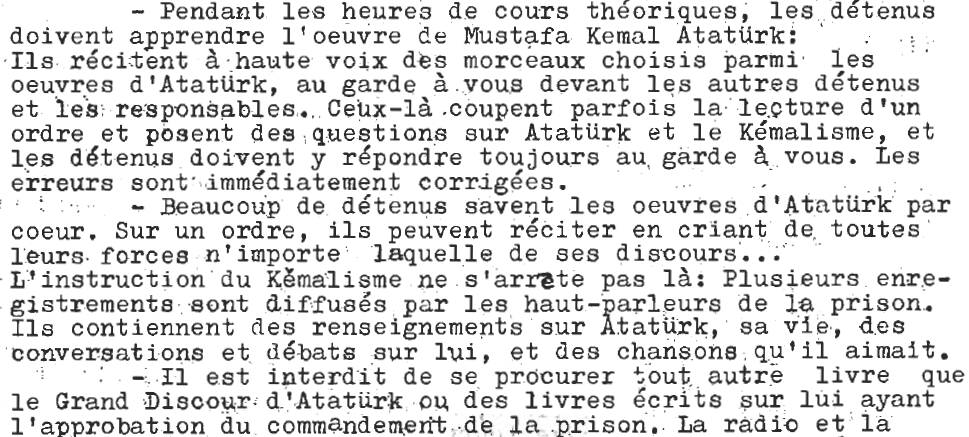
Comble de l'ironie, le reportage est signé par le reporter Emin
Cölasan, célèbre éditorialiste devenu
entre-temps l'un des plus chauds
partisans du complexe militaro-kémaliste turc et
récemment licencié par
le quotidien Hürriyet. Une belle perle immortalisée en
ligne grâce à
l'archivage des gestionnaires de l'agence Info-Türk.
J'ai demandé à Dogan Özgüden, co-fondateur
d'Info-Türk, s'il fallait s'attendre encore à d'autres
publications ?
"Nous venons seulement de publier nos bulletins de 1980 à ce
jour mais
il reste encore la mise en ligne des années 1973 à 1980
en plus des
livres et brochures que nous allons progressivement mettre en ligne.
Les premiers bulletins d'Info-Türk datent de 1973-74 sous un
format
d'impression sur stencil. Il n'était évidemment pas
encore question
d'informatique ou d'internet à l'époque. Puis, dès
1976, nos bulletins
sont devenus mensuels et aussi multilingues. En 1998, nous avons sorti
une première version en ligne sur internet tout en poursuivant
l'expérience de la version papier pour finalement totalement se
concentrer sur l'information en ligne. Sur le plan linguistique,
c'était assez variable puisque nos premiers bulletins
étaient
trilingues (FR-TR-EN) puis nous avons ajoutés des versions
flamande,
allemande et espagnole pour finalement se contenter des bulletins
bilingues (français et anglais). Il n'y a effectivement plus de
version
en langue turque car il existe aujourd'hui une presse d'opposition en
Turquie, la presse turque d'opposition est également disponible
sur
papier et sur internet dans les pays européens... ce qui
n'était
évidemment pas le cas sous la dictature", m'a expliqué le
journaliste
Dogan Özgüden.
(http://allochtone.blogspot.com/2007/09/info-trk-publie-ses-archives-en-ligne.html)
Latest Trials of Journalists and Writers in Turkey
- Public Prosecutor in Diyarbakir launched a court case against Hikmet
Erden, correspondent with the Dicle News Agency, in connection with the
news appeared on the paper before 22 July elections. Erden wrote news
alleging that soldiers were forcing villagers not to vote DTP. The
indictment wants Erden to be sentenced to a term of imprisonment
between 1 year and 4 years according to Article 267 of Law on Press for
"slandering by means of mass media". The case would commence at
Diyarbakir Penal Court of First Instance No 2. (ANF-TIHV, September 5,
2007)
- A court case was launched against Yasin Yetisgen, owner and
editor-in-chief of the weekly journal "Çoban Atesi" published in
Gaziantep, according to the Article 302 TPC for "damaging the unity and
indivisibly of the nation and country". The case reportedly launched
for saying "Antep is one of the biggest cities of Northern Kurdistan
with its 2 millions Kurdish residents" in the article published on 2
September. The issue of the journal was confiscated and Yetisgen was
arrested. The case would commence at Adana Heavy Penal Court.
(BIA-TIHV, September 4, 2007)
- On 31 August, Istanbul Heavy Penal Court No 14 continued to hear the
case against Çagri Karadag, owner of the leftist journal "Tek
Yol
Devrim! Hareket", and editor-inchief of the journal Kemal Bozkurt
launched in connection with the articles "Kürtler Kardesimdir, E
Tipindeki Evlatlarin", "1 Eylül Dünya Baris Günü",
"Mücadele Zamani:
YÖK'e Hayir!" for violating Anti-terror Law. The court decided
that the
articles should have been regarded within the freedom of expression and
acquitted the defendants. The indictment wanted the defendants to be
sentenced to a term of imprisonment between 1 year and 5 years.
(Gündem-TIHV, September 1, 2007)
- On 31 August, Istanbul Heavy Penal Court No 14 concluded to hear the
retrial of Gülçiçek Günel launched in
connection with the book "Dilimiz
Varligimiz Dilimiz Kültürümüzdür (Our Language
is Our Existence, Our
Language is Our Culture)" published by Aram Publishing. The case had
been launched according to the Article 312/2 of the former TPC for
"inciting people hatred and enmity" and Günel had been sentenced
to 20
months' imprisonemnt during first trial. The court acquitted the
defendant on the grounds that elements of crime were not materialised.
(Gündem-TIHV, September 1, 2007)
Erdogan Must Be Joking by saying "Our intellectuals keep
too quiet"
Prime Minister Recep Tayyip Erdogan made the opening speech at the 38th
International Congress of Asian and North African Studies (ICANAS) in
Ankara, in which he claimed that " unfortunately the voices of
scientists, intellectuals and artists do not rise loudly enough against
injustice in the age we live in."
In reaction, independent parliamentary candidate Prof. Dr. Baskin Oran
and Prof. Dr. Ahmet Insel have published a statement on Baskin Oran's
website. They first asked, "Is this a joke or derision?" and then made
a list of former Minister of Justice Cemil Cicek's past treatment of
intellectuals:
" In September 2004 he was the one who by saying, 'We support making
adultery a crime' , turned attention towards this absurdity and away
from Article 301.
When Minister of Justice, he was the one who allowed Hrant Dink to be
tried under Article 301 (then 159),
who called on the Minority Rights and Cultural Rights Report
"intellectual nonsense" and intellectual mischief".
In September 2005, when the Armenian conference could finally take
place, it was him who hit his fist on the parliamentary podium and
said, 'They stabbed us in the back'.
It was he who in September 2006 said that 'the person really
responsible for 301 is Orhan Pamuk', and he who said in February 2007
that "I have seen how hypocritical and spineless intellectuals are in
the 301 discussion'.
It was Cemil Cicek who said in September 2006, 'We cannot abolish 301.
Wait, and the judiciary will make fine adjustments'. He is still in
cabinet, this time as the State Minister and Deputy Prime Minister
responsible for the coordination of human rights institutions and
affairs" and also as government speaker!
If we leave Cemil Cicek's real identity to the side for a moment, what
about Prime Minister Erdogan preventing the Human Rights Advisory
Committee, which is meant to meet at least three times a year, from
meeting since October 2004? As Prime Minister then and now, he has to
explain why.
We also expect an explanation from President Abdullah Gül, because
at
the time, he was the Deputy Prime Minister in charge of human rights.
If he can stay silent on human rights violations, if he can offer Cemil
Cicek, who supports these violations, first the post of Minister of
Justice and now that of coordinator of human rights affairs, then we
call on Prime Minister Erdogan to be serious, to first think and then
talk." (BIA news centre, September 13, 2007)
A Park
Too Much for human rights activist
The Municipality of Diyarbakir, the Kurdish-majority Province in the
South-east of Turkey, has met with hurdles in its plans to name a park
after deceased human rights activist and publisher Ayse Nur Zarakolu.
The Regional Administrative Court has decreed that the Park cannot be
named after a person who "supported separatist ideas and spread
terrorist propaganda both in her own books and in the books she
published".
The Court had become involved after the Diyarbakir Governor's Office
had objected to the naming. The Diyarbakir Municipality Council will
assemble in order to decide on their reaction.
The husband of Ayse Nur Zarakolu, Ragip Zarakolu, a journalist at
the " Özgür Gündem" (Free Agenda) and a publisher, has
said: "Ayse Nur Zarakolu, like Hrant Dink, was a person who tried to
build bridges between our peoples on the basis of mutual respect , and
she is one of the people who paid for this with her life."
In an article yesterday (22 August), Zarakolu wrote that his wife was
sentenced to imprisonment under Article 8 of the Anti-Terrorism Law,
but that this article has now been dropped in the process of "pretend
democratisation".
Thus, argues Zarakolu, the sentence has lost its validity, as have the
decreeing courts, the State Security Courts, which have been abolished.
"Whether or not Ayse Nur Zarakolu's name is on the gate of the Park or
not, she will always live on and symbolise the brotherhood between
peoples."
And 4 times Turkish Goverment accepted to pay compensations to Zarakolu
family, because of the decisions of European Human Rights Court, which
canceled the unjust convictions of Turkish Courts about her, which
violated freedom of expression.
A park on the Dicle Kent Boulevard had been named the "Ayse Nur
Zarakolu Free Women's Park Forest". Following the court decree, the
Municipality has renamed the park "Park Forest".
In 2003 a Center of Education and Health for the Women had been named
with her name, “Ayse Nur Zarakolu” in Dogu Beyazid Town (near to the
Mount Ararat), which was built with the donations of Italian
municipalities.
And there is a Human Rights Library with her name in Istanbul.
Human Rights Association gives ANZ Freedom of Expression Awards every
year.
During last years Hrant Dink, Baskin Oran, Yilmaz Guney, Vedat Turkali
etc. had ANZ Awards.
And She had also Human Rights Watch’s, American PEN’s, Turkish
Publisher Association’s, Catania and Padova City’s (Italy),
French /Armenian Community’s Awards for Freedom of Expression and
Righteousness; and Greek/Turkish Peace Awards. (BIA news
centre, Erol Onderoglu, September 12, 2007)
Gündem
suspended for 30 days for publishing two
articles by Kurdish leader
The Istanbul 12th Penal Court has decreed that "Gündem" newspaper
be
suspended for 30 days as punishment for publishing two articles by
Kurdistan Workers Party (PKK) leader Murat Karayilan. The newspaper was
charged with spreading PKK propaganda, under the Anti-Terrorism Law.
Editor-in-chief Yüksel Genc pointed out that the newspaper was
being
punished under a law that President Ahmet Necdet Sezer sent to the
Constitutional Court. He added, "It is difficult to understand that our
publication is being stopped for the fourth time by an Article which
tramples on freedom of the press. The continuing penalties exacted
under this law show again that Turkey is a problematic country as far
as freedom of the press and expression are concerned."
In one article, published on 2 September 2007 and entitled "Let us
become populist, let us win", Karayilan wrote: "We are a movement which
is only based on its own strength." He declared that the PKK "got its
power from society and relies on the people".
On the next day, in a second article entitled "Self-criticism not in
words but in practice", Karayilan pointed out mistakes made by the
"Free Citizen Movement" and called for self-criticism.
In response to the closure ruling, Siirt MP Osman Özcelik of the
Democratic Society Party (DTP) said, "If people are killed when it is
said that there is zero tolerance of torture, if newspapers are closed
when the freedom of press is talked about, then this is
thought-provoking. It is clear that the Justice and Development Party
(AKP) is only talking about the EU norms. We will take this to
Parliament."
DTP MP Hasip Kaplan from Sirnak added that the government's new
programme purports to seek an intensification of the EU accession
process and full guarantees for freedom of expression: "This ruling
shows that there is no tolerance of opposition voices, and basic rights
and freedoms are limited under the Anti-Terrorism Law."
DTP MP Akin Birdal from Diyarbakir said that he would take the issue to
the Human Rights Commission in Parliament: "In Ankara there are
oppressive policies to shut the people up. We support 'Gündem' to
the
last."
Aysel Tugluk of the DTP added, "Such actions damage democracy. We will
not allow the people's voice to be silenced."
Gündem newspaper has been closed three times before in 2007: on 6
March
for 30 days, on 9 April for 15 days, on 12 July for 15 days.
(BIANET/IFEX, September 11, 2007)
Journalist, two editors, fined for publishing interview with
Kurdish militant
The Istanbul 10th Penal Court has sentenced "Hürriyet" newspaper
journalist Sebati Karakurt to an advance payment of 455 YTL (approx.
US$350). Karakurt is being tried for an interview he conducted with
Kurdish Kongra-Gel militants on Kandil Mountain in Northern Iraq. He
faces a possible prison sentence.
Hasan Kilic and Necdet Tatlican, editors at the newspaper, have been
ordered by the court to pay fines amounting to 60,000 YTL (approx.
US$47,000), for "publishing statements of a terrorist organisation" and
"spreading the propaganda of a terrorist organisation" by including the
interview in the newspaper. Should they not pay their fines, their
trials will continue on 13 November 2007.
Karakurt had interviewed militant leader Murat Karayilan and had
written about changes in the lives of militants living on the mountain.
The interview was published in "Hürriyet" newspaper on 10 October
2004,
under the title: "In Kandil, feminism has gone beyond Kurdish
nationalism". At first, Karakurt and Kilic were accused of publishing
terrorist statements. Subsequently, Kilic and Tatlican faced the
additional charge of spreading terrorist propaganda.
In a separate case, "Milliyet" journalist Namik Durukan was acquitted
on 10 May 2007 of any crime related to an article he wrote on former
Kurdish leader Osman Öcalan and the fact that his life had changed
since he had left the Kurdistan Workers Party (PKK). The article was
published on 29 April 2005 under the title "Osman rocks the cradle" and
"The PKK should retreat". (BIANET/IFEX, September 11, 2007)
International PEN, ARTICLE 19 and IPA call
for abolition of Article 301
The following is a joint International PEN, ARTICLE 19 and IPA press
release:
International PEN, ARTICLE 19 and the International Publishers
Association call for the abolition of Article 301 of the Turkish Penal
Code
Today International PEN, ARTICLE 19 and the International Publishers
Association issued an open letter to the newly-elected President of
Turkey Adbulah Gül. The letter calls for the abolition of Article
301
of the Turkish Penal Code.
In the letter the three organisations expressed their deep concern
about the impact of Article 301 on the right to freedom of expression
in Turkey and its inconsistency with international law.
Article 301 of the Turkish Penal Code prohibits public denigration of
"Turkishness", a term that is extremely vague and can be easily abused.
It has been widely used to repress freedom of expression and open
debate in the country. In particularly, the letter draws President
Gül's attention to the fact that, between April and July 2007,
there
were 18 trials against 24 people under Article 301.
While welcoming progressive changes to Turkish legislation since
mid-1990s, the letter also points to the fact that hopes that the
Turkish government might consider the abolition of Article 301 faded
away after the assassination of (editor of the Armenian-Turkish weekly
Agos) Hrant Dink in January 2007. Mr. Dink had himself been convicted
under Article 301 and was handed down a six-month suspended sentence in
October 2005. Since his killing, Article 301 trials continue.
The letter also makes reference to the joint declaration of 41
international and national NGOs urging the abolition of Article 301
from the Turkish Penal Code - as well as other provisions violating
freedom of expression - issued on 14 February 2007; it further cites
the resolution on the same issue adopted by ARTICLE 19, International
PEN and the International Publishers Association on 24 November 2006.
The letter urges President Gül to do all in his power to ensure
Turkey's compliance with its obligations under international law,
particularly through the abolition of Article 301. (ARTICLE 19/IFEX,
September 11, 2007)
Journalist Stand Trial over Elections Report
Reporter of Dicle News Agency Hikmet Erden stands trial over reporting
the claims that the military police intimidated locals in Diyarbakır’s
Karacadağ district not to vote DTP candidate. Diyarbakır prosecution
office charges the reporter with “slander” as the military police
department complained.
Erden will appear in Diyarbakır Primary Court num 2 on 2 February 2008.
(antenna-tr.org, September 9, 2007)
Pornographic Sculpture Case in Kemer
Antalya's tourist quarter Kemer is talking about a sculpture which was
opened by the mayor and the artist Zafer Sarı only last week.
Former mayor of Kemer CHP's Mustafa Gül applied to the local
administrator to remove the sculpture since he said it was too
pornographic and would damage the morals of young girls. Gül said:
"Citizens call me complaining and finally a group of 40 people said
they would bring it down. We respect artwork but such a sculpture can
not be place in the middle of Kemer. It is not only tourists who live
in Kemer there are young girls and families too. We can not let their
morals to be damaged."
AKP Kemer Borough Chairman Zafer Yaman said "I am embarrassed when I
look at that sculpture." Yaman said that the sculpture was an attack on
women’s rights.
Artists Sarı said he was bewildered with the reactions: "My work is on
love. I am sorry that pure emotions are tainted like this."
This is not the first fight on sculpture in Turkey. The most famous one
was between Ankara mayor Melih Gökçek and the artist Mehmet
Aksoy in
1994. Gökçek had said after he was elected the sculpture
“Land of
Fairies” in Altınpark was about orgasm and said he would spit on that.
Gökçek got the sculpture removed. Court ordered him to pay
the artist
Aksoy 1 billion 342 million old lira. (antenna-tr.org, September
9,
2007)
Journalist Alkan Receives Death Threats
Journalist Türker Alkan of the "Radikal" newspaper used to receive
death threats before the 28 February 1997, when the National Security
Council forced the then Prime Minister Necmettin Erbakan to resign (The
28 February is often described as a "postmodern coup").
The death threats stopped with the "coup". Now, however, Alkan is being
threatened again.
In an article, Alkan said, "After 22 July [the general elections],
there have been new angry and threatening messages. In a recent message
the author claimed to be a police officer and said that I was a
"traitor" and that he would "shot at my head twice".
He added, "Who knows, is he really a policeman? But even if he is not,
what does the fact that someone with such a mentality has identified
themselves with the police role tell us?"
Alkan referred to French sociologist Alexis de Tocqueville's saying,
"The greatest threat to democracy is the one that comes from social
pressure", saying, "it is impossible not to worry whether we are facing
such a danger now."
The article continued:
"...But seeing democracy only as a constitutional and institutional
order creates problems in the long run. Democracy is also a phenomenon
related to socially dominant values, behavioural moulds and culture.
Saying that, one should not divide people into "religious, laicist,
right-wing, left-wing" or judge people as being part of a democratic or
an authoritarian camp. In the past we have seen that the left-wing and
laicist, as well as the religious and authoritarian, can be
authoritarian to the same degree. Now it is the AKP's turn to show its
practices. It seems to me that, given the opportunity..."
BIA: Do not leave crimes towards journalists unpunished
The BIA media observation desk had reported 17 incidents of attacks and
6 cases of threats towards journalists in its second quarterly Media
Observation Report published on 6 July.
BIA had demanded that in order to prevent a culture of impunity, those
responsible for these crimes needed to be punished as a matter of
urgency. (BIA news centre, Erol Önderoglu, September 6, 2007)
Singer Tunc Still Accused of Spreading Terorrist
Propaganda
Singer Ferhat Tunc had called for peace, reminding people that PKK and
MKP members who die are also "children of this country". His comments
have landed him in court.
At a concert in Alanya (district of Antalya, southern Turkey) on 22
July last year, singer Ferhat Tunc had said, "Just as every soldier who
dies in this country is counted as a child of this country, so every
guerrilla who is killed is a child of this country. My heart burns for
every dead soldier, my heart bleeds for every dead guerrilla."
Tunc is being tried under Article 7/2 of the Anti-Terrorism Law for
this comment, and is first due in court on 4 October at the Izmir 10th
Heavy Penal Court.
In addition, the Malatya Public Prosecution has begun an investigation
into Tunc for "spreading propaganda for the Maoist Communist Party
(MKP)". AT a concert on 12 August 2006, he had dedicated a song to "the
17". The fact that members of the audience chanted "Dersim [the old
name for Tunceli] is proud of you" has been interpreted as proof for
his crime.
Tunc's statement
Giving a statement at the Istanbul Public Prosecution, Tunc said that
his speech at the first concert was expressing his opinion that the
people of Turkey should coexist peacefully. As for the "17", he said
that he had known most of the MKP members who had been killed in the
Mercan Valley (in Tunceli province) in 2004 since their childhood, and
that he was not able to ignore the event. When he had expressed his
feelings about the gravity of the event in his song, he had not aimed
at spreading propaganda.
Tunc had said at the second concert, "We have to overcome and destroy
the fears that are imposed on us. There are conflicts in our country,
there are deaths. In order to oppose them, we first have to overcome
our fears. We want to sing our peace songs on our own land, without
fear, without worry. For that to happen, the conflict has to end and we
have to work towards that with all our efforts. Let us all say no to
war." Then he sang his song entitled "No to war".
Tunc is also being tried for being part of a human rights delegation
which freed private Coskun Kirandi after he had been kidnapped by the
PKK. He has also received death threats by a group calling itself the
"Turkish Revenge Brigade" (TIT). (BIA news centre, September 5, 2007)
New Tool against Separatism: Article 302 of
the Turkish Penal Code
The case against the owner and the editor of “Çoban Ateşi”
newspaper
Yasin Yetişgen who is on remand over publishing an article which
carried the phrase “North Kurdistan” will be held by Adana High
Criminal Court. Yetişgen is on remand in Gaziantep H Type prison. He is
charged with “destroying the unity of the state and the integrity of
the country” under TPC article 302. The date of hearing is yet unknown.
The paper was confiscated over an article published on August 2007
which carried "Antep is the biggest metropolis of North Kurdistan with
its almost 2 million population... Antep with its rich culture should
be viewed as the Istanbul of North Kurdistan”. Yetişgen was arrested
“as a caution” and an order of arrest was issued fro writer Hurşit
Kaşıkkırmaz who lives abroad.
Article 8 of Anti Terror Law which was applied against separatism was
abolished on 15 July 2003. Now the article 302 is used to prevent the
usage of the term “north Kurdistan”. (antenna-tr.org, September 5, 2007)
Anti-Terror
Law Targets Journalists
Solidarity Platform for Journalists in Prison (SPJP) demanded the
release of Hasan Coşar of Atılım newspaper an other journalists in
prison. The spokesperson Necati Abay demanded said that the authorities
turned a blind eye to the situation of the journalists in prison. Abay
said "Press Council ignores our list. Ministry of Justice should
clarify whether there are journalists in prison or not?".
Along with journalists Çoşar, 5 journalists from Atılım paper, 1
from
Free Radio, 5 from “Özgür Halk” and “Genç Bakış”
magazines, 2 from Odak
magazine, 1 from “Ekmek ve Adalet” magazine, 1 from “İşçi
Köylü”
newspaper, 3 from Dicle news agency, 2 from “Gündem” daily, 1 from
“Alınteri” paper, 1 journalist from “Güney” magazine, and 1
journalist
from “Çoban Ateşi” paper are in prison.
Editor of “Atılım” Ahmet Yaman' said: "Hasan Coşar is a human rights
defender. Yet he was arrested with the charge of membership to a
illegal organisation, which was a conspiracy on the part of the
ATL”. (antenna-tr.org, September 1, 2007)
Kurdish
Question / Question kurde
12
morts dans une embuscade attribuée au PKK par les
autorités
Douze personnes ont été tuées et deux autres
blessées samedi dans le
sud-est de la Turquie dans une attaque attribuée par les
autorités au
PKK. L'attaque a eu lieu vers 14H00 GMT près de la petite ville
de
Beytüssebab, dans la province de Sirnak, frontalière avec
l'Irak, a
annoncé dimanche le gouverneur local Selahattin Apari.
"Des terroristes du PKK ont mitraillé un minibus transportant
pour la
plupart des civils. Ils ont massacré 13 personnes", a dit le
responsable. Mais la mort de la 13e personne a été
démentie plus tard.
Parmi les morts figure un mouhtar, chef de village, et ses quatre fils,
tous des "gardiens de village". Les "gardiens de village" sont une
milice kurde recrutée et armée par Ankara pour assurer la
protection
des villages du sud-est anatolien contre les guérillas du PKK.
Une opération de l'armée est en cours pour capturer les
responsables de l'attaque.
De retour d'une visite aux Etats-Unis, le Premier ministre turc Recep
Tayyip Erdogan a dénoncé devant la presse une "attaque
lâche qui ne
restera pas impunie". Il a affirmé que le PKK avait
commencé à s'en
prendre aux civils, ce qui démontre, selon lui, que
l'organisation est
en "détresse" en raison des opérations de l'armée.
"Notre détermination
à lutter contre les terroristes se maintiendra", a-t-il
ajouté.
Dimanche, deux rebelles qui tentaient de s'infiltrer depuis l'Irak ont
été tués par des gendarmes près de la
bourgade de Cukurca, tout près de
la frontière, a indiqué le gouvernorat local. (AFP,
30 sept 2007)
Un inculpé
du DHKP-C exécuté par des militaires
à Dersim
Le 26 septembre 2007, des gendarmes membres des forces spéciales
(Özel
Tim) de la caserne de Boytas (Amutka en kurde) ont ouvert le feu sur
deux apiculteurs qui récoltaient du bois à Hozat, une
localité de la
province de Tunceli (Dersim en kurde). Gravement blessés, les
victimes,
Bülent Karatas et Ali Riza Ciçek, ont été
séquestrées dans la caserne.
Les militaires ont ensuite contacté leurs familles pour qu’elles
viennent rechercher « leurs défunts ». Karatas et
Ciçek ont été emmenés
à bord d’un hélicoptère de l’armée vers
l’hôpital de l’université de
l’Euphrate à Elazig. Ils étaient alors tous les deux
vivants.
Cependant, le lendemain vers 3h du matin, Bülent Karatas a
succombé à
ses blessures. Les médecins ont extrait trois balles de son
corps et
découvert plusieurs blessures « sans doute
provoquées par des coups de
crosse ». Ali Riza Çiçek est en ce moment en soins
intensifs.
D’après le gouverneur de Tunceli, Mustafa Yaman, les deux
apiculteurs
étaient des « terroristes » qui auraient fui suite
aux « sommations des
militaires ». « Terroristes » est aussi le
qualificatif utilisé par
l’état-major de l’armée dans son site web à
l’égard des deux victimes.
Pourtant Bülent Karatas et Ali Riza Ciçek n’étaient
pas armés. Ils
étaient en possession de cadres de ruches, de
tronçonneuses et
accompagnés de chevaux qui transportaient le bois coupé.
Ces derniers mois, les populations civiles ont été la
cible à cinq reprises des tirs aveugles de l’armée.
Le 28 septembre 2007, plus de 5000 manifestants ont participé
à ses
funérailles dont la maire de Tunceli, Mme Songül Erol
Abdil, le maire
de Hozat, M. Cevdet Konak ainsi qu’un député du parti
pro-kurde DTP
Serafettin Halis ainsi qu’une délégation du barreau de
Tunceli, de
l’association turque des droits de l’homme (IHD) et d’autres
associations de gauche. Bülent Karatas a été
inhumé aux cris de «
Bülent Karatas est immortel », « Dersim sera le
tombeau du fascisme »,
« L’Etat assassin devra rendre des comptes » et sous les
pleurs de sa
mère, de son épouse et de ses sœurs.
Le lendemain, la police a procédé à onze
arrestations lors d’une
manifestation organisée devant le lycée de Galatasaray
à Istanbul
destinée à protester contre l’assassinat de Bülent
Karatas.
Bülent Karatas était un villageois âgé de 32
ans qui sympathisait avec
les mouvements révolutionnaires. En 1997, Karatas avait
été emprisonné
pour avoir aidé le mouvement maoïste MKP. En
décembre 2006, il avait
été arrêté dans une opération visant
le DHKP-C (Parti et Front
révolutionnaire de libération du peuple). Au moment de sa
mort, il
était toujours inculpé dans un procès politique,
accusé d’avoir porté
assistance au DHKP-C.
Après sa dernière garde à vue, Bülent Karatas
aurait été contraint sous
la menace à la collaboration par un responsable militaire de la
région
dénommé Tuncay Basçavus. Son refus de collaborer
avec l’armée et ses
sympathies déclarées pour les révolutionnaires
avaient fait de lui une
cible de choix pour les militaires de la région. (Source :
Halkin Sesi
TV, Evrensel, Yeni Özgür Politika, CNN Türk)
Deux soldats
turcs tués, quatre blessés par une mine, des heurts avec
le PKK
Deux soldats turcs ont été tués et quatre autres
blessés mardi lors de
deux incidents impliquant des militants kurdes dans l'est et le sud-est
anatolien, ont affirmé des sources locales.
Une bombe posée près d'un poste militaire du village de
Kocakoç, dans
la province de Tunceli (est), a été actionnée
à distance alors que des
soldats contrôlaient un véhicule leur apportant de la
nourriture, a
déclaré dans un communiqué le gouvernorat de
Tunceli.
L'explosion a tué un soldat et en a blessé quatre autres,
a indiqué
cette source, ajoutant que six personnes, dont le conducteur du
véhicule, avaient été arrêtées.
Un sous-officier a par ailleurs été tué lors d'un
accrochage avec des
militants kurdes survenu dans la province de Sirnak (sud-est), dans une
zone montagneuse de Beytüssebab, à une centaine de
kilomètres de la
frontière irakienne. (AFP, 25 sept 2007)
Kurdish Conference: Main requirements for a peace
process
29-30 September 2007, Diyarbakir
Metropolitan Municipality Theatre Hall
At least three major conferences have been held in Turkey on the
Kurdish issue since the previous year; however, there are still a large
number of questions waiting to be discussed.
Reference is often made to what was experienced in various countries in
the discussions about the Kurdish issue. The examples of Ireland and
Spain, in particular, are brought up in this connection. There is a
great deal of benefit from discussing extensively the topics such as
the settlement processes of ethnic problems from all parts of the
world, the hardships faced during these processes, and the methods
employed in order to overcome them. Hence, each issue must be addressed
primarily within its particular context and a serious analysis of the
existing situation must be made in the process of resolving the
conflicts arising from this problem. The reasons for the conflict, the
status of the internal and external actors, the structures of the
organizations involved, the roles these organizations play in resolving
the conflict, and the steps that need to be taken must be discussed
openly. Throughout this conference, we would like to look into some
international examples with the intention of discovering clues for
creating the circumstances under which the conflicts could be
terminated in a permanent manner.
The militarism that develops in societies swept with widespread armed
conflict impedes to a great extent the democratic participation of the
civil actors in the process that could play an active role in resolving
the conflict. Not only does this fact make it impossible for the
authoritarian structures within the armed organizations to transform
into democratic institutions but it also makes it more difficult for
the latter to work smoothly with the civil entities seeking
participation in the peace process. The process of resolving conflicts
through democratic ways, however, also requires measures for internal
democratization, political participation, and a pluralist approach.
The United Nations Security Council's Resolution 1325 stresses the
importance of women's participation in the peace process. A different
kind of understanding, strengthening, and awareness develops among
women at times of conflict. This development, in turn, strengthens
women's potential contribution to the peace process. The participation
of women in the process for a democratic and lasting peace is of utmost
importance.
In the international field, Turkey is directly impacted by the
political developments in the neighboring countries such as Iran, Iraq,
and Syria. It is the developments in Iraq rather than those in Iran and
Syria that have been observed to be exerting a direct and enormous
impact on Turkey's Kurdish issue. The situation in Iraq has made the
USA practically a part of the Kurdish issue. The EU is also directly
involved in the Kurdish issue due to Turkey's accession process. For
these reasons, it is important to analyze the roles of the surrounding
international environment and the actors mentioned in the settlement of
the Kurdish issue.
The Kurdish area has been suffering deep economic and social problems
since long before. A sizable populace was forced to migrate to the
cities during the armed conflict, compounding the existing hardships by
the massive addition of vital problems like lack of education,
skyrocketing rates of unemployment among the young, food, and shelter.
The worsening socio-economic conditions play a key role in raising
tension in the area and nurturing the climate of desperation.
The subject of cultural rights also bears a special meaning within the
Kurdish issue. Although certain steps have been taken in this area, the
rights granted are extremely limited and serious problems are
encountered in practice.
It is generally accepted that the mechanisms for democratic
participation and political representation serve a constructive and
facilitating function in conflict resolution. There are grave problems
in Turkey in this respect, as well. The 10-percent election threshold,
in particular, constitutes one of the most fundamental obstacles
blocking the path towards political representation. The steps for the
solution of this problem must be discussed in order to seek models of
democratic representation and legitimacy at the national and local
levels suitable to the composition of Turkey's population.
This conference has been organized in order to allow an in-depth
discussion of the aforementioned issues. The goal is to share
experiences with specialists from the international field and Turkey on
the one hand while conducting analyses and making determinations
towards taking steps for a solution on the other hand. The two-day
conference is aimed at its core to make a contribution to the steps to
be taken toward peace in Turkey. (kurdmedia.com, September 24, 2007)
Mass grave found in the courtyard of Turkish 7th Army
Headquarters
A mass grave with bones from an unknown amount of people was found on
September 21 in the courtyard of the Turkish 7th Army Headquarters in
the Kurdish capital of Amed (Diyarbakir) in northern Kurdistan
(southeastern Turkey.) The discovery of the mass grave was made by the
Kurdish news agency DIHA after a tip from an anonymous caller to one of
their reporters in the city.
The discovery of the mass grave was the climax after several days of
investigations and inquiries by human rights organizations, bar
associations and news agencies in the city. The investigations started
after human bones were found in sand that was used in different
construction projects all over the city.
The sand comes from an excavation done by an undisclosed company that
had won a bid to “dig up sand from the 7th Army’s courtyard and use
this sand in construction projects in different locations in the city,”
sources said. Why the sand had to be taken from the 7th Army instead of
from different existing excavation sites in other parts of the city was
not clear.
The mass grave is located on the grounds of the 7th Army Headquarters
in Amed (Diyarbakir.) The excavation site is where the infamous
Diyarbakir Military Prison Facility once was located, DIHA reports.
Clothing were also found among the bones, according to DIHA.
The Turkish 7th Army was led by the now Chief of Staff Yasar Buyukanit
between 1996-2000. The 7th Army is sometimes refered to in Kurdish
press as “Buyukanit’s Army.” The Turkish military intelligence JITEM’s
main headquarter in northern Kurdistan (southeastern Turkey) is also
located at the 7th Army.
At the moment, the origins of the bones are not known, but
investigating organizations have promised to get to the bottom of the
matter.
Although promising to start investigations, Turkish military
prosecutors have not taken any steps to uncover the true origins of the
bones in the mass grave, raising further suspicion among the Kurds,
local news sources reports. (DIHA-DozaMe.org-kurdish-info.net,
September 23, 2007)
Neuf combattants kurdes tués dans des combats
en Turquie
Neuf combattants du PKK ont été
tués dans des combats avec l'armée dans le sud-est
anatolien, ont annoncé samedi les militaires.
Deux affrontements distincts se sont produits, a précisé
l'armée dans un communiqué publié sur son site
internet.
L'un, qui a fait quatre morts dans les rangs du PKK, a eu lieu dans la
nuit de vendredi à samedi dans la province d'Hakkari,
frontalière de
l'Irak et de l'Iran.
Cinq autres ont péri vendredi dans la province de Sirnak Friday,
selon la même source. (AFP, 22 sept 2007)
Invitation des associations kurdes pour des
manifestations à Bruxelles
Le 1er mars 2007, les avocats de Monsieur Ocalan ont fait une
conférence de presse à Rome pour déclarer les
résultats des analyses
effectués sur les échantillons de cheveux de Monsieur
Ocalan. Les
résultats obtenus dans trois pays européens ont
démontré que les taux
de strontium et de chrome sont beaucoup plus élevé que la
normalité et
décèle la présence d'une intoxication chronique.
Dans de différents pays européens le peuple kurde
à manifester afin que
le CPT ( comité pour la prévention de la torture) puisse
se rendre sur
l'île d'imrali où est détenu le leader du peuple
kurde Ocalan depuis
plus de 8 ans. Suites à toutes actions démocratiques du
peuple kurde
ainsi aux efforts des parlementaires européens, le CPT s'est
rendu sur
l'île d'Imrali afin de faire des examens. Mais jusqu'à ce
jour, ce
comité n'a toujours pas déclarés les
résultats obtenus.
Le peuple kurde, est très inquiet de la santé de Monsieur
Ocalan qui
mène depuis des années une lutte
démocratique pour la résolution de la
question kurde et pour la liberté de la femme. Vouloir
empoisonner
Monsieur Ocalan est vouloir empoisonner le peuple kurde et est de nier
encore une fois la question kurde. C'est pourquoi, les kurdes
vont se
réunir le 29 septembre 2007 à 10h devant la gare du nord,
pour marcher
jusqu'à la porte d’Anderlecht, pour faire appel aux institutions
européennes en ce qui concerne leur demande.
Une participation de 10.000 kurdes venant de l’Allemagne de France, des
Pays-Bas et de la Belgique ainsi que des parlementaires
européens qui
prendront parole et les amis du peuple kurde sont attendus à la
manifestation et au meeting.
Rassemblement à 10 heures devant la Gare du Nord
Marche à partir de 11heures jusqu’à la porte d’Anderlecht
et Meeting à 13heures
Organisateurs :
Initiative de Femme Kurde de Belgique
Commission des Droits de la Femme du Congrès National du
Kurdistan (KNK)
Commission des droits de la femmes de la
Confédération des Associations Kurdes en Europe (
KON-KURD)
Pour plus d’information vous pouvez contacter le 0476.02.87.67 ou le
0484.64.05.77
Inquiry Report about Ill-treatments at the Yaprak
Village in Pervari
A group, which live in ‚emekare Field of Pervari District in Siirt
Province, have applied to IHD (Human Rights Association) Branch Siirt
in 10.08.2007. The group alleged that soldiers and village guards had
attempted to evict their field after the declaration of temporary
security zone, in 26.06.2007, by General Staff of Turkey.
Then the road from ‚emekare to Pervari was blocked with sand and
stones. Subsequently, entrances of villagers were forbidden and a
baby-Ünal Cakir- who was in high fever died since the family was
not
allowed to go to the doctor.
When they applied to public prosecutor about practises, villagers were
subjected to ill-treatment, beat, threat, took under custody
arbitrarily by Commandership of Pervari Gendarmerie.
The group demanded help from IHD Branch in Siirt.
The committee was composed to inquire allegations about compelling to
forcibly evacuations, restricting right of travel, communication,
ill-treatment, embargo on food-essential goods and to provide accession
to real facts by means of research/inquiry and to contribute protection
of right to resident, to travel live under security atmosphere, which
are covered by various national and international rules.
Conviction
The Human Rights Committee, considering the all interviews, findings
and observation-by the Committee-during the inquiry, thinks that there
is an intention for forcibly evacuation of ‚emekare field once again,
deprivation of means of production and isolation from people.
The committee has convinced that right to life, freedom of movement,
prohibition on threat/ill treatment will be violated once again unless
necessary judiciary and administrative precaution will be taken.
The committee has observed that there is a quite serious pressure and
arbitrary implementations on villagers in the region. In addition, the
committee argues; there is a perpetual risk for violation of right to
life, prohibition on torture, right of property.
Conclusion
Compelling people to forcibly evacuation, blocking access to freedom of
movement (which might cause violation of right to life as well), and
essential goods are considered as torture, which is practiced during 24
hours or whole day and has serious effects.
Investigation period should be completed without concealing proofs. The
accused people should be judged and sentenced as it ought to be. In
order to protect right to life, right to access essential goods of
other villagers, who also subjected serious violations, and to provide
an atmosphere in which people can deal with their livestock and
agricultural tasks; an effective investigation should be conducted
against all security forces (particularly who work in Gendarmerie
Station of Pervari) and village guards.
Also, responsible people should be removed from their positions.
Security force members’ ideological acting in events for citizens,
violation of official authority, using excessive force, practicing
torture or inhuman ill-treatment, violation of right of property should
not be connived.
There is/should not a preferential treatment in law. Power of law is
valid for everyone. Judicial mechanism should make a conclusion, in an
effective way, without delay. Bar associations, which have
responsibility (because of being a law institution) for protection of
human rights, should be followers of the judicial process that started
in ‚emekare field to get an effective conclusion in domestic law.
In order to reveal serious human rights violations, which have been
occurred for last two months, and carry out judicial, administrative
investigations against responsible people; the Human Rights
Investigation Commission, which operates under the Turkish Grand Nation
Assembly (TBMM), should conduct inquiry at the scene without any delay.
IHD and MAZLUMDER will be the followers such illegal provocative
actions, human rights violations, which have become spread and
systematic in Siirt and its neighbourhood and aim to harm social peace
atmosphere, both in national and international arena. (e-mail:
posta@ihd.org.tr, http//www.ihd.org.tr)
Cinq militants kurdes tués lors de combats dans
le sud-est turc
Cinq militants kurdes du PKK ont
été tués lors de
combats survenus tard mercredi dans le sud-est anatolien, a-t-on
indiqué jeudi de sources officielles.
L'affrontement s'est produit dans la zone montagneuse de Kato,
près de
la frontière avec l'Irak, a-t-on indiqué de mêmes
sources à Diyarbakir,
chef-lieu du sud-est anatolien peuplé majoritairement de kurdes.
Mercredi un soldat turc avait été tué dans la
province de Bitlis, également dans le sud-est. (AFP, 20 sept
2007)
Council of Europe calls
for legal reforms to improve Kurdish rights
The Congress Bureau of the Council of Europe discussed a report Monday
aimed at investigating legal charges against two pro-Kurdish mayors and
17 councilmen in southeastern Anatolia.
The report calls for changes to Turkey's law on municipalities and for
broadening the reforms to encompass Kurdish-language related ones.
A high-level political delegation from the Council of Europe which is
based in Strasbourg traveled to Diyarbakır and Ankara last month to
focus on local democracy particularly in southeastern Anatolia, after
concerns about the increasing court cases against mayors of the
pro-Kurdish Democratic Society Party (DTP). The rapporteurs drafted a
report following the visit and submitted it to the Congress Bureau.
"In our view, the current law [on municipalities], in both its
substantive and its procedural aspects, is so flawed as to be
unsustainable," said the report and listed the shortcomings.
"There is the asserted but fraught distinction between 'international'
and 'ethnic' languages; there is the confusion over what exactly
constitutes a 'political' abuse of power by public authorities; there
is uncertainty about the distinction between those things done under
the authority of an official resolution and those done as a matter of
administrative practice; there is uncertainty, evidenced by the
procedures in the Sur case itself, about the procedural protections
available to the mayor and councilors when legal measures are taken
against them; and, perhaps above all, we are unhappy about the
apparently arbitrary way in which the law may be invoked and enforced
against different instances of alleged breach of the law."
Two mayors and 17 councilmen in Diyarbakır who introduced Kurdish and
other languages in office are facing jail terms of up to three years.
The accused include Diyarbakır Mayor Osman Baydemir and Abdullah
Demirbaş, who was removed from his post as mayor of Diyarbakır's
multi-ethnic Sur municipality in June after the city council allowed
the use of Kurdish, Armenian, Arabic, Assyrian and English in the
municipal services.
"We have some sympathy with claims that abrupt action was taken against
Sur in circumstances where other authorities have been left unscathed.
It is, therefore, our view that, rather than simply undertaking a
narrow reform of the Municipality Law in isolation, a broader review of
existing law should also be adopted," said the report.
The trial of Baydemir, Demirbaş and the 17 city councilmen who voted
for the municipal bill on the use of Kurdish as well as other languages
in office is scheduled to begin in November.
Turkey's ruling Justice and Development Party (AKP) has drawn on
substantial electoral support from the Kurdish population but the July
22 general elections also paved the way for the representation of the
DTP in the Turkish Parliament, said the report.
"The [Turkish] Parliament has a new speaker. The State has a new
president, who has expressed the desire to introduce new constitutional
measures. These developments have the possibility of producing the
momentum for the sort of broad political change, which could readily
encompass the Kurdish language-related reforms of both law and policy
that are so clearly needed. The Congress should, we believe, express
its confidence in the commitment and capacity of the new political
leadership of Turkey to make substantial progress in this direction,"
the report said.
The Congress also decided to extend an invitation to Professor Beşir
Atalay, Turkey's new interior minister, to address the Congress, on the
occasion of its November fall session in Strasbourg, and outline the
policy that the new Turkish government intends to follow with regard to
the specified issues.
"Moreover the Congress could encourage the Turkish government, as it
ventures on a new phase of reform and modernization, to underpin its
commitment to diversity and pluralism by signing the European Charter
for Regional or Minority Languages and the Framework Convention for the
Protection of National Minorities. The Congress, for its part, could
stress that it remains at the disposal of the Turkish authorities and
would be willing to undertake a further mission to Turkey, should this
be appropriate," the report said.
The Congress Bureau has two chambers, the Chamber of Local Authorities
and the Chamber of Regions. It brings together 318 full and 318
substitute members representing more than 200,000 European territorial
communities.
A Council of Europe official previously told the Turkish Daily News
that Congress reports are not binding but relevant governments take
them seriously to show that they are open to progress on human rights.
( Turkish Daily News, September 19, 2007)
Lawyers protest Semdinli Court Transfer
Following a decree by the 9th Penal Chamber of the Supreme
Court of
Appeals, the Van 3rd Penal Court last week sent the Semdinli case to a
military court last week.
The Semdinli case is concerned with the bombing of a bookshop
in
Semdinli, in the southeastern province of Hakkari, in November 2005.
After the bombing two noncommissioned officers and a PKK informant were
arrested.
In its decision of 16 May, the Supreme Court of Appeals
justified
the transfer of the case to a military court with the fact that two of
the accused, junior officers Ali Kaya and Özcan Ildeniz, were
accused of a crime which would have been committed "on duty".
However, retired military judge and a lawyer at Istanbul Bar
Association Ümit Kardas and human rights law specialist lawyer
Mehmet Nur Terzi have disputed this justification.
Kardas says that although the military courts are given a
wide range of
duties in domestic law, the military judiciary should be limited to
issues related to internal discipline:
"Letting this case be heard by a military court contravenes
the natural principle of the judiciary and the unity of trial."
For Terzi, the transfer to a military court represents a
violation of the principle of impartial trials:
"There are no independent soldiers. This is an issue of human rights.
The European Court of Human Rights (ECHR)
has decreed many times that decisions made by the military judiciary,
particularly the State Security Courts, cannot be indepedent and
neutral. Whatever internal law says, the European Convention on Human
Rights and the ECHR need to validate the decisions."
Terzi argues that crimes that soldiers commit against each other also
need to be dealt with by civil courts. "If a soldier kills another,
hurts him/her, or steals from him/her, the trial has to take place in a
civil court. For instance, former Marine Commander Ilhami Erdil [tried
for unjust enrichment in a military court and then sentenced to 2 years
6 months imprisonment] should also have been tried in a civil court."
Prof. Dr. Osman Dogru, of the Law Faculty at
Marmara University (Istanbul), explains the contravention of the
principle of an impartial trial as follows:
"The ECHR says that if a civilian is tried by a court which
includes
members of the military,then the defendant may have doubts about the
impartiality of the court. An impartial trial is also important for the
plaintiffs. First of all, the defendant needs to be tried fairly. If
the trial is not impartial, then the crime will not transpire, and then
the aggrieved parties cannot claim compensation."
Tahir Elci, one of the trial lawyers, commented on the
decision of the Supreme Council of Appeals: "The principle of an
impartial trial is also valid from the perspective of the aggrieved
parties. You cannot believe that a case where the rights of civilians
in a civilian space were violated by soldiers can be tried impartially
by a military court."
Terzi has pointed to Turkey's two-headed judiciary (i.e. a
civil and
a military judiciary) as the essence of the problem: "This means a
military republic. The military is reserving the right to sentence
their own, and this damages democracy. They have the potential to try
anyone they see as a threat. This is the same as saying, 'We will try
whoever we want, but you cannot try us.'" (BIA news
centre,
Tolga Korkut, September 19, 2007)
Des affrontements dans le Sud-Est font six morts
Cinq militants kurdes du PKK et un responsable des forces de
sécurité turques ont péri mardi soir et mercredi
dans des affrontements
dans le sud-est de la Turquie, a-t-on appris de source militaire.
Des soldats turcs, appuyés par des
hélicoptères, ont
attaqué un groupe d’une trentaine de militants
armés dans la province de
Sirnak, frontalière de l’Irak. L’opération se poursuivait
en fin de
journée, a-t-on ajouté.
Un responsable des forces de sécurité turques a
été tué
mardi soir lors d’un raid de combattants kurdes contre une
caserne de gendarmerie dans le sud-est de la Turquie, rapportent
mercredi des responsables de la sécurité. Les activistes
ont réussi à prendre la fuite après cette
opération, menée dans la province anatolienne de Bitlis. (armenews.com,
20 septembre 2007)
Kurdish
Question: Action, Not Words Needed
Newly-elected President Abdullah Gül had chosen to visit five
provinces
in the East and South-East of Anatolia for his first domestic tour. The
last stop was Diyarbakir, a Kurdish-majority city.
Sezgin Tanrikulu, president of the Diyarbakir Bar Association, who
spoke with Gül during his visit to the city, told bianet that
Gül was
aware of the Kurdish question. Tanrikulu had told Gül that people
were
expecting him to put forward a project to solve the problem.
Hasip Kaplan, MP for the pro-Kurdish Democratic Society Party (DTP),
met with Gül in his home constituency on Thursday (13 September).
He
agreed with Tanrikulu that "more action than words" was expected from
Gül.
Tanrikulu said that he told Gül that since 1991, Presidents and
Prime
Ministers had put a name and definitions to the Kurdish question, but
that steps needed to be taken towards a solution.
"Whatever school, whatever class you go to in Turkey, maths classes
always start with set theory, you always return to the beginning. I
gave the honourable President this example and said, 'Let us not return
to the beginning, now we need a programme of solutions.'"
According to Tanrikulu, the fact that Gül said, "Whoever it
belongs to,
the spilt blood and tears sadden and hurt us", was an indication that
Gül was aware of the problem.
New constitution can contribute to
solution
Tanrikulu reported that in a meeting with NGO representatives, Gül
spoke of the possibility of a new era, of a country which could solve
its problems in the next three to four years. He also spoke of the
constitution.
"We told the President that making peace between this society and the
state and rebuilding democracy could be promising. We also spoke of
discussions around the new constitution. We said that a constitution
which valued participation, equality and freedom whould contribute to a
solution."
However, Tanrikulu also told the President that before the constitution
was passed, there was need for a legal package which guaranteed the
freedom of expression:
"In order for discussions about the constitution to be more fruitful,
first articles in the Penal Code and the Anti-Terrorism Law which
prevent the freedom of expression need to be abolished."
MP Kaplan, who met with Gül in Sirnak, found it meaningful that
Gül
visited the five provinces of Van, Hakkari, Siirt, Sirnak and
Diyarbakir, provinces, which he said had been "neglected for years".
Kaplan told bianet, "This is the first presidential visit since
Özal.
Such a visit, at a time when 250,00 soldiers are at the Iraq border,
when the armed conflict continues (in Turkey), when the constitution is
being discussed, is very important."
Kaplan drew attention to words from Gül's first speech after his
election. Gül had said, "our differences are our wealth".
He said that he and Gül had discussed development, education and
culture, but that he had emphasised to Gül that the most vital
issue
was to stop the conflict and that the people expected this.
Kaplan added, "It would be unrealistic to expect immediate results from
one visit. But an optimistic atmosphere was created." (BIA news centre,
Tolga Korkut, September 17, 2007)
Semdinli
case goes to military court...
The case of the two gendarmerie officers, Ali Kaya and Ozcan Ildeniz
who were caught and tried for the bombing a bookshop in Semdinli, in
the southeastern province of Hakkari will be taken up again by the
Military court, news agency reports said on Sunday.
The case which was publicly known as Semdinli case was viewed as an
example of the deep state involved in provoking further conflict in the
already disturbed region.
In 2006, Van Heavy Penal Court had sentenced Ali Kaya and Özcan
Ildeniz
to 39 years 5 months and 10 days imprisonment each but in 2007, the 9th
Penal Office of the Supreme Court of Appeals had rescinded the
sentences of the two officers, arguing that there had been
"insufficient investigation". Furthermore, it had decreed that the case
should be tried by a military court. (The New Anatolian, 17 September
2007)
Gul's Presidential Tour in Kurdish Provinces Ignored
Reality
Unfortunately, the first domestic tour of 11th President Abdullah
Gül
has not gone beyond formalities. There was no mention of the real
issues that concern the region.
In Siirt, the welcome that Abdullah Gül got was lukewarm. One
reason
for that may be that Siirt was formerly the constituency of charismatic
leader Prime Minister Recep Tayyip Erdogan.
There had been no serious preparation for the visit. The official
bulletin of the governor's office only ran a few lines and did not say
when the President would arrive. As for the loudspeaker announcement of
the municipality, it sounded as if the people were being told "you are
not the state":
"Our honourable President will come to our city at 10.30 am and meet
with NGOs."
As for the NGOs, there was a distinct lack of democratic, human rights
and trade unions organisations. There was the Turkish Aeronautical
Association (THK), the Red Crescent and Traders' Associations...
The only banner in the city had been hung up in front of the governor's
building. Abdullah Gül did not really visit the city anyway, as he
went
to the Brigade Gazino a hundred metres away from the governor's
building. He left Siirt without looking at the Atatürk memorial in
the
centre or any other part of the city.
Official departments and municipalities had been called, but had not
accepted. The district governors (kaymakam) and mayors who had come,
the ceremonial guests and curious citizens - they all looked like
extras in a film.
Some families had come with their children in order to talk with the
President. The calls of "Turkey is proud of you" sounded less
enthusiastic than the slogans at football matches.
The luckiest child was eight-year-old Yusuf Aygan, whose parents had
asked for help with his and his five siblings' school expenses. Yusuf's
friends were upset that the President had not handed out toys.
The small crowd was mostly made up of the two Justice and Development
Party (AKP) MPs, district and central mayors and other party members.
Maybe this lack of interest was a way of saying, "You said you were
going to be everyone's President, not just the President of the AKP!"
The presents given to the President were meaningless and lacked
seriousness. The "Siirt blanket", which is meant to be made from
mohair, was died and synthetic. It was saddening to see that thus this
famous handicraft was encouraged in its decline rather than saved.
What makes us so negative is that there was an opportunity to be seized
for Siirt and the country. The conflict in the region was ignored and
there was no mention of social peace or constitutional change.
Unfortunately the only thing that Turkey will remember from this tour
is not the creation of original projects, but a Muslim President who
accidently drank water and thus broke his fast early.
Our only consolation was that Gül could see the founding rector of
Siirt University, who has campaigned for the protection of the Botan
river from poisonous waste and for employment for the young. (BIA news
centre, Cumhur KILICCIOGLU, September 14, 2007)
DTP demands constitutional solution for Kurdish issue
The Democratic Society Party (DTP) asked President Abdullah Gül
for a
constitutional solution to the Kurdish problem Friday during his visit
to Şırnak.
During Gül's four-day trip to the southeastern provinces of Van,
Hakkari, Siirt, Şırnak and Diyarbakır, he met with the governor of
Şırnak, representatives of nongovernmental organizations, DTP deputies
Hasip Kaplan and Sevahir Bayındır, and Şırnak's DTP Mayor Ahmet Ertak.
We demand constitutional arrangements regarding the Kurdish problem
while the new constitutional changes are being drafted, said Ertak.
The DTP's deputy Kaplan added, Equal and free citizenship should be
embraced. The constitution is important in this respect. If the [new]
constitution opens the door for it, other laws could be made in line
with the constitution. If you provide 70 million citizens with equal
and free citizenship status, you then eliminate the mentality of
discrimination," he said, presenting the Spanish constitution as an
example.
Bringing a solution to the Kurdish issue, which has been delayed and
which used to be treated as an issue of security via a constitutional
arrangement, will have a vital contribution to the democratization in
Turkey, said Bayındır.
Gül said he would evaluate the issue and proposals.
I said that a constitution, which will solve all the problems of Turkey
in the best way and carry Turkey to brighter days, should be prepared.
Now, all these are to be negotiated, Gül said.
The last stop Friday on Gül's tour was Diyarbakır. Gül met
with
Diyarbakır's governor and representatives of local nongovernmental
organizations.
Agriculture minister, Mehdi Eker, Diyarbakır mayor, Osman Baydemm,
Diyarbakır parliamentarians, and representatives from the Diyarbakır
Bar Association, trade organizations, the Human Rights Association's
Diyarbakır branch and local trade unions attended the meeting with
Gül
held in the governor's office. (Turkish Daily News, September 15, 2007)
Pression turque maximum sur les nouveaux
députés kurdes et sur le maire de Diyarbakir
Déclaration de M.
André Métayer, président d' Amitiés Kurdes
de Bretagne:
Le gouvernement et le Parlement de Turquie font pression sur le groupe
DTP (Parti pour une Société Démocratique) de
députés kurdes,
nouvellement élus, pour qu'il déclare que le PKK
est une organisation
terroriste : " Qu'est-ce que ça changerait à la situation
?" rétorque
Osman Özçelik (Siirt), l'un des députés
DTP, en ajoutant ironiquement
: "avez-vous seulement un quelconque projet pour résoudre le
problème
kurde ?". Et de dénoncer les entreprises
d'instrumentalisation dont
le DTP est l'objet de la part des différents groupes
politiques du
parlement.
La justice maintient également sa pression sur plusieurs
députés DTP,
en instance de procès pour "soutien à une organisation
terroriste" et
"aide et encouragement à une organisation terroriste" dont
Aysel
Tuğluk (Diyarbakir) et Ayla Akat Ata (Batman) qui ont
assuré,en tant
qu'avocat, la défense d'Öcalan, et Sebahat Tuncel
(Istanbul), ancienne
porte parole des femmes du DTP : leur immunité parlementaire
pourrait
être levée, comme en 1993 pour Leila Zana, Hatipe Dicle,
Orhan Dogan et
Selim Sadack , députés du DEP qui furent condamnés
à une peine de 15
ans d'emprisonnement.
une nouvelle (c'est à dire une énième)
information judiciaire est
ouverte à l'encontre de Osman Baydemir, maire de
Diyarbakır, au sujet
d'une polémique provoquée par le premier ministre Recep
Tayyip Erdogan
mettant le maire au défit d'apporter les preuves d 'une
politique
gouvernementale discriminatoire envers la ville de Diyarbakir : " ce
n'est pas moi qui ai provoqué la polémique,
précise Osman Baydemir, je
n'ai fait qu'user de mon droit de réponse en rendant publique la
liste
des projets qui n'ont pas été soutenus par le
gouvernement et que
j'avais présentés aux services du Premier ministre en
août 2005"
mettant en évidence une "discrimination négative".
Osman Baydemir, qui promet d'envoyer son rapport à tous les
parlementaires, est aussi la cible du parti nationaliste
d'opposition
(MHP) qui "pousse les feux" en critiquant le gouvernement
accusé de
conduire, face au terrorisme séparatiste, une politique laxiste
qui
encourage des attitudes comme celles du maire de Diyarbakir.
Le CHP Parti républicain du peuple, premier parti d'opposition,
membre
de l'internationale socialiste, s’est également invité au
débat, en
reprochant à l'AKP, parti islamiste modéré au
pouvoir, de ne pas
soutenir les municipalités administrées par des partis
d'opposition et
de traiter Diyarbakır comme une ville qui se trouverait en dehors de la
Turquie.
Akın Birdal, député DTP de Diyarbakır a, lors d'une
conférence de
presse parlementaire, soutenu Osman Baydemir dans sa
quête pour
obtenir un traitement d'équité pour sa ville.
Notons que l'association bretonne "Projet pour Hakkari" attend toujours
l'autorisation du gouvernement turc pour verser au GABB (union des
municipalités du Sud-est anatolien), présidée par
le maire de
Diyarbakir, les dons en provenance du Conseil Régional de
Bretagne et
autres collectivités territoriales bretonnes pour la
construction du
centre municipal de formation et de santé
spécialement conçu pour les
femmes de Hakkari, province que vient de visiter le nouveau
président
de Turquie, Abdullah Gül : " une visite destinée
à renforcer les liens
du pouvoir central avec ces zones défavorisées
économiquement, a-t-on
indiqué dans son entourage".
C'est précisément pour aider cette zone
défavorisée que "projet pour
Hakkari" est né. (andre-metayer@numericable.fr, 16 septembre
2007)
Roj
TV Letter Trial Waits for Danish Answer
On 30 December 2005, 56 mayors had sent Danish Prime Minister Anders
Fogh Rasmussen a letter in which they asked for the Kurdish Roj TV
channel to remain open. 54 of the mayors were of the pro-Kurdish
Democratic Society Party (DTP) and two of the Social Democratic
People's Party (SHP).
The mayors are now on trial for "knowingly and willingly helping a
terrorist organisation", or more precisely, for "helping the
organisation by preventing the taking away of a visual propaganda
medium of the terrorist organisation". The prosecution is asking
for
sentences of between 7.5 and 15 years for 53 mayors. Three mayors have
been acquitted.
The defendants are being tried under Articles 314/3 and 220/7 of the
Turkish Penal Code.
Indictment: Roj TV threatens Turkey
The investigation into the letter was initiated by the Diyarbakir Chief
Public Prosecutor's Office on 2 January 2006. In the indictment which
was prepared after a six-month investigation, it is said that Roj TV
spreads "propaganda of the organisation".
The indictment also says, "Although the letter expressed a legal and
democratic right, it ignored the fact that the organisational views of
Roj TV contain broadcasts which threaten Turkey."
The court case was continued yesterday (11 September) at the Diyarbakir
5th Heavy Penal Court. In the short hearing, it was decided to ask for
the original answer of the Danish Media Secretariate concerning the
status of Roj TV. The court decided to write to the Ministry of Justice
to ask for Denmark's answer. The hearing was postponed until 20
November.
The defendants were represented by their lawyers Muharrem Erbas and
Sezgin Tanrikulu at the hearing. The lawyers argued that the hearing
was more like a trial of Roj TV than of the defendants. (BIA news
centre, Erol Onderoglu, September 12, 2007)
Une militante présumée du PKK
condamnée à la prison à vie
Un tribunal d'Istanbul a condamné jeudi une femme
soupçonnée
d'appartenance au PKK à la prison à vie pour son
implication dans un
attentat à la bombe qui avait tué une personne et
blessé 32 autres en
1999 dans cette métropole, a rapporté l'agence de presse
Anatolie.
Mesil Demiralp a par ailleurs été trouvée coupable
par les juges dans
un autre incident survenu la même année où les
démineurs de la police
avaient désamorçé un engin de forte puissance
placé dans un café
internet du quartier très fréquenté et touristique
de Beyoglu, sur la
rive européenne d'Istanbul, précise l'agence.
La condamnée ne pourra bénéfier d'aucune remise de
peine ou d'amnistie, a décidé la Cour, ajoute Anatolie.
(AFP, 13 sept 2007)
Zones de sécurité dans le Sud-Est
maintenues jusqu'au 10 décembre
L'armée turque a affirmé vendredi dans un
communiqué avoir prolongé de
trois mois la durée d'application de zones temporaires de
sécurité
établies dans le sud-est anatolien pour empêcher les
mouvements des
rebelles séparatistes kurdes.
Ces zones couvrent des espaces montagneux inhabités dans les
provinces
de Siirt, Sirnak et Hakkari, proches de la frontière avec l'Irak.
Elles avaient déjà été mises en place le 9
juin pour une période de trois mois arrivant à
échéance dimanche.
L'état-major affirme que ces zones, dont l'accès est
interdit aux civils, resteront en place jusqu'au 10 décembre.
Ankara estime que des milliers de rebelles du Parti des travailleurs du
Kurdistan (PKK), tolérés ou soutenus selon elle par les
Kurdes d'Irak,
utilisent le nord de ce pays comme base arrière pour lancer des
opérations dans le sud-est de la Turquie, où la
population est en
majorité kurde.
Ces attaques ont augmenté depuis le début de
l'année provoquant l'émoi de l'opinion publique turque.
L'armée turque demande depuis avril une autorisation politique
pour
lancer une opération transfrontalière afin de les
neutraliser, mais le
gouvernement a pour l'instant privilégié la diplomatie
sans exclure
totalement l'option militaire. (AFP, 8 sept 2007)
Les Kurdes de Med-TV ne risquent plus rien
Onze ans après le début
de l'instruction, la chambre des mises en accusation de Bruxelles a
prononcé la prescription des faits dans le dossier relatif
à la chaîne
de télévision kurde Med-TV, a indiqué vendredi Me
Paul Bekaert,
l'avocat de cette télévision. A la suite de cet
arrêt, tous les biens
et les moyens financiers saisis dans le cadre de ce dossier devront
être restitués à leurs propriétaires
légitimes.
On ne sait pas encore
si le parquet se pourvoira en cassation. Il dispose de 15 jours pour en
décider. Dix-sept personnes, kurdes pour la plupart,
étaient
poursuivies pour blanchiment d'argent, faux en écriture
(factures et
comptabilité), détention illégale d'armes et
embauche de clandestins.
Selon
le ministère public, l'enquête a montré qu'il
existait des liens entre
Med-TV, la société de production ROJ et le PKK . Le
dossier porte avant tout sur le
financement de la chaîne, qui a un siège à
Denderleeuw et s'adresse aux
Kurdes (du Kurdistan et de la diaspora). (Belga, 9 septembre 2007)
Iraq asks Kurd rebels to stop fighting Turkey, Iran
Iraq wants Kurdish rebels based in its northern region of Kurdistan to
stop using the area to launch attacks against neighbouring Turkey and
Iran, Iraqi President Jalal Talabani said.
Talabani, on a visit to the Kurdish city of Sulaimaniya on Friday, said
his comments did not mean Baghdad was threatening the rebels, who are
holed up along northern and northeastern border areas.
"We ask them to ... put an end to armed struggle or at least stop their
operations for one or two years against these countries to avoid
foreign interference in the Kurdistan territory," Talabani said in a
recording of his news conference seen on Saturday.
Kurdistan Workers Party (PKK) guerrillas took up arms against Turkey in
1984 with the aim of creating an ethnic Kurdish homeland in the
country, home to up to 15 million Kurds.
Several thousand PKK fighters are believed to be based in mountains
inside Iraq's autonomous Kurdistan region near the Turkish border.
Other guerrillas of the PJAK, who seek autonomy for Kurdish areas in
Iran, shelter in the northeastern border area. PJAK, the Party of Free
Life of Kurdistan, is an Iranian offshoot of the PKK.
"If they do not accept this (to suspend operations), then let them go
back to their countries and do such a thing there," said Talabani, a
Kurd.
"So far this is a request. We have not decided to do anything against
them."
Iraq's government in recent months has protested against shelling by
Turkey and Iran of the border regions. Cross-border skirmishes also
occasionally occur between the rebels and soldiers from Turkey and
Iran. (Reuters, September 8, 2007)
Baydemir gives proof of discriminations
against Diyarbakir
Following the recent spat between Prime Minister Recep Tayyip Erdogan
and mayor Osman Baydemir, Erdogan had challenged Baydemir to prove his
claim of discrimination against the municipality.
In response, Baydemir has listed projects that were not supported by
the government and says that he presented a file to the Prime
Ministerial Office in 2005.
In a statement made at the Democratic Society Party's (DTP)
office,
Baydemir commented on the fact that the Diyarbakir Public Prosecution
has initiated an investigation into his utterances. He said, "First of
all, I did not start an argument. I used my right to reply to a
provocation and to a long period of unfair criticism."
Baydemir relisted the evidence of "negative discrimination" that he had
presented to the Prime Minsterial Office in August 2005:
* We have been waiting for the solid waste project
for a year. We
prepared a project according to EU standards and criteria. It should
have been in third place among all projects, but was put in eighth
place. Thus, it was not accepted into the 2007-2009 programme.
* Five files on municipal companies have not been
taken to cabinet to be approved.
* We aimed to use an area of around 670,000 square
metres for the
city. Although there was provision for green space, the project was
rejected by the Treasury and the land was not alloted to us
* We moved the Wood Market out of the city and were
forced to buy
land for the complex. Normally, municipalities are given land for such
projects, but unfortunately we had to pay.
* The Tigris Valley Project has become a concrete,
applicable product, but the State Planning Agency has not approved it.
* Despite our insistence, the Regional Development
Agency was not founded in Diyarbakir.
Baydemir has promised to send an updated version of the report to all
members of parliament. (BIA news centre, September 5, 2007)
Two
Kurdish DTP
deputies' trial continues
Two deputies from the Democratic Society Party (DTP) who are awaiting
trial on charges of "promoting a terrorist organization" and "assisting
and abetting a terrorist organization" might be brought before the
court despite their immunity as deputies.
DTP deputies Aysel Tuğluk and Ayla Akat Ata, who are also lawyers who
previously represented Abdullah Öcalan -- the head of the
terrorist
Kurdistan Workers' Party (PKK) who is jailed in an island-prison in
İstanbul -- might face trial if Parliament decides to remove their
immunity.
The cases of a number of DTP deputies facing similar charges were
combined into a single file which is being dealt with by the İstanbul
9th High Criminal Court. There are 13 suspects in the case. The court
had a hearing yesterday; however, none of the suspects, including
Tuğluk and Ata Birand, showed up in court. Özcan Kılıç, a
lawyer
representing Tuğluk, was present at the hearing. The court accepted the
public prosecutor’s demand to continue with Tuğluk and Ata’s trial,
stipulating that the Parliament’s Presidency be informed of its
decision.
Kılıç said his clients faced up to twelve-and-a-half years on
charges
of promoting, assisting and abetting a terrorist organization.
Kılıç
said most of the accusations were made on the basis of statements made
by Tuğluk and Ata when they defended Abdullah Öcalan in court.
The decision of the court also creates a risk for Sebahat Tuncel,
another DTP deputy facing trial, being brought before the court, as the
decision of the court may be taken as an precedent. A court hearing in
October will decide whether the trial of Tuncel, who is accused of
membership in a terrorist organization, should continue despite her
election to Parliament. (Today’s Zaman, September 5, 2007)
Diyarbakir Mayor
Baydemir attacked by AKP
and MHP
Diyarbakır Mayor Osman Baydemir was the recipient of harsh
words from
the government and the opposition Nationalist Movement Party (MHP)
yesterday after he complained his southeastern city was subject to
discrimination and declared his pro-Kurdish Democratic Society Party
(DTP) was ready if the government wants to launch a war on Diyarbakır.
The MHP directed criticism against the government, saying its soft
stance on separatist terrorism had encouraged the controversial mayor
to make such a statement, while the party at the heart of criticism,
the DTP, defended Baydemir, saying it is tired of such debates and
wants some empathy. During discussions of the government's plan for the
next five years, there was an exchange of words between the Justice and
Development Party (AKP) and the DTP. Prime Minister Recep Tayyip
Erdoğan, during a speech in Parliament on Tuesday, had said the DTP
should declare the outlawed Kurdistan Workers' Party (PKK) a terrorist
organization.
The discussions and the exchange of words on the issue continued on
Wednesday, but this time with the involvement of the MHP and the
Republican People's Party (CHP). The DTP, while backing Mayor
Baydemir, also underlined they are tired of being in the spotlight all
the time and want empathy, but will maintain their policy of
constructive opposition. Siirt DTP deputy Osman Özçelik
also added that
the other parties are trying to use them as a tool.
MHP parliamentary group deputy chairman Mehmet Şandır said Prime
Minister Erdoğan is preparing the groundwork for politics based on
ethnicity. While talking to reporters in Parliament yesterday, Şandır
said Erdoğan and his discourse are encouraging Baydemir. "Diyarbakır is
a very important city of Turkey, but Erdoğan is acting like he is the
official of another country. Turkey is a state governed by law, and the
judicial system should be the venue for Baydemir," Şandır said.
Şandır reiterated Erdoğan's words on Tuesday, urging the DTP to declare
the PKK a terrorist organization, and said, "These words mean
renouncing wrong actions." "Only after this declaration will we see
what has changed and what has not," Şandır added.
Erdoğan also harshly reacted to Baydemir and categorically rejected the
claims that there is negative discrimination against the city. In his
speech yesterday at his party’s parliamentary group, he said: “No one
should try to exploit the people of one city. The municipalities should
produce projects instead of producing words.” Erdoğan added that they
are against all kinds of politics based on ethnic or religious lines.
Baydemir also claimed “Diyarbakır is a castle and cannot be conquered,”
referring to his party’s local administration in the city. Some AK
Party deputies evaluated these words as preparation for the local
elections in 2009. In the general elections in Kurdish-populated areas,
the AKP took some of the DTP votes; this fact has led to
discussions within the DTP.
The CHP also got involved in this fierce discussion. Its deputy
chairman, Mustafa Özyürek, said the AKP does not support the
municipalities administered by opposition parties and that it is not
right to treat Diyarbakır as a city which lies outside of Turkey.
Özyürek said the job of the municipalities is to serve
people, not to
be castles.
Despite these discussions, the DTP supported Mayor Baydemir. Diyarbakır
deputy Akın Birdal said at a parliamentary press conference that
Baydemir’s statements should not be considered a challenge, rather
statements trying to serve peace.
“Why are we entering into polemics over some words? Baydemir, as the
mayor of Diyarbakır, is showing his reaction to the fact that the city
cannot get aid. Peace and justice depend on guarding the people from
starvation,” Birdal said.
Özçelik said they are tired of being in the spotlight all
the time, but
will not give up. He said since they entered Parliament, they
have
been constantly told to “behave.”
“Let’s say we declare the PKK a terrorist organization. What will
change? Will those demanding this from us be able to put forth any
project to solve the Kurdish problem?” he said.
Özçelik added they entered Parliament to democratically and
peacefully
solve the Kurdish question. “Turkey should get used to us. We have a
different point of view. We want empathy, tolerance and dialogue,”
Özçelik stressed. (Today’s Zaman, September 5, 2007)
Turkey
Peace Parliament: Do Not Ignore Kurdish Question
Following a conference in January which convened to look for peaceful
solutions to the Kurdish question, the Turkey Peace Parliament
assembled in Ankara on 1 September, Peace Day. The AKP government has
been called on to stop pretending to act and to look for solutions.
The first session of the parliament began with a commemoration of
murdered journalist Hrant Dink and former MP Orhan Dogan, who died
recently.
"Shared will of Turkish pacifists"
The parliament has described its aims as follows:
"The Turkey Peace Parliament reflects the shared will of Turkish
pacifists. The individuals who make up this parliament are part of a
structure which is independent of political thought and outside of any
organisations they may be members of. Decisions will be made according
to general leanings, there will be no voting. Individual opinions do
not bind the parliament. Units which are considered necessary will be
formed within and outside of the parliament. In their formation,
expertise and interest are important. The parliament will apply the
principles of democracy in its actions, work and relations with
society."
AKP has not brought social peace or solution to Kurdish question
Three of the conveners of the Peace Parliament spoke to bianet.
Yavüz Önen, the president of the Turkey Human Rights
Foundation (TIHV),
Orhan Miroglu, a leader in the Democratic Society Party (DTP) and Prof.
Dr. Büsra Ersanli criticised the fact that the ruling Justice and
Development Party's (AKP) approach to social peace and the Kurdish
question has not gone beyond the conventional discourse on "security".
Government ignores Kurdish
question
Referring to the AKP's newly announced government programme, Önen
said:
"This is a programme which ignores Turkey's most important problem, the
Kurdish issue, pretending it is not there. This programme is doomed to
faillure. This is not a political will which will put an end to the war
in Turkey, however it is termed."
In the new programme of Turkey's sixtieth government, the term "human
rights" is used four times, and "basic rights and freedoms" six times.
The term "peace" is used in the context of Iraq, regional peace, global
peace and social peace related to justice. There is also the claim that
"we will continue the mobilisation of services in areas such as
education, health, justice, roads and drinking water which we started
in the whole of the country, and first and foremost in our eastern and
southeastern regions."
Miroglu commented, "It is possible to read numerous headings related to
democratic process in the Turkish Peace Parliament programme. I wish we
could see a tenth of that in the government programme. But it is not
there."
Ersanli: Government needs to be
monitored
Ersanli pointed out that social peace was related to social justice,
labour, unemployment, minority rights, the environment, education, and
women and youth issues.
"Those who are critical, who are left-wing, who are pacifist,
continuously need to criticise and monitor the government. Meaningful
pressure and a proper left-wing movement have the potential to effect
change."
Steps: Mothertongue education and
freedom of expression
For Ersanli, a key issue in the solution to the Kurdish question is
education in the mother tongue. Önen, on the other hand, considers
the
freedom of expression an important step towards a solution: "We must
think of freedom of expression as going hand in hand with the freedom
to organise and have political rights. There are still political
prohibitions and discrimination within the state, and they are not
changed. Political parties sit back and watch discrimination. Freedom
of expression on its own is not enough."
Önen further called on the AKP government to "listen to the voices
of civil society".
"We want the AKP to develop dialogue on human rights as a serious
agenda. We must be able to explain, and the government must listen."
According to Miroglu, the AKP has up to now "pretended to be doing
something but has done nothing". There is a great political emptiness
which needs to be filled. "This will not work with only the DTP. We
need a more comprehensive political organisation which brings together
democrats, pacifists, left-wing and socialist powers." (BIA,
September
5, 2007)
Kurdish
opposition criticized the AKP power in the
Parliament
"We are seeking for a solution without debating Turkey`s unity, unitary
form of state, solidarity and brotherhood. We act by realizing that
what we are going through is our common pain," Democratic Society Party
(DTP) parliamentary group chairman Ahmet Turk said on Monday.
Turk delivered his party`s comments at the Turkish Parliamentary
General Assembly on the Program of the 60th Government.
Turk criticized the government for failing to remove restrictions on
the freedom of expression, specifically article 301 of the Turkish
penal code which has been used to prosecute intellectuals including
Nobel Prize winner Orhan Pamuk for his comments on the mass killings of
Armenians and Turkey's Kurdish question.
"There's no concrete step taken to ban articles that restrain the
freedom of expression, including article 301," Turk said.
"There's no point in talking about other aspects of democracy as long
as there is no tolerance for different opinions," Turk said.
Ahmet Turk, of Democratic Society Party, or DTP, delivered one of the
first speeches by a pro-Kurdish lawmaker in Parliament in more than a
decade. The party's legislators were ousted from the assembly in the
early 1990s and spent more than a decade in prison for speaking Kurdish
while taking the oath of office.
Turk and 19 others are the first DTP members to have entered Parliament
since the expulsion and arrest of Kurdish deputies of DEP in the early
1990s for speaking Kurdish while taking the oath of office. The party
fielded all of its candidates as independents in last month's general
elections to get around a 10-percent threshold required for parties to
win representation on the 550-seat Parliament.
The Justice and Development Party (AKP) will maintain the status quo in
Turkey without going further and taking Turkey to higher levels of
achievements as argued in its government program, claimed Turk.
"Everyone has a role to play under this noble roof of parliament. Our
role is to contribute to a Turkey that has resolved its Kurdish
problem, provided universal human rights, developed its democracy,
established a strong economy and has become an example of peace and
freedoms in the region", said Turk.
Turk defended that the AK Party government has not realized the
importance of votes it received from citizens in eastern and
southeastern Turkey. (turkishpress.com and AP, September 3, 2007)
DTP Mayor Faces Charges for building Kurdistan-Shaped
Swimming Pool
Court proceedings are under way against the DTP Mayor of the
Municipality of Kayapinar in Amed Zulkuf Karatekin, and four others,
for building a public swimming pool in the shape the supposed Kurdistan.
Karatekin failed to attend an initial hearing at Amed 6th High Criminal
Court and gave no reason for his absence. Mehmet Gundogan, a
contractor, Mustafa Sencar, a scientific supervisor with Kayapınar
Municipality, Ahmet Sis, a civil engineer and parks controller, and
agricultural engineer Mehmet Askeri Kelekçiler were all present
at the
hearing.
The accused rejected claims made against them. The court decided on the
forced attendance of Mayor Mr. Zulkuf Karatekin at future hearings. The
court also demanded an example of a map of the supposed Kurdistan from
Amed Police Department. (Hurriyet-kurdistanobserver.com, September 2,
2007)
War
balance for August according to the Kurdish
Guerrilla
The People's Defense Forces (HPG) of the Kurdish Guerrilla has
published the war balance for August 2007 on their website presenting
the following numbers:
Total number of Turkish-Iranian military operations against HPG: 45
- Military operations by Turkey: 42
- Joint Turkish-Iranian military operations: 3
Skirmishes during Turkish-Iranian operations: 60
Total number of retaliatory actions by HPG: 52
- Turkish casualties: 137
- Privates: 122
- Officers: 11
- Para-militaries: 4
- Turkish wounded: 114
- Privates: 108
- Lieutenants: 2
- Captains: 2
- Majors: 2
- Total number of Turkish-Iranian military vehicles destroyed: 7
- HPG casualties: 23
(hpg-online.net-dozame.org, September 1, 2007)
Minorités
/ Minorities
Génocide
arménien : nié au Parlement, reconnu
à Saint-Josse
Un secrétaire d'Etat bruxellois (PS) signe la pétition
suivante :
"Nous rejetons l'allégation injuste et irréaliste de
génocide arménien.
Nous nous adressons aux communes de Bruxelles et d'Ixelles : nous
demandons la suppression immédiate de l'indication sur le
monument au
prétendu génocide arménien qui offense l'honneur
du peuple turc et des
Turcs vivant en Belgique". (cf. page 56 du rapport d'activités
2003-2004 publié par l'Association de la Pensée
d'Atatürk en Belgique -
BADD)
La pétition évoque la négation d'un
génocide et concerne un monument
ixellois. Le signataire est l'actuel secrétaire d'Etat (adjoint
de
Charles Picqué) aux Monuments et Sites de la région
bruxelloise.
Pensez-vous qu'on puisse oser interpeller ce mandataire public au
Parlement bruxellois ? Aucun élu Ecolo ou CDH n'a pris le risque
d'interpeller le responsable politique au niveau de l'assemblée
régionale. Trop risqué de mettre sa "grande coalition" en
difficulté
pour une vulgaire question de négationnisme. Par contre au PS,
le
ministre-président Charles Picqué (PS), a eu le courage
de poser une
question directe... sur RTL-TVi : oui ou non a-t-il signé ce
document
où figurent pourtant sa signature, son nom ainsi que son adresse
?
L'intéressé s'est contenté de... nier (encore) au
Parlement en évoquant
un trou de mémoire et en tentant maladroitement de minimiser les
faits
(la signature) devant les interpellations du groupe MR.
"Alors que la date fatidique de l'audience en appel se rapprochait, et
que de nouveaux éléments matériels avaient
été mis à jour
postérieurement au premier jugement en première instance,
notamment une
pétition prônant le démantèlement du
monument à la mémoire du génocide
arménien, il a décidé d’abandonner la voie
judiciaire. Suite à l’arrêt
de la procédure, fait incontestablement nouveau, Viviane
Teitelbaum a
déposé une nouvelle demande de question orale pour la
rentrée
parlementaire. Hier [26/09/07], le bureau élargi a
décidé de ne pas
prendre en considération la question de Madame Teitelbaum en
arguant
une nouvelle fois qu’aucun fait nouveau n’était intervenu et
qu’il n’y
avait pas de lien entre le retrait de la plainte et la pétition,
et ce
malgré les insistances des représentants MR au bureau",
annonce un
communiqué du parti libéral dans l'opposition.
Nié au Parlement bruxellois, le génocide arménien
reste reconnu et à
l'affiche jusqu'au 27 octobre au Théâtre Le Public
à Saint-Josse où...
Emir Kir (PS) siège comme conseiller communal car échevin
empêché !
L'excellente pièce de Caroline Safarian, "Papiers
d'Arménie", raconte
l'histoire de deux jeunes (Azad et Levent), conditionnés par
leur
mémoire personnelle et l’amnésie collective, qui refont
le temps d’un
trajet en train vers Liège le chemin de l’immigration et de
l’identité
diasporique. L’un souffre d’un silence démentiel, l’autre
revendique
l’amnésie volontaire. Un jeu théâtral autrement
plus élevé et nettement
plus subtil que le triste spectacle joué en ce moment par
l'hémicycle
parlementaire. (Mehmet Koksal, http://allochtone.blogspot.com, 28
septembre 2007)
Despair at Hurdles in Dink Murder Trial
The second hearing in the trial of Agos newspaper's editor-in-chief
Hrant Dink's murder is on 1 October (Monday) at the Istanbul 14th Heavy
Penal Court.
Dink family lawyer Fethiye Cetin has complained that there will be no
police officers at the hearing, despite the fact that Erhan Tuncel,
tried for incitement to murder, said at the first case hearing on 2
July: "I brought all the information. I told [the police] how and where
Hrant Dink would be killed."
Referring to the recent controversy over nationalist singer Ismail
Türüt's song and a clip praising the murder of Hrant Dink
which was
published on You Tube, Cetin said: "Hate crimes, which are considered
very important in international law, need to be categorised as such in
Turkey, too. There need to be academic and/or parliamentary projects on
this issue."
In an interview with bianet, Cetin spoke about the first hearing of the
trial, at which some of the 19 accused were heard, and her experiences
with the Dink murder trial so far.
1. Is the progress in the case satisfactory? What are you uncomfortable
with?
After the first hearing, there was an investigation under the Law on
Trying Civil Servants and other Public Employees. There is only
permission to question two members of the gendarmerie, and no trial has
been opened yet.
Secondly, there was an investigation into the Istanbul Police
Department. Again, there is only permission to investigate one person.
And because the case is still at the administrative court, it is not
even clear whether there will be permission.
The investigation into the Trabzon Police Department was to ascertain
whether there had been negligence in preventing Dink's murder. We
wanted to investigate eight police officers, but the Trabzon province
administration did not permit it. It was decided that no fault would be
ascribed to the police force. We have appealed against this decision at
the regional administrative court.
The process is continuing, but this picture shows us that in Dink's
death and in a possible prevention of his death and in the
investigation of his death, there has been great negligence on behalf
of the gendarmerie and police, to the extent that some actions could be
called "possible premeditation". This is very worrying.
[...]
2. Why has there been a limit to the number of lawyers? Will it be
possible to hear the officers that Erhan Tuncel said he was in contact
with?
Again, we objected to the limit in lawyer numbers. This is not legal.
Legally there is a limit to defense lawyers which can be applied if
there is an abuse of position. The plaintiff lawyers did not abuse
their position in the first hearing, on the contrary, they are trying
to help the investigation. That is why we objected, and most probably,
the limit will be lifted.
At this hearing we will not be able to listen to Erhan Tuncel's
witnesses. The defendants will be questioned. According to the new
Penal Trial Law, we will be able to ask the defendants direct questions.
3. Is it a coincidence that by the first trial day the video recordings
of shops [in the area of the murder site] had not been examined yet?
What might be the effect of such flaws?
If there had only been one incident, one could have supposed extremely
negligent behaviour. However, there are so many similar examples in the
file that the prosecutors need to investigate them. Those who have been
negligent need to put on trial. When there is an accusation of trying
to destroy evidence of a crime, this is evaluated as a "connected
crime" and is added to the case.
4. What kind of impression does one get of the Turkish justice system
if the Hrant Dink murder is not solved?
First of all, the trust in this country's justice system has been
severely shaken and will disappear. That is a desperate situation for
Turkey. If a society does not trust justice and the law, then no
individual can live safely.
5. How have you been affected by Ismail Türüt and the clip?
It has to be said clearly: This can never be compatible with the
freedom of expression. International standards of freedom of expression
would never accept such a racist hate discourse. Furthermore, Ismail
Türüt and the clip have violated several articles of the
Turkish Penal
Code.
6. In the past Hrant Dink and other dissidents were tried under Article
301. Now some Protestants are being tried under the same article. Prof.
Dr. Ibrahim Kaboglu and Prof. Dr. Baskin Oran have not been acquitted
under Article 216. Do you think that the law has been helpless and
deficient in some cases?
Article 301 in particular protects values such as "Turkishness" and
"the Republic". There is not even a proper definition of these values.
But the judges in the cases see themselves as the protectors of these
values. That is why, from the start, they are secretely biased. This
bias is mostly reflected in the decrees. Article 301 has led to
sentences because judges are not neutral. [...] Article 301 must
immediately be abolished. (BIA news centre, Erol Onderoglu, September
28, 2007)
RSF: “Il faut poursuivre ceux qui savaient”
“Certains progrès survenus depuis le début du
procès, le 2 juillet
dernier, dus aux efforts de la famille de Hrant Dink, témoignent
du
fait que les autorités ont commencé à saisir la
gravité de cette
affaire. Nous nous en réjouissons. Mais ces premiers pas sont
encore
insuffisants. Il est indispensable que toutes les personnes ayant
participé à ce crime ou n’ayant rien fait pour
l’empêcher, alors
qu’elles avaient connaissance de sa préparation, soient
poursuivies et
punies selon la loi”, a déclaré Reporters sans
frontières.
Le 1er octobre 2007, la deuxième audience du procès des
assassins
présumés du journaliste turc d’origine arménienne,
Hrant Dink,
s’ouvrira à Istanbul. Dix-neuf personnes sont poursuivies pour
“assassinat “ ou “complicité d’assassinat”, dont huit
écrouées, après
la décision du tribunal de remettre en liberté quatre
suspects (Salih
Hacisalioglu, Veysel Toprak, Osman Alpay et Irfan Ozkan) lors de la
première audience.
A la suite de la lettre du 15 mars 2007 de Rakel Dink, l’épouse
du
journaliste assassinée, lui demandant instamment
d’enquêter sur les
mois précédant la mort de son mari, le Premier ministre
Recep Tayyip
Erdogan a annoncé s’être saisi du dossier via sa Commision
d‘enquête
(institution permanente auprès du Premier ministre). Deux
inspecteurs
se seraient, depuis, rendus à Trabzon (Nord) pour enquêter
sur les
accusations pesant sur les forces de l’ordre de la ville. Deux membres
de la gendarmerie sont déjà sous le coup d’une
enquête ouverte sur la
base des déclarations de Coskun Igci, le dix-neuvième
inculpé dans
cette affaire. Celui-ci a affirmé avoir été
employé comme informateur
par les forces de l’ordre et les avoir alertées de la
préparation d’un
attentat contre Hrant Dink.
Après le dépôt d’une nouvelle plainte par la
famille du journaliste
disparu, Yasin Hayal et Erhan Tuncel, les deux principaux
accusés, ont
été à nouveau entendus, de même que la
famille du journaliste, à propos
de la responsabilité de deux fonctionnaires de la gendarmerie.
Toutefois, le 7 août, le gouverneur de la ville de Trabzon a
décidé de
ne pas poursuivre les hauts responsables des forces de l’ordre
accusés
de n’avoir pas empêché l’assassinat en dépit de
multiples alertes. Le
chef du service de renseignements Ramazan Akyürek, le chef de la
police
de Trabzon Resat Altay et les membres des forces de l'ordre Engin
Dinç,
Faruk Sari, Ercan Demir, Özkan Mumcu, Muhittin Zenit et Mehmet
Ayhan ne
seront pas inquiétés par la justice. La famille Dink a
fait appel de
cette décision. (europe@rsf.org, 28 septembre 2007)
Procès
de policiers turcs ayant posé aux
côtés du meurtrier d'un journaliste
Deux policiers turcs sont passés en jugement vendredi pour avoir
posé
aux côtés du meurtrier présumé du
journaliste turco-arménien Hrant
Dink, annonce l'agence Anatolie.
Avec ce procès qui se tient dans la ville de Samsun (nord),
c'est la
première fois que des membres des forces de
sécurité comparaissent
devant un tribunal depuis ce meurtre, commis le 19 janvier, que la
police est accusée de ne pas avoir su prévenir.
Le procès est une conséquence de la plainte
déposée par la famille de
Dink qui accuse la police d'avoir protégé le tueur, Ogun
Samast, 17
ans, arrêté à Samsun le lendemain du crime
perpétré à Istanbul.
Dans les jours qui ont suivi le crime, plusieurs médias turcs
ont
publié des photos de policiers, certains en uniforme, posant aux
côtés
d'Ogun Samast qui agitait un drapeau turc.
Huit policiers ont déjà subi des sanctions
disciplinaires dans cette
affaire, mais deux seulement, Metin Balta, directeur adjoint du
département de lutte contre le terrorisme, et Ibrahim Firat, un
chef de
police du même département, ont été
formellement accusés. (AFP, 28 sept
2007)
US report on Turkey’s dismal record on religious freedom
On September 14, the U.S. State Department issued a critical report on
Turkey’s dismal record on religious freedom. The report, released by
the Bureau of Democracy, Human Rights, and Labor, lists several cases
of blatant violations of human rights by Turkey. It also reveals the
fact that besides the three officially recognized minorities, there are
several hidden minorities that have not been recognized by Ankara.
The report, covering the period from July 1, 2006, to June 30, 2007,
titled "Turkey: International Religious Freedom Report 2007," notes:
"The Constitution provides for freedom of religion, and the Government
… imposes some restrictions on Muslim and other religious groups and on
Muslim religious expression in government offices and state-run
institutions, including universities."
It lists too many abuses to fit in this column. Here is a partial list:
- In late April 2007, police arrested four street evangelists in
Istanbul for "missionary activity," disturbing the peace, and insulting
Islam. The arrested included a U.S. citizen, one Korean, and two Turks
- On June 26, 2007, Members of the Greek Orthodox community said the
legal restrictions particularly threatened the survival of the
Ecumenical Patriarchate in Istanbul
- In April 2007 four suspects were arrested after an armed assailant
was caught preparing for an attack against the president of the Higher
Board of Education;
- In May 2007 the Council of State ruled as illegal a 2005 regulation
issued by the Education Ministry, which would have allowed imam hatip
students to earn degrees from regular high schools by taking distance
learning courses;
- After the April 18, 2007, killings in Malatya of three Christians,
Turkish victim Ugur Yuksel was denied a Christian burial and given an
Islamic/Alevitic burial instead. In October 2006 a prosecutor pressed
criminal charges against two (Muslim) converts to Christianity for
violating Article 301 ("insulting Turkishness"), inciting hatred
against Islam, and secretly compiling data on private citizens for a
Bible correspondence course;
- On April 18, 2007, three members of a Protestant church in Malatya,
including a German citizen, were tortured and killed in the office of a
company that publishes books on Christianity. The suspects of the
killings had notes on their persons claiming, "We did it for our
religion. May this be a lesson to the enemies of religion."
- There were multiple religiously motivated attacks on persons during
the reporting period. On May 28, 2007, two Georgian priests touring the
country were beaten in Artvin because they were believed to be
missionaries;
- In February 2007, two persons fired guns in the air after a memorial
service commemorating the 40th day following the Hrant Dink
assassination. The suspects were arrested shortly after the incident
and reportedly claimed they intended to target Armenian Patriarch
Mesrob II, who presided over the ceremony;
- On April 21, 2007, the International Protestant Church in Ankara was
firebombed with Molotov cocktails. Local police investigated the attack
promptly;
- In March 2007, a hand grenade was thrown into the courtyard of the
President of the Syriac Churches Foundation in Mardin’s Midyat
district. The police started an investigation, but there were no
reports of arrests following the incident;
- On January 28, 2007, vandals attacked the building of the Agape
Church Foundation in Samsun;
- In the May 2007 deposition of accused Malatya killer Emre Gunaydin,
he … revealed that he planned to kill a different Christian. The report
also underlines that, "There were reports of societal abuses and
discrimination based on religious belief or practice. Violent attacks
and threats against non-Muslims during the reporting period created an
atmosphere of pressure and diminished freedom for some non-Muslim
communities. Although proselytizing is legal in the country, some
Muslims, Christians, and Baha’is faced … harassment."
What is now Turkey occupies an area of 301,383 square miles and has a
population of 72.6 million. Contrary to Ankara’s claims that "99
percent of the population is Muslim, the majority of which is Sunni,"
the human rights nongovernmental organization (NGO) Mazlum-Der and
representatives of various religious minority communities insist that
"the actual percentage of Muslims is slightly lower. The Government
officially recognizes only three minority religious communities—Greek
Orthodox Christians, Armenian Orthodox Christians, and Jews—although
other non-Muslim communities exist. … In addition to the country’s
Sunni Muslim majority, academics estimated there are 15 to 20 million
Alevis. ... The Government considers Alevism a heterodox Muslim sect."
In a gross violation of human rights and an obvious effort to commit
retroactive injustice, "In 1936 the Government required all foundations
to declare their sources of income. In 1974 amid political tensions
over Cyprus, the High Court of Appeals ruled that the minority
foundations had no right to acquire properties beyond those listed in
the 1936 declarations. The court’s ruling launched a process, under
which the state seized control of properties acquired after 1936.
Minority religious groups, particularly the Greek and Armenian Orthodox
communities, have lost numerous properties to the state in the past and
continued to fight ongoing efforts by the state to expropriate
properties. … Non-Muslim minorities complain that … the law on
foundations have led to interference in the elections of foundation
boards, the treatment of charitable community foundations as business
corporations for tax purposes, the freezing of revenue from real estate
transactions, and a ban on transferring surplus income from one
foundation to another. In other words, groups are disallowed from using
funds from properties in one part of the country to support communities
in other parts of the country."
The report also highlighted the Alevi plight: "Alevis in the Kartal
district of Istanbul continued to fight a court battle, which began in
2004, against a decision by local authorities to deny them permission
to build a cem house. In May 2006 authorities in the Sultanbeyli
municipality of Istanbul reportedly banned the construction of a cem
house on the grounds that the Pir Sultan Abdal Association, an Alevi
group, had not acquired the necessary construction permits. … many
Alevis alleged discrimination in the Government’s failure to include
any of their doctrines or beliefs in religious instruction classes in
public schools. Alevis currently have more than 4,000 court cases
against the Ministry of Education regarding this alleged
discrimination. … Practically, the Diyanet budget is reserved for the
Sunni community. In January 2004 an Alevi parent filed suit in the
European Court of Human Rights, charging that the mandatory religion
courses violate religious freedom; the case of Zengin v. Turkey is
ongoing.
The report detailed the additional hardships inflicted upon the
Armenian, Greek and Jewish communities: "Officially recognized
religious minorities may operate schools under the supervision of the
Ministry of Education. The curriculum of these schools includes Greek
Orthodox, Armenian Orthodox, and Jewish instruction. Such schools are
required to appoint a Muslim as deputy principal; reportedly, these
deputies have more authority than their nominal supervisors.
Additionally, regulations have made it somewhat difficult for
non-Muslims to register and attend these schools. The Ministry of
National Education reportedly checks to make sure that the child’s
father or (as of 2006) mother is from the minority community before the
child may enroll. Moreover, non-Muslim minorities that are not
officially recognized do not have schools of their own."
Also revealed is the assault launched by secular Turks against the
devout Muslim Turks: "The National Security Council categorizes
religious fundamentalism as a threat to public safety. President Sezer
delivered a speech in April 2007 in which he repeated concerns that
separatism and religious fundamentalism are threats facing the country.
The President stated that the ‘fundamentalist threat has been following
the Republic as a sinister shadow since its establishment.’ According
to human rights NGO Mazlum-Der and other groups, a few government
ministries have dismissed or barred from promotion civil servants
suspected of anti-state or Islamist activities. Reports by Mazlum-Der,
the media, and others indicated that the military periodically
dismissed religiously observant Muslims from military service. Such
dismissals were based on behavior that military officials believed
identified these individuals as Islamic fundamentalists, which they
were concerned could indicate disloyalty to the secular state."
Some members of the Greek Orthodox community are quoted as having
stated that "the legal restrictions particularly threatened the
survival of the Ecumenical Patriarchate in Istanbul because, with no
more than 4,000 Greek Orthodox remaining in the country, the community
was becoming too small to provide enough Turkish citizen prelate
candidates to maintain the institution. The Ecumenical Patriarchate in
Istanbul continued to seek to reopen the Halki seminary on the island
of Heybeli in the Sea of Marmara. The Government closed the seminary in
1971 when the Patriarchate chose not to comply with a state requirement
for all private institutions of higher learning to nationalize; the
Patriarchate found it impossible to comply. Government officials have
reportedly not responded to formal communications from the Greek
Orthodox Church regarding the re-opening of Halki Seminary and
resolutions to other concerns affecting the Ecumenical Patriarchate."
The Yedikule Surp Pirgic Armenian Hospital Foundation which has been
targeted for many decades is not overlooked either. The report
describes the extent of losses inflicted on the Armenian foundation and
numerous other Armenian establishments in Turkey.
The "Nationalist"-controlled racist and chauvinist Turkish media gets a
slap in the face too: "A variety of newspapers and television shows
regularly published and broadcast anti-Christian messages, and at least
one municipality distributed anti-missionary publications.
Anti-missionary and anti-Christian rhetoric appears to have continued
among government officials and national media sources such as Hurriyet
and Millyet. Government ministers, such as Mehmet Aydin, Minister of
State in charge of religious affairs, called missionaries ‘separatist
and destructive.’ Additionally, nationalist sentiments sometimes
contained anti-Christian or anti-Semitic overtones.
The well-balanced report highlighted some "Improvements and Positive
Developments in Respect for Religions." But alas, the section on
"positive" developments is dwarfed by the vast section of the 13-page
report that lists heart-rending and mind-boggling human rights abuses.
According to the report, the types of abuses range from outright
harassment of non-Sunni minorities to gruesome killings. These
non-Sunni minorities include the Kurds, Alevis, the Jews, the
Armenians, the Greeks, the Syriacs, the Maronites and others.
This latest condemnation by the United States, re-confirms the fact
that Turkey still has a long way to go to be eligible to join the
international community of civilized nations. No matter how much it
claims to have achieved "higher" level of democracy, Turkey continues
to remain a pariah state. (By AppoJabarian - USA Armenian Life Magazine
(21.09.2007) / HRWF Int. (24.09.2007) – Email: info@hrwf.net – Website:
http://www.hrwf.net )
Turkish
lobbies in US stepping up efforts
As Washington has increasingly been turning a blind eye to the red
lines of Turkish foreign policy, pro-Turkish lobbies are looking for
ways to strengthen their position in the United States.
The American Turkish Society (ATS), one of the leading Turkish lobbies
in the U.S., asked key businessmen to become members on its board.
Muhtar Kent, the president and chief operating officer of The Coca-Cola
Company, Murat Megalli, JP Morgan Turkey director and Haluk
Dinçer,
president of the Food and Retailing Group joined the ATS. With its new
members the ATS is targeting to become more effective in better
promoting Turkish-U.S. relations.
After Ahmet Ertegün, the founder of Atlantic Records and also long
time
president of the ATS passed away last year many were concerned that the
Turkish community in the U.S. had lost an important voice. Ertegün
successfully brought American and Turkish businessmen and politicians
together and almost served as an unofficial ambassador for well over 20
years. Kent was one of the names being mentioned behind the scenes to
take Ertegün's place to promote Turkish-American relations.
Like Ertegün, Kent is also the son of a diplomat.
Ertegün's father
Munir Ertegün was a prominent figure in Turkish-U.S. relations. In
1946
then President Truman ordered the battleship USS Missouri to return his
body to Turkey as a demonstration of U.S. power opposing Russian
demands on Turkey. Likewise Kent's father was also an interesting
figure in Turkish diplomatic history. Ambassador Necdet Kent was posted
as Consul General to Marseilles between 1941 and 1944, gave Turkish
citizenship to dozens of Turkish Jews living in France who did not have
proper identity papers to save them from deportation to the Nazi gas
chambers. Thus the American Sephardic Federation and Raoul Wallenberg
Committee awarded Necdet Kent.
Muhtar Kent's good relations with the Jewish community is accepted as
an important asset for the Turkish lobbies. Especially after the
Anti-Defamation League (ADL) acknowledged the Armenian Genocide in
August. Although the ADL's statement reaffirmed that the
legislation
pending in Congress to recognize the genocide is "a counterproductive
diversion" it created some concern in Ankara. Many Democrats
think
that those concerns are valid. Off the record some Democrats say that
the Armenian Genocide Resolution will for sure pass sometime this
fall. Political observers believe that as well as the Armenian
Genocide issue, the outlawed Kurdistan workers' Party (PKK) is another
problem that Washington and Ankara should find common ground on.
Sources close to Democrats say a process is underway to prepare a
report on the PKK. However many think that a report of this
nature
will be a bitter pill to swallow for Ankara.
Ankara will need a strong lobby in Washington in the meantime. Kent is
seen as an important player in this picture. However it is still a
question mark if Kent's busy schedule will allow him to play the role
expected of him. (Turkish Daily News, Elif Özmenek, September 18,
2007)
Fans of Racist Singers Threaten Journalist
Singer Ismail Türüt and composer Arif Sirin( also known as
Ozan Arif)
arrived at the Sultanahmet Law Court yesterday (19 September) in order
to make statements to Press Prosecutor Nurten Altinok.
An investigation has been started into the song "Plan, Don't make a
plan", composed by Sirin and sung by Türüt. It is said to
include
references to and praise of the suspected murderers of journalist Hrant
Dink. In addition, the song was put on the Internet website YouTube
with a video clip about the murder.
Türüt and Sirin arrived in a Hammer jeep and a 20-strong body
guard.
When they left the building again, Radikal reporter Serkan Ocak asked,
"Are these people your body guard?" Ocak was pointed at and threatened
by a guard, who said, "Be careful!"
Türüt said, "Oh no, this is not a body guard. These are my
friends, my
fans." He added, "Those who made the [You Tube] clip are despicable. I
am suing."
Journalist Ali Bayramoglu, who had written about the clip, has been
threatened, and yesterday Türüt and Sirin's lawyer Ömer
Yesilyurt chose
the same tone in front of the law court:
"The ink on Elif Safak's novel has not dried. I call on all columnists
who are burying their heads in the sand when people say "Armenians were
murdered". We will continue to say what we know. Everyone should know
their limits."
CHD has filed criminal complaint
against Erdemir
The president of the Izmir Bar Association, Nevzat Erdemir, had spoken
of the song as "patriotic and behaviour that needs to be congratulated".
The Modern Lawyers' Association (CHD) has filed a criminal complaint
against Erdemir for "praising a crime and criminals" (Article 215 of
the Turkish Penal Code) and "inciting the people to disobey laws"
(Article 217) and "attempting to influence an impartial trial" (Article
288).
The CHD said, "During his three years as president of the Bar
Association Nevzat Erdemir has never made a positive, modern or
democratic statement in the name of law or justice and never shown such
a reflex. It is shameful that he talks about the freedom of expression
for the first time when he wants to protect and glorify those who
legitimise and praise a murder."
In their statement, the CHD also said, "This is not the first shameful
act of the Izmir Bar Association and its president, who refused to
openly condemn the murders of Hrant Dink, of the priest Santoro and the
Malatya massacre."
The CHD accuses Erdemir of:
* "Closing the Group for Prevention of Torture as
soon as he came
to office and starting a slandering campaign against his colleagues who
had worked in that group, together with [nationalist lawyer] Kerincsiz
arranging the protest to "dip the Patriarch in the water", and allowing
the administrator of the racist "Turkic Socialist People's Association"
to join the bar as an administrator,"
* "Organising the Talat Pasa march in Lausanne
together with Dogu Perincek and his group,"
* "Giving space to the racist texts of suspects in a
gang trial on the bar website,"
* "Protecting a lawyer who pointed a gun at
colleagues at a plenary assembly"
* "Ignoring the attitude of lawyer Fuat Turgur, who
insulted and
threatened Rakel Dink, her family and third-party lawyers at the first
hearing of the Dink trial." (BIA news centre, Erol Onderoglu,
September 21, 2007)
Reactions Against Racist Song Praising Dink's
Assassination
The song "Plan, don't make a plan", composed by Ozan Arif and sung by
Ismail Türüt gained notoriety when it was played on Youtube's
website,
accompanied by a clip.
Singer Türüt, speaking by telephone to several television
channels, has
said that he stands behind the song, but does not approve of the clip.
He says that the song does not aim at praising the murder.
Following a report from the Istanbul Police Department, the Istanbul
Chief Public Prosecutor's Office has started an investigation of
Türüt
and composer Ozan Arif.
According to NTV channel, the Istanbul 1st Criminal Court of Peace has
decided to block access to the video images on the Youtube site.
Although the prosecution has acted, the Istanbul branch of the Human
Rights Association (IHD), the Say Stop to Racism and Nationalism
Initiative and many other NGOs have decided to meet in front of the
Sultanahmet Law Court tomorrow (18 September) at 1 pm to read a press
statement.
The IHD said, "We invite everyone to join this criminal complaint
activity in order to react against efforts to make racism and murderers
seem harmless."
In addition, the IHD and the Association for Human Rights and
Solidarity for the Oppressed (MAZLUMDER) are going to collaborate in
filing a criminal complaint in Ankara. They are going to accuse Arif,
Türüt and those preparing the clip of "praising a crime and
criminals".
Representatives of the associations are going to meet in front of the
Ankara Law Court at 11.30 am tomorrow (18 September).
Fethiye Cetin, one of the Dink family lawyers, told bianet, "In this
case the prosecutors, charged with guarding the public good, need to
act on their own account. This is not just the problem of the Dink
family, it is a problem for all of us. We will support anyone who
wishes to act in addition to the prosecution."
The song's lyrics are as follows:
Plan, do not make a plan, that
does not suit the Black Sea,
Stabs in the back, lies and untruths do not succeed at the Black
Sea,
Let neither Johnny (i.e. the Americans) nor the Russians lay
traps,
The horn of separatism does not blow at the Black Sea,
Stop ringing (church) bells, stop being pro-Armenian,
The people do not swallow such food at the Black Sea,
Let them say this on that day ("Ogün") and this today,
The Black Sea does not run out of Fatihas (Muslim prayer) and
Yasins
Put forth your honour, glory and life,
At the Black Sea no one sells their homeland,
If a person sells the homeland, business ends immediately,
The sun of the Turk and Islam does not set at the Black Sea,
As long as we stand like that, even if Bush is your uncle,
Your jeer is not worth five cent.
We know you're offended and hold a grudge,
(But) you're not strong enough to cause a disturbance at the
Black Sea.
It is assumed that the line "Let them say this on that day",where "that
day" can be read as a name, "Ogün", refers to murder suspect O.S.,
and
the line "The Black Sea does not run out of [...] Yasins" to Yasin
Hayal, who stands accused of planning the murder.
The clip on Youtube also includes images of O.S. as he was photographed
standing under a Turkish flag on the night of his arrest, on 20
January. It had emerged later that police and gendarmerie officers took
"souvenir" pictures of and with O.S..
Meanwhile, the Say Stop to Racism and Nationalism Initiative have
organised a campaign entitled "Article 301 to be Abolished, Racists to
be Judged" and a panel entitled "Why does Article 301 need to be
abolished?" (BIA news centre, Erol Onderoglu, September 17, 2007)
Une chanson ultranationaliste met le pays en émoi
Dans un de ses morceaux récents, le chanteur populaire Ismail
Türüt
fait une apologie à peine voilée du meurtre du
journaliste turc
arménien Hrant Dink et d'un prêtre catholique. Un fan en a
fait une
vidéo plus explicite encore.
Une nouvelle chanson du chanteur populaire turc Ismail Türüt
faisant
l'éloge à mots couverts des meurtriers du journaliste
turc arménien
Hrant Dink suscite colère, ressentiment et tristesse dans une
grande
partie de la société turque. L'émoi est d'autant
plus grand qu'un fan
anonyme a utilisé la chanson dans un clip vidéo montrant
Hrant Dink et
le père Andrea Santoro, un prêtre italien qui fut
assassiné [en février
2006 à Trébizonde]. Le ministère de la Justice et
celui de l'Intérieur
ont ouvert une enquête. Dans le même temps, Ertugrul
Günay, ministre de
la Culture et du Tourisme, reconnaissait qu'il avait été
"horrifié" de
ce qu'il avait lu dans les journaux, ajoutant que le gouvernement
ferait tout ce qui est en son pouvoir pour interdire l'accès au
clip
vidéo sur Internet.
"Cette chanson flatte les sentiments de haine et d'hostilité au
sein de
la société", a souligné Günay. L'Association
turque des droits de
l'homme a appelé au boycott de Türüt et annoncé
qu'elle allait intenter
une action en justice contre le chanteur. "Comment une
société
peut-elle fonctionner correctement quand des gens qui ont l'audace de
vanter un meurtre lâche et abject sont respectés dans
divers milieux et
disposent de leurs propres émissions de télévision
?" s'interroge le
journaliste Ergun Babahan [du quotidien Sabah].
Beaucoup de proches de Dink sont profondément attristés.
Les avocats de
la famille Dink ont appelé le ministère public à
intervenir. "Cette
chanson est une incitation au meurtre", a réagi Kazim Bayraktar,
qui
dirige l'Association du barreau contemporain.
Les paroles de la chanson de Türüt, écrites par Ozan
Arif, poète très
apprécié des ultranationalistes, sont sans
équivoque. Elles font
l'éloge de l'adolescent qui a abattu Hrant Dink le 19 janvier
dernier.
Türüt dément que sa chanson soit raciste, bien que le
nom de
l'adolescent et celui de Yasin Hayal, accusé d'avoir
commandité le
meurtre, soient cités, dissimulés par des jeux de mots
assez
transparents.
La chanson fait par ailleurs clairement référence
à l'assassinat du
père Santoro. "Arrêtez de sonner les cloches, assez
d'être
proarméniens, les gens ne vont pas gober ça, pas dans la
région de la
mer Noire". Dans la vidéo, une photo du père Santoro
apparaît au moment
où Türüt entonne : "Arrêtez de sonner les
cloches". On peut également y
voir des images des obsèques de Dink, auxquelles avaient pris
part des
centaines de milliers de personnes brandissant des banderoles "Nous
sommes tous des Arméniens" et défilant en une longue
procession dans
les rues d'Istanbul. Une photo du cadavre de Dink devant son journal,
Agos, apparaît ensuite, alors que Türüt chante : "Si
quelqu'un brade
notre patrie, il mourra sur-le-champ".
Le quotidien Star a révélé que le fan qui a
réalisé la vidéo était un
ouvrier turc vivant à Vienne. Dans une première version,
le clip
montrait une image d'Evren Ilhan, l'auteur présumé du
film incriminé.
"Je n'ai rien à voir avec la vidéo", se défend
Türüt. Arif, le
parolier, explique : "Je n'ai pas entendu parler du clip. C'est sans
doute le fait d'un de ces 'zozos' d'Internet. C'est moi qui ai
écrit
les paroles de ce morceau. J'en reconnais chaque strophe, chaque mot."
Se disant désolé de l'assassinat de Dink, le parolier
poursuit : "Quoi
qu'il en soit, on peut se poser des questions sur le slogan : 'Nous
sommes tous des Arméniens'. Il est illogique d'établir un
parallèle
entre le meurtre et la chanson." (Zaman-courrierinternational.com, 18
septembre 2007)
What is 'Dangerous' about Minority Report?
Prof. Dr. Ibrahim Kaboglu and Prof. Dr. Baskin Oran had been tried for,
and then acquitted of, "inciting to hatred and hostility" with the
publication of the Minority Rights and Cultural Rights Working Group
report. A court of appeal has now overturned the acquittal.
Kaboglu is sure that the decree will be overturned in Strasbourg (i.e.
at the European Court of Human Rights), but his deepfelt wish was that
it would be overturned in Ankara.
According to the professor, hope for the freedom of speech existed in
judges such as the Penal Judge Avni Mis, who had decreed the initial
acquittal, as well as Appeals Judge Hamdi Yaver Aktan, who had voted
against overturning the acquittal. Kaboglu added, "A change of attitude
will take a long time."
Yavuz Önen, the president of the Turkish Human Rights Foundation
(TIHV), which had put its signature to the report, protested against
the fact that two academics could be tried for up to five years
imprisonment for writing about issues in the report which were being
discussed in the preparation of a "civil" constitution now.
He was referring to the concept of "Turkish Republic Citizenship" which
has been included in the draft for a new constitution. This does not
sound very different from the suggestion that Kaboglu and Oran had
made, when they put forward the concept of "Turkey-ness" (meaning in
effect citizenship of the Turkish Republic) as a "supra-identity".
Constitution does not guarantee freedom of expression
Kaboglu also commented on the "interesting coincidence" that the
concept in the constitutional draft was being published at the same
time as their court acquittal was being overturned: "It has been shown
clearly once again that it is even more important to get rid of legal
decisions which turn the freedom of thought and expression into crimes
than to rewrite the constitution."
Similarly, Önen said, "This example shows that it is not enough to
enshrine human rights in the constitution; they have to be internalised
and applied by all the institutions of the country."
The 8th Penal Chamber of the Supreme Court of Appeals had said in its
justification of the overruling: "In the report, a redefinition of the
term 'minority' will represent a danger to the unitary state and the
indivisibility of the nation."
In a written statement, Kaboglu reacted to this interpretation of the
report as "dangerous": "There was no justification given for this
evaluation and no proof whatsoever of whatever danger was supposed to
have emerged."
Kaboglu and Oran had been tried under Article 216/1. The same law has
been used in Gaziantep, in the south-east of Turkey, where journalist
and newspaper owner Yasin Yetisgen is on trial under Article 216/1 for
publishing an article containing the expression "Northern Kurdistan" in
his weekly local "Coban Atesi" (Shepherd's Fire) newspaper.
The controversial sentence reads, "With a population of nearly two
million, Antep is the biggest metropole of Northern Kurdistan."
Yetisgen and Hursit Kassikkirmaz, the journalist who wrote the article,
will both be on trial from 4 October. The trial will take place at the
Gaziantep 10th Penal Court. (BIA news centre, Erol Onderoglu, September
17, 2007)
A la
mémoire hantée d'un génocide nié
Le hasard assassin ou initiatique : quand Levent, un Turc, saute dans
le train pour passer une audition au conservatoire de Bruxelles, il a
oublié tous ses papiers. Face au contrôleur, qui a la
rigidité d'un
règlement, une main inconnue se tend. Azad, en route pour la
même
audition, lui refile sa convocation, histoire de fausser le
contrôle...
Et voilà le Turc dans l'identité d'un Azad... Bergonian !
Peu importe,
si tous les deux sont nés ailleurs, l'un est devenu Belge,
l'autre
Français. Entre un Turc et un Arménien, il y a un
génocide à porter, de
génération en génération, que certains
nient, là où d'autres sont
meurtris. Un deuil coincé.
Sur une trame habilement rocambolesque, la comédienne belge
d'origine
arménienne Caroline Safarian (lire ci-contre) a écrit
"Papiers
d'Arménie, sans retour possible", une pièce dense,
poétique, juste et
sans haine, où le comique de situation s'efface pour donner
plusieurs
paroles. Elle la donne à la mémoire d'un peuple, meurtri
jusqu'à Azad.
Elle la donne à un jeune Turc d'ici, avec le droit de ne pas
être
concerné mais pas de défendre la logique du "massacre en
temps de
guerre", version officielle de l'Etat turc. Ça ne suffit
à personne.
Azad porte son histoire, il a besoin que Levent porte la sienne, sans
le déni d'une mémoire arménienne qui existe.
Avec une poésie sombre, époustouflante, Caroline Safarian
nous offre
des récits de massacres avec une dignité
métaphorique d'une force
inouïe où, sous le soleil turc, les poussières
rouges de sang
devenaient de véritables rubis. Si le texte est magnifique, la
mise en
scène de Guy Theunissen le lui rend bien, poussant un peu plus
dans la
poésie les apparitions de la Mémoire, introduisant de
superbes
ponctuations chorégraphiques, de corps à corps
turco-arméniens imaginés
par Edith Depaule.
Sur scène, le spectacle est presque baroque : un décor
basé sur
d'imposantes traverses de chemins de fer, une lumière intimiste,
des
bruits de vagues ou de trains, quelques fumigènes, des musiques
turques, arméniennes et même un passage d'Aznavour,
très music-hall !
Le tout est servi par d'excellents comédiens, avec le physique
de
l'emploi en prime : Laurent Capelluto (Azad), Gaetano Vanto (Levent),
François Sikivie (le contrôleur) et Mathilde Schennen
(l'auteure,
Ellen, l'exilée de 1915).
Ce "Papiers d'Arménie" est une écriture aboutie et une
réussite
théâtrale, mais aussi un voyage original en grandes
émotions. Un
premier du genre - et bienvenu - sur le génocide arménien
: près de 1,5
million de morts perpétrés en 1915 sous l'Empire ottoman
finissant.
((La Libre Belgique, Nurten Aka, 14 septembre 2007)
Bruxelles, jusqu'au 27/10, au Théâtre Le Public.
0800.944.44. Web www.theatrelepublic.be
Deux universitaires peuvent-être
rejugés pour un rapport sur les minorités
Une cour d'appel turque a rejeté jeudi l'acquittement de deux
universitaires auteurs d'un rapport commandé par le gouvernement
réclamant la reconnaissance de nouvelles minorités, ce
qui pourrait
conduire à les rejuger pour sédition.
La Cour a rejeté l'acquittement en arguant du fait que le
rapport
présenté en octobre 2004 par les professeurs Baskin Oran
et Ibrahim
Kaboglu, en appelant à accorder le statut de minorité
à de nouveaux
groupes ethniques, tels que les Kurdes, constituait une menace pour
l'indivisibilité de la nation.
"La création et la reconnaissance d'une nouvelle
minorité... pourrait
être un danger pour l'unité de l'Etat et
l'indivisibilité de la nation"
précise le verdict de la Cour, rapporté par l'agence
Anatolie.
Ankara, conformément au Traité de Lausanne de 1923 qui a
vu naître la
Turquie moderne, ne reconnaît que trois minorités et
uniquement sur une
base religieuse: les Arméniens, les Grecs et les Juifs.
La Cour a également dénoncé la recommandation du
rapport de permettre à
ceux qui le souhaitent de s'identifier, parallèlement à
leur
citoyenneté turque, à leurs différentes
ascendances ethniques.
"Avec cette recommandation, le rapport est allé au-delà
des limites
permises à la critique et à la liberté de
pensée et est devenu une
menace pour la paix sociale" souligne le verdict.
La Cour a ajouté que les deux professeurs devraient être
jugés pour incitation à la haine raciale.
Un tribunal avait acquitté les deux universitaires
l'année dernière
estimant qu'ils avaient exercé leur droit à la
liberté d'expression en
recommandant au gouvernement d'accroître les droits des Kurdes et
des
citoyens non-musulmans.
Les deux professeurs sont membres du Conseil consultatif sur les droits
de l'Homme, un organisme rattaché au bureau du Premier ministre
qui
avait commandité le rapport.
Le rapport n'a jamais été publié et a
été désavoué par le gouvernement sous la
pression des groupes nationalistes.
Selon des fuites dont la presse de l'époque s'était fait
l'écho le
rapport considérait que la Turquie ne satisfaisait pas aux
normes
universelles des droits de l'Homme et proposait des amendements
importants à la Constitution et et aux lois concernant les
minorités.
Toujours selon ces fuites, le rapport qualifiait de "paranoïa"
l'idée
que l'octroi aux minorités de droits spécifiques pouvait
conduire à
l'éclatement du pays.
Les droits des minorités ainsi que les procès faits
à des écrivains et
à des intellectuels pour leurs opinions constituent l'un des
points en
discussion dans processus entamé par la Turquie pour son
adhésion à
l'Union européenne. (AFP, 13 sept 2007)
Dink's Case is "Police Free"
Two gendarmerie officers who were involved in taking photographs with
murder suspect O.S. after he had been caught at Samsun bus station will
be tried at the Samsun Penal Court on 28 September.
The media had reported on the photographs taken with flags and more
than two officers were involved. However, only those two who "leaked
the pictures to the press" and who held O.S. in the tea room of the
Police Anti-Terrorism Station instead of a cell are going to be tried
for "neglect of duty" and "exposing secret information".
In a letter which the widowed wife of Agos editor-in-chief Hrant Dink,
Rakel Dink, sent to Prime Minister Recep Tayyip Erdogan on 15 March,
she demanded that the murder of 19 January be investigated by the Prime
Ministerial Review Committee. This has happened, and recently two
investigators of the committee were in Trabzon, spoke with the police,
the gendarmerie, the governor's office and the court and subsequently
wrote a report.
Dink family lawyers have already protested against the report of
investigators of the Ministry of the Interior, which had concluded that
there was no reason to suspect neglect of duty. As a result of that
report, the Trabzon governor's office had not given permission for an
investigation into head of police directorate intelligence unit Ramazan
Akyürek, former Trabzon police chief Resat Altay and officers
Engin
Dinc, Faruk Sari, Ercan Demir, Özkan Mumcu, Muhittin Zenit and
Mehmet
Ayhan.
The lawyers have contested the decision.
Based on suspect Erhan Tuncel's statement, the Istanbul Public
Prosecution had demanded an investigation into the Trabzon police for
"not taking precautions against a murder". The Trabzon governor's
office province administration commission had said that there was no
neglect of duty and also denied the claim that there had been 17
warnings of a planned murder of Hrant Dink.
Police informant Coskun Igci, a relative of suspect Yasin Hayal, had
stated that he notified the police of the planned murder. As a result
of this statement, the investigation of two Trabzon gendarmerie
officers has been permitted.
Recently the statements of Erhan Tuncel and Yasin Hayal, accused of
instigating the murder, were taken at Tekirdag court. They are being
held at Tekirdag F-type prison.
The statements of the Dink family will be taken on 18 September.
There are 18 defendants in the murder trial, and 12 of them are being
detained. The court case is being heard at the Istanbul 14th Heavy
Penal Court. At the first hearing, four defendants were released from
detention, Salih Hacisalihoglu, Osman Altay, Irfan Özkan and
Veysel
Toprak. The next hearing is on 1 October.
Based on the objection of lawyer Erdal Dogan, informant Igci, who is in
detention, is also going to be tried. (BIA news centre, Erol
Onderoglu, September 12, 2007)
EAFJD: La résolution du PE sur la Turquie
régresse
Ce jeudi 13 septembre, la Commission des Affaires Etrangères du
Parlement européen examine le rapport de Mme Ria Oomen-Ruijten,
députée
européenne hollandaise PPE- Chrétiens Démocrates,
rapporteur sur
l’adhésion de la Turquie à l’Union européenne.
Le projet de
résolution de 2007 de Mme Oomen-Ruijten félicite la
Turquie pour les progrès accomplis, et pointe les
différents
manquements de la Turquie. La Fédération
Euro-Arménienne souligne que
celle-ci s’avère plus accommodante que le rapport Eurlings
(2006) et en
net recul par rapport aux positions que le Parlement européen a
adoptée
dans ses résolutions de 2000 à aujourd’hui.
A la lecture de la version initiale de cette résolution, la
Fédération
s’est dit déçue et inquiète à la vue du ton
complaisant et des
positions déséquilibrées défendues par le
rapporteur.
«Inutile de dire que cette régression est grave et
inacceptable : nous
travaillons avec toutes les forces démocratiques du Parlement
européen,
afin d’amender ce texte en vue d’une résolution qui identifie
clairement les manquements de la Turquie à ses
responsabilités», a
déclaré Hilda Tchoboian, Présidente de la
Fédération.
« Le Parlement ne peut pas permettre que des sujets tels que le
génocide des Arméniens, les droits légitimes des
Kurdes de Turquie, et
l’occupation de Chypre restent en dehors du champ de cette
résolution
ou occultés » a poursuivi Hilda Tchoboian. .
« Alors que la résolution de Mme Oomen-Ruijten sera
discutée puis votée
dans les prochains jours par la Commission des Affaires
Etrangères du
PE, nous appelons tous nos collègues et amis à travers
l’Europe entière
à se mobiliser afin d’informer les députés
européens et la classe
politique de leur région et de leur pays respectif de ce qu’il y
a lieu
de faire » a affirmé la Présidente de la
Fédération Euro-arménienne.
La Fédération invite les responsables des organisations
et associations
arméniennes d’Europe à se mobiliser en concertation avec
l’action
engagée au sein du Parlement européen par elle
même, en contactant la
représentation de Bruxelles. (contact@eafjd.org, 11 septembre
2007)
Christians face ongoing intimidation: church
building in Izmit vandalized
Police in Turkey's western city of Izmit have arrested a man who set a
fire early yesterday morning at the entrance of the local Protestant
church and then shot off his pistol several times.
The church's pastor is the brother-in-law of one of the converts to
Christianity murdered in Malatya in April and has been targeted by
Islamic extremists.
Identified by police authorities as Semih Sahin, the man who set fire
to the church entrance reportedly told interrogators that he had been
"bothered" by what he heard and read in the newspapers about the Izmit
Protestant Church, so he wanted to "make a scene" to arouse public
attention against it.
According to local police, who described the apprehended suspect as a
"psychopath," Sahin has a previous criminal and prison record. He was
brought before a local prosecutor, formally charged and jailed
yesterday afternoon.
Yesterday's incident, which occurred at 3:15 a.m., was recorded on a
security camera installed by the church several months ago, in the wake
of the gruesome stabbing deaths of three Protestant Christians in
Malatya on April 18.
One of the murdered victims, Turkish Christian convert Necati Aydin,
was a brother-in-law of Izmit Protestant's pastor.
On the security camera video recorded Monday morning (September 3),
Sahin walked up to the door of the church, laid down a box and some
other flammable materials, poured liquid over the pile and lit it while
smoking a cigarette.
He then walked off, returning shortly to find the pile burning brightly
on the stone steps. Stepping away down the street, he proceeded to
shoot off his pistol loaded with blanks into the air several times.
Police arrived within four minutes and were soon joined by 10 people
from the neighborhood, but the fire was not put out until the fire
department came minutes later.
The suspect, whom police said was about 30 years old, was apprehended
on a nearby street shortly after the incident still carrying the
pistol. The church pastor confirmed to Compass that police authorities
called him at 8 a.m. to inform him of the incident.
Although the fire blackened the entrance and steps to the church, there
was no structural damage to the building, the pastor said.
The Izmit pastor has been provided with an armed government security
guard since the last week of April, when he returned home with his
family after his brother-in-law's funeral.
On May 20, the testimony of one of the Malatya murder suspects was
leaked to the Turkish press, stating that he had planned to murder the
Izmit pastor next.
The pastor was again targeted in the Turkish media on July 14, when
police authorities in Izmit's Kocaeli province reported the round-up of
a mafia-style gang of 23 suspects involved in assassinations of
businessmen and a rash of other illegal activities in the region.
After his capture, gang leader Ismail Halil was interrogated about the
group's alleged plans to murder the Izmit pastor in the near future,
for which they were to receive $1 million, according to Sabah
newspaper. Halil reportedly claimed his legal right to remain silent on
this question.
In a previous incident this summer, a group of neighborhood boys
plastered the front of the church building with raw eggs on the morning
of July 30, just as the church began a week-long English club for its
young people. Police identified the culprits after viewing the security
camera footage, bringing them from their homes to clean up the mess.
"The Protestant community is negatively affected by contemptuous,
disinformative media coverage which also has the effect of showing
Christians - and in particular persons who have converted to
Christianity - as targets for acts of violence," noted a new report
released Saturday (September 1) by Turkish Protestants.
Issued by the Legal Committee of the Alliance of Protestant Churches of
Turkey, the "summary of concerns" called for the Turkish authorities to
create a "culture of tolerance" toward its minorities.
"In the last year, there have been scores of threats or attacks on
congregations and church buildings," the report said. "The perpetrators
have not been found."
The report concluded, "The State should be guaranteeing freedom of
religion and the security of individuals and property." (Compass Direct
News / HRWF Int, by Barbara G. Baker, 4-7 September 2007)
12 Organisations juives supplémentaires
reconnaissent le génocide arménien
Le Comité National Arménien de l’Amérique (ANCA) a
obtenu l’appui d’au
moins 12 nouvelles associations dont l’Union Judaïque
Réformée, les
Américains pour la Paix Maintenant, l’Organisation Sioniste de
l’Amérique et l’Alliance Juive Progressiste ; rapporte l’agence
de
presse JTA.
Ces prises de positions découlent de celle de la Ligue
d’Anti-Diffamation (ADL) le mois dernier sur la qualification des
massacres de 1915-1916 comme « équivalents à un
génocide ».
La motion, présentée par le Démocrate Adam Schiff
à la Chambre des
Représentants, un parlementaire juif très lié avec
la communauté
Américaino-Arménienne, recueille actuellement une
majorité à la Chambre
des Représentants des Etats-Unis, mais il reste encore le vote.
La
motion demande au Président des États-Unis d’employer le
terme
‘génocide’ dans son communiqué annuel du 24 avril.
Un certain nombre de groupes juifs dont l’ADL s’étaient
initialement
opposés à ce texte, en prétextant qu’il pourrait
nuire aux relations
Turco-Israelienne et compromettre la communauté juive de
Turquie.
(eafjd.org-PanARMENIAN.Net, 9 septembre 2007)
Deux
photos du génocide des Arméniens
publiées par un journal turc
Le 30 août 2007 le site internet du quotidien turc « Sabah
» a publié deux photographies du génocide.
Le quotidien turc a repris en faite une information issue d’un article
de Robert Fisk intitulé « l’Holocauste oublié
» et publié le 28 août
2007 par le quotidien anglais « The Independent » dans
lequel ce
dernier écrit :
« Ces photographies, inédites jusqu’ici, capturent les
horreurs du
premier holocauste du XX ème siècle. Elles montrent un
peuple terrorisé
en mouvement - hommes, femmes et enfants, certains accompagnés
d’animaux, d’autres à pied, traversant les faubourgs
extérieurs aux
environs d’Erzerum en 1915, au début de leur marche vers la
mort. Nous
savons qu’aucun de ces Arméniens partis d’Erzerum - dans ce qui
est
l’actuel Nord-Est de la Turquie - n’a survécu. La plupart des
hommes
ont été abattus, les enfants - y compris, très
certainement, ce jeune
garçon ou cette petite fille portant un foulard, en gros plan
sur la
photographie - périrent de faim ou de maladie. Toutes les jeunes
filles
ont presque été violées, les femmes plus
âgées battues à mort, tandis
que les malades et les enfants furent abandonnés à la
mort au bord de
la route.
Ces photographies uniques sont un témoignage frappant sur l’un
des
événements les plus terribles de notre temps. Leur pauve
qualité -
l’échec de l’appareil à suivre le tourbillon et le
mouvement des
déportés arméniens au premier plan ou telle
empreinte du doigt figurant
sur le haut de la seconde - leur donnent une indiscutable
authenticité.
Elles proviennent des archives de la Banque allemande, la Deutsche
Bank, qui en 1915 fournissait l’entretien et l’extension du
réseau
ferroviaire turc. Une photographie incroyable - qui n’avait
été publiée
à ce jour que dans deux magazines spécialisés, en
Allemagne et dans
l’Arménie actuelle - montre en fait des dizaines de malheureux
Arméniens, y compris des enfants, entassés dans des
fourgons à bestiaux
pour leur déportation. Les Turcs entassaient 90 Arméniens
dans chacun
de ces wagons - le même nombre utilisé par les Nazis pour
leurs
transports vers les camps de la mort d’Europe de l’Est pendant
l’holocauste Juif ».
Interrogé par le journal turc le président de l’Institut
d’Histoire
Turque a uniquement déclaré « ces photographies ne
prouvent pas le
génocide ».
L’une des photographies avait été découverte par
l’historien Hans-Lukas
Kieser il y a plusieurs années. ( Stéphane/armenews, , 7
Septembre 2007)
Erdogan
prépare un voyage aux Etats-Unis pour
rencontrer l’ADL
Après la formation du nouveau gouvernement, le Premier ministre
Recep
Tayyip Erdogan prépare une visite aux Etats-Unis destiner
à faire comme
l’annonce la presse turque « à tuer deux oiseaux avec une
pierre ».
M.Erdogan projette de voir son petit-enfant qui n’est pas encore
né et
dont l’arrivée est prévue pour mi-septembre et il
aspirerait aussi à
rencontrer des leaders mondiaux pendant une réunion de
l’’Assemblée
Générale des Nations unies.
Le nouveau Ministre turc des Affaires Etrangères Ali Babacan
l’accompagnera et on s’attend à ce qu’ils rencontrent
quelques-uns des
groupes de lobbys Juifs dont la Ligue Anti-diffamation (ADL)
malgré sa
décision de reconnaitre les meurtres d’arméniens pendant
la Première
guerre mondiale comme un génocide.
« Parfois il est important de répéter vos avis
à d’autres et cette
sorte de réunions fournit toujours une occasion » a
déclaré une source
au ministère turc des Affaires Etrangères.
M. Erdogan a prévu de faire un discours à la
conférence sur le
changement climatique le 24 septembre à la demande du
Secrétaire
général de l’ONU.
A ce jour rien ne permet de préciser si le Premier ministre turc
va
rencontrer le président américain George Bush mais le
ministère turc
des Affaires étrangères a commencé son travail
avant l’annonce
officielle du nouveau cabinet.
« Nous le rencontrerons certainement mais le ministère des
Affaires
Etrangères travaille en faveur d’une réunion
bilatérale » a dit le
Premier ministre mercredi.
L’ambassadeur américain à Ankara, Ross Wilson, a dit que
l’Assemblée
Générale fournirait une occasion pour M.Babacan de
rencontrer avec la
Secrétaire d’Etat Condoleezza Rice.
De son côté la visite annuelle aux Etats-Unis du
Sous-Secrétaire du
ministère turc des Affaires Etrangères, Ertugrul Apakan,
a été annulée.
Une visite de M.Apakan pour rencontrer son homologue Nicholas Burns
n’est pas pour demain. (Stéphane/armenews, 4 septembre 2007)
Politique
intérieure/Interior Politics
Sharp critics on AKP's Draft Constitution
The Constitution draft of AKP has been subjected to very sharp critics
of NGOS. Most of the critics focus on the "Spirit of 12 September"
which is being kept in the new Constitution. Here is a summary of basic
critics:
The magical terms in 12 September Constitution were "National security,
public order, preventing crime, public health and public morals..."
which were used to restrict freedoms. AKP’s draft for constitution
preserves all those 12 September phrases in all of the articles on
rights and freedoms. The only exception is freedom of belief and
conscience! In that the only restriction is 'public order and morals'.
The draft carries most of the present article 13 which reads rights and
freedoms can not be in violation with "the wording and the spirit of
the constitution, democratic public order” while the part “secular
republic” is removed.
The present article 14 'prevention of the abuse of rights and freedoms'
states that no right or freedom 'can be used to disrupt the unity of
the state and the nation or with the intention of destroying democratic
and secular republic based on human rights'. Article 13 of the draft
proposes the same.
In 12 September constitution 'privacy of personal life', 'privacy of
ones house' and 'freedom and privacy of communication', could be
violated for 'national security, public order, preventing crime, public
health and protecting public morals”. EU reforms introduced “court
decision' and 'order of an authority” in emergencies as a rule. The
draft preserves the present restrictions.
Article 23 of the constitution states that the freedom of residence
could be restricted in order to 'prevent crime, social and economic
development, regular urbanisation and protection of public goods” and
freedom of travelling can be restricted in order to 'prevent crime'.
The draft adds in 'healthy and regular urbanisation' and 'protecting
public health'.
The present constitution restricts right to set up an association,
trade union, right to demonstrate and strike with "national security,
public morals or protecting the rights of others”. The draft preserves
the restrictions.
Present constitution restricts freedoms of expression and dissemination
of ideas with “national security, public order and safety, protection
of the fundamental features of the republic and the unity of the state
with its nation, prevention of crime, punishment of criminals, secrecy
of classified information, protection of rights and reputations, privet
lives of others, protection of professional secrets and judicial
duties.”
The draft removes the term “unity of the state” and adds 'preventing
war propaganda, preventing all kinds of discrimination, hostility or
hate propaganda”. (antenna-tr.org, September 24, 2007)
Tezic once wanted non-amendable provisions to change
Higher Education Board (YÖK) President Erdoğan Teziç, under
the
spotlight for the past few days for his stern opposition to the Justice
and Development Party's (AK Party) initiative to introduce a new and
civilian constitution, once proposed radical changes to the
constitution himself, a 15-year-old document from the Turkish
Industrialists and Businessmen's Association (TÜSİAD) has revealed.
YÖK Chairman Erdoğan
Teziç
About 15 years ago, Teziç claimed that the 1982 constitution was
anti-democratic and demanded a new constitution expanding freedoms. He
prepared a draft constitution for TÜSİAD along with a group of
academics in 1992. In the draft Teziç highlighted that a new
constitution need not be drafted by a founding parliament, as some
today including Teziç said. The introductory chapter of the
constitution, which highlights that Turkey is a social, democratic and
secular state of law was entirely abolished in the TÜSİAD draft,
while
mention of Atatürk’s principles and his reforms were dropped from
the
presidential and parliamentary oaths.
Among other professors who are critical of the AK Party’s constitution
today but who contributed to the TÜSİAD draft, titled “For a New
Constitution,” are Professor Süheyl Batum and Professor Necmi
Yüzbaşıoğlu, currently a member of YÖK. The remaining
co-authors of the
draft, which was ordered by the then-TÜSİAD President Bülent
Eczacıbaşı
and later presented to the Parliament Speaker’s Office are Professor
Fazıl Sağlam, Professor Bülent Tanör, Professor Sait
Güran, Professor
Yıldızhan Yayla, Professor Köksal Bayraktar and Professor Devrim
Ulucan.
The introductory chapter to the TÜSİAD constitution underlines
that the
1982 constitution developed in the post-coup period was not prepared in
a democratic and participatory matter and emphasizes the need for a new
constitution based on national compromise.
The document also discusses whether a regularly elected parliament has
the authority to write a constitution from scratch or whether that
option is preserved only for a founder of parliament. “There are no
doubts that a body that has the authority to make constitutional
amendments has the power to make a new constitution.” The document
gives the second constitution of the republican period, the 1924
constitution, which was passed not by a founding parliament but by a
regular parliament and even without being referred to the people.
Recently, former Supreme Court of Appeals Chief Prosecutor Sabih
Kanadaoğlu claimed that a regular parliament drafting a new
constitution would be against the law.
Changes to non-amendable principles
The new constitution proposal drafted by a group of academics at the
initiative of the AK Party has drawn the ire of the pro-establishment
forces that claim that the efforts to introduce a new constitution are
actually steps to undermine Turkey’s secular regime. However in the
draft they penned for TÜSİAD 15 years ago Teziç and his
co-authors
argued that the provision defining Turkey as a “republic” was a
tradition of all earlier Turkish constitutions, but the other
introductory provisions could be changed.
Draft reveals Teziç’s
liberal background
The draft constitution prepared by Teziç and his colleagues
shows that
Teziç, too, had a liberal mindset. This draft constitution
embodies the
constitution without ideology concept proposed by AK Party Mersin
deputy Professor Zafer Üskül. “In liberal democratic regimes,
states
shall not have an official ideology,” says Teziç’s draft
constitution,
further arguing that the new constitution should be cleansed of
ideological provisions. Thus, the concepts which may have ideological
connotations such as Turkish nationalism or Atatürk nationalism
should
be deleted from the constitution and replaced with the attribute
“national” which is a legal phrase, the draft text suggests. The
following reason is given in the draft for removing the official
ideology from the Constitution: “Atatürk’s ultimate target is to
attain
a Western-type liberal democracy. In liberal democratic regimes, states
shall not have an official ideology. With the general elections of
1946, Turkey started to move toward the pluralist, democratic regime as
the ultimate target set by Atatürk. From this point on,
realization of
pluralism, freedom and equality as the principles of liberal democratic
societies should have been given weight. In this respect, the most
realistic solution is to replace the preamble of the constitution -- if
it should have a preamble at all -- with wording that emphasizes the
role of Atatürk’s principles in Turkey’s becoming a national state
and
in establishing a secular order as well as adherence to a pluralist
liberal democratic regime which these principles set as their target.”
Preamble is incompatible with
democracy
The text also maintains that a preamble is not necessary in the
constitution and that if there must be a preamble, then it should be
designed taking into consideration fundamental legal principles.
“Therefore, the effect of the heavily ideological preamble of the
constitution of 1982 has not been considered as binding,” it says.
Furthermore, it emphasizes that having a preamble is not a legal rule
and that the ideological disposition of the preambles of the
constitutions of 1961 and 1982 has created problems, rather than
solving them. “The text of the preamble of the constitution of 1982,
consisting of only one sentence with intricate wording that refers to
fundamental principles and ideas on which the constitution of 1982 is
based, brings to mind associations with an authoritarian state
ideology. Indeed, this is how it has been construed by the judicial
organs. A mindset which glorifies the state as an abstract entity and
attaches it to the attribute ‘sacred’ cannot be reconciled with a
liberal and pluralistic democratic order,” it says. (todayszaman.com,
23 September 2007)
Vote sur la nouvelle Constitution probablement
début 2008
Le projet de nouvelle Constitution turque, qui a suscité de vifs
débats
entre le gouvernement, issu de la mouvance islamiste, et les
défenseurs
de la laïcité, devrait être soumis au début de
l'année prochaine au
parlement, a annoncé samedi la télévision citant
un député.
Le Parti de la justice et du développement (AKP au pouvoir, issu
de la
mouvance islamiste) travaille encore sur le projet et devrait
"probablement" le soumettre au vote du parlement au début de
l'année
prochaine, a déclaré Bekir Bozdag, député
de l'AKP, cité par la chaîne
CNN Turk.
Fort de sa victoire aux législatives en juillet, l'AKP du
Premier
ministre Recep Tayyip Erdogan a commencé à rédiger
un projet de
nouvelle Constitution qui, selon les responsables du parti,
élargira
les libertés individuelles.
L'actuelle Constitution, inspirée par l'armée
après un coup d'Etat en
1980, a été révisée plusieurs fois,
notamment dans le cadre des
aspirations d'Ankara à rejoindre l'Union européenne, mais
les experts
estiment qu'il faut la remplacer par un texte plus libéral
conforme aux
Constitutions européennes.
Mais le projet de l'AKP, qui devrait abolir l'interdiction du port du
voile islamique à l'université, a suscité une
nouvelle polémique entre
le gouvernement et les défenseurs de la laïcité,
comme l'armée, la
haute magistrature et les universitaires.
M. Erdogan a alimenté la polémique mercredi en se
prononçant en faveur de l'abolition de cette interdiction.
Les défenseurs de la laïcité considèrent le
port du foulard comme un
signe d'appartenance à l'islam politique. (AFP, 22 sept 2007)
Le patronat met en garde le gouvernement sur un
projet de Constitution
L'influente organisation patronale turque TÜSIAD a enjoint
vendredi le
gouvernement d'impliquer toutes les composantes de la
société ans la
rédaction d'un projet de nouvelle Constitution et d'assurer que
le
principe de la laïcité ne serait pas remis en cause.
"Si on ne prévoit que d'amender la Constitution, alors on ne
peut pas
transiger avec la philosophie sous-tendant cette Constitution, en
particulier avec le principe de la laïcité", a
déclaré lors d'un
rassemblement d'hommes d'affaires Arzuhan Yalçindag, la
présidente de
la TÜSIAD.
"Si le but est d'introduire des changements radicaux, alors le projet
doit être préparé par un conseil spécial
comprenant des représentants
de toutes les composantes de la société", a-t-elle
ajouté.
Fort d'une large victoire aux élections législatives en
juillet, le
Parti de la justice et du développement (AKP, issu de la
mouvance
islamiste) du Premier ministre Recep Tayyip Erdogan a commencé
à
rédiger un projet de nouvelle Constitution.
L'AKP a affirmé vouloir remplacer l'actuelle Constitution,
héritée du
coup d'Etat militaire de 1980 et qualifiée d'autoritaire par ses
détracteurs, par une loi fondamentale d'inspiration plus
libérale et
respectueuse des droits individuels.
Le parti n'a pas encore dévoilé le résultat de ses
travaux, mais les
défenseurs les plus déterminés de la
laïcité, qui accusent l'AKP de
vouloir islamiser la société turque, ont
déjà exprimé leur inquiétude
de voir celui-ci rédiger un texte favorisant ses visées.
Certains d'entre eux -notamment des juges et des cadres des
universités- ont critiqué l'appel de M. Erdogan à
abandonner
l'interdiction du voile islamique dans les facultés. Le port de
ce
voile est perçu par le camp laïc comme un signe de
défiance à l'égard
du principe de laïcité.
Mme Yalçindag a estimé que l'introduction d'une
Constitution qui
remettrait en cause la nature du régime serait
"dommageable".(AFP, 21
sept 2007)
La nouvelle constitution provoque un débat sur
le sujet du voile
Les projets du gouvernement turc de remplacer la constitution du pays,
rédigée après un coup militaire, par un texte plus
libéral qui devrait
autoriser le voile islamique à l'Université a
provoqué un vif débat
autour de cette question ultra-sensible en Turquie, pays musulman mais
laïque.
Le président turc Abdullah Gül et le Premier ministre Recep
Tayyip
Erdogan, issus de la mouvance islamiste, se sont dits favorables
à
l'abolition de l'interdiction du port du voile sur les campus,
strictement appliquée jusqu'à présent.
Alors que juristes et cadres du Parti de la justice et du
développement
(AKP, issu de la mouvance islamiste), au pouvoir, discutent du bien
fondé d'une telle abrogation dans le projet de nouvelle
Constitution
qu'ils ont élaboré, les deux hommes ont affirmé
que l'interdiction
violait les libertés individuelles.
"Le droit à une éducation supérieure ne peut pas
être restreint en
raison de la tenue que porte une jeune femme", a déclaré
M. Erdogan au
Financial Times.
Les défenseurs de la laïcité, comme l'armée,
la haute magistrature et
les recteurs d'universités, considèrent le port du
foulard comme un
signe d'appartenance à l'islam politique.
Ils accusent l'AKP de M. Erdogan, et M. Gül qui vient de quitter
après
son élection tumultueuse à la présidence le mois
dernier, de vouloir
éroder la séparation de l'Etat et de la religion.
Le comité des recteurs, farouchement opposé aux plans de
l'AKP, a
qualifié d'"illégitime" toute tentative de vouloir lever
cette
interdiction.
"L'interdiction sur le foulard est un fait juridique
décidé par la
justice turque et confirmée par la Cour européenne des
droits de
l'Homme" en 2005 dans un arrêt, a dit aux journalistes le
président du
comité, Erdogan Teziç, au terme d'une réunion.
Il a aussi attaqué l'AKP pour n'avoir consulté aucun
autre parti
politique: "On ne peut pas parler d'un processus démocratique
(...) le
projet a créé des craintes au sein de la
société".
Interrogé pour savoir s'il était personnellement pour
l'incorporation
d'une disposition levant cette interdiction, M. Erdogan a implicitement
répondu lors d'une conférence de presse par
l'affirmative, évoquant les
"libertés".
Il a cependant insisté que "nous ne préparons pas
la constitution de
l'AKP mais de la République de Turquie" et de dire que le projet
était
encore à un stade initial, précisant que le texte sera
préparé "avec le
plus grand consensus possible".
M. Erdogan a indiqué que le projet prônant davantage de
libertés sera
débattu par la société civile avant d'être
présenté au Parlement,
probablement à la fin de l'année et soumis ensuite
à un référendum.
M. Gül a pris la défense du gouvernement.
"Il vaut mieux pour elles (les femmes voilées) qu'elles aillent
à
l'université plutôt que de rester à la maison et
d'être isolées de la
vie sociale", a déclaré M. Gül.
"Nous devons voir la question du point de vue des libertés
individuelles", a-t-il dit.
Les épouses et les filles de ces deux dirigeants turcs sont
voilées.
Depuis son arrivée au pouvoir en 2002, l'AKP a souhaité
lever cette
interdiction mais s'est heurté, à chaque fois, à
l'opposition du camps
laïc.
Fort aujourd'hui de sa victoire de 46% aux législatives de
juillet,
l'AKP souhaiterait désormais régler le sujet dans le
cadre d'une
nouvelle loi fondamentale qui remplacerait l'actuelle, aux accents
autoritaires, instaurée en 1982, deux ans après un putsch
militaire
mais amendée 13 fois depuis.
Nombre d'experts sont pourtant critiques.
Mustafa Bumin, un ex-président de la Cour constitutionnelle, a
ainsi
estimé qu'un allègement de l'interdiction provoquerait
des pressions
sur les femmes sur les campus.
"Cela entraînerait inexorablement la prolifération des
habits
conservateurs dans les universités. Les étudiantes seront
forcées de se
couvrir", a-t-il dit. (AFP, 19 sept 2007)
AKP retains controversial articles in the
Constitution
In its constitutional draft, the Justice and Development Party (AKP)
has offered the definition of citizenship from the 1924 Constitution,
right after the foundation of the Turkish Republic.
Prof. Dr. Baskin Oran argues that this definition, which speaks of the
"nation's inseparable integrity" creates "not voluntary but compulsory
citizenship".
He adds, "The fact that the AKP retains the sentence, 'The official
state language is Turkish', uses the term 'Turkish' in its definition
of citizenship and also retains the expression "the inseparable
integrity of state and nation" shows that it is putting a veneer on the
12 September [1980, the military coup] constitution and re-presenting
it to us."
The discussion of the constitutional draft coincides with the
controversial overruling of the acquittal of Prof. Dr. Baskin Oran and
Prof. Dr. Ibrahim Kaboglu. The 8th Penal Chamber of the Supreme Court
of Appeals last week decreed that the academics should be punished for
the Minority Rights and Cultural Rights report they wrote when members
of the Prime Ministerial Human Rights Advisory Committee in 2004.
They stand accused of "opening the nation's integrity for discussion"
and "threatening the unitary state and the nation's inseparability".
Indeed, the term "clear and present danger" was used...
At the same time, an investigation into Ismail Türüt's racist
song has
been started by the prosecution. However, he is not accused of
"inciting hatred and hostility", like Oran and Kaboglu were, but of
"praising crime and criminals".
At a weekend camp, at which the AKP discussed the new constitutional
draft, three articles which concern citizenship and minority rights
were accepted:
Definition of citizenship: The statement of the 1924 Constitution has
been retained: "Everyone bound to the Turkish state through the bond of
citizenship is a Turk".
Article 3: This article is in the current constitution (from
1982) and
has been used to justify the closure of several parties: "The Turkish
state, with its territory and nation, is an indivisible entity.
Turkish as state language: The committee of experts, under the
leadership of Prof. Dr. Ergun Özbudun, had suggested that the
relevant
sentence in Article 3 should read "The state's official language is
Turkish". However, at the weekend meeting, the AKP delegation decided
to retain the formulation of the present constitution: "The state
language is Turkish."
Oran: Not "Turkish", but "of Turkey"
Prof. Dr. Oran outlined how these three articles create "compulsory
citizenship":
Definition of citizenship: "The term 'Turkish' denotes a race, even
worse, it denotes a race and a religion. They do not call non- Muslim
Turkish Republic citzens 'Turk'; when they say, for instance, 'A Jewish
girl married a Turk', what they mean is, 'She married a Muslim'. The
term 'Turkish' in the definition of citizenship is separatist because
it leaves out Kurds and non-Muslims. You can claim 'without religious
or racial discrimation' as long as you want. It does not make a
difference."
"This is not a constitution which extols the individual. When an
individual's sub-identity is not accepted, the individual does not
count. It tells those who say 'I am Kurdish, I am Armenian', 'You are
of the Turkish nation'. But if they said 'a Turkey Armenian, a Turkey
Kurd', this would be step towards voluntary citizenship."
"In the beginning (of the Republican period), Mustafa Kemal preferred
the term 'Turkey' to 'Turkish'. He talked about the 'Turkey army' and
the 'Turkey woman'. In a handwritten constitutional draft of 1923, he
even uses the term 'of Turkey' (in Turkish 'Türkiyeli') for
citizens.
It is in 1924 that the expression 'is Turkish' arrives. Around a year
after that, 16 months after the declaration of the Republic, the
Kurdish uprising begins."
The nation's inseparable integrity: "The state may have inseparable
integrity, but this is not applicable to the nation. Because you said
'Turkish' before, this means that you oppress all non-Turks. If you had
said 'the Turkey nation', this would not be the case."
"This constitutional article has begun to be used instead of the old
Articles 141 and 142. In the past, they were used for anyone seeking
socio-economic rights. They were labelled 'communist' and punished. Now
this constitutional article is used against anyone seeking freedom of
expression and human rights."
(Official) state language: "A state does not have a language, only an
official language. The reason for the 1982 Constitution saying 'the
state language is Turkish' is that the real statement was 'In Turkey,
no language but Turkish is spoken or written'."
Oran claims that the AKP, which received 47 percent of the votes in the
22 July general elections, is not able to make these changes:
"The AKP has not become urbanised. It is still rural. One leg is in the
village, one leg in Europe, it is stuck between the two. It is trying
to step from Malatya (in the East) to Brussels without passing through
Istanbul."
"Society is being frightened by the 'fear sprayers' to such an extent
that we have people like Ismail Türüt. Society recreates
them. First
the AKP must become civilised and modern." (BIA news centre, Tolga
KORKUT, September 17, 2007)
"The
President Cordially Invited..." a wide
variety of
people…
Newly-elected President Abdullah Gül has given his first reception
at
Cankaya Palace in Ankara. Representatives of NGOs, the media and the
business world were invited.
Invited were representatives of the Turkish Union of Chambers and Stock
Exchanges (TOBB), the Savings Deposit Insurance Fund (TMSF), the Ziraat
and Halk banks, the Association of Turkish Industrialists and Business
People (TÜSIAD), the Independent Association of Industrialists and
Business People (MÜSIAD), the Turkish Assembly of Exporters (TIM),
the
Confederation of Revolutionary Workers' Syndicates (DISK), the HAK-Is
trade union, the Turkish Society of Journalists (TGC), the Turkish
Trade Union of Journalists (TGS), the Association of Modern Journalists
(CGD) and the Anatolia Agency.
Important names of the business world were joined by religious
representatives: The Armenian Patriarch Mesrop Mutafyan, Turkey's Chief
Rabbi Ishak Haleva, the President of the Alevi Cem Foundation Izzettin
Dogan were all invited.
The media was represented by Vakit, Yeni Asya, Samanyolu TV and the
Cihan News Agency, Reuters, AP and El Cezire TV.
There were delegates from the Young Civil Movement, the Human Rights
Foundation (IHD), the Turkish Human Rights Foundation (TIHV), the
Flying Broom, the Capital City Platform, and the Association for the
Support and Education of Women Candidates (Ka-Der).
The Young Civil Movement representative gave Gül a present of a
pair of
red Converse shoes, which represent the movement. Gül said, "You
got my
shoe size right. I wear 43."
Gül introduced members of the movement to other guests by saying,
"Do
you know these young people? They write very witty articles. They
practice opposition with beautiful irony. They are working for
democracy."
Zeynep Piyade, the president of the Capital City Platform, the first
headscarved woman to be invited to the Palace in the last seven years,
asked Gül why his wife, Hayrünnisa Gül, was not present.
She said: "She
should not stay in the shadows." Gül answered, "She is not the
kind of
woman to stay in the shadows."
Halime Güner of the Flying Broom said, "At one point I hesitated
about
coming because one woman [meaning Hayrünnisa Gül] is locked
up next
door or upstairs." Gül answered, "She is a very powerful person.
She
will surmount this difficulty. There will be days when I will be
together with Ms Gül. Believe me, that will be soon." (BIA
news
centre, September 11, 2007)
Le Parlement accorde sa confiance au gouvernement,
les généraux boudent Gül
Le gouvernement du Premier ministre turc Recep Tayyip Erdogan, issu des
élections législatives du 22 juillet, a été
confirmé mercredi lors d'un
vote au Parlement a annoncé son président Köksal
Toptan.
Le vote était acquis car le Parti de la justice et du
développement
(AKP, issu de la mouvance islamiste) de M. Erdogan dispose d'une
confortable majorité de 339 sièges (sur 550) à
l'Assemblée nationale. Sur les 535 députés qui ont
participé au vote, 337 ont voté "oui" et 197 "non" et une
abstention.
Par contre, l'armée turque a de nouveau marqué sa
désapprobation à
l'égard du nouveau président turc, Abdullah Gül, en
"séchant" la
première réception officielle présidentielle.
Le chef de l'état-major, le général Yasar
Buyukanit, qui n'avait cessé
de critiquer Gül, avait déjà boycotté la
cérémonie d'intronisation du
nouveau président et l'armée n'était
représentée ce mercredi que par un
officier subalterne.
De même, alors que la plupart des partis étaient
représentés à cette
cérémonie, le Parti républicain du peuple,
laïc, n'était pas non plus
présent.
A la suite du vote de confiance, le Parlement a décidé de
repartir en
vacances, interrompues par les élections, jusqu'au 1er octobre.
(AFP, 5
sept 2007)
Forces
armées/Armed Forces
Coup General Evren Accused of Hypocrisy
The current debate around a new constitution has also touched on the
military junta who created the last constitution in 1982, two years
after a military coup on 12 September 1980.
The 1982 constitution had made provisions which would prevent a later
trial of the junta. Responding to calls for this article to be
abolished, retired general Kenan Evren, the leader of the coup has
said: "Let there be a referendum; if the people want it, I will go on
trial."
Evren made this statement in an interview with "Milliyet" journalist
Abbas Güclü, who published this and other comments on 26
September.
Human rights activists from the 78'ers Turkey Initiative have poured
scorn on this announcement. They pointed to the countless extrajudicial
killings, missing persons, cases of torture, and deaths from torture
which took place during the time of the military coup: "Despite the
principle of equality in the constitution, why was the temporary
Article 15 [which exempted the junta from being put on trial later]
kept in the constitution?"
They asked Evren, "If you are so respectful of the people's wishes, why
did you put Article 15 into the constitution?" They further questioned
why no "civil" government ever took this article out.
The Initiative added, "The highest political person responsible is
Evren, the leader of the coup. If even one family seeks justice for the
child they lost under torture, then coup leader Evren has to be tried.
You cannot be cleared of human rights violations, some of which were
crimes against humanity, under the guise of a referendum."(BIA news
centre, Nilüfer ZENGIN, September 28, 2007)
Appeal by
Conscientious Objector Savda
The former Article 155, with which militarists presented pacificists,
democrats, liberals and humanists in Turkey in the past, has been
turned into Article 318. The essence is the same.
Article 318 of the Turkish Penal Code is militarism's totalitarian,
death-loving and anti-democratic face which works against the culture
of liberties and peace. Article 318 is a serious hurdle for the
freedoms of thought and expression, as well as preventing the
strengthening of the civilian movement and the building of peace.
Conscientious objectors are tortured. Their backers and writers who
support them in articles are threatened by Article 318. [...] In the
last few years, many people have been tried for "causing people to be
disaffected by military service". They have received punishments.
Supporters and journalists on trial
For instance, "Birgün" journalist Gökhan Gencay, who
interviewed a
conscientious objector, is on trial for this "crime". Birgül
Özbaris of
the "Gündem" newspaper, is on trial for her articles, with up to
21
years imprisonment demanded.
Dear Serpil Köksal, who read a press statement at a protest in
Ankara
on 18 April 2007 in order to call for an end to the torture I was
experiencing at Corlu Military Prison, for my freedom and for
conscientious objection to be accepted as a right, is being tried with
up to two years imprisonment demanded.
The same has happened to Murat Düsen and Ibrahim Kizartici, who
held banners saying "Do not become a soldier" at the same event.
Our friend Dogan Özkan, who, in 2005, read a press statement in
the
name of the Istanbul branch of the Human Rights Association (IHD), has
been sentenced to six months imprisonment.
I am being tried for the press statement we Istanbul War Opponents made
when we protested against Israel's siege of the Lebanon and gathered in
front of the Israel embassy in Istanbul in order to show our solidarity
with Israeli conscientious objectors.
Just as the controversial Article 301 is a hurdle to the freedom of
ideas and Turkey's democraticisation, Article 318 prevents Turkey from
achieving peace and democracy.
Campaign against Article 318 and
for right to object
Our campaign can be summarised under four headings:
* Turkey is the only member state of the European
Council which
does not accept the right to conscientious objection. Despite accepting
conventions and signing them, Turkey is acting against them. On 24
January 2006, the European Court of Human Rights (ECHR) condemned
Turkey's government after the appeal of conscientious objector Osman
Murat Ülke. The court described the state of conscientious
objectors as
"civil death". Turkey is resisting the application of the court
decision. Following the warning of the Council of Ministers, Turkey
promised in June 2007 to implement the decree. We call on Turkey to
keep its promise to the European Council's Council of Ministers.
* We call for an end of the "civil death" which
conscientious
objectors are forced into, as well as the application of Article 18 of
the International Covenant on Civil and Political Rights and Article 9
of hte European Convention on Human Rights.
* We call for the abolition of Article 318, whihc
represents a
hurdle to peace, democraticisation and freedom of thought/expression in
Turkey.
* As if it were not enough that conscientious
objectors are
tortured, their supporters, pacifists and democrats, are also
persecuted. Journalists supporting conscientious objectors are also
threatened by Article 318. Personally and as a person organising this
campaign, I consider these acitivities of groups and individuals as
democratic activities.
I call on everyone to support our campaign with their signature. (BIA
news centre, Halil SAVDA, September 28, 2007)
*
Halil Savda is a conscientious objector and member of the "Working
Group Against Article 318".
Military Hypocrisy in Mother tongue Education Debate
General Ilker Basbug, commander of the Turkish Ground Forces, has said:
"It is one matter to accept and respect the wish of some ethnic groups
to learn their own languages in addition to Turkish; accepting
education and teaching in these languages is a different matter
altogether."
Speaking at the opening of the academic year for military schools,
Basbug has thus added his voice to the debate on a civil constitution.
His comments strike one as hypocritical if one examines the website of
the Turkish Armed Forces, which describes the military highschool
syllabus:
"Military Highschools comprise four years, including a year of
[language] preparatory classes and the education is mostly in a foreign
language."
For instance, pupils in the first year of Maltepe Military Highschool
have 14 hours of English a week. This drops to nine hours a week in
second and third grade, and seven hours in twelfth grade. In the same
school, Turkish Literature and Language classes are taught five hours a
week in the first three grades and is incrased by one hour in the last
grade.
According to the Turkish Armed Forces website, the aim of the education
at military schools is "to educate officer candidates who can adapt to
the social, cultural, technological and academic conditions of the
Science Age, who have a developed awareness of the law, who respect
human rights and freedoms, who know at least one, but preferably two
foreign languages, and who have been educated in different branches of
engineering."
Civilian schools also aim at at least four hours of foreign language
education a week. In so-called Anatolian highschools, pupils have eight
hours a week in the first two grades.
Foreign language medium teaching in private universities
Many private universities and some courses at state universities are
also taught in foreign languages, forcing many students to take at
least a year of language preparatory classes. It is thus hypocritical
that "some ethnic groups" are not allowed to learn or teach their
languages at schools.
While religious minorities have their own schools, in which the
children can learn Greek, Hebrew, Armenian, etc., the teaching of
Kurdish was finally allowed at private language courses, but with many
hurdles put in the way of anyone opening a course.
In a book entitled "Language Rights during the EU Process", published
by the Helsinki Citzen's Charter, Pulat Tacar defines mothertongue as
"the first language an individual learns in his/her family or social
environment. The mothertongue reaches the subconscious, counts as a
basic building block of identity and is one of the most powerful
connections between individual and society."
Tacar also differentiates between assimilation and integration, saying:
"The priority for pre-modern countries is to form and protect a state.
The leaders of these countries believe that if they do not strenghten
the central state, the country will fall apart. This is why they
interpret ethnic, linguistic and religious variety or differences as a
threat to the country's unity and integrity. Assimilation tries to
dissolve cultural variety through direct or indirect pressure."
Integration, on the other hand, is defined as "creating a social unit
with another group, coming together in order to gain a super-identity".
Mother tongue a Right not a Threat
Ground Forces Commander General Ilker Basbug has asserted that the
right to mothertongue education would threaten the nation state.
This is not the first time the General Staff has interfered in this
issue. In 2004, following a complaint by the army, the Ankara
Governor's Office filed a suit to close the Trade Union for Education
and Science Employers (Egitim-Sen) because it supported mothertongue
education in its statute. The case was only closed when the trade union
changed its statute.
According to experts, there are two problems when children are forced
to use the dominant language of the country:
* Everyone has the right to love and develop their
language and
culture, and states have the responsibility to protect this right.
According to research data, children are exposed intensely to the
dominant language at an early age so that they forget their own
language and become monolingual individuals. The language is thus not
handed on to the next generation and a culture dies out. UNESCO, the UN
Organisation for Education, Science and Culture, has announced that
around half of the 6,000 languages spoken around the world are
threatened by extinction. 96 percent of these languages are spoken by
only 4 percent of the world population. UNESCO supports language
proficiency at at least three levels: in the mothertongue, in the
national language and in a language of communication.
* Today individuals are forced to use more than one
language.
However, if there is no early education in a child's mothertongue, this
child will have difficulties in learning other languages and is likely
to be less successful at school. International research shows that
mothertongue education plays a positive role both in identity formation
and in academic success. A UNESCO newsletter of 2003, published on its
website, speaks of these positive effects.
Turkey has signed the UN Convention on the Rights of the Child, but
only after Articles 17, 29 and 30 were taken out.
Parts of these articles read as follows:
Article 17: "States Parties recognize the important function performed
by the mass media and shall ensure that the child has access to
information and material from a diversity of national and international
sources, especially those aimed at the promotion of his or her social,
spiritual and moral well-being and physical and mental health. To this
end, States Parties shall:
[...]
(d) Encourage the mass media to have particular regard to the
linguistic needs of the child who belongs to a minority group or who is
indigenous; "
Article 29: "1. States Parties agree that the education of the child
shall be directed to:
[...]
(c) The development of respect for the child's parents, his or her own
cultural identity, language and values, for the national values of the
country in which the child is living, the country from which he or she
may originate, and for civilizations different from his or her own;
(d) The preparation of the child for responsible life in a free
society, in the spirit of understanding, peace, tolerance, equality of
sexes, and friendship among all peoples, ethnic, national and religious
groups and persons of indigenous origin; "
[...]
Article 30: "In those States in which ethnic, religious or linguistic
minorities or persons of indigenous origin exist, a child belonging to
such a minority or who is indigenous shall not be denied the right, in
community with other members of his or her group, to enjoy his or her
own culture, to profess and practise his or her own religion, or to use
his or her own language."
In many countries, children make use of the rights which General Basbug
opposes. For instance, in Germany, or since 1998 in France, minority
schools can educate children in their own language. What Prof. Ibrahim
Kaboglu said six years ago, is still valid today: "For minorities in
Turkey to make use of rights, the state must first of all recognise
minority identities." (BIA news centre, Gökce
Gündüc-Erhan
Üstündag, September 26, 2007)
Retired
Army Officer Admits Abuse of Position in Anti-PKK War
In the book he recounts how he tried to "create the impression of a
battle" by letting soldiers fire machine guns and missiles. Apparently
he had informed the district governor (kaymakam) and prosecutor in
advance and obtained their approval.
On page 183, he writes:
"I thought a lot about how I could prevent the terrorists from entering
the district town [of Semdinli]. Finally I decided; it was quite a mad
plan, but we had no other choice. I finally made my decision and met
with Kaymakam Ahmet Bey and Prosecutor Bülent Bey. I told them:
'Honourable Kaymakam and Prosecutor. The situation is very grave.
We
are surrounded by PKK militants on three sides. It
would only
take one night for the terrorists to come here [to Semdinli] from
Hakurk in the south, from Jerma in the east and from Basyan in the
west. If they enter the town, we are face to
face with the people
and they will suffer. We do not want this. That is why will take this
precaution.'
They both answered, 'Alright, Major. We are behind you to the last.'"
Then a major, Saribeyzek had started his duty as a Gendarmerie Border
Batallion Commander in 1992.
In his book, he describes his "plan" as follows:
"My plan was this. Every two or three nights, I would throw a 120 mm
mortar star shell over the district town. Then we would start shooting
at previously arranged targets with machine guns, then we would fire
missiles and create the feeling of a battle.
The next morning we would gather the people in the town square and tell
them how much the town and the people would be harmed by a possible
battle, and that we could thus not let the terrorists enter the town.
We did this. We did this at least once a week in Semdinli, and for a
long period of time. You might call it madness, but we got results and
prevented the people from being harmed, the rest is not important."
Sarizeybek also writes of how the army created "bearded teams", dressed
them in PKK uniforms and sent them ahead to secure roads.
Diyarbakir Lawyer: Officer's
Confessions Carefully Timed
Sezgin Tanrikulu, the president of the Diyarbakir Bar Association has
reacted to officer Sarizeybek's published confessions by saying that
former soldiers only make such statements when they are sure that the
statute of limitations applies.
Officer Erdal Sarizeybek has published a book in which he admits to
deliberately pretending to be battling PKK militants at Semdinli town
(province of Hakkari in the south-east of Turkey) and to dressing
soldiers in PKK uniforms.
According to Tanrikulu, "Most probably the events he wrote about would
have been investigated within the framework of "abuse of position". It
is interesting and important that former soldiers wait for enough time
to pass before they make such statements, so that the statute of
limitations applies and they can be sure to evade punishment."
It is interesting, because "it is an indication of the future. It shows
that those doing duty in that area [in the East and South-East] have
got a lot to say."
It is important, because "up to now we have been drawing attention to
the illegality, violations, killings and kidnappings in the region. We
said, 'the perpetrators are known.' Now it is being admitted."
Tanrikulu also drew attention to the statements of retired corps
commander Altay Tokat, who said that during his time on duty in the
South-East, he "had one or two bombs dropped to bring the judges and
civil servants into line". Tokat was first tried in a civil court, but
the case was then sent to the General Staff Military Chief Prosecutor,
who decided to dismiss proceedings.
The current "Semdinli trial", concerned with the bombing of a bookshop
in Semdinli in November 2005, at which two junior officers and a PKK
informant were arrested, has also been pulled between civilian and
military courts. The Van 3rd Heavy Penal Court had finally decided that
a military court should judge the defendants.
Tanrikulu has called for a complete investigation into the time of
armed conflict, in which many rights violations were experienced. He
said, "We cannot have justice without calling people to account for
that period. We need to do this for our future."
Diyarbakir MP Akin Birdal of the pro-Kurdish Democratic Society Party
(DTP) has announced that the case would be taken to the Human Rights
Commission of the Parliament. The commission meets on 1 October, the
same day that parliament opens. Birdal, who is a former president of
the Human Rights Association (IHD), pointed out that human rights
activists had long reported on soldiers pretending to be PKK members:
"There were many claims and indicators. It has been said that PKK
uniforms were put on, that soldiers introduced themselves as PKK
members and raided houses, that they asked people for support in the
disguise. If they received help, people were accused of aiding and
abetting. If they did not receive help, people were tortured,
maltreated or killed." (BIA news centre, Tolga KORKUT, September 26,
2007)
L'armée
s'oppose à ce que la laïcité
soit
débattue
L'armée turque s'est opposée lundi, par la voix de l'un
de ses plus
hauts responsables, à ce que la laïcité, "pierre
angulaire de la
République", figure dans les débats concernant la
nouvelle constitution
élaborée par le parti issu de la mouvance islamiste au
pouvoir.
"Les descriptions qui concernent le principe de la laïcité
dans la
Constitution ne doivent pas figurer parmi les sujets de discussions"
sur la nouvelle loi fondamentale, a dit le général Ilker
Basbug,
commandant de l'armée de terre, dans un discours à
l'académie militaire
d'Ankara.
Qualifiant la laïcité de "pierre angulaire de toutes les
valeurs
constituant la République" de Turquie, le numéro deux de
l'armée a
souligné que son institution était
déterminée à faire respecter ce
principe.
"La protection des valeurs fondamentales de la République (...)
incombe
à toute personne qui se perçoit comme un membre de la
nation turque.
Les forces armées font partie de ces défenseurs", a-t-il
ajouté.
Fort de sa victoire aux législatives en juillet, le Parti de la
justice
et du développement (AKP, issu de la mouvance islamiste) du
Premier
ministre Recep Tayyip Erdogana a préparé un projet de
nouvelle
Constitution qui a suscité de vifs débats, notamment
autour du port du
voile islamique.
Selon les responsables du parti, ce projet de nouvelle Constitution
doit élargir les libertés individuelles.
L'actuelle Constitution, inspirée par l'armée
après un coup d'Etat en
1980, a été révisée plusieurs fois mais les
experts estiment qu'il faut
la remplacer par un texte plus libéral conforme aux
Constitutions
européennes.
Le projet de l'AKP, qui devrait abolir l'interdiction du port du voile
à l'Université, a suscité une polémique
entre le gouvernement et ses
opposants comme l'armée, la haute magistrature et les
universitaires. Ils considèrent le port du foulard
comme un signe d'appartenance à l'islam politique.
M. Erdogan, dont l'épouse et les filles sont voilées,
s'est prononcé en
faveur de l'abolition de cette interdiction. (AFP, 24 sept 2007)
OYAK: An untouchable military conglomerate?
The military-run Turkish Armed Forces Pension Fund (OYAK) was once
again brought to attention as lower-ranking retired military personnel
decided to take their 40-year-long "legal battle" to the European Court
of Human Rights in Strasbourg over grounds that the conglomerate
deprived them representation at the management level, though they
comprise almost 70 percent of the strength of the Turkish Armed Forces
(TSK).
Except for those officers who had formerly taken a case to the same
court regarding their dismissal from the TSK on the grounds of their
alleged extreme fundamentalist activities, the latest decision by
retired officers marks a rare action taken against a rather
authoritarian TSK, autonomous from political leadership. It is worth
noting that the European court in Strasbourg rejected the claims of the
dismissed officers, saying that the military should be disciplined
enough not to allow extreme activities within themselves.
OYAK was first established in January 1961, almost a year after the
country's first military coup, to generate additional income for
underpaid officers in all ranks. It later became a big business empire
with stakes in about 26 companies, including the automotive, cement,
finance, food, chemical and service sectors.
OYAK's 2006 balance sheet is reported as YTL 5 billion ($4.032 billion).
Article 1 of the OYAK law reads as follows: "An institution related to
the Ministry of National Defense to be known as the Armed Forces
Pension Fund is hereby established to provide members of the Turkish
Armed Forces with mutual assistance set out in this law. The
headquarters of the fund shall be in Ankara. The fund shall be subject
to the provisions of this law and private law and shall be a corporate
body with financial and administrative autonomy."
Thus its financial and administrative autonomy makes OYAK more
problematic vis-à-vis the transparency of its activities.
TEMAD demands do not contradict
fairness
Turkey's retired noncommissioned officers filed a complaint with the
top European court concerning the violation of rights of equality and
fairness of its noncommissioned officers, who regularly pay monthly
fees to OYAK but are not given access to either administrative and
auditing boards or general assembly meetings of OYAK or its affiliates,
such as Oyak Bank.
The Turkish Retired Noncommissioned Officers Association (TEMAD) argued
that all of these facts are in violation of the principles of equality
and fairness, yet their appeal for abolishment of related articles was
rejected -- first by a local court in Ankara and then by the Supreme
Court of Appeals. Last Tuesday TEMAD finally filed its complaint with
the European Court of Human Rights on Sept. 10.
"We have found out that Law No. 205 [relating to the establishment of
OYAK] is not in line with the principles of equality and fairness.
Although we are members of OYAK, we are not mentioned among those who
will be assigned to administrative and auditing boards. As the TEMAD
Administrative Board, we have decided to go to the European Court of
Human Rights on behalf of our 75 branches and 95,000 members," TEMAD
Deputy Chairman Galip Kaplan told the Anatolia news agency on Sept. 17.
Unlike other social insurance entities, it is obligatory for members of
the TSK to be members of OYAK and pay monthly fees. Membership fees are
taken from commissioned officers, noncommissioned officers, civilian
officers and master sergeants, according to Article 16 of the OYAK law,
while Article 17 of the same law says that commissioned officers and
skilled civilian officers are to be assigned to administrative and
auditing boards.
"This situation constitutes a contradiction with the principles of
equality, justice and fairness on which the establishment of OYAK was
based. It is also in violation of the Constitution," TEMAD claimed in a
press statement released on Monday.
With nearly 50 affiliates and around 20,000 employees, OYAK is the
third-largest holding in the country, TEMAD noted. Regular membership
fees constitute almost 70 percent of fund resources for OYAK, TEMAD
Chairman Mustafa Erol underlined while speaking with Sabah columnist
Umur Talu, who has been closely following the issue for the last few
years.
"…After exhausting the domestic remedies, the issue has been discussed
with sensitivity with certain institutions and talks have been held
about recognition of our rights. However [this process] proved
unproductive yet again. The social, political and economic environment
of our country has also been evaluated and it has been decided to
convey the issue within the legal period of time to the European Court
of Human Rights as an external remedy. I hope this endeavor will prove
beneficial for us," Erol was quoted as telling Talu in the latter's
Sept. 17 article, without elaborating on the names of the institutions
with which they tried to reach a compromise.
TEMAD action: tip of the iceberg
For the first time in its 40-year history, in November 2001 OYAK
revealed its 2000 activity report, raising question marks, among other
things, over the accountability and transparency of this
entrepreneurial army body.
Appearing before the press on Nov. 16, 2001, OYAK executive board
members were also introduced to the press with their names and ranks.
The board was composed of four active generals, three officers, two
retired generals and a colonel, as well as two civilians, one of whom
was OYAK General Manager Coşkun Ulusoy -- nine members altogether.
While disclosing its activity report, OYAK also revealed its intentions
to be run mostly by professionals in order to make their businesses
more effective.
But, as some retired colonels told Today's Zaman, there are serious
questions surrounding how transparent OYAK has been in running its
businesses.
"For me, TEMAD's decision to take OYAK to the European court is the tip
of the iceberg when it comes to other serious problems existing within
OYAK vis-à-vis transparency. For example, according to OYAK law,
generals on its boards are appointed by the Turkish General Staff. It
is not only the noncommissioned officers affected by OYAK practices,
but also those under the rank of general," said a retired staff colonel.
The same source went on to say that, for example, if OYAK goes bankrupt
and closes down, there is nothing in its founding law about how the
members' accumulated financial resources will be repaid. "A retired
general friend of mine told me that if OYAK goes bankrupt and closes
down, none of its members will be entitled to be paid their shares,"
the retired colonel asserted.
OYAK laws sometimes contradict decisions implemented by the board
members, complained another retired colonel. Though some percentage of
salaries from officers from all ranks is being cut to generate income
for OYAK, says another retired colonel, it could make risky decisions
without input of contributors to OYAK. OYAK's purchase of Erdemir is a
good example of that, he remarked.
Oyak Bank was sold to the Dutch bank ING for $2.67 billion in June of
this year while it bought 46.12 percent of Turkey's largest iron and
steel manufacturer, the Ereğli Iron and Steel Company, (Erdemir) last
year for $2.77 billion. In protest of the planned sale to a Dutch bank,
another association representing retired officers and generals declared
that a majority of its members would withdraw their retirement wages
from Oyak Bank.
TSK's influence through OYAK
Through the TSK-controlled OYAK, one of the biggest corporations in the
country, the military provides for itself important political leverage.
According to Associate Professor Ümit Kardaş, a retired military
judge
and prosecutor, the president of OYAK is a retired general and gets
help from professionals in the management of OYAK's businesses. "It
also employs the relatives of the generals, etc. OYAK is involved in
several businesses, thus creating a power within the system. OYAK is an
economic power and provides strength to the military rule," Kardaş
stressed.
It is not known whether OYAK plays a direct role in earmarking
financial resources for the acquisition of arms. (Zaman, Lale
Sarıibrahimoglu, 23 September 2007)
Army Chief: Our primary goal is to manufacture weapons
in Turkey
Chief of Staff General Yasar Buyuanit said Monday the primary goal of
the Turkish Armed Forces is to manufacture "our own weapons in our
factories in collaboration with our research and development teams and
universities and with the facilities provided by our national
industry." He added that Turkey is eager to become an exporter of
military vehicles.
Taking the floor at the flag-hoisting and launching ceremony held at
the Istanbul Naval Yard for two mine sweepers and a mosquito boat on
Monday, Gen. Buyukanit emphasized that Turkey had interests in all
three seas surrounding the country.
"The increasing efforts of all countries in the world to seek interests
and claim rights in the seas, and the geostrategic and geopolitical
significance of our country deems necessary a well trained, modern
naval force with a strong fire power that is always on call. We take
pride in the level of, infrastructure, combat ability, and
sophistication in ship building engineering and craftsmanship that our
Naval yards reached," said Gen. Buyukanit.
Following the speeches Gen. Buyukanit and his wife launched the mine
sweeper "Anamur". Later, flags were hoisted to a minesweeper and a
mosquito boat.
Commander of Turkish Air Forces Gen. Aydogan Babaoglu, Commander of
Gendarmerie Isik Kosaner, Governor of Istanbul Muammer Guler and
Istanbul Metropolitan Mayor Kadir Topbas also attended the ceremony.
(The New Anatolian, 18 September 2007)
Military of 48 countries and police force of 13
trained in Turkey
Established on the compiled knowledge of the 600-year-old Ottoman
Empire, the Republic of Turkey is a leading world educator. Turkey's
War of Independence inspired many third-world colonized countries to
struggle for their independence.
Since its establishment Turkey has offered its knowledge to all
countries, educating 48 military and 13 police forces around the world,
helping 12 countries build a parliamentary and legislative system and
25 countries to build a judicial and legal system.
Turkey has also educated several countries in the fields of customs,
taxes, business, economy, foreign capital, transportation, health,
documentation and education. Turkey shared its military expertise with
many countries that were forming their first governments. With one of
the most organized and disciplined militaries in the world, Turkey has
helped Azerbaijan, Georgia, Pakistan and the Turkish Republic of
Northern Cyprus (KKTC) establish an organized military and helped
Palestine set up its first uniformed police force.
Particularly in the period after the end of the Cold War, Turkey
supported many Asian, African, Middle Eastern, Balkan and Turkic
republics that had won independence to establish their governments.
Under the Guest Military Personnel (MAP) accord, Turkey has educated
19,399 foreign soldiers. In 2007 alone, 1,064 soldiers from 27
countries received training in Turkey. After attending classes at
military academies, military high schools, military schools, the
Military Medical Academy or noncommissioned officer’s higher vocational
schools, the foreign soldiers receive training by the Turkish Armed
Forces.
Several soldiers have received training in Turkey and then returned to
their respective countries to rule, namely Pakistani President Pervez
Musharraf, Libyan leader Moammar Gaddafi and former Egyptian leader
Anwar al-Sadat. The Turkish Armed Forces (TSK) also sent military
personnel to different countries to educate military forces in their
own countries. Azerbaijan and Georgia requested Turkey’s assistance
with a complete restructuring of their military.
Among the 48 countries Turkey has shared military expertise with are:
Azerbaijan, Kyrgyzstan, Kazakhstan, Tajikistan, Kosovo,
Bosnia-Herzegovina, Albania, Turkmenistan, Georgia, Kenya, Kuwait,
Bahrain, Thailand, Moldova, Sudan, Jordan, Palestine, Israel, Somali,
Indonesia, Malaysia, South Korea, Bulgaria, Romania, Chili, Pakistan,
Bangladesh, Libya, Afghanistan, Tunisia, Morocco, Egypt, the Democratic
Republic of Congo, Kadar, Oman, Yemen, Lebanon, the United Arab
Emirates, Japan, Saudi Arabia, Iran, Uzbekistan, Macedonia, Croatia,
India, Iraq, Mongolia and Belarus. Twelve of these countries have also
received police training from Turkey.
Turkey has offered most of its police training to the Turkic republics
and countries in the Balkans. Turkey provided the Palestinian police
force everything from education to uniforms, helping Palestine create
its first official police force. The police forces of Azerbaijan,
Tajikistan, Kosovo, Bosnia-Herzegovina, Albania, Georgia, the
Nakhchivan Autonomous Republic, Kyrgyzstan, Kazakhstan, Turkmenistan
and Iraq also received training from Turkish officials.
Turkey has allotted a quota of 10 students at Turkish Police Academies
for every country with which it has signed joint agreements. Some
foreign students that received an education in Turkey have returned to
their countries to become leaders of their police forces.
Despite its young democratic history, Turkey has shared its democratic
experience with many countries that won their independence after the
formal end of the Soviet Union. Through the joint initiatives of the
Turkish Parliament, the Turkish Cooperation and Development Agency and
the Legislation Association, Turkey shared its legislative experience
with the parliaments of Azerbaijan, Georgia, Syria, Mongolia,
Bosnia-Herzegovina, Tajikistan, Bahrain, Kyrgyzstan, the KKTC and
Macedonia. Turkey also contributed to the preparation of the KKTC
Constitution and prepared the bylaws of the Kyrgyzstan Parliament.
After the end of the Soviet Union, Turkey extended educational and
financial support to the autonomous and self-governing republics in the
Russian Federation, such as Bashkortostan, Tatarstan, Chuvashia and
Gagauzia to name a few.
The 25 countries that took Turkey’s legislative structure as an example
and received training from Turkey are Albania, Azerbaijan, Bulgaria,
Bosnia-Herzegovina, Algeria, the Czech Republic, China, Morocco,
Georgia, India, Croatia, Iran, Iraq, Kazakhstan, the KKTC, Kuwait,
Lithuania, Ethiopia, Macedonia, Egypt, Mongolia, Uzbekistan, Pakistan,
Poland and Romania. Many countries also adopted the same court system
as Turkey.
With projects headed by the Turkish Cooperation and Development Agency
(TİKA), Turkey led Ukraine in building its customs and archive system.
The Turkish General Directorate of Highways (KGM) prepared
Turkmenistan’s master highway plan and the Turkish Ministry of Defense
tutored Turkmenistan on mapping. Turkey also set up Turkmenistan’s
custom and archive system and supported Albania, Bosnia-Herzegovina,
Kosovo and Macedonia in setting up their customs systems.
(turkishweekly.net-Ercan Baysal, Zaman)
Le chef de l’armée félicite le
président Gul
Le chef d’état-major des forces armées turques, Yasar
Buyukanit, a
rendu lundi une visite de courtoisie fortement symbolique au
président
Abdullah Gul, leur première rencontre en privé depuis que
l’ex-ministre
des Affaires étrangères, issu de la mouvance islamiste
modérée, a été
élu chef de l’Etat le 28 août par le parlement.
Le général Buyukanit s’est rendu au palais
présidentiel de Cankaya pour
féliciter Gul. Les deux hommes se sont retrouvés avec le
sourire et une
poignée de mains avant un entretien de 45 minutes qui n’a
donné lieu à
aucune déclaration.
L’état-major de l’armée n’avait ostensiblement pas
assisté à la cérémonie de
prestation de serment de Gul devant le parlement, pas plus qu’à
sa
première réception en tant que chef de l’Etat, ce qui
avait tout l’air
de camouflets infligés au nouvel élu.
L’armée, qui d’ordinaire est à cheval sur le protocole,
s’était attiré
les critiques de certains médias pour son attitude envers Gul,
et
Buyukanit, depuis lors, s’est employé à éteindre
les braises.
L’armée avait vu d’un oeil très critique l’accession d’un
ex-islamiste
à la présidence, fonction qui lui confère les
pouvoirs de commandant en
chef des trois armes.
Elle avait organisé une vaste campagne de mobilisation de
l’opinion
publique pour bloquer une première fois au printemps la
candidature de
Gul à la présidence. Le mouvement a
débouché sur des élections
législatives anticipées remportées haut la main
par les islamistes de
l’AKP en juillet.
(Agences, 11 septembre 2007)
Affaires
religieuses/Religious Affairs
Domestic
Media Obsessed with Islamicisation in Malaysia
There were many who had interpreted the overwhelming victory of the
religious Justice and Development Party (AKP) in the general elections
of 22 July as the beginning of a new era.
It was thought that now the AKP would show its real colours and start
on its project of Islamicisation. The party's current efforts to write
a new constitution, albeit up to now with no participation from other
segments of society, has been seen as an effort to allow the headscarf
into public life.
Now there is a heated debate on whether or not Turkey faces a threat of
increasing Islamicisation. Recent American comparisons of Turkey and
Malaysia as two moderate Muslim states have had strong reactions in
Turkey.
President Gül himself has argued that Malaysia is very different
from
Turkey. Now the domestic media has taken up the theme, asking, "Could
Turkey become a Malaysia?"
"Milliyet" newspaper has sent its reporter Ece Temelkuran to Malaysia
to make comparisons. In her "This is Malaysia" series, today's headline
is "No food or money for children during Ramazan". Underneath it
says,
"The practices in Malaysia, the centre of 'moderate Islam' show how
'personal' it is when 'political Islam' is described as a 'personal
choice'."
"A typical example are primary school children who are forced to stay
hungry: during Ramazan the school does not give a lunch break, the
canteen is closed, but people are free not to fast!"
The "Vatan" newspaper also continues a series analysing Malaysia.
Today, Prof. Dr. Nur Vergin, "Zaman" journalist Ali Bulac and "Posta"
journalist Mehmet Barlas try to answer the question of whether the AKP
will Islamicise society through state mechanisms.
Ezgi Basaran and Sebati Karakurt of the "Hürriyet" newspaper spoke
with
Zeinah Anwar, from the Sisters in Islam (SIS) group for the newspaper's
series "Malaysian women from tradition to modernity". Anwar told the
journalists that Turkey would not turn into a Malaysia.
Alev Alatli of the "Zaman" newspaper took an ironic stance; comparing
the Turkish and the Malaysian economy, she said, "I wish we could
become Malaysians."
In Hasan Bozkurt's interview with Prof. Dr. Metin Heper of Bilkent
University, the academic said that "I have never seen pressure put on
uncovered women."He was referring on current discussions of
"neighbourhood pressure" (read peer pressure) which covered women are
said to apply.
The "Sabah" newspaper covered a series published by the weekly "Yeni
Aktüel" magazine, owned by the same group. Under the heading
"Malaysia:
Neither Fully Laicist Nor Fully Islamic" it read "Malaysia, which
together with Turkey Americans had shown as an example of moderate
Islam, has a "laicism" article in its constitution, but it also has
quite a powerful Fetva Council".
The newspaper's editor-in-chief Ergun Babahan wrote, "As there is talk
of a constitution which could change the balance of power in Turkey,
those who favoured education for headscarved women recently have
suddenly started saying that it is too early."
In the Kemalist "Cumhuriyet" newspaper, Mahmut Güler has prepared
a
series entitled "The reality of Malaysia", with today's heading being
"A country of compulsory Islam".
Underneath it says, "The official religion of Malaysia, which is 60
percent Muslim, is Islam. Those who do not fast are punished with
prison sentences or fines. At university graduation ceremonies all
women, be they Muslims or not, have to wear a headscarf. If a woman
wears revealing clothes, she is taken to court for corrupting
morality." (BIA news centre, Tolga KORKUT, September 26, 2007)
Silenced
by Compulsory Religion at School
"Sometimes I am uncomfortable in Religious Education (RE) classes, but
because it is compulsory, there is nothing I can do. If it becomes an
elective class, I will not choose it."
Thus says an Alevi girl who is at primary school in Eyüp,
Istanbul. She
has obviously found nothing of her own beliefs in the RE classes, which
are mostly designed to teach the tenets of Sunni Islam.
AKP offers two alternatives
After the 22 July general elections, one of the issues in the
constitutional discussions initiated by the Justice and Development
Party (AKP) has been how RE is going to be organised at school.
In the draft constitution prepared by a committee under Prof. Ergun
Özbudun, two alternatives have been presented. The first is that
RE
becomes an elective class, which parents or students can ask for. The
second alternative is that RE remains a compulsory class, but that
students can ask to be exempted from the lesson.
When the AKP Central Executive Council debated the draft last week, it
favoured the second alternative.
Simsek: State should not be
involved in RE
On the other hand, there are also experts who argue that the state
should not be involved in RE at all. Emirali Simsek, the General
Secretary of the Trade Union of Education and Science Employees
(Egitim-Sen) says that RE should not have a place in the constitution.
"A laicist state cannot organise RE itself. There cannot be a structure
where the taxes of all citizens are collected to teach the beliefs of
one segment of society. In Turkey, dozens of beliefs coexist. One could
argue for an education in 'religious culture', which would treat all
religions impartially, but that is practically impossible."
Simsek criticised the presentation of two alternatives, "Either
elective or compulsory....This is not the question, but they are trying
to get everyone used to those two choices."
Legacy of 1980
Compulsory RE classes were introduced in Turkey after the 1980 military
coup. Many Alevi organisations, but also other individuals and experts
have for years called for a change in policy.
For instance, Ali Kenanoglu, the vice chair of the Alevi Bektasi
Federation (ABF) went to court in 2006 so that his son could be exempt
from RE classes. He won his case. Another case is currently at
the
European Court of Human Rights, to be heard on 3 October.
Because the Ministry of Education has published conflicting mandats,
non-Muslim children are exempt from RE at some schools, while they are
forced to attend in others.
The Alevi student who spoke to bianet said that she had not learned
anything about her own beliefs in RE classes. In her class of 38
students, there are 13-14 Alevis, but for fear of discrimination, they
are silent. The girl, who is in 8th grade, said that it depended on the
teacher whether there were problems.
This year, she said, there have not been any problems, because there is
no RE teacher, and they have more Turkish lessons instead. Not wanting
to experience any problems at school, she does not say her name. She
wants RE classes to be electives so that she can be at ease. (BIA news
centre, Erhan Üstündag September 24, 2007)
Erdogan
defended Islam at the iftar dinner to
ambassadors
"Islam is a religion that encourages peace. It will never allow acts of
terror since it considers killing of a person killing of humanity. No
one can say that Islam allows terrorism. Somebody's wrongdoing cannot
be blamed on Islam," Prime Minister Recep Tayyip Erdogan said on
Wednesday.
Her was addressing the iftar dinner hosted by the ruling Justice &
Development (AK) Party in honor of ambassadors in Ankara.
Addressing the ambassadors after the dinner, Prime Minister Erdogan
said, "today, democracy is more powerful in Turkey in all its
dimensions. We are determined to take all necessary steps to make
Turkey a more modern country. We are living through a period in which
significant changes and developments occur in the world. Turkey also
faces important tests because of its unique position between the east
and the west. We pursue a multidimensional and constructive policy with
our democratic and secular political system, our sound free market
economy and our social tradition. Our policy aims at setting up good
relations with the other countries."
"Our target is to create a regional and international atmosphere that
will provide stable and humanitarian development in peace and
prosperity. Turkey will fulfill its responsibilities to this end," he
said.
Prime Minister Erdogan stressed, "weapons of mass destruction should be
eliminated in the whole world. While the total money spent for armament
amounts to 1 trillion USD, there is a terrorism stemming from poverty
and ignorance in some countries including African countries. There is
no global effort to stop this."
"We know that the process is difficult, but Turkey is sincere as
regards its aspiration on EU membership," he told the ambassadors.
Erdogan said the government is determined to implement the reforms on
the way to full membership to the EU which he said is a priority for
Turkey's foreign policy.
Noting that Turkey will pursue its efforts, Erdogan said that however,
if a political obstacle is put regarding a chapter heading, it will be
very saddening for Turkey. He added that Turkey has met every
requirement in the process.
He said that if EU will be the home of peace, love and alliance of
civilizations, it has to accept Turkey as a member. (The New Anatolian,
21 September 2007)
Erdogan
calls
for end to headscarves ban
Recep Tayyip Erdogan, Turkey’s prime minister, insisted on
Tuesday that the ban on women wearing headscarves on the campuses of
the country’s state universities should be lifted as part of a proposed
constitution.
Mr Erdogan said Turkey had to solve “the problem of the headscarf” in
the changes to the constitution that he said would strengthen the
country’s democratic and secular foundations.
He told the Financial Times that it was unfair that some girls were
denied a higher education because they were not allowed to wear the
headscarf at state universities.
It was a political issue that could not be ducked, he said, in spite of
a swirling controversy in Turkey over whether any easing of the ban
would undermine the country’s secular constitutional and political
system.
“The right to higher education cannot be restricted because of what a
girl wears. There is no such problem in western societies but there is
a problem in Turkey and I believe it is the first duty of those in
politics to solve this problem,” Mr Erdogan said.
It was part of a wider ambition to introduce a fully civilian
constitution for Turkey, a goal that was shared by Turks of all
political and social persuasions, he said. He pointed out that Turkey’s
two most recent constitutions were drafted by the military after coups
in 1960 and 1980.
Mr Erdogan promised that a wide-ranging debate would be held on the new
constitution, which is being drafted by a team led by constitutional
scholars.
“We want a constitution that is going to provide and protect a state
that is a democratic, secular, social state of law,” he said. “This
constitution is going to point Turkey in a certain direction and it is
our duty to debate it and consult with people in the widest possible
sense.”
Women have not been allowed to wear the headscarf on state university
campuses since 1982.
“What we are trying to achieve is not a new process,” Mr Erdogan said.
“In Turkey, it was possible to go to university while wearing the
headscarf, and later you could not. So it is not a new issue.”
But several commentators have warned that any removal of the ban at
state universities would be the beginning of a slow but inexorable move
towards forcing all women to cover their heads in public. Many in
Turkey see the banishment of the headscarf into the private sphere as
an essential act in the country’s modernisation. (The Financial Times
Limited , September 18, 2007)
The danger on the horizon for Turkey: Neighborhood pressure
The leading article of the daily
Hürriyet by Ertugrul Özkök:
The future of women in Turkey is in danger. Yes, this danger sits
before us in a very concrete way. Many thanks to Hurriyet reporter Ayse
Arman. But more than just to Arman, thanks to Professor Serif Mardin,
who I have always been proud of to have had as a teacher.
Because what Mardin has achieved is to have us think very seriously
about Turkey's future. What he has done first is to draw our attention
to a frightening factor we can call "neighborhood pressure." This
"neighborhood pressure" is actually the most dangerous aspect to the
period in which we find ourselves now. Yes, the "despots" of the
neighborhood.
* * *
Mardin is calling on women all over Turkey to awaken to the dangers
inherent now in the future. And I have begun to be afraid of what lies
ahead also. Don't misunderstand-I don't think at all that either
President Abdullah Gul or Prime Minister Recep Tayyip Erdogan want to
implement any sort of secret agenda, or bring Turkey into some sort of
dark ages.
Knowing them and seeing who they are, I have no such worries. What I am
instead afraid of is a danger which rises above them. What I am afraid
of is a "religious dictatorship" which one single person could start up.
This is a danger which could turn Turkey into a state worse off than
Iran's current state.
And what I want know is to warn everyone, including AKP supporters and
turbaned women, against this danger.
* * *
An article carried last week in the Milliyet newspaper was what really
sparked this train of thought in me. Apparently, inter-city buses in
Turkey have begun registering more and more requests for "prayer stops"
during their journeys.
Now, there might be a few who would stop me to ask "So what if a few
people have asked this of their bus drivers?"
But the side of me that remains a sociologist does not trust this
reasoning at all.
Even if there were only one person in all of Turkey who asked for such
favors which riding on inter-city buses, it would still mean that we
were facing a religious danger.
Because that "one single person" would being acting in the "name of
religion."
And when that's the case, our collective force of protest is broken in
one moment.
And so we see that the foundation of democracy, the ability and
strength to protest, is collapsing.
Why?
Let's diagnose this in all honesty.
Because we are afraid.
We are afraid that if we step forward to say a couple of words in
protest, we will be immediately labeled as being "without religion,"
and will become potent targets for fanatics.
* * *
Let's admit that when the subject turns to religion, and especially
Islam, we are all afraid of this sort of fanaticism.
So that even on a bus of 40 people, the "dictatorship" created by one
person envelops us all.
This is thus why, despite the fact that I would like to, I cannot
defend with all my strength the move to allow turbans into our
universities.
Because I know that allowing turbans into the universities would mean
that in certain towns and cities across Anatolia, the turban would be
made a "necessity" and that young girls would disappear under this wave.
On this point, former Constitutional Court president Mustafa Bumin
agrees, and points out many of these same dangers I have expressed.
What's more, these worries are more and more becoming the shared
feeling of "reasonable people" across Turkey.
* * *
My natural reflexes to defend democracy have always, up until today,
been based on the idea of protecting rights and freedoms against
military coups. In other words, they have been based on the need to
defend the individual.
But what about our protective reflexes against despotic individuals?
What I mean to say is, what is it we are going to do about those who
interfere with drinking alcohol during Ramazan, who force bus drivers
to stop for "prayer breaks," and who will no doubt try to prevent
Anatolian girls from entering universities there without a turban?
* * *
Let me tell you this in closing:
Most of us fear that despotism more than we do the military.
We sense that while there is a certain captivity that lies in the
direction of the military, there is murder that lies in the other
direction.
One of these two forces comes, and then leaves on its own volition.
The other though, when it arrives, never leaves.
Yes, Serif Mardin has warned us all.
But you can be sue that more than just warning us, this concerns the
AKP, which is deeply involved in preparing the framework for the new
Constitution.
The real danger faced by the AKP originates from these flanks of
society I have talked about.
And so, the real danger of coup staring down at those waiting for
democracy is this... (Hürriyet, Ertugrul Özkök,
September 18, 2007)
Un attentat
déjoué à Ankara à l'anniversaire du 11
septembre
La police turque a désamorcé en plein centre d'Ankara
mardi, jour
anniversaire des attentats du 11 septembre 2001 aux Etats-Unis, une
bombe de forte puissance qui aurait pu causer des dommages
"catastrophiques" dans la métropole et pointé du doigt
les séparatistes
kurdes.
Après près de trois heures de travail minutieux, les
artificiers de la
police ankariote ont pu neutraliser l'engin placé dans un
minibus garé
dans un parking du centre d'Ankara.
"Le travail méticuleux des forces de police a
empêché une éventuelle
catastrophe (...) Je ne veux même pas penser à ce qui se
serait produit
si l'attentat avait été mené à terme", a
déclaré sur place aux
journalistes le gouverneur de la capitale Kemal Önal qui a
évoqué "une
grande quantité d'explosifs".
Plus tard dans la journée, le même responsable a
affirmé que la quantité d'explosifs "dépasse
toutes nos estimations".
Les chaînes d'information NTV et CNN-Türk ont parlé
de 300 kg
d'explosifs mais cette information n'a pas été
confirmée de source
officielle.
Le parking à niveaux est situé dans le quartier de
Kurtulus, une zone
d'habitation densément peuplée et
fréquentée du centre-ville d'Ankara
où sont situés de nombreux commerces.
Le gouverneur a souligné que des chiens spécialement
entraînés avaient
repéré les explosifs dans le véhicule apparemment
volé et traqué depuis
lundi soir par les forces de sécurité. Le minibus portait
une fausse
plaque d'immatriculation.
Interrogé sur une possible revendication, M. Önal a
indiqué que pour l'heure il n'y en avait pas eu.
Pour NTV, le type d'explosif présente des similitudes avec ceux
utilisés pour les attentats de novembre 2003 à Istanbul
visant
notamment des intérêts britanniques et attribués
à une cellule turque
du réseau terroriste Al-Qaïda.
Après avoir été neutralisé, l'explosif a
été transporté à l'académie de
police pour y être examiné par des criminologues.
Le conseil pour la lutte anti-terroriste qui rassemble des responsables
civils et militaires doit se réunir mercredi à Ankara
pour évoquer
notamment cet attentat manqué.
Le 12 septembre est un jour où les mesures de
sécurité sont renforcées
car c'est l'anniversaire du coup d'Etat militaire de 1980.
La Turquie a été frappée aux cours des
dernières années par plusieurs attentats meurtriers.
Les attentats de 2003 ont été les plus sanglants de
l'histoire de la
Turquie. Des véhicules bourrés d'explosifs conduits par
des terroristes
islamistes ont frappé, dans la première métropole
du pays, Istanbul,
deux synagogues le 15 novembre, puis le consulat britannique et la
banque HSBC le 20 novembre, faisant 63 morts et 600
blessés. (Agences de presse, 11
sept 2007)
Neo-Liberal
Education with an Islamic Sauce
The Justice and Development Party (AKP) government does not have a
policy on children, but that does not stop it from forcing its policies
on children. One area where this is particularly obvious is the
education as organised by the Ministry of Education (MEB).
One of the most overused phrases since the general election of 22 July
has been that of "compromise". Those who feared that there would be
tensions between the AKP, which received serious support from the
voters, and the army, which had from the beginning assumed opposition
duty, called for "compromise" from both sides.
So, for instance, central-right Köksal Toptan was chosen for the
office
of Parliament Speaker, names who were associated with the social
democratic movement entered parliament on the AKP list, Ertugrul
Günay,
a former general secretary of the Republican People's Party (CHP) was
given a cabinet post (as Minister for Culture and Tourism).
In return, Abdullah Gül, who had been vehemently opposed by the
army
and behind it the CHP, representing the laicist section of society, was
elected President.
It seems that the waves created by Chief of General Staff Yasar
Büyükanit with a press statement on 12 April have now calmed.
The
mainstream media has followed suit by returning to the Kurdish question
which had been neglected. Now it is back to headlines such as "Baydemir
[mayor of Diyarbakir] has overstepped the mark" and "Terrorist's body
transported by municipality".
While everyone was focusing on Gül, they forgot that controversial
Hüseyin Celik, who had been predicted to lose his cabinet seat in
the
"cabinet-toto", has remained in his old post of Minister of Education.
Celik's past "achievements" give us a good idea of what teachers and
their pupils can expect in the new school year:
Teachers: When teachers tried to improve their personal rights and the
trade union Egitim-Sen protested, Celik commented on 23 November, a day
before "Teachers' Day" is celebrated: "Teachers work two hours a day.
They conspire with the administration and go home. He declared the
trade union protest illegal. The ministry's decision to make
appointments without exams and to allow administration a greater say in
the appointment of rectors and vice rectors was overruled by the
Council of State.
Neo-liberalism: Celik's solution for "equal education for everyone" was
to pour ministry funds into private schools. Prime Minister Erdogan
said, "let the state withdraw and the private sector take over
education". This draft was vetoed.
Islamic impact: In 2005, Celik suggested a change in regulations, which
would have allowed students who had studied one term at an open access
high school to count as graduates from a high school. According to
trade union Egitim-Sen, this suggestion was made in order to allow
students of the religious Imam Hatip schools to enter university in
fields other than that of theology more easily.
The "Creation Atlas", which tries to counter Darwinism with a religious
explanation, was handed out to high school teachers for free.
When it was found that students at a high school in Istanbul were
praying en masse during school hours, the director of education said,
"There is freedom of religion and conscience".
Among a list of "100 basic books" which the Ministry recommended, it
emerged that some of them had been "Islamicised". Thus for instance,
Pinoccio's carpenter father Gepetto was changed to Galip Dede, and
Heidi's grandfather Alm to Alp.
Pupils: As a solution to the increase in violence at schools, Celik
suggested an increase in "isolation" of students. Experts decried this
as both pedagogically and psychologically unsound.
At the OKS exam, which determines what high school pupils can go to,
school certificate grades were miscalculated, which resulted in
hundreds of students being placed lower than they deserved.
The curriculum has changed, but children still have to take the
compulsory Religious Education class.
In last week's introduction of the new government programme, Erdogan
did not mention any of this. Quite the opposite, he spoke of making
pre-school education more common and increasing the rate of school
attendance to a hundred percent.
World
churches say Christians face hardship in Turkey
Orthodox believers and other Christian minorities in secular but mainly
Muslim Turkey face hardships and barriers in exercising their faith,
the World Council of Churches (WCC) said Thursday.
The assertion came in a statement strongly backing Istanbul-based Greek
Orthodox Patriarch Bartholomew in a legal battle with Turkish courts
over the right to the 14 centuries-old title "ecumenical" or universal.
His Patriarchate, said the WCC, "is facing growing hardships imposed by
the decisions of the Turkish judiciary" whose Court of Appeals ruled in
June that use of the title was illegal and that the church had no
special legal status in the country.
"The Greek Orthodox are not the only religious minority facing
hardships in Turkey," said the WCC, which links Protestant, Orthodox
and other churches representing some 560 million Christians in some 110
countries.
"Hindrances to their normal activities" were also faced by the Armenian
and Syrian Orthodox and others, the statement declared - pointing to
the grisly murders of three people at a Bible publishing house in April
and two other recent murders.
The comment from the WCC, which aims to promote Christian unity and
works with the Catholic Church, came just over a week after Bartholomew
was summoned to tell an Istanbul prosecutor why he was still calling
himself "Ecumenical Patriarch."
Diplomats in Geneva who follow religious issues said the WCC move had
no link to the appointment as Turkey's president Wednesday of former
foreign minister Abdullah Gül from the Islamic-rooted AK Party.
In an Aug. 29 letter released Thursday, WCC General Secretary Samuel
Kobia told Bartholomew that he had "firm support" in defending the
title, which had "unique and historic importance to the world's 300
million Orthodox believers."
Istanbul, the former Constantinople, was capital of the mainly
Greek-speaking Orthodox Byzantine Empire for centuries until it fell to
Ottoman Turks in 1453. The Orthodox Patriarch has been dubbed
"Ecumenical" since the sixth century.
The row in Turkey centers around official objections to the title on
the grounds that it has political overtones that could imply a
challenge to the country's sovereignty. The Patriarchate says the term
is purely an internal church designation.
Religious minority rights have been an issue in Turkey's drive to enter
the European Union, with EU officials insisting that Ankara must move
on a long-stalled law on church foundations and treat the Orthodox
Patriarch better. (Reuters, September 1, 2007)
Socio-économique
/ Socio-economic
ETUC and ITUC condemn the violation of fundamental
rights in Turkey
The International Trade Union Confederation (ITUC) and European Trade
Union Confederation (ETUC) condemned the violation of the rights of
women workers in Antalya Free Trade Zone in Turkey. The Presidents of
the Women's Committees of the two organisations issued the following
statement on the case. The Women's Committees of the ITUC and
ETUC are
expressing their full support of and solidarity with the women workers
of Novamed, now on strike for exactly one year in the Antalya Free
Trade Zone of Turkey.
They condemn totally the inhuman treatment imposed on these women
workers, which is infringing on human and fundamental rights enshrined
in the EU Charter of Fundamental Rights, the Social Charter of the
Council of Europe, and Conventions of the International Labour
Organisation (ILO). The Women's Committees are particularly
shocked by
the clear and unambiguous assault on the dignity of these women
workers, and the way these women are discriminated against on the basis
of their gender. We understand that the company owning Novamed is
a
German company, Fresenius Medical Care, which should be fully aware of
European and ILO standards and values with regard to gender equality,
trade union rights and collective bargaining rights, and should be held
accountable for the refusal of Novamed to negotiate with the
trade
union freely chosen by the workers.
We demand first and foremost for the discrimination and harrassment of
women workers to stop and for dignity of these workers to be respected
and restored, for the workers to be reinstated with full rights, and
secondly we demand from the employers to recognise the union and start
negotiations with them about a proper settlement of the situation
safeguarding employment for all the workers. (Pgrillo@etuc.org,
27
September 2007)
In Some
Schools No Teacher, in Some No Students
The situation in the province of Sanliurfa (south-east Turkey) is
repeated many times over in Turkey, particularly in the south-east of
the country. Children are working in the fields and not able to
start
school on time.
No students...
According to the "Birgün" newspaper, of the 650 pupils at primary
school in Konuklu, Sanliurfa, 300 have not been able to start school
yet, because the cotton harvest has been late this year. Teachers are
going to the fields and trying to persuade the parents to send their
children to school.
Justice and Development Party (AKP) MP Cagla Aktemur Özyavuz is
also
meeting with parents in order to convince them to send their daughters
to school. The reluctance to send girls to school is not usually
related to the agricultural duties of children, but to the attitude
that girls should stay at home.
Furthermore, the poverty of the region means that parents have often
been unable to pay the school expenses of children.
Özyavuz said that she is aiming at increasing the rate of girl
pupils:
"Most families do not knwo that there is financial support for those
who send their children to school. We identify girls working in the
fields and talk with their families so that they do not have their
right to education taken away."
"I want to go to school, but I have
to work"
13-year old Halime Isikdag was working in the field. She has finished
primary school (8 years) and wants to become a doctor, but says that
her family has taken her out of school: "We don't have a father, so I
have to work in the fields with my family. We are eight siblings, and I
am the only girl who has gone to school."
According to Turkish Institute for Statistics (TÜIK) data from
2006,
there are 12,477,000 children in the age range from 6 to 14. Of these,
4,448,000 work at home, while 320,000 have to work in industry,
business and agriculture.
There are 182,000 children working as agricultural labourers, with no
differentiation made between boys and girls.
According to the same 2006 Child Labour Survey, 945,000 of the children
in this age range do not continue with their education, 576,000 of
these being girls.
...and no teachers
Another problem affecting education in rural areas is the lack of
teachers. In Akcakale district in Sanliurfa, some classes have to be
cancelled because there are not enough teachers. Says Akcakale district
governor (Kaymakam) Muhammet Aktas: "We try to cover the classes with
university graduates. This is all we can do. When we get new teachers,
we will send them to the districts and villages.
The "Urfa News"also reported complaints by female teachers who have
been sent to the district about the lack of teacher lodgings in
villages, forcing teachers to travel between town and village every
day. (BIA news centre, Erhan Üstündag, September 25, 2007)
CSI:
Aucun progrès réel en
matière de
droits
syndicaux en Turquie
La
Confédération syndicale internationale (CSI) vient de
publier son
rapport annuel des violations des droits syndicaux dans le monde.
L’édition du Rapport 2007, qui couvre 138 pays, met en exergue
l’augmentation alarmante du nombre de personnes assassinées en
raison
de leurs activités syndicales, passant de 115 en 2005 à
144 en 2006.
Voici
le texte complet des constatations de la CSI sur les violations des
droits syndicaux en Turquie:
Aucun progrès réel n’a été
réalisé pour mettre la législation du pays en
matière de droits
syndicaux et des travailleurs en conformité avec les normes
internationales. Les changements prévus n’en sont encore qu’au
stade de
projet, bien en retard par rapport à d’autres domaines
législatifs qui
ont déjà été modifiés en vue de
l’adhésion de la Turquie à l’Union
européenne.
Restrictions à la liberté syndicale:
La liberté syndicale et le droit de constituer un syndicat sont
inscrits dans la loi tant pour les ressortissants nationaux que pour
les travailleurs étrangers, avec toutefois certaines
restrictions.
Les sections 3(a) et 15 de la loi n°4688 sur les
syndicats des
employés de la fonction publique refusent la liberté
syndicale à
plusieurs catégories de fonctionnaires. La section 3(a) ne
l’accorde
qu’aux employés ayant un contrat permanent et qui ne sont plus
en
période d’essai. La section 15 énumère une
série de travailleurs qui
n’ont pas le droit d’adhérer à un syndicat: les avocats,
les
fonctionnaires civils du ministère de la Défense
nationale et des
forces armées de Turquie, les employés des institutions
carcérales, le
personnel des forces spéciales de sécurité, les
employés publics «à des
postes de confiance», les présidents des
universités et les directeurs
des établissements d’enseignement secondaire, etc. Plus de
450.000
employés de la fonction publique sont exclus de la sorte.
Le projet de loi n°2821 (loi sur les syndicats) contient
encore de
nombreuses restrictions détaillées au droit de
grève. Le projet de loi
n°2822 (loi sur les conventions collectives, les grèves et
les
lock-out) abolit l’obligation d’obtenir un certificat notarié
pour les
travailleurs qui souhaitent adhérer à un syndicat, mais
pas pour ceux
qui veulent en démissionner. Les travailleurs doivent
rémunérer ce
service (d’après des sources syndicales, le tarif va
jusqu’à 50 USD).
Les deux projets de loi remplaceront la législation existante
dès lors
qu’ils auront été adoptés par le Parlement. D’ici
là, les conditions de
dix ans d’ancienneté et de citoyenneté turque
s’appliqueront encore aux
candidats à un poste syndical. Même après
l’entrée en vigueur des deux
projets de loi, la législation turque pertinente restera en
infraction
des Conventions n°87 et 98 de l’OIT.
Activités limitées:
Les syndicats doivent obtenir une autorisation officielle pour
organiser des réunions ou des rassemblements, et laisser la
police y
assister et enregistrer leurs débats. Les associations ne
peuvent
toujours pas utiliser d’autre langue que le turc dans leurs
activités
officielles. La loi sur les syndicats des employés de la
fonction
publique contient des dispositions détaillées sur les
activités et le
fonctionnement des organisations syndicales, ce qui est contraire aux
principes de la liberté syndicale.
Un syndicat qui serait reconnu coupable d’infraction grave
à la loi
régissant ses activités peut être contraint de
suspendre celles-ci ou
de se mettre en liquidation sur ordre du tribunal du travail.
Restrictions à la négociation collective:
Pour être reconnu comme agent de négociation, un syndicat
doit
représenter au moins 50% plus un des travailleurs d’une
entreprise et
10% de l’ensemble des travailleurs du secteur concerné à
l’échelon
national. Un seul syndicat par entreprise –celui ayant le plus
d’effectifs– est autorisé à négocier
collectivement. Les
recommandations du Comité de la liberté syndicale de
l’OIT visant à
amender la loi n°2822 sur les conventions collectives, les
grèves et
les lock-out pour la mettre en conformité avec certains
principes
fondamentaux applicables à la négociation collective et
au droit de
grève ont été prises en compte dans le nouveau
projet de loi, qui doit
encore être adopté.
Quant au secteur public, il n’est nulle part question de
négociation
collective dans la loi sur les syndicats de fonctionnaires publics, qui
parle en revanche d’«entretiens consultatifs collectifs».
La loi décrit
en détail les matières sur lesquelles ceux-ci peuvent
porter, mais la
liste se limite à des questions financières portant sur
les salaires et
autres prestations, les indemnités et les primes. C’est
très loin de la
définition de la négociation collective que donne la
Convention n°98 de
l’OIT et, dans les faits, le pouvoir de décision reste entre les
mains
du gouvernement.
Importantes restrictions au droit de grève:
Malgré une révision de la loi sur les syndicats des
employés de la
fonction publique, le droit de grève n’est toujours pas
officiellement
reconnu dans le secteur public. L’OIT a fait remarquer de
manière
réitérée que les sections 29 et 30 de la loi
n°2822 sur le droit de
grève sont incompatibles avec la Convention. L’OIT a
rappelé que les
restrictions au droit de grève dans le service public
dépendent
uniquement des fonctions détenues par les fonctionnaires
concernés. Ces
restrictions doivent, par conséquent, se limiter aux
fonctionnaires qui
exercent une autorité au nom de l’État et à ceux
qui travaillent dans
les services essentiels – dans le sens le plus strict du terme.
Les grèves de solidarité, les grèves
générales, les grèves perlées
et les occupations de lieux de travail sont toujours interdites. Des
peines graves, de prison notamment, sont prévues en cas de
participation à ces grèves. Toute grève non
convoquée par un conseil
exécutif syndical est interdite. Les grèves pour
non-respect des
conventions collectives du travail sont interdites.
Dans les secteurs où les grèves sont
autorisées, il faut toutefois
respecter un délai excessif (près de trois mois) à
partir du début des
négociations avant de pouvoir mener une action de grève
et les
syndicats sont en outre tenus de remplir toute une série de
formalités
précises. Il faut tout d’abord qu’il y ait eu une
négociation
collective. Si la décision de mener effectivement une action de
grève
est prise, l’employeur doit recevoir un préavis d’une semaine au
moins.
Les employeurs ont le droit de recourir au lock-out contre les
grévistes, mais ils n’ont pas le droit d’engager des briseurs de
grève
ou de faire appel au personnel administratif pour effectuer le travail
des grévistes. Ils n’ont pas non plus le droit de renvoyer des
employés
qui incitent à la grève ou y prennent part lorsque
celle-ci est légale.
Il est interdit d’empêcher l’entrée de
matières premières dans une
usine ou la sortie de produits finis, tout comme d’empêcher le
travail
de ceux qui ne sont pas membres du syndicat. Seuls quatre ou cinq
grévistes peuvent former un piquet de grève devant
l’entrée de l’usine;
il leur est interdit de planter une tente ou un abri quelconque et de
pendre des banderoles où serait écrit autre chose que
«lieu de travail
en grève».
Si le projet de loi n°2821 est adopté, plusieurs
de ces restrictions seront levées; d’autres resteront
malgré tout en vigueur.
Protection limitée contre la discrimination
antisyndicale:
La législation sur la sécurité de l’emploi ne
s’applique qu’aux
établissements comptant au minimum 30 salariés. Par le
jeu du recours à
la sous-traitance et aux contrats à durée
déterminée, près de 95% des
lieux de travail comptent moins de 30 salariés.
Les amendes applicables aux employeurs qui ne respectent pas
les
droits syndicaux sont trop modestes pour être dissuasives.
Cependant,
des amendements au Code civil, apportés au cours de
l’année, devraient
corriger cette lacune. L’adoption et la mise en œuvre du nouveau Code
civil auraient dû n’être qu’une simple formalité,
compte tenu de la
majorité absolue au parlement turc du parti au pouvoir pour la
première
fois depuis 70 ans. Or, cela n’est pas encore le cas, ce qui
démontre à
quel point la protection contre la discrimination antisyndicale n’est
pas une priorité en Turquie.
Libertés
syndicales dans la pratique
Les droits syndicaux ne sont pas encore totalement reconnus:
L’édition de novembre 2006 du rapport d’étape de la
Commission
européenne sur l’adhésion de la Turquie à l’Union
européenne constate
que l’instauration des droits syndicaux continue de poser un
problème.
La part de la population active couverte par des conventions
collectives reste extrêmement faible en raison des seuils de
représentation fixés par la loi pour pouvoir
négocier. Sur les quelque
11 millions de travailleurs titulaires d’un contrat de travail, seul un
million serait couvert par des conventions collectives.
Ingérence dans les affaires syndicales:
La fédération syndicale du secteur public KESK et ses
affiliées ont vu
les pouvoirs publics s’immiscer dans leurs statuts. Le président
de
ENERJI-SEN, qui avait été transféré vers
une autre usine parce qu’il
avait fondé le syndicat, est poursuivi du fait qu’il
était «à la fois
membre et président du syndicat». La
confédération DISK est poursuivie
dans une affaire relative à l’élection de ses
représentants.
Obstacles à la négociation:
Les syndicats indiquent que le gouvernement manipule les chiffres des
effectifs ou prétend que des irrégularités ont
été détectées dans ces
chiffres afin de leur nier le droit à la négociation
collective, et que
des pressions sont exercées sur les adhérents pour qu’ils
démissionnent
des syndicats.
L’obstruction à laquelle se livrent les employeurs
n’est pas
suffisamment sanctionnée, même lorsqu’une juridiction
statue en faveur
d’un syndicat. Bien que les travailleurs licenciés en raison de
leurs
activités syndicales aient le droit d’être
réintégrés, souvent dans la
pratique les arrêts du tribunal du travail obligent simplement
l’employeur à payer une amende. L’OIT a souligné à
de nombreuses
reprises que les normes juridiques ne suffisent pas si elles ne
s’accompagnent pas notamment de sanctions suffisamment dissuasives pour
garantir leur application.
Le gouvernement tend à ne pas traiter les syndicats
comme des
partenaires sociaux à part entière, comme en
témoigne le cycle de
négociations collectives de 2006. Face à l’attitude
ouvertement
antisyndicale du gouvernement au cours des pourparlers de
négociation
collective tenus du 15 au 30 août, la KESK a décidé
de se retirer. Par
conséquent, le gouvernement a pris toutes les décisions
de manière
unilatérale.
Pressions pour amener les travailleurs à quitter leur
syndicat:
Des travailleurs sont victimes de discrimination pour le simple fait
d’être membres d’un syndicat. C’est ainsi qu’ils sont
transférés dans
un autre établissement voire, souvent, dans une autre ville. Les
autres
formes de discrimination occasionnées par le fait d’appartenir
à un
syndicat, ainsi que les pressions exercées sur les travailleurs
pour
qu’ils renoncent à leur affiliation, continuent de poser un
problème.
Au cours de l’année 2006, 15 employés de la fonction
publique ont été
transférés, 402 ont été soumis à une
«enquête disciplinaire», 131 ont
été poursuivis en justice, quatre ont reçu une
peine de prison et neuf
des amendes. Deux syndicats du secteur public ont subi des pressions
dans le cadre de poursuites judiciaires pour les forcer à
changer leurs
statuts. Dans 14 lieux de travail différents, les syndicats ont
été
empêchés d’utiliser leurs bureaux, et dans trois autres
cas les locaux
syndicaux ont été vidés par la force pendant une
action syndicale
légitime.
Licenciements:
Les employeurs du secteur privé ont tendance à passer
outre à la
législation et à licencier les travailleurs
syndiqués pour saper ou
détruire les syndicats, comme le montrent de nombreux cas
répertoriés
ci-dessous.
Violations en
2006
Dans
son rapport d’étape de novembre 2006, la Commission
européenne a
déclaré: «Il n’y a aucun progrès à
signaler en matière de droits
syndicaux».
Utilisation abusive du système légal pour
cibler des syndicats:
En février, la Cour européenne des Droits de l’Homme a
rendu un arrêt
stipulant que la dissolution, en 1995, du syndicat des travailleurs de
l’information et de la communication Tüm Haber-Sen, affilié
de la KESK,
était illégale. En raison de cette dissolution, le
syndicat Haber-Sen
avait été fondé en 1996.
À Eskisehir, un procès a été
intenté contre six membres du comité
exécutif de syndicats affiliés à la KESK
«pour avoir influencé une
affaire au tribunal» du fait qu’ils s’étaient rendus
à l’audience.
Suite au procès, ils ont été licenciés.
Le 14 novembre, la Cour européenne des Droits de
l’Homme a rendu un
arrêt déclarant que le transfert de l’un des fondateurs du
syndicat
Enerji-Yapi Yol Sen, affilié à la KESK, était
illégal car décidé sur
base de ses activités syndicales. En octobre 2001, les
autorités
locales avaient prétendu que ce transfert était
motivé par la menace à
l’ordre public constituée par sa participation constante aux
activités
de la KESK.
Tout au long de l’année 2006, neuf syndicalistes ont
reçu des
amendes pour un total de 1.476 YTL (environ 1.110 USD). À la fin
de
l’année, 36 syndicalistes faisaient encore l’objet
d’enquêtes
disciplinaires. Des sanctions disciplinaires avaient été
infligées à
132 syndicalistes. Quinze syndicalistes avaient été
transférés. Toutes
ces mesures avaient été prises en raison de leurs
activités syndicales.
Ingérence: des syndicats forcés de modifier
leurs statuts:
La KESK a continué à subir des ingérences de la
part du ministère du
Travail et de la Sécurité sociale quant à ses
statuts. Une des raisons
invoquées était le fait que les statuts de la KESK
renferment
l’expression «négociation collective» qui selon le
ministère n’est pas
compatible avec l’expression «entretiens consultatifs
collectifs»
qu’utilise la loi sur les syndicats de fonctionnaires publics.
Plusieurs autres syndicats, comme Kültür-Sanat Sen, ESM,
Haber-Sen et
le syndicat du personnel public de la santé (SES), tous
affiliés à la
KESK, ont également reçu l’ordre du ministère de
modifier leurs
statuts.
Pression sur les autorités locales pour que ne soient
pas appliquées les conventions collectives:
L’année dernière, le Rapport avait indiqué que le
ministère de
l’Intérieur exerçait des pressions sur les
autorités locales pour
qu’elles n’appliquent pas les quelque 130 conventions collectives que
le Syndicat du personnel des municipalités et services locaux
TUM BEL
SEN, affilié à la KESK, avait signées avec les
collectivités
municipales au cours des 12 années précédentes. En
dépit de l’arrêt
rendu le 21 novembre par la Cour européenne des Droits de
l’Homme en
faveur du syndicat, à la rédaction du présent
Rapport, le ministère
n’avait pas modifié sa politique: dans huit
municipalités, les
conventions collectives signées par TUM BEL SEN étaient
violées.
Harcèlement antisyndical et licenciements:
En février, 35 membres du syndicat Tekstil/Disk ont
été licenciés de
l’entreprise Inteks International Textile Industry and Export parce que
la direction ne voulait pas que le syndicat parvienne à
syndicaliser
une majorité des travailleurs de la fabrique.
En septembre, l’entreprise britannique d’emballage Ds Smith a
licencié 22 membres de Tümka-Is (Syndicat unitaire du
secteur du
papier) affilié à la DISK, en raison de leurs
activités syndicales. Au
cours de l’année 2006, des mesures disciplinaires ont
été prises contre
111 employés de la fonction publique en raison de leurs
activités
syndicales. Six fonctionnaires publics syndiqués ont subi une
enquête
disciplinaire et cinq d’entre eux ont ensuite été
référés à la Haute
Cour disciplinaire où leur procès pour avoir
distribué un bulletin
syndical est en attente. Une enquête judiciaire a
été menée contre 89
syndicalistes; pour deux d’entre eux, le motif était d’avoir
accroché
le calendrier syndical.
Harcèlement de syndicalistes et recrutement de
briseurs de grève:
Quelque 300 travailleurs de l’entreprise allemande Fresenius Medical
Care, dont 98% de femmes, se sont mis en grève le 26 septembre
dans la
zone franche d’exportation d’Antalya. C’est la première
grève jamais
menée dans une zone franche turque. L’appel à la
grève avait été lancé
par le syndicat Petrol-Is près de 18 mois après la
réussite de la
campagne de syndicalisation des travailleurs. Pendant une année
entière, la direction a refusé de reconnaître le
syndicat. Après
l’avoir finalement reconnu, la direction a commencé les
pourparlers de
négociation avec le syndicat le 19 avril, mais elle a
refusé de manière
ostentatoire de parvenir à un accord. Avant la création
du syndicat,
les conditions de travail étaient épouvantables: les
travailleuses
devaient demander la permission à l’entreprise pour pouvoir se
marier,
et il était interdit de parler sur le lieu de travail. Les
conditions
s’étaient quelque peu améliorées suite à la
syndicalisation de l’unité
de production, mais la direction avait continué de harceler les
membres
syndicaux, exerçant ouvertement des pressions pour les faire
démissionner du syndicat. Dans un effort pour briser la
grève, la
direction est allée jusqu’à engager près de 60
briseurs de grève, alors
que cette pratique est interdite même dans la loi turque actuelle
n°2822. La grève continuait au moment de la rédaction
de ce Rapport.
Violence policière contre des manifestants et
incarcération de dirigeants syndicaux:
En mars, Motesan, une entreprise faisant partie d’un groupe appartenant
à la société turque Desan, a résilié
les contrats de 55 dockers
adhérents du syndicat Limter-Is, qui à son tour est
affilié à la DISK
et à la Fédération internationale des
organisations des travailleurs de
la métallurgie (FIOM). La direction refusait également de
leur verser
les arriérés de salaires. Le 23 mai, les travailleurs ont
organisé une
manifestation de protestation devant les grilles du chantier naval de
Tuzla. Le 31 mai, la police a attaqué les travailleurs, dont six
ont
été blessés, et elle en a arrêté 16,
dont le président de Limter Is,
Cem Dinç, ainsi que le responsable syndical Kamber Saygili, qui
sont
restés en prison 40 jours. Le 9 août, après des
mois de lutte, les deux
dirigeants syndicaux ont été libérés et les
travailleurs ont perçu
leurs salaires.
Le 30 mai, la police a réagi avec une violence
excessive à une
manifestation pacifique de plusieurs centaines de membres de la KESK
demandant davantage de droits sociaux et de meilleures conditions de
travail. Un certain nombre de manifestants ont été
blessés. (www.ituc-csi.org, 19 septembre 2007)
Taux
de chômage de 8,8 pc en Turquie
Le taux de chômage en Turquie a atteint 8,8 pc durant le mois de
juin
dernier, enregistrant une baisse par rapport au chiffre de 11 pc
atteint durant le mois de janvier, a annoncé lundi le conseil
turc des
statistiques (TUIK).
L'impact du chômage a été beaucoup plus manifeste
dans le milieu urbain
avec un taux de 11,1 pc, alors que les chômeurs n'ont
représenté que
5,5 pc de la population active dans les zones rurales, indique la
même
source.
Selon des chiffres diffusés par TUIK, les pourcentages des sans
emploi
durant les mois de janvier, février, mars, avril et mai,
étaient
respectivement de 11, 11,4, 10,4, 9,8 et 8,9 pc.
Selon des chiffres officiels, la population active globale
employée est
estimée en Turquie à 23,2 millions, et le nombre de
chômeurs dépasse
les 2 millions. (MAP, 17 septembre 2007)
Turkish workers abroad tend to shift investments away
from Turkey
Turkish workers, whose foreign currency reserves at the Central Bank of
Turkey amount to $16 billion, tend to seek stability in their
investment environments during Turkish economic crises, a study has
found. Following the economic crises of 1994, 2000 and 2001, Turkey
experienced considerable decreases in the inflow of foreign currency
from Turkish workers abroad.
According to central bank data of the $130 billion transferred by
Turkish workers abroad to Turkey, approximately $80 billion went to the
central bank and $50 billion to private banks. According to the study,
conducted by the central bank, there are about 3.9 million Turks living
in Europe; however, the real number is usually estimated at around 5
million. Of this number, 3 million live in Germany and 2 million live
in Western European countries. Of those living in Germany, an estimated
1.2 million have jobs.
According to World Bank statistics Turkey ranked 17th -- with $1.9
billion in revenue -- in foreign money input from workers abroad in
2005 among developing countries. Turkey ranked third in 1980 and fourth
in 1985 and 2000. It seems that after the 1980 military coup, Turkish
workers living abroad started to shift their investments to other
countries. According to the findings of the central bank study, the
lack of policies designed to create a secure investment environment for
Turkish workers abroad played a significant role in this decrease.
Currently, about 1.2 million Turkish workers in several foreign
countries regularly send foreign money to Turkey. The amount of foreign
money transfers to Turkey from Turkish workers abroad has been
decreasing rapidly when compared to gross national product (GNP) and
imports. Beginning in 2004 Turkey implemented a new recording system
for the balance of payments, and this has had a big impact on the
decrease.
According to this system, the records of expenditure in Turkey by those
residing abroad are evaluated within the scope of tourism statistics.
As a result a portion of foreign monies brought to Turkey are recorded
under the heading of tourism. Thus, the amount of foreign currencies
transferred via banks in 2004 decreased to $804 million.
The inflow of foreign currency from Turkish workers abroad was $8
million in 1964. It gradually rose to $1.1 billion and then to $2.1
billion in 1980. However, the military coup created instability in the
Turkish economy, which in turn badly affected the inflow of foreign
money from Turkish workers abroad. The inflow continued to decrease
until it reached $1.5 billion in 1983, taking some time to be restored
to its former levels in 1987. The economic crisis of 1994, too, had a
negative effect on the inflow of foreign currency from Turkish workers
abroad, decreasing the figure to $1.7 billion in 1995 from $2.6
billion. The 70 percent devaluation of the Turkish lira during the 1994
crisis significantly curbed the investment interest in Turkey of
Turkish workers abroad; they began to prefer European investment
opportunities.
The coalition government of the Welfare Party (RP) and the True Path
Party (DYP) gave high interest rates and dividends to foreign money of
Turkish workers abroad, and this led to a record level of inflow of
such foreign currencies. In 1998, it reached its peak with $5.3
billion, while it decreased to $4.5 billion in 2000 and $2.7 billion in
2001. Again, economic crises in these years were found to be the main
factors for decrease. The decrease in the foreign currency inflow from
Turkish workers abroad continued, falling to $1.9 billion in 2002, $1.2
billion in 2003, $800 million in 2004, $700 million in 2005 and finally
to $667 million in 2006.
While an increase in foreign currency inflow from Turkish workers
abroad was expected in a stable environment characterized by low
inflation rates and high growth rates, the reverse trend was seen
because of excessive valuation of the Turkish lira and decreasing
interest rates.
A report titled "The International Migration Outlook 2007," issued by
the Organization for Economic Cooperation and Development (OECD), had
argued that visas issued to unite the families of Turkish workers
living abroad had served to increase the Turkish population in foreign
countries. The same report also maintained that the number of Turkish
citizens seeking asylum fell considerably, totaling 11,200 in 2005. The
OECD had also noted the considerable decrease in the inflow of foreign
currencies from Turkish workers abroad. The central bank is expected to
implement several measures to counteract the fall in the inflow of
foreign currency from Turkish workers. The bank sees double taxation as
the biggest obstacle undermining foreign currency's inflow to Turkey.
According to statistics from the Labor and Social Security Ministry,
1,197,968 of 3,519,804 Turkish citizens living abroad have jobs. The
remaining 2,321,836 are unemployed. This high rate of unemployment
among Turks also had a negative impact on the unemployment rates of the
countries in which they live. (turkishweekly.net-ERCAN YAVUZ, TZ,
September 16, 2007)
Explosion sur un gazoduc reliant l'Iran à
la Turquie
Une explosion est survenue tard dimanche dans le nord-est de la Turquie
sur un gazoduc approvisionnant la Turquie en gaz iranien, ont
affirmé
lundi des sources concordantes.
"En raison d'une explosion survenue le 9 septembre vers 23H40 (20H40
GMT) sur la ligne principale d'approvisionnement de l'est anatolien,
une avarie partielle du gazoduc a été constatée",
a affirmé dans un
communiqué la compagnie de distribution de gaz Botas.
"L'acheminement en gaz iranien a de ce fait été
suspendue", a ajouté la
compagnie, précisant que l'incident n'avait occasionné
aucune coupure
de gaz chez le consommateur grâce à une augmentation des
importations
en provenance d'autres pays.
Selon Botas, l'explosion est survenue dans la province d'Agri,
près de
la localité de Dogubeyazit, à 17 kilomètres de la
frontière iranienne.
La déflagration a occasionné un incendie qui s'est
éteint de lui-même
vingt minutes plus tard, a déclaré à l'agence
Anatolie Atay Uslu, un
adjoint du sous-préfet de Dogubeyazit.
"L'enquête se poursuit. Nous pensons qu'il pourrait en ressortir
que
l'explosion a été causée par une
défaillance technique", a ajouté M.
Uslu, indiquant que les travaux de réparation étaient en
cours, mais ne
précisant pas quand la circulation du gaz pourrait reprendre.
"Les exportations du gaz iranien vers la Turquie se sont
arrêtées hier
soir et il n'y pas d'exportation à l'heure actuelle", a
confirmé Reza
Kassaizadeh, vice-ministre iranien du Pétrole chargé des
affaires
gazières, cité par l'agence de presse iranienne Mehr.
La Turquie importe du gaz iranien à des fins domestiques via ce
gazoduc
qui relie la ville de Tabriz, dans le nord-ouest de l'Iran, à
Ankara.
Gazprom augmente ses exportations
Le géant russe du gaz Gazprom a augmenté lundi de 50% ses
approvisionnements vers la Turquie par le gazoduc sous-marin Blue
Stream, les portant à 30 millions de mètres cubes par
jour, à la suite
d'une explosion sur un gazoduc reliant l'Iran à la Turquie, a
annoncé
Gazprom.
"Aujourd'hui, conformément à une demande de la partie
turque, Gazprom a
augmenté le volume de ses exportations de gaz à la
Turquie de 20 à 30
millions de mètres cubes par jour", a déclaré
Gazprom dans un
communiqué.
Une explosion est survenue tard dimanche dans le nord-est de la Turquie
sur un gazoduc approvisionnant le pays en gaz iranien.
La Turquie occupe la troisième place en termes de volumes de gaz
russe
achetés. Ce volume a été en 2006 de 19,9 milliards
de mètres cubes au
total, a rappelé Gazprom. La Russie a exporté pour la
première fois du
gaz à la Turquie il y a 20 ans. (AFP, 10 sept 2007)
New
Government: Neo-Liberalism Continues
Turkish Parliament met at 3 pm on Friday (31 August) to announce the
presidentially approved list of cabinet members.
Subsequently, Prime Minister Recep Tayyip Erdogan addressed the
parliament and outlined the government programme for the coming
legislative period.
He began his speech by underlining the high voter turnout in the 22
July elections and interpreted it as a sign of participatory and
representative democracy.
Erdogan addressed the following issues:
Constitution: The new constitution must fully represent the basic,
unamendable principles of the Republic, namely a democractic, laicist,
social state governed by the rule of law. Individuals' rights must be
protected effectively, and basic rights and freedoms must be protected
according to the principles and standards of the Universal Declaration
of Human Rights and the European Convention on Human Rights. The
ultimate goal of democracy and a legal state is to guarantee all basic
rights and freedoms and let people live free from fear and worry.
Human rights: Just as before, there will be great determination to deal
with human rights violations by applying a policy of "zero tolerance"
towards torture, disappearances, deaths in detention and unsolved
murders.
The right of individuals to access unbiased news is a primary condition
for a strong culture of democracy.
Copenhagen criteria: The international agreements concerning basic
rights and freedoms that our country has undersigned will be put into
practice. Particularly the Copenhagen Political Criteria will be
applied.
Media: A transparent government is only possible with an independent,
neutral and responsible media. That is why the necessary steps will be
taken to develop pluralist, transparent and competitive
structures for
the media. We will continue our reforms of the justice system with
determination.
Violence: We have effectively defended Turkey's justified stance
towards "terrorism" on international platforms and will continue to do
so.
Economy: Our government considers privatisation an important policy in
order to increase productivity and employment.
As our economy opens itself to international markets and becomes better
integrated, the welfare of our people will increase. (BIA news centre,
Nilüfer ZENGIN, September 3, 2007)
Relations
turco-européennes / Turkey-Europe Relations
Plus de 230 amendements au rapport d'Oomen-Ruijten au
PE
Les députés européens ont finalement
déposé 236 amendements visant à
améliorer le projet de résolution en cours sur «
les relations
UE-Turquie ». La version provisoire de ce document –
préparée par Mme
Oomen-Ruijten (Chrétiens-démocrates, Pays-Bas) – avait
été critiquée –
y compris au sein de son groupe, le PPE – en raison de sa
rédaction
lapidaire qui fait l’impasse sur la plupart des questions importantes :
droits socioculturels des Kurdes, occupation de Chypre, capacité
d’absorption de l’Union ou permanence de forces racistes au plus haut
niveau de l’Etat turc.
Les questions arméniennes totalement censurées font
également l’objet
d’importantes tentatives de réintroduction par le biais de
nombreux
amendements déposés par des parlementaires issus de
différents groupes
politiques.
La volonté de la Turquie d’exclure l’Arménie des projets
régionaux et
le blocus direct de l’Arménie par la Turquie sont ainsi
dénoncés par
divers amendements de conservateurs (PPE), libéraux (ALDE),
souverainistes (UEN) et socialistes (PSE). Les mêmes – plus les
communistes (GUE) réitèrent également l’exigence
de reconnaissance du
génocide des Arméniens ainsi que l’abandon de la
politique d’Etat
négationniste d’Ankara. L’ensemble des amendements est
disponible ici.
Des amendements de compromis – qui eux-mêmes excluent le volet
arménien
du dossier turc viennent d’être proposés par le
rapporteur, Mme
Oomen-Ruijten, et sont en cours de négociations. Cependant
plusieurs
députés ont fait savoir qu’ils maintiennent leurs
amendements demandant
explicitement à la Turquie de reconnaître le
génocide et de lever le
blocus de l’Arménie.
« Nous nous réjouissons pour l’Europe qu’il y ait des
députés européens
qui conservent leurs positions sur la nécessité de
rappeler – comme
chaque année – ces exigences morales et politiques
vis-à-vis de la
candidature turque » a déclaré Hilda Tchoboian.
La Fédération Euro-Arménienne appelle les
parlementaires européens à
voter les amendements exigeant clairement de la Turquie la
reconnaissance du génocide, l’abandon de son
négationnisme d’Etat, la
levée du blocus de l’Arménie ainsi que l’arrêt de
sa politique
d’obstruction de l’Arménie au sein des projets
d’intégration régionale.
La résolution sera votée en Commission des Affaires
Etrangères mercredi
3 Octobre prochain. (contact@eafjd.org, 28 septembre 2007)
La Turquie, grande absente sur les pièces de l'euro
La Turquie a disparu de la carte d'Europe, où elle était
auparavant
représentée, figurant sur les pièces de dix
centimes et de deux euros
frappées en Slovénie, indiquent les médias
européens.
Les frontières géographiques de l'Europe se sont
déplacées vers l'Est du continent, intégrant une
partie de la Russie.
Certains membres du Parlement européen voient dans cette
exclusion de
la Turquie une décision politique du Conseil des ministres de
l'UE.
"Le Conseil a sciemment et secrètement effacé la Turquie
des nouvelles
pièces en euro", peut-on lire dans un communiqué des
eurodéputés
libéraux italiens Marco Cappato et Marco Pannella.
"Des dictatures comme la Biélorussie ou des pays autoritaires
comme la
Russie figurent sur les nouvelles pièces en euro, mais pas un
pays
démocratique comme la Turquie, dont les négociations pour
l'intégration
dans l'UE sont en cours", ont-ils regretté.
La Commission européenne dément cependant les
affirmations selon
lesquelles le nouveau dessin de l'euro aurait été
influencé par des
dessous politiques.
"L'idée était d'obtenir un design plus stylé
qu'une simple
représentation géographique de l'Europe, qu'il est,
naturellement,
difficile de faire figurer sur une petite surface", a
déclaré la
porte-parole de la Commission pour les Affaires économiques et
monétaires, Amelia Torres. Elle a reconnu que le design
adopté n'était
pas exactement celui proposé par la Commission européenne.
Selon les médias, il était non seulement possible pour
Bruxelles
d'étendre les frontières de la carte de l'Europe vers
l'Est, mais
également d'y ajouter la mer Caspienne.
Mme Torres estime que le nouveau design "reflète
l'élargissement de
l'UE" et a été approuvé pour éviter qu'on
n'ait à le corriger trop
souvent.
Les anciennes pièces portent le dessin des "vieux" pays membres
de l'UE. (Novosti, 26 septembre 2007)
L'UMP
peu encline à supprimer le référendum
préalable aux adhésions à l'UE
L'exécutif souhaiterait que le référendum
obligatoire pour les
nouvelles adhésions à l'UE soit retiré de la
Constitution, mais la
suppression de ce verrou anti-Turquie ne sera pas facile à faire
accepter à l'UMP.
Le ballon d'essai a été lancé par le
secrétaire d'Etat aux Affaires
européennes Jean-Pierre Jouyet, début septembre, devant
le comité
Balladur sur la réforme des institutions.
Et il a été confirmé par Bernard Kouchner, le
ministre des Affaires
étrangères, selon lequel le président Nicolas
Sarkozy "souhaite" cette
réforme. Il s'agit de revenir à la situation
antérieure à 2005 : le
président de la République avait alors le choix entre la
procédure
référendaire et la procédure parlementaire pour
faire ratifier les
nouvelles adhésions.
Edouard Balladur a publiquement affiché son soutien à la
suppression du
référendum obligatoire, introduit dans la Constitution
à l'initiative
de Jacques Chirac en février 2005.
Celui-ci voulait alors éviter que la question turque ne
parasite le débat sur la Constitution européenne.
Aujourd'hui, les adversaires du référendum obligatoire
soulignent
notamment que cette épée de Damoclès sur les
futurs processus
d'adhésion risque de perturber la stratégie de l'UE dans
les Balkans.
L'UE tente de faire miroiter l'adhésion à la
Macédoine ou à la Serbie,
voire à un futur Kosovo indépendant, pour obtenir la
stabilisation de
ces pays.
Autre motif invoqué : d'un point de vue institutionnel, ce
référendum
s'imposant au président de la République apparaît
comme tout à fait
atypique dans la Constitution de la Vème république.
Mais si les différents responsables UMP reconnaissent le
bien-fondé des
arguments, l'épouvantail turc nourrit encore bien des
réserves dans le
parti majoritaire.
D'accord pour supprimer le référendum obligatoire, mais
seulement
lorsque "l'UE aura donné des garanties que la Turquie ne peut
pas
entrer dans l'UE, notamment par la définition des
frontières", a
déclaré le secrétaire général de
l'UMP, Patrick Devedjian.
"C'est un vrai sujet", mais "il n'y pas urgence", selon Axel
Poniatowski, président UMP de la commission des Affaires
étrangères,
qui réclame lui aussi que l'UE précise d'abord ses
frontières.
Ce serait envisageable "s'il y avait des engagements très
précis du
gouvernement" contre l' éventuelle adhésion de la
Turquie, a déclaré de
son côté son collègue UMP Hervé de Charette,
ancien ministre des
Affaires étrangères.
"Or on ne les a pas, et on a même le sentiment que le
gouvernement a
biaisé, esquivé une prise de position trop ferme" sur la
Turquie,
notamment en ne s'opposant pas à la poursuite des
négociations
d'adhésion, a-t-il regretté.
Depuis Strasbourg, l'eurodéputé UMP Alain Lamassoure,
l'un des
spécialistes des questions européennes dans son parti,
estime que ce
n'est "pas une mauvaise idée" de supprimer l'obligation du
référendum.
"Mais il faudra que le président de la République trouve
le moyen de
démontrer que le problème turc est réglé,
et que jamais la Turquie ne
rentrera dans l'UE", ajoute-t-il.
M. Sarkozy devrait, selon lui, pouvoir y arriver : "Nos partenaires
européens se sont libérés" sur la question turque,
et "tout le monde
sait que le processus de négociation" avec Ankara "n'aboutira
pas",
affirme-t-il. (AFP, 26 sept 2007)
Paris et Ankara
vont travailler ensemble "sur toutes les
possibilités"
La France et la Turquie vont travailler ensemble au niveau des
ministres des Affaires étrangères pour envisager "toutes
les
possibilités" dans le rapprochement avec l'Union
européenne (UE), a
annoncé mardi soir à New York le chef de la diplomatie
française
Bernard Kouchner.
M. Kouchner, qui s'exprimait devant l'institut de recherche
américain
Council on foreign relations, a expliqué qu'il faisait partie de
ceux
qui avaient "convaincu" cet été le président
Nicolas Sarkozy de "ne pas
casser l'ensemble du processus" de négociation en cours entre la
Turquie et l'UE.
"Nous avons passé une heure et demie hier (lundi) avec le
Premier
ministre (Recep Tayyip) Erdogan et nous avons décidé que
le ministre
turc des Affaires étrangères (Ali Babacan) et
moi-même allions être
chargés de la mise en place d'une sorte de groupe de travail
afin
d'envisager toutes les possibilités", a déclaré M.
Kouchner.
Lundi et mardi, MM. Sarkozy et Kouchner participaient ensemble à
l'Assemblée générale annuelle de l'ONU à
New York.
"La position française est très claire : nous avons le
temps", a
expliqué le ministre. "La Turquie et l'Union européenne
doivent ouvrir
35 chapitres dans leurs négociations", a-t-il rappelé, en
soulignant
que "seuls 5 supposent une intégration au sein de l'UE, 30
pouvant être
acceptés dans le cadre d'un partenariat".
"Nous allons donc ouvrir les 30 premiers et cela prendra des
années et
des années", a poursuivi M. Kouchner. "Entre-temps, nous aurons
de
bonnes relations avec la Turquie".
Paris et Ankara vont "travailler aussi à ce nouveau chapitre de
l'Union
méditerranéenne", a dit le ministre, en
référence à l'initiative de M.
Sarkozy destinée à rassembler les pays du pourtour
méditerranéen qui
n'ont pas vocation à intégrer l'UE.
M. Kouchner a souligné toutefois que, contrairement au
président
Sarkozy, lui pensait qu'il fallait "accepter la Turquie car rejeter
l'islam modéré vers l'extrémisme serait une grande
faute". Mais il a
précisé : "Ce n'est pas moi le meneur de jeu !".
"Nous l'avons convaincu de ne pas casser l'ensemble du processus", a
dit le ministre des Affaires étrangères en parlant du
président
français, adversaire déclaré de l'entrée de
la Turquie dans l'UE.
M. Sarkozy a évoqué fin août la possibilité
de relancer les
négociations d'adhésion de ce pays à condition que
tout nouveau
chapitre soit "compatible" avec les deux visions possibles : soit
l'adhésion, soit une association aussi étroite que
possible.
Le chef de l'Etat français a également proposé fin
août aux autres pays
de l'UE la mise en place d'un "comité de sages" qui serait
chargé de
"réfléchir à l'avenir de l'Europe et à la
question des frontières de
l'Europe". (AFP, 25 sept 2007)
Sarkozy réaffirme que la Turquie n'a pas "sa
place" en Europe
Le président Nicolas Sarkozy a réaffirmé jeudi ne
pas penser "que la
Turquie ait sa place en Europe" tout en souhaitant qu'elle puisse
bénéficier d'un "véritable partenariat" avec l'UE,
dans un entretien
télévisé.
"Je ne crois pas que la Turquie ait sa place en Europe, et pour une
raison simple, c'est qu'elle est en Asie mineure", a-t-il
déclaré sur
TFI et France 2, reprenant un vocabulaire qu'il avait largement
utilisé
lors de la campagne électorale, mais qu'il avait semblé
modérer
récemment.
"Ce que je souhaite présenter à la Turquie, c'est un
véritable
partenariat avec l'Europe, ce n'est pas l'intégration en
Europe", a
ajouté le président de la République.
Le chef de l'Etat a rappelé qu'il avait proposé fin
août aux autres
pays de l'Union européenne la mise en place d'un "comité
de sages" qui
serait chargé de "réfléchir à l'avenir de
l'Europe et à la question des
frontières de l'Europe".
M. Sarkozy avait à l'époque lié son accord
à l'ouverture de nouveaux
chapitres dans les négociations d'adhésion entre l'UE et
la Turquie à
la mise sur pied de ce comité de sages.
La proposition, qui pourrait éviter à Paris de bloquer
ces négociations
à court terme, avait été interprétée
comme un bémol dans l'opposition
de M. Sarkozy à l'entrée d'Ankara, bien qu'il ait
constamment affirmé
qu'il y était, par principe, hostile.
M. Sarkozy est resté évasif sur les déclarations
de son secrétaire
d'Etat aux Affaires européennes, Jean-Pierre Jouyet, qui avait
proposé
la semaine dernière que la France renonce aux dispositions de sa
constitution imposant un référendum pour toute nouvelle
adhésion à
l'UE, au delà de celle de la Croatie qui pourrait intervenir en
2009.
"C'est l'avis de Jean-Pierre Jouyet. J'aurai des propositions à
faire
le moment venu" dans le cadre des travaux de la commission
chargée de
réfléchir à la réforme des institutions
françaises, présidée par
l'ancien Premier ministre Edouard Balladur, a-t-il dit.
M. Jouyet avait justifié sa prise de position personnelle par le
fait
que des référendums automatiques pourraient entraver
l'adhésion de
pays, comme certains Etats des Balkans, dont la vocation
européenne
n'est pas sujette à caution et qui répondraient à
toutes les conditions
imposées par l'UE.
Les déclarations du secrétaire d'Etat avaient
été vivement critiquées
par des adversaires de l'adhésion de la Turquie, qui y ont vu
une
possibilité de priver les Français -largement hostiles
à l'adhésion
turque selon les sondages- d'un référendum au cas
où les négociations
de l'UE avec Ankara aboutiraient. (AFP, 20 sept 2007)
Le MPF lance une
pétition nationale contre l'entrée de la Turquie dans
l'Europe
Le Mouvement pour la France (MPF), le parti de Philippe de Villiers, a
décidé de lancer une pétition nationale
intitulée " Non à la Turquie
dans l'Europe".
Cette pétition "demandera à l'Union européenne de
stopper immédiatement
les négociations pour l'adhésion de la Turquie pour
protester contre
les récentes déclarations du nouveau président
Abdullah Gül", a indiqué
Guillaume Peltier, secrétaire général du MPF, dans
un communiqué.
Le MPF estime en effet qu'"en se déclarant pour la partition de
Chypre,
la Turquie bafoue le droit international et insulte les Chypriotes et
tous les Européens", et qu'"en demandant l'autorisation du port
du
voile à l'Université, le parti au pouvoir met à
mal le modèle laïc de
la Turquie". (AFP, 19 sept 2007)
Ankara promet un "nouveau programme" de
réformes pro-européennes
Le ministre turc des Affaires étrangères Ali Babacan a
déclaré lundi
que son pays allait élaborer un "nouveau programme" pour faire
avancer
les réformes destinées à intégrer la
Turquie à l'Union européenne.
"Le nouveau programme de réformes qui est en préparation
vise surtout à
harmoniser (les lois turques) à l'acquis communautaire", a
indiqué M.
Babacan avant une réunion des diverses instances officielles
impliquées
dans le processus pro-européen.
Ce programme qui fixera un calendrier précis des réformes
devant encore
être réalisées, doit être lancé lors
de cette réunion, a souligné le
ministre.
Il a aussi rappelé les amendements aux différentes lois
et à la
Constitution opérés ces dernières années en
Turquie dans les domaines
des libertés individuelles, des droits de l'Homme et de la
suprématie
de l'Etat de droit pour aligner le pays sur les normes
européennes et
ajouté: "Ces réformes vont se poursuivre dans la
période à venir".
Jean-Christophe Filori, un responsable au sein de la Commission
européenne travaillant sur le dossier de la Turquie, a
indiqué la
semaine dernière que la Turquie doit donner un "nouvel
élan" et des
"signaux concrets" de réformes avant novembre, si elle veut
éviter un
nouveau rapport négatif de Bruxelles, qui évalue chaque
année ses
progrès vers l'UE.
La Commission demande en particulier depuis des mois à Ankara
d'abroger
ou de modifier l'article 301 de son code pénal, qui a permis de
lancer
des poursuites contre des dizaines d'intellectuels pour "insulte
à
l'identité turque".
Si Ankara n'annonce aucune réforme significative d'ici novembre,
elle s'expose à un troisième rapport
d'évaluation négatif.
A l'automne 2005, juste après après l'ouverture des
négociations
d'adhésion de la Turquie à l'UE, Bruxelles avait
déjà dénoncé le
ralentissement des réformes.
L'an dernier, son évaluation avait aussi été
très sévère, conduisant
même à geler certains chapitres de négociations en
raison du refus
d'Ankara d'ouvrir ses ports aux navires chypriotes grecs. (AFP, 17 sept
2007)
Devedjian: Sarkozy toujours "hostile" à
l'adhésion de la Turquie à l'UE
Le secrétaire général délégué
de l'UMP, Patrick Devedjian, a assuré
samedi que Nicolas Sarkozy était toujours "hostile, comme il l'a
répété
tout au long de sa campagne, à l'entrée de la Turquie
dans l'Union
européenne".
"Le gouvernement, l'Etat, disent non à l'entrée de la
Turquie dans
l'Union européenne", a martelé M. Devedjian lors d'un
débat interne
organisé par l'UMP au cours du week-end.
Le député des Hauts-de-Seine évoquait le
débat soulevé par le
secrétaire d'Etat aux Affaires européennes Jean-Pierre
Jouyet qui, à
titre personnel, a suggéré la suppression de l'article
88-5 de la
Constitution, introduit en mars 2005 sous la présidence de
Jacques
Chirac.
Cet article stipule que toute adhésion d'un Etat "à
l'Union européenne
et aux Communautés européennes est soumis au
référendum par le
Président de la République".
L'éventualité de la disparition de cet article a
été interprétée par
les souverainistes comme un recul sur la question de la Turquie.
La vice-présidente du FN Marine Le Pen avait
dénoncé vendredi le
"reniement cynique du président de la République sur la
Turquie", après
la suggestion du secrétaire d'Etat Jean-Pierre Jouyet de
supprimer le
référendum obligatoire en France pour ratifier toute
nouvelle adhésion
à l'UE.
"Un tour en bateau estival et un mauvais hamburger lors d'un
pique-nique chez le président Bush auront donc suffit à
enterrer les
déclarations vibrantes du candidat Sarkozy sur la Turquie 'pays
asiatique', et son fameux serment préélectoral 'je ne
vous trahirai
pas, je ne vous mentirai pas, je ne vous décevrai pas'",
avait-elle
déclaré dans un communiqué.
"Ce dispositif constitutionnel a pour objet d'être un verrou
à
l'adhésion de la Turquie", a commenté M. Devedjian. Il ne
faudra y
renoncer que "si nous avons de la part de l'Union européenne des
garanties que la Turquie n'entrera pas".
Ces garanties pourraient être apportées, selon lui, par un
groupe de
travail sur les frontières de l'Europe voulu par M. Sarkozy.
"Si les frontières de l'Europe passent au milieu des
Dardanelles, la
question de l'adhésion de la Turquie est réglée,
c'est non
naturellement", a-t-il poursuivi, et dans ce cas, pourra être
"abordée
l'éventuelle suppression" de la procédure
référendaire en France.
Cette procédure est propre à la France et pourrait
devenir un obstacle
à l'adhésion de pays dont la caractère
européen ne fait pas débat,
comme la Suisse ou la Norvège, a-t-il fait valoir. (AFP, 15 sept
2007)
Bruxelles réclame un "nouvel élan"
des réformes avant novembre
La Turquie doit donner un "nouvel élan" et des "signaux
concrets" de
réformes avant novembre, si elle veut éviter un nouveau
rapport négatif
de Bruxelles, qui évalue chaque année ses progrès
vers l'UE, a indiqué
mercredi un responsable européen.
Après les élections législatives et
présidentielle, "il y a une
nouvelle situation, bien meilleure. Le paysage est dégagé
et la Turquie
peut relancer ses réformes", a déclaré
Jean-Christophe Filori, un
responsable de la Turquie au sein de la Commission européenne,
lors
d'un débat sur les relations UE-Turquie.
"Aujourd'hui, la voie est dégagée pour au moins donner
des signaux très
forts, donner un nouvel élan aux réformes", a-t-il
ajouté.
Il a rappelé que la Commission rédigeait actuellement la
première
ébauche de son rapport annuel, qui doit être publié
le 7 novembre. Et
qu"'il y avait encore du temps d'ici là pour voir des
événements en
Turquie".
"La Turquie a toutes les cartes en main pour envoyer ces signaux", a
encore noté M. Filori, réclamant notamment des "signes
convaincants" en
matière d'amélioration de la liberté d'expression.
La Commission demande en particulier depuis des mois à Ankara
d'abroger
ou de modifier l'article 301 de son code pénal, qui a permis de
lancer
des poursuites contre des dizaines d'intellectuels pour "insulte
à
l'identité turque".
Interrogé à ce sujet samedi au Portugal, le
nouveau ministre turc des
Affaires étrangères Ali Babacan était resté
flou, liant cette question
de la liberté d'expression à la rédaction de la
nouvelle constitution
turque.
"La Commission salue le débat sur une nouvelle constitution, qui
est
nécessaire, mais je m'inquiète que ce processus ne
devienne une manière
d'éviter la question des réformes nécessaires", a
commenté mercredi M.
Filori.
Le parti au pouvoir en Turquie envisage de présenter d'ici fin
2007 le
texte de cette nouvelle Constitution qui doit élargir les
libertés
individuelles.
Si Ankara n'annonce aucune réforme significative d'ici novembre,
elle s'expose à un troisième rapport
d'évaluation négatif.
A l'automne 2005, seulement quelques semaines après l'ouverture
des
négociations d'adhésion de la Turquie à l'UE,
Bruxelles avait déjà
dénoncé le ralentissement des réformes.
L'an dernier, son évaluation avait aussi été
très sévère, conduisant
même les 27 à geler 8 des 35 chapitres thématiques
qui jalonnent les
pourparlers d'adhésion en raison du refus d'Ankara d'ouvrir ses
ports
aux navires chypriotes grecs.
Alors que certains Etats membres, France en tête, sont plus que
réservés sur l'entrée de la Turquie dans l'UE, M.
Filori a dans le même
temps appelé l'UE à respecter ses engagements.
"Autrement, les choses
vont encore se dégrader", a-t-il prévenu. (AFP, 12 sept
2007)
Groupe des Sages de Sarkozy: Barroso ne lui voit
qu'un rôle consultatif
Le président de la Commission européenne José
Manuel Barroso a qualifié
jeudi d'"intéressante" l'idée de Nicolas Sarkozy de
créér un groupe de
Sages sur l'avenir de l'Union européenne, tout en estimant qu'il
ne
devrait avoir qu'un rôle consultatif.
Le président français avait indiqué fin août
que la France pourrait
renoncer à s'opposer à la poursuite des pourparlers
d'adhésion de la
Turquie à l'Union, si les 27 lançaient une
"réflexion essentielle sur
l'avenir de l'Union" via un "comité de sages".
L'idée serait que ce groupe de Sages- des "personnalités
extrêmement
qualifiées", nommées et mandatées par les
dirigeants des 27 - se penche
sur "les grands objectifs de l'Europe" dans 20-25 ans et
présente ses
conclusions "fin 2009", a indiqué M. Barroso lors d'une
rencontre avec
quelques journalistes.
Mais "ce serait un travail indépendant, qui ne remplacerait pas
les
décisions des institutions", a-t-il souligné, même
si "cela ne veut pas
dire que les institutions ne peuvent pas écouter".
Il a par ailleurs insisté sur le fait que les responsables
européens
devaient aussi écouter les citoyens de l'Union et les
députés des
Parlements nationaux.
M. Barroso a semblé ainsi vouloir réduire d'avance
l'impact des travaux
de ce groupe des Sages, rejoignant ainsi la position très
réservée
d'Olli Rehn, le commissaire européen à l'Elargissement
chargé des
négociations avec la Turquie, sur l'initiative du
président français.
La proposition de M. Sarkozy avait néanmoins été
vue comme une
ouverture, puisqu'il avait dit et répété jusque
là que la Turquie
n'avait "pas sa place" dans l'UE.
Les négociations avec la Turquie sont quasiment au point mort
depuis
leur ouverture en octobre 2005, seuls quatre des 35 chapitres
thématiques qui jalonnent les négociations ayant
été ouverts à ce
stade. (AFP, 13 sept 2007)
Projet de résolution du Parlement
européen sur les relations UE–Turquie
Le Parlement européen,
A. considérant que des négociations ont été
ouvertes avec la Turquie le
3 octobre 2005 après que le Conseil en eut approuvé le
cadre et que cet
acte constitue le point de départ d'un processus de longue
haleine dont
l'issue reste ouverte,
B. considérant que la Turquie s'est engagée à
entreprendre des
réformes, à entretenir de bonnes relations de voisinage
et à intégrer
progressivement l'acquis communautaire,
C. considérant que toute adhésion à l'Union
européenne (UE) reste
subordonnée au respect intégral de l'ensemble des
critères de
Copenhague,
D. considérant que la Turquie n'a pas encore pleinement mis en
oeuvre
les dispositions prévues dans l'accord d'association et dans son
protocole additionnel,
E. considérant que le rythme des réformes a ralenti en
Turquie après
l'impressionnante vague réformatrice des années 2002
à 2004,
F. considérant que le nouveau gouvernement turc issu des
élections
parlementaires anticipées du 22 juillet dernier devra
présenter un plan
de réformes complémentaires,
1. invite la Commission à préciser dans son rapport
régulier les
questions que la Turquie doit examiner en priorité, à
mettre l'accent
sur la concrétisation des objectifs à court et moyen
terme fixés dans
le partenariat pour l'adhésion et à attacher une
attention particulière
aux points mis en exergue dans la présente résolution;
attend de la
Commission qu'elle mette pleinement en oeuvre tous les moyens
appropriés pour soutenir concrètement le processus de
réforme en
rappelant à la Turquie que sa crédibilité passe
avant tout par le
respect des engagements qu'elle a contractés, et ce dans les
délais
prévus par le partenariat pour l'adhésion;
2. félicite la Turquie d'avoir organisé des
élections libres et
équitables, comme l'ont confirmé la mission
d'évaluation électorale de
l'OSCE/BIDDH et une délégation de l'Assemblée
parlementaire du Conseil
de l'Europe (APCE); se réjouit que les élections aient
consolidé la
représentativité de la Grande assemblée nationale
de Turquie et invite
les députés nouvellement élus à s'engager
personnellement dans la
transformation du pays et dans l'instauration d'une démocratie
stable;
3. espère que le nouveau gouvernement turc, qui s'est vu donner
un
mandat fort et qui peut compter sur une large confiance populaire,
relancera le processus de réforme pour se conformer aux
engagements
pris dans le partenariat pour l'adhésion; encourage le
gouvernement
turc à rechercher, au sein du parlement national, un large
consensus
sur les volets institutionnels majeurs; rappelle que l'émergence
d'une
Turquie démocratique et prospère, régie par
l'État de droit, revêt une
importance stratégique pour le pays, sa société et
l'Union européenne;
4. salue le développement économique favorable de la
Turquie de ces
dernières années mais estime toutefois qu'il est
essentiel d'augmenter
l'emploi et de mettre en place une stratégie réformatrice
permettant de
renforcer la cohésion sociale de la société turque;
5. se félicite des efforts faits par le gouvernement turc pour
intégrer
l'acquis communautaire dans le domaine de l'énergie; plaide pour
un
renforcement plus étroit de la coopération entre l'Union
européenne et
la Turquie dans ce domaine afin d'améliorer la
sécurité des
approvisionnements énergétiques tout en favorisant
l'utilisation de
sources d'énergie renouvelable et les investissements dans
l'efficience
énergétique;
6. prend acte de la place croissante que la Turquie occupera ces
prochaines années dans les transports et la logistique; invite
la
Commission à publier un rapport sur les toutes dernières
évolutions et
les enjeux futurs dans ces deux secteurs;
7. s'inquiète de ingérence répétée
des forces armées turques dans la
vie politique; souligne que de nouveaux efforts s'imposent pour que
toutes les forces armées soient bel et bien oeuvre de la
stratégie de
sécurité nationale devraient être encadrées
par les autorités civiles;
invite à mettre en place un contrôle parlementaire total
de la
politique militaire et de défense, ainsi que de toutes les
dépenses y
afférentes;
8. se félicite du dialogue entre les sociétés
civiles de l'Union
européenne et de la Turquie, et demande à la Commission
de faire
rapport sur les activités menées à bien dans ce
cadre; souligne
l'importance de contacts accrus entre les sociétés
civiles de la
Turquie et de l'UE; invite la Commission à renforcer sa
présence dans
diverses régions de la Turquie et à fournir une aide
ciblée à la
société civile; demande au nouveau gouvernement turc
d'associer plus
étroitement la société civile du pays,
véritable moteur de la
démocratie, au processus de réforme national;
9. renvoie à sa résolution de 2006 sur la Turquie et
notamment aux
paragraphes consacrés aux réformes indispensables pour
améliorer le
fonctionnement du pouvoir judiciaire, le respect des libertés et
des
droits fondamentaux de la personne humaine, la protection des droits de
la femme, la mise en place d'une politique de tolérance
zéro à l'égard
de la torture ainsi que la protection des droits des minorités
et des
droits culturels; attend, avant d'évaluer les progrès
réalisés dans la
mise en oeuvre de ces réformes, les résultats du
contrôle étroit des
critères politiques annoncé par la Commission dans sa
dernière
stratégie d'élargissement; invite la Commission à
publier ces résultats
sans plus attendre;
10. invite instamment le nouveau gouvernement turc à transposer
pleinement les dispositions prévues dans l'accord d'association
et dans
son protocole additionnel; rappelle que le non-respect par la Turquie
des engagements prévus dans le partenariat pour
l'adhésion continuera
de peser lourdement sur le processus de négociation;
11. déplore que plusieurs personnes continuent de faire l'objet
de
poursuites au titre de l'article 301 du code pénal turc et
invite
instamment le gouvernement turc à s'appuyer sur sa
majorité
parlementaire pour abroger les dispositions permettant de restreindre
arbitrairement l'expression d'opinions non violentes et pour garantir
la liberté d'expression et de la presse;
12. insiste sur la nécessité d'adopter sans tarder une
loi sur les
fondations pour répondre à l'insécurité
juridique actuelle à laquelle
sont confrontées les minorités religieuses et pour fixer
clairement un
cadre juridique qui les habilite à exercer librement leur foi en
les
autorisant, entre autres, à détenir un bien immobilier et
à former leur
clergé; partage l'inquiétude qu'a inspiré au
Conseil, le 24 juillet
dernier, le récent arrêt rendu par la Cour de cassation de
Turquie sur
le Patriarcat oecuménique; invite instamment le nouveau
gouvernement
turc à mettre son approche des minorités religieuses en
adéquation avec
les principes de la liberté religieuse; demande à la
Commission
d'aborder ces problèmes avec le nouveau gouvernement turc;
13. condamne fermement l'assassinat de Hrant Dink, le meurtre de trois
chrétiens à Malatya, l'attaque terroriste d'Ankara ainsi
que tous les
autres actes de violence motivés par des considérations
politiques;
attend des autorités turques qu'elles fassent toute la
lumière sur ces
affaires et qu'elles traduisent en justice l'ensemble des responsables;
souligne la nécessité pressante de lutter efficacement
contre toute
forme d'extrémisme et de violence et d'exclure le recours
à de telles
pratiques dans toutes les sphères de la vie publique du pays;
invite le
gouvernement turc à mieux protéger les groupes,
minorités ou
particuliers qui se sentent menacés;
14. invite le nouveau gouvernement turc à prendre des mesures
concrètes
pour garantir le respect plein et entier des droits syndicaux au sens
des normes européennes et de l'OIT; encourage ce gouvernement
à
favoriser la relance du dialogue social entre les organisations
patronales et les syndicats; demande à la Commission d'aborder
ce point
avec le nouveau gouvernement turc;
15. constate que, en Turquie, une multitude de femmes occupent des
postes importants dans les affaires et dans le monde universitaire et
que le nombre de femmes à avoir été élues
au Parlement est en
augmentation; souligne que la croissance et l'essor économiques
de la
Turquie de demain passent par l'accès des femmes à
l'éducation et par
leur émancipation économique;
16. attire l'attention sur la nécessité d'une
stratégie globale
destinée à développer sur le plan
socioéconomique le sud-est de la
Turquie; invite la Commission à préciser dans quelle
mesure il est
possible de mettre en oeuvre l'instrument de préadhésion
pour, d'une
part, accompagner les efforts que le nouveau gouvernement turc se doit
de faire pour développer le sud-est du pays, et pour, d'autre
part,
coordonner l'aide en question avec l'action des autres institutions
financières internationales;
17. condamne fermement les actes de violence perpétrés
par le PKK et
les autres groupes terroristes sur le sol turc; assure la Turquie de sa
solidarité dans la lutte contre le terrorisme; invite toutefois
instamment ce pays à s'abstenir de toute action
unilatérale violant le
territoire irakien;
18. attache une grande importance à l'engagement pris par la
Turquie
d'entretenir des relations de bon voisinage, conformément aux
règles
fixées dans le cadre de négociation; réaffirme
qu'il attend de la
Turquie qu'elle s'abstienne de tout blocus économique, fermeture
de ses
frontières, menaces ou actions militaires susceptibles
d'accroître les
tensions avec les pays voisins; renouvelle l'appel lancé aux
gouvernements turc et arménien pour qu'ils engagent un processus
de
réconciliation;
19. regrette l'absence de progrès notables sur la voie d'un
règlement
global de la question chypriote; renouvelle l'appel lancé aux
deux
parties d'adopter une attitude constructive pour arriver, dans le cadre
des Nations unies, à un règlement global basé sur
les principes
fondateurs de l'Union européenne;
20. se félicite de la mise en place d'un instrument d'aide
financière
destiné à promouvoir le développement
économique de la communauté
chypriote turque; demande à la Commission de faire rapport, en
particulier, sur l'efficacité de cet instrument;
21. souligne l'importance du rôle joué par la Turquie dans
la région de
la mer Noire et des relations étroites qu'elle entretient avec
l'Asie
centrale; invite la Commission à resserrer sa coopération
avec le
gouvernement turc dans le cadre de la politique communautaire
menée
dans ces deux zones géographiques;
22. rappelle qu'il a exigé de la Commission un rapport de suivi
de
l'étude d'impact présentée en 2004 et demande que
ce rapport lui soit
remis en 2007;
23. charge son Président de transmettre la présente
résolution au
Conseil et à la Commission ainsi qu'au gouvernement et au
parlement
turcs.
Draft
of new resolution of European Parliament
about Turkey
The first draft resolution on European Union-Turkey relations
underlining the chief areas that need to be addressed by Turkey in the
short run has been finalized by the new European Parliament rapporteur
for Turkey, Ria Oomen-Ruijten, who took over from Camiel Eurlings
earlier this year.
The draft resolution will be presented to the European Parliament's
Committee on Foreign Affairs next week by Dutch rapporteur
Oomen-Ruijten who said it should be taken into consideration by the
European Commission, which will publish its regular report on Turkey in
November.
In the draft, the European Parliament welcomed that the July 22
elections led to a better representation in the Turkish Parliament, and
encouraged the newly elected deputies to engage themselves in the
transformation of Turkey into a stable democracy. The new Turkish
government is being urged to accelerate the process of reforms and to
search for a broad consensus within the Turkish Parliament on important
institutional matters.
Criticism of Turkish military and
warning against unilateral action in Iraq
The resolution refers neither to the April 27 declaration of the
Turkish military nor to the political crisis that followed. The
repeated interference of the Turkish Armed Forces in the political
process, however, is criticized. While stressing the need to ensure
full civilian control over the military, it is underlined that civilian
authorities should supervise the formulation of a national security
strategy and its implementation. It also called for the establishment
of a full parliamentary oversight of military and defense policy, and
all related expenditures.
The European Parliament condemned the violence perpetrated by the
Kurdistan Workers' Party (PKK) and other terrorist groups on Turkish
soil. Turkey, however, is urged to refrain from any unilateral steps
violating Iraq's territory. The draft resolution also pointed out the
need for a comprehensive strategy for the social-economic development
of southeastern Turkey.
No reference to Armenian Genocide
claims
Contrary to Eurlings's draft report in 2006, Oomen-Ruijten avoided any
reference to Armenian genocide in her draft. Eurlings' proposal of
introducing recognition of Armenian genocide as a condition for
membership was rejected by the European Parliament last year. In
Oomen-Ruijten's draft resolution this year, Turkey is asked to refrain
from imposing economic blockades, border closure or military activities
against neighboring countries. Turkish and Armenian governments are
called to start a process of reconciliation.
Freedom of religion
In the draft resolution, serious concern is expressed over the ruling
by the Turkish Supreme Court of Appeals on the Ecumenical Patriarchate.
The new Justice and development Party (AKP) government is urged to
bring its approach toward religious minorities in line with principles
of freedom of religion. Adoption of the Law of Foundations which sets a
clear legal framework enabling them to exercise religion freely by
allowing them to own property and train clergy, is identified as a
matter of urgency for the new government.
Amendment of Article 301of the Penal Code is defined as another matter
of priority to be addressed by the new government. In the draft, the
European Parliament urged the government to use its parliamentary
majority to make sure that provisions allowing for arbitrary
restrictions on the expression of non-violent opinions are removed, and
that freedom of expression and press are guaranteed.
In the draft resolution other problematic areas include the functioning
of the judiciary, respect for fundamental rights and freedoms,
protection of women rights, implementation of a
zero-tolerance-to-torture policy, and protection of minority rights.
Ankara concerned about debate
outcome
Although Oomen-Ruijten's draft resolution is not especially
controversial, Turkey is concerned of the possible outcomes of the
debate on the resolution, which will take place at the Committee on
Foreign Affairs. Diplomatic sources said, Greek Cypriot and Greek
members of Parliament will probably try hard to insert tougher language
by introducing many amendments to the current text. The Turkish side is
worried that such a public debate just before the publication of the
regular report – considered as the most important document of the year
– may cause negative pressure on the Commission. (Turkish Daily News,
Cansu ÇAMLIBEL, September 7, 2007)
Babacan décidé à changer la
Turquie et convaincre l'UE de l'accueillir
VIANA DO CASTELO (Portugal) - Pour sa première sortie sur la
scène
européenne, le nouveau ministre turc des Affaires
étrangères Ali
Babacan s'est engagé samedi à faire de son pays une
"véritable"
démocratie qui convaincra l'UE de lui ouvrir ses portes.
"Nous avons l'intention ferme de changer les choses en Turquie, de
faire de la démocratie turque une démocratie de
première classe, de
faire de la Turquie un véritable pays démocratique
où l'Etat de droit
s'applique, où le peuple exerce ses libertés, et
où les droits
fondamentaux sont respectés", a déclaré le chef de
la diplomatie
turque, qui est également toujours le négociateur en chef
avec l'UE.
Le successeur du nouveau président turc Abdullah Gül
était invité -
comme les autres représentants des pays candidats à une
entrée dans
l'Union - à participer samedi à une partie de la
réunion des ministres
des Affaires étrangères européens à Viana
do Castelo, au Portugal.
En s'engageant ainsi, M. Babacan répond aux pressants appels aux
réformes de l'UE, après une longue période
électorale (législative et
présidentielle) pauvre en réformes et une année de
relations tendues
entre Ankara et les 27.
"Il est temps de revitaliser le processus de réforme", a ainsi
répété
vendredi le commissaire européen à l'Elargissement Olli
Rehn, qui doit
présenter dans quelques semaines son rapport annuel sur les
progrès
réalisés par la Turquie dans sa marche vers l'UE, qui
s'annonce sévère.
Le rapport 2006 avait déjà été
particulièrement négatif, conduisant
même les 27 à geler 8 des 35 chapitres thématiques
qui jalonnent les
pourparlers d'adhésion en raison du refus d'Ankara d'ouvrir ses
ports
aux navires chypriotes grecs.
Mais M. Babacan a insisté samedi sur le fait que son pays ne
faisait pas ces réformes pour "obtenir une bonne note".
"Bien sûr, nous utilisons ces rapports, (...) mais ce que nous
faisons,
c'est pour nous-mêmes, pour préparer un meilleur
environnement
politique et économique pour notre peuple, pour la
stabilité, la
prospérité. C'est tout ce dont nous nous
préoccupons".
Alors que certains Etats membres, France en tête, sont plus que
réservés sur l'entrée de la Turquie dans l'UE, M.
Babacan s'est dit
certain que ces réformes permettraient à la Turquie
d'être "de plus en
plus perçue comme un atout par l'UE".
Un atout déjà évident pour certains pays,
Grande-Bretagne en tête. Le
ministre britannique des Affaires étrangères David
Miliband a encore
plaidé vendredi pour l'adhésion de la Turquie, pays
"central" et
stratégique pour les relations entre l'Occident et le monde
islamique
ou encore les questions énergétiques.
Mais même lui a appelé Ankara à tout faire "pour
aider à désarmer les
critiques", insistant notamment sur les "problèmes entourant la
liberté
d'expression".
Cette question de la liberté d'expression, et en particulier de
l'article 301 du code pénal turc qui a permis le lancement de
poursuites contre des dizaines d'intellectuels pour "insulte à
l'identité turque", est une des principales critiques de l'UE.
Interrogé samedi sur la volonté d'Ankara de
réexaminer cet article, M.
Babacan n'a pas répondu, assurant toutefois que la
liberté d'expression
avait été respectée pendant les campagnes
électorales.
M. Babacan n'a pas commenté non plus l'infléchissement du
président
français Nicolas Sarkozy, qui pourrait renoncer à
s'opposer à l'avancée
des pourparlers d'adhésion de la Turquie à l'UE, à
condition que les 27
mettent en place un "comité des sages" pour
réfléchir à l'avenir de
l'Union.
La Turquie est l'un des sujets les plus polémiques entre les 27.
Même
les experts les plus optimistes prévoient que ses
négociations
d'adhésion à l'Union, qui ont commencé en octobre
2005, durent au moins
10 ou 15 ans. (AFP, 8 sept 2007)
Bruxelles
discutera jeudi du Groupe des sages voulu par
Sarkozy
La Commission européenne discutera jeudi prochain de la
création d'un
"comité des sages" sur l'avenir de l'UE réclamée
par le président
français Nicolas Sarkozy pour accepter de relancer les
négociations
d'adhésion de la Turquie au bloc européen.
"On parlera de ce groupe des sages lors du séminaire de la
Commission
la semaine prochaine", le 13 septembre, a indiqué à l'AFP
le
commissaire à l'Elargissement Olli Rehn, ajoutant que des
discussions à
ce sujet avaient déjà commencé "dans les
capitales" de l'UE.
Nicolas Sarkozy a indiqué en août que la France pourrait
renoncer à
s'opposer à l'avancée des pourparlers d'adhésion
de la Turquie à l'UE,
à condition que les 27 lancent une "réflexion essentielle
sur l'avenir
de l'Union" via un "comité de sages".
Cette déclaration avait été vue comme une
ouverture, le président
français ayant dit et répété jusque
là que la Turquie n'avait "pas sa
place" dans l'UE.
Les négociations avec la Turquie sont quasiment au point mort
depuis
leur ouverture en octobre 2005. L'ouverture de 8 des 35 chapitres
thématiques qui jalonnent les négociations a même
été gelée en décembre
dernier en raison du refus d'Ankara d'ouvrir ses ports et
aéroports aux
navires et avions chypriotes grecs, une question intimement liée
à la
division de Chypre.
"Il est important que la France soit prête à continuer le
processus de
négociations avec la Turquie, malgré certaines conditions
qui méritent
de plus amples discussions", a estimé vendredi M. Rehn.
Il a souligné qu'il ne comprendrait pas la "raison d'être"
de ce groupe
des sages s'il se concentrait uniquement sur l'élargissement et
les
frontières de l'UE.
Mais il a reconnu qu'il serait "très utile" de
réfléchir à "l'avenir de
l'UE à l'horizon 2020-2030", notamment à des "questions
de
fonctionnement et de politique commune après le nouveau
traité et la
révision du budget". (AFP, 7 sept 2007)
Turquie-USA/
Turkey-USA
U.S.
urges Turkey to take key policy steps
The United States, while praising Turkey's newly-elected civilian
leaders as friends of America, has called on Ankara to take a series of
critical political steps, including refraining from energy deals with
Iran, opening its border with Armenia, lifting obstacles before freedom
of speech and reopening a Greek Orthodox religious school.
"We very much welcome (Abdullah) Gül's election" as
president,
Undersecretary of State for Political Affairs, Nick Burns, said late
Thursday in a speech on U.S.-Turkish relations at the Atlantic Council,
a think tank.
He said Washington was looking forward to working with Gül and
Prime
Minister Recep Tayyip Erdoğan both of whom he said were "good allies of
the United States."
Following months of friction with the military over secularism,
Erdoğan's ruling party, whose roots lie in political Islam, won a
landslide victory in general elections on July 22. About a month later
Gül, Erdoğan's former foreign minister, was elected president by
the
new Parliament.
Burns' policy speech, in which he focused on the prospects and
challenges awaiting the U.S.-Turkish relationship, came ahead of
high-level talks. He will travel to Ankara early next week, and Erdoğan
is expected to meet with U.S. President George W. Bush in the United
States within the next two weeks.
Burns highlighted Turkey's role as a bridge between the West and the
chaotic Middle East, qualifying the NATO nation as the most successful
example of secular democracy in Muslim-populated countries. He said
Gül's election showed the maturity of Turkey's democracy.
Then he presented the Turks with a list of U.S. requests.
He made it clear that the United States was much annoyed by Turkey's
move this summer to sign a memorandum of understanding on natural gas
cooperation with Iran. Washington accuses Tehran of seeking to obtain
weapons of mass destruction, and urges its allies to impose stronger
sanctions on the Islamic Republic.
"Now is not the time for business as usual with Iran," Burns said.
Earlier, U.S. officials warned that Turkey might be subject to U.S.
sanctions if its planned natural gas cooperation with Iran progressed.
He said the U.S. administration was against the passage of an Armenian
genocide resolution pending in the U.S. House of Representatives, but
urged Turkey to move toward reconciliation with Armenia.
"We call on Turkey to normalize its relations and open its border with
Armenia," Burns said. Turkey has no diplomatic relations with Armenia
and accuses it of occupying part of neighboring Azerbaijan's territory
in the Caucasus.
On the domestic policy front, Burns urged Ankara to abolish Article 301
of the Turkish penal code, which limits freedom of speech, according to
critics.
He also said Turkey should reopen the Greek Orthodox theological school
of Halki in Istanbul to boost religious freedom. (Turkish Daily News,
September 15, 2007)
Rice en octobre à Istanbul pour une nouvelle
réunion des voisins de l'Irak
La secrétaire d'Etat américaine, Condoleezza Rice,
participera fin
octobre à Istanbul à une nouvelle réunion des pays
voisins de l'Irak, a
annoncé mardi le porte-parole du département d'Etat, Sean
McCormack.
L'ambassadeur des Etats-Unis à Bagdad, Ryan Crocker, avait
annoncé
cette réunion la veille au Congrès sans préciser
si la chef de la
diplomatie américaine y prendrait part.
"Elle a l'intention d'y participer", a déclaré M.
McCormack.
Cette réunion, organisée conjointement par l'Irak et la
Turquie, se
tiendra sur le modèle de la première réunion
ministérielle de ce genre
qui s'était déroulée en avril à Charm
el-Cheikh (Egypte), a précisé le
porte-parole.
En avril, Mme Rice avait brièvement rencontré son
homologue iranien,
Manouchehr Mottaki, et plus longuement le chef de la diplomatie
syrienne, Walid Mouallem.
M. McCormack n'a pas exclu qu'elle puisse avoir de nouvelles rencontres
avec les représentants des deux bêtes noires des
Etats-Unis dans la
région: "Je suppose que cette option est ouverte, mais nous
n'avons
aucune rencontre au programme à l'heure actuelle", a-t-il
déclaré.
Les Etats-Unis accusent Téhéran de fournir des armes aux
mouvements
extrémistes irakiens et reprochent à Damas de ne pas
empêcher les
"terroristes" de franchir la frontière syro-irakienne.
Téhéran et Damas
démentent ces accusations.
Dimanche dernier, au cours d'une réunion de suivi de la
conférence de
Charm el-Cheikh au niveau des groupes de travail, le Premier ministre
irakien Nouri al-Maliki a demandé "plus d'efforts" à ses
voisins pour
aider à l'amélioration de la sécurité dans
son pays.
L'Irak sera au centre d'une activité diplomatique intense au
cours des
prochaines semaines: avant la réunion d'Istanbul, une
réunion
internationale sur l'Irak doit se tenir à New York en marge de
l'Assemblée générale de l'ONU.
M. McCormack a expliqué que la réunion de New York serait
centrée sur
"le rôle positif que l'ONU peut jouer en Irak" et les diverses
résolutions du Conseil de sécurité concernant ce
pays.
La réunion d'Istanbul servira pour sa part à "aider
à la stabilité
stratégique de l'Irak", a-t-il expliqué. "C'est fait pour
rassembler
les voisins, non seulement pour voir comment ils peuvent aider les
Irakiens dans un certain nombre des secteurs mais aussi pour
évaluer ce
qui a été accompli dans les groupes de travail et les
actions qui ont
pu être prises".
"Nous avons trouvé que la réunion de la dernière
fois (NDLR: à Charm
el-Cheikh) était très utile", a-t-il poursuivi. "Cela
permet d'attirer
l'attention des voisins sur les problèmes à régler
et de rassembler
tout le monde dans la même pièce: ils promettent devant
tous les
autres, devant une audience, qu'ils vont aider l'Irak". (AFP, 11 sept
2007)
Relations
régionales / Regional Relations
L'Irak
refuse d'autoriser la Turquie à
pourchasser les guérillas kurdes
La Turquie et l'Irak ont signé vendredi un pacte antiterroriste
pour
coopérer contre les guérillas kurdes, mais Bagdad a
refusé
une des principales demandes d'Ankara: l'autoriser à envoyer des
troupes sur son territoire pour pourchasser les rebelles du PKK.
Les deux parties, néanmoins, ont annoncé qu'elles
continueraient les
pourparlers concernant la demande turque de pouvoir franchir la
frontière afin de poursuivre les guérillas du PKK, qui
conservent des bases dans les zones reculées du
nord de l'Irak.
Le ministre irakien de l'Intérieur, Jaouad al-Bolani, a
apparemment
rejeté la demande sous la pression de l'administration kurde
irakienne,
qui s'oppose fermement à une intervention militaire turque dans
le nord
de l'Irak. Les autorités kurdes ont fait savoir qu'elles
devraient
accepter l'accord si cette demande était retirée.
"Il n'a pas été possible de parvenir à un accord
sur des mesures contre
des organisations terroristes dans les régions
frontalières, et sur un
accroissement de la sécurité et de la coopération
dans les zones
frontalières", a déclaré le ministre turc de
l'Intérieur Besir Atalay
lors d'une conférence de presse. "Toutefois, nous
espérons que cette
question sera résolue dans l'avenir".
Rappelons, en effet, qu’il avait commencé à être
négocié début août par
les deux Premiers ministres et avait déjà
été reporté, faute de
comporter cette autorisation d’incursion militaire pour faire la chasse
au PKK.
Le gouvernement central irakien était, lui, plutôt
prêt à céder aux
exigences turques, mais l’administration régionale kurde s’y
est, elle,
farouchement opposée. Cette région du nord
quasi-indépendante ne
considère en effet pas la rébellion kurde comme une
organisation
terroriste, à la différence du ministre irakien de
l’Intérieur, Jawad
al-Bolani. Ses dirigeants refusent d’ailleurs de laisser les militaires
turcs entrer comme ils le veulent sur leur territoire.
Le protocole de coopération anti-terroriste contient bien des
mécanismes visant à limiter les moyens d’action et de
nuisance du PKK,
comme l’extradition ou le jugement de ses chefs. Mais il reste à
savoir
s’ils seront mis en œuvre dans un Irak de plus en plus
désorganisé. (AFP et agences de presse, 28 septembre 2007)
Les
Kurdes d'Irak "pas informés" de l'Accord contre
le PKK
Les autorités locales du Kurdistan irakien ont
déploré samedi ne pas
avoir été associées ni même informées
de la teneur de l'accord signé
entre le gouvernement central et la Turquie pour lutter contre les
séparatistes kurdes turcs.
"Nous sommes la partie concernée dans cette affaire", a
déclaré Falah
Moustafa Bakr, chargé des relations extérieures au sein
du gouvernement
autonome kurde à Erbil (350 km au nord de Bagdad).
"Il aurait été beaucoup mieux de nous associer à
la négociation ou que
quelqu'un nous informe de la teneur de cet accord", a-t-il
regretté.
Vendredi, les ministres turc et irakien de l'Intérieur ont
signé à
Ankara un accord de coopération pour lutter contre le PKK, qui
utilisent le nord de
l'Irak comme base arrière pour lancer des opérations en
Turquie.
Aucun détail n'a été rendu public sur cet accord,
qui n'autorise
cependant pas les troupes turques à pénétrer dans
le Kurdistan irakien
pour y effectuer des opérations militaires limitées
contre le PKK.
La région du Kurdistan irakien, constituée des trois
provinces kurdes
de Dohouk, Erbil et Souleimaniyeh, bénéficie d'une
très large autonomie
par rapport au gouvernement de Bagdad. (AFP, 28 sept 2007)
Kurdish
MPs are against Iraqi-Turkish security accord
A watered-down version of the agreement was signed on Friday between
the interior ministers of Iraq and Turkey after the Kurdistan Regional
Government expressed strong condemnation for the accord, reported local
and international media.
Two main points were removed from the accord: firstly, Turkey cannot
enter Kurdistan’s territory to attack the PKK; and secondly, the Iraqi
authorities cannot hand-over the PKK member to Turkey. However, the PKK
cannot use the southern Kurdistan’s territory to attack Turkey.
After the accord was signed, the members of Kurdistan Parliament and
Kurdistani members of the Iraqi assembly condemned the accord.
Ares Abdullah, an MP in Kurdistan, told Sbeiy.com on Friday that the
government of Iraq has no power to implement any accord if the KRG
would not cooperate with them.
Sozan Muhammed, a Kurdish MP in Bagdad, told Sbeiy.com on Friday that
they [the Kurdish bloc in Iraqi assembly] would never support any
agreement that undermines the Kurdistan’s sovereignty. “We never
support the handing over of the PKK leaders to Turkey. This [Kurdish]
issue should be solved via diplomacy and negotiation,” she added.
The spokesperson for the Kurdistan Regional Government, Falah Mustafa,
told local media that the KRG is not aware of the content of the
agreement. Mustafa stated that the KRG as a related side should have
been invited to the negotiation or should have been made aware of the
content of the accord. “Because we are now in a democratic Iraq and not
a dictatorial Iraq that is run by a single party,” Mustafa critically
added.
Turkey refused to recognise the KRG as a legitimate authority in Iraq
and refused to recognise the Kurdistani bloc in the Iraqi government.
(KurdishMedia.com, 28 September 2007)
L'Iran
confirme des tirs d'artillerie contre des
combattants kurdes en Irak
Un haut responsable militaire iranien a confirmé dimanche que
l'artillerie iranienne bombardait des combattants kurdes du groupe
Pejak
(PJAK) en Irak d'où ils opérent en Iran.
"Ils s'infiltrent en territoire iranien, ils font sauter des bombes et
créent de l'insécurité", a dit le
général Yahia Rahim Safavi,
conseiller spécial pour les affaires militaires du guide
suprême
l'ayatollah Ali Khamenei, dans une interview à la
télévision iranienne
Press-TV.
Les propos du général, tenus en persan, étaient
directement traduits en anglais par la chaîne.
L'Iran avait démenti au début septembre des informations
de
responsables du Kurdistan irakien sur le bombardement de villageois de
cette région autonome de l'Irak où sont repliées
les militants du Pejak.
"Nous avons averti le gouvernement irakien de retirer de la zone (les
militants du Pejak) et lui avons demandé de respecter ses
obligations,
mais malheureusement la région du Kurdistan n'a pas
écouté", a dit le
général Safavi.
"C'est pourquoi nous estimons de notre droit de viser les bases
militaires du Pejak et elles ont été sous le feu de notre
artillerie",
a ajouté le général, qui commandait jusque
récemment le corps d'élite
des Gardiens de la révolution.
"Certaines de leurs bases sont à environ dix kilomètres
à l'intérieur
du territoire irakien, et il est donc de notre droit naturel de
sécuriser nos frontières", a-t-il encore dit.
Le ministère iranien des Affaires étrangères avait
démenti
"catégoriquement" le 3 septembre tout bombardement iranien du
nord de
l'Irak.
La province iranienne d'Azerbaïdjan occidental, qui compte une
importante minorité kurde, est le théâtre
d'affrontements réguliers
entre l'armée iranienne et les activistes du Parti de la vie
libre au
Kurdistan (PJAK).
Ce groupe séparatiste est proche du PKK.
Le général Safavi a expliqué que
Téhéran ne considèrait pas leurs actes
"comme une grande menace", mais "leurs agissements commis par des
petits groupes de 4 ou 5 hommes créent de
l'insécurité". (AFP, 23 sept
2007)
La
Turquie attend une réponse d'Israël
sur des réservoirs de carburant
La Turquie a affirmé lundi qu'elle attendait d'Israël une
réponse
rapide après la découverte, près de sa
frontière avec la Syrie, de deux
réservoirs largables de carburant, et a qualifié
l'incident
d'inacceptable.
"Il s'agit pour nous d'un développement inacceptable", a
déclaré à
Ankara le ministre turc des Affaires étrangères Ali
Babacan au cours
d'une conférence de presse conjointe avec son homologue syrien
Walid
Mouallem.
"Nous poursuivons nos enquêtes. Israël a affirmé
qu'il s'intéresserait
à l'incident et nous donnerait des informations au plus vite",
a-t-il
poursuivi, estimant que "les pays de la région doivent respecter
leurs
droits souverains réciproques et s'abstenir de mener des actions
qui
accroissent les tensions".
La Turquie avait affirmé dimanche avoir demandé des
éclaircissements à
Israël au sujet de deux réservoirs largables de carburant
découverts la
semaine dernière près de la frontière syrienne,
peu après le survol
supposé de la Syrie par des avions israéliens.
La presse turque a rapporté que ces réservoirs
appartiennent à des appareils F-15 utilisés par
l'aviation israélienne.
La Syrie a annoncé que sa DCA avait tiré jeudi à
l'aube sur des avions israéliens qui avaient violé son
espace aérien.
Israël maintient l'ambiguité sur les survols de la Syrie,
observant un mutisme officiel qui alimente les spéculations.
M. Mouallem a qualifié lundi l'incident d'"attaque
intentionnelle et hostile menée par Israël".
"Cela montre qu'Israël n'a jamais désiré la paix et
qu'il a une
intention secrète", a-t-il ajouté, selon la traduction en
turc de ses
propos.
La Turquie est le principal allié d'Israël dans la
région depuis la
signature, en 1996, d'un accord de coopération militaire qui
avait
provoqué la colère des pays arabes et de l'Iran.
Ankara a aussi considérablement amélioré au cours
des dernières années
ses relations avec son voisin syrien après des années
d'animosité
nourrie par le soutien que Damas accordait aux rebelles
séparatistes
kurdes de Turquie.
M. Mouallem doit rencontrer mercredi le Premier ministre Recep Tayyip
Erdogan et le président Abdullah Gül.
Il doit remettre à M. Gül un message du président
syrien Bachar
al-Assad le félicitant pour sa récente élection
à la présidence turque.
(AFP, 10 sept 2007)
Iraqi Foreign Minister Demands Iran To Stop Shelling of
Kurdish Area
Iraq’s foreign minister, Hoshyar Zebari, delivered a strongly worded
demand to Iran’s president, Mahmoud Ahmadinejad, and other Iranian
officials here on Monday to halt the shelling of a mountainous border
region in Iraq’s north, where Mr. Zebari said the bombardment has
driven as many as 3,000 Kurdish villagers from their homes and set
orchards and fields ablaze.
Mr. Zebari said in an interview that the Iranians, who have refused to
acknowledge publicly that the shelling was taking place, did not
dispute his account.
He said the Iranian foreign minister, Manouchehr Mottaki, described the
shelling as Iran’s response to guerrilla attacks against it by a group
that is opposed to the Iranian government and is believed to have bases
on the Iraqi side of the border.
Members of that group, Pezak, have claimed responsibility for attacks
inside Iran, and they are believed to have shot down at least one
Iranian helicopter in recent months. But Mr. Zebari said the shelling
of the villages was indiscriminate and was achieving little against
Pezak positions, and he made clear that Iraqi patience was wearing thin
with the bombardment, which has taken place intermittently for about
two weeks.
“In a normal relationship between two countries, this amounts to an act
of aggression,” Mr. Zebari said.
Although Mr. Zebari conceded in the interview that the conflict in Iraq
made this time far from ordinary, his words were likely to be sobering
against the backdrop of the Iran-Iraq war of the 1980s, during which
millions died.
In a news briefing during President Bush’s visit to Iraq on Monday,
Prime Minister Nuri Kamal al-Maliki also discussed the situation in the
north and suggested that Turkey too was shelling across the border into
Iraq.
Before Turkish elections last month, Turkey’s military staged an
enormous troop buildup on its border and by some accounts was on the
verge of a major attack, citing incursions by Kurdish armed groups from
Iraq into Turkey. Some of those groups are believed to favor an
independent Kurdish nation that would include parts of Kurd-dominated
southern Turkey.
The Iranian Foreign Ministry did not respond to requests in Tehran on
Monday by The New York Times for comment on the bombardments, and a
Times reporter accompanying the Iraqi foreign minister was effectively
barred from a diplomatic conference attended by Mr. Ahmadinejad and Mr.
Mottaki.
The Iraqi government had previously sent an official letter of protest
to Iran about the shelling. But the Iraqi ambassador to Iran, Mohammad
Majid al-Sheikh, said Monday that Iran had ignored that letter.
“We have not received any sensible response from them,” Mr. Sheikh
said. “We demand that they respond to our protest.”
As senior government officials discussed the attacks, poor villagers in
the area, which is north and east of the provincial capitals of Erbil
and Sulaimaniya, were paying the price. On Monday, Awella Saleem, 62,
returned to his largely destroyed house near the border. He said his
family was inside when bombs started falling several days ago.
“We survived by coincidence, and two of our family were injured,” Mr.
Saleem said. “Why are we under such a savage attack by Iran? There is
nobody in our village who would harm Iran.”
Officials in the Kurdish Regional Government and the Iraqi Red Crescent
Society, a relief organization, said that about 500 families had been
displaced by the bombing, figures that were generally consistent with
the estimates by Mr. Zebari, who is Kurdish. Othman Haji Mahmoud, the
interior minister for the regional government, said last week that the
government denounced the bombing and offered to open direct talks with
Iran on the subject.
Members of Pezak are said to be Iranian Kurds essentially seeking
autonomy for Kurds in Iran. How long their cross-border incursions have
been taking place is not known.
Senior Iraqi government officials suspect that the Iranian shelling may
be in part a response to American assertions that Iran is supplying
deadly weaponry to armed groups, particularly Shiite militias, in Iraq.
The United States has demanded that Iran stop supporting the armed
groups, and now Iran is demanding that Iraq and the United States stop
the Pezak attacks. Privately, Iran has said it believes the United
States could be backing the Pezak group, an assertion that could not be
confirmed late Monday.
Mr. Zebari said that controlling the group should fall to Iraqi
government forces, in particular the Kurd-dominated national army in
the northern region.
But with so many of those troops committed to security operations in
the unstable center of Iraq, the northern government was short of
troops to send to the border regions, he said.
In an interview near the border on Monday, Hawere Kareme, who described
himself as a Pezak official, asserted that Iran was aiming to empty the
border villages of Kurds and fill them with what he called Islamic
extremists.
The sectarian tension between Kurds, who are generally Sunni, and Arab
and Iranian Shiites is high in the area, adding yet another troubling
dimension to the Iraq conflict.
“Iran wants to destroy what the Kurds of Iraq have built and
destabilize the province,” Mr. Kareme said. “Take a look at our
headquarters and our fighters in the Kandeel Mountains; none of them
was injured. These villages are far from our activities and movements,
but Iran shells it fiercely.” (nytimes.com, JAMES GLANZ, September 4,
2007)
Chypre
et la Grèce / Cyprus and Greece
Bruxelles
a du mal à concrétiser ses promesses
d'aide à Chypre Nord
L'importante aide financière allouée en 2006 par l'UE
pour sortir la
communauté chypriote turque de l'isolement risque de ne pas
être
totalement dépensée, la division persistante de
l'île entravant les
projets auxquels elle est destinée, a reconnu jeudi la
Commission
européenne.
"Le contexte juridique, diplomatique et politique" dans lequel la
Commission travaille "présente un certain nombre de défis
et de risques
pour la mise en oeuvre réussie" de ces 259 millions d'euros
destinés à
la République turque de Chypre du Nord (KKTC,
uniquement reconnue par
Ankara), reconnaît l'exécutif européen dans un
récent rapport.
En 2004, après l'échec du référendum sur
l'unification de Chypre et
juste avant l'entrée dans l'UE de la partie grecque au sud de
l'île, la
Commission avait proposé une aide financière en faveur du
nord de
Chypre.
Pendant près de deux ans, Nicosie y avait mis son veto, avant
d'accepter en février 2006 le déblocage de ces 259
millions d'euros. Un
geste qui avait été décrit comme un premier pas
vers la levée de
l'isolement imposé à la KKTC.
Mais depuis cette décision, seuls 14,5 millions d'euros de
contrats ont été effectivement passés, selon la
Commission.
Parmi les obstacles qui empêchent la signature de nouveaux
contrats,
Bruxelles déplore d'abord le manque de coopération entre
les deux
parties de l'île divisée depuis 1974.
Le fait que 78% des terrains privés du nord de l'île
appartiennent à
des Chypriotes grecs, qui devront donner leur accord à nombre
des
projets d'infrastructure, complique encore les choses, note la
Commission.
Du coup, elle indique qu'elle va préparer "des projets de
réserve"
pour "limiter les risques que des projets ne puissent être
mis en
oeuvre faute d'accord des propriétaires".
Un blocage des projets d'infrastructures serait d'autant plus
problématique que Chypre Nord présente de "graves
lacunes" dans ce
domaine, en particulier pour l'eau et l'assainissement, la
sécurité du
trafic ou les télécommunications.
"Après des années de sous-investissement et de
négligence, les secteurs
d'infrastructure clé doivent être
réhabilités et modernisés", souligne
la Commission, qui a alloué la majorité de ses aides
à ce secteur (130
millions d'euros).
Les obstacles sont non seulement politiques mais aussi techniques: les
projets n'ont pu être préparés suffisamment
à l'avance en raison du
blocage de Nicosie, et Bruxelles risque de ne pas pouvoir lancer tous
les appels d'offres avant fin 2009 comme exigé par les
règles
européennes.
La question chypriote empoisonne depuis des années les relations
de
l'UE avec la Turquie. Malgré son statut de candidat à une
adhésion à
l'Union, Ankara refuse toujours de reconnaître. (AFP, 27
sept 2007)
Washington
demande la nomination d'un nouvel émissaire de l'ONU pour Chypre
Washington souhaite la nomination d'un nouvel émissaire de l'ONU
chargé
de relancer le processus de paix à Chypre et s'engage à
ouvrir une
nouvelle page dans les relations avec le gouvernement chypriote, a
déclaré mercredi à New York un haut responsable
américain.
Les Etats-Unis veulent un nouveau départ avec le gouvernement
chypriote", a déclaré à la presse le
secrétaire d'Etat adjoint aux
Affaires politiques, Nicholas Burns, à l'issue d'une rencontre
dans un
grand hôtel de New York avec le président chypriote Tassos
Papadopoulos.
"J'ai dit au président, de la part de notre gouvernement, que
nous
allions créer le climat propice à une nouvelle relation",
a-t-il
ajouté, précisant que cette rencontre, qui se tenait en
marge de
l'Assemblée générale des Nations unies,
était sa première avec M.
Papadopoulos.
Evoquant la partition de l'île, dont la partie nord est
occupée depuis
1974 par la Turquie, principal allié des Etats-Unis dans la
région, M.
Burns a estimé qu'il fallait relancer sans tarder le processus
de paix.
"C'est pourquoi nous recommandons au secrétaire
général de l'ONU de
faire une nouvelle tentative et de nommer un émissaire
chargé de
diriger des négociations de paix à Chypre", a-t-il
précisé.
"J'ai dit que les Etats-Unis soutiendraient activement ce processus et
s'y impliqueraient activement", a-t-il poursuivi.
Le dossier chypriote, qui a très peu évolué depuis
2004, quand les
Chypriotes-grecs, M. Papadopoulos en tête, ont massivement
rejeté un
plan onusien de réunification accepté par les
Chypriotes-turcs. En mai
2004, Chypre intégrait, toujours divisée, l'Union
européenne.
M. Papadopoulos a prévu de rencontrer dimanche le
secrétaire général de
l'ONU Ban Ki-moon pour discuter des moyens de relancer le processus de
paix dans l'île méditerranéenne divisée.
M. Ban rencontrera ensuite Mehmet Ali Talat, le dirigeant de la
République turque de Chypre Nord (KKTC), le 16 octobre.
L'armée turque a envahi la parti nord de l'île en 1974, en
réaction à
un coup d'Etat militaire fomenté par des Chypriotes grecs avec
le
soutien d'Athènes pour rattacher l'île à la
Grèce. La Turquie maintient
environ 40.000 militaires dans le nord de l'île. (AFP, 26 sept
2007)
Les Chypriotes-turcs inaugurent une liaison par
ferry avec la Syrie
La République turque de Chypre du nord (KKTC), uniquement
reconnue par
Ankara, a inauguré samedi une liaison par ferry avec la Syrie
qui sera,
lors de son ouverture au public prévue en octobre, la
première liaison
maritime régulière avec un autre pays que la Turquie,
selon des médias.
Une croisière promotionnelle a été
organisée samedi entre le port de
Famagouste, dans l'est de l'île divisée, et celui de
Lattaquié, en
Syrie. Des liaisons régulières sont prévues
à partir d'octobre entre
ces deux cités portuaires, distantes de moins de 200
kilomètres.
Cette liaison avait pour la première fois été
ouverte aux passagers en 1978 mais n'avait été
assurée que pendant un an.
Le chef de la diplomatie de la KKTC, Turgay
Avci,
cité par la chaîne de télévision publique
chypriote-turque BRT, s'est
engagé à cette occasion à poursuivre les efforts
pour atténuer
l'isolement international des Chypriotes-turcs.
Soutenus par Ankara, les Chypriotes-turcs tentent d'obtenir depuis 2004
et et l'échec du plan onusien de réunification de Chypre
--qu'ils
avaient approuvé-- un assouplissement de l'embargo sur le
commerce et
le transport dont ils sont l'objet.
Mais la République de Chypre, qui a refusé ce plan et a
adhéré en 2004
à l'Union européenne, s'oppose fermement à toute
initiative qui
pourrait aller dans le sens d'une reconnaissance officielle de la KKTC.
(AFP, 22 sept 2007)
Chypre
va protester les propos de Gül
auprès de l'ONU et l'UE
La République de Chypre a indiqué mercredi qu'elle allait
protester
auprès des Nations unies et de l'Union européenne, dont
elle est
membre, à la suite de la visite "illégale" la veille du
président turc
Abdullah Gül dans le nord de l'île
méditerranéenne, occupé par la
Turquie.
La ministre des Affaires étrangères chypriote, Erato
Kozakou-Marcoullis, a affirmé sur la radio d'Etat que son pays
effectuerait des "démarches fortes" auprès de la
communauté
internationale après cette visite du nouveau président
turc et des
déclarations jugées "provocatrices".
Le président chypriote-grec Tassos Papadopoulos évoquera
lui-même cette
question lors de l'Assemblée générale de l'ONU qui
s'ouvre la semaine
prochaine à New York.
Comme il est de coutume, Abdullah Gül a réservé la
première visite d'un
président turc à l'étranger à la
République turque de Chypre du nord
(KKTC), uniquement reconnu par Ankara.
Lors de cette visite dans la partie turque de Nicosie, dernière
capitale divisée au monde, il a déclenché la
colère des responsables
chypriotes-grecs en laissant entendre qu'un règlement du conflit
passait par la partition officielle de l'île.
"La réalité sur l'île est qu'il y a deux Etats,
deux démocraties, deux langues et deux religions", a-t-il dit.
"Ceux qui pensaient que l'élection (de Gül) à la
présidence turque
apporterait un changement (...) se sont bercés d'illusions", a
réagi
Mme Kozakou-Marcoullis.
A Nicosie, le président turc a aussi exhorté la
communauté
internationale à tenir sa promesse en levant les sanctions qui
pèsent
sur la KKTC.
Il faisait référence à l'engagement pris par
l'Union européenne
d'atténuer l'isolement économique de la KKTC pour
récompenser les
Chypriotes-turcs de leur soutien au plan de réunification
proposé par
l'ONU en avril 2004.
Ce plan avait cependant échoué en raison de son rejet par
la communauté
chypriote-grecque lors d'un référendum organisé
dans le même temps.
Les négociations entre les deux communautés sont
aujourd'hui dans l'impasse.
Chypre est divisée depuis l'intervention de l'armée
turque dans le nord
de l'île en 1974, en réponse à un coup d'Etat
d'ultranationalistes
chypriotes-grecs qui voulaient rattacher l'île à la
Grèce. (AFP, 19
sept 2007)
Gul demande la fin des sanctions contre Chypre-nord
Le président turc Abdullah Gül s'est prononcé pour
un règlement du
conflit chypriote, mardi à Nicosie, où il a
exhorté la communauté
internationale à tenir sa promesse en levant les sanctions qui
pèsent
sur le secteur turc (nord) de l'île, uniquement reconnu par
Ankara.
"La Turquie et la République turque de Chypre du Nord (KKTC) ont
prouvé
leur sincère désir de paix (...) mais davantage doit
être fait", a dit
M. Gül aux journalistes dans la partie nord de la capitale
divisée,
après des entretiens avec Mehmet Ali Talat, le dirigeant de la
KKTC.
"La Turquie et la KKTC espèrent que la communauté
internationale
honorera ses promesses", a ajouté le chef d'Etat à
l'occasion de sa
première visite officielle à l'étranger depuis son
élection le 28 août.
M. Gül faisait référence à l'engagement pris
par l'Union européenne
d'atténuer l'isolement économique de la KKTC pour
récompenser les
Chypriotes-turcs de leur soutien au plan de réunification qui
leur
avait été proposé par l'ONU en avril 2004.
Ce plan avait cependant échoué en raison de son rejet par
la communauté
chypriote-grecque lors d'un référendum organisé
dans le même temps.
Le mois suivant, la République de Chypre est entrée dans
l'UE tandis que la situation d'isolement de la KKTC a été
maintenue.
M. Gül a précisé que son pays continuerait de
soutenir les efforts de
l'ONU en faveur de la paix à Chypre, mais a laissé
entendre qu'un
règlement de ce conflit passait, selon Ankara, par la partition
officielle de l'île.
"La réalité sur l'île est qu'il y a deux Etats,
deux démocraties, deux
langues et deux religions", a-t-il dit, soulignant qu'une solution au
conflit chypriote ouvrirait la voie à une coopération
régionale entre
Chypre, la Turquie et la Grèce.
M. Talat et le président chypriote, Tassos Papadopoulos, ont
participé
le 5 septembre à une rencontre sous l'égide de l'ONU pour
relancer le
processus de paix. Mais elle n'a débouché sur aucun
résultat concret.
Le ministère chypriote des Affaires étrangères a
condamné mardi la
visite de M. Gül, présentée comme une "nouvelle
action illégale de la
Turquie et une provocation grave contre un membre de" l'UE.
Le non-règlement du dossier chypriote constitue un handicap pour
la candidature de la Turquie à l'entrée dans l'UE.
Chypre est divisée depuis l'intervention de l'armée
turque dans le nord
de l'île en 1974, en réponse à un coup d'Etat
d'ultranationalistes
chypriotes-grecs qui voulaient rattacher l'île à la
Grèce.
Accompagné pour la première fois lors d'un
événement officiel par son
épouse voilée, Hayrünnisa, M. Gül devait
s'adresser mercredi au
Parlement chypriote-turc avant de rentrer en Turquie.
Les présidents turcs ont pour habitude de réaliser en
KKTC, où la
Turquie compte 40.000 soldats, la première visite à
l'étranger de leur
mandat. (AFP, 18 sept 2007)
Papadopoulos says Cyprus' only enemy is
Turkish army
Opening his presidential campaign Greek Cypriot President Tassos
Papadopoulos declared the only enemy on the island is the "Turkish
occupation army."
The Greek Cypriot president speaking on Greek Cypriot TV Tuesday night
claimed initiatives towards a political settlement have been undertaken.
He said that the insistence of the UN Security Council and significant
states to implement a UN-brokered agreement with the Turkish Cypriot
community “will yield results.``
Speaking at a televised interview here this evening, the Greek Cypriot
leader called for unity, stressing that the only enemy is the "Turkish
occupation army."
“Unfortunately there was no positive outcome at my recent meeting with
the leader of the Turkish Cypriot community because the necessary
political will to implement the agreement was not there. We shall not
be disappointed, nor shall we relinquish our efforts irrespective of
the difficulties,” he said.
The Greek Cypriot president said that he believed that the worst has
been avoided when a UN-proposed solution plan (the Annan plan) was
rejected.
“We have overcome the difficulties we had to face in the period
following the referendum on the Annan plan through our initiatives,” he
said, adding that Turkey did not achieve its goal to have the Turkish
Cypriot regime recognized.
Cyprus, he went on to add in his opening remarks, has strengthened its
status by joining the European Union and the forthcoming membership of
the Euro zone will bring important economic and political benefits in
Cyprus.
“We have managed to improve our finances, we have put our house in
order, enlarge the social role of the state, strengthened social
cohesion and promoted institutional changes. We are improving the
quality of life for every citizen,” he said.
Papadopoulos pointed out that not everything has been rectified nor is
everything perfect but there have been many and significant steps
towards progress.
“What we have achieved so far proves in practice that we can and shall
achieve even more. We shall continue on our course, a sure path
forward,” he said.
Concluding his opening remarks, the President called on all citizens to
stay away from fanaticism that divides people.
“History teaches us that division can only bring bad things to the
country and to our struggle. We have to safeguard our unity as the most
valuable basis of our struggle. There are no enemies among us. The
enemy is one: the Turkish occupation army. The opponents in the
political arena and in elections are only political opponents with
different positions and not enemies,” he said.
Finally, he urged people to deal with all presidential candidates with
due respect, saying that each candidate has something to propose.
“Everybody has something to offer to the country and their intention is
to do just that. Citizens have to listen to the positions, proposals
and arguments of the candidates and judge for themselves,” he added.
(The New Anatolian, 13 September 2007)
Rencontre entre dirigeants grec et turc pour
sortir du statu quo à Chypre
Les dirigeants chypriotes grec et turc se sont retrouvés
mercredi à
Nicosie pour tenter de remettre sur les rails une initiative de l'ONU
sur la réunification de l'île, après plus d'un an
d'immobilisme.
Le président de la République de Chypre, Tassos
Papadopoulos, et le
dirigeant de l'entité chypriote turque, Mehmet Ali Talat, se
sont
retrouvés vers 16H00 locales (13H00 GMT) à Nicosie, dans
la zone tampon
sous contrôle de l'ONU, qui sépare les communautés
grecque et turque.
Ils devaient tenter de faire progresser la mise en oeuvre de l'accord
cadre conclu lors de leur dernière rencontre, le 8 juillet 2006.
Celui-ci vise à négocier sur le principe d'une
fédération bizonale et
bicommunautaire dans cette île de la Méditerranée,
divisée depuis 33
ans.
Aucune avancée n'a été enregistrée depuis
cette date.
Les deux parties ont exprimé leur souhait de parvenir à
des résultats
mercredi. M. Talat, dirigeant de la République turque de Chypre
du Nord
(KKTC), uniquement reconnue par Ankara, a affirmé dimanche qu'il
avait
"l'espoir" d'une avancée.
Mais il a indiqué qu'il n'était "pas question de
céder sur des
principes fondamentaux qui sont l'égalité politique des
Chypriotes-turcs et sur le maintien de la Turquie comme pays garant".
De son côté, M. Papadopoulos, dont le pays est membre de
l'Union
européenne depuis 2004, a assuré que le but était
de "sortir de
l'impasse".
Pour un diplomate européen s'exprimant sous le couvert de
l'anonymat,
cette rencontre est "une occasion d'améliorer la situation".
La Grande-Bretagne, ancien pouvoir colonial, a salué la reprise
des
discussions. "Nous espérons que ces négociations seront
menées avec un
réel esprit d'ouverture et de détermination par les deux
parties", a
affirmé le secrétaire d'Etat britannique aux Affaires
étrangères, David
Miliband, lors d'une visite à Ankara.
Cette rencontre intervient alors que le dossier chypriote a très
peu
évolué depuis 2004, date à laquelle les
Chypriotes-grecs ont
massivement rejeté un plan onusien de réunification qui
avait été
accepté par les Chypriotes-turcs.
L'immobilisme actuel relance les craintes que la seule solution
à la question chypriote soit la division permanente de
l'île.
Et M. Talat a mis en garde dans un entretien au Daily Telegraph contre
ce risque. "Le fossé s'agrandit. Il y a des sondages qui
montrent que
la majorité des Chypriotes-turcs est favorable à une
solution de deux
Etats. C'est un grand danger", a-t-il déclaré.
De même, le député européen Marios Matsakis,
un Chypriote-grec, a
relancé la polémique au sud en suggérant la
semaine dernière que la
meilleure solution était la partition permanente de Chypre. "Il
est
temps que nous, Chypriotes-grecs, regardions les choses en face",
a-t-il dit dans la presse.
Pour sa part, le chef de la mission de l'ONU (UNFICYP), Michael
Moeller, interrogé sur son degré d'optimisme avant la
réunion, a
répondu être "toujours optimiste".
Chypre est divisée depuis l'invasion du nord de l'île par
l'armée
turque en 1974, en réaction à un coup d'Etat militaire
fomenté par des
Chypriotes-grecs avec le soutien d'Athènes pour rattacher
l'île à la
Grèce.
La Turquie maintient environ 40.000 militaires dans le nord
occupé,
arguant de l'absence d'un règlement durable du conflit entre les
deux
communautés. (AFP, 5 sept 2007)
Immigration
/ Migration
Manifestation à Bruxelles en faveur
de la libération d'Ocalan
Quelque 6.000 Kurdes, provenant de plusieurs pays européens, ont
manifesté samedi à Bruxelles pour obtenir la
libération d'Abdullah
Ocalan, leader du Parti des travailleurs du Kurdistan
(PKK), détenu depuis 1999 sur l'île-prison d'Imrali, au
nord-est de la
Turquie.
Les manifestants demandent à l'Europe d'intervenir pour obtenir
la
création d'une commission d'enquête indépendante
chargée d'examiner
l'état de santé du détenu. Selon ses
sympathisants, Ocalan, serait
victime de tortures.
De nombreux manifestants étaient venus d'Allemagne en autocars.
Les
communautés kurdes de France, des Pays-Bas et de Belgique
étaient
également représentées.
Le cortège a démarré vers 11 heures à la
gare du Nord et, via les
boulevards du centre-ville, a gagné la gare du Midi où
les manifestants
ont été harangués par les organisateurs.
Ils ont notamment sollicité l'appui des parlementaires
européens pour
qu'une commission du Conseil de l'Europe puisse rendre visite à
Ocalan.
La manifestation, organisée par Kon-Kurd
(confédération des
associations kurdes en Europe), le Mouvement des femmes kurdes et le
Congrès national du Kurdistan, s'est déroulée sans
incident et a été
suivie par des équipes de chaînes de
télévision turques. CYA
(kurdish-info.net-29 septembre 2007)
Les plédoiries de la défense au
procès DHKP-C
C'est la défense qui a eu la parole lors du “procès
DHKP-C” les 27-28 septembre 2007 à la Cour
d’Appel d'Anvers.
Les plédoiries de la défense ont porté sur des
questions essentielles
de procédure, et notamment sur:
1) le fait que malgré la
cassation, ce
procès reprenne au niveau d'Appel, ce qui attente contre le
principe
des “deux degrés de juridiction”;
2) le fait que ce
procès politique
(le procureur et les magistrats ayant été jusqu'à
défendre la
qualification de démocratique pour la Turquie et justifié
les horreurs
des juntes militaires comme réponse nécessaire à
la radicalité de
l'opposition de gauche, l'argument rêvé de tous les
dictateurs) soit
traité en Correctionnelle et non en Assises;
3) le fait que
l'avocat de
la Turquie, État s'étant constitué partie civile,
joue de facto le rôle
de deuxième procureur.
Vendredi 28 la défense a exigé de la justice
belge que le dossier
soit correctement complété. Autrement dit, qu'elle
réalise les enquêtes
indispensables afin que les faits mentionnés comme
s'étant déroulés en
Turquie soient une fois pour toutes investigués, ce qu'on n'a
fait à
aucun moment jusqu'à présent.
Lors de cette audience de vendredi le procureur fédéral
s'est montré
particulièrement contradictoire : Selon lui, la Cour d'assises
ne se
justifie pas car les délits incriminés ne sont pas de
nature politique. Pourtant, il a affirmé une fois de plus que
les militants incriminés
voulaient agir en Turquie ou aider des personnes agissant en Turquie,
ce qui ne l'a pas empêché de s'opposer avec
véhemence à toute enquête
judiaciaire en Turquie. En même temps, il a défendu avec
emphase la
qualification de démocratique pour la Turquie et justifié
à maintes
reprises les horreurs des juntes militaires turques comme des
réponses
nécessaires à la radicalité de l'opposition de
gauche : l'argument rêvé
de tous les dictateurs.
La cour d'appel d'Anvers rendra un arrêt
intermédiaire le 26
octobre sur les questions de procédure que la défense a
soulevées jeudi et vendredi. Le procès, hors
guerre de procédure, pourrait commencer le 8 novembre.(Belga-CLEA,
27-28 septembre 2007)
Emir Kir est toujours protégé par le PS
au Parlement bruxellois
Le communiqué de presee du
groupe MR du 27 décembre 2007:
Ce mercredi 26 septembre, le bureau élargi du Parlement
bruxellois a
refusé la question orale de la Députée Viviane
Teitelbaum (MR) au
Secrétaire d’Etat Emir Kir, sur la signature de la
pétition niant le
génocide arménien et demandant le
démantèlement du monument à Ixelles
suite à l’abandon du procès qu’il avait initié
à l'encontre de deux
journalistes.
Rappel des faits antérieurs
Le 24 novembre 2006, Viviane Teitelbaum a posé une question
d’actualité
pour savoir si oui ou non Monsieur Kir avait signé une
pétition sur le
démantèlement d’un monument dédié au
génocide arménien. La réponse de
Monsieur Kir s’est limitée à un « Cette
procédure suit son cours en
Cour d’Appel… Vous comprendrez donc que je ne désire pas
m’exprimer
plus avant par rapport à une pièce qui fait partie
intégrante d’un
procès en cours ». Dans sa réplique, Viviane
Teitelbaum a insisté pour
avoir une réponse claire : « Oui ou Non ? ».
Monsieur Kir ne lui ayant
pas donné de réponse, le Président a conclu :
« Mme Teitelbaum, vous
n’êtes pas satisfaite de la réponse, libre à vous
d’interpeller le
Secrétaire d’Etat à une autre occasion ».
Le 8 décembre, Viviane Teitelbaum a reformulé son
interrogation sous
forme de Question Orale. Monsieur Kir n’a, une fois de plus,
donné
aucune réponse concrète quant au fait qu’il aurait ou non
signé ladite
pétition, se bornant à préciser : « J’ai
demandé à mes adversaires de
produire l’extrait original de ma signature ».
Suite à cette non-réponse, Viviane Teitelbaum a, à
deux reprises,
redéposé des questions orales pour avoir une
réponse précise. Ces deux
questions ont été refusées avec comme
justification qu’aucun fait
nouveau n’était intervenu depuis le mois de décembre.
En juillet dernier un communiqué de presse d’Emir Kir
annonçait qu’il
arrêtait la procédure en cours mais que cette
décision ne devait pas
être interprétée comme une acceptation dans son
chef du bien-fondé du
jugement du Tribunal de Première Instance.
Ce jugement qualifiant le secrétaire d’Etat de "menteur",
"négationniste" et "délinquant" restera désormais
dans les annales
comme la vérité judiciaire. Viviane Teitelbaum rappelle
que c'est à
l’initiative du Secrétaire d’Etat que la justice belge a
été saisie et
que, suite à son jugement, Emir Kir avait décidé
d'interjeter appel.
Alors que la date fatidique de l'audience en appel se rapprochait, et
que de nouveaux éléments matériels avaient
été mis à jour
postérieurement au premier jugement en première instance,
notamment une
pétition prônant le démantèlement du
monument à la mémoire du génocide
arménien, il a décidé d’abandonner la voie
judiciaire.
Suite à l’arrêt de la procédure, fait
incontestablement nouveau,
Viviane Teitelbaum a déposé une nouvelle demande de
question orale pour
la rentrée parlementaire.
Hier, le bureau élargi a décidé de ne pas prendre
en considération la
question de Madame Teitelbaum en arguant une nouvelle fois qu’aucun
fait nouveau n’était intervenu et qu’il n’y avait pas de lien
entre le
retrait de la plainte et la pétition, et ce malgré les
insistances des
représentants MR au bureau.
« Il semble flagrant que le Président Eric Tomas ne veut
pas obliger
Monsieur Kir à me donner une réponse précise. En
effet, jusqu’en
juillet, celui-ci se cachait derrière sa plainte et maintenant
le
Bureau argumente qu’il n’y a pas de lien entre la plainte et la
signature de la pétition » s’insurge Viviane Teitelbaum.
« Manifestement, le gouffre séparant les sénateurs
belges qui ont voté
la résolution de 1998 invitant le Gouvernement turc à
reconnaître la
réalité du génocide et Monsieur Kir qui nie le
génocide et demande le
démantèlement du monument commémoratif, semble
bien plus large que le
détroit du Bosphore » conclut-elle. (Viviane Teitelbaum
0475 41 72 74)
Séjour en France
autorisé pour huit Kurdes sans papiers
La préfecture de l'Hérault a autorisé mercredi
huit Kurdes de Turquie,
sans papiers, à séjourner en France, pendant un an au
moins pour six
d'entre eux et jusqu'à la fin des procédures
administratives engagées
pour les deux autres, a-t-elle indiqué dans un communiqué.
En mars, un groupe de seize Kurdes dont certains vivent en France
depuis plus de dix ans, avait observé une grève de la
faim afin
d'obtenir leur régularisation.
Ils avaient été évacués de force des locaux
où ils menaient cette
action et hospitalisés après avoir cessé de
s'alimenter pendant 29
jours.
Le 4 juillet, l'ensemble des grévistes de la faim avait
bénéficié d'une
autorisation provisoire de séjour de trois mois, avec droit au
travail,
a rappelé la préfecture.
Par la suite, cinq des 16 Kurdes ont été
régularisés "pour des raisons tenant à leur
santé ou à leur situation familiale".
Au total, ce sont donc treize personnes qui bénéficient
d'une
autorisation de séjour. En revanche, "trois personnes ont vu
leur
demande individuelle de réexamen rejetée, aucun
élément nouveau de
quelque nature ne pouvant justifier une régularisation à
titre
humanitaire", a précisé la préfecture dans son
communiqué.
Interrogé par l'AFP, le préfet de la région
Languedoc-Roussillon,
Cyrille Schott, a indiqué que les six personnes
bénéficiant d'un titre
de séjour d'un an avaient sans doute vocation à
être régularisées, dans
la foulée.
Il a précisé que les trois personnes expulsables,
"célibataires et sans
attache particulière" dans la région n'avaient "pas
vocation à rester
sur le territoire" et devaient se tourner vers les services "d'aide au
retour" dans leur pays d'origine.
Elles ont bénéficié, comme le reste du groupe,
d'autorisations
provisoires de séjour qui s'achèvent "en début de
semaine prochaine".
"Nous avons fait preuve d'ouverture d'esprit et sommes allés
aussi loin
que nous le pouvions", a estimé le préfet. (AFP, 26 sept
2007)
L'acharnement de la Turquie contre ses opposants
à l'étranger
Dans le présent procès qui mobilise beaucoup le Clea, il
y a un élément
qui ne passe pas inaperçu : la Turquie se constitue partie
civile et
emploie un avocat pour la représenter. Il est vrai que, vu son
gabarit,
l'avocat en question ne risque pas de passer inaperçu pour celui
qui
assiste au procès mais ceci n'est que boutade ;-)
Ainsi, l'État turc qui ne peut bien entendu pas être
traîné devant la
Justice belge comme justiciable pour ses nombreux crimes, feu la
compétence universelle ou pas - et il y aurait matière
à raconter ! - a
toutefois la possibilité de se constituer partie civile contre
ses
propres opposants politiques dans un pays étranger, jouant ainsi
le
rôle du deuxième procureur.
Du moins, c'est ce qu'avaient estimé les juges
précédents. À nouveau,
les avocats de la défense ont demandé l'annulation de
cette mesure
spéciale, l'un des nombreux éléments qui font de
ce procès, un procès
d'exception le situant en dehors des normes juridiques habituelles. La
décision autour de cet enjeu doit tomber bientôt. A suivre
donc...
Ce qui est encore plus intéressant, c'est que cela s'inscrit
dans un
interventionnisme classique de l'État turc directement
dirigé contre
ceux qui le contestent en dehors de ses frontières.
Comment se concrétise cet interventionnisme ?
Outre les avocats qu'elle recrute pour attaquer ceux qui
émettent de
l'information nuisible à son image et à son processus
d'adhésion, la
Turquie s'est dotée du fameux article 301 du code pénal
qui prévoit
l'incarcération d'une personne si elle insulte la Turcité
(sic!), la
République, les institutions et les organes de l'État. Le
troisième
paragraphe de l'article prévoit également
l'incarcération si l'insulte
est émise d'un pays étranger par un citoyen turc. S'il
est suspecté
d'insulte contre son pays, ce dernier n'a pas intérêt
à y retourner en
vacances par exemple...
Le procureur turc Kemal Kerinçsiz a été rendu
célèbre pour s'être
spécialisé dans les poursuites lancées au nom de
cet article. Ainsi,
des personnalités telles que Orhan Pamuk, le prix Nobel de
littérature,
Baskın Oran, professeur de sciences politiques à Ankara et
auteur d'un
rapport sur les minorités (qui a été
commandé par le gouvernement
lui-même !) ou même Hrant Dink, intellectuel d'origine
arménienne
assassiné au début de l'année sont ou ont
été poursuivis en vertu de
l'article 301.
Dans le cas de Baskın Oran, parler de minorités dans un pays qui
n'en
reconnaît aucune a été assimilé à une
insulte contre l'État. Orhan
Pamuk, quant à lui, a choisi de quitter le pays...
De plus, il existe un nombre conséquent de mandats d'arrêt
internationaux relâchés par la Turquie contre les
militants kurdes et
ceux de la gauche non-nationaliste.
Zübeyde Ersöz est une journaliste kurde. Ses écrits
sur les agissements
de l'État turc au Kurdistan dérangent. Au début de
l'année 2006, elle
est arrêtée au Grand-Duché du Luxembourg. La raison
: la Turquie a
relâché un mandat d'arrêt international pour
terrorisme à l'encontre de
la jeune femme. Durant plusieurs semaines, elle est humiliée et
enchaînée aux mains et aux pieds comme un animal. Un
comité de soutien
réunissant déi Lénk, des verts luxembourgeois et
des intellectuels
s'émeut de son cas et se rassemble autour d'elle. Elle sera
finalement
libérée le 1er juin 2006 et obtiendra même le
statut de réfugiée
politique peu après (European Left).
L'arrestation de Bahar Kimyongür aux Pays-Bas l'année
passée n'a pas
non plus été oubliée au sein du Clea. On sait
aujourd'hui qu'il s'agit
d'une opération coordonnée avec la Belgique qui visait
à l'extrader
vers la Turquie. Chose impossible depuis la Belgique, puisqu'il en
possède la nationalité. Cette révélation a
fait la une de la Libre
Belgique et du Soir du 20 septembre 2006. Le président de la
réunion en
vue de son extradition vers la Turquie n'était autre que le
procureur
fédéral Johan Delmulle en charge dans le "procès
du DHKC" ; un fait
grave qui pourrait lui valoir virtuellement des poursuites
sévères.
Le principal des arguments déployés par l'État
turc devant justifier
son extradition et rejetés par le juge hollandais dans un
sursaut de
bon sens : une manifestation contre l'ancien ministre turc des Affaires
étrangères İsmail Cem venu faire l'éloge de la
démocratisation en
Turquie au Parlement européen le 28 novembre 2000 !
La Maison Populaire de Genève est une association fondée
par des exilés
kurdes qui s'est notamment distinguée en menant une série
de
dénonciations contre ce type d'arrestations arbitraires comme en
Allemagne où Süleyman Şahin fut à son tour l'objet
d'un mandat d'arrêt
lancé par l'État turc. Lui, pourtant, avait obtenu le
statut de réfugié
politique en 1996. Après une mobilisation en sa faveur, il a
été
relâché à la fin de l'année 2006.
La même association a fait campagne autour d'un autre cas : celui
d'Erdoğan Elmas, également réfugié,
également réclamé par la Turquie
mais non extradable en fin de compte sur décision du tribunal
fédéral
suisse.
À peine le temps de souffler, que déjà un autre
mandat d'arrêt, une
autre arrestation, un autre cas - celui de Binali Yıldırım - remobilise
l'association kurdo-hélvétique : à nouveau le
statut de réfugié
n'inquiète pas Ankara, à nouveau on retrouve exactement
les mêmes
motivations politiques mais là, la Turquie tente sa chance en
Espagne... (ASSMP)
Enfin, en juin dernier, on a appris que désormais c'est Avni Er,
militant turc de gauche arrêté en Italie lors de
l'opération du 1er
avril 2004, que la Turquie réclame. Encore une fois, il
s'agissait de
quelqu'un de nuisible pour l'image de démocratie respectueuse
des
Droits de l'Homme qu'elle tente d'acquérir. En effet, Avni Er
gérait un
site web à Pérouse où il diffusait de
l'information sur les violations
aux Droits de l'Homme que les militants turcs subissent (voir ce topic).
En tout, il y aurait un millier de mandats d'arrêt internationaux
relâchés par la Turquie dans le monde...
En réalité, choisir l'opposition revient souvent à
choisir l'exil.
Doğan Özgüden et İnci Tugsavul le savent bien. Ce sont
certainement les
réfugiés et opposants turcs les plus connus en Belgique.
Ils ont quitté
la Turquie après le coup d'État militaire de 1971 mais
depuis
maintenant plus de 30 ans ils réalisent sans relâche un
travail
d'information considérable par le biais de leur fondation
Info-Türk.
Le 8 mars 2006, leur travail informatif sur la situation des Droits de
l'Homme en Turquie a été récompensé par
l'İHD [İnsan Hakları Derneği -
Association des Droits de l'Homme]. Bien que leurs inculpations par
l'État-major turc remontent à de très nombreuses
années, l'État turc ne
leur pardonne pas cet engagement et il leur a été
impossible d'aller
chercher leur prix à İstanbul puisque un mandat d'arrêt
local court
toujours. De la sorte, le message très clair que veulent
véhiculer les
autorités turques est que le chemin de la militance, de
l'opposition et
in fine de l'exil est une voie à sens unique...
D'ailleurs, ceux qui mènent une activité jugée
opposée aux intérêts de
la Turquie doivent vivre avec la peur des représailles à
l'encontre de
leurs proches vivant toujours au pays. C'est ce qui est arrivé
à Derwêş
Ferho et à son frère Medenî Ferho dont le
père et la mère agés
respectivement de 85 et 80 ans ont été sauvagement
assassinés le 2 mars
2006 par des escadrons spéciaux et des gardiens de village
après avoir
reçu de nombreuses menaces à cause des activités
militantes de leurs
fils (indymedia.be). Derwêş Ferho est président de
l'Institut Kurde de
Bruxelles et son frère est écrivain et travaille pour Roj
TV, une
chaîne de télévision entièrement en langue
kurmancî (kurde) qui émet
depuis l'Europe mais formellement interdite en Turquie... Faire
sous-traiter l'assassinat des contestataires ou de leurs proches par
des bandes mafieuses d'extrême-droite est une pratique courante
en
Turquie, une pratique dont l'affaire Hrant Dink n'a été
que la pointe
médiatique et bien visible.
Un autre exemple de cet interventionnisme turc à
l'étanger : la
réaction de Fuat Tanlay, l'ambassadeur turc de Bruxelles
auprès du
quotidien De Standaard et de l'agence de presse Belga.
Alors que l'Institut Kurde de Bruxelles venait d'être
incendié pour la
seconde fois par des nationalistes turcs et que des personnes d'origine
kurde étaient prises à partie par les mêmes
groupes, le diplomate s'est
plaint dans une lettre du 17 avril dernier de la
"désinformation"
opérée à ce sujet par l'agence de presse à
laquelle il reprochait
"d'accentuer les différences ethniques" (Info-Türk). On
reconnaît ici
la très classique désapprobation du gratin turc par
rapport à l'emploi
du terme "kurde".
Quelques jours auparavant, le même Fuat Tanlay sonnait les
clairons de
la lutte contre le terrorisme et mettait en avant de son argumentation
les pseudo-réformes spectaculaires de la Turquie dans une lettre
adressée au rédacteur en chef du Standaard pour...
s'indigner que
"Bahar Kimyongür le terroriste" ait le droit d'y publier son
opinion et
pour tenter d'obtenir la censure du journal. Ce devait être sans
doute
un trop plein de dépaysement...
De fait, les efforts pour le contrôle des esprits ne sont pas en
reste
non plus. Il faut savoir que dans chaque pays où une
communauté turque
est présente de manière significative, il existe
généralement une
représentation de l'Association de la Pensée
d'Atatürk [Atatürkçü
Düşünce Derneği] dont le travail consiste essentiellement
à s'assurer
que les dogmes kémalistes et le nationalisme turc soient bien
assimilés
par les expatriés. Toutes ces associations de par le monde sont
directement gérées par une centrale depuis Ankara. Le
culte
obsessionnel et fanatique du portrait d'Atatürk et de l'Ay Yıldız,
le
drapeau turc, y est bien sûr de rigueur. À titre
d'exemple, les
manifestations nationalistes gigantesques d'avril et mai derniers en
Turquie n'étaient autres que l'une de ses initiatives. Mais elle
est
aussi très active à l'étranger comme le 29 mai
2004 où l'Association de
la Pensée d'Atatürk en Belgique [APAB] organisait une
manifestation à
Bruxelles contre un monument commémorant le génocide
arménien
(suffrage-universel.be).
De même, sur la toile, il existe toute une panoplie de sites qui
n'ont
d'autre ambition que celle de "rétablir la vérité
sur la question
arménienne", comprendre faire oeuvre de contre-information pour
éviter
par tous les moyens médiatiques possibles que le terme
"génocide" ne
soit employé à cet égard, et ce, jusqu'au
ministère du tourisme turc (!)
Les sites négationnistes et les départements d'histoire
financés par
l'État turc à l'étranger et acquis à la
négation de ce terme ne se
comptent plus à tel point que l'historiographie dont la Turquie
s'est
dotée dans cette seule perspective fera grimacer l'historien
Pierre
Vidal-Naquet :
"De toutes les
historiographies, la pire est évidemment l'historiographie
d'État, et
les États admettent rarement le fait d'avoir été
criminels. [...] Mais
les Turcs n'en sont pas là; ils offrent l'exemple même
d'une
historiographie de la dénégation. [...] Inutile donc de
nous attarder
sur une historiographie où tout est prévisible." P.
VIDAL-NAQUET, Les
assassins de la mémoire, ch. V, Paris, 1995.
On le voit, la Turquie est un État qui dépense des
moyens
considérables pour lutter contre la plus petite opinion
divergente qui
viendrait ébranler son kémalisme rigide et monolithique :
moyens
pénaux, mandats d'arrêt via Interpol, menaces et crimes
ignobles,
instrumentalisation des communautés turques expatriées ;
rien n'est
épargné. Employer des avocats et se présenter
comme "partie civile" (et
donc "victime") est certes une réaction empreinte de cynisme,
mais
c'est surtout d'une banalité consternante dans ce
déploiment
totalitarisant.
Encore qu'il ne faille pas perdre de vue que les exemples donnés
ici ne
représentent en eux-mêmes qu'un échantillon
réduit dans l'espace et
dans le temps, c-à-d principalement centrés sur la zone
du Bénélux et
s'étant déroulés depuis ces deux ou trois
dernières années. Rien
d'exhaustif donc mais assez pour que l'on puisse tout de même en
tirer
la conclusion qu'il n'existe probablement aucun autre exemple au monde
pour porter ce type d'acharnement aussi loin.
(http://blogduclea.blogspot.com,
24 septembre 2007)
La
réalité turque au Parlement italien
Le moins que l'on puisse dire, c'est que le député
Francesco Saverio
Caruso (Rifondazione Comunista, dans l'actuelle coalition
gouvernementale) n'a pas la plume dans sa poche. Jeudi dernier, dans
une question parlementaire écrite adressée au ministre
italien de la
Justice, il est revenu sur le cas d'Avni Er et de Zeynep Kiliç
arrêtés
et emprisonnés depuis plus de 2 ans en Italie sur base des
nouvelles
lois antiterroristes et sans qu'aucun fait criminel concret ne puisse
leur être reproché (pléonasme ?).
Ce fut l'occasion de revenir sur la situation peu glorieuse des Droits
de l'Homme en Turquie et sur la pratique très courante et
sous-médiatisée de la torture dans ce pays.
L'attention a surtout été attirée sur le risque
d'extradition pour Avni ou d'expulsion dans le cas de Zeynep :
[...]
La crainte pour Avni Er et Zeynep Kiliç est qu’à leur
arrivée en
Turquie, ils soient immédiatement incarcérés et
torturés. Avni Er et
Zeynep Kiliç ne peuvent pas être remis à la
Turquie, pays dans lequel
ils risquent leur vie ;
Selon les indications d’Amnesty International et de toutes les
organisations internationales des Droits de l’Homme, encore
aujourd’hui, dans les prisons turques, la torture et le viol sont
pratiqués systématiquement : durant la période de
détention sans qu’il
y ait aucun contact avec l’extérieur, police et gendarmerie
pratiquent
à l’égard des détenus tout type de violence, y
compris les électrochocs
sur les parties génitales et sur les seins ;
En effet, le processus de démocratisation de l’État turc
continue
officiellement, bien que, dans la réalité, les Droits de
l’Homme et les
règles élémentaires de démocratie soient
violés systématiquement ;
[...]
Le jeune député italien décrit quelques cas
symptomatiques et
écoeurants, l'impunité qui règne en
maîtresse à l'égard des militaires
et des gendarmes, le climat de peur, la réticence des procureurs
à
poursuivre des membres des services de sécurité.
Dans sa question écrite relativement bien étayée
et longue, il revient
aussi sur l'isolement carcéral avec une rare pertinence par
rapport ce
qui a pu exister jusqu'à maintenant dans les interventions de ce
genre.
Son ton tranche clairement avec la paranoïa relayée dans la
plupart des
médias italiens.
Est-il opportun de livrer deux exilés turcs à la lie de
l'humanité
exerçant dans ce pays et qu'ils dénoncaient quelques
temps auparavant,
indépendamment des normes les plus élémentaires du
droit international
? C'est la très bonne question que pose Caruso.
Toutefois, la grosse inconnue reste la réaction politique de
Clemente
Mastella, le ministre de la Justice. Complice ou pas complice ?
La traduction entière de l'interrogation parlementaire de Caruso
et le
site de soutien à Avni et Zeynep.
(http://blogduclea.blogspot.com/, 23
septembre 2007)
Two Detention Deaths of Refugees in One Month in
Turkey
Just as Turkey is still reeling from the death of Nigerian refugee
Festus (Faustus) Okey in police detention last month (20 August),
another death has been reported.
The Istanbul Police Department has announced that 39-year-old Polish
national Darius Witek died while in detention at the "Foreigners'
Guesthouse" in the night of 18 September.
The police claims that an analysis of recordings shows that Witek
hanged himself by using the string of his trousers.
The police further says that Witek,who entered Turkey on 12 September,
had been brought before the Kadiköy Public Prosecution on 15
September
for an involvement in a knife fight. The prosecution had released Witek.
In the police statement there was no mention of what Witek was accused
of, why he was released by the prosecution, whether there was going to
be a trial, and how the process of deportation had been initiated.
bianet has learnt that Witek was supposed to be transferred to the
Bakirköy Hospital for Psychological Disorders and that
transactions had
been completed.
Human rights violations in "guest houses"
The Istanbul branch of the Human Rights Association (IHD) has protested
against the poor condition of the "guesthouse" in Kumkapi (Istanbul),
where foreigners and refugees are kept. They have called for the place
to be investigated by NGOs and will write to the Istanbul Police
Department.
The IHD claims that it receives an average of one phone call per day
concerning the violations of human rights of refugees being held in
Kumkapi.
They gave as an example the call of an Iranian refugee, whose wish to
fast for religious reasons was ridiculed by the police and who thought
that he would be killed.
Both the United Nations Working Group Against Random Arrests and the
European Council Committee for Prevention of Torture (CPT) have
reported on the subhuman conditions of the "guesthouses" where refugees
and foreigners are held.
Okey case: Missing shirt
Meanwhile, there has been further police negligence in the case of
Festus Okey. After his suspicious death in detention, of which there
are no video recordings, now Okey's bloody shirt has disappeared
somewhere between the Beyoglu Police Department and the Taksim First
Aid Hospital.
The shirt would have been an important clue as to how close the gun was
when fired and how the death took place.
The Beyoglu Prosecution has started a second investigation into the
missing shirt.
What happened between 5.47 and 6.06pm?
According to the indictment, Okey was stopped in the street at around 5
pm on 20 August and brought to the Beyoglu Police Department at 5.47
pm. According to the camera recordings of the entrance door, he was
taken out of the building at 6.06pm and taken to the Taksim First Aid
Hospital.
He arrived at the hospital at 6.08 pm. The shirt is said to have been
lost when he was taken to the operation theatre.
Police officer K.K.A. said in a statement on 21 August that there was
no shirt among the things that the hospital gave him.
If the shirt was found, it would probably show whether Okey died
because, as claimed, he and police officer Cengiz Y. held the gun
together and it went off during the struggle, or, if he was shot from
further away. (BIA news centre, Tolga KORKUT Ismail SAYMAZ, September
21, 2007)
Manifestation de solidarité avec Bahar le 27 septembre 2007
Le communiqué du CLEA:
Manifestation: Jeudi, 27 septembre 2007, de 9 h à midi
Cour d'Appel Anvers, Waalsekaai 35A, 2000 Anvers

Liberté d'expression: qu'est-ce qui est en jeu?
Nous exigeons la liberté d'association et d'expression

Texte de plate-forme pour la liberté d'association et d'expression - 1 juin  2007

La Belgique a une longue tradition démocratique de participation active de la société civile dans le débat politique. Il existe une interprétation très large de la liberté d'association et de la liberté d'expression, toutes deux ancrées dans notre constitution. L'action sociale est indissolublement liée à l'exercice de ces libertés.

Ces dernières années, une série d'événements ont montré que ces libertés ne sont pas définitivement acquises. Dans le cadre de la lutte contre la criminalité organisée et contre le terrorisme, les compétences des services de police ont été considérablement élargies. Ces nouveaux instruments permettent de contrôler les mouvements sociaux et de limiter leur liberté d'action.


L'activité des ONG risque d'être criminalisée. Des questions et des critiques légitimes sont considérées comme une menace. Elles entrent souvent en conflit avec le droit à la propriété ou avec l'ordre public. Chaque fois que des intérêts commerciaux sont menacés, des moyens sont rapidement mis en place pour limiter le droit à l'action sociale. L'accusation récente d'association de malfaiteurs à l'égard de Greenpeace Belgium par Electrabel constitue une évolution inquiétante.


Depuis les attentats du 11 septembre, il existe en Belgique une tendance à assimiler des points de vue radicaux à du terrorisme. L'actualité judiciaire de notre pays, avec l'inculpation des trois altermondialistes liégeois pour participation à une organisation criminelle d'une part et l'affaire Bahar Kimyongür d'autre part, suscite l'impression qu'un certain nombre de lois, et en particulier la loi contre les infractions terroristes, permettent l'application de lourdes peines à des actes qui ne revêtent aucune forme violente, et encore moins terroriste. Dans les deux cas, il s'agit bien plus d'actions militantes non violentes ou d'expression et de diffusion d'une opinion.

Les associations ne peuvent pas permettre la restriction des libertés d'association et d'expression.
Les associations constatent aujourd'hui que leur liberté de mouvement est atteinte de différentes manières:

- Par l'abus des procédures (par exemple: référence à des articles du code pénal qui ne sont   pas   d'application, comme l'article 322 sur l'association de malfaiteurs)
- Par la poursuite judiciaire des actions (intimidation par des inculpations lourdes)
- Par une législation antiterroriste qui porte atteinte aux droits fondamentaux
- Par l'extension des compétences des services de police et de renseignement
- Par des requêtes unilatérales qui arrêtent des actions
- Par les menaces d'astreintes ou des plaintes pour atteinte à l'honneur ou diffamation
- Par des arrestations et des perquisitions

Des militants d'organisations syndicales, de partis politiques, d'organisations nongouvernementales, du mouvement altermondialiste et bien d'autres encore, qui s'engagent pour le progrès social et écologique, pour la solidarité internationale ou pour les droits de l'homme, peuvent être criminalisés et, en conséquence, condamnés lourdement et de manière tout à fait disproportionnée.
La protection des libertés constitutionnelles est une partie essentielle de l'état de droit. Les organisations signataires demandent au prochain gouvernement fédéral de rectifier cette tendance et de prendre des initiatives législatives pour clarifier l'interprétation de ce qui relève de la contestation sociale sous toutes ses formes afin de la retirer du champ d'application du code pénal, de l'action criminelle ou terroriste.

INFO www.leclea.be

LISTE DES ORGANISATIONS SIGNATAIRES DU TEXTE - PLATFORME

http://www.greenpeace.org/belgium/assets/binaries/platform-organisations
Fehriye Erdal sera
jugée en Belgique pour un assassinat en Turquie
Fehriye Erdal, la militante présumée du DHKP-C, pourra
être jugée en Belgique pour son implication dans un
triple assassinat commis à Istanbul en 1996, a
décidé mardi la cour de
cassation (rôle flamand).
La cour de cassation a ainsi confirmé l'arrêt de la
chambre des
mises en accusation, rendu en 29 mars dernier, et qui allait dans le
même sens. La cour a rejeté le pourvoi introduit par
Fehriye Erdal.
Le dossier devra être instruit par une juge d'instruction
brugeoise. La Turquie avait demandé l'extradition de Fehriye
Erdal pour
ce triple assassinat. La Belgique avait refusé.
Fehriye Erdal a été condamnée l'année
dernière à quatre ans de
prison par la cour d'appel de Gand en vertu de la loi réprimant
le
terrorisme. Elle a fui à la veille du prononcé du
jugement. Cet arrêt a
été cassé et les faits sont actuellement
rejugés à Anvers.
Le triple assassinat qui doit être instruit à Bruges a
été commis
le 9 janvier 1996 à Istanbul. Des tueurs avaient
pénétré les locaux de
l'entreprise Sabanci. Ils avaient tué le patron du groupe,
Ozdemir
Sabanci, sa secrétaire Ayse Hasefe, ainsi que le directeur de
l'usine
turque de Toyota, Haluk Gorgun.
Fehriye Erdal, qui avait été engagée par le groupe
Sabanci, aurait
donné son badge d'accès aux tueurs pour qu'ils puissent
pénétrer dans
le bâtiment.
Mardi, la cour de cassation a rejeté le pourvoi de Fehriye
Erdal.
Sa défense faisait notamment valoir que deux demandes
d'extradition de
la Turquie visaient toujours Mme Erdal. Pour Me Bekaert, aussi
longtemps que le gouvernement ne s'était pas prononcé, un
juge belge ne
pouvait être désigné.
Le parquet général partageait un point de vue similaire.
Mais la cour de cassation ne les a pas suivis. (Belga-La Libre
Belgique, 19 septembre 2007)
Reprise du procès DHKP-C et une plaisanterie
de mauvais goût
La cour d'appel d'Anvers a ouvert le 13 septembre 2007 le procès
contre
dix membres présumés du DHKP-C. Quatre des
prévenus étaient présents à
l'audience.
Une trentaine de personnes étaient présents devant le
palais de justice
avec des banderoles. Tout s'est déroulé dans le calme. La
cour a pris
certaines mesures de sécurité pour éviter tout
incident. Un détecteur
de métaux et une présence renforcée de la police
figurent parmi ces
mesures.
Après avoir les conclusions des avocats, la cour commencera le
27 septembre de traiter du dossier.
Bahar avec un bazooka, une plaisanterie de mauvais goût
Un des prévenus, Bahar Kimyongür, s'indigne de la
jonction à son
dossier, par le procureur fédéral Delmulle, d'une photo
le montrant au
Liban, porteur d'un bazooka.
Kimyongür a réagi contre cette nouvelle démarche du
procureur par le communiqué de presse suivant:
"Je tiens à protester formellement contre le fait que le
procureur
fédéral ait sorti une photo de moi, un bazooka à
la main, à l’occasion
la session de réouverture du procès, et qu’il l’ait
transmise
immédiatement à la presse. C’est une manipulation de
l’opinion publique.
"Il s’agit d’une photo prise en septembre 2002 au Liban, à
l’occasion
du vingtième anniversaire du massacre de Chabra et Chatilla.
"La photo a été prise dans le camp pour refugiés
palestiniens de Aïn
El-Hilwé. Par plaisanterie, j’y ai saisi un instant un bazooka
tout
rouillé qui pendait au mur dans une pièce de la maison.
Sur les murs,
on aperçoit aussi des photos de Palestiniens, entre autres Abou
Ali
Mustafa. Cela n’a donc strictement rien à voir avec ma
supposée lutte
armée. Des centaines de gens ont posé avec des armes par
raillerie.
Qu’une telle photo puisse être suggérée comme
preuve juridique contre
moi est hallucinant ! Il s’agit d’une très mauvaise
plaisanterie. Je
trouve d’ailleurs étonnant, pour ne pas dire plus, que le
journal de la
VRT reprenne cette photo sans un seul commentaire critique ? Je demande
que cesse ce genre de lynchage médiatique de bas niveau.
L’État belge
n’a-t-il vraiment rien de mieux à faire dans sa lutte contre le
terrorisme?"
D'ailleurs, Kimyongür a diffusé ironiquement une
de ses photos de
famille où il pose à l'age de 8 ans en compagnie de son
frère Kem (6
ans) “camp” de Walibi en 1982.
Appel du CLEA au rassemblement sur les marches du
palais de justice d'Anvers
Après la victoire de la Cassation d'avril 2007, le procès
intenté
contre 7 membres présumés de l'organisation
révolutionnaire DHKP-C
recommence à Anvers !
JEUDI 13 SEPTEMBRE 2007 à 14h à ANVERS
RASSEMBLEMENT SUR LES MARCHES DU PALAIS de JUSTICE
Dès 13h, Waalse Kaai, 35a.
Bahar, Kaya, Musa, Sükriye... ne sont ni des malfaiteurs, ni des
criminels, ni des terroristes. Exprimons-leur notre solidarité
car, à
travers leur procès, l'objectif de la Justice est de
restreindre la
liberté d'expression et d'association des citoyens.
La Cour de Cassation a cassé tous les jugements des tribunaux de
première instance et d'appel et ordonné la
libération de tous les
détenus dans le procès du DHKP-C. Elle a estimé
que la désignation
spéciale du juge Troch était partiale et ne garantissait
pas un procès
équitable aux inculpés. Tous les démocrates se
réjouissent de cette
sage décision. Les avocats de la défense ont
souligné l'importance de
la mobilisation suscitée par le CLEA et la Plate-Forme
néerlandophone.
Aujourd'hui, le procès reprend à Anvers. Pour la
Belgique, c'est un
test important dans l'application de la loi antiterroriste. Cette loi
permet de faire d'un simple militant de gauche ou d'un lointain
sympathisant de la cause kurde, palestinienne ou basque un "dirigeant
d'organisation terroriste". Le procès de Bahar Kimyongür
montre que la
traduction d'un communiqué d'une organisation marxiste
considérée comme
illégale coûtera cinq ans ferme avec arrestation
immédiate ! Tous les
pays de l'Union européenne se sont dotés de
législations contre le
terrorisme et élaboré des listes de groupements et
personnes décrétées
terroristes. Ces décisions des Conseils de ministres
européens
résultent d'un alignement croissant sur la politique des
Etats Unis.
Depuis l'arrêt de la cour de Cassation, de nombreuses autres
personnes
sont victimes en Europe de ces législations : Jose Maria Sison
aux
Pays-Bas, en situation parfaitement légale depuis des
années, vient
d'être arrêté. Des sociologues allemands ont
été arrêtés, puis
relâchés, mais restent inculpés pour « avoir
employé les mêmes mots »
qu'un groupe jugé terroriste. Deux syndicalistes espagnols,
Candido et
Morala, ont été emprisonnés, puis
relâchés sous caution, pour avoir mis
une caméra de surveillance hors d'état de nuire lors
d'une grève contre
la privatisation d'un chantier naval. Etc...
Militants politiques résistant à l'Empire, sociologues
défendant des
analyses de gauche, militants syndicaux combattant les
privatisations..., les lois antiterroristes ne font pas dans le
détail.
Soirée d'information «
Résister n'est pas un crime »
L'affaire Bahar Kimyongür et la criminalisation de la militance
politique.
Luk Vervaet, CLEA, Stephan Galon, secrétaire syndical et
membre de la
Plate-forme pour la liberté d'expression, Bahar
Kimyongür, ex-détenu
politique et inculpé
Librairie De Groene Waterman, Jeudi 13 septembre
2007, à 20h, Wolstraat 7, Anvers
Organisation: De Groene Waterman Kelder.
Nadine Rosa-Rosso, Rue Van Artevelde, 161/19 - 1000 Bruxelles
(0484597802 – 027926913)
Campagne contre
l’extradition de deux prisonniers politiques en Italie
Le communiqué de l'
Association de Solidarité Prolétaire (ASP):
Le 20 décembre 2006, s’est terminé à
Pérouse le procès en première
instance contre les camarades turcs du DHKP-C (Parti/Front
Révolutionnaire de Libération du Peuple) Avni Er et
Zeynep Kiliç. Les
deux communistes et réfugiés politiques en Italie ont
été incarcérés le
1er avril 2004 durant une opération répressive de
dimension
internationale organisée par les autorités turques en
collaboration
avec les autorités de différents États
européens, Italie en tête. Il
s’agit de la même opération en raison de laquelle, suite
à un procès
scandaleux finalement annulé, d’autres activistes, parmi
lesquels Bahar
Kimyongür, du bureau d’information du DHKP-C de Bruxelles ont fini
dans
les prisons belges.
A Pérouse, Avni et Zeynep faisaient un travail courageux de
contre-information sur la politique fasciste et criminelle de
l’État
turc, comme leurs camarades en Belgique, et pour cette raison ils sont
en train de purger respectivement 7 et 5 ans de prison.
Quelques chiffres de la répression en Turquie : 4 coups
d’État depuis
la fondation de l’État turc (le dernier en 1980) ; 30.000 Kurdes
tués,
8.000 villages brûlés et des centaines de milliers de
réfugiés durant
la guerre au Kurdistan turc des années 90 ; 21 prisons qui, le
19
décembre 2000, durant 4 jours, ont été prises
d’assaut par 8 bataillons
de gendarmerie et 8.335 soldats mobilisés pour briser la
résistance des
détenus qui s’opposaient au transfert dans les cellules
d’isolement de
type-F, 20.000 bombes lancées dans les dortoirs, 28 prisonniers
assassinés et environ un millier de blessés et/ou
violés dans cette
opération appelée cyniquement “Retour à la vie” ;
122 martyrs des
grèves de la faim au finish contre les violations aux Droits de
l’Homme
et l’isolement carcéral ; 2.000 prisonniers politiques, des
dizaines
d’intellectuels menacés par l’extrême droite au pouvoir et
plusieurs
milliers de mandats d’arrêt internationaux contre les opposants
en exil…
Qu’est-ce que le terrorisme ? Qui sont les vrais terroristes ? Pour
nous permettre de répondre correctement à cette question,
Zeynep et
Avni sont allés à l’encontre de ceux qui, pour des
intérêts financiers
énormes, promeuvent l’image d’une Turquie démocratique,
prête à faire
son entrée dans l’Europe démocratique.
En conséquence de quoi, il leur en a valu l’accusation de
terrorisme
international, en conséquence de quoi, ils risquent
l’extradition… vers
la torture.
Le 7 mai, Clemente Mastella, le ministre de la Justice, a signé
de fait
l’extradition vers l’Allemagne de Zeynep. Quant à la
requête
d’extradition d’Avni émise directement par l’État turc,
elle date de
juin.
Lutter pour empêcher l’extradition d’Avni et de Zeynep, c’est
lutter
contre toute forme de fascisme, contre la criminalisation du
communisme, pour le respect des Droits de l’Homme et d’une
démocratie
réelle.
Nous invitions tout le monde à s’exprimer publiquement contre
l’extradition des camarades Avni Er et Zeynep Kiliç en envoyant
des
télégrammes et fax de protestation à Clemente
Mastella - ministre de la
Justice - Via Arenula 70, 00186 Rome. Fax : +39 06.68897777.
Envoyer un email pour plus d’info à l’Association de
Solidarité Prolétaire (ASP), email :
Ass-solid-prol@libero.it
Signez l’appel “non à l’extradition de Avni Er et Zeynep
Kiliç” en envoyant un email à
Ass-solid-prol@libero.it
Association de Solidarité Prolétaire (ASP)
CP 380, 80133 Naples– Italie
(www.avni-zeynep.net, 9 septembre 2007)
Arrestation aux
Pays-Bas d'un membre du PKK recherché par la France
Les autorités néerlandaises ont arrêté
samedi soir à De Lier (ouest des
Pays-Bas) un membre du PKK contre qui la France avait émis un
mandat
d'arrêt européen, a annoncé dimanche le parquet
national des Pays-Bas.
"Il sera extradé vers la France", dit le parquet dans un
communiqué.
L'homme, âgé de 29 ans, se cachait parmi "des partisans",
indique le parquet.
Il avait été arrêté en France en
février, puis remis en liberté, mais
ne devait pas quitter la région parisienne et était tenu
se présenter à
la police une fois par semaine.
Fin août, il n'était plus apparu. C'est alors que Paris
avait émis
contre lui un mandat d'arrêt européen, précise le
parquet national
néerlandais. (AFP, 9 sept 2007)
L'Allemagne s'inquiète des néophytes
de l'islam
«Les terroristes préparaient un 11 septembre allemand et
ils vivaient
au milieu de nous, ils venaient de notre voisinage.» A l'instar
du
grand quotidien populaire Bild, l'Allemagne est encore sous le choc
après la découverte, mardi, du réseau de
terrorisme islamique qui
préparait des attentats plus violents encore que ceux de Londres
en
juillet 2005. Deux des trois personnes arrêtées
étaient en effet de
jeunes Allemands récemment convertis à l'islam, le
troisième étant un
jeune Turc vivant depuis longtemps dans la région de Francfort.
Au cœur
de la question se trouve aussi l'influence d'un centre religieux,
désormais fermé, à Ulm, en Bavière.
Il s'agissait de la plus importante opération antiterroriste
menée en
Allemagne depuis le fameux «automne allemand» de la Rote
Armee
Fraktion, en 1977. Dans une villa du Sauerland, une région de
collines
proche de la Ruhr, la police criminelle a arrêté trois
personnes
soupçonnées de préparer une série
d'attentats contre des intérêts
américains, la base aérienne de Ramstein, et des
discothèques. Les
trois hommes avaient rassemblé dans une villa de location pas
moins de
730 kilos d'un produit extrêmement explosif, le peroxyde
d'hydrogène,
équivalent à 530 kilos de TNT. La police, qui surveillait
le groupe
depuis 2006, avait d'ailleurs secrètement échangé
le produit original,
d'une concentration de 35, par une solution plus diluée,
à moins de 3,
afin d'éviter tout risque.
Alors que la police recherche encore une dizaine de personnes
mêlées de
près ou de loin aux préparatifs des attentats, la
question que se pose
l'opinion publique allemande est de savoir s'il faut désormais
craindre
la radicalisation des néophytes de l'islam.
Jeudi, le ministre allemand de l'Intérieur, Wolfgang
Schäuble, n'a
d'ailleurs pas rassuré l'opinion, même s'il se
défend de tout amalgame:
«On croit que celui qui grandit ici et jouit de notre
société de
liberté est immunisé. Mais quelques-uns sont prêts
à se radicaliser. Ce
sont des gens fanatiques et dangereux avec un haut degré
d'énergie
criminelle. Cela m'inquiète beaucoup.» La police
criminelle et les
services de renseignement allemands confirment avoir observé
depuis
quelques mois que les nouveaux convertis sont devenus des cibles de
recrutement pour les extrémistes islamistes. Parce qu'ils sont
moins
repérables que les étrangers et parce qu'ils connaissent
mieux les
habitudes et les codes culturels de l'Allemagne.
Les deux ressortissants allemands arrêtés mardi venaient
d'Ulm, une
ville de Bavière. Ils s'étaient rencontrés
à la «Maison multiculturelle
islamique» qui, jusqu'à sa fermeture en 2005, a fortement
influencé le
milieu islamique et radical allemand. Son chef, le cheik Abou Omar,
était connu pour ses discours haineux et ses incitations au
djihad.
Certes, la police avoue n'avoir recensé que moins de 70
néophytes
potentiellement dangereux, sur un total de 18000 musulmans d'origine
allemande. Mais, selon le centre d'information sur l'islam à
Soest, le
nombre de conversions a considérablement augmenté depuis
deux ans; de
1000 Allemands convertis en 2005, on est passé à 4000
l'an dernier. Et
le directeur du centre, Salim Abdullah, avoue que les néophytes,
«soucieux de bien faire, se montrent particulièrement
zélés». Ainsi, on
retrouve un ressortissant de Duisburg, Christian G., fraîchement
converti, impliqué dans la préparation de l'attentat de
Djerba en avril
2002.
Ce qui inquiète par-dessus tout les autorités allemandes,
c'est
l'augmentation des jeunes musulmans allemands que l'on retrouve en
séjour de langue ou de formation religieuse au Pakistan. Il y en
aurait
plus d'une dizaine actuellement. En juillet, les autorités
pakistanaises avaient arrêté sept Allemands qui
cherchaient à rejoindre
un camp d'entraînement. Leur principal leader, Tolga D.,
actuellement
emprisonné à Munich, aurait d'ailleurs bien connu l'un
des comploteurs
arrêtés mardi, Fritz G., converti à l'âge de
15 ans. C'est lui qui
aurait guidé le jeune dans ses premiers pas vers l'islam. Comme
ses
deux autres compagnons, Fritz G. a lui aussi été
entraîné en juillet
2006 dans un camp pakistanais de l'Union du djihad islamique, un
mouvement extrêmement radical auquel le réseau
démantelé semble
appartenir. (Le Temps, Yves Petignat, 7 septembre 2007)
informations du mois
passé  Informations
of the past month
Informations
of the past month
Toutes les informations depuis 1992
All informations since 1992