Droits
de l'Homme / Human Rights
La
Turquie condamnée pour plusieurs
violations des droits de l'Homme
La Cour européenne des droits de l'Homme a condamné jeudi
la Turquie
pour plusieurs violateions des droits de l'Homme, notammen pour avoir
déchu avoir déchu de son mandat un député un
député pro-foulard islamique, jugeant qu'il
s'agissait d'une atteinte au droit à des élections libres.
Bekir Sobaci était depuis 1999 député du Fazilet
Partisi (Parti de la
Vertu) qui a été dissout en juin 2001 parce que certains
de ses membres
avaient qualifié de persécution l'interdiction du port de
foulard
islamique, en contradiction avec le principe de laïcité
inscrit dans la
constitution turque. Le député déchu et trois
autres membres du parti
reçurent en outre l'interdiction d'adhérer à un
autre parti politique
pour une période de cinq ans.
Le requérant se présenta aux élections
législatives de novembre 2002 comme candidat indépendant,
mais ne fut pas élu.
Dans son arrêt, la Cour européenne conclut à
l'unanimité, à la
violation de l'article 3 du Protocole n° 1 (droit à des
élections
libres) de la Convention européenne des droits de l'Homme.
Elle admet que la déchéance parlementaire avait pour
finalité de
préserver le caractère laïc du régime
politique turc mais estime
qu'elle n'était pas proportionnée aux buts poursuivis.
"La déchéance
d'un mandat parlementaire est une sanction d'une extrême
gravité" selon
la CEDH.
La Cour observe par ailleurs que certains membres du Fazilet Partisi,
dont le président et le vice-président qui se trouvaient
dans une
situation comparable à celle du requérant, n'ont subi
aucune sanction.
La mort d'un manifestant dans un
commissariat
La Turquie a été condamnée jeudi par la Cour
européenne des droits de
l'Homme après la mort par balle d'un homme de 29 ans dans un
commissariat d'Istanbul.
Les juges de Strasbourg ont alloué 15.000 euros pour dommage
matériel
au frère de la victime, un habitant de Montreuil (France) qui
avait
porté plainte devant la CEDH pour violation du droit à la
vie.
Vedathan Gülsenoglu, un étudiant âgé de 19
ans, avait été arrêté en
mars 1994, alors qu'il participait à une manifestation à
Istanbul.
Conduit au commissariat, il avait été atteint
mortellement à l'arrière
du crâne par un coup de feu tiré par l'un des agents de la
circulation
qui l'avait appréhendé. L'agent fut condamné
à 20 ans de prison,
jugement ensuite cassé pour vice de procédure et
l'affaire est toujours
pendante.
La Cour a considéré que le recours à la force
meurtrière tombe
pleinement sous le coup de la Convention européenne des droits
de
l'Homme même si on avait prétendu que la victime
était en possession
d'une arme à feu au moment des faits.
Aucune réponse n'ayant été donnée à
cette question, le gouvernement a
manqué à son obligation de fournir une explication
convaincante aux
événements litigieux, selon l'arrêt.
Condamnation dans deux
affaires pour garde à vue abusive
La Cour européenne des droits de l'Homme (CEDH) a
condamné mardi la
Turquie pour la durée jugée abusive de la garde à
vue de citoyens turcs
soupçonnés d'appartenir au Parti des travailleurs du
Kurdistan (PKK) ou
de l'avoir aidé.
Dans une première affaire, les juges de la CEDH ont
alloué un total de
7.000 euros pour préjudice moral à trois
requérants, Medine Yakut,
Sebiha Zengin et Huseyin Hutanc, interpellés en 2000 et
accusés d'être
membres du PKK, dont la durée de la garde à vue, huit et
neuf jours,
est jugée trop longue.
Les juges de la Cour ont jugé à l'unanimité qu'il
y avait eu violation de l'article 5.3 (droit à la liberté
et à la sécurité).
Dans une deuxième affaire, le requérant, Mehmet Siddik
Celepkulu,
soupçonné d'avoir aidé le PKK, s'était
plaint de tortures infligés par
les policiers et d'aveux extorqués "sous la pression" en 1997,
ainsi
que d'une durée excessive de la garde à vue.
Dans son arrêt, la Cour n'a pas retenu les faits de tortures,
estimant
que "les allégations du requérant ne sauraient passer
pour avoir été
dûment étayées", mais elle alloue au
requérant une somme de 2.500 euros
pour préjudice moral pour violation de l'article 5.3. (AFP,
27-29 nov 2007)
Police Law Has Brought More Violence in Turkey
Ever since the government prepared the ground for human rights
violations with changes in the Law on Police Duties and Authorities in
June, there has been an increase in police violence.
The police are now entitled to stop anyone and ask for their ID, and
more importantly, are allowed to determine the degree of violence used
themselves.
After each case of violence, human rights organisations warned the
government that the changes in law would lead to more torture, deaths
in detention and extrajudicial killings. However, no action has been
taken.
Below follows an overview of cases that were widely covered in the
media:
24 November: In Izmir, 20-year old Baran Tursun, who is said not to
have followed a police order to stop the car and not to have stopped at
a barricade, is in a deep coma after being shot in the head. His
friends Emre Ökcelik and Atilla Dogan, who were also in the car,
said
that there was no warning with sirens or megaphones, that there was no
barricade, and that there were only shots.
24 November: In Istanbul, Mehmet Coskundeniz, editor at the Posta
newspaper, was stopped by the traffic police when returning from a
night out with his girlfriend Derya Özel, who was driving the car.
Coskundeniz was handcuffed, thrown to the ground and beaten up. The
Istanbul Police Department claims that Coskundeniz was "controlled with
gradually increased force" and that Coskundeniz attacked the police.
21 November: 26-year old Feyzullah Ete in Avcilar, Istanbul, died as a
result of a police officer kicking him in the chest. The Istanbul
Police Department claims that Ete attacked the police and fell to the
ground during a scuffle. The police officr in volved, Ali M., has been
arrested.
17 November: When Muzaffer Ates was walking in Taksim, Istanbul, police
asked him for his ID. when he asked, "Who are you?", he was punched by
an officer. When Ates went to the nearby Beyoglu Police Station to
complain, he was asked, "Who are you complaining about to whom?" and
maltreated similarly. After undergoing a medical check-up, Ates took
the report to the prosecution and filed a complaint.
14 November: Sertan Celik was beaten by traffic police in Taksim
because he did not turn the music down. He was arrested.
7 November: 19-year old Ferhat Gercek, who was selling the
"Yürüyüs"
magazine in Yenibosna, outer Istanbul, was hit by a police bullet in
the tumult. He is now paralysed.
24 September: In Sisli, Istanbul, a young woman who was arrested in a
gold jewellry shop for suspicions of theft was first handcuffed and
then exposed to physical violence. The shop's security cameras recorded
the police violence.
18 September: Polish citizen Dariusz Witek committed suicide while in
detention in the "guesthouse" of the Police Foreigners Branch. No one
saw anything.
9 September: In Izmir, lawyer Mustafa Rollas was arrested when trying
to see two of his clients who had been arrested. He was also physically
assaulted. Later it was denied that he was arrested.
20 August: Nigerian Festus Okey was shot dead at the Taksim Police
Station.
10 August: Mehmet Nezir Cirik was beaten at the Taksim Police Station
and thrown onto the road. His spleen has been taken out.
2 August: In Kiziltepe, Mardin (southeastern Turkey), Eyyüp Dogan
was
trying to hitchhike a lift home. He gestured at a van, not knowing it
was a police vehicle. He was then beaten by police from the van. He has
registered a complaint with the Human Rights Association (IHD).
29 July: Lawyer Muammer Öz was beaten after arguing with police in
Moda, Istanbul. His nose was broken.
26 July: In Istanbul, journalist Serkan Tekpetek was forced into a
police car, beaten, and then thrown into the street.
17 June: 24-year old Mustafa Kükce was arrested for claims of
theft. He
was taken to three different police stations. He was not taken to the
prosecution and claims of torture were not investigated. He later died
at an E-Type prison in Ümraniye, Istanbul.
8 June: Sezai Yakar, who was beaten up at the Taksim Police Station in
central Istanbul, had a broken nose and hand as a result.
6 June: E.T., who had been detained at a police station in Izmir for
claims of theft, hanged himself.
5 June: Transsexual Esmeray was told by two police officers standing
outside the Beyoglu Police Station that she could not pass and was
beaten.
4 June: Hakki Canci, arrested for suspicion of theft, is said to have
hanged himself at the Canakkale police station.
26 May: When, after an argument, Ferhat Yalcinkaya was searched, found
not to have ID on him and to be caryring a knife, he was taken, beaten
with wooden truncheons, and gas was sprayed in his face. He was thrown
out of the police car at a deserted area in Yedikule, Istanbul.
22 May: Taxi driver Engin Topal was beaten by police. When Ali Bakca
objected, he was beaten with wooden truncheons, fists and kicks.
1 May: Police used excessive violence on hundreds of people who had
gathered for 1 May, as well as on the journalists covering the event.
Thousands of people were arrested or held. People were forced to wait
in buses and were sprayed with tear gas. A police officer slapped Masis
Kürkcügil who was sitting in a restaurant. (BIA,
Tolga KORKUT, November 28, 2007)
Nigerian Refugee Murder Case at Heavy Penal Court
The Beyoglu 7th Court of First Instance has decreed that there is a
possibility of "intentional killing" in the case of the death of
Nigerian refugee Festus Okey, who died while in detention at the
Beyoglu Police Station in central Istanbul. The case has thus been sent
to the Beyoglu Heavy Penal Court.
Initially, police officer Cengiz Yildiz was accused of accidentally
killing a person, but after the hearing yesterday (26 November), the
prosecutor demanded that Yildiz be charged with "intentional killing"
and that the case be sent to a heavy penal court.
The court of first instance had refused the demand of the Modern
Lawyers' Association (CHD) to join the case as joint plaintiffs. Serhan
Arikanoglu, the CHD Istanbul branch president, told bianet that the
association would repeat its demand at the heavy penal court.
Members of the CHD Istanbul have previously made statements on the
suspicious nature of Okey's death and the investigation into the death.
Okey's family, which lives in Nigeria, will not be represented, as they
have not asked for representation and the Nigerian Consulate has not
acted either. Should the CHD not be allowed to join the case, this
would mean that only the prosecutor and the judge would be allowed to
crossexamine the defendant and witnesses in order to clear up the
contradictions currently existing.
Mavioglu:Highly suspicious
circumstances
Journalist Ertugrul Mavioglu of the "Radikal" newspaper yesterday (26
November), drew attention to the lack of transparency in the case,
drawing on information from the CHD.
* First of all, defendant Cengiz Yildiz was one of
the police
officers who prepared the report on the event he was involved in
himself.
* Furthermore, this report was presented as
evidence. It has also
become clear that the prosecution was informed of the shooting three
hours to late. The CHD, so Mavioglu, believes that three hours would be
sufficient to get rid of evidence.
* The fact that there were no gunpowder traces found
on Yildiz's
hand can only be explained by him washing his hands. Allowing a suspect
to wash his hands is a serious case of negligence.
* Furhtermore, the gun used in the incident, which
was confiscated
by the Criminal Court of First Instance, has been given back to the
defendant. The police officer on trial has not been taken off duty and
continues on full salary, with the gun back in his belt.
* It is suspicious that Okey was taken to the room
reserved for
meetings with lawyers rather than being searched in the lockup.
* One police officer, Mehmet Aldemir, said that he
was not present,
but saw the event on camera. However, no recordings of the incident are
to be found. The police claimed that the computer coud not save images.
However, images of Okey and the officers entering and leaving the
station have been found. There is thus a great possibility that the
images of the incident were later deleted.
* Although Okey's shirt is to be seen on the police
recordings
entering and leaving the police station and on the hospital camera when
entering hospital, it has now disappeared. The police claims that it
disappeared in hospital. The shirt represents an important piece of
evidence which would have thrown light on the distance and angle of the
shot. (BIA, Tolga KORKUT, November 28, 2007)
La CEDH
condamne la Turquie pour garde à vue
abusive
La Cour européenne des droits de l'Homme (CEDH) a
condamné
mardi la Turquie pour la durée jugée abusive de la garde
à vue de
citoyens turcs soupçonnés d'appartenir au Parti des
travailleurs du
Kurdistan (PKK) ou de l'avoir aidé.
Dans une première affaire, les juges de la CEDH ont
alloué un total de
7.000 euros pour préjudice moral à trois
requérants, Medine Yakut,
Sebiha Zengin et Huseyin Hutanc, interpellés en 2000 et
accusés d'être
membres du PKK, dont la durée de la garde à vue, huit et
neuf jours,
est jugée trop longue.
Les juges de la Cour ont jugé à l'unanimité qu'il
y avait eu violation
de l'article 5.3 (droit à la liberté et à la
sécurité).
Dans une deuxième affaire, le requérant, Mehmet Siddik
Celepkulu,
soupçonné d'avoir aidé le PKK, s'était
plaint de tortures infligés par
les policiers et d'aveux extorqués "sous la pression" en 1997,
ainsi
que d'une durée excessive de la garde à vue. (AFP, 27 nov
2007)
Une association
de gauche saccagée par des fascistes
à Ikitelli
Suite à la dispersion brutale d’un rassemblement de près
de 500
sympathisants du parti pro-kurde DTP par la police, hier soir à
19h20,
heure turque, l’association pour les droits et les libertés
fondamentaux (Temel Haklar ve Özgürlükler Dernegi) du
quartier Atatürk
dans l’arrondissement de Ikitelli à Istanbul a été
mise à sac par près
de 300 « Loups Gris », une milice fasciste liée au
Parti d’action
nationaliste (MHP).
Réunis initialement dans le cadre d’une contre-manifestation
anti-kurde, les assaillants d’extrême droite s’en sont à
nouveau pris à
une association de gauche par esprit de vengeance.
Ils ont d’abord tenté de bouter le feu au local de
l’association, puis
ont tabassé les occupants, détruit le mobilier et
tiré sur les murs et
le plafond à l’aide de fusils à pompe.
Une fois de plus, la police a laissé faire les Loups Gris et
s’est
contentée d’observer leurs actes de barbarie.
A Okmeydani, un arrondissement d’Istanbul où l’opposition de
gauche est
très forte, dimanche soir, vers 20h, des enfants
âgés de 9 à 14 ans qui
se disputaient entre eux, ont été la cible des tirs de la
police. Par
chance, aucun enfant n’a été blessé mais l’on
relève un grand nombre
d’impact de balles sur les façades des maisons du quartier nord
de
Piyalepasa.
Ces dernières semaines, des policiers masqués qui
sillonnent,
mitraillettes au poing, les quartiers jugés rétifs
à bord de petits
blindés « Scorpion », ont multiplié leurs
actes de terreur et
d’intimidation, avec l’aide des milices d’extrême droite. (Dicle
Haber
Ajansi (DIHA), Halkin Sesi TV, www.temelhaklar.com, 26 novembre 2007)
Attentat à la bombe contre le domicile
d’une militante de gauche !
La nuit du 22 novembre vers 2h00 du matin, le domicile familial de
Gözde Buldu situé dans l’arrondissement stambouliote de
Okmeydani a
été attaqué à l’explosif.
L’attentat n’a causé que des dégâts
matériels.
Malgré la gravité des faits, les enquêteurs ne sont
venus sur les lieux
que deux heures après l’attentat et ont procédé
à la collecte des
preuves avec la plus totale désinvolture, en glissant celles-ci
dans
leurs poches et en se gardant bien d’attribuer un caractère
politique à
l’attentat.
La personne manifestement visée par l’attentat, Gözde
Buldu, est une
militante de gauche active dans l’association pour les droits
fondamentaux (Temel Haklar) de son quartier. Cette association est une
antenne locale du Front pour les droits et les libertés
(HÖC), une
organisation marxiste qui lutte depuis de nombreuses années par
des
moyens légaux, sur le terrain politique, social, culturel et
syndical.
Dans un communiqué du Front pour les droits et les
libertés lu le
lendemain en public sur la place Dikilitas à Istanbul où
se sont
regroupés une quarantaine de militants, le nouveau directeur de
la
Sûreté de l’arrondissement de Beyoglu a été
tenu pour responsable de
cet attentat. Ce dernier aurait récemment juré de «
nettoyer Okmeydani
» de ses militants.
Ces derniers mois, profitant de l’hystérie ultranationaliste qui
gagne
le pays, les forces de police et les milices d’extrême droite
(Loups
Gris en tête) ont multiplié leurs attentats terroristes
contre les
organisations démocratiques, pro-kurdes ou de gauche.
(www.halkinsesi.tv , 24 novembre 2007)
122 Distinguished Women Call for Peace
122 women, many of them singers, actresses, writers, academics and
journalists, have published their peace messages on a website,
www.vakitgeldi.org. They also published advertisements in newspapers.
Other women are welcome to add their message on the website.
"We women have promised peace! We have expressed in words the greatest
wish which holds us together."
Famous singer Sezen Aksu reminded the readers of Mahatma Gandhi's
words: "An eye for an eye makes the world blind". Writer Oya Baydar
said, "When the issue is peace, people and life, then the rest is
details." Human rights activist and lawyer Fethiye Cetin wrote: "The
right to peace is a human right which includes the right to live, to
oppose violence, armament and war and the right to conscientious
objection; like all rights, it becomes more powerful when it is used
and shared."
Oya Eczacibasi, co-founder of the Istanbul Modern art museum, said: "As
a whole nation, we have to make an effort towards peace and brotherhood
to succeed in our country before more blood is spilt.
Human rights activist Eren Keskin said, "Understanding is the beginning
of peace."
Women's rights activist Zozan Özgökce wrote, "The ones who
survive war
are those who cry, who have a bad conscience and who are wounded. I do
not want to cry, have a bad conscience or be wounded. And you?"
Journalist Ece Temelkuran said, "I don't want the child I will give
birth to to die. Is that too much to ask?"
Bosphorus University lecturer Prof. Dr. Nükhet Sirman, also a
participant in the campaign, told bianet that the campaign was an
effort to open a new space for women as an alternative to the hegemonic
war discourses. However, she pointed out that the wide-spread
anti-intellectualism in Turkey would obstruct the campaign.
The organisers have called on men to start a similar campaign.
The 122 women are:
Selma Acuner, Adalet Agaoglu, Meltem Ahiska, Nilüfer Akbal,
Nebahat
Akkoc , Sezen Aksu, Cihan Aktas, Gülen Aktas, Derya Alabora, Evrim
Alatas, Leyla Alaton, Ayse Gül Altinay, Müjde Ar, İnci Aral,
Jülide
Aral, Nurdan Arca, Müjgan Arpat, Sibel Asna, Cigdem Aydin,
Aydan
Baktir, Arzu Basaran, Oya Baydar, Saadet Becerikli, Aynur Bektas, Gila
Benmayor, Fatmagül Berktay, Meral Danis Bektas, İdil Biret, Aksu
Bora,
Ayse Böhürler, Ayse Bugra, Nilgün Cerrahoglu, İpek
Calislar, Ayse C
avdar, Jaklin Celik, Fethiye Cetin, Nesteran Davutoglu, Ayse Bilge
Dicleli, Adalet Dinamit, Gönül Dincer, Aynur Dogan, Yildiz
Ecevit, Oya
Eczacibasi, Sibel Eraslan, Sema Erder, Asli Erdogan, Ayla Erduran,
Büsra Ersanli, Ayse Erzan, Sirma Evcan, Leyla Gencer, Nur Ger,
Berat
Günc ikan, Halime Güner, Ayse Hür, İpek İlkkaracan,
Pinar İlkkaracan,
Handan İpekci, Müge İplikci, Karin Karakasli, Yildiz Kenter, Eren
Keskin, Zülal Kilic , Ayse Kulin, Reyhan Kumru, Jülide Kural,
Dilek
Kurban, Pinar Kür, Perihan Magden, Lale Mansur, Nur Bekata Mardin,
Cigdem Mater, Türkel Minibas, Nil Mutluer, Meral Okay,
Gülseren Onanc ,
Zeynep Oral, Günay Göksu Özdagan, İsil
Özgentürk, Zozan Özgökce, Melek
Özman, Jale Parla, Sirin Payzin, Yildiz Ramazanoglu, Rojin, Suzan
Samanci, Türkan Saylan, Pinar Selek, Sennur Sezer, Nükhet
Sirman,
Sükran Soner, Hale Soygazi, Ayse Soysal, Müge Gürsoy
Sökmen, Talin
Suciyan, Nesrin Sungur, Gülriz Sururi, Meral Tamer, Zeynep Tanbay,
Alin
Tasciyan, Melek Uagay Taylan, Sirin Tekeli, Latife Tekin, Ece
Temelkuran, Nuran Terzioglu, Ferai Tinc , Gülay Toksöz,
Takuhi
Tomasyan, Rojbin Tugan, Deniz Türkali, Emine Usakligil, Buket
Uzuner,
İlknur Üstün, Nazan Üstündag, Fatma Nevin
Vargün, Reyhan Yalc indag,
Yesim Yasin, Nese Yasin, İsik Yenersu, Serpil Yilmaz, Serra Yilmaz, Su
Yücel. (BIA news centre, Gökce Gündüc, November 23,
2007)
Rights Activist Eren Keskin Sentenced for Saying
“Kurdistan”
It seems that courts are confused as to what speeches represent
“incitement to hatred and hostility”.
The Penal Court in Viransehir, province of Sanliurfa in the southeast
of Turkey, has convicted human rights activist and lawyer Eren Keskin
of this crime for saying,
“If we look at the state statistics on perpetrators of sexual violence
in Turkey and Kurdistan, then soldiers are in the majority; the reason
there are so many is the war in Kurdistan.”
On the other hand the Public Prosecution in Bulanik, province of Mus in
the southeast of Turkey, dropped proceedings against Keskin after she
used the word “Kurdistan”, arguing that “although it was unacceptable,
it consisted of a statement of opinion”.
In Bulanik, Keskin had spoken at an event on 17 September 2006, saying:
“It is impossible to understand the Kurdish question without coming to
Kurdistan; here they see that the PKK has become like a state, this is
a reality, and accepting that one has to try and find a solution.”
The decision to drop proceedings was justified by saying that Keskin
“used the term Kurdistan to refer to the areas where Kurds are in the
majority.”
At a Culture and Arts Festival in Viransehir on 2 October 2004, former
Human Rights Association (IHD) president Keskin used the expression
“Kurdistan”.
Speaking at a panel entitled “Woman, Society and Family”, Keskin had
said: “But could you display this attitude in other places, in
Istanbul, in Usak or in Izmir? Then we call the murders there ‘honour’
killings and the murders in Kurdistan ‘custom’ killings.”
In the same talk, she said: “Because in Kurdistan women have really
always come on stage with demands” and “they are far from the reality
of Kurdistan”. These expressions were used to justify her sentence.
On 16 October, she was sentenced to one year imprisonment under Article
312/2 of the old Penal Code.
Judge Hüseyin Ugurlu decreased the sentence to 10 months due to
“the
possible effects of the sentence on the defendant” and, based on
Article 4 of Law No. 647, converted the sentence to a fine of 3,300 YTL.
The court had decreed that the use of “Kurdistan” “incited hatred and
hostility of one social group against another based on regional
difference”.
Fatma Karakas, Keskin’s lawyer, reported that they were informed of the
decision on 20 November and would file an appeal in the next few days.
Karakas said, “It is unacceptable in democracies that statements which
do not contain violence and which represent an opinion are punished. In
legislation on these issues, Turkey is below international standards.”
(BIA news centre, Erol ONDEROGLU, November 21, 2007)
Leyla Zana is charged for wanting Kurdish Province
A case has been opened against former DEP MP Leyla Zana over her speech
at a rally in Iğdır. Iğdır Criminal Court charges her under TPC 216
'inciting hatred and hostility among the people' (prison sentence
between 1 and 3 years).
DTP Igdır City chairman Murat Yikit and former chairman Mehmet Nuri
Güneş are also charged over the same rally.
Zana had argued at the rally: "Ankara knows what Kurds want. Kurds made
a major change in their strategy since 1999. They said 'there is no
need to draw borders, people can live together. If Only the rulers
could accept that.'... We supported a process of peace and what did you
do? Nothing you took one or two steps then went back.
The first thing you should do now is a general amnesty. The second
thing is to set up a Kurdish province system… this does not mean
division it means integration and coexistence. (www.antenna-tr.org,
November 21, 2007)
"Anti-Terrorism
Propaganda" at School
The Diyarbakir Police Department Anti-Terrorism Branch told bianet that
for the last two years it had organised conferences at schools "in
order to raise awareness about terrorism in students" and that these
events were based on guidelines from the Ministry of the Interior and
the Prime Ministerial office:
"The terrorist organisation spreads its propaganda through the media in
order to increase its effectiveness. We are now spreading propaganda
against them."
According to "Birgün" newspaper, a conference took place at the
Dicle
Necati Ceylan highschool in Diyarbakir ten days ago. After the
conference, the students were given a questionnaire to fill in. It
contained questions such as, "Do you believe that your family does
enough to make you aware of terrorism? Do you believe that your
teachers do enough to raise awareness of terrorism?"
The trade union of educators, Egitim-Sen, confirmed that there had been
a conference. In an interview with the Dicle News Agency, Egitim-Sen's
Diyarbakir branch secretary Hasan Güngür warned that
"students,
teachers and families were being put on lists." He added that such
activities turned students into spies and directed them towards
violence.
Other questions in the questionnaire were:
* Have you been expposed to negative propaganda by
one or more of
the below? a) No b) my family c) my relatives d) my friend e) a
religious authority f) member of an association g) boss h) teacher i)
neighbour
* What are the most-watched TV channels in your home?
* Which of the following activities supporting an
illegal ideology
have you taken part in? (You may choose more than one) a) meetings in a
home b) meetings at a workplace c) meetings at an association d)
meetings in a teahouse e) meetings at a mosque f) meetings at an
Internet cafe g) demonstrations and marches h) press briefings i) trips
and picknicks j) I have not taken part in any of these
Students were also asked to write down their thoughts about the
conference. They were given a card signed by Diyarbakir Province Police
Chief Zeki Catalkaya, reading, "If you want to come and drink a cup of
tea with us, we are here". The telephone number, address, email address
and website of the Police Department were all given.
The police representative speaking to bianet said that the content of
the conferences had been created "together with academics" and that
similar activities would continue in other provinces.
"Just as we try to protect our children from drugs, we also try to
protect them from terrorism. It is not true that we are pushing them
into becoming spies. Our aim is to prevent illegality." (BIA news
centre, Erhan USTUNDAG, November 21, 2007)
Acquittal after Remembering Student Death
Thirty years ago, Ertugrul Karakaya, a leader of the Student
Representative Council at the Middle East Technical University
(ODTÜ)
in Ankara, was shot dead by gendarmerie at the university campus.
Last year, his 73-year old mother Ayse Karakya and 19 other people
attending a memorial at his graveside in Salihli were charged with
"praising a crime and criminal" under Article 215 of the Turkish Penal
Code.
The prosecution based its charges on a police record which said that
Karakaya had died while "battling against gendarmerie". The slogan
"Ertugrul has not died, the struggle continues", which was shouted at
the memorial was thus construed as praise of a crime.
At the court hearing at the Salihli 1st Penal Court on Friday, 16
November, Ayse Karakaya and the other nineteen defendants were
acquitted.
The court hearing had been attended by many members of the Izmir branch
of the "78ers Initiative", by Izmir branch members of the Freedom and
Solidarity Party (ÖDP), by writer Gönül Ilhan and
relatives of Ertugrul
Karakaya.
The defendants had been represented by lawyers from the Izmir branch of
the Modern Lawyers' Association (CHD). One of them, Ömer Kavili
said:
"This is a case where the truth has to be found. The trial has been
prolonged, and by forcing the 74-year old mother Karakaya and relatives
and friends to the hearings, they are in effect being punished. There
was no choice for the court but to decree an acquittal." (BIA news
centre, Erol Onderoglu, November 19, 2007)
Landmine Monitor: Still Many Mines Left in Turkey
In 2005, 68 people died and 152 were injured because of landmines. Last
year, says the Landmine Monitor Report 2007, 18 people died and 55 were
injured, which represents "significantly fewer casualties".
Muteber Ögreten, coordinator of the Initiative for a Turkey
without
Mines, told bianet that a press briefing in parliament on landmines was
held by MPs Abdurrahman Kurt, Mehmet Emin Ekmen and Akin Birdal. The
briefing was joined by 14-year-old student Mehmet Nesim Öner, who
lost
an arm and an eye in a mine explosion in Diyarbakir in 2004.
Öner went to a school for the visually impaired and says he has
difficulties taking notes and reading. He called for suitable education
and rehabilitation facilities for mine victims. He said, "This is my
story, but I know there are many people like me in this country."
The most recent Landmine Monitor report covers the period from May 2006
to May 2007:
* Turkey has destroyed 94,111 stocked mines. There
are 983,166
mines left, but it was also said that not all numbers had been reported.
* The Turkish government has said that the PKK
continues to use
antipersonnel mines. In July 2006 Geneva Call reported that the PKK
signed its Deed of Commitment renouncing antipersonnel mines.
* Turkey prepared a mine action plan in June 2007,
according to which it aims at clearing all emplaced land mines by 2014.
* There has been improvement in the data collection
on land mine casualties by NGOs.
The report further says, "The Republic of Turkey acceded to the
Mine
Ban Treaty on 25 September 2003 and the treaty entered into force on 1
March 2004. Turkey has not enacted domestic implementation legislation,
but has indicated that its constitution, criminal code and directives
of the army general staff give legal effect to the treaty’s provisions."
Turkey has called for its neighbouring countries to sign the treaty,
too. It also protested against the fact that the PKK had been allowed
to sign the Geneva Call Deed of Commitment without Turkey being
informed. (BIA, Erhan Ustundag, November 14, 2007)
252 Organisations Call for Peace and Democratisation
252 Organisations from 22 provinces in Eastern and Southeastern
Anatolia have published a shared statement in which they have called
for the ground to be prepared for a discussion of the Kurdish question.
They have also demanded that the PKK lay down its arms, and that the
government create the necessary conditions for this to happen. The
organisations have also protested against planned cross-border
operations into Northern Iraq.
The "Democratisation and Peace Declaration", prepared by rights
organisations, bar associations, political parties and NGOs, was read
by Ali Öncü, spokesperson of the Diyarbakir Democracy
Platform.
Öncü said that Turkey’s most basic problem was the Kurdish
question,
that Prime Minister Recep Tayyip Erdogan’s US visit had not resulted in
solving, but in making the issue worse.
Öncü also warned that cross-border operations would have
irreparable
results.
The following statements were made in the declaration:
“The Kurdish question is Turkey’s most basic problem. The politics of
denial which do not solve the problem but make it worse need to be
given up, the Kurdish question needs to be considered together with its
historical and social roots, and the ground for discussion needs to be
paved. Concrete steps must be taken.”
“The PKK must announce that it has given up an armed struggle, must
take concrete steps to realise this and must prepare to disarm.”
“The government must create the liberal and democratic conditions which
will allow the PKK to give up arms; social, political and legal
arrangements have to be made according to a specified timetable.”
“The recent nationalist wave against Kurds is worrying. There is a
danger of brotherhood turning into antagonism between peoples. The
government and public authorities must take precautions against this
great danger.”
“Cross-border operations, which we believe will only result in great
pain and irreparable economic loss, must not be carried out; the
parliamentary bill [permitting these operations] must be withdrawn.
Anticipating the contributions of the regional Kurdish government
towards a solutoin, there must be diplomacy and dialogue based on peace
and friendship, and neighbours and the law must be respected.” (BIA,
Tolga KORKUT, November 10, 2007)
40,000
People Gathered for Peace Rally in Ankara
The Confederation of Trade Unions of Public Employees (KESK), the Union
of Turkish Chambers of Engineers and Architects (TMMOB) and the Turkish
Union of Physicians (TTB) had called for a rally in Ankara on Saturday
(3 November).
The rally had been organised to call for a "free, democratic and
egalitarian constitution". However, the current discussion over
constitutional change has been pushed to the background in the face of
possible cross-border operations into Northern Iraq. The rally thus
turned into an anti-war demonstration.
At least 40,000 people, many of whom had travelled to Ankara by bus,
gathered at the Sihhiye Square in Ankara, shouting slogans like "The
bill [allowing operations] has been passed, let Baykal do his military
service", "Murderer USA, collaborator AKP", "Silence the guns", "Don't
cross the border, don't shoot your brother".
Parties of the left and DTP
supported rally
The rally was also supported by parties of the left, the Freedom and
Solidarity Party (ÖDP), the Labour Party (EMEP), the Social
Democratic
Party (SDP) and the Turkish Communist Party (TKP), as well as the
pro-Kurdish Democratic Society Party (DTP), trade unions, professional
associations, civil initiatives and NGOs. Four MPs from the DTP,
Nurettin Demirtas, Selma Irmak, Ayla Akat Ata and Hamit Geylani, as
well as ÖDP MP Ufuk Uras joined the demonstration.
There were also many young people and women present at the rally.
Particularly KESK had been successful in bringing people to Ankara.
Cities in the Kurdish-majority areas or with a high percentage of
Kurdish refugees had responded well to the invitation. Engineers,
teachers, workers, doctors and nurses from all corners of Turkey took
part in a lively and ordered walk. At least 4,000 people from Istanbul
had travelled to Ankara in 70 buses and two trains.
The organisers interpreted the high number of participants as a
response to the worrying increase in nationalism, particularly in small
cities.
Turkish and Kurdish slogans
Participants carried placards reading "Silence the guns, peace now",
"We are walking for peace", "No bill, but a democratic solution",
"Imperialism is the enemy, peoples are brothers", "In Sivas we are
Alevi, with Hrant [Dink] we are Armenian, with Ape Musa we are Kurdish,
in Iraq we are Arabs".
The slogan "Long live the brotherhood of peoples" was chanted in
Turkish and in Kurdish and there were placards and balloons with
"peace" written on them in Kurdish.
When small groups started shouting slogans in support of PKK leader
Abdullah Öcalan, the organising committee asked everyone to stick
to
prearranged slogans. (BIA news centre, Ertugrul KÜRKCÜ,
November 5,
2007)
Student Making Death Threat in Court
Necati Abay, publisher and spokesperson for the Platform of Soldarity
with Imprisoned Journalists, had written an article entitled “Another
Journalist Has Been Murdered, the ‘Good Kids’ killed Hrant Dink” on the
eve of Hrant Dink’s murder on 19 January.
Following the article, 20-year-old Mert Sahin had threatened him with
death. Sahin was then a student in Akyazi, in the province of Sakarya,
east of Istanbul. At the hearing, Sahin said that he did not know
Necati Abay: “The statement that Abay made after Hrant Dink’s murder
was sent to me by people I do not know and they demanded that I react
to the statement. With my nationalist feelings aroused at the time, I
reacted, but my aim was not to threaten.”
Abay had received a threatening email the day after Hrant Dink’s
murder, coming from the email adres meksikali87@hotmail.com. The mail
said, “If you continue to inform the public by accusing such
nationalists, your fate will be the same.”
The first hearing of the case took place on 30 October at the
Sultanahmet 8th Penal Court (Istanbul) . Abay and his lawyer
Gülüzar
Tuncer, and Mert Sahin, who is being tried without detention, were
present.
Lawyer Tuncer has demanded that the defendant be tried under
Articles
106/2-d and 115 for “benefiting the fear created by criminal
organisations which exist or are believe to exist in order to threaten
someone” and “obstructing the freedom of belief, thought and
convictions”. She called for a sentence of between three and eight
years.
The court said that the Sultanahment Public Prosecution had to decide
on the sentence and postponed the hearing until 6 February 2008.
Abay made a statement in front of court after the hearing, saying:
“Whatever O.S., the murder suspect of Hrant Dink is, Mert Sahin who
threatened me is the same. They are both ‘good kids’. [Here Abay is
referring to an utterance by now-Chief of Staff Yasar
Büyükanit who
defended two officers being tried for the bombing of a bookshop in
Semdinli by calling them ‘good kids’.] It is not enough to try OS. and
the Mert Sahins, the system which feeds them needs to be tried.”
Istanbul Public Prosecutor Abdülaziz Özaslan prepared an
indictment on
19 June, in which he charged the defendant under Article 106/2-b and
demanded between two and five years imprisonment. The charge is “hiding
ones identity and threatening someone with an anonymous letter or
special signs.” (BIANET/IFEX, November 2, 2007)
EMEP official convicted for allegedly "praising a
crime and criminals"
After saying, “The death of soldiers, and the death of Kurdish martyrs
pains us”, Tunceli’s Province Chair of the Labour Party (EMEP),
Hüseyin
Tunc, was sentenced to three months imprisonment, converted into a
1,500 YTL fine.
Tunc had uttered the words in a speech in Tunceli on 2 September 2006,
saying: “There are battles in Sirnak and Silopi, and soldiers have died
there. Believe me, our hearts are aching, when we think of their
families. In the same way our hearts are aching, breaking apart because
Kurds are going to be martyrs.”
The Tunceli Penal Court had sentenced him for “praising a crime and
criminals” (Article 215/1 of the Turkish Penal Code).
Tunc’s lawyer Baris Yildirim said that because an appeal against the
fine was not possible and because as a “person in a political position”
Tunc should have more rather than less freedom of expression, they
would appeal to the European Court of Human Rights (ECHR) on 17 October.
Yildirim said that they would base their appeal on Article 10 of the
European Convention on Human Rights, as well as Article 2 of Additional
Protocol 7, which deals with the right to a two-tiered judiciary
process.
Because of the same speech, Tunc was also tried, but acquitted, under
Article 301. He had further said in the speech:
“Those who speak of peace are hit on the head with truncheons, are
sentenced to imprisonment; …those in the country who speak of peace are
lynched…we strongly condemn this hypocrisy…"
"If the state of the Turkish Republic and its government and its
opposition do not accept Kurds, then they are liars, they are
hypocrites, they are the enemy of the people, they are traitors.”
(BIANET/IFEX, November 2, 2007)
Call to the Free and Democratic Turkey Demonstration
A group of intellectuals issued a statement saying they were concerned
about “the violent hysteria”. The group including Adalet Ağaoğlu, Ercan
Karakaş, Oral Çalışlar, Oya Baydar an other writers, journalists
and
artists called all to take part in the “Free and Democratic Turkey
Demonstration“ organised by KESK (public sector workers union
confederation), TMMOB (Architects and Engineers Chambers Federation)
and TTB (Doctors Union) on 3 November in Ankara.
A delegation of the organisers visited President Abdullah Gül. The
delegation said after the visit that Gül supported the demo and
was
pleased with a call against terror to be made at the rally.
Those supporting the demonstration include Mehmet Ali Alabora, İpek
Çalışlar, Taner Öngür, Ece Temelkuran, Nuray Mert,
Harun Tekin, Ercan
Karakaş, Tarık Ziya Ekinci, Berat Günçıkan, Prof. Dr.
Tahsin Yeşildere,
Aydın Çubukçu, Adalet Ağaoğlu, Görkem Yeltan, Halil
Ergün, Zeynep
Tanbay, Pelin Batu, Kerem Kabadayı, Ertuğrul Kürkçü,
Sennur Sezer, Oral
Çalışlar, Macit Koper, Mahir Günşıray, Melek Taylan,
Gülsüm Cengiz,
Ayşe Berktay, Metin Boran, Roni Marqulies, Ayşegül Devecioğlu,
Adnan
Özyalçıner, Şinasi Haznedar. (www.antenna-tr.org, November
1, 2007)
Pression
sur les médias / Pressure on the Media
ECHR
Overrules Turkish Censorship
Ömer Sükrü Asan appealed to the European Court of Human
Rights (ECHR)
after his book "Pontus Culture" was confiscated for allegedly
containing "separatist propaganda". The ECHR has sentenced Turkey to
paying 1,500 Euros compensation.
The book was first published by Belge Publications in 1996. The first
edition was not stopped. In 1999, the book was published in Greece, and
the second edition came out in Turkey in 2000. The then State Security
Court decreed the confiscation of the book in January 2002.
The ECHR questioned why the second edition was confiscated if the first
one was not and there had been no changes in law. According to the
ECHR, the only difference was that the media had pounced on the
publication of the second edition.
The court said that it was not convinced that it was necessary in a
democratic society for the government to limit the freedom of
expression of Asan. It further recorded that the book did not contain
any political theses but rather ethnological, cultural and linguistic
information.
The book was allowed to be sold again in Augst 2003, after the ban on
the book had been lifted.
Nur Radio: Earthquake "a warning
from Allah"
In a separate case, the ECHR found no grounds for the six-month closure
of Nur Radio station and TV channel by the Radio and Television Supreme
Council (RTÜK). A person at the radio station had described the
earthquake of August 1999 as "a warning from Allah". However, the ECHR
did not consider it necessary to sentence Turkey to compensation or
investigate a claim of discrimination in this case.
When the radio station reported the opinions of a spokesperson of the
Mihr Community, who had said that the 1999 earthquake was "a warning
against Allah's enemies" and that "Allah had decided on it", RTÜK
had
closed the station for six months in October 1999.
Radio representatives said that they had interpreted the earthquake
from their own point of view, but that other people were free to
believe or doubt their view.
The station appealed to the ECHR on 27 January 2003. The court found
the 160-day broadcasting ban too extreme a penalty. (BIA,
Erol ONDEROGLU, November 28, 2007)
Mesud Barzani Stands Trial in Turkey!
The first case against the editor Ali Rıza Vural over the book “Barzani
and Kurdish National Liberation Movement” published by Doz publishing
house was opened in 2003. The book was written by Mesud Barzani the
leader of the regional government in Northern Iraq. That case was
dropped due to legal amendments. As the second edition was published in
May 2005 another case was filed against Vural with the charge of
"insulting the republic through publishing" under article 301 of
TPC. Vural is asked to be imprisoned for up to three years. Ali
Riza Vural will appear in Beyoğlu Criminal Court Num. 2 on 28 November
2007 at 09:45 am.
Beyoğlu Public prosecutor Nihat Erdem thinks the following excerpts of
the book constitute crime under TPC 301. Memories and quotes from
Mullah Mustafa Barzani (Mesud Barzani’s father, the leader of former
Kurdish resistance in Iraq, 1903 - 1979):
“...Kurds rose up many times. They revolted against imperialists and
the regional states that seized their rights. All revolts were crashed
violently. M. Kemal in Turkey crashed Kurds. Yet he had succeeded in
setting up the republic, getting Greeks out of Turkish land, got the
Allies recognize the new Turkish state thanks to Kurds. Mustafa Kemal
made generous promises to Kurds in the beginning. However he forgot
them all once he felt secure.”
“...Barzanis were in close contact with Armenians as well as
Assyrians. I want to convey something I listened from Barzani himself
(Mullah Barzani) about relations with Armenians. As Armenians suffered
massacres towards 1920s, Antranik Pasha sent Seyh Ahmet a letter asking
him to save them. Şeyh Ahmet Veli sent 200 armed men to help Antranik.
I was in the armed groups. We went to help Armenians. As we moved
through the regions controlled by Rekan and Orminiyan clans we were
asked us “where are you going?” we answered “We are going to shoot the
Armenians”. Unfortunately the Turkish government had convinced many of
them that it was a war between Muslims and Christians and Turkey fought
for Islam. We helped Armenians and we took them to Syria. Among the
families we saved was the family of Antranik Pasha. We returned Barzana
via Zaho. We lost 14 people in the fight with Turkish army as we helped
Armenians.” (www.antenna-tr.org, November 27, 2007)
New
Trials Against Journalists and Publishers
Beyoglu 2nd Criminal Court of First Instance , 28 November 2007 at
09:45 am
A case was opened against the editor of Doz Publishers Ali Rıza Vural
for publishing “Barzani and Kurdish National Liberation Movement.” The
book includes the memoirs and words of Mulla Mustafa Barzani (the
father of Mesut Barzani and the former leader of Kurdish Resistance of
1903-1979). The first edition of the book dated February 2003 was
prosecuted but the case was dismissed due to change of law. The recent
case was opened for the second edition dated May 2005. (TCK 301/2)
Silivri 2nd Criminal Court of First Instance, 29 November 2007 at 02:00
pm
The case is opened against Hakan Taştan and Turan Topal with the charge
of ¨insulting Turkishness, inciting hatred and hostility among the
peope and collecting personal information unlawfuly¨ over their
work to
spread Protestant belief in Silivri. Fatih Köse, Alper Ekşi and
Oğuz
Yılmaz are complainants. (TCK 135, 216/1, 301/1)
Diyarbakir 4th High Criminal Court, 30 November 2007 at 09:00 am
A case has been opened against Aysel Tuğluk, Co-president of Democratic
Society Party (DTP) and Abdullah Öcalan´s attorney and Hilmi
Aydoğdu
Diyarbakır city chairman of DTP over their speeches at a rally on the
World Peace Day in Diyarbakır. They are asked to be imprioned for upto
5 years. (TMK 7/2)
See
http://www.antenna-tr.org/dunya/first_page_en.asp for this month’s
cases on freedom of expression and other statistics.
Writer- Journalist Ergündoğan Condemned
Yalcin Ergündogan, the editor-in-chief of the sesonline.net
website
wrote an article entitled "The disciples have rebelled against Haydar
Bas", which was published in the "Birgün" newspaper on 26 April
2005.
Haydar Bas, chair of the Independent Turkey Party (BTP) then demanded
compensation.
The Beyoglu 4th Civil Court of Peace has sentenced Yalcindogan to
paying 1,500 YTL (around 850 Euros). The criminal trial which was
opened following Bas' complaints, and in which three years imprisonment
are demanded, will start at the Beyoglu 2nd Penal Court on 26 December.
Journalist Ergündogan has announced that he will appeal against
the
court decision and said: "Is it not a news item that disciples who
spent a long time with Haydar Bas, the chair of a party, have left the
sect and have published their reasons on an Internet website [entitled:
'The real face of Haydar Bas']?"
Ergündogan has also been taken to court by people said to be Bas'
wives. They have also demanded compensation. (BIA news centre, Erol
Onderoglu, November 26, 2007)
Journalist faces imprisonment in "confidentiality of sources"
case
The Beytüşşebap prosecution in the Sirnak province, southeastern
Turkey, has charged Emin Bal for not informing legal authorities when
people shouted "criminal" slogans at the funeral of a PKK fighter he
was filming.
The charge has been justified with Article 278 of the Penal Code, which
says that "a person who does not inform legal or administrative
authorities when a crime is being committed is to be punished with up
to a year imprisonment."
The article is often used when someone knows the whereabouts of a
kidnapped person but does not disclose them, or if a person is aware of
the illegal use of electricity.
Bal's case has been postponed until January 2008. Bal, who works for
Dogan News Agency, told bianet: "I told the judge that I fulfilled my
duty as a journalist and that I did nothing wrong."
Should Bal be punished, this case would set a precedent for all
journalists, who would have to report criminal activities to the
authorities. It would also mean that journalists would have to become
experts on criminal law, in order to be able to discern all crimes...
(BIA news centre, Emine Ozcan, November 23, 2007)
RSF Condemns Ban on PKK Interviews in Iraq
In a press release on 20 November, Reporters Without Borders condemned
the Kurdish regional government for not allowing reporters to visit PKK
bases.
Reporters Without Borders (RSF) urged the Kurdish regional government
in Northern Iraq to lift a ban on journalists visiting the bases of the
Turkish armed separatist group, the Kurdistan Workers’ Party (PKK). It
also called for the release of a correspondent of the satellite TV
station Kolsat who was arrested yesterday in Mosul, 80 km west of
Erbil, the regional capital.
“Kurdistan is one of few regions in Iraq where local and foreign
journalists can move about freely without constant risk to their
lives,” the press freedom organisation said. “This ban is a serious
violation of their ability to report on the clashes in Iraq between the
PKK’s fighters and the Turkish army. The regional government in Erbil
and the national government in Baghdad must stop blaming journalists
for crises.”
The Kurdish regional government yesterday banned journalists from going
to meet PKK combatants who have found refuge in the Qandil mountains on
the border between Iraq and Turkey. Kurdistan Regional Government
spokesman Jamal Abdullah said “media reports have led to an
acceleration of the crisis with Turkey.”
The Iraqi Journalistic Freedoms Observatory said several journalists
were arrested near the Turkish border as a result of the regional
government’s decision.
In a separate development, Fayçal Ghazala, the correspondent of
the
satellite TV station Kolsat, was arrested yesterday at his home near
Mosul by Kurdish security forces and could face charges of “terrorist
activity.” He is reportedly being held in the Dohuk police station.
The Iraqi news agency Aswat Al-Iraq meanwhile reported that the editor
of the weekly Al-Fayçal, Mohammed Mazhar Al-Shaheen Al-Shumari,
was
freed on 17 November. He was arrested by the US military in October in
Tikrit (180 km north of Baghdad) for reasons still unknown. (BIA news
centre, November 21, 2007)
Ban on Kurdish Returns
A letter in Kurdish sent by the former DTP Kars city chairman Mahmut
Alınak to Prime Minister Tayyip Erdoğan has become a matter of
prosecution in three different cases. Alınak is charged with violating
the 1928 dated Letter Revolution law, and political parties’ law in two
different cases. His letter is also listed in the indictment against
DTP.
Alınak had sent a letter to Erdoğan last February explaining the
problems of his city. As he did not receive any reply he translated the
letter into Kurdish and sent it again. Alınak could not reach Erdoğan
but the judiciary heard him Ankara Criminal Court of Peace Num 4
charged him with violating the law on the usage of Turkish alphabet and
letters under article 222 of TPC. Kars Criminal Court charged him under
article 81 of political parties’ law “suggesting that there are
minorities in Turkey and making propaganda in a language other than
Turkish.
Alınak said that he sent the letter to highlight the problems of the
city and also to note that Kurdish was treated with double
standard.
(www.antenna-tr.org, November 21, 2007)
Two Journalists May Face Prison in New Year
Yakup Önal, journalist of the "Sarköy's Voice" newspaper is
still on
trial, charged with insulting the Justice and Development Party's (AKP)
mayor Can Gürsöy and two municipal councillors.
The Sarköy Penal Court in the province of Tekirdag in Thrace has
decided that an expert opinion is necessary in order to decide whether
the journalist's article entitled "Fairy tales for adults- Pinocchio
and the nine dwarves" represents a crime.
Court president Serkan İcöz has announced that the file will be
sent to
the Istanbul Duty Penal Court and the trial will be continued on 20
February 2008.
The newspaper had started a series called "President Pinocchio and the
nine dwarves" on 20 July 2005. The story started, "Once upon a
time...in a country, there was a president called Pinocchio in a
coastal town called Sarki. Pinocchio had nine dwarves who approved all
of his decisions like a suction pump."
The prosecution has demanded 10 years imprisonment, arguing that
Önal
has insulted the mayor and municipal councillors Olcay Yücel and
Ercan
Yücel.
The present case has been continuing for some time. On 21 November
2006, the Sarköy civil court of first instance had decided that
the
journalist had "gone beyond the limits of criticism" in his article
about the fairy tales. However, it had not demanded any compensation
payments.
The court had called on Önal to "end the unfair attacks" on mayor
Gürsoy and had decided that the decree be published in the
Sarköy
newspaper in order that "third persons be informed" (Aticle 25/2 of the
civil code). Önal had appealed against the decision.
In another case involving a journalist, Mustafa Koyuncu, responsible
editor of the "Emirdag" newspaper in Afyonkarahisar, in the inner
Aegean region, is still on trial for "insulting through the press".
Koyuncu had drawn attention to allegations of prostitution, beatings
and insults at the police department. The article in question,
entitled "Should we have entered the EU like this? They are abusing
their positions", was published on 12 March 2007. He spent a week in
prison after being stopped in traffic on 13 March and arrested.
44 police officers have filed a complaint against him and he is facing
a possible prison sentence and a demand for 440,000 YTL compensation.
The Emirdag Civil Court of First Instance and Penal Court decided on 15
November that the case would be continued on 30 January 2008. (BIA news
centre, Erol Onderoglu, November 16, 2007)
Broadcasting and Print Ban on Hostage
Investigation
The Gendarmerie Public Order Corps Command Military Court in Van, in
south-eastern Turkey, has put in place a broadcasting and print ban
concerning the investigation of the eight soldiers taken hostage by the
PKK on 21 October and released two weeks later.
The decision was also announced on the website of the Radio and
Television Supreme Commission (RTÜK).
The ban was decided on unanimously in order to "avoid a distortion of
the aim of the investigation and misinformation of the public, to avoid
giving rise to misunderstandings and in order to safeguard the
authority and objectivity of the judiciary."
The decision cited Articles 13 and 28 of the constitution as well as
Article 3 of Press Law No. 5187 and includes "activities to obtain,
spread, criticise and interpret on information concerning the
investigation".The ban is to stay in place until the investigation is
completed.
The government had demanded a broadcasting ban on the PKK attack in
Daglica/Hakkari two days after the attack, on 23 October, in which 12
soldiers were killed, 17 injured and eight taken hostage. However, the
State Council had rejected the demand for such a ban, arguing that the
extent of the ban was not clear.
This new ban includes all written and visual press and media
institutions. Following the demand of hte Gendarmerie Public Order
Corps Command Military Prosecution on Monday (12 November), the
military court decided on the ban yesterday (13 November).
Parts of the decision read as follows: "Because the event under
investigation happened when the unity of the state was threatened and
activities aimed at separating state territory from state
administration, most information and documents of this investigation
need to stay secret for state security reasons." The ban is aimed at
"preventing the publication of information which needs to stay secret
in order to protect public order, public security and territorial
integrity".
The broadcasting and print ban has been criticised by Ümit Kardas,
retired military judge and prosecutor. He said that such a general
decision was akin to "sweeping away press freedom". Kardas argued that
court hearings could be closed to the public, but that a general ban
was unnecessary.
Ercan Ipekci, president of the Turkish Journalists' Trade Union (TGS)
has also protested against the ban: "It is not possible to understand
why the need for such a ban has been felt." Like Kardas, he argued that
closed court hearings and similar measures would have been sufficient.
Referring to the State Council's rejection of the earlier broadcasting
ban, Ipekci predicted a similar decision concerning this ban.
Ahmet Abakay, president of the Modern Journalists' Association (CGD),
said: "We don't know what kind of information the court has, but there
is no point in these kind of bans anymore. We are faced with a
communication reality which overcomes limits. In Turkey, forbidden
information can be found out through other channels."
Abakay argued that rumours about secret information would perhaps even
reach a wider audience and would misinform the public to a much greater
extent. (BIA, Erol Onderoglu, November 14, 2007)
Journalist Ersen Korkmaz On Trial For Last Five Years
Government representatives have said about the controversial Article
301, that "we cannot abolish it, we can change it".
However, Ersen Korkmaz, owner of the local Demokrat Iskenderun
newspaper, is not being tried under Article 301, but under its
predecessor in the old Turkish Penal Code, Article 159.
After watching a panel organised by the Turkish Communist Party (TKP)
and writing an article entitled "The Leader of the Kurds Has Been Taken
and Delivered to the Fascists", Ersen Korkmaz, as well as TKP member
Necmettin Salaz have been charged with "insulting and ridiculing the
army and security forces", a charge which carries a three-year prison
sentence.
The panel took place in September 2002. At today's (14 November)
hearing at the Iskenderun Penal Court, it was decided that the analysis
of a CD with recordings from the panel would be waited for. The next
hearing is on 14 March 2008.
Korkmaz told bianet that he has been on trial for five years now. He
has followed the government's messages on Article 301, but does not
know what will happen, which worries him.
Minister of Justice Mehmet Ali Sahin has said, "we are not considering
its abolition", but has announced that it would be discussed in
parliament by the end of this year.
What does Article 301 say?
1. A person who publicly denigratesTurkishness, the Republic or the
Grand National Assembly of Turkey, shall be punishable by
imprisonment
of between six months and three years.
2. A person who publicly denigrates the Government of the Republic of
Turkey, the judicial institutions of the State, the military or
security organizations shall be punishable by imprisonment of between
six months and two years.
3. In cases where denigration of Turkishness is committed by a Turkish
citizen in another country the punishment shall be increased by one
third.
4. Expressions of thought intended to criticize shall not constitute a
crime.
What did Article 159 say?
A person who insults or ridicules Turkishness, the Turkish nation, the
Turkishstate, the Turkish Grand National Assembly, the cabinet,
ministries, courts, the state's armed or security forces or their
representatives shall be punishable by imprisonment of between one and
three years.
Should the crime described be committed in writing, it is accepted as
insult or ridicule even if the target is not openly declared, if the
target is easily identified.
Anyone damning the laws of the Turkish Republic or decisions passed by
the Grand National Assembly shall be punished with imprisonment of
bewteeen one and six months.
Should the insult and ridicule of Turkishness, the Turkish nation and
the Turkish state be committed by a Turkish citizen living abroad, the
punishment is to be increased by a third.(BIA, Erol Onderoglu, November
14, 2007)
Newspaper Confiscated for "Anti-Military" Article
The Gaziantep 1st Criminal Court of Peace has ordered the confiscation
of the 32nd issue of the local "Coban Atesi" (Shepherd's Fire)
newspaper after journalist Berkant Coskun wrote an article entitled
"Mother, Don't Send Me to the Army". The newspaper stands accused of
"damaging the public image of military service".
Judge Saban Kaplan decreed the confiscation of the issue "because the
article contained passages which committed the crime of damaging the
public image of military service". He cited Article 25/2 of Press Law
No. 5187.
Article 25/2 is concerned with "Confiscation and a ban on distribution
and sales". Since the article also calls for an investigation, the
newspaper's editor-in-chief Yasin Yetisgen was called to the police
station to give a statement.
The court's decision was an immediate response to the Public
Prosecution's demand on the same day. The police went to the newspaper
office and collected 130 copies of the relevant issue.
The article in question referred to the Geneva and LaHague Conventions
and called operations of the Turkish Armed Forces in the Oremar
(Daglica) region of Hakkari a "massacre"; it also referred to the
social effects of these operations on children and Kurds.
One passage of the text reads: "I am afraid, mother, take me inside, I
am afraid...The army wants [me] because they say there will be a war,
mother they tell me 'lie down' and 'get up'. Mother, they give me a gun
and tell me 'kill'...Switch off your television, mother, they are
deceiving you as well...This song goes around in my head when I watch
the heroic (!) soldiers' operations on television..."
Article 318 of the new Turkish Penal Code, which is concerned with
"damage to the public image of military service", has been used
against pacifists, journalists and rights activists. Journalist Perihan
Magden of the "Aktüel" magazine was acquitted under the article,
but
conscientious objector Halil Savda, writer Serpil Köksal,
pacifists
Murat Dünsen and Ibrahim Kizartici, "Birgün" reporter
Gökhan Gencay and
"Ülkede Özgür Gündem" reporter Birgül
Özbaris are still on trial under
the article.
The first case against conscientious objection began in 1989, when
Tugrul Eryilmaz, editor-in-chief of the "Sokak" (Street) magazine and
self-declared conscientious objectors Tayfun Gönül and Vedat
Zencir
were given suspended sentences for "damaging the public image of
military service". The "Günes" newspaper which covered the
statements
of the objectors was later also investigated.
The article reads: "(1) People who suggest or encourage activities
which damage the public image of military service are to be punished
with a prison sentence between six months and two years. (2) Should the
act have taken place in the media or press, the punishment is increased
by a half." (BIA, Erol Onderoglu, November 14, 2007)
Gün TV:
Kurdish Broadcasts Difficult
The local Gün TV channel in Diyarbakir, in south-eastern Turkey,
is the
only channel to have broadcast Kurdish programmes for the last one and
a half years. However, the channel, which is legally allowed to
broadcast four hours a week in Kurdish, has faced many difficulties,
both over its news and music programmes.
Gün Radio-TV representative Ahmet Birsin says that because they
are
obliged to translate everything into Turkish as well, they have to
organise dubbing, translation and editing serivces. Because they have
not got simultaneous translation facilities, they cannot have live
programmes.
The channel has broadcast a twelve-part porgramme on handicrafts and an
EU-supported programme on "conscious farming". Birsin said that the
latter programme had allowed farmers to discuss agricultural problems
in their own language and had been very popular.
Birsin regretted the fact that the regulations on non-Turkish
broadcasts forbid programmes targeting children, which meant that
producing programmes related to health problems were severely
restricted.
Birsin also reported that the Gün Radio, part of the same group,
has
been taken to court for a song entitled "Mesopotamia", which was played
by the radio station on 9 November 2006. Based on the translation and
report of the police department, the radio station's former executive
editor, Cemal Dogan, faces a trial under Article 216 of the Penal
Code
for "inciting the public hatred and hostility or denigration".
The Diyarbakir Public Prosecutor Turan Güzeloglu said in his
indictment
of 28 February that the song said, "Who said that you have no owner,
here we have come Lice, we have come, Emperor, Shah Kurdistan" and
"With wounds and blood, with guns and stars, with religion and belief".
Birsin said that "we ask ourselves whether we face these situations
because we broadcast in Kurdish".
On 25 January 2004, the Radio and Television Supreme Council
(RTÜK)
amended Article 4 of RTÜK Law No. 3984 and Law No. 4471, so
as to
allow "the broadcast of traditionally used different languages and
dialects used by Turkish citizens". Institutions wanting to broadcast
in Kurdish were given permission two years later, but with a daily
limit of 45 minutes and a weekly limit of four hours. All programmes
must have Turkish subtitles. Radio stations are allowed one hour of
Kurdish daily and five hours weekly, also with mandatory translation.
(BIA, Erol Onderoglu, November 14, 2007)
RSF: 301 Needs "Deeds not Words"
Reporters Without Borders (RSF) today urged the Turkish authorities to
move to ‘deeds not words’ on reform of Article 301 of criminal law
allowing prosecution for “insulting Turkish identity” after the justice
minister yesterday (6 November) made a new statement of intent.
“It’s been two years now since, alongside Turkish journalists and press
freedom organisations, we have called for the law to be amended and
proceedings dropped against those who criticise, on the pretext that
they are” insulting Turkish identity,” the worldwide press freedom
organisation said.
“We cannot forget that Turkish authorities have used Article 301 as a
tool of terrible repression. It gives voice to and stokes up
nationalist tensions at work in Turkey and finds fervent advocates in
the Turkish legal system,” the organisation said.
The Turkish journalist of Armenian origin Hrant Dink, murdered on 19
January 2007, was himself prosecuted under this article. His son, Arat
Dink was given a one-year suspended prison sentence on 11 October, for
reprinting in the weekly Agos an interview given by his father to the
Reuters news agency, in which he recalled that the massacres of
Armenians between 1915 and 1917 were genocide”, it continued.
Justice minister Mehmet Ali Sahin told the Anatolie news agency
yesterday that the government in Ankara had decided to amend Article
301. He specified that the council of minister would “at the first
opportunity” examine various projects on the basis of proposals from
civil organisations, select some and then seek debate on them in
parliament.
This statement was in response to the conclusions of the annual report
on the state of negotiations on Turkish membership of the European
Union (EU), released by the European Commission on the same day.
The report stressed that “considerable effort is still required on
freedom of expression” and urged the Turkish government to take
“immediate steps” in this area.
Turkish President Abdullah Gül told the Parliamentary Assembly of
the
Council of Europe on 3 October that he was in favour of amending
Article 301. The Prime Minister, Recep Tayyip Erdogan, made similar
promises in November 2006 ahead of the publication of the annual EU
report.
Article 301 headed “denigration of Turkish identity, of the republic,
the institutions or organs of state”, imposes a sentence of six months
to three years on “anyone who openly denigrates the government, organs
of state justice or military or police structures.”
Not only do the Turkish courts severely apply this law, but they ignore
paragraph 4 which stipulates that, “Expressions of thought intended to
criticize shall not constitute a crime”. (BIA, November 10, 2007)
Local
TV in Diyarbakir Fined by RTÜK
The Radio and Television Supreme Council (RTÜK) has given the
local Gün
TV channel fines totalling 200,000 YTL (around 115,540 Euros) for
"broadcasts violating truth and neutrality" and preventing people from
making up their mind freely.
In a news item referring to the bomb explosion in Diyarbakir centre on
16 September 2006, when children were also killed, the channel had said
that "the police made the traders close up their shops". It received a
80,000 YTL fine for this item and had to pay within 15 days. The fine
was given on 27 February 2007, with RTÜK citing Article 4 of Law
No.
3984 on Radio and Television Institutions and Broadcasting Rights.
The prosecution had also investigated this case, but decided that the
news item was referring to the fact that the police asked traders to
keep their shops closed for security reasons and that no trial should
be opened.
In a second case, on 8 April, Gün TV had broadcast a news item
based on
information from the Dicle News Agency, saying that two distributors of
the "Gündem" newspaper had been beaten up by police and one been
arrested. This item was broadcast on the main news programme for 1.5
hours.
RTÜK again fined the channel for "a broadcast violating truth and
neutrality". Citing Article 33 of Law 3984, which allowed a 50 percent
increase in a punishment if a violation occured for the second time
within a year, RTÜK handed out a fine of 120,000 YTL.
Gün TV has gone to court in order to fight against this heavy fine
and
is waiting for the decision of the Ankara Regional Administrative
Court. (BIA, Erol Onderoglu, November 10, 2007)
Judges and Prosecutors Criticise Prime Minister
The Union of Judges and Prosecutors (YARSAV) has reacted to Prime
Minister Recep Tayyip Erdogan’s comments on the decision of the State
Council’s 13th Chamber to stop the ban on broadcasts relating to
the
PKK attack in Daglica/Hakkari on 21 October.
The government had decided on a broadcasting ban after the attack, but
the State Council later overruled the decision.
At a meeting of province party leaders of the Justice and Development
Party (AKP) on 2 November, Erdogan criticised the State Council’s
decision in terms which YARSAV called “lacking in legal judgement,
deliberate and extremely unfortunate.”
"Enough is enough"
The Kanaltürk TV channel had asked the State Council to revoke the
broadcasting ban. Erdogan referred to “a known TV channel”, saying:
“Our government wanted to ban broadcasts. It used the legal paths for
that. And there are rights which the government has and which it wants
to use…But then you see that a TV channel makes an appeal, a known one.
In response, another institution decides in that direction. This makes
us think, you cannot see anything like this in any other country in the
world. Enough is enough.”
“Is it right that our televisions show our martyrs every day, and all
operations in an agitated manner? Those who watch the country from
those TV channels believe that there is war all over the country”, said
Erdogan.
He added that he expected “sensitivity” from all channels:
“If all our institutions cannot show the same sensitivity, then whether
we want to or not, we start to think differently. It comes down to
opposing the government. The reason why I say this so clearly is
because I am hurting. I am hurting for this country, for this nation.”
(BIA news centre, Erol Önderoglu, November 7, 2007)
Sabah Journalist Talu "Warned"
Following the death of well-respected politician and physicist Erdal
Inönü, "Sabah" journalist Umur Talu had written about a
headline
referring to Inönü as "The Politest Politician" and to news
about Erdal
Inönü which had circulated six years earlier, in an article
published
on 21 October 2001, entitled, "Saved from Confiscation by Foundation".
Talu had insinuated that some of those now mourning Inönü's
death had
engineered this article about him in 2001 at a time of early elections,
when Inönü was preparing to form a new party. Inönü
had then given up
politics.
Lawyers of the Dogan Media Group, which owns the "Hürriyet"
newspaper
that published the above mentioned article in 2001, sent a letter of
refutation, in which they asked, "Does a person who has allowed his
personal hostility to become an obsession that has led to unbelievable
false accusations have the right to continue being a journalist?"
Talu calls for protests
Umur Talu printed the letter of refutation and his own reply in his
column on 4 November. He called for professional associations and
international organisations of freedom of expression to react to this
threat to press freedom.
The Turkish Journalists' Society (TGC) and the Turkish Journalists'
Trade Union (TGS) have condemned the lawyer's text, arguing that the
legal right of "correction and answer" has been abused for a different
purpose.
The TGC pointed out that the right to contradict a publication had
recently been abused in order to insult, target and spread slander; the
society accused the judiciary of encouraging such abuse by disregarding
the content of such corrective statements in trials.
The TGS reacted to a sentence in the statement which questioned
"whether Talu had the right to be a journalist": "Talu has the right to
be a journalist, but it should be debated whether media bosses who
value commercial profit over the principles of the profession have the
right to print and broadcast newspapers and TV programmes."
The TGS further said that those media bosses and editors-in-chief who
member of the Association of Turkish Industrialists and Businesspeople
(TÜSIAD) did not have the right to question Umur Talu's right to
be a
journalist:
"Asking whether he has the right to be a journalist is an open
invitation for his dismissal. The media bosses secret alliances which
prevent the employment of journalists who leave their group has become
declared in this call by the employer's representative.
"We remind everyone that journalist Umur Talu and all people employed
in journalism are protected by law against arbitrary demands and
decisions of media owners and we announce the TGS's unconditional
support for them. " (BIA news centre, Erol Önderoglu, November 7,
2007)
Cumhuriyet Dismisses Writer Speaking on Roj TV
Journalist and writer Erdogan Aydin has been dismissed from the
“Cumhuriyet” newspaper after taking part in a discussion programme on
Roj TV recently.
The programme, which was broadcast on 23 October, discussed obligatory
religious education at school and the appeal of an Alevi citizen to the
European Court of Human Rights. The programme also discussed the
current attempts by the government to create a new constitution.
The programme was also joined by Dutch MPs, including Senator
Düzgün
Yildirim, and the President of the Alevi Pir Sultan Abdal Association
Kazim Genc.
Aydin expressed the opinion that although the draft for a new
constitution seemed to be civilian, it was not really different from
the constitution put in place by the military junta in 1982. He also
said that the Kurdish question could not be solved with arms, that arms
needed to be put down and that stability could only be achieved
with
politics of peace.
The Pir Sultan Abdal Association has started a campaign in support of
Aydin and in order to react to the Cumhuriyet newspaper. The statement
says,
“We call on all those individuals and organisations who consider
themselves democrats, who support the freedom of expression, who
consider themselves social democrats or socialists, and who support
human rights and freedoms not to stay silent in the face of the
injustice that Aydin has suffered.”
Aydin told bianet, “I know that there is no problem with the content of
my articles. I would have expected the Cumhuriyet newspaper to defend
the right of people, particularly its own writers, to be different, to
express their opinions.”
The fact that Aydin had joined a programme on Roj TV, the channel which
is broadcast in Turkey from Denmark, and the closure of which the
Turkish government has been pushing for, was widely reported and
distorted in the Islamist press and websites.
Following this coverage, an article Aydin had written criticising
French historian Francois Georges’ book on Sultan Abdulhamit was not
published.
Aydin said, “Freedom is not something that can be increased by double
standards. Indeed, this is Turkey’s greatest wound. […] And I am its
latest victim. Unfortunately I don’t think I will be the last.”
Aydin holds the “nationalist streak” at the newspaper responsible for
his dismissal, adding that he was not even informed himself.
He believes that he was dismissed because he openly expressed his
support for peace.
At the TÜYAP book fair which took place in Istanbul last week, his
eight books were not displayed, his panel and signature day were
cancelled. “People asking for me were told “He has cut contact with us”.
Aydin, who has published his books with Cumhuriyet Publications for the
last eight years and who wrote on historical themes for the Cumhuriyet
Saturday supplement and book critiques on Thursdays, was forced to
display his works by himself at the fair. (BIA news centre, Erol
Önderoglu, November 6, 2007)
Freedom
of expression under the siege of Article 301
As more than 100 people have been on trial under TPC article 301 since
1 June 2005, 22 people have been on trial during July-September 2007
period. Among them the late chief editor of AGOS weekly Hrant
Dink who
was assasinated, and Nobel winner Orhan Pamuk, and many other
journalist, writer and academic.
This week's '301' victims are journalist Hacı Boğatekin, publisher
Ahmet Önal and writer Murat Çoşkun. Boğatekin is charged
over his
article published in "Fırat Gerger" newspaper, Önal and Coşkun
are
charged over the book "Language of Suffering".
"Freedom of Expression" Trials of this week:
Accused: Haci Bogatekin
Court and Date of Hearing:: Gerger Criminal Court of First Instance, 06
November 2007 at 10:00 am
Introduction: Journalist Boğatekin is charged with ¨openly
insulting
the state¨ over and anonymous article published ¨Gerger Fırat
Newspaper¨. The article wrote ¨State made a mistake. Where and
When?.
Yesterday in the East and South East, and then in İstanbul. In Maraş
and Sivas. Today in Trabzon, Mersin and the south east.
Accused: Muzaffer Erdogdu on behalf of Pencere Publishers, Ahmet Guner,
Taner Akcam
Court and Date of Hearing: Ankara 6th Legal Court of First Instance, 08
November 2007 at 09:35 am
Introduction: Republic People Party (CHP) MP Şükrü Elekdağ
opened a
case over the book “Treatment of Armenians in Ottoman Empire, 95-96”
against the publisher Muzaffer Erdogdu, the translator Ahmet Guner and
the historian Taner Akçam whose article was published in the
book.
Elekdağ claimed 20.000 Turkish Liras of compensation.
Accused: Ahmet Onal, Murat Coskun
Court and Date of Hearing: Beyoglu 2nd. Criminal Court of First
İnstance, 08 November 2007 at 10:15 am
Introduction: Writer Murat Coskun and owner of Peri publishing house
Ahmet Onal stand trial for Murat Coskun´s book ¨The language
of
suffering: Woman¨.
State Council Criticises Government Censorship
The State Council Administrative Chambers Board has criticised the
government’s insistence on censorship on news coverage regarding the
PKK attack in Daglica, Hakkari, on 21 October.
Deputy Prime Minister Cemil Cicek had notified the Radio and Television
Supreme Council (RTÜK) of a broadcasting ban shortly after the
attack
took place on 21 October. The 13th Chamber of the State Council
rejected the ban unanimously, but the government has insisted on
perpetuating the ban.
According to Law 3984 on Radio and Television Institutions and
Broadcasts, the Prime Minister or an appointed minister can ban
broadcasts if it is considered necessary. Because the bans mean
stopping broadcasts before they are aired, the State Council pointed to
the sensitive nature of such decisions, which, particularly in
“democratic regimes” needed to be justified very clearly and in a
concrete manner.
The decree said that if there was no clarity, a stop to broadcasts
would make broadcasting institutions doubt their legality.
The ban had been justified in order “to keep the morale of security
forces high, not to damage the social psychology, and to protect
children’s psychology”.
However, argued the State Council, considering the variety of radio and
television broadcasts, it was not clear which broadcasts would
“negatively affect public order and the people’s morale, create a weak
image of the security forces, negatively affect social psychology”.
As there was no clear framework, the extent of the ban was not clear,
and thus, argued the State Council, violated Article 25/1 of Law 3984.
(BIA news centre, Erol Önderoglu, Novermber 2, 2007)
Third Quarterly Media
Monitoring Report: Full Text
According to
the
quarterly report of the Bia Media
Monitoring Desk, relating to events in July, August and September 2007,
125
people, most of them journalists, and six media institutions have been
tried
for expressing their thoughts freely.
This report
lists the violations of the freedom of
expression under seven headings:
- Murder, attacks and threats
- Detentions and arrests
- Trials and investigations
- Corrections and seeking legal redress
- European Court of Human Rights
- Reactions to censorship
- RTÜK [Radio and Television Supreme Council] practices
Murder, Attacks and Threats
Two security officers who were involved in the taking of photos
of O.S., the murder suspect of Agos editor Hrant Dink, together with
gendarmerie and police in the tea room of the Samsun Department for
Terrorism, are now on trial. At the first hearing at the fourth penal
court in Samsun on 28 September, the defendants Metin Balta, the acting
director of the Terrorism Department, and Ibrahim Firat, police officer
at the department, did not attend. The hearing has been postponed until
2 November in order to take their statements and evaluate demands.
Bahri Bayram Belen, a lawyer for the Dink family, has demanded that the
court file of Balta and Firat be added to the murder case which is
being heard at the Istanbul 14th Heavy Penal court. Belen also
requested that Hrant Dink’s wife, daughter, son and brother be allowed
to join the trial as third-party plaintiffs.
When nationalist singer Ismail Türüt and lyrics writer
Arif Sirin
(also known as “Bard Arif”) gave statements about the song “Plan, don’t
make a plan” and the clip which was broadcast on You Tube using that
song, Radikal reporter Serkan Ocak asked Türüt: “Are those
with you
your body guards?” One of the men pointed his finger at Ocak and said,
“Be careful”. Türüt called his entourage “my friends, my
fans.” In the
Objektif programme on Fox TV, broadcast on 20 September, Sirin
continued to threaten journalist Ali Bayramoglu of the Yeni Safak
newspaper, who had first written about the song and the video clip. He
said: “I was surprised at Ali Bayramoglu’s approach in this matter.
What is such a writer doing in such a climate? This community needs to
examine this writer carefully.” Bayramoglu had previously been
threatened after publishing an article entitled “Our Life is in Danger”
on 4 July, in which he pointed out the importance of solving the Hrant
Dink murder. He received an email message saying, “If you continue to
write like that, you will end like Hrant Dink”. The matter has been
taken to the prosecution.
Lawyers of the Dink family have appealed against the decision of the
Trabzon Governor’s Office not to allow the investigation of Ramazan
Akyürek, the head of the Intelligence Unit at the Police
Department,
Resat Altay, former police chief in Trabzon, and police officers Engin
Dinc, Faruk Sari, Ercan Demir, Özkan Mumcu, Muhittin Zenit and
Mehmet
Ayhan. The governor’s office is basing its refusal on a report by
investigators of the Ministry of the Interior who had prepared a
report.
Kasim Ciftci, the owner of the “Hakkari Province Voice” newspaper died
on the evening of 22 September after being shot by one or more unknown
persons. The murder was condemned by the Van Lake Journalists’ Society,
the former Hakkari mayor and Abdurrahman Keskin, owner of Hakkari’s
“The People’s Voice” newspaper. It is not clear yet whether he died
because of activities relating to press freedom or the freedom of
expression.
“Radikal” journalist Türker Alkan wrote that he used to receive
threats
before 28 February 1997, a date commonly remembered as a “postmodern
coup” in Turkey. He said that threats by email had resumed since the
general elections of 22 July. Writing on 6 September, Alkan said:
“After 22 July, angry and threatening communications have again shown
themselves. In a recently received communication, someone claiming to
be a police officer said that I was a ‘traitor’ and that s/he would
‘shoot into my head twice.’” Alkan added, “Who knows, was that person
really a police officer? But even if s/he was not, what do you think it
means that someone with such a mentality has appropriated the role of
police officer?”
Prime Minister Erdogan criticised “Hürriyet” columnist Bekir
Coskun
heavily for writing about Abdullah Gül, “He Will Not Be My
President”.
In the Arena programme of Kanal D, which Erdogan attended on 20 August,
he responded to the column by saying: “Unfortunately there are those
who do not know propriety. Those who say such things should first give
up their citizenship of the Turkish Republic.” In his editorial
comment, Oktay Eksi of the “Hürriyet” newspaper then replied: “The
honourable Prime Minster has to be asked by someone: ‘Are you kicking
Bekir Coskun off your father’s farm?” Orhan Erinc, president of the
Turkish Journalists’ Society (TGC) evaluated the PM’s comments as
“unfortunate and misplaced”. Prime Ministerial spokesperson Akif Beki
replied that the Prime Minister had not criticised Coskun, but the
attempts at making the issue [of the presidential elections] personal.
Reporter Ahmet Ün of the local “Kulp News” newspaper in Diyarbakir
filed a criminal complaint in August, saying that he has been receiving
death threats and insults from mayor Mahmut Zengin after criticising
him for not solving a water problem which was causing illnesses.
The “Tunceli Emek” (Labour) newspaper, which had reported that a petrol
tanker belonging to the state-run village services had emptied its
petrol into the petrol station of former mayor Hasan Korkmaz, was
subsequently visited by a man called Hasan Cakici on 3 August. He
threatened newspaper employees. It has been said that after he was
removed from the office with the help of others, Hasan Korkmaz’s
brother came to the office and hurled threats.
Aris Nalci, the news editor of the weekly Turkish-Armenian “Agos”
newspaper has said that although there has been a decrease in email
threats, they do continue. High school student R.D. was arrested on 2
August for sending the newspaper a threatening email one day after
editor-in-chief Hrant Dink’s murder. In his first statement R.D. said,
“I sent that message in a moment of ignorance.” He was then sent to
Bayrampasa prison in Istanbul.
Sinan Tekpetek, journalist and editor for the “Özgür Hayat”
(Free Life)
newspaper and the “yüzde 52 Öfke” (52 percent Anger)
magazine, has
stated that he was forcibly taken away by a police car in Taksim
(central Istanbul) on the evening of 26 July, brought to a desolate
place, continuously exposed to insults, death threats and violence, and
then thrown out of the police car near Karaköy. The international
Reporters Without Borders (RSF) reacted to the incident by saying: “It
is not clear yet whether the journalist was exposed to violence because
of his professional activities as a journalist or because of a court
case related to his objection to police violence.” In a press statement
which he read at the Istanbul branch of the Human Rights Association
(IHD), Tekpetek said that he did not know the reason for the attack,
but that it may either be the activities of the magazine or a court
case opened against him after he had witnessed police violence in 2005.
Tekpetek gave a statement to prosecutor Enver Dikilitas on 31 July.
The daily “Bölge” (Region) newspaper in Adana was attacked
by a
group for writing that those who “made efforts to ensure that no one
voted for the CHP (Republican People’s Party) thus did not have the
right to criticise the CHP”. Around 20 people came to the newspaper
office to speak to editor-in-chief Nevzat Ucak. They reacted to an
article published on 29 July, which said that “the gathering in front
of the head office was a fiasco” and to an article criticising them as
“The Children of Soros” on 30 July. The CHP opponents insulted
newspaper employees and when they reacted, the intruders harrassed them
further. Ucak said, “We wrote that those who had said ‘Do not vote for
the CHP’ and who had hung up posters, put adverts in newspapers and had
generally worked towards that goal, did not have the right to call for
CHP chair Baykal’s resignation; they stormed our office.” The Cukurova
Journalists’ Society condemned the attack with a statement.
On 13 July, the Professional News Camerapersons’ Association condemned
the physical attack by AKP supporters on the news group of the
Kanaltürk channel when filming an election campaign with 500
cycling
children in Ankara. Cameras were broken and film cassettes confiscated.
Reporter Duygu Kayacik and cameraman Müjdat Genc were targeted,
too. In
its statement, the association said: “We demand that those responsible
for the attack on democracy and free publishing during the election
campaign, one of the greatest gains of democracy, be brought to trial.”
On 13 July, lawyers of the Dink family appealed against the decision of
the Samsun Public Prosecution to dismiss proceedings against police and
gendarmerie officers who formed close relationships with Hrant Dink’s
murder suspect O.S. after his arrest.
In the Hrant Dink murder trial, joint attorneys appealed against the
decision of the court to release four of the eighteen detained
suspects, Salih Hacisalihoglu, Osman Alpay, Irfan Özkan and Veysel
Toprak, from detention at the first hearing of the case on 2 July. In
the appeal to the 9th Heavy Penal Court in Istanbul, it said: “Basic
and critical issues which are needed to shed light on this case are to
be found in the actions of the released suspects.”
The international Reporters Without Borders (RSF) reacted to a report
by the Police Department, which said that the murder of journalist
Hrant Dink was organised by “a group based on friendship”. RSF said,
“This report is attempting to clear the security forces. The question
that really needs to be answered is why the warnings of Erhan Tuncel
were ignored. The police said that ties with Tuncel were cut in
November 2006, but he said at the hearing, ‘I told the police that an
attack against Hrant Dink would be organised.’”
In a press briefing on 3 July, one day after the first hearing in the
Hrant Dink murder trial, lawyer Fethiye Cetin called for the trial of
all the gendarmerie and police officers whose relations with the murder
suspects have emerged, and who did not prevent the murder despite
knowing about it. Cetin cited Article 83 of the Penal Code, which deals
with “related crimes”, and demanded that these officers be tried as
part of the murder case.
At the first hearing of the Hrant Dink murder trial at the Istanbul
14th Heavy Penal Court, the release of detained defendants Salih
Hacisalihoglu, Osman Altay, Irfan Özkan and Veysel Toprak was
decided.
Defendant O.S., tried for being the suspected gunman, used his right to
silence. Erhan Tuncel, tried for incitement to murder, said: “I served
the state. I do not know why I am here.” Defendant Yasin Hayal said:
“Tuncel deceived us. He planned the murder. It was him who built the
bomb that was thrown at Mc Donald’s [in an earlier incident in
Trabzon].” The first hearing lasted all day. All eighteen defendants
were questioned and the demands of the defense and the joint attorneys
were listened to. Requests of both sides to widen the investigation
were accepted. The court case was to continue on 1 October.
Detentions and Arrests
Idris Akboga, the editor of the “Özgür Halk” (Free People)
magazine,
was arrested when he went to the Istanbul 11th Heavy Penal Court on 26
September in order to give a statement on the September issue of the
magazine. He was sent to Bayrampasa prison in Istanbul. The court has
accused Akboga of “praising crimes and criminals”, of “printing and
publishing texts of a terrorist organisation”, of “committing a crime
by helping members of a terrorist organisation or spreading propaganda."
Füsun Erdogan, the general broadcast coordinator of
“Özgür Radyo” (Free
Radio), who had been arrested together with 22 other people in an
operation targeting members of the Marxist Leninist Communist Party
(MLKP) on 12 September 2006, is to appear at the Istanbul 10th Heavy
Penal Court on 26 October for the first time. Others accused of
relations with the organisation are Atilim newspaper editor Ibrahim
Cicek, who is being held in an F-type prison in Tekirdag, and Atilim
publishing coordinator Sedat Senoglu, being held in an F-type prison in
Edirne, former Atilim editor Ziya Ulusoy and Atilim journalist Bayram
Namaz. In the 292-page indictment prepared by Public Prosecutor Ali
Cengiz Haciosmanoglu, prison sentences ranging from 10.5 to 45 years
are being demanded.
Durmus Sahin, a student of the Ankara Gazi University Education
Faculty, was arrested on 11 July when he refused to shake hands with
Minister for Health Recep Akdag. Sahin had said, “I do not shake hands
with those in government who do not provide services to the citizens”.
After five days detention, he was brought before the Olur Criminal
Court of Peace. There Sahin said, “Although I did not want to shake
hands, the minister persisted in wanting tos hake my hands. Because I
did not give my hand, he sent me to prison.” Sahin was released from
detention but will be tried. A prison sentence from six months to two
years is being demanded.
Mehmet Cevizci, reporter for the Dicle News Agency, who was taking part
in a news workshop organised by Press Now and the IPS Communications
Foundation, was arrested by gendarmerie coming to his room at the Mavi
Göl hotel at 5am. He was released at around 2pm after giving a
statement. Cevizci said that he had been arrested at a protest against
“criminal gangs and prostitution”, which ended in disturbances after a
banner saying “Amed [the Kurdish name for Diyarbakir] is honour,
protect your honour” was opened. Cevizci was being searched for since
then.
Issues of the weekly “Coban Atesi” (Shepherd’s Fire) newspaper in
Gaziantep were collected and confiscated after an article in the issue
of 3 August 2007 said, “Antep is an industrial city in Northern
Kurdistan.” A week later, Yasin Yetisgen, owner and editor of the
newspaper, was arrested when he went to the Gaziantep 1st Peace Court
of First Instance to give a statement regarding the notification of the
confiscation. The newspaper’s publishing board said in a statement:
“Our newspaper, which supports real freedom of expression, will
continue its struggle against all kind of legal, administrative and
political decisions and practices which mean an attack on the freedoms
of thought and expression.” The board also protested against the
“precautionary arrest” of Yetisgen. Yetisgen was released after three
weeks in detention. There has been an arrest warrant issued for writer
Hursit Kasikkirmaz of the same newspaper.
Four people who had been in detention for more than 10 months after the
“Gaye” operation targeting the Marxist Leninist Communist Party (MLKP)
in 21 September 2006 were released on 7 August. One of them is Emin
Orhan, the editor of the “Dayanisma” (Solidarity) newspaper. The case,
in which 32 people, nine of them still in detention, are being tried
for “membership in an organisation”, will continue on 6 December. The
Istanbul 9th Heavy Penal Court decided to continue the detentions of
Yusuf Demir, Yunus Aydemir, Erdal Demirhan, Ali Haydar Keles and
Günes
Senyüz.
Sait Bayram and Firat Avci, the news editor and reporter of
Diyarbakir-based “Söz TV and Newspaper” were arrested after
claiming
that judge Mehmet Yücel Kurtoglu was transferred because he
had
been taking bribes. The two reporters were released a month later, on
20 July. They had been sent to Diyarbakir’s Closed Prison under the
charge of “insulting through the press”. The relevant article had been
published on 18 June 2007. The court case will continue on 31 October.
Sinan Kara, the owner of the “Datca News” newspaper was arrested when
preparing a book about the city of Batman and its environs. He was
arrested on 3 February under the charge of “insulting through the
press”. He was released on 3 July, after spending more than four months
in an M-type prison in Batman, and then 20 days in a prison in Mugla.
Trials and Investigations
The trial of Rojda Kizgin, reporter for the Dicle News Agency (DIHA),
Ridvan Kizgin, former branch president of the Human Rights Assocation
(IHD) and Dogan Adibelli will continue on 30 October. Adibelli had
claimed that village guards were using government bombs to hunt fish,
and this was reported by DIHA. The defendants are being tried under
Article 301/2, for “degrading the state’s military and security forces”.
Emin Karaca, journalist for the “Yazin” magazine in Turkey and Europe,
had criticised the army for the execution of student revolutionary
leaders Deniz Gezmis, Yusuf Aslan and Hüseyin Inan on the
anniversary
of their execution. The Supreme Court of Appeals has ruled that Karaca
be retried under Article 301/2, and the trial continues on 3
October. In September 2005 he was given a five-month prison
sentence which was then converted into a 900 YTL fine. The sentence was
then overruled for a technical reason (a missing signature) and wil now
continue at the 2nd Penal Court in Istanbul.
The case which retired ambassador and MP for the Republican People’s
Party (CHP) M. Sükrü Elekdag initiated against Publisher
Muzaffer
Erdogdu for the publication of a book entitled “The Treatment of
Armenians in the Ottoman Empire 1915-1916: Documents Presented to
Fallodon Viscount Grey by Viscount Bryce” continues at the Ankara 6th
Civil Court of First Instance. Elekdag is demanding compensation of
20,000 YTL. The book, which was published in November 2005, has also
caused the trial of translator Ahmet Güner and historian Taner
Akcam.
Akcam is further being tried for an article in the “Birikim” journal.
The trial will continue on 8 November.
Abdurrahman Dilipak and Mehmet Özcan, journalist and editor of the
“Akit” newspaper respectively, are still on trial at the Bagcilar 2nd
Penal Court (Istanbul) for an article entitled “My Country is Something
Else” and published on 27 April 2001. The two defendants are on trial
for “inciting the public to hatred and hostility”. The trial will
continue on 20 November.
It has been decided to continue four trials against DTP Batman MP Aysel
Tugluk for “spreading propaganda for a terrorist organisation”. The
cases were heard at the Istanbul 13th Heavy Penal Court on 20
September. Tugluk did not attend, but her lawyer Özcan Kilic
demanded
that the court consider Tugluk’s immunity (due to her status as a
parliamentarian). The court has cited Article 14 of the constitution
which foresees that “basic rights and freedoms are not abused” and
decided to continue. Up to five years imprisonment are being demanded.
Singer Ferhat Tunc has been on trial for around three years for an
article entitled “A Revolutionary Leyla and a Song”, published in the
“Yeniden Gündem” newspaper on 19 January 2004. He has been charged
with
“degrading and ridiculing the court”. In the article, he had criticised
the detention and trial of Leyla Zana and the former DEP MPs. Up to
three years imprisonment are being demanded. The trial is to continue
on 13 December at the Beyoglu 2nd Penal Court (Istanbul) and the
newspaper’s responsible editor Mehmet Colak, who lives abroad, is also
being tried.
In the trial against Hakan Tastan and Turan Topal, who have been
accused of “degrading Turkishness and inciting hatred and hostility”
and “illegally collecting data” with Protestant missionary activity,
there has been a change of court. Following a complaint of lawyer Kemal
Kerincsiz and others from the Great Lawyers’ Union about the judge, the
case has been transferred to the Silivri 1st Penal Court. At the
hearing on 26 September, the demand of Sevgi Erenol, press spokesperson
of the Turkish Orthodox Church, to join the trial as a third party was
denied. The case will be continued on 29 November. Prosecutor
Demirhüyük, who was in charge of the case before, had said on
18 July,
“The right to live and spread the religion one wants is protected by
the constitution and our laws in terms of the freedom of religion and
conscience.”
The case against the Belge Publications for translating and publishing
Prof. Dr. Dora Sakayan’s “An Armenian in Turkey” (The Memoirs of
Garabet Haceryan) and George Jerjian’s “The Truth Will Set Us Free”
will continue on 3 October. Because the court cannot reach Jerjian,
publisher Ragip Zarakolu is on trial instead. For Sakayan’s book, both
Zarakolu and translator Atilla Tuygan are on trial. Zarakolu faces up
to 7.5 years imprisonment demanded for “degrading and ridiculing the
State and the Republic” and “insulting the memory of Atatürk”.
Tuygan
faces six years imprisonment for “degrading and ridiculing the army”.
Prime Minister Erdogan lost his court case against “Cumhuriyet” writer
Ilhan Selcuk, who had written an article entitled “There is No Language
Particular to the Reactionary” published on 6 May 2007. Selcuk had
written “The worst thing was how the reactionary gang who spoke in the
name of the Supreme Allah, the Holy Prophet and the Holy Qu'ran became
wild when they had come to power." Erdogan had demanded 20,000 YTL
compensation, but judge Ahmet Metin Tözün at an Ankara court
decreed
that there was no criminal element in the words.
"The state made mistakes. When and where? Yesterday, in the East and
South-East. then in Istanbul. In Maras and Sivas. Today in Trabzon,
Istanbul, Mersin and in the South-East,” said journalist Haci
Bogatekin, and had to face court again on 26 September. Because he
criticised state policies in an article entitled "Turkey Has Made
Mistakes", published in his newspaper on 10 March 2007, he is on trial
for "degrading Turkishness, the Republic, state institutions or its
organs" (Article 301). The case will continue on 6 November.
On 21 September, the Kocaeli 2nd Penal Court punished caricaturist
Muhammet Sengöz to 11 months and 20 days imprisonment for a
caricature
entitled "Who's next, Mayor?" published in the "Free Kocaeli"
newspaper. The sentence was converted into a 7,000 YTL fine. The
prosecutor had called for an acquittal, but nevertheless, Sengöz
was
sentenced in the case brought by mayor Ibrahim Karaosmanoglu.
Sengöz
had reacted to billboards which Karaosmanoglu had put up around the
city which praised his achievements. A constant theme on the billboards
was a person asking, "What's next, Mayor?" In Sengöz's caricature,
a
man with his back to the reader and with his trousers down is asking,
"Who's next, Mayor?"
Umut Karakoyun, owner of the local "Tunceli Emek" newspaper in Tunceli,
eastern Anatolia, was being tried under Article 301 for accusing the
judiciary of bias. Karakoyun has claimed that the Tunceli governor's
office obstructed advertisements in an arbitrary manner and had written
about the governor's press and PR manager Elif Polat. Karakoyun is also
accused of "insulting a public officer through the media". On 21
September, the Tunceli Penal Court acquitted him on both accounts.
Sinan Kara, a journalist who has been imprisoned three times before,
was acquitted in a trial under Article 301, concerning an article he
wrote in which he joined EU Commission Turkey representative Hans
Jörg
Kretschmer's criticism of the army. The article was entitled "Barracks
Party". At the hearing on 20 September, the Beyoglu 2nd Penal Court
acquitted him. He is also on trial under Article 301/2 for an article
entitled "Justice has become Militarism's Jester", published in the
"Social Democracy" (Toplumsal Demokrasi) newspaper on 20 November 2006.
He will face court again on 26 October. Kara is also on trial for an
article entitled "Full-time killers", in which he criticised the state
and the army in relation to a bombing in Diyarbakir in which 10 people
died, eight of them children. Again, Article 301 has been cited, and
the case will start on 26 October. Finally, Kara will face the Istanbul
14th Heavy Penal Court on 30 January 2008 for an article entitled
"Isolation Knows No Limits", writing about isolation cells in prisons.
The article was published in the "Ülkede Özgür
Gündem" newspaper on 14
November 2006. In addition, the "Ülkede Özgür
Gündem" newspaper's
responsible editor Özlem Aktan and writer Mustafa Temizkan are on
trial
for "praising a criminal" after an article referred to imprisoned PKK
leader Abdullah Öcalan as "the leader of the Kurdish People".
Retired judge Zekeriya Dilsizoglu is demanding 100,000 YTL compensation
from editor Nurgül Balcioglu of the “Gaziantep Sabah newspaper.
Balcioglu had criticised the judge's claim that "In nine out of ten
murders, a woman is involved". The case began on 14 September at the
Bakirköy 8th Penal Court (Istanbul) and will continue on 29
November.
A case against “Nokta” magazine editor Alper Görmüs began on
19
September. The trial is related to the publication of parts of retired
Navy Commander General Özden Örnek’s diaries. On 29 March,
the magazine
had published an article entitled “Sarikiz and Ayisigi in Suprising
Detail. We had a narrow escape from two military coups in 2004!”
Following a complaint by Örnek, Görmüs is now on trial.
The case will
continue on 29 February 2008 and up to six years and eight months
imprisonment are being demanded.
Dink family lawyer Erdal Dogan is on trial for saying that "Hrant was
particularly worried about Veli Kücük getting involved in his
trial".
Veli Kücük, a retired brigadier general who is infamous in
Turkey for
his involvement in the "deep state", is said to have threatened Dink.
There is no investigation against Veli Kücük. Kücük
is deamnding 10,000
YTL compensation for being portrayed as a “murderer” and for being
accused without justification. At the hearing on 18 September, the
Beyoglu 4th Penal Court requested more evidence from both sides. The
trial will continue on 22 November.
Yasin Yetisgen, owner and responsible director of the weekly "Coban
Atesi" (Shepherd's Fire) newspaper in Gaziantep, south-eastern Turkey,
is on trial under Article 216/1 of the Turkish Penal Code. Yetisgen,
and the writer of the article, Hursit Kasikkirmaz, are charged with
“inciting hatred and hostility”. The case is based on the controversial
use of the term “Kurdistan” in the sentence “With a population of 2
million, Antep is the biggest metropoloe in Northern Kurdistan”. The
case will begin on 4 October at the Gaziantep 10th Penal Court.
Prof. Dr. Ibrahim Kaboglu and Prof. Dr. Baskin Oran had been on trial
under Article 216/1 for the writing of the report of the Minority
Rights and Cultural Rights Working Group. The two academics had
suggested the term "citizenship of Turkey" (or literally "Turkey-ness",
in Turkish "Türkiyelik") as a super-identity in their report.
Since 14
November 2005 they have been on trial, with a sentence of between 1.5
and 4.5 years being demanded. An Ankara Penal Court had aquitted the
two academics of "inciting hatred and hostility" on 10 May, but,
following the appeal of Ankara Public Prosecutor Hüseyin
Boyrazoglu,
the supreme court overturned this decree. On 13 September, the 8th
Penal Department of the Court of Appeals decreed that "a new definition
of minority will endanger the unitary state and the inseparability of
the nation".
A Recep Akkus and an Asim Demir have filed a criminal complaint against
the “Radikal” newspaper for translating two articles into Turkish and
publishing them. The articles in question are “New Evidence of Armenian
Genocide” by the experienced Middle East correspondent Robert Fisk from
the “Independent” newspaper and “How Sincere is the ‘Never Again’
Slogan?” by Jeff Jacoby from the “Boston Globe”. Radikal’s responsible
editor Hasan Cakkalkurt may face a trial under Article 301 for
“degrading Turkishness”. The complaint is still being investigated.
Fuat Turgut, the defense lawyer of Yasin Hayal, a suspect in the Hrant
Dink murder trial, is demanding a total of 20,000 YTL compensation from
“Radikal” columnist Perihan Magden, “Birgün” journalist Ahmet
Tulgar
and Dink family lawyer Erdal Dogan. The trial was opened on 12
September. In an article published on 5 July 2007, Magden had described
Turgut as a “freak showman”. On the same day, Tulgar wrote of him as
“mad and showy”.
The case of DTP Batman PM Aysel Tugluk and the party’s former Siirt
Province chair Murat Avci continued on 11 September. They are on trial
for a statement they made - on World Peace Day. Tugluk is accused of
“spreading terrorist propaganda”. The Diyarbakir 4th Heavy Penal Court
has decided to request an official statement regarding Tugluk’s
parliamentarian status. The court has further decreed that if Avci, who
has not attended hearings, does not appear in court by 13 November,
which is the next hearing, he will be brought forcibly. Tugluk is also
being tried for a speech she made in Batman last year. Article 7/2 of
the Anti-Terrorism Law has been cited and up to five years imprisonment
are being demanded. The next hearing in this case is 25 October.
The trial against 56 mayors who had written to Danish Prime Minister
Anders Fogh Rasmussen in 2005 in order to persuade him not to close
down Roj TV has had to be postponed awaiting the answer of Denmark’s
media secretary. On 11 September, the Diyarbakir 5th Heavy Penal Court
demanded an original English text on the situation concerning Roj TV
for the second time. The trial will continue on 20 November. The 56
mayors, 54 of whom are from the pro-Kurdish DTP, and two from the
Social Democratic People’s Party (SHP), are being accused of “knowingly
and willingly aiding a terrorist organisation” by “trying to prevent
the loss of a visual propaganda medium of the terrorist
organisation”. The prosecution has demanded the acquittal of
three and prison sentences ranging from 7.5 to 15 years for the other
53. They are being tried under Articles 314/3 and 220/7 of the Turkish
Penal Code.
Hikmet Erden, reporter for the Dicle News Agency (DIHA) is being tried
for claiming that soldiers were trying to prevent people from voting
for the “A thousand hope” candidates supported by the pro-Kurdish DTP
party in the Karacadag region of Diyarbakir. Following a criminal
complaint by the gendarmerie, the Diyarbakir Public Prosecution has
opened a trial against Erden for “spreading slander in the press”,
citing Article 267 of Law 5237 of the Penal Code and demanding between
one and four years in prison. The case will start at the Diyarbakir 2nd
Penal Court on 2 February 2008.
Emin Bal, reporter for the Dogan News Agency and the “Sirnak News”
newspaper, filed a complaint against police officers for hitting him at
the same time as they claimed the same about him. Bal has been to court
eight times for “hitting three police officers” a year ago. On the
other hand, no trial has been opened against the police officers, whom
Bal claims hit him. Bal had a medical report saying that he was unfit
to work for six days. The journalist’s lawyer Mücahit Dursun said,
“Although we filed criminal complaints on the same date, the case
against my client has nearly been decided. Our complaint against the
police however, is still waiting at the prosecutor’s office. The case
against Bal will continue on 4 October. Bal claims that he was arrested
and beaten by police officers on 10 October 2006 when he went to court
to research a court case.
Singer Ferhat Tunc is being tried for saying at a concert in Antalya’s
Alanya district on 22 July 2006: “Just as every soldier who dies in
this country is a child of this country, every guerilla who is killed
is this country’s child.” Tunc will appear at the Izmir 10th Heavy
Penal Court on 4 October. He is being tried under Article 7/2 of the
Anti-Terrorism Law and five years imprisonment are being demanded.
Yücel Sayman, former president of the Istanbul Bar Association,
who
accused Kemal Kerincsiz’s lawyers of influencing the judiciary at the
first hearing in the trial against journalists from the “Agos”
newspaper, is being tried for insulting those same lawyers. The hearing
in question was on 10 May 2006, when editor-in-chief Hrant Dink, editor
Arat Dink and licence holder Serkis Seropyan were being tried.
Following a complaint by Kerincsiz, Sayman will have to appear at the
Sisli Penal Court in February 2008. Article 125 of the Penal Code is
being cited, and up to two years imprisonment are being demanded.
Cagri Karadag and Kemal Bozkurt, the owner and editor-in-chief of the
“Revolution is the Only Way Movement” magazine were acquitted at a
hearing at the Istanbul 14th Heavy Penal Court on 31 August. The trial
had been opened because of two articles entitled "The Kurds are my
brothers and the people in E-type prisons are your children" and "1
September World Peace Day". The articles were published in the
eighth issue of the magazine in September and October 2004, and the two
journalists had been on trial under Article 7/2 of the Anti-Terrorism
Law. In the first article it had said: "As those resisting become
isolated, attacks increase. Let us unite our forces in order to create
an effective resistance against the brutal attacks on the Kurdish
movement, the systematic attacks on the revolutionaries and the
torture.” Bozkurt is furthermore on trial for an article about Mahir
Cayan, a student revolutionary leader of the 1960s, and his friends. He
is accused of “praising a crime and criminals” and will be tried on 18
October at the Istanbul 2nd Penal Court.
Özgür Ulas Kaplan, the president of the Tunceli Bar
Association, and
Hüseyin Tunc, the province chair of the Labour Party (EMEP) were
on
trial under Article 7/2 of the Anti-Terrorism Law for opposing military
operations in a programme broadcast by Roj TV. They were acquitted on
16 August. Kaplan and Tunc said that they made a press statement at the
Tunceli Municipality conference room together with political party
representatives and municipality officials at the end of 2006. After
the statement, a Roj TV reporter connected with them by phone and they
told the TV channel that operations needed to stop.
On 13 August it emerged that the General Staff filed a criminal
complaint against “Sabah” newspaper’s columnist Umur Talu for an
article published on 12 June 2007 and entitled, "Are these impossible?"
Article 95/4 of the Military Penal Code has been cited and a sentence
ranging from six months to three years is being demanded. The legal
article also envisages an increment in the sentence because a published
text is concerned. Talu is being accused of "acting in an insulting and
derisive manner aimed at undermining relations between junior and
senior officers and destroying the trust in superiors or commanders".
Talu gave a statement to the Press Prosecutor Ismail Onaran in Istanbul
on 7 August. Talu’s article, which expressed common complaints of lower
ranking soldiers, included a call for "human treatment when alive for
noncommissioned officers and the totally excluded sergeants by the
high-ranking officers who attend their funerals", as well as "their
admission to army leisure centres". The Initiative against The Crime of
Thought has protested against Talu's prosecution, saying, "Civilians
are still being tried by Military Penal Law, which is incongruous with
the promises made in the EU reform packages."
Mustafa Koyuncu, the responsible director of the local “Emirdag”
newspaper in Afyonkarahisar has been accused of insulting local
authorities in the press. He was arrested on 13 March and held for a
week. His trial, now without detention, will continue on 3 October. In
the 12 March 2007 issue of the newspaper, Koyuncu had criticised the
police in Emirdag in an article entitled “Should We Enter the EU Like
This? They Are Abusing Their Positions”. The article quotes claims from
people who had been arrested in Emirdag. The journalist was stopped
when driving and arrested. 44 police officers have filed complaints
against him.
Nurdan Acur, the Human Resources Manager of the Merkez Newspaper
Magazine Group, is suing the publishing companies of three news
websites, www.superpoligon.com, www.celiknet.com, and
www.haberciler.com, for 6,000 YTL compensation. The websites had
reported on the suit which the Turkey Journalists’ Syndicate (TGS) has
filed against Acur for pressurising trade union members to resign from
the trade union. She is said to have handed out pre-prepared Trade
Union Resignation Forms to employees of the Merkez Newspaper Magazine
Press Publishing Company, whether they were members of the trade union
or not. Acur said in her complaint of 25 July that her personal rights
had been attacked. The editor-in-chief of the website Gercekgündem
(Real agenda), Baris Yarkadas was told on 12 August to attend the
hearing at the Sisli 1st Court of First Instance on 21 November.
On 9 August, “Hürriyet” newspaper’s reporter Sebati Karakurt was
told
by the Istanbul 10th Heavy Penal Court to pay a preliminary fine of 455
YTL. Karakurt is being tried for a feature on the Kongra-Gel (popularly
still known as the PKK) miltiants on the Qandil mountain in Northern
Iraq. Responsible editors Hasan Kilic and Necdet Tatlican have been
sentenced to pay 40,000 YTL and 20,000 YTL fines respectively. The
feature had been published under the title “In Kandil feminism has gone
beyond Kurdish nationalism" on 10 October 2004. Karakurt and Kilic are
accused of “spreading the statements of a terrorist organisation”.
Should the fines not be paid, the court case will continue on 13
November with a possibility of prison sentences.
On 8 August, the prosecution in Sarköy (province of Tekirdag in
Thrace)
demanded ten years imprisonment for journalist Yakup Önal of the
local
"Sarköy'ün Sesi" ("The Voice of Sarköy) newspaper for
insulting mayor
Can Gürsoy of the Justice and Development Party (AKP) and two
municipal
council members, Olcay Yücel and Ercan Yücel. The case will
continue on
31 October. The case had initially been handled by prosecutor Tamer
Soysal. On his transferal to Diyarbakir, the case had been taken over
by prosecutor Hüseyin Kocaslan. Soysal had appealed against the
acquittal of the journalist in an earlier case (14 March), related to
an article entitled, "Beer drinkers in blue-flagged Sarköy,
beware!" In
that case, Önal had been on trial for "violating the secrecy of an
investigation" and "attempting to influence the judiciary".
The Bagcilar Prosecution conducted investigations into “Radikal”
newspaper’s columnists Perihan Magden and Yildirim Türker at the
beginning of August. Prosecutor Ali Cakir conducted a formal
investigation into Magden after she wrote an article entitled “Tonight
your paint is everywhere, state”, but dismissed proceedings on 29 June.
Magden had criticised the ban on news coverage of the weapons Arsenal
found in a home in Ümraniye (Istanbul) in her article. Magden was
also
investigated for “harming the public image of the military” in the same
article. Following a complaint by a Recep Akkus, there is also an
investigation against Türker under Article 301/2 for “degrading
the
state’s armed forces”. The investigation is related to an article
entitled “Invisible Attack”, published on 8 July 2007 in the Radikal
supplement. Türker had written about the process which led to
Hrant
Dink’s murder, including the indifference of media and state
authorities in the face of racism.
On 3 August it was reported that the Supreme Court of Appeals ratified
the decision of the Sisli Penal Court to drop its case against writer
Orhan Pamuk. Pamuk had been on trial under Article 159 of the old Penal
Code after saying in an interview with weekly Swiss magazine “Das
Magazin” that “One million Armenians and 30,000 Kurds have been killed
on this soil”. Up to three years imprisonment had been demanded, but
when the Ministry of Justice had refused permission for trial, the
Sisli court had dropped the case.
On demand of the Ministry of the Interior, Mayor Abdullah Demirbas of
the Sur municipality in Diyarbakir lost his post in June and the
municipal council was dissolved. The Sur municipality had offered
its services in Kurdish and Arabic as well as Turkish. Now the 8th
Chamber of the State Council has opened a case against Demirbas and
council members for “abusing their position” and “violating the law on
insurgency”. In the indictment, prison sentences ranging between one
and three and a half years are demanded for the council members
deciding on the multilingual services and Osman Baydemir, the mayor of
Greater Diyarbakir. A total of 21 persons will be tried at the
Diyarbakir 2nd Penal Court on 7 November for “abusing their position”
and “violating the law on Turkish letters”. Demirbas has been acquitted
in another case concerning an article entitled “Local Government in
Light of Multilingual Municipal Services” which he had presented to the
European Social Forum.
At the end of July, the Ankara 13th Civil Court of First Instance
partially accepted the complaint of a Sükrü Elekdag against
“Agos”
writer and historian Taner Akcam and decreed that Akcam should pay
compensation. Akcam had written an article entitled “Gündüz
Aktan and
the Saik Issue in the Genocide” and it was published in the weekly
newspaper on 6, 20 and 27 January and 3, 10, 17 February 2006. Elekdag,
an MP, had claimed that his personal rights were attacked and he was
insulted. He had demanded 20,000 YTL compensation. It was decided that
Akcam and the newspaper should pay 10,000 YTL and legal interest.
Lawyers have appealed against the decision, arguing that it violates
the European Convention on Human Rights.
After saying in a speech, “We will count an attack on Kerkük as an
attack on Diyarbakir”, DTP province chair Hilmi Aydogdu was detained
for one and a half months. Since 5 April, he has been on trial without
detention. The court has listened to journalists who interviews Aydogdu
and it has been decided that local journalist Abdülselam Tayfun’s
statement also be taken. Now the Diyarbakir 8th Penal Court is going to
evaluate CD recordings. At a hearing on 26 July, Aydogdu’s lawyer
Hayrettin Güzel had been given time to examine the analysis of the
recording. Aydogdu is being tried under Article 216/1 of the old Penal
Code for “inciting the public to hatred and hostility” and up to 4.5
years imprisonment are being demanded. The case will continue on 2
October.
Lawyer Ferhat Bayindir had taken on the case of Hasin Is, who had been
killed in front of the Batman Municipality building two years ago, on
27 August 2005. Bayindir himself was put on trial after a press
statement he made on 16 June 2005. He was accused of "insulting the
police force". The case will continue at the Batman Heavy Penal Court
on 4 October.
In the case against Diyarbakir mayor Osman Baydemir, the expert report
has been questioned. Baydemir is said to have told the “Tempo” magazine
in an interview that “Turks and Kurds cannot live together”. On
24 July the Bagcilar 2nd Penal Court (Istanbul) accepted Baydemir’s
lawyer Özcan Intas’s claim that the expert had confused the
utterances
of Baydemir and DTP Siirt province chair Murat Avci and the lawyer’s
demand for correction. The court has ordered the correction, and, if
recordings of Baydemir exist, their analysis. Baydemir has been on
trial under Article 216 of the old Penal Code for “inciting the public
to hatred and hostility”. The case will continue on 6 December.
Eren Keskin, lawyer and former president of the Istanbul branch of the
Human Rights Association (IHD), will not be tried for “inciting to
hatred and hostility” after a speech she made in the Bulanik district
of Mus, in which she used the term “Kurdistan”. The Bulanik prosecution
decreed that “however unacceptable it was, it consisted of expressing
an opinion” and dropped proceedings. In the justification it said that
the suspect had used the term Kurdistan to refer to the area mostly
inhabited by Kurds. However, she will be tried for the use of the same
term used at a panel entitled “Woman, Society and Family” at the
Viransehir Culture and Arts Festival two and a half years ago. Keskin
has said that there are 15 trials open against her under Articles 159
and 301.
Ali Riza Vural, editor of Doz Publications, is being tried for
“degrading and ridiculing the Republic in print” after publishing Mesut
Barzani’s two-volume book entitled “Barzani and the Kurdish National
Freedom Movement”. The Beyoglu 2nd Penal Court decided on 18 July to
postpone the trial of Ahmet Zeki Okcuoglu, who had initally been tried
in relation with the book. The case was opened under Article 301/2 on 5
October 2005 and three years imprisonment is being demanded for Vural.
The book was initially published in February 2003 and then withdrawn
after a change in law. The second edition came out in May 2005. Vural
will appear in court on 28 November.
The case against Arat Dink and Serkis Seropyan, editor and licence
holder of the Agos newspaper respectively, continued on 17 July. The
two journalists are being tried for an interview which murdered Hrant
Dink gave the Reuters News Agency and for an article entitled “A Vote
against 301”. The trial was opened after Recep Akkus of the nationalist
Great Lawyers’ Union filed a complaint. The trial, brought under
Article 301/1 continues on 11 October. Up to three years imprisonment
are being demanded.
Durmus Sahin, a student of the Ankara Gazi University Education
Faculty, was arrested on 11 July when he refused to shake hands with
Minister for Health Recep Akdag. Sahin had said, “I do not shake hands
with those in government who do not provide services to the citizens”.
After five days detention, he was brought before the Olur Criminal
Court of Peace. There Sahin said, “Although I did not want to shake
hands, the minister persisted in wanting tos hake my hands. Because I
did not give my hand, he sent me to prison.” Sahin was released from
detention but will be tried. A prison sentence from six months to two
years is being demanded.
The Ankara 14th Civil Court of First Instance has rejected the
complaint of Prime Minister Erdogan against “Sabah” columnist Hincal
Uluc. After the murder of Hrant Dink, he had written an article
entitled “Sects and Presidential Candidacy”, which was published on 7
February. Erdogan had demanded 20,000 YTL compensation for “serious
atttack and slander”, but on 12 July the court rejected the complaint.
Uluc had claimed that the positions of Istanbul Police Chief Celalettin
Cerrah and Minister of the Interior Abdülkadir Aksu were being
protected after the murders of priest Andrea Santoro and journalist
Hrant Dink because of their connections with religious sects and that
the Prime Minister was closely linked to sects.
On 8 July, the Ankara 14th Civil Court of First Instance also rejected
the 20,000 YTL compensation case which the KOZA gold mining company
(which uses cyanide in its extraction) opened against the
“Günlük
Evrensel” newspaper. The complaint had been made when the newspaper
reported on events which took place between KOZA goldmine employees and
municipal officials on the one hand and the public on the other at the
“Cyanide-Gold Environment Panel”. The Izmir 2nd Civil Court of First
Instance had rejected two complaints of the same company against the
“Birgün” newspaper’s editor Ibrahim Cesmecioglu and reporter Elcin
Yagiz after the publication of two articles entitled, “Road of Acid”
and “Closure Trial for Ovacik Gold Mine”.
Journalist Sinan Kara has been sentenced to 3 months and five days
imprisonment and a fine of 522 YTL after Datca’s district governor
(Kaymakam) Savas Tuncer had filed a complaint against him for
“insulting him in the press”. The journalist was notified of the
decision by the Datca Penal court, made on 4 July, on 23 July. In an
article published on the website Memleketinsesi.com on 25 January 2005,
Kara had claimed that Tuncer was turning a blind eye to and protecting
the smuggling of historical artifacts. Kara said, “Now I go to prison
without complaining. These are the days we live in.” Kara has spent a
total of one year and three months in prison and there are 25 more
cases against him. Should the court decision under Article 482/4 be
ratified by the Supreme Court of Appeals, he will go to prison again.
Prime Minister Erdogan has opened a 10,000 YTL compensation trial
against journalist Cüneyt Arcayürek for attacking his
personal rights.
Arcayürek had appeared on the “Politika Duragi” programme of the
Kanaltürk channel and is said to have said, “Their insides and
their
outsides are lies. They are liars.”
On 4 July it was reported that Prime Ministerial advisor Cüneyd
Zapsu’s
demand for 10,000 YTL compensation from the “Milliyet” newspaper and
editor Dogan Akin had been rejected. the Istanbul 6th Civil Court of
First Instance decideded on 28th June that the article written about Al
Qaida operations and published on 3 July 2006 did not contain an insult
to Zapsu. The complaint against the newspaper said a conscious
slandering campaign against Zapsu had been initiated, wrong and
misleading statements were made, and the impression was created in the
public that he was connected to and supported terrorist organisations.”
On 2 July, the Ankara 5th Commercial Court of First Instance rejected
the Army Mutual Aid Foundation (OYAK)’s 10 million YTL compensation
claim from “Milliyet” journalists Güngör Uras and Metin
Münir. They had
criticised the fact that OYAK had bought the Erdemir iron and steel
factories and then sold some of the shares to a foreign company. OYAK
had also demanded a total of 25 million YTL compensation from Yigit
Bulut, then writing for “Radikal”, Aydin Ayaydin from “Sabah” and
Ibrahim Haselcin of the “Star Borsaci” magazine.
Corrections and Seeking Legal
Redress
The trial of N.B. and M.B., accused of attacking journalist Necip
Capraz two years ago, started on 17 September. Capraz, a reporter for
the Anatolia Agenc and the owner of the “Yüksekova News” in
Hakkari
province, had investigated reactionary activities. On 22 September
2005, he was attacked by ten masked people and seriously injured. He
then filed a complaint against his attackers. The court case will
continue on 5 November. While the accused protest their innocence,
Capraz has identified the car used that night and the driver of the
car. The defendants are being tried for “deliberately causing injury”.
As of 10 August, “Cumhuriyet” newspaper’s reporter Alper Turgut, who
was attacked by riot police at Taksim Square when covering a forbidden
1 May rally there, has not yet been able to bring those responsible to
trial. The Supreme Court of Appeals’ Public Prosecution has decided not
to proceed with the Turgut’s lawyer Tora Pekin’s complaint against
Istanbul Police Chief Celalettin Cerrah and the Riot Police Department.
Pekin had complained to the Council of State Chamber Presidency because
of “deliberate injury of a person” and “violation of the freedom to
work”. He had based his complaint on Articles 86/1, 3-c and 117/1 of
the Turkish Penal Code.
Three relatives of Mus’s MP from the Justice and Development Party
(AKP), Medeni Yilmaz, have been found guilty of threatening Emrullah
Özbey, owner of the local weekly “News 49” newspaper. Özbey
was told on
5 July that Mahsun Yilmaz, Fatih Yilmaz and Ferit Yilmaz were given a
two-year suspended sentence each. In addition, Mahsun Yilmaz has been
fined for insulting the journalist.
Reactions to censorship and
monopolisation
At the end of September, 114 lecturers at the prestigious Bosphorus
University (Istanbul) condemned the trial of Prof. Dr. Baskin
Oran and Prof. Dr. Ibrahim Kaboglu, the authors of the Minority Rights
Report. Among them were Prof. Dr. Nükhet Sirman, Prof. Dr. Ayse
Bugra,
Prof. Dr. Edhem Eldem, Prof. Dr. Fatma Gök, Prof. Dr. Caglar
Keyder and
Assistant Prof. Dr. Koray Caliskan. The academics emphasised that the
report "does not contain any elements of violence", as was claimed in
the justification for the trial. They also demanded the abolition of
Articles 301 and 216 and similar articles in the Turkish Penal Code and
said, "We view Kaboglu and Oran's trial under Articles 301 and 216 as a
restriction of academic freedom."
On 20 September the Human Rights Association (IHD) published its report
on the first six months of 2007. According to the report, 94 court
cases were opened against 451 people who had used their right to
freedom of expression, and 88 investigations were launched against 361
people. In the 103 cases against 368 people which were concluded in
that period, the punishments added up to 229 years, 3 months and 15
days imprisonment and 7,981 YTL in fines. The IHD evaluated these
statistics as an indication that “there has no improvement in the area
of freedom of expression”. According to the IHD, 17 cases in this
period were brought under Article 301, 22 under Article 215 (“praising
a crime and criminals”), 4 under Article 314, 2 under Article 216
(“inciting the public to hatred and hostility”), 2 under Article 288
(“attempting to influence the judiciary”), 20 under Article 7 of the
Anti-Terrorism Law, 2 under the Law Concerning Crimes Committed against
Atatürk, and 1 under Article 312 of the old Turkish Penal Code.
On 10 September, the Istanbul 12th Heavy Penal Court decreed that the
"Gündem" newspaper would be closed for 30 days as a punishment for
publishing two articles by PKK leader Murat Karayilan, entitled "Let us
become populist, let us win" and "Self-criticism not in words but in
practice". The newspaper was accused of spreading PKK propaganda. The
newspaper had had three previous publication bans, on 6 March 2007 for
30 days, on 9 April 2007 for 15 days, and on 12 July 2007 for 15
days. Editor-in-chief Yüksel Genc pointed out that the
newspaper
was being punished under a law which 10th President Ahmet Necdet Sezer
had sent to the Constitutional Court. He added, "It is difficult to
understand that our publication is being stopped for the forth time by
an Article which tramples on the freedom of the press."
The “Cagdas Tuzla” (Modern Tuzla) newspaper has won its case at the
Istanbul 7th Administrative Court after its building was sealed up by
the Tuzla municipality in Istanbul four months ago with the
justification that there was no authorisation for employment in the
building. Newspaper owner Halil Özen announced that, after being
deprived of their workplace for four months, the newspaper would sue
Tuzla mayor Mehmet Demirci for compensation for material and mental
damages.
The judiciary in Turkey allows for the closure of a whole website if
one item contained in it has become the subject of a complaint. After
the alternative dictionary Eksi Sözlük and the Antoloji.com
websites,
the WorldPress.com website was closed in August. Cause for the closure
was a complaint by Adnan Oktar. The Reporters Without Borders (RSF)
organisation has previously stated that it finds this wholesale closure
of a website “radical and disproportionate.”
A Regional Administrative Court has decreed that a park in Diyarbakir
cannot be named after human rights activist and publisher Ayse Nur
Zarakolu who died five yeras ago, arguing that she was a person who
"supported separatist ideas and spread terrorist propaganda both in her
own books and in the books she published". The widower of Ayse Nur
Zarakolu, Ragip Zarakolu, journalist at the "Ülkede
Özgür Gündem"
and publisher, said: "Ayse Nur Zarakolu, like Hrant Dink, was a person
who tried to build bridges between our peoples on the basis of mutual
respect , and she is one of the people who paid for this with her life."
On 16 August, the G-9 Platform, which unites ten professional press
organisations, condemned the dismissal of journalist Emin Cölasan
from
the “Hürriyet” newspaper. The platform said that Cölasan had
committed
years to the newspaper from which he was then dismissed arbitrarily.
The platform described this as a warning that everyone needed to
protect press freedom and freedom of expression. Reyhan Yalcindag, the
president of the Human Rights Association (IHD), on the other hand, did
not believe that Cölasan was dismissed because of rights issues
and
took a more critical stance: “We do not consider thoughts which serve
violence as freedom of expression.”
The Human Rights Association (IHD) branch in Adana (southern Turkey)
received a letter by one Ayhan Bozkaya saying that the prison
management does not give prisoners newspapers. On 13 August Ethem
Acikalin of the IHD said that the association had applied to the Penal
Execution Judge and the Ministry of Justice, protesting against the
fact that daily newspapers and periodicals were not allowed into prison
despite the fact that there was no court order to confiscate them. The
letter of objection said that this was obstructing the right to inform
oneself and that it represented a violation of international agreements
that Turkey was part of. Acikalin said that prisoners at an F-type
prison in Kürkcüler (Adana) had been given newspapers after
human
rights associations had publicised their plight.
On 24 July, the Turkey Journalists' Society (TGC) awarded its Freedom
of Press Prizes to Rakel Dink, widow of murdered journalist Hrant Dink,
publisher Ragip Zarakolu and lawyer Gülcin Cayligil as
representatives
of "all those journalists and writers who have suffered and been tried
under Article 301 of the Turkish Penal Code.". TGC president Orhan
Erinc presented the awards at the ceremony at Dolmabahce Palace in
Istanbul. In his opening speech, he said, "Today censorship is not the
direct inspection of newspapers, but the limiting clauses placed in
laws." In her acceptance speech, Rakel Dink criticised Cemil Cicek,
Minister of Justice when her husband was still alive. He had said, "Let
them be happy, they get prizes because of us". Hrant Dink had replied,
"Our greatest prize would be the abolishment of Article 301."
In July, a heavy penal court in Istanbul stopped the "Güncel"
newspaper
from publishing for twelve days, arguing that it was the continuation
of the "Gündem" newspaper which had been closed for 15 days.
"Gündem"
had been closed on 15 July 2007 for an article on pre-election opinions
in Batman, a province in the south-east of Turkey, published on 12 July
and entitled: "Batman's message: Look after the guerrillas". Mehmet
Samur, the editor-in-chief of the "Güncel" newspaper evaluated its
closure in the daily "Evrensel" newspaper as "election censorship". The
newspaper was closed until 28 July, six days after the general
elections took place.
A Heavy Penal Court in Istanbul decreed the closure of the
"Gündem"
newspaper for fifteen days. Cause for the closure was an article
published on 12 July in issued 132, entitled: "The Batman Message:
Stand By the Guerrillas". The newspaper has been closed for 30 and 15
days before and has now been closed for "spreading PKK propaganda in a
call for violence". Friday's issue (13 July) of the newspaper was
confiscated. Gündem's Editor-in-chief Yüksel Genc argued that
the
closure was a violation of the freedom of the press. He said that the
newspaper was continually being targeted. The newspaper had quoted a
worker from Batman as saying, "The people's expectations of the
[pro-Kurdish] independent candidates are very clear. The people are
sending them to parliament not in order to support PKK terrorism, but
to support the people's children who are struggling for their rights.”
European Court of Human Rights
(ECHR)
On 20 September, the ECHR decreed that Turkey had violated the freedom
of expression of 19 people in prison when not allowing them to write or
receive letters. Three of them were Mahmut Sakar and Vedat Cetin from
the Human Rights Association (IHD) and Erdal Tas, the editor-in-chief
of the “New Agenda in 2000” (2000’de Yeni Gündem). The European
court
awarded the two IHD plaintiffs 3,500 Euros compensation each. The ECHR
further decreed that Erdal Tas had not received a fair trial when he
had twice been tried and fined under Article 6 of the Anti-Terrorism
Law for “publishing the statements of the PKK”. Turkey is to pay
Turkey a total of 4,000 Euros compensation. Further, the court decreed
that 16 prisoners from Aydin prison, who had protested against the
arrest of PKK leader Abdullah Öcalan in a statement to the
Ministry of
Justice, should not have been tried for “separatist propaganda”, as
this was incongruous with the freedom of expression. The freedom of
expression of Sükrü Tapkan, Dilaver Keklik, Murat Dogan,
Mehmet Hazbin
Korkut, Hilmi Olsoy, Fuat Ay, Ali Budak, Celalettin Polat, Ahmet Ertas,
Ilhami Gülmez, Hamdullah Kiran, Ibrahim Elbir, Velat Cetinkaya,
Hüseyin
Vural, Ilhan Dayan and Riza Tan was thus limited unacceptably. However,
the ECHR has only awarded Vural 1,000 Euros compensation for mental
damages, while the others are to paid 1,000 legal costs.
On 31 July, the ECHR decreed that Turkey did not limit the freedom of
expression of former Kayseri mayor Sükrü Karatepe when it
punished him
for "inciting hatred and hostility" in several of his speeches. On 9
October 1997, Karatepe had been sentenced to a year imprisonment and a
fine by the Ankara State Security Court for "spreading hatred and
hostility by pointing to differences in religion" in speeches made in
October and November 1996. Karatepe was removed from his office in
February 1998 and arrested on 24 April 1998. Karatepe, a member of the
Welfare Party (RP), was given a conditional release on 17 September
1998. While the ECHR acknowledged that the army members of the state
security courts made fair trials less likely, and that this was
incongruous with Article 6/1 of the European Convention on Human
Rights, it found that Karatepe's punishment was not excessive,
considering the aim of preventing the incitement to crime. Voting six
to one, the ECHR decreed that the sentence did not violate Article 10
of the Convention on Human Rights and denied Karatepe the right to
compensation. It charged the former mayor with paying 500 Euros court
expenses.
On 24 July, the ECHR found Turkey guilty of “limiting freedom of
expression” in an appeal against the banning of the “Yedinci
Gündem”
(Seventh Agenda) newspaper in the regions ruled by emergency law (OHAL
regions). Although the ECHR acknowledged that decisions made in OHAL
regions were not subject to the judiciary, it nevertheless found the
case incongruous with Article 13 of the European Convention on Human
Rights which deals with “the right to effective appeals to court”.
Complainants to the ECHR were Hünkar Demirel, Evrim Alatas, Lales
Arslan, Mehmet Burtakucin, Zeynal Akgül, Abdulvahap Tas, Azad
Özkeskin,
Bozkurt Mevlüt, Ragip Zarakolu and Hidir Ates.
The ECHR has found the punishment of Hasan Celal Güzel, who had
been
given a suspended prison sentence, wrong. In an article in the “Yeni
Günaydin” newspaper on 23 June 1997, Güzel had commented on
the then
President Süleyman Demirel, writing, “If you are President, then
act
like a President”. Turkey is to pay Güzel 5,000 YTL legal costs.
RTÜK [Radio and Television
Supreme Council] practices
RTÜK announce that Kanaltürk’s main news at 8 pm on 24, 25,
26 and 28
June 2007 and the lunchtime news programme “Editor’s Desk” at 1pm had
conveyed interpretations which could the direct public against the
Justice and Development Party (AKP). In the statement, RTÜK said:
“While news about many political parties was broadcast in up-to-date
form, news regarding the AKP was broadcast in combination with the
Prime Minister’s speeches from the past and in a biased manner”. Since
11 September, the channel has not been allowed to broadcast its main
news programme. The “Word Parliament” programme presented by Tuncay
Özkan has also been stopped nine times. CHP leader Deniz Baykal
has
criticised RTÜK’s decision.
The Supreme Electoral Council (YSK) has filed a complaint against
RTÜK
president Zahid Akman and RTÜK Monitoring and Evaluating
Department
Head Nurullah Öztürk at the Ankara Public Prosecution. The
complaint
concerns the fact that RTÜK members Saban Sevinc and Mehmet Dabak
are
said to have deliberately given the names of TV channels and radio
stations disobeying the election bans to the YSK late.
The Supreme Electoral Council (YSK) punished 20 TV channels with
warnings and programme bans because of violations of the pre-election
broadcasting rules. Evaluating 117 monitoring reports, RTÜK acted
in 39
cases. Kanaltürk was punished with six programme bans, 24 TV was
warned
and three different programmes were banned 3, 6, and 9 times
respectively. CNN Türk was warned, and two programmes were banned
3 and
5 times respectively. Two programmes on Fox TV were banned three times
each. Haber 7 and Haber Türk both received a warning and three
programmes were banned once for each channel. Kanal 7 was warned and
two programmes were banned 3 and 4 times respectively. ATV, Flash TV,
Kanal B, Kanal D, NTV, Sky Türk and Star TV received a warning
each.
Kanaltürk, Meltem TV and TGRT Haber received a warning each and
three
programmes on each channel were banned 3, 6, and 9 times respectively.
Mesaj TV was warned and four programmes were banned 3, 6, 9 and 12
times respectively. Ulusal 1 TV received a warning and three programmes
were banned 3,4 and 6 times respectively. (BIA news centre, Erol
ONDEROGLU, November 1, 2007)
Government Insists in Censoring the TV Channels
Government insisted in its censorship directive on the reports of PKK
attacks in Hakkâri's Dağlıca province. Prime Minister’s office
appealed
against the High Court decision cancelling the implementation of the
ban.
A directive sent to RTUK (Radio and Television Higher Board) on 23
October with the signature of Deputy Prime Minister Cemil
Çiçek read
'programs which damages the psychology of people and show weakness for
armed forces are to be banned'. RTÜK sent the directive to TV
channels.
Kanaltürk TV Channel applied to High Court to stop the
implementation
of the ban and won the case. Governmental spokesperson
Çiçek had said
initially that they would not appeal. However Prime Minister’s office
did appeal against the high Court decision.
High Court Department Num. 13 will make a decision.
(www.antenna-tr.org, October 31, 2007)
Abuse
of Journalists' Confidential Material
In the last three years there have been more than ten events in which
the secrecy of journalists' sources was compromised. Journalists were
forced to say whom they had spoken to or their recordings were
confiscated.
Three French journalists detained
When Capa Agency cameraman Marc de Banville wanted to cross into
Northern Iraq at the Habur border gate in Silopi (province of Sirnak),
he had to watch how his camera was confiscated by force. Guillaume
Perrier of Le Monde, who had been in the same group, was forced to hand
over his laptop to be searched after he returned from Northern Iraq on
the evening of 28 October.
Perrier said that he was held for four hours at the border while his
computer and other materials were examined in great detail. He told
bianet that there was no respect for the safety of his sources of
information.
Perrier, Banville and Estelle Vigoureux had previously been detained
for 30 hours before entering Northern Iraq because they had refused to
hand over their recordings. They were later released on order of the
prosecution.
Use of recordings for court
In another case on 8 October in Beytüşşebap, another district of
Sirnak, the Beytüşşebap Criminal Court of Peace wanted to search
the
office of Emin Bal, reporter for the Dogan Haber Agency. Bal had
reported on the funeral of a PKK member in the district, and the court
wanted to obtain the recordings in order to “identify who was shouting
slogans in favour of Abdullah Öcalan”.
This case was the fifth example of the violation of the secrecy of
informants which Emin Bal and other journalists in the district have
experienced since July 2006.
Frequent violations in
Beytüssebap
On 21 March, police was given permission to confiscate video tapes from
Emin Bal after he had filmed the Newroz celebrations organised by the
pro-Kurdish Democratic Society Party (DTP). The justification was that
slogans in support of the PKK had been shouted.
A panel organised on 6 March by the DTP on occasion of World Women’s
Day was searched in order to investigate whether “propaganda of an
illegal organisation was being spread.“
When Emin Bal was covering the Sheep Shearing Culture Art and Mountain
Pasture Festival, the police organised a search of his office. All of
his cassettes and CDs were confiscated with the permission of the
prosecution in order “to be used as evidence in court.”
The police required journalists who had attended a press briefing of
mayor Faik Dursun to hand over recordings of the meeting. The district
governor (kaymakam) had protested against Dursun because he had changed
the names of some streets.
Abdil Tekin, regional reporter for the Ihlas News Agency (IHA) was
stopped at a military checkpoint attached to the Beytüşşebap
regiment
command when returning from a festival. He was taken to a police
station and questioned and his cassettes and CDs were confiscated.
Mainstream media also affected
In May 2006, Tolga Sardan, “Milliyet” newspaper’s Ankara correspondent,
was called to make a statement by the Police Department so that it
could “use his information”. Professional press assocations had
condemned this event.
Sebati Karakurt, a reporter for “Hürriyet” who wrote a feature on
the
Kongra-Gel militants on Kandil mountain in Northern Iraq in 2004, was
arrested on his return and asked to hand over the photographs he had
taken. (BIA news centre, Erol ONDEROGLU, November 1, 2007)
Yeni
Asya Newspaper on Trial again
Faruk Cakir, editor-in-chief at the Yeni Asya newspaper, is to be tried
for two articles entitled "Council of State to Expand Case" and
"Investigation of Council of State is Being Expanded". He is accused of
violating the secrecy of an investigation.
Connecting attack on court with
weapons arsenal
Bagcilar Public Prosecutor Ali Cakir has opened a trial against Cakir.
The articles say that the Ankara 11th Heavy Penal Court is
investigating possible links between the attack on the 2nd Chamber of
the Council of State in Ankara in May 2006, in which a lawyer attacked
the judges, killing one, and the finding of a weapons arsenal in a home
in Ümraniye, Istanbul.
Up to 4.5 years imprisonment
The indictment of 25 July says that Cakir carries responsibility for
the articles, as he has not revealed the names of the authors, and
demands up to 4.5 years imprisonment for breaching Article 11 of the
Press Law and Article 285/1-3 of the Penal Code concerned with the
violation of secrecy.
It is further said in the indictment that the articles, published on 23
June 2007, violate the secrecy of the investigation by quoting from
statements from the investigation run by the Istanbul Public
Prosecution.
Acquittal in previous case
The Bagcilar Public Prosecution had previously opened a trial against
Cakir for an article entitled "Hayal Says: Pamuk Should Behave". The
charge was also that of violating the secrecy of an investigation. The
trial had been initiated by Levent Yildirim, lawyer of Hrant Dink's
murder suspect O.S.. The indictment had cited Article 19/1 of Press Law
No. 5186. The journalist was acquitted in that case.
Fined already
On 13 February, Cakir was already punished with a 3,600 YTL fine from
the Bagcilar 2nd Penal Court for "attempting to influence a trial". The
article entitled "The Game has Backfired" said that lawyer Alparslan
Arslan who had carried out the attack on the Council of State was a
member of a nationalist organisation called "Red Apple". The newspaper
also said that some retired members of the Turkish Armed Forces had
encouraged the attack. (BIA news centre, Erol ONDEROGLU,
November 1, 2007)
Kurdish
Question / Question kurde
Appel urgent des intellectuels kurdes réunis au
Parlement européen
Suite à l’appel du Congrès National du Kurdistan (KNK),
les
personnalités des divers milieux du Kurdistan et les amis du
peuple
kurde ont tenu une conférence de presse le 28
novembre au
Parlement européen à Bruxelles. Lors de cette
conférence présidée par
Jean Lambert (MEP, Verts), les intellectuels kurdes ont lancé le
suivant appel urgent à l'opinion publique européenne
ainsi qu'aux
autorités du Kurdistan du Sud:
"Comme on le sait, toute référence relative à la
langue kurde, à la
culture kurde et à l'identité kurde est, pour les 20
millions de Kurdes
vivant en Turquie, frappée d’interdiction et toute demande de
reconnaissance en droit est fortement réprimée. Il faut
savoir aussi
que ces interdits n'ont pas réussi à empêcher une
révolte armée qui se
poursuit depuis plus de 23 ans. Partisan de trouver une solution
à la
question kurde par des moyens pacifiques, la partie kurde a
décrété
jusqu’à 5 cessez-le-feu unilatéraux, auxquels l’Etat turc
a répondu, en
contre partie, en poursuivant ses attaques, sans relâcher le
moins du
monde ses méthodes répressives.
"L’armée turque qui, en menant, ces derniers jours, des
opérations
contre la guérilla, porte la responsabilité de
l'intensification des
combats, s'est attaquée parallèlement, dans les
métropoles, aux
institutions démocratiques, et plus particulièrement au
DTP, s'en
prenant aux domiciles et lieux de travail de kurdes, et orchestrant,
d’une certaine manière, une véritable campagne de
lynchage. En
mobilisant des centaines de milliers de militaires sur les
frontières
du Kurdistan Irakien, l’armée turque menace, à
présent, de mener des
opérations extra frontalières et d’envahir le Kurdistan
Irakien.
"Par ailleurs, les conditions de détention du leader kurde
Abdullah
Öcalan, au secret depuis 9 ans dans l’Ile prison Imrali, se sont
durcies au point de se transformer en tortures psychologiques. Bien
plus, ces méthodes archaïques ne suffisant pas, les
autorités turques
intentent à la vie du Leader en l'empoisonnant à petite
dose. A ce
sujet, le CTP, qui avait, suite à la mobilisation de la partie
kurde et
à la réaction de l’opinion publique, envoyé une
commission d'enquête à
Imrali, n'a toujours pas, 6 mois s'étant pourtant
écoulés, communiqué
le moindre résultat.
"L’Etat turc, au lieu de trouver une solution à la question
kurde,
poursuit ses opérations d’anéantissement, et a
réussi à renforcer ses
alliances antikurdes à l’extérieur du pays, en
intégrant les milieux
ultra nationalistes et réactionnaires arabes de la région
à celles
qu'il entretient depuis des années avec les régimes
d’Iran et de Syrie,
avec l'appui des Etats-Unis d'Amérique.
"Ayant réussi à amener le Kurdistan irakien à
prendre des dispositions
nuisibles, grâce au soutien des Etats-Unis, la Turquie, à
présent,
déploie ses efforts en direction de l’Union Européenne en
vue d'obtenir
également son soutien.
"Il est hautement important de savoir que ces manœuvres conduisent la
Turquie à se lancer dans une guerre régionale et tout
laisse accroire
que les Etats occidentaux fermeront les yeux comme semblent l'indiquer
des communiqués du genre “La Turquie a le droit de se
défendre, une
opération extra frontalière limitée est
envisageable”.
"Si une Turquie agressive, qui ignore l’existence de 20 millions de
Kurde, a le droit de se défendre, le peuple Kurde, en contre
partie,
écrasé, lésé et innocent, n'aurait pas le
droit de le faire aussi?
Chacun doit se rendre à l’évidence que, non seulement,
une opération
quelconque, même limitée, ne saurait résoudre la
question Kurde, mais
qu'elle aurait, encore, pour effet de pousser le Moyen Orient dans un
nouvel et profond chaos, provoquant, ipso facto, des morts et du sang.
Le comble serait qu'aucune réaction sérieuse ne
s'élève contre une
telle guerre qui commencerait au Kurdistan pour s'étendre
à toute la
région, avant de glisser au fur et à mesure vers
l’Occident.
"L’armée et le gouvernement turcs doivent se rendre à
l’évidence que la
question kurde ne sera résolue ni par des méthodes
répressives, dont
l'échec est patent jusqu’à présent, ni en
continuant d’ignorer la force
démocratique et politique que le peuple Kurde a acquis au prix
de
grands sacrifices. Des ultimatums du genre “Soit soumission, soit
anéantissement” engendreront moult souffrance pour notre peuple
et
instabilité pour notre région. Ce n'est pas en terme de
sûreté ou de
sécurité qu'il faut envisager la question kurde mais dans
le cadre d'un
projet démocratique : c'est ainsi que la Turquie doit envisager
le
processus de paix. Nous invitons donc le gouvernement turc à
réfléchir
sainement et à abandonner une voie sans issue.
"Dans ce cadre, dans ce lieu connu comme la conscience de l’Europe,
nous invitons l’opinion publique démocratique européenne
et toutes les
parties concernées, à prendre la situation très au
sérieux, à être
solidaire du peuple kurde et à se dresser contre toutes
attitudes
agressives de la Turquie qui entraîneraient de nouvelles
tragédies.
"Depuis ce lieu sacré, nous voulons faire savoir essentiellement
au
gouvernement et à la population du Kurdistan irakien que
l’attitude
agressive de la Turquie vise l’ensemble des Kurdes. L’objectif initial
peut être les guérilléros de la liberté,
mais, par la suite, ce sont
vos acquis qui sont visés. C'est pourquoi nous disons que les
dernières
attitudes des autorités du Kurdistan irakien sont inconvenantes,
dangereuses et contraires à l’unité nationale. Chacun, au
contraire,
doit s'opposer aux agressions de l’Etat turc et accorder
priorité à
l’unité et à la cohésion nationale.
"En tant que partie Kurde, nous disons, unitairement : “Cela Suffit”
à
l’entêtement de l’Etat Turc, à ses agressions incessantes,
à sa
politique nihiliste et négationniste et à ses
méthodes d’isolement et
de torture psychologique sur la personne du leader Abdullah
Öcalan. Où
que nous soyons, nous serons unitaires et, en tant que
défenseurs de la
liberté et de l’honneur, nous nous mobiliserons tous ensemble
contre
ces agressions. Nous croyons en la sincérité de notre
peuple qui
répondra à notre appel à tous les niveaux.
"En conclusion, l’Etat turc, en persistant dans sa politique de non
solution de la question kurde, apporte dans la région,
instabilité,
sang et larmes, alors que la partie kurde veut promouvoir, dans la
région , les valeurs contemporaines comme la démocratie,
la paix, et la
stabilité. La partie Kurde veut l’union volontaire, et non la
séparation, le dialogue, et non l’affrontement, la paix, et non
la
guerre, l'amitié, et non la haine."
Grand Kurdish Rally in Diyarbakir: Call for
"Dignified Life"
On Sunday (25 November), the pro-Kurdish Democratic Society Party
(DTP)'s province branch in Diyarbakir organised a rally under the
slogan: "Say 'Enough' for a Dignified Life". According to the Firat
News Agency, the meeting was organised to say "enough" to the lynching
attempts against Kurds and operations against the PKK.
According to the "Hürriyet" news website there were 30,000 people
at
the rally, while the "Günlük Evrensel" news website spoke of
100,000.
DTP Diyarbakir province chair Hilmi Aydogdu said that the rally had
been organised in order to express the demands of the Kurdish people.
Ayna: No changes in Turkey
Emine Ayna, DTP co-chair and MP for Mardin, spoke at the rally.
Referring to the invitation by mainstream politicians to "do politics
in the city", she said: "Is it not you who ignore those who do politics
in the city? Is it not you who do not know the will of the people?"
According to the Firat News Agency, Ayna criticised the atttitude of
the US and the EU towards Turkey saying: "What has changed in Turkey?
What is there that happened in the 80s and 90s and does not happen now?
Is the use of Kurdish free? No. Is education in one's mothertongue
allowed? No. Are there cultural rights, identity rights? No. Is there
torture? Yes. Are there unsolved murders? Yes, there are."
Ayna spoke of the meeting of the Parliamentary Assembly of the Council
of Europe in Ankara, saying: "The generals spoke of their regrets. They
are given the EU the message that they are remorseful. You cannot fool
us, nor the top nor the people. It is enough."
Ayna also criticised the fact that leaders spoke differently in
Diyarbakir and differently in Ankara: "All problems in Turkey, not only
the Kurdish issue, can be solved with democratic autonomy". She defined
this concept as "a shrinking of the state and a growth in the
importance of the people."
Selahattin Demirtas: Let people
come down from mountains
Selahattin Demirtas, DTP MP in Diyarbakir, said: "When the closure of
the DTP and the lifting of parliamentarian immunity came onto the
agenda, everyone became a disciple of democracy. So then open the paths
that lead down from the mountain if you want people to come down. We
are proud of the Iraqi regional government."
Nurettin Demirtas: Turkey at a
juncture
DTP co-chair Nurettin Demirtas sent a message which read: "It is
important for us how the government, international forces and the
Northern Iraqi Patriotic Union of Kurdistan (PUK) and the Kurdistan
Democratic Party (KDP) react to the message of this meeting."
He added that Turkey was at a juncture: "Turkey can loose its Kurds, or
it can gain them on the basis of dignity and equality. This will become
apparent in the messages and approaches towards the Diyarbakir people."
People at the rally held banners reading "No to Isolation [in prison
cells]", "Say 'enough' for a Dignified Life", and "No to Operations,
Yes to Democratic Solutions and Dialogue". People also carried flags of
the DTP, the party which is threatened with closure.
Baydemir: No life without identity
and culture
Osman Baydemir, mayor of Greater Diyarbakir, spoke in Kurdish, saying
that Diyarbakir was an ancient city, in which life had not stopped for
7,000 years. He called on Ankara to listen to Diyarbakir: "The wish of
the Kurds is peace, brotherhood and democracy."
He said that no people anywhere in the world could live without
identity, without culture: "The Kurdish people have never denied anyone
their language or their identity. We must all be like that."
According to the Ntvmsnbc news website, there was tension between
protesters and police. The police used tear gas and some people were
arrested. (BIA news centre, Nilufer ZENGIN, November 27, 2007)
La
police disperse une manifestation de Kurdes
dans le sud-est
La police turque a dispersé dimanche à l'aide de gaz
lacrymogène des
centaines de Kurdes qui manifestaient en faveur de la rébellion
séparatiste à Diyarbakir (sud-est de la Turquie), a
constaté un
correspondant de l'AFP.
Un rassemblement organisé par le Parti pour une
société démocratique
(DTP, pro-kurde) pour dénoncer la tentative des autorités
d'interdire
la formation, a rassemblé quelque 40.000 personnes
à Diyarbakir, la
plus grande ville du sud-est de la Turquie à majorité
kurde.
Le rassemblement a dégénéré lorsqu'un
groupe d'un millier de
manifestants s'est dirigé vers le siège d'un parti
d'opposition
nationaliste et a lancé des pierres contre le bâtiment et
les forces de
l'ordre.
La police a dispersé la foule à l'aide de bombes de gaz
lacrymogènes et a interpellé plusieurs personnes.
Les protestataires ont scandé des slogans en faveur du PKK et
son dirigeant emprisonné Abdullah Ocalan.
La Cour constitutionnelle turque a annoncé vendredi qu'elle
n'avait pas
décelé de vice de procédure dans un acte
d'accusation réclamant
l'interdiction le principal parti pro-kurde du pays, le DTP, et
qu'elle jugerait l'affaire. (AFP, 25 nov 2007)
La Cour constitutionnelle turque va juger le parti
pro-kurde DTP
La Cour constitutionnelle turque a annoncé vendredi qu'elle
n'avait pas
décelé de vice de procédure dans un acte
d'accusation réclamant
l'interdiction du principal parti pro-kurde du pays et qu'elle jugerait
l'affaire.
La cour a "décidé d'accepter l'acte d'accusation (et) la
procédure
judiciaire va se poursuivre" a affirmé le vice-président
de la Cour
constitutionnelle Osman Alifeyyaz Paksüt, dont les
déclarations étaient
retransmises à la télévision.
L'acte d'accusation va à présent être transmis au
Parti pour une
société démocratique (DTP), qui aura 30 jours pour
présenter sa défense
par écrit à la Cour, a indiqué M. Paksüt.
Le procureur de la Cour de cassation Abdurrahman Yalçinkaya
avait
déposé la semaine dernière auprès de la
Cour constitutionnelle un acte
d'accusation recommandant l'interdiction du DTP au motif qu'il
était un
"foyer d'activités préjudiciables à
l'indépendance de l'Etat et à son
unité indivisible".
M. Yalçinkaya accusait la direction du DTP d'obéir aux
"directives" du
chef emprisonné des rebelles kurdes du PKK.
Le DTP, qui détient 20 des 550 sièges du Parlement,
rejette les
accusations de liens avec le PKK, mais a été
critiqué pour son refus de
qualifier l'organisation de terroriste et pour les sympathies qu'il
affiche parfois à l'égard des rebelles.
Les poursuites engagées contre le DTP interviennent alors que la
Turquie menace d'intervenir militairement contre les rebelles du PKK
retranchés dans le nord de l'Irak, dont ils se servent comme
d'une base
arrière pour leurs opérations dans le sud-est anatolien.
(AFP, 23 nov
2007)
Ahmet Türk : Aucun projet n’aura de
succès sans le DTP
Le président de groupe du DTP au sein de l’Assemblé Turc
a déclaré
qu’aucun projet n’aura de succès sans la participation de leur
parti,
soulignant aussi « nous ne signerons en aucunement un projet qui
ne se
sera dans les intérêts de notre peuple »
La réunion de groupe du DTP se faisant en présidence de
Fatma Kurtalan
et avec la participation de nombreux membres du Conseil de Paix.
Nombreux artistes, intellectuelles, écrivains,
académiciens et
représentants d’organisations civiles ont participé pour
les soutenir.
M. Türk dans son discours d’ouverture a mit l’importance sur
« nous
sommes décidé à tresser la chaîne la paix,
la démocratie et la
fraternité dans ce pays. Nous allons créer des formules
dans les
intérêts et la sérénité de notre
peuple. La Paix et la Démocratie sont
nos principes élémentaires. » … «
Désormais nous ne devons plus parler
de la fermeture des partis politiques dans ce pays. Le procès en
cours
est totalement hors juridiction. Ce sont tout simplement les sentiments
de lynchage qui se montre dans la procédure de jugement »
Précisant que la démocratie est devenue un besoin
fondamental en
Turquie M. Türk signale « Nous ne signerons aucun projet qui
ne serait
pas en faveur de notre peuple. Malgré tout les obstacles, nous
sommes
ici pour représenter notre peuple »
Ahmet Türk reprit son discours par “İls essayent de dissoudre
notre
parti tout simplement non pour les choses que nous avons faites mais
pour ce que nous n’avons pas fait. İl veulent que nous soyons loyale au
serment que nous avons fait à l’Assemblée. Mais dans ce
serment n’y
a-t-il pas la Démocratie? Vous essayez de dissoudre un parti qui
a été
élu avec les voix du peuple, et vous nous parler avec cela de
plus de
Démocratie”
« Dans ce pays les cambrioleurs de banque, les escroqueurs du
gouvernement, les personnes de corruption, se sont tous unis contre
nous. Nous malgré tout cela, nous resterons sur une plate forme
démocratique de façon obstiné. Venez, que nous
laissons les droits
d’opinions et d’expressions en liberté, suite à cela nous
pourrons
retirer toute immunité. Par contre les manières
appliquées sont dans le
cadre de nous rendre envers nos opinions. »
Ahmet Türk termina avec « Nous n’approuvons en aucun cas les
manières
de recherche de droit via la violence. Nous sommes prêt à
prendre place
dans un projet qui sera dans le cadre de stopper les confrontations
militaires et dans le cadre d’une solution politique de la
problématique kurde. Si le DTP ne prend pas place dans les
projets qui
vont être développer, ces projet n’auront aucune chance
d’aboutir avec
succès. Il serait possible de commencer par un projet qui serait
dans
les intérêts de l’arrêt définitif de la lutte
armée du PKK. Désormais
personne n’a le droit de faire de la politique sur la guerre et la
perte de sang. Nous sommes prêt à prendre place dans un
projet qui
serait en faveur de la Paix Social. Pour la Paix tout le monde doit
mettre sa main sous une pierre… nous sommes le parti qui a le plus
souffert des pressions, pour la lutte de la démocratisation du
pays.
Nous n’avons pas besoin de prendre de cours de démocratie. A
présent
nous devons créer la langue de la paix. Arrêtons les
injures. Nous
devons créer, développer des formules qui apaiserons les
douleurs de
nos mères à tous. » (ANF-Kurdish Info, November 23,
2007)
301 Case against Demirtaş and Irmak for ‘Peace Day’
statement
Ankara Public Prosecution opened a case against DTP leader Nurettin
Demirtaş and executive member Selma Irmak with the charge of 'insulting
the republic and the military organisation of the state' asking for
prison sentences between 1 and 5 years.
Public prosecutor Nadi Türkaslan noted in the indictment that
Demirtaş
and Irmak released the statement on '1 September World Day of Peace'
through news agencies.
The indictment quoted the statement saying “Violent operations of
destruction is being held in one part of the country, all our efforts
to lay the road for peace are being damaged by military operations". It
is noted that the statement carried “the fact that the bodies are not
given to the families on various excuses, strengthens the claims of the
use of chemical weapons”, referring to the killing of 11 militants in
the operations in Şırnak's Uludere province.
Ankara Criminal Court Num 19 accepted the indictment.
(www.antenna-tr.org, November 23, 2007)
Support Visit to the DTP by Peace Parliament
Human rights activists, academics, writers, journalists, politicians of
the left and members of NGOs were escorted to the building by
plain-clothes policemen, searched, and then admitted into the
parliament building.
They joined the DTP parliamentary group meeting as group leader Ahmet
Türk was making a speech. Türk interrupted his speech; the
pacifists
were received with applause and sat down in empty seats.
Continuing his speech, Türk said that they were happy to see
progressive, pacifist intellectuals who represented the peace and
democracy forces in Turkey, and that this empowered them.
Referring to the attempts to close the party, he said: "They accuse us,
but there is no violence or incitement to violence mentioned in the
indictment. Rather, said Türk, the indictment accused them of not
doing
and not saying things.
He emphasised that the party was always ready to participate in
solutions to the problem which were based on the PKK laying down arms,
but that the government seemd to want to leave the DTP out of the
process. This he warned, would not solve but complicate the matter.
Türk accused MPs of forgetting that in their parliamentarians'
oath
they pledged to protect democracy, human rights and the rule of law.
Saying that the party was ready for any steps leading to a solution of
the Kurdish question, Türk nevertheless said that a denial of
their
identity would not contribute to a solution.
After Türk, Peace Parliament speaker Cengiz Gülec spoke,
saying that
they had come to "stand beside the Kurdish people, to show that we
support peace". He added, "Up to today you faced all pressures with
patience and honour; from now on we will be with you."
Another member of the Peace Parliament, Vedat Türkali, a poet and
writer, said: "It is said that the military is making a solution
impossible, but if the civilians are brave enough, no soldier can stand
in the way of a solution."
Lawyer and writer Mebuse Tekay said that as a lawyer and pacifist she
opposed the pressure on the DTP.
Nuray Mert, academic and columnist, said: "We want to help the Kurds.
Please, support us, too." (BIA news centre, Nilüfer ZENGIN,
November
21, 2007)
Peace
Parliament Calls for Discourse of Peace
The Turkish Peace Parliament assembled for the second time on 17
November, and yesterday (20 November) published the results of the
meeting.
Around 370 participants criticised the fact that the government reduced
the Kurdish question to a security issue and insisted on cross-border
operations: "This political mentality which does not recognise
democratic and political platforms for the solution of the Kurdish
question only encourages more violence and war."
The report makes the following observations:
* According to the results report, more than 100
people have died in battle since the middle of October.
* The lynching campaign started against the
pro-Kurdish Democratic
Society Party (DTP) group in parliament has resulted in party buildings
being set on fire and even Kurdish work places and homes being marked.
* In the face of the policies which are pulling
Turkey into a
regional and ethnic civil war, it is the duty of the Turkish Peace
Parliament, together with all the other democracy and labour forces in
the country, to change the nationalist, chauvinist, and discriminatory
atmosphere which is currently dominant in society, and to demilitarise
the public.
Some of the decisions which the assembled Peace Parliament made are:
* To meet directly with the different sides of the
conflict as soon
as possible in order to bring the conflict to an end and build peace,
and to contribute to a peaceful and democratic solution.
* To visit the DTP group in parliament as an act of
solidarity
* To express solidarity with the eight soldiers who
are being tried
at military courts after being released from PKK capture. The
parliament believes that this will be an expression of pacifism in the
face of the killing culture which is dominating the country.
* Believing that peace comes only with social
justice, the Peace
Parliament supports the strike of the Telecom workers and the "Peace
Days" of the students at the Middle East Technical University
(ODTÜ).
(BIA news centre, Tolga KORKUT, November 21, 2007)
So, Prime Minister, What is the "Comprehensive Plan"?
US Foreign Secretary Condoleezza Rice has said that the Turkish
government has a "comprehensive plan" to deal with the Kurdish
question. However, no one has been told what this plan entails.
Prime Minister Recep Tayyip Erdogan, on his return from Azerbaijan,
said, "They are either going to keep on doing what they do now, or they
are going to lay down arms, choose the cities over the mountains and
continue the race on the political platform". Now, bianet would like to
know:
* What is the comprehensive plan?
* Why has it not been announced?
* What steps are planned for peace?
* How are those who collect information are going to
be integrated in this process?
* How far will the peace programme of the Peace
Parliament be considered?
* What was discussed at the meeting of governors and
police
authorities of the eastern and southeastern provinces at the weekend?
What decisions were made?
What is Erdogan saying?
In recent days, Erdogan has displayed reluctance to commit to
cross-border operations. He has also reacted negatively to the
Nationalist Movement Party's (MHP) demand to lift the immunity of MPs
from the pro-Kurdish Democratic Society Party (DTP).
At the AKP parliamentary group meeting of 13 November, he said: "Let us
be aware that our real power is domestic social peace and solidarity.
(...) Turkey is going to solve this problem by preserving brotherhood,
increasing freedoms and welfare and establishing justice. (...) We must
not forget that the real solution of the problem lies in developing the
nation's freedom and welfare even further, and by letting law and
justice rule, and we must not give into the logic of terrorism. (...)
Democracy and law do not weaken but strengthen us in our struggle
against terrorism. All thoughts and demands which are not based on
violence, which do not try to gain strength through violece, which do
not incite to violence are valuable for us and deserve consideration.
This is what politics is really about. Talking and condemning violence,
solving problems in dialogue and using laws, this is our understanding
of politics. However, those who do not distance themselves from
violence, who are not reconciled with law, democracy and the nation's
values, continue to look for help from circles outside of politics."
Erdogan happy with Lausanne definition of minorities
"In our country, it is clear who the minorities are. They were defined
in the Lausanne treaty. Apart from that there are no minorities in
Turkey. (...) On our recent trips abroad [...] they talk about 'the
minorities in your country'. When we ask who they are, I am told that
my citizens of Kurdish origin are referred to. Because the separatist
terrorist organisation describes my citizens of Kurdish origin as
'minorities' abroad. I told them: 'Do not let the citizens of Kurdish
origin in my country hear this...They would be the first to rebel
against this term.' Because they are the real elements of our country.
You are trying to define the real elements as a minority."
On 14 November, on the way to the Czech Republic, he said: "We are not
considering any cross-border operations. And our attitude to these
operations is that as a priority the arms must be put down here."
On 17 November, returning from Azerbaijan, he said: "Everyone who is
against terrorism must not support arms. They are either going to keep
on doing what they do now, or they are going to lay down arms, choose
the cities over the mountains and continue the race on the political
platform. Choosing the path of democratic struggel means not having a
gun in the hand or keeping the company of those carrying out armed
activities."(BIA news centre, November 19, 2007)
IHD Condemns Prosecution's Attack
The Supreme Court of Appeals' Chief Public Prosecutor's Office has
written an indictment concerning the demand for the closure of the
pro-Kurdish Democratic Society Party (DTP). In the indictment, links
are drawn between the DTP and the Turkish Human Rights Association
(IHD).
According to the prosecution, "it is clear that the association works
under the control of the PKK".
Hüsnü Öndül, president of the Human Rights
Association, has reacted to
the indictment, saying, "We believe that the Chief Prosecution is
violating the principle of the rule of law by accusing the IHD, people
who are not part of the case."
Speaking with bianet, Öndül added: "We are not an institution
on trial,
but the indictment makes judgments about us. The Chief Prosecution is
making judgments about the IHD, which is not being investigated, in an
indictment concerning the demand to close a political party."
Öndül said that there is no causal connection between the
demand to
close the DTP, the resignation of writer Adalet Agaoglu from the IHD
and the IHD: "A first-year law student would know this, so it is
impossible for the Chief Prosecution not to. So how is it that we are
mentioned in the indictment? We believe that this is a matter
concerning the principle of rule of law."
"An independent judiciary must keep clear of any ideological approaches
and justice must not be influenced. But here we see that not legal
criteria, but ideological and political criteria are being used, that
there are subjective evaluations."
"Of course we realise that this is also a threat. The proceedings
concern the demand to close a political party which represents an
important actor in the Kurdish question in Turkey. We do not want to
become a side issue here."
Chief Prosecutor Abdurrahman Yalcinkaya wrote on page 44 of the
indictment:
"Another event on the national platform which needs to be evaluated is
the fact that writer Adalet Agaoglu, a founding member of the IHD,
resigned from the association,arguing that after Emil Galip Sandalci
lost the post of president of the Istanbul branch, the association
followed a policy of supporting the PKK and becoming one-sidedly racist
and nationalist. The IHD, which has clearly been pulled from where it
should be to an unrelated position, expresses the same opinions as the
DTP on trial (and the terrorist organisation PKK) on almost every
platform because of what Agaoglu observed. It is thus clear that the
Human Rights Association is acting fully under the control of the
terrorist organisation PKK." (BIA news centre, Tolga Korkut,
November
20, 2007)
IHD
and TIHV: Do Not Close DTP
The Chief Public Prosecutor's Office of the Supreme Court of Appeals
sent a file demanding the closure of the pro-Kurdish Democratic Society
Party (DTP) to the Constitutional Court on Friday, 16 November.
Hüsnü Öndül, president of the Human Rights
Association (IHD), and Yavuz
Önen, president of the Turkish Human Rights Foundation (TIHV),
said in
a joint press statement that up to today the closure of many parties
concerned directly or indirectly with the Kurdish question has been
demanded.
"In order to find a democratic and peaceful solution to the Kurdish
question, our citizens of Kurdish origin must be permitted to live
their own identity. This must include the political arena."
"As far as we know from the press, the Chief Prosecution is demanding
that the DTP MPs be stripped of their parliamentarian status and tried.
At the same time, the trial demanding the closure of the Rights and
Freedoms Party is continuing."
"It is clear that the demand to close the DTP will not contribute at
all to an urgent and democratic solution which all citizens feel is a
top priority. The People's Labour Party, the Democracy and Change
Party, the Democratic Mass Party, the Freedom and Democracy Party, the
People's Democracy Party (HADEP) and the Democratic People's Party
(DEHAP) were all closed."
The human rights organisations argued that democratically elected MPs
should only leave parliament if they were not re-elected in elections.
The organisations are concerned about antidemocratic attempts to
suppress dissident thoughts.
"One of the most important indicators of the level of democracy
existing in a country is how far citizens are offered opportunities to
participate in the political arena. Political parties are important
opportunities. As a result, a constitutional change on 2 October 2001
made it more difficult for political parties to be closed."
"However, there are still trials demanding the closure of parties. It
is a reality that this situation obstructs the democratisation of
political life. We want an end to this practice." (BIA news centre,
Gokçe Gunduc, November 19, 2007)
Columnists Against Closure of DTP
Columnists Ferai Tinc, Taha Akyol, Rauf Tamer and Hasan Bülent
Kahraman
are all in agreement about the fact that the pro-Kurdish Democratic
Society Party (DTP) should not be closed.
However, their opposition is not rooted in support for the party
itself, but rather in a desire to foil alleged plans of the PKK.
Tinc: "DTP wants to be closed"
Ferai Tinc of the "Hürriyet" newspaper argued that "Erdogan is
against
the closure of the DTP, but hte DTP itself is determined to be closed."
He added, "The speeches the DTP made at the rallies in Van and the
calls for 'resistance' make clear that there is a political attitude
which hopes for success from a deepening crisis. The government, part
of the opposition and the media are increasingly opposing the closure
of the DTP, but the DTP wants to be closed."
Tinc also questioned how sincere the government's call for disarmament
was, asking: "As long as soldiers in Diyarbakir march and shout the
slogan 'One language', then is the invitation to do politics not
meaningless? This opening should not just become a meaningless piece of
advice."
Tamer:"It is up to what the law
says"
Rauf Tamer of the "Vatan" newspaper wrote that "if it were up to me, I
would say do not close them, but it is whatever the law says." He adds
a few words of advice to those who are protesting against closure
demands:
"Gentlemen! ..the attention of the domestic and international public,
of all the world, has been drawn to cross-border operations for weeks.
There is no one apart from you who does not call the terrorists
terroists by now. The seriousness of the issue, the extent of the
operation, this was all decided at the White House...But you pretend as
if nothing has happened and support subversion and incitement."
Kahraman:"Give DTP time"
Hasan Bülent Kahraman of the "Sabah" newspaper also argues that
the DTP
should not be closed: "It was clear that the Kurds had come to an
important junction after the 2007 elections. The votes for the Justice
and Development Party (AKP) in Southeast Anatolia and the ensuing
number of "yes" votes in the referendum showed that people are in need
of a new formation. This new formation is getting rid of Öcalan."
Kahraman is of the opinion that the DTP has made big mistakes, and that
the biggest mistake has been "not to be able to produce politics." "The
DTP has not been able to follow the principle of democratisation. It
did not distance itself from terrorism. Nevertheless, however, the
party must continue. If it does continue and its right to speak out is
protected, then it will become convinced after some time and will
oppose PKK terrrorism."
Akyol:"Political mistake"
Taha Akyol of the "Milliyet" newspaper said that "even if it is legally
acceptable to close the DTP, it is politically wrong."
"Closing or not closing a party is government strategy. Countries
arrange this according to the struggle against terrorism and their
understanding of national unity."
According to Akyol, closing the party would be a mistake because "it is
the PKK which has decided to close the DTP anyway. That is why we have
seen the party behaving wildly." (BIA news centre, Nilufer Zengin,
November 20, 2007)
Procès
fascisant pour l'interdiction du parti
pro-kurde DTP
Malgré la promesse du gouvernement turc pour une
démocratisation de la
vie politique, la justice turque a lancé vendredi une
procédure
fascisante qui pourrait se solder par l'interdiction du principal parti
pro-kurde de Turquie.
La demande a été déposée auprès de
la Cour constitutionnelle à
l'encontre du Parti pour une société démocratique
(DTP), fondé en 2005
sur les cendres d'un autre parti pro-kurde dissous par la justice pour
ses liens avec le PKK, une organisation terroriste pour Ankara,
Washington et l'UE.
"Le parti en question est devenu le foyer d'activités
préjudiciables à
l'indépendance de l'Etat et à son unité
indivisible", en l'occurence en
faveur du PKK, a affirmé dans un communiqué le procureur
de la Cour de
cassation, Abdurrahman Yalçinkaya.
Le procureur réclame que les dirigeants de la formation soient
interdits d'activité politique pendant cinq ans.
Huit députés sont visés par cette mesure.
Selon l'acte d'accusation la direction du DTP obéit aux
"directives" du chef emprisonné du PKK, Abdullah Öcalan.
La mesure intervient alors qu'Ankara menace de lancer une
opération
militaire contre les repaires en Irak du PKK qui utilise le nord de ce
pays comme base-arrière pour lancer des attaques en Turquie.
Le DTP a dénoncé une atteinte à la
démocratie. "C'est n'est pas
vraiment une surprise", a commenté à l'AFP Sirri Sakik,
député et
figure influente du DTP.
"Il s'agit d'un retour en arrière dans le processus
démocratique ainsi
que dans celui de l'intégration à l'Union
européenne", a-t-il affirmé.
La Turquie a entamé en 2005 de difficiles négociations
d'adhésion à
l'UE après avoir mené un vaste chantier de
réformes démocratiques,
notamment en faveur de sa communauté kurde.
Le DTP succède à une lignée de partis pro-kurdes
dissous, dont le plus
connu à l'étranger est le parti démocratique
(DEP). Quatre députés,
dont la lauréate du prix Sakharov des droits de l'Homme, Leyla
Zana,
ont purgé de 1994 à 2004 une peine de dix ans de prison
pour liens avec
le PKK. Leyla Zana, elle aussi, se trouve parmi les responsables du DTP
accusés actuellement dans ce nouveau procès
d'interdiction.
Lors d'élections législatives, les partis pro-kurdes
n'ont jamais
réussi à franchir la barre des 10% de voix
nécessaires au plan national
pour entrer au Parlement.
Au dernier scrutin en juillet dernier, le DTP a choisi de contourner
cet obstacle en envoyant à l'Assemblée 20 candidats
indépendants (sur
550 sièges) qui se sont ensuite regroupés sous la
bannière de leur
formation.
Les députés du DTP sont accusés par le
gouvernement, l'opposition,
l'armée et la majorité de la presse d'être la
vitrine politique légale
du PKK.
Une députée du DTP, Sabahat Tuncel, est actuellement
jugée --malgré son
immunité-- pour soutien présumé au PKK tandis que
le mari d'une autre
élue, Fatma Kurtulan, lutte dans les rangs du PKK.
Les députés nationalistes ont récemment
demandé que l'immunité de leurs
collègues du DTP soit levée mais le Premier ministre
Recep Tayyip
Erdogan s'y est opposé.
PS: L'interdiction du parti kurde
serait un "retour en arrière" de la démocratie
Le Parti socialiste français (PS) estime que l'interdiction en
Turquie
du DTP, principal parti kurde, "si elle était confirmée,
serait
indéniablement le signe d'un retour en arrière du
processus
démocratique en Turquie".
Pierre Moscovici, secrétaire national du PS aux Relations
internationales, affirme vendredi dans un communiqué que le
Parti pour
une société démocratique (DTP), menacé
d'interdiction par le
gouvernement turc, "est un parti légal", "qui milite pour une
solution
pacifique et politique de la question kurde en Turquie".
Pour le PS, l'interdiction du DTP, "si elle était
confirmée, serait
indéniablement le signe d'un retour en arrière du
processus
démocratique en Turquie".
"Les droits légitimes de la minorité kurde en Turquie et
son expression
politique légale et pacifique ne doivent pas être
confondus avec le
terrorisme du PKK" (Parti des travailleurs du Kurdistan), poursuit-il.
Le Parti socialiste, "qui s'est réjoui des avancées
démocratiques en
Turquie ces dernières années, souhaite vivement que le
processus des
réformes en matière de démocratie et des droits
des minorités se
poursuive".
Le PS souhaite "qu'une solution politique soit trouvée dans le
respect
de l'intégrité de la Turquie et des valeurs
démocratiques". (AFP, 16
nov 2007)
Dispersion violente d'une manifestation kurde,
10 arrestations
La police turque a arrêté samedi dix personnes lors de la
dispersion
violente à Van (est) d'une manifestation organisée par le
principal
parti pro-kurde de Turquie, accusé de collusion avec le PKK.
Quelque 2.000 personnes étaient rassemblées à Van
à l'appel du Parti
pour une société démocratique (DTP), contre lequel
une procédure
d'interdiction a été lancée la veille par la
justice turque.
Les policiers sont intervenus lorsque des manifestants ont
scandé des
slogans en faveur du dirigeant du PKK emprisonné Abdullah
Ocalan, a
indiqué la télévision NTV.
Les policiers ont tiré en l'air et utilisé des gaz
lacrymogènes à
l'encontre des manifestants qui ont riposté en lançant
des pierres.
Un journaliste, atteint par une pierre, a été
blessé à la tête, a
indiqué pour sa part l'agence turque Anatolie. (AFP, 17
nov 2007)
MHP's
attempt to lift the DTP politicians' immunity
At a parliamentary group meeting of the MHP on 13 November, party chair
Devlet Bahceli had called the DTP MPs the "PKK's strawmen in
parliament" and had demanded that "immunity be lifted where crimes
against the state were concerned".
MHP MPs yesterday signed a suggestion for constitutional amendment
concerning " Immediate lifting of parliamentarians' immunity for crimes
targeting the state's and nation's inseparable unity". The change would
concern Article 83 of the constitution. In order for a bill of change
to be brought before parliament, there need to be 184 signatures, but
there are only 70 MHP MPs. The party is thus going to ask for support
among MPs from the Justice and Development Party (AKP) and the
Republican People's Party (CHP).
Ercan Karakas, honorary president of the Social Democracy Foundation
(SODEV), has reacted to attempts by the Nationalist Movement Party
(MHP) to have the immunity of pro-Kurdish Democratic Society Party
(DTP) MPs lifted: "Democracy includes ideas which you do not like. Just
because you do not agree, does not mean you can forbid them. The MHP is
showing its own understanding of democracy. As long as violence is not
used, all thoughts must be represented in parliament."
Karakas believes that immunity needs to be reconsidered generally. "But
we do not want anyone to be tried because of political beliefs;
immunity also protects people from being tried for other offenses. This
also has to be changed. I am against banning the freedom of expression."
Karakas evaluated the MHP's initiative as antidemocratic, and further
argued that the DTP MPs had not committed any crimes threatening the
"inseparability of the nation".
He pointed to the lifting of the immunity of MPs of the four Democracy
Party (DEP), among them Leyla Zana, in 1994:" At that time I was also
in parliament. We tried to prevent it, but were not successful."
Lifting the immunity of the DTP parliamentarians, would, so Karatas, be
a great mistake: "We have great need of the DTP presence in parliament
if we want to solve the problems peacefully. If their immunity is
lifted, if they are left out of parliament, if they are punished, then
the MPs will suffer, Turkey's international reputation will suffer, and
society will hurt. In short, there would be irreparable damage done."
Up to today, forty MPs have had their immunity liften, including the
DEP MPs, Cetin Altan, a writer and Turkish Workers' Party MP, and Hasan
Mezarci, a former Welfare Party MP.
Former State Minister Esat Kiratlioglu has also evaluated the lifting
of immunity as dangerous as long as there was no proof of the validity
of accusations. "Lifting the immunity of the DEP MPs was not useful. On
the contrary, it caused more problems." (BIA news centre, Erol
Onderoglu, November 16, 2007)
Turkey
vs. rebels: a language of war
When Turkey reports the death of Kurdish rebels, it calls them
"terrorists" and says they were "rendered ineffective," a euphemism
designed to distance Turkish troops from the brutality of killing. But
the military glorifies its own dead as "martyrs."
While Turkey ponders how to attack guerrillas based in northern Iraq,
it is drawing on a broad vocabulary of diplomatic and military terms in
its battle with the militant Kurdistan Workers' Party. A common goal of
Turkish war talk is to portray the rebel group as illegitimate and
unrepresentative of the interests of Turkey's Kurdish minority, many of
whom are tired of fighting that tore apart their communities until the
1999 capture of rebel leader Abdullah Ocalan.
The PKK rebels, who abandoned a unilateral cease-fire in 2004, draw
recruits from Turkey's impoverished southeast. Twenty pro-Kurdish
lawmakers allegedly have close ties to militants who seek more rights
and autonomy for Kurds. Turkish pressure on the United States and Iraq
to crack down on the Kurdish rebels paid off when Secretary of State
Condoleezza Rice said the PKK was a "common enemy," and President Bush
used similar language after a Nov. 5 meeting with the Turkish prime
minister.
In practical terms, it means the United States is providing military
intelligence to Turkey, possibly enabling it to conduct targeted
airstrikes and pinpoint operations against PKK sites in Iraq rather
than a cross-border occupation of territory that could get bogged down
in winter weather and turn into a public relations fiasco.
Turkey is sensitive to suggestions that it might launch an invasion,
saying instead that any operation would be an "incursion" of limited
scope. The United States and the European Union describe the PKK as a
terrorist organization, based on its record of bombings and other
attacks on civilians in a war that has killed tens of thousands of
people since 1984. Turkish Prime Minister Recep Tayyip Erdogan
reinforced the point at the National Press Club in Washington after his
meeting with Bush.
"Calling them rebels or resistance fighters instead of terrorists
upsets us," Erdogan said. "It's impossible to accept this."
The Turkish military seldom refers to the full name of the Kurdish
rebel group or its acronym - PKK - apparently in an effort avoid any
hint that it could be an adversary of stature. The term for slain
guerrillas has a dehumanizing ring: rendered ineffective, or "etkisiz
hale getirildi" in Turkish.
However, military officials say the term is supposed to be mild because
they seek to win the support of Kurds in a "hearts and minds" campaign.
Authorities used to refer to Kurds as "Dag Turku," or "Mountain Turks,"
as a way of denying the existence of a distinct Kurdish minority, but
dropped the term in the early 1990s as fighting with rebels reached its
peak and Turkey faced widespread accusations of human rights abuses. On
Nov. 4, rebels released eight Turkish soldiers who were abducted in an
ambush, but the Turkish military never acknowledged they were prisoners
or hostages, a status that could trigger calls for negotiations on
their release.
Turkey, which refuses to talk to the PKK, said only that communication
with the soldiers had been disrupted during a clash, and the troops had
"rejoined" the army. They have been charged with neglecting their duty
amid speculation that they did not fight hard enough when they were
ambushed; the soldiers said they ran out of ammunition. Turkey
describes its war dead as martyrs, or "sehit" in Turkish. The
Arabic-based term, also used by the PKK, is associated with those who
die in the belief that they are fighting for Islam, but Turkey's
secular military prefers a nationalist meaning. Fighters who died
during the wars that led to the 1923 creation of the Turkish republic
were also given that title.
The PKK has its own war language, referring to its fighters as "heroes"
and accusing Turkey of spreading rumors about rebel infighting to
undermine the group. The Web site of the People's Defense Forces, the
PKK's armed wing, delivers accounts of battles with Turkish forces in
restrained language, though the accuracy of many reports is in doubt.
One word held dear by rebels is "Apo," the nickname for Abdullah, the
first name of the rebel leader who still inspires many followers from
his Turkish prison cell. (Christopher Torchia, Associated Press, Nov.
15, 2007)
DTP Subject to Systematic Attacks and Conspiracy
The pro-Kurdish Democratic Society Party (DTP) has come under attack
ever since three DTP MPs took part in a delegation to receive the
soldier hostages handed over by the PKK in Northern Iraq last week.
DTP parliamentary group leader Ahmet Türk called on the Prime
Minister
to enter a dialogue at his party's parliamentary assembly: "We have
said it hundreds of times: we are citizens of this country, this flag
is a symbol for us all, we support unity and integrity."
He accused "some circles" of having started conspiracies against the
party. Referring to recent claims that DTP's MP Fatma Kurtulan from
Van, in south-eastern Turkey, had been in a PKK camp in the past, he
said: "Although it is known that deputy parliamentary group leader
Fatma Kurtulan has been part of democratic politics since the 1990s,
some people are trying to show her as 'the MP brought into parliament
from the mountains'."
Reiterating his party's support for unity and integrity, Türk said
that
the party's proposals were all aimed at strengthening this unity:
"Our suggestions are made to strengthen, not divide Turkey. They are
suggestions which protect our flag, which is our country's shared
symbol, more than anyone else. We do not want a nation breaking up, we
want a stronger, democratic nationalisation. The only thing we want is
more democracy. Those who insist on calling us 'separatist' despite our
discourses are either blind or malevolent."
Saying that his party's MPs were often told to remember their pledge,
Türk said: "We also want to remind them of something. There is
rule of
law, there is a democratic republic, there is respect for democracy,
democratic rights are being used. Bu you are not discussing the use of
such democratic rights."
Devlet Bahceli, chair of the Nationalist Movement Party (MHP), has
called on the Prime Minister to lift the immunity of the MPs of the
"political institution called the DTP". He said that Turkey had come to
"a historica crossroads, a moment of decision and fate, in the struggle
against armed terrorism and ethnic separatism". (BIA, November 14, 2007)
Geylani: You Can't Stop Me From Speaking Kurdish
The Prime Ministerial Office has presented parliament with digests on
183 MPs for "opposing election law".
There are two MPs of the pro-Kurdish Democratic Society Party (DTP), as
well as Prime Minister Recep Tayyip Erdogan and Deniz Baykal, chair of
the main opposition Republican People's Party (CHP) on the list.
Hamit Geylani, independent MP of Hakkari, says that demands to lift his
immunity are based on the fact that he spoke Kurdish at a rally in
Yüksekova, Hakkari, before the 22 July general elections.
Speaking to the "Yüksekova News", Geylani said that no one
could
prevent him from speaking his mother tongue: "Even if it is a crime, I
will continue to commit it".
In his statement, he said further: "There have been demands for my
immunity to be lifted because I spoke Kurdish at an election rally in
Yüksekova. It was a speech I made knowingly, willingly, lovingly.
No
one can prevent me from saying 'Hello' to my people in my mother tongue
and from speaking about the people's problems in their mother tongue.
No one can lift my immunity. No one can stop me from speaking my mother
tongue."
There have also been demands to lift Sanliurfa's DTP MP Ibrahim
Binici's immunity because he used Kurdish propaganda. (BIA, November
14, 2007)
Quatre soldats tués, deux blessés dans
des heurts avec le PKK
Quatre soldats, dont un officier, ont été tués et
deux autres blessés
lors de combats mardi avec des rebelles kurdes dans une zone du sud-est
anatolien proche de la frontière irakienne, a annoncé
l'armée turque.
Les heurts, qui ont duré une heure et demie, se sont produits
aux
abords du mont Küpeli, dans la province de Sirnak, précise
le site
internet de l'état-major des armées.
De précédentes informations faisaient état
d'accrochages sur le mont Gabar, situé à proximité
du mont Küpeli.
D'autres unités ont bloqué les axes de la zone afin
d'empêcher que les
rebelles ne s'échappent, précise l'armée, qui
ajoute que les troupes
mènent actuellement des opérations de ratissage.
De son côté le gouvernement du Kurdistan irakien a
annoncé que
l'artillerie turque avait visé dans la nuit de lundi à
mardi un
poste-frontière désaffecté dans le nord de l'Irak,
mais a démenti que
l'aviation d'Ankara ait pris part à ce raid.
"Des avions turcs ont lancé des fusées éclairantes
dans la zone de la
frontière près de Zakho mais il n'y pas eu de frappe ou
de raid", a
déclaré depuis Erbil à l'AFP, Jamal Abdallah,
porte-parole du
gouvernement régional.
"Par contre, il y a eu un bombardement de l'artillerie turque sur un
poste de police abandonné", a-t-il ajouté.
Auparavant, un responsable local, parlant sous couvert de l'anonymat,
avait indiqué que l'aviation turque avait bombardé dans
la nuit de
lundi à mardi trois villages du Kurdistan irakien
considérés comme des
zones d'activité des rebelles du PKK.
Ces villages sont situés près de la ville de Zakho, dans
le nord-est du
Kurdistan irakien, le long de la frontière avec le sud-est de la
Turquie.
Peu auparavant, les chaînes d'information NTV et CNN-Türk,
à Ankara,
avaient fait état du bombardement tôt mardi matin par des
avions turcs
d'une position située côté irakien à
quelques kilomètres de la
frontière.
Les chasseurs turcs avaient pour cible un poste abandonné
situé dans la
zone de Vansora, non-loin de Zakho. Ce poste date de l'époque du
président déchu Saddam Hussein, selon CNN-Türk, qui
a affirmé qu'il
avait été détruit. (AFP, 13 nov 2007)
“Eight
Soldier Hostages Arrested as Deterrents”
The soldiers released by the PKK after two weeks were arrested on
Sunday (11 November) and are being charged with “insistence on
disobedience”, and, in two cases, “desertion abroad”.
Retired military judge Ümit Kardas said: “It is not the eight
soldiers
who are responsible, but those who gave the soldiers jamming guns, who
did not provide intelligence, who did not send support.”
“Why were the eight soldiers arrested? When we look at how the event
developed, we do not know the file, the government is not saying
anything.”
Based on the statements of the soldiers published in yesterday’s (12
November) newspapers, Kardas said: “No intelligence was processed, the
guns were not modern, there was no help, no support. Those who have
responsibilities need to be held responsible. Those who caused this
weakness need to be dismissed from their posts by the General Staff.
The Chief of Staff could also accept responsibility and resign.”
Kardas even claimed that the eight soldiers had a right to compensation
for physical and mental damages; the state was responsible, but was
acting in a manner so as not to loose prestige.
Interpreting the charges against the soldiers, Kardas said: “If
domestic security was the issue, if the soldiers had joined the
organisation or supported it, then a name could be put to it, but
according to the information given, this is not the case. If there had
been an enemy country, then the Geneva Conventions would have been
applied.”
Kardas also warned that “the social conscience has been injured. The
motivation of other soldiers has been affected. People do not want to
commit suicide in such a situation. You cannot accuse people, saying,
‘Why did you not die?’ Those really responsible should be called to
account.
Journalist and writer Mehmet Tanju Akad believes that the soldiers were
arrested after their return in order to deter other soldiers from
seeing surrender as an option.
“It is normal behaviour to prefer life over death. This is not just
about the eight soldiers, this can happen to anyone. This trial will
not have a result. The soldiers have been arrested in order to set an
example for the others, so that not everyone in a difficult situation
becomes a hostage; so that being taken hostage is not considered an
option…” (BIA, Emine ÖZCAN, November 13, 2007)
Scandale: huit soldats libérés par
le PKK écroués par une Cour militaire
Huit soldats turcs, libérés la semaine dernière
après avoir été retenus
pendant deux semaines par le PKK dans le nord de l'Irak, ont
été
arrêtés puis écroués par un tribunal
militaire de Van (est), ont
rapporté les médias.
Les conscrits ont été accusés d'avoir
refusé d'obéir aux ordres et d'avoir franchi sans
autorisation la frontière irakienne.
Les soldats étaient interrogés par des officiers et des
procureurs
militaires d'abord à Ankara puis à Van depuis leur
libération, le 4
novembre dernier.
Les 8 soldats avaient été capturés par le PKK lors
d'une embuscade le
21 octobre qui avait coûté la vie à 12 autres
militaires dans le
sud-est anatolien, proche de la frontière irakienne.
Les journaux turcs ont spéculé que les soldats, dont
plusieurs sont
originaires du sud-est, peuplé majoritairement de kurdes, ont
refusé de
combattre et se sont rendus aux rebelles.
Trois députés kurdes turcs du Parti pour une
société démocratique (DTP,
pro-kurde) ont assisté à la remise au gouvernement
autonome kurde du
nord de l'Irak des huit soldats.
Le parquet d'Ankara a lancé une enquête à
l'encontre des trois
parlementaires pour déterminer si leur implication dans cette
libération pouvait constituer un crime au regard de la
législation
anti-terroriste. (AFP, 11 nov 2007)
"Des milliers de morts en Turquie" si Ocalan meurt,
affirme son frère
Si Abdullah Ocalan, le dirigeant du PKK détenu en Turquie, meurt
en prison, "des milliers de personnes
mourront en Turquie, civils et militaires", a menacé samedi son
frère,
Osman Ocalan.
Interrogé par un journaliste de l'AFP dans sa maison de Koya, au
Kurdistan irakien, Osman Ocalan, qui a passé 18 ans dans les
maquis du
PKK avant d'abandonner la lutte armée en 2004, a
déclaré: "le PKK a
plus de 7.000 combattants. Je suis sûr que si Apo ("oncle", le
surnom
de son frère) meurt, 5.000 d'entre eux seront volontaires pour
des
opérations kamikaze dans le centre des villes turques".
"Sa santé en mauvaise", a-t-il ajouté. "Il souffre des
poumons. Les
Turcs lui font peut-être respirer des produits chimiques pour le
tuer à
petit feu, comme les Anglais ont fait avec Napoléon".
"Le PKK demande depuis des mois qu'une équipe de médecins
puisse
l'examiner, mais Ankara refuse. Parce qu'ils ont quelque chose à
cacher? Apo est le PKK et le PKK est Apo. Il faut continuer la lutte
pour obtenir sa libération", a-t-il encore clamé.
Les guérilleros du PKK, dont le nombre tourne entre 3.000 et
4.000
selon des sources occidentales, ont lancé en octobre deux
embuscades
meurtrières contre des positions de l'armée turque en
Turquie,
s'attirant les foudres d'Ankara et des menaces de représailles
à grande
échelle.
La famille d'Abdullah Ocalan a le droit de lui rendre visite une
demi-heure par semaine dans sa cellule, dans une île-prison non
loin
d'Istanbul, a ajouté son frère. "Il a beaucoup de mal
à respirer, ses
poumons sont atteints. Nous sommes très inquiets", a-t-il
répété.
Abdullah Ocalan, chef historique du mouvement, a été
arrêté au Kenya en
1999. Il est l'objet d'un quasi-culte de la part des membres du
PKK.
(AFP, 10 nov 2007)
Multilingual Diyarbakir Municipality on Trial
The court trial against Abdullah Demirbas, former mayor of the Sur
(City Walls) municipality of Diyarbakir, as well as 19 members of the
municipal council and Osman Baydemir, mayor of Greater Diyarbakir, has
begun.
Abdullah Demirbas was forced from office by the State Council's 8th
Chamber in June for offering municipal services not only in Turkish,
but also in Kurdish, Armenian and Syriac. He had also been accused of
"spreading propaganda for a terrorist organisation or its aims", but
was acquitted in that trial.
The twenty-one defendants are charged with "harming the public by
abusing their position" (Article 257 of the Turkish Penal Code) and
"acting in contradiction with the hat and Turkish letters" (Article
222). Punishments between 1 year and 2 months and 3 years and 6 months
are being demanded.
Demirbas, Baydemir and the 19 council members, all undetained, were
present at the trial opening, as well as 12 defense lawyers.
Osman Baydemir said in his defense, "I wonder if we committed a crime,
or if the political authority protecting existing laws and existing
structures is. I think this has to be discussed."
Demirbas pointed out the Kurdish was still forbidden in the public
sphere and said, "The fact that this decision is valid for Kurdish,
Armenian and Syriac in particular is discrimination."
Pointing out that other municipalities offered multilingual services
but had not been prosecuted: "If it is a crime to publish in other
languages, then why have we been targeted with such a trial and other
municipalities have not?"
Demirbas might have been referring to the municipalities of Antalya and
Alanya in the south of the country. Due to tourism and a considerable
number of foreign people settling in the area, these municipalities
offer their website information in German, English and Polish as well
as Turkish. The Alanya website also offers a Dutch version.
Lawyer Sezgin Tanrikulu, president of the Diyarbakir Bar Association,
said: "Article 257 looks at damage to the public. Here it is not clear
who has suffered in what way. I am not able to understand what kind of
crime is supposed to have been committed."
Muharrem Erbey, the lawyer representing Osman Baydemir, argued that
Article 222 threatened the liberalisation and reforms of the
constitution and made a written appeal arguing that the article
contravened the constitution.
Article 222 foresees a punishment of between two and six months for
anyone violating the 1925 Law on Wearing a Hat, which Atatürk
introduced instead of the Fes, and the 1928 Law on the Acceptance and
Practice of Turkish Letters.
The court rejected Erbey's claim that Article 222 violates 26 articles
of the constitution.
The court trial will continue on 29 February 2008.
Representatives of the Legal Research Assocation (HUDER), the
Association for Human Rights and Solidarity with the Oppressed
(MAZLUMDER), as well as lawyers from the Human Rights Association (IHD)
and the Diyarbakir Bar Association were at the trial to support the
defendants. (BIA, Erol Onderoglu, November 10, 2007)
le DTP en congrès dénonce la menace
d'incursion en Irak
Le principal parti pro-kurde de Turquie s'est opposé avec force
jeudi
lors d'un congrès à Ankara à la politique
"militariste" du gouvernement
et à ses menaces d'opérations militaires
transfrontalières contre les
camps des rebelles kurdes dans le nord de l'Irak.
Le deuxième congrès du Parti pour une
société démocratique (DTP) a élu
Nurettin Demirtas a la tête du parti. Il s'est tenu sur fond de
menaces
turques d'intervention dans le Kurdistan irakien où sont
retranchés les
séparatistes turcs du Parti des travailleurs du Kurdistan (PKK).
"La politique militariste de l'AKP (Parti de la justice et du
développement, au pouvoir) est inacceptable (...) Au lieu de
dépenser
le temps et l'énergie pour une opération
transfrontalière, dépensons
les pour instaurer la paix à l'intérieur", a
affirmé Nurettin Demirtas
dans un discours, quelques heures avant d'être élu
à la tête du parti.
De strictes mesures de sécurité ont encadré la
tenue de ce congrès,
dans un pays où des attaques meurtrières du PKK dans le
sud-est
anatolien, peuplé majoritairement de kurdes, ont provoqué
un sursaut de
patriotisme.
M. Demirtas, considéré comme un "faucon" au sein du
militantisme kurde
et qui a été emprisonné dans sa jeunesse pour
appartenance au PKK, a
été ovationné pour ses propos prononcés
devant un parterre de plusieurs
centaines de militants de cette formation créé en 2005
dans la lignée
de partis pro-kurdes dissous par la justice pour collusion avec le PKK.
Aujourd'hui encore, le DTP, dont plusieurs dirigeants sont jugés
pour
apologie du PKK ou de son chef emprisonné Abdullah Öcalan,
est sous la
menace d'une interdiction.
Le ministre de la Justice Mehmet Ali Sahin a indiqué mercredi
soir que
"l'opinion publique pense qu'ils (le DTP) ont des liens" avec le PKK et
a affirmé que cette formation pourrait être interdite.
"S'ils insistent à servir les objectifs du PKK sur le terrain
politique
(...) ils en souffriront alors les conséquences", a-t-il averti.
Le DTP, qui refuse de considérer le PKK comme une organisation
terroriste à l'instar d'Ankara, de Washington et des
Européens, a
réussi à faire envoyer 20 représentants au
Parlement turc (550 sièges)
lors des dernières élections législatives de
juillet, une première pour
un parti luttant essentiellement pour les droits des Kurdes.
Les projecteurs se sont braqués de nouveau sur le parti ces
derniers
jours après une embuscade, le 21 octobre, qui a
coûté la vie à 12
soldats turcs. L'attaque attribuée à des rebelles
infiltrés en Turquie
depuis la montagne irakienne, a accru la probabilité d'une
intervention
turque en Irak.
Le parti au pouvoir avait fait adopter quelques jours auparavant
à une
très large majorité à l'Assemblée nationale
une autorisation pour mener
des opérations militaires au delà de la frontière.
Le DTP a voté contre.
"L'AKP a volé les voix des Kurdes lors des élections en
disant qu'il
favorisait la paix, le scrutin passé, il ne parle que d'une
opération
transfrontalière", a souligné Nursel Aydogan, une
dirigeante du parti.
Les médias font ces deux derniers jours leurs choux gras de
l'information selon laquelle le mari de l'une des députés
kurdes du
DTP, Fatma Kurtulan, aurait rejoint le PKK dans les années 1990.
L'élue controversée présente au Congrès a
refusé de répondre aux questions des journalistes sur son
époux.
Les délégués arrivés des quatre coins de
Turquie ont salué les réformes
"insuffisantes" entreprises par Ankara pour se rapprocher des normes
démocratiques européennes, mais étaient en
revanche très sceptiques de
l'efficacité d'opérations en Irak.
"Il y a eu 20 incursions militaires dans le passé et ils n'ont
pas mis
fin à l'existence du PKK. Pourquoi en lancer une nouvelle ?", a
souligné Abdullah Ayhan, représentant Iskenderun (sud),
l'ancienne
Antioche. (AFP, 9 nov 2007)
Les monts Qandil sont inexpugnables, assurent des
vétérans peshmergas
Quand on lui demande si l'armée turque peut déloger les
guérilleros du
PKK des monts Qandil, leur sanctuaire montagneux dans l'est du
Kurdistan irakien, Adib Kawa sourit: "Jamais".
Aujourd'hui responsable politique à Raniya, la ville la plus
proche de
la forteresse naturelle qui abrite les quelque 3.000 hommes et femmes
du Parti des Travailleurs du Kurdistan (PKK), ce petit homme trapu a
passé dix ans, de 1981 à 1991, caché dans ce
massif escarpé qui servait
alors de refuge aux peshmergas, les combattants kurdes irakiens, contre
l'armée de Bagdad.
"Les soldats de Saddam ont tout tenté pour nous chasser.
Ils ont
bombardé, monté des centaines d'offensives: toujours
échoué", assure ce
vétéran peshmerga dans le salon de sa maison,
décoré d'une carte du
"Grand Kurdistan", qui ignore les frontières internationales et
regroupe toutes les populations kurdes d'Irak, d'Iran, de Syrie et de
Turquie.
"Là-haut les vallées sont tellement étroites,
encaissées et boisées que
nous avions à peine besoin des grottes pour échapper aux
hélicoptères",
dit-il. "Et s'ils montaient à pieds, leurs pertes étaient
terribles.
Ils renonçaient".
Alors que la région vit dans la crainte d'une attaque terrestre
ou
d'opérations aériennes contre les bases des rebelles
kurdes turcs du
PKK dans le Kurdistan irakien frontalier de la Turquie, Adib Kawa se
dit certain qu'elles sont vouées à l'échec.
"Les gars du PKK sont plus forts que nous ne l'étions: ils sont
très
disciplinés, ont de gros moyens. Leurs fortifications, leurs
cachettes,
leurs souterrains sont formidables. Les Turcs les dérangeront un
peu.
C'est tout".
En 1992, les peshmergas irakiens ont prêté, pour des
raisons
politiques, assistance aux troupes d'Ankara dans une offensive contre
le PKK. Adib en était.
"Chaque fois que nous approchions, ils disparaissaient. Des
fantômes.
Vous pouvez prendre une de leurs positions, mais elle sera vide. Et
vous n'aurez jamais assez d'hommes pour la garder".
Il se souvient d'avoir inspecté des cavernes transformées
en entrepôts,
avec munitions et nourriture soigneusement emballées sous film
plastique.
"Ils sont aguerris, entraînés, rapides. Avec un peu de
pain, de riz et
de thé, ils tiennent des mois. Et comme ils paient bien il y
aura
toujours des contrebandiers pour les ravitailler. Depuis l'Iran, ou la
Turquie, ou ici".
A 38 ans, Mohammad Abdullah, physique de colosse, poignée de
main à
broyer des noix, pistolet à la ceinture, est lui aussi depuis
longtemps
descendu dans la plaine pour devenir un notable et un politicien.
Mais il a gardé de ses cinq ans à Qandil la même
certitude: le massif, surnommé "le Tora Bora kurde", est
inexpugnable.
"Personne, jamais, dans l'histoire du monde n'a pris ces montagnes.
Vous voyez la vallée du Panchir d'Ahmad Shah Massoud? Qandil est
encore
plus facile à défendre".
Les promesses de Washington de fournir des renseignements,
essentiellement à partir d'images obtenues par leurs drones,
font
sourire Mohammad Abdullah. "Ils ont des caméras qui voient sous
les
arbres, les Américains?"
Proche des frontières turque et iranienne, cette région
offre aussi de
nombreuses possibilités de retraite et de repli, fait-il
remarquer.
"Quand la pression de Saddam était trop forte, ou qu'ils
utilisaient
des obus chimiques, on filait en Iran, en Turquie. C'était
facile. Le
PKK fera pareil", ajoute-t-il.
"Il leur suffira de rester à l'abri pendant un mois. Même
ici, dans la
vallée, ils ont des partisans pour les cacher. Au printemps, il
suffira
de revenir", assure encore cet ex-peshmerga.
"La seule solution est politique, pas militaire. Vous croyez que
l'armée turque ne le sait pas? Il ont mené une vingtaine
d'offensives.
Elles ont toutes échoué. La prochaine, ce sera pareil".
(AFP, Michel
MOUTOT, 9 nov 2007)
Le KNK qualifie de partial le rapport annuel de la
Commission
européenne
Le communiqué du
Congrès National du Kurdistan (KNK) relatif au rapport de la
Commission européenne:
La Commission européenne a déclaré son rapport
annuel le 06 Novembre
2007. Dans ce rapport, en ce qui concerne la Turquie, on attire
l’attention sur beaucoup de points qui n’ont pas été
accomplis par ce
pays. Mais malheureusement dans le contenu du rapport de M. Olli Rehn
tous les problèmes en Turquie ne sont pas bien vus. Plutôt
on voit bien
que la Commission a pris en considération la sensibilité
de la Turquie.
Donc, nous ne pouvons pas considérer ce rapport d’une
façon complète et
impartiale.
M. Rehn attire bien l’attention sur les problèmes en ce qui
concerne la
liberté d’expression, l’influence des militaires sur la
politique et
l’administration antidémocratique. Ainsi les violations des
droits de
l’homme sont critiquées dans le rapport et nous
considérons ceux-ci
comme de bons signes.
En parallèle aux progrès qui sont mentionnés dans
le rapport,
malheureusement la question kurde n’est bien décrite, même
cette
question n’est pas nommée comme telle quelle est. C’est une
question
essentielle de la Turquie et si celle-ci est résolue ce pays
peut faire
des progrès plus importants. Dans le rapport la question kurde
est
décrite dans le cadre des droits individuels en Turquie, donc
ceci ne
peut pas être accepté par les Kurdes.
Malgré le cessez-le-feu qui est déclarée par le
Mouvement de la Liberté
Kurde depuis l’an dernier et par contre les opérations de
l’armée
turque continuent au Kurdistan, dans le rapport de M. Rehn ce n’est que
le Mouvement de Liberté de Notre Peuple qui est nommée
comme une
organisation terroriste. Nous tenons à rappeler, le fait que la
Commission européenne soutient la Turquie dans ses efforts de
lutte
antidémocratique contre notre peuple, ceci, dans aucun cas, ne
peut pas
être accepté par les Kurdes.
Pendant ces derniers mois le Parti Pour une Société
Démocratique (DTP)
est sous une pression totale des autorités turques.
Malgré que les
bureaux de ce parti sont attaqués, ces membres sont
emprisonnés et un
de ces maires est éloigné des ses fonctions, nous ne
voyons pas un mot
de critique en vers de l’état turc dans le rapport de la
Commission
européenne. Il faut rappeler que le maire qui est
éloigné de ses
fonctions par le ministère de l’intérieure turque avait
soutenu l’usage
de la multiple langue, dont le kurde.
Nous tenons à rappeler que, avec ce rapport de la Commission
européenne, l’UE dont le feu vert à l’état turc de
faire une opération
armée au Kurdistan Irakien. Un tel rapprochement n’est pas
convenable
aux critères démocratiques européens. Donc, nous
demandons aux
institutions européennes de ne pas rester silencieuses en face
d’une
telle politique.
Il faut accepter que la question essentielle de la Turquie est la
question kurde. Tant que cette question n’est pas résolue nous
ne
pouvons pas panser à trouver une solution pour les autres
questions et
ainsi personne ne peut dire que la Turquie pourra se rapprocher
à
l’Union européenne. C’est pourquoi nous demandons à
l’Union européenne
qu’elle nomme avant tout la question kurde et cherche à trouver
une
solution juste et équitable. Si l’Union européenne nous
demande un
soutien, toutes les organisations kurdes sont prêtes à
faire le
nécessaire. (farasin@hotmail.com, 7 novembre 2007)
Lawyers Attacked While Their Weekly Visit to Ocalan
Abdullah Ocalan’s defence lawyers who went to Gemlik for his weekly
visit were attacked by a group of people.
Around 50 people who gathered outside Gemlik Borough Gendarme Base,
attacked lawyers Muharrem Şahin, Asya Ülker, Mehmet Bayraktar and
Hatice Korkut as they were taking a minibus to the ferry port.
The group blocked the road, breaking the windows of the vehicle.
Gendarme and police teams calmed down the group. The minibus succeeded
moving. Gemlik-Bursa road was shut down for a while.
(www.antenna-tr.org, November 7, 2007)
La
Turquie ne renonce pas à l'option
militaire contre le PKK en Irak
La Turquie a annoncé mardi, au lendemain de la visite du Premier
ministre Recep Tayyip Erdogan à Washington, que l'option
militaire
restait sur la table contre les rebelles kurdes retranchés dans
le nord
de l'Irak.
Le PKK visé a appelé de son côté les Turcs
à négocier avec lui.
La Turquie "reste déterminée à prendre les mesures
politiques,
diplomatiques et militaires dans le cadre de l'autorisation du
Parlement pour lutter contre les foyers terroristes", souligne un
communiqué des services de M. Erdogan.
Les députés turcs ont donné un feu vert le mois
dernier au gouvernement
pour mener, si nécessaire, des opérations militaires
transfrontalières
contre les bases arrières du PKK.
Le déplacement de M. Erdogan aux Etats-Unis était
très attendu par
l'opinion publique et l'opposition parlementaire turques qui pressent
son gouvernement d'ordonner à l'armée d'entrer en Irak
voisin pour
"nettoyer" les bases du PKK.
L'opposition nationaliste au Parlement a été peu
impressionnée par le
tête-à-tête Erdogan-Bush, estimant que "la montagne
a accouché d'une
souris".
"Il faut parvenir à un résultat final dès
maintenant" a estimé Devlet
Bahçeli, chef du parti de l'Action nationaliste (MHP), exhortant
le
gouvernement à ordonner immédiatement une
opération transfrontalière,
la 25ème depuis les années 1990.
Pour la presse turque, les propos que les deux hommes ont tenus devant
les caméras laissent entrevoir la possibilité de frappes
ciblées contre
le PKK.
"Feu vert à une opération", titrait ainsi le journal
Radikal.
"Il semble qu'il n'y aura pas de pas en arrière quant à
la décision de
procéder à des opérations militaires", commentait
Rusen Cakir,
journaliste au quotidien Vatan et expert de la question kurde.
"Ankara devrait dans quelques jours mettre en oeuvre des mesures
concrètes, dont une partie sera soutenue ou avalisée par
Washington et
d'autres qui seront faites à son insu et même contre son
gré", a
souligné l'analyste.
M. Erdogan doit regagner jeudi la Turquie à l'issue d'une visite
en Italie. (AFP, 6 nov 2007)
Le PKK
renouvelle son appel au dialogue avec Ankara
Un dirigeant du PKK a appelé mardi la Turquie à
négocier avec son
organisation, affirmant que le dialogue, et non la confrontation
armée,
était la clé pour mettre un terme à 23 ans de
campagne armée.
"Les opérations et attaques ne viendront pas à bout de la
guérilla
(...) N'assombrissez pas le siècle nouveau en affrontant les
Kurdes", a
déclaré Murat Karayilan à l'agence de presse
pro-kurde, Firat News.
"Nous vous disons ce qu'il est nécessaire de faire:
arrêtez les
attaques et discutons de projets pour résoudre le
problème", a-t-il
ajouté.
Le gouvernement turc a affirmé mardi qu'il était
déterminé à utiliser
l'option militaire s'il le fallait contre les camps des rebelles kurdes
situés dans le nord de l'Irak, alors que le président
américain George
W. Bush a assuré la veille une aide militaire accrue à la
Turquie
contre le PKK.
Avec quelque 100.000 soldats massés à la
frontière, la Turquie a menacé
d'intervenir militairement dans le nord de l'Irak si Bagdad et
Washington n'agissaient pas rapidement et concrètement contre
les
rebelles.
M. Karayilan a pour sa part estimé qu'une opération
armée ne résoudrait pas le conflit.
"Vous (Ankara) insistez pour que nous quittions l'Irak. Serait-ce
réellement une solution?", s'est-il interrogé. "Nos
forces sont partout
(...) Nous sommes aussi présents sur le sol turc". (AFP, 6 nov
2007)
Un soldat turc tué dans une attaque de la
guérilla kurde
Des rebelles séparatistes kurdes ont attaqué un poste de
l'armée turque
dans l'est de la Turquie mardi soir, tuant un soldat, a annoncé
l'agence Anatolie.
L'attaque s'est produite dans la province montagneuse de Tunceli, ont
précisé à l'agence les autorités locales.
L'armée a envoyé des troupes
à la recherche des assaillants.
Tunceli, un bastion du Parti des Travailleurs du Kurdistan (PKK), est
situé à environ 600 kilomètres au nord de la
frontière entre la Turquie
et l'Irak où les affrontements entre les rebelles
séparatistes et
l'armée turque se sont intensifiés ces dernières
semaines. (AFP, 6 nov
2007)
Le
dilemme de Güle, tiraillée entre
l'armée turque et les rebelles
kurdes
Cizre, Turquie - Avec un fils engagé dans les rangs de
l'armée turque
et un frère combattant aux côtés des rebelles
kurdes, Güle Uysal est
prête à tout faire pour éviter que les violences
qui frappent le
sud-est anatolien n'embrasent le nord de l'Irak.
«Je ne veux pas que mon frère tue mon fils ou que mon fils
tue mon
frère», déclare cette femme âgée de 41
ans, portant une robe pourpre et
un foulard blanc, dans la cour sur laquelle donne son modeste
appartement de Cizre, tout près de la frontière irakienne.
Cette petite ville, située dans la province de Sirnak, est au
coeur du
sanglant conflit entre les forces armées turques et les
séparatistes du
Parti des travailleurs du Kurdistan (PKK), qui combat le pouvoir
central turc depuis 1984 au prix de plus de 37 000 personnes
tuées.
La vie de Güle porte les cicatrices de plus de deux
décennies de
violences.
Un de ses frères a été abattu par l'armée
lorsqu'il combattait pour le
PKK et son père est décédé des suites de
tortures infligées par les
militaires.
«Les soldats ont brûlé notre maison parce que
frère a rejoint le PKK au
début des années 1990. Nous avons juste eu le temps de
nous sauver»,
dit la femme. Et d'expliquer que son père a ensuite
été arrêté et
torturé.
«Il est mort un mois après avoir été
libéré», soupire Güle.
Maintenant, l'éventualité de nouvelles violences se
profile à l'horizon
avec les menaces turques d'une intervention armée dans le
Kurdistan
irakien contre les bases du PKK établies dans cette zone
autonome
dirigée par les Kurdes irakiens.
De nombreux habitants de Cizre, à l'instar de Güle, pensent
que le PKK,
considéré comme une organisation séparatiste par
la Turquie, les
États-Unis et les pays européens, se bat pour les droits
fondamentaux
de la communauté kurde de Turquie.
«Cette lutte n'est pas seulement la lutte du PKK mais celle du
peuple
kurde. Mon frère est mort pour une juste cause», se
défend G�le.
Dans le cadre des changements en vue de se rapprocher des normes de
l'UE, la Turquie a mis en vigueur toute une série de mesures en
faveur
des droits culturels des Kurdes qui constituent 12 à 15 millions
des 73
millions d'habitants du pays.
L'État d'urgence a été levé et
l'enseignement privé du kurde, ainsi que
la diffusion des émissions dans cette langue sur les
chaînes publiques
de télévision a été autorisée.
Mais après une trêve unilatérale de cinq ans,
accompagnée d'une
accalmie, le PKK a repris les armes en 2004, arguant que les
réformes
gouvernementales en faveur des Kurdes étaient insuffisantes.
Le lourd tribut des années de sanglants combats semble avoir
amené G�le
à renoncer à croire que la violence soit la solution face
aux
aspirations kurdes.
«Je ne veux plus de morts, ni de l'armée ni du PKK. Je
veux qu'aucune
mère ne soit obligée de vivre ce que j'ai vécu. Je
ne veux plus de
conflit», lâche cette mère, les larmes aux yeux.
L'exemple à suivre, dit-elle, est celui de sa fille,
première de sa
classe au lycée local et espérant faire des études
de droit.
«L'éducation est le plus important. Je souhaite que ma
fille devienne
avocate pour poursuivre notre lutte par la loi et non par les
armes»,
ajoute Güle. (AFP, Zoltan Simon, 5 novembre 2007)
Ankara accuse le principal parti kurde de liens avec
le PKK
Le gouvernement turc a accusé lundi le principal parti pro-kurde
de
liens avec les rebelles séparatistes du PKK après la
participation de
parlementaires de cette formation à la libération la
veille de huit
soldats turcs retenus dans le nord de l'Irak.
"Ce qui s'est produit hier (dimanche) montre clairement qui est proche
de qui et qui est en contact avec qui", a dénoncé le
vice-Premier
ministre Cemil Cicek. "Ils ont été pris la main dans le
sac", a ajouté
M. Cicek, interrogé par l'agence Anatolie, à propos du
rôle du Parti de
la société démocratique (TDP).
Trois députés du DTP ont assisté dimanche à
la remise au gouvernement
autonome kurde du nord de l'Irak de huit soldats faits prisonniers il y
a environ deux semaines par le Parti des travailleurs du Kurdistan
(PKK).
Le parquet d'Ankara a lancé lundi une enquête à
l'encontre des trois
parlementaires -- Osman Özçelik, Aysel Tugluk et Fatma
Kurtulan -- pour
déterminer si leur implication dans cette libération
pouvait constituer
un crime au regard de la législation anti-terroriste, a
indiqué
l'agence Anatolie.
Le DTP, qui détient 20 sièges au parlement turc, est
fréquemment accusé
par Ankara d'être un instrument du PKK, en rébellion
armée depuis 1984
pour obtenir l'indépendance des Kurdes du sud-est de la Turquie
dans un
conflit qui a déjà tué plus de 37.000 personnes.
Le DTP rejette ces
accusations, affirmant militer pour une solution pacifique.
Les 8 soldats relâchés dimanche avaient été
capturés par le PKK lors
d'une embuscade le 21 octobre qui avait coûté la vie
à 12 autres
militaires.
Cette attaque avait fait monter la tension dans la région; le
gouvernement turc avait fait adopter une loi au parlement l'autorisant
à des incursions de l'autre côté de la
frontière avec l'Irak pour
éliminer les bases rebelles du PKK implantées dans le
nord. (AFP, 5 nov 2007)
La
guérilla kurde a libéré huit soldats
turcs
La guérilla du Parti des travailleurs du Kurdistan (PKK) a
annoncé la
libération dimanche dans le nord de l'Irak de huit soldats turcs
capturés en Turquie le mois dernier lors d'une opération
qui a accru la
menace d'intervention militaire turque en Irak.
Les huit hommes faits prisonniers le 21 octobre ont été
remis aux autorités locales du Kurdistan irakien.
"Nous les avons libérés à 07H30 (locales, 4H30
GMT) ce matin", a
déclaré à l'AFP le responsable des relations
extérieures du PKK,
Abdurrahman Cadirci, interrogé au téléphone par
l'AFP depuis Erbil, au
Kurdistan irakien.
"Leur libération est intervenue après la médiation
du gouvernement du
Kurdistan irakien et d'un dirigeant du Parti pour une
société
démocratique" (DTP, principal parti pro-kurde de Turquie), a
expliqué
M. Cadirci.
"J'ai remis personnellement les huit soldats à deux responsables
kurdes
irakiens, Karim Sinjari, le ministre des Affaires internes au sein du
gouvernement kurde, et Othman Hadji, le ministre de
l'Intérieur",
a-t-il ajouté, sans préciser le lieu de cette
libération.
"Hier soir, nous sommes allés dans un endroit
à environ trois
heures d'Erbil (ville à environ 330 km au nord de Bagdad, ndlr)
- nous
ne savons pas si c'était en Turquie ou en Irak - quand des
membres du
PKK sont arrivés avec les soldats", a relaté à
l'AFP Osman Özçelik, un
député du DTP présent à la
libération.
"Ils étaient en bonne santé", a-t-il poursuivi.
"Après, nous avons
récupéré les soldats et sommes revenus à
Erbil où nous les avons remis
aux forces américaines", a-t-il dit.
Les ex-prisonniers ont embarqué dans un avion américain,
a relaté
le Premier ministre de la région kurde d'Irak, Nechirvan
Barzani, dans
un entretien à CNN-Türk.
Mais ensuite, "ils ont changé d'avion et sont rentrés en
Turquie dans
un appareil turc", a-t-il ajouté, suggérant que le
transfert avait dû
se faire sur une des bases dont dispose l'armée turque dans le
nord de
l'Irak.
Dans un communiqué, le gouvernement autonome du Kurdistan
irakien a
estimé que la libération des soldats était la
conséquence des "efforts
personnels du président de la région kurde, Massoud
Barzani, du
président Jalal Talabani et du Premier ministre de la
région kurde
Nechirvan Barzani".
"Il n'y a pas eu de marché pour les libérer. Seules des
considérations
humanitaires ont guidé notre action", a commenté Fouad
Husseini,
principal collaborateur de Massoud Barzani.
L'armée turque, qui n'a jamais confirmé la capture des
soldats mais
avait indiqué avoir "perdu le contact" avec eux, a
annoncé dans un
communiqué que les militaires ont
"réintégré les forces armées turques".
Les Etats-Unis ont salué, dans un communiqué du
département d'Etat, les
"efforts du gouvernement irakien" qui ont permis la libération
des
soldats et ont appelé l'Irak et la Turquie à "approfondir
immédiatement
leur coopération dans la lutte contre le PKK", "ennemi commun de
la
Turquie, de l'Irak et des Etats-Unis". (AFP, 4 nov 2007)
Communiqué de la
guérilla à propos de la libération des 8 soldats
turcs
Le 20 Octobre 2007, l'armée turque a lancé une grande
offensive dans la
zone frontalière entre le nord et le sud du Kurdistan. Plusieurs
unités
de l'armée turque ont essayé de passer la
frontière dans la zone
d'Oremar de la province de Hakkari. Nos forces de guérilla ont
attaqué
en réponse l'armée d'invasion. De violents combats ont
alors éclaté.
Dans ces combats 35 soldats ont été tués, 8
soldats turcs sont tombés
en tant que prisonniers de guerre entre les mains de nos forces de
guérilla.
Lors de cette période, l'état-major général
turc et le gouvernement
n'ont jamais officiellement reconnu l'emprisonnement des 8 soldats
turcs. Les soldats ont été remis ce matin à une
délégation composée du
ministre de l'Intérieur du gouvernement régional kurde
Mahmut Haci
Osman, du président de la Fondation internationale Tolerans,
Kerim
Sincari, ainsi que des députés du Parti de la
société démocratique
(DTP) Osman Özçelik, Aysel Tugluk et Fatma Kurtulan.
Une nouvelle fois le PKK a montré à l'opinion publique
mondiale le
désir de liberté et de démocratie de la nation
kurde, et que pour le
mouvement la dignité humaine représentait une grande
importance.
Nos guérillas des HPG (Forces de défense populaires) se
sont comportées
en accord avec le droit international et ont pris en compte la peine
des familles des 8 soldats turcs. (www.kurdish-info.net, 4 novembre
2007)
Ankara:
L'option militaire contre le PKK reste sur la table
Les options militaires "restent sur la table pour la Turquie"
concernant les séparatistes kurdes retranchés dans le
nord de l'Irak, a
affirmé samedi à Istanbul le chef de la diplomatie
turque, Ali Babacan,
après que Bagdad eut annoncé de nouvelles mesures contre
les rebelles.
"Il y a divers moyens dans la lutte contre le terrorisme, politique,
diplomatique, dialogue et les options militaires", a
déclaré M. Babacan
à la presse en présence de son homologue irakien Hoshyar
Zebari, au
terme d'une conférence internationale sur l'Irak.
"Toutes les options restent sur la table pour la Turquie", a
souligné
le ministre avant d'ajouter que le recours ou non à l'une
d'elles et le
moment opportun relevaient d'une "question de stratégie".
La Turquie a menacé d'intervenir militairement contre le PKK
dans le nord de l'Irak, une région
utilisée par les rebelles comme base arrière pour leurs
attaques dans
le sud-est de la Turquie.
Ankara accuse les autorités autonomes du Kurdistan irakien de
soutenir
les activités du PKK.
Le gouvernement autonome du Kurdistan d'Irak a fermé samedi des
bureaux
d'un parti irakien étroitement lié au PKK dans plusieurs
villes de la
région, un geste envers la Turquie. Il a aussi annoncé
des mesures pour
couper court à "tout soutien logistique à tout membre du
PKK".
Réagissant à ces annonces, un responsable gouvernemental
turc a
souligné que son pays "ne voit rien de nouveau" dans ces mesures.
"Les parties restent sur leurs positions", a-t-il ajouté, dans
une
référence à la Turquie, l'Irak et les Etats-Unis.
Craignant une déstabilisation du Kurdistan irakien, les
Etats-Unis
s'opposent à une intervention unilatérale de la Turquie
dans cette
région.
La secrétaire d'Etat américaine Condoléances Rice
a eu un entretien
samedi à Istanbul avec ses homologues irakien et turc, pour
tenter
d'empêcher une opération militaire turque contre le nord
de l'Irak.
(AFP, 3 nov 2007)
Des milliers de Kurdes manifestent contre une
opération en Irak
Environ 5.000 kurdes de Turquie ont manifesté samedi près
de la
frontière irakienne pour dénoncer les plans turcs
d'incursion militaire
contre les rebelles kurdes en Irak, estimant qu'une telle
opération
attiserait les tensions ethniques dans la région.
La manifestation qui s'est déroulée sans incident
à Silopi, ville
turque la plus proche de la frontière, a été
organisée par le principal
parti pro-kurde du pays, le parti pour une société
démocratique (DTP)
et par des ONG locales, a constaté un correspondant de l'AFP.
"S'il y a une incursion militaire, ce sera la guerre entre Turcs et
Kurdes", a estimé Hasan, un jeune homme de 19 ans.
Les manifestants ont affirmé rejeter la violence mais ont
demandé de
plus amples droits culturels et politiques pour les Kurdes, qui
constituent une communauté de plus de 12 millions sur 73
millions
d'habitants.
"Nous ne voulons pas de solution par les armes, nous voulons une
solution par la plume, par voie de dialogue", a souligné Ahmet
Ali, un
autre manifestant.
Des mesures strictes de sécurité ont été
prises à l'occasion du rassemblement mais la police n'est pas
intervenue. (AFP, 3 nov 2007)
Ocalan appelle à des négociations avec
le gouvernement turc
Le leader emprisonné du Parti des travailleurs du
Kurdistan (PKK), Abdullah Ocalan, souhaite des négociations avec
le
gouvernement turc pour mettre fin au conflit, alors qu'Ankara envisage
une offensive contre la guérilla kurde en Irak.
"Nous sommes prêts à toute solution démocratique.
Je viens vers eux
pour la paix à nouveau", a déclaré Abdullah Ocalan
à ses avocats, qui
lui ont rendu visite mercredi dans sa prison sur l'île d'Imrali,
au
large d'Istanbul, selon l'agence pro-kurde Firat.
"S'ils veulent vraiment une solution, alors il peut y avoir une
constitution sur laquelle les Kurdes pourraient s'entendre
également",
a-t-il ajouté, appelant le Premier ministre turc Recep Tayyip
Erdogan à
proposer des solutions pour la paix.
Abdullah Ocalan, 58 ans, purge une peine de prison à vie
à l'isolement
sur l'île d'Imrali, au large d'Istanbul, pour son activité
de chef du
PKK,...
Le gouvernement turc a exclu toute négociation avec le PKK,
qu'il
qualifie d'organisation terroriste. Les propos d'Abdullah Ocalan -qui a
déjà lancé de tels appels par le
passé-n'ont donc que peu de chances de
déboucher sur une avancée dans la situation.
(www.kurdish-info.net, 3
novembre 2007)
Des
Kurdes sont pris pour cible en Turquie
Depuis le regain d’attaques des rebelles du PKK retranchés en
Irak, les
Kurdes de Turquie subissent les assauts d’extrémistes turcs.
C’est le
cas notamment à Bursa.
AVEC ses élégantes mosquées, Bursa,
première capitale ottomane, cultive
avec fierté un passé impérial prestigieux. Six
siècles plus tard, la
cité de l’ouest de la Turquie est tout aussi prospère :
l’arrivée de
Renault et de Fiat, dans les années 1960, l’a transformée
en plaque
tournante de l’industrie automobile. Pourtant, cette ville, plus
épargnée que la moyenne par les grands maux du pays, la
pauvreté et le
nationalisme, a été ces derniers jours le
théâtre de violences sans
précédent contre la communauté kurde : commerces
saccagés, maison
brûlée, agressions au couteau, menaces de mort,
association assiégée...
« J’habite ici depuis trente ans, je n’ai jamais vu ça,
même au plus
fort de la guerre civile, s’inquiète Abdülaziz Akyol,
président, à
Bursa, de l’Association des droits de l’homme, qui vient de publier un
rapport sur les incidents. Il suffit désormais d’être
kurde pour être
visé, mais je ne suis pas au courant de tout, les gens ont peur,
ils ne
parlent pas. »
La mort de 12 soldats, tués par les séparatistes kurdes
du PKK,
dimanche 21 octobre, a donné le coup d’envoi aux
représailles à Bursa.
Elles ont culminé le mardi, avec les funérailles de Samet
Saraç, l’un
des « martyrs », et se poursuivent par hoquets depuis. Dans
la
quasi-indifférence des médias, focalisés sur
« la lutte contre la
terreur » et les menaces d’intervention militaire en Irak. La
recrudescence des actions du PKK s’est accompagnée d’une hausse
des
violences ethniques en Turquie, attisées par les harangues des
partis
nationalistes et une presse revancharde.
À Bursa, « des petits groupes se rassemblent devant la
statue
d’Atatürk, au centre, et déambulent dans les rues en
faisant le signe
des Loups gris [NDLR : une milice d’extrême droite proche du
Parti
d’action nationaliste, MHP], personne ne leur fait de remarque, raconte
Abdülaziz Akyol. Les militants des Alperen (NDLR : foyers de
jeunesse
du Parti islamo-nationaliste de la grande union [BBP]) participent
également aux attaques.»
Boutiques mises à sac
Le plus effrayant, de l’avis général, ce sont ces
lycéens, encadrés par
leur professeur, qui ont défilé en hurlant « Allah
Akbar ! » et « la
patrie est indivisible », lors de l’enterrement du militaire.
« Ces
jeunes sont fanatisés, je redoute qu’ils ne passent à
l’acte si on leur
en donne l’ordre », explique Alireza Beyaztas. Ce père de
famille de 39
ans tient un café, « un endroit connu pour être
démocrate où tout le
monde se mélange » et où les chansons d’Ahmet Kaya,
grand poète kurde,
agrémentent les soirées.
Le jour des funérailles, il a reçu des coups de
téléphone anonymes : «
Nous allons te régler ton compte. » Le soir, « des
types dans la salle
ont applaudi lorsqu’un drapeau turc est apparu à la
télé, raconte-t-il.
Ça a commencé comme ça. » Ça a
continué par des gaz lacrymogènes et des
coups de couteau. Alireza Beyaztas a été touché
à la cuisse, son cousin
dans le dos, et un client a été poignardé dans le
ventre. Huit jours
après, il est toujours hospitalisé, les organes vitaux
touchés.
« Je ressens de plus en plus le racisme antikurde, j’ai
l’impression
qu’on me prend pour un terroriste », témoigne un
commerçant, qui refuse
de donner son nom. Il a accroché un drapeau au-dessus des piles
de
vêtement. « Ce drapeau appartient à tous les
citoyens, pas seulement
aux Turcs, revendique-t-il, mais les nationalistes cherchent à
nous le
confisquer. »
Une motivation patriotique qui semble être une exception dans ce
marché
majoritairement kurde : depuis la tentative de mise à sac des
boutiques
par un groupe de trois cents personnes, les drapeaux ont fleuri devant
les étals. « C’est mieux pour les affaires »,
chuchote un vendeur, qui
a été frappé, comme s’il craignait que l’absence
de l’étendard rouge et
blanc le désigne comme un traître.
Un supermarché de la chaîne Saypa a également
été saccagé. Depuis, le
propriétaire, kurde, a placardé un « Avis à
la population » sur ses
vitrines. On peut y lire que Saypa existe depuis la création de
la
République turque, que cette « firme turque n’oublie pas
» les familles
des martyrs en faisant des dons alimentaires. Aucune arrestation n’a
suivi ces actes de vandalisme, pas plus lorsque la maison de la famille
Adam, dans le district de Kemal Pasa, à l’extérieur de
Bursa, a été
incendiée.
Ses voisins parmi les agresseurs
« Ils ont brûlé la bergerie, puis le toit de la
maison, mon frère était
coincé à l’intérieur », raconte Vedat Adam,
joint par téléphone.
Pourtant l’an dernier, le fils d’un habitant du quartier a
été tué dans
le sud-est, j’étais à ses funérailles et nous
étions tous désolés. Mais
après l’incendie, personne n’est venu nous réconforter.
» Il a reconnu
ses voisins parmi ses agresseurs. Le lendemain du sinistre, ce
maçon a
été renvoyé par son patron. Il pense aujourd’hui
quitter la région et
rentrer à Diyarbakir, la grande ville kurde dans l’Est.
Au local du Parti pour une société démocratique,
pro kurde, les vitres
cassées témoignent encore de « l’attaque
menée par plus d’un millier de
personnes », selon Sedat Ertugrul, le vice-président de la
section de
Bursa. « Le mot d’ordre est de ne pas répondre aux
provocations pour ne
pas empirer la situation ni déclencher des affrontements
ethniques,
explique-t-il. Mais parmi les Kurdes, il y en a qui veulent
désormais
affronter les Loups gris. » (LE FIGARO, LAURE MARCHAND, 2
novembre 2007)
Les Kurdes
exilés en France sentent un vent mauvais
se lever en Turquie
"Chacun pense à sa famille restée là-bas, on sent
de l'inquiétude".
Osman Kocaoglu, kurde de Turquie exilé en France depuis 25 ans,
a le
regard soucieux : les nouvelles qui arrivent de la communauté
restée au
pays alimentent toutes les craintes.
"Ils cassent des magasins kurdes à Istanbul et dans les autres
grandes
villes turques", assure ce commercial, qui a fui la Turquie en 1982 en
raison de ses sympathies pour le Parti des travailleurs du Kurdistan
(PKK, séparatiste).
La soeur d'Hasan Salikara, arrivé en 1979 à Paris, est
professeur de
littérature turque à Izmir (ouest) et "des
élèves se sont mis à la
menacer parce qu'elle est originaire d'un village identifié
comme
kurde", raconte cet homme de 52 ans.
Le centre culturel kurde Ahmet Kaya, situé dans le 10e
arrondissement
parisien et dont il est l'un des responsables, accueille une
communauté
avide d'informations alors que la Turquie envisage une action militaire
dans le Kurdistan irakien pour traquer les rebelles du PKK.
Comme dans d'autres cercles, les exemples d'agressions se
répandent
comme une traînée de poudre. Ici on raconte comment une
jeune fille a
été molestée dans la rue parce qu'elle
écoutait de la musique kurde.
Là, c'est un bus reliant Istanbul à Diyarbakir, ville
principale de
l'est de la Turquie (région majoritairement kurde) qui a
été attaqué le
week-end dernier par des jeunes extrémistes turcs lors d'un
arrêt à
Ankara : ils seraient montés avec des armes et auraient
obligé les
passagers à chanter l'hymne turc sans que la police intervienne.
Selon un autre témoignage, "une bombe a été
désamorcée à Istanbul dans
le mariage d'un député kurde où il y avait un
millier d'invités" le
week-end dernier également.
Kudret Gurnes, journaliste et cinéaste kurde, a
téléphoné à sa famille,
11 frères et soeurs qui vivent aux abords d'Ankara. "Ils ont
très peur,
le climat est mauvais", dit-il.
"Pour la première fois, note M. Kocaoglu, la fête
nationale lundi (84e
anniversaire de la République turque, ndlr) s'est
transformée en
manifestation anti-kurde".
"Même à l'époque des combats les plus meurtriers
avec le PKK dans les
années 90, il n'y avait pas cette haine populaire du Kurde. On
sent le
danger", poursuit-il, n'hésitant pas à comparer le
phénomène avec "ce
que l'Histoire a connu avec Mussolini et Hitler".
Ali Donmez, 33 ans, "regarde les médias turcs" et "constate une
militarisation des esprits". Pour lui, qui a fui la Turquie
étudiant,
le gouvernement, au travers des médias, "prépare la
population à
quelque chose... à une mobilisation nationale contre un ennemi,
mal
défini d'ailleurs : est-ce le PKK? tous les Kurdes ?".
"Dans plusieurs villes du pays, comme à Gaziantep (sud), des
nationalistes manifestent dans les quartiers kurdes et distribuent des
drapeaux turcs : les maisons qui ne les arborent pas sont
notées...
cela n'annonce rien de bon", affirme un jeune Turc, exilé
politique en
France depuis 2002 parce que communiste et qui a requis l'anonymat.
"Ces petites actions se sont déclenchées partout dans le
pays. Je
crains une guerre civile", confie Suayip Adlig, réalisateur et
producteur de cinéma qui a tourné son dernier long
métrage dans le
Kurdistan irakien.
Pour lui, les velléités de la Turquie de traquer le PKK
en Irak
s'expliquent: "Tous les prétextes sont bons pour
déstabiliser cette
région qui devenait stable et donnait un exemple de
multiculturalisme
avec des progressistes kurdes, sunnites, chiites et
turkmènes".
(AFP,
Sophie LAUTIER, 3 nov 2007)
Résistance
kurde: Elle est légitime
La résistance kurde est légitime mais elle
dérange. Elle trouble la
quiétude do monde occidental qui croyait avoir
réglé le problème avec
les accords de Lausanne du 24 juillet 1923 dont les
bénéficiaires
furent les britanniques, les français et les turcs. On croyait
que les
kurdes, ces « turcs des montagne » allaient se laisser
assimiler.
On avait oublié que ce peuple, l'un des plus anciens de
Mésopotamie,
vivant principalement de l'élevage, allait, lors des plus noires
périodes de son histoire, se réfugier « dans la
montagne », gardant
ainsi sa langue, ses coutumes et son identité, alors que les
classes
marchandes et l'élite intellectuelle pactisaient avec
l'envahisseur.
Dans la fable de la Fontaine, le peuple kurde aurait été
plutôt roseau
que chêne : « il plie mais ne rompt pas »,
malgré toutes les révoltes
qui se terminèrent dans le sang. Pauvres kurdes ! Ils
étaient
sympathiques parce que battus, et battus parce que qu'ils
étaient
divisés, comme nos sympathiques gaulois qui subirent la dure loi
de la
« pax romana ».
Mais, fait nouveau, depuis 1984, une rébellion est née
sous l'impulsion
d'un chef charismatique, Abdullah Öcalan ! Et oui, et même
s'il nous
dérange, il est le leader d'une mouvement, le parti des
travailleurs du
Kurdistan, le PKK, qui, depuis plus de vingt ans, revendique, les armes
à la main, des doits culturels et politiques pour le peuple
kurde.
Tous les observateurs auraient dû remarquer que ce mouvement,
isolé sur
la scène internationale, qui ne comporterait que 3 à 4000
combattants,
devrait être depuis longtemps anéanti s'il ne
bénéficiait pas d'un
large soutien populaire. Öcalan, même condamné
à la prison à vie, qui
croupit misérablement dans les geôles turques depuis 1999,
dérange
encore parce qu'il reste la tête pensante qui conduit une
politique
intelligente en tenant compte des évolutions dans le monde : oui
il a
fait évoluer les revendications kurdes identitaires en ne
remettant
plus en cause les frontières existantes, malgré leur
caractère inique,
mais en faisant admettre qu'un même peuple peut vivre sur
plusieurs
pays et que plusieurs peuples peuvent également vivre au sein
d'une
même nation, pour peu qu'elle leur reconnaisse leur
identité et qu'elle
leur garantisse des droits culturels et politiques. C'est ce qu'on
nomme aussi le fédéralisme.
Mais Öcalan, avec sa grosse moustache, ses discours redondants,
son
langage fleuri et ses contre pieds énerve les esprits
cartésiens,
trouble le jeu de la diplomatie occidentale et déstabilise la
Turquie
Kémaliste pour qui la nation ne peut se concevoir que unitaire
dans la
« turquitude » :« heureux celui qui peut se dire turc
» La rébellion
fut donc d'abord accusée d'être séparatiste, puis
marxiste léniniste,
et enfin terroriste.
Séparatiste, elle le fut mais cette revendication n'est plus
d'actualité, sauf dans les procès attentés aux
militants de partis
politiques pro kurdes ou aux maires kurdes accusés d'être
« en
collusion avec une organisation illégale séparatiste
». la deuxième
accusation, celle d'être un parti marxiste, fait peur encore
aujourd'hui, et pourtant, il n'en fut rien si j'en crois Bernard Dorin,
ambassadeur de France : « Le PKK a brandi la bannière du
marxisme-léninisme, non pas que la population kurde de Turquie
soit
communiste, ni même les chefs du PKK, mais pour une raison
géostratégique », ajoutant qu' Abdullah Öcalan
et l'état-major du PKK
avaient misé sur le soutien de l'URSS pour mener à bien
leur lutte
armée, mais « ce calcul politique n'a pas
été judicieux car le soutien
de Moscou n'est jamais venu ».
L'organisation très stricte et les méthodes, parfois
brutales, qu'on
peut désapprouver, voire condamner, furent moins le fruit d'une
idéologie « totalitaire » que la résultante
découlant des contraintes
de la lutte armée et clandestine. Comme toutes les luttes
armées,
celle-ci cessera d 'être « terroriste » lorsqu'elle
aura remporter la
victoire. qui se souvient que Ben Gourion était «
terroriste » , que
Bourguiba, Ben Bella, Nelson Mandela, étaient «
terroristes », que Jean
Moulin était « terroriste » , sans oublier Guy
Moquet, fusillé à 17
ans? Mais les attentats du 11 septembre 2001 et les peurs qu'ils ont
engendrées ont amené les Etats Unis et l'Union
européenne à dresser la
liste des organisations terroristes et, de crainte d'en oublier une
seule, ils ont décidé de ratisser large.
La Turquie s'est trouvée confortée dans sa politique
répressive et
s'est enfoncée dans une impasse idéologique dont elle
espère s'en
sortir par la fuite en avant. Elle en appelle à la rue, avec la
complicité d'une presse déchaînée, et ses
organisations extrémistes
tentent d'organiser des véritables pogromes anti-kurdes non
seulement
dans les grandes villes de Turquie mais aussi à Bruxelles,
à Berlin et
même à Salzbourg, en Autriche.
Ses communiqués de victoire cachent mal son incapacité
à vaincre.
Pourtant chacun connaît les termes d'un règlement
politique qui
mettrait un terme au conflit et que rappelle Kendal Nézan dans
« Libé »
datée du 29/10/2007
• Reconnaissance dans la Constitution turque de l'identité kurde
et des
droits culturels, linguistiques et politiques qui s'y rattachent
(enseignement et médias en langue kurde, liberté de
créer associations
et partis politiques kurdes…...)
• Amnistie générale pour les militants du PKK et pour les
militaires
turcs impliqués dans les massacres contre les Kurdes, pour
tourner
définitivement le long et douloureux chapitre de la guerre et de
la
violence.
• Aide à la reconstruction de plus de 3 000 villages kurdes
détruits
par l'armée et au retour dans leur foyer de plus de deux
millions de
Kurdes déplacés. J'ajouterai que, seule, l'organisation
qu'on qualifie
de « terroriste » est prête à ouvrir ces
négociations et a montré
périodiquement sa volonté d'aboutir à un accord
politique en décrétant
unilatéralement des cessez-le-feu que la Turquie rejette
toujours avec
dédain : « on ne traite pas avec des terroristes ».
(Amitiés Kurdes de
Bretagne, 2 novembre 2007, le porte parole: André
Métayer,
www.agencebretagnepresse.com)
Evénements
clés depuis les dernières menaces
de la Turquie
Voici les événements clés depuis les
dernières menaces de la Turquie
d'intervenir contre la guérilla du PKK retranchée dans le
nord de
l'Irak.
--OCTOBRE 2007--
- 9: Ankara menace d'une opération contre les bases des
séparatistes
kurdes du PKK après la mort de 15 de ses soldats dans des
attaques de
rebelles s'infiltrant en Turquie depuis le nord de l'Irak.
- 13-14: Bombardements turcs sur le nord irakien.
- 17: Le Parlement turc autorise le gouvernement à lancer, si
nécessaire, des incursions militaires contre les bases du PKK en
Irak.
- L'Irak indique sa détermination à mettre un terme aux
activités et à l'existence du PKK sur son territoire.
- Washington presse Ankara de ne pas intervenir.
- 18: Le gouvernement autonome régional kurde irakien appelle
Ankara à
un "dialogue direct" sur le PKK. Rejet d'Ankara, qui ne reconnaît
comme
interlocuteur que Bagdad.
- 19: Les autorités du Kurdistan d'Irak
déterminées à combattre toute attaque contre leur
territoire.
- 21: Douze soldats turcs tués à la frontière
irakienne dans une
embuscade du PKK, huit capturés. 34 rebelles tués dans
des
affrontements.
- Le président irakien Jalal Talabani rejette la demande turque
de lui livrer les chefs du PKK basés en Irak.
- 22: Les rebelles kurdes prêts à un cessez-le-feu si
Ankara renonce à
une action militaire et s'engage à reconnaître leurs
droits. Le
ministre turc des Affaires étrangères Ali Babacan rejette
cette offre
du PKK, qualifié d'"organisation terroriste".
- Washington assure Ankara de sa coopération pour combattre les
rebelles basés en Irak.
- 23: Bagdad annonce qu'il fermera les bureaux du PKK et interdira au
groupe "terroriste" d'opérer sur son sol.
- 24: La présidence du Kurdistan d'Irak appelle le PKK à
mettre fin à la lutte armée.
- 25: Le gouvernement du Kurdistan irakien dément la
présence de
bureaux du PKK en Irak, mais reconnaît une présence
militaire dans le
massif du Qandil (nord).
- La Turquie fustige les appels américains à la retenue,
se disant déterminée à intervenir dès que
"la situation l'imposera".
- Les huit soldats turcs capturés se trouvent toujours en
Turquie (PKK).
- 26: Echec d'entretiens irako-turcs à Ankara.
- 28: Importante opération militaire turque dans l'est: 15
rebelles et
quatre soldats tués, selon les médias, un soldat
tué selon l'armée.
- 29-31: L'armée turque pilonne dans la province de Sirnak,
frontalière
de l'Irak, indiquant avoir tué 15 rebelles et perdu trois hommes.
--NOVEMBRE--
- 1er: Le PKK veut un "plan de paix", mais se dit prêt au combat.
- Ankara ferme son espace aérien au nord de l'Irak (TV).
Infirmé par le Premier ministre turc Recep Tayyip Erdogan.
- 2: La secrétaire d'Etat américaine Condoleezza Rice est
reçue à Ankara par le Premier ministre turc.
- Tenue d'une conférence internationale à Istanbul sur
l'Irak.
- Ankara affirme qu'il est temps de passer à l'action contre le
PKK. (AFP, 2 nov 2007) -
Bilan de Guerre des HPG pour Octobre 2007
Centre de presse des HPG "A la presse et à l’opinion publique !
Le 28
Octobre l’armée turque a lancé une vaste opération
dans le triangle
Dersim-Pülümür- Nazmiye dans la province de Dersim
(Tunceli). Lors de
cette opération un total de 10000 soldats a été
déployé."
"Des unités ont été mises en place par voies
aériennes pour soutenir des secteurs stratégiques.
Le même jour, de violents combats ont éclatés
à différents endroits. Le
lendemain la zone d’opération s’est élargie et des
bombardements ont
été effectués avec des canons et 4
hélicoptères Cobra. Dans les combats
11 soldats ont été tués. Plusieurs autres ont
été blessés. Après le
2ème jour de combats, l'armée turque, en raison du niveau
élevé de ses
pertes, s’est en partie retirée de la zone d’opération.
Dans ces combats, nos combattants de la guérilla n'ont pas subi
de
pertes, et sont rentrés en toute sécurité dans
leurs bases arrière. Sur
l’ensemble de la zone d’opérations des incendies ont
été allumés par
l’armée turque. Les incendies brûlent toujours.
Le 29 Octobre, l'armée turque a lancé dans la montagne de
Cudi
(Şırnak), une vaste opération. Des informations
détaillées sur les
opérations seront transmises dans les jours suivants Le 22
Octobre dans
les combats à Oremar le combattant de la guérilla
Bedirxan Sadun (Nom
de code: Zınar Dirbêsiye) est tombé après une
courageuse résistance. Du
fait de la continuité de l’opération, l’identité
d’un autre combattant
de la guérilla tombé n’a pu être identifiée.
L'affirmation de l’état
major général turc comme quoi 36
guérilléros étaient tombés est fausse.
Seuls deux guérilléros sont morts.
Bilan de guerre pour le mois d’octobre 2007
A la presse et à l’opinion publique !
Opérations militaires : 58
Opérations militaires de l’armée turque: 57
Opération commune des armée turque et iranienne : 1
Nombre de combats: 43
Actions de la guérilla: 40
Pertes de l'armée turque lors des combats: 147
Dont Officiers de l’armée turque: 6
Dont soldats de l’armée turque : 138
Dont policiers: 3
Prisonniers militaires: 8
Blessés: 86
Hélicoptères endommagés: 3
Armement capturé :
1- 1 A-6
2- 1 BKC
3- 6 G-3
4- 3 M-16
5- 1 lance grenade
Guérilléros tombés : 6
Lors des opérations de l'armée turque dans le nord du
Kurdistan dans
les régions de Botan, Amed, Dersim et Erzurum plusieurs
forêts ont été
incendiées." (www.kurdish-info.net, November 2, 2007)
Le PKK veut un "plan de paix" mais se dit prêt au
combat
Le Parti des Travailleurs du Kurdistan (PKK) qui défie Ankara
depuis
ses bases du nord de l'Irak, a exhorté jeudi la Turquie à
proposer un
"plan de paix", mais s'est dit prêt à combattre en cas
d'attaque.
Dans un entretien avec l'AFP au coeur du repaire du PKK dans le massif
montagneux du Qandil, un responsable de cette formation, Abdurrahman
Cadirci, a lancé cet appel à la veille d'une
conférence régionale
cruciale à Istanbul.
Cette rencontre doit réunir vendredi et samedi des ministres des
Affaires étrangères d'Irak, des pays voisins, des cinq
membres
permanents du Conseil de sécurité de l'ONU et ceux du G8.
Le secrétaire
général des Nations unies Ban Ki-moon sera
également présent.
"J'appelle la Turquie à avoir du courage et à
présenter un plan de paix
pour résoudre ce problème", a déclaré M.
Cadirci, porte-parole du PKK
en charge des relations extérieures de l'organisation. "Ainsi
nous
pourrons déposer les armes".
Ankara a massé des troupes dans le secteur frontalier avec
l'Irak et
menace de lancer une opération militaire dans le Kurdistan
irakien
(nord) pour éliminer les bases de la rébellion du PKK,
qui abrite entre
3.000 et 4.000 combattants.
Le PKK, considéré comme une organisation terroriste par
les Etats-Unis
et l'Union européenne, lance à partir de ces bases des
opérations
meurtrières dans le sud de la Turquie.
"Nous avons pris toutes les mesures politiques et militaires (en cas
d'incursion), et tous les Kurdes dans le monde seront à nos
côtés", a
averti M. Cadirci.
Il a soutenu que la Turquie serait isolée sur la scène
internationale
si elle conduisait une incursion militaire et qu'une telle
opération
serait vouée à l'échec.
"Les Turcs ont déjà conduit 24 incursions, sans pouvoir
atteindre leurs
objectifs", a-t-il souligné. "Et cette fois-ci personne ne sera
au côté
de la Turquie contre nous. Elle ne pourra pas nous éliminer".
Reprenant un thème développé par les
autorités du Kurdistan d'Irak, il
a estimé qu'Ankara visait l'expérience de cette
région autonome qui a
pris ses distances d'avec Bagdad et offre l'exemple d'un mini-Etat
stable et prospère.
"Une attaque turque vise à détruire l'expérience
du Kurdistan autonome
qui s'est développé dans le sud du Kurdistan", a
estimé M. Cadirci,
usant de la terminologie des nationalistes kurdes qui
considèrent que
leur Territoire s'étend sur les quatre pays voisins: la Turquie
(nord),
l'Iran (est), l'Irak (sud) et la Syrie (ouest).
"J'appelle la Turquie à ne pas attaquer le PKK et à agir
de façon
raisonnable. Nous ne les avons pas attaqué et nous avons
annoncé un
cessez-le-feu", a-t-il encore déclaré.
"J'appelle la Turquie à reconnaître leurs droits aux
Kurdes, leurs
droits nationaux, culturels, linguistiques, politiques et le droit
à la
libre expression, et aussi à libérer notre chef Abdullah
Öcalan qui est
incarcéré dans des conditions sévères",
depuis 1999, a poursuivi
Abdurrahman Cadirci.
"Ainsi, pas à pas, nous pouvons obtenir des progrès et
trouver une
solution à nos problèmes, et ne pas avoir recours
à la force miliaire
qui n'a jamais été un succès", a ajouté le
responsable du PKK.
Il a reçu le journaliste de l'AFP dans une base du PKK, dans la
zone
escarpée du Qandil, où sont déployés des
combattants du mouvement, en
treillis vert sombre, armés de fusils d'assaut, et
équipées de
jumelles, pour surveiller les accès à leur repaire.(AFP,
Par Kamal
TAHA, 1 nov 2007)
Investigation on Zana's Speech at 'Democratic
Society Congress'
Diyarbakır Public Prosecution launched an investigation on the words of
Leyla Zana former DEP MP with the charge of 'propaganda of terrorist
organisation'. Zana spoke at “Democratic Society Congress” in
Diyarbakır on 26 October. Chief Prosecutor Kavak said that the
investigation was under article 72 of ATL. Leyla Zana argued at the
conference that Northern Iraqi officials should not submit PKK members
and suggested amnesty for Abdullah Öcalan.(www.antenna-tr.org,
October
31, 2007)
Minorités
/ Minorities
Disparition d'un prêtre chrétien
syriaque dans le sud-ouest de la Turquie
Un prêtre de la communauté chrétienne syriaque a
disparu mercredi dans
le sud-ouest de la Turquie et aurait été enlevé
pour obtenir une
rançon, a-t-on appris auprès de dirigeants de la
communauté et de
responsables locaux.
La voiture du prêtre a été retrouvée
abandonnée sur une route proche de
Midyat, dans la province de Mardin, a précisé à
l'agence de presse
turque Anatolie Ismail Karadas, un fonctionnaire de la région.
Selon un responsable de la communauté syriaque dans la province,
un
prêtre a reçu un appel d'une personne utilisant un
téléphone mobile
précisant que le religieux enlevé serait
libéré en échange d'une somme
de 300.000 euros.
"Ils ont ensuite envoyé sur le même
téléphone un message disant 'Soyez
raisonnable, si vous n'apportez pas 300.000 euros, nous le tuerons'", a
dit ce responsable, Anto Nuay, à l'agence Anatolie.
Le nom du prêtre est Edip Daniel Savci.
"Nous n'avons aucune idée de qui peut être derrière
cet incident (...)
Notre communauté est préoccupée", a
déclaré un autre responsable local
syriaque, Yusuf Bektas, à la chaîne d'information
télévisée 24. Il a
indiqué que les forces de sécurité avaient
lancé une opération pour
tenter de retrouver le prêtre.
Les chrétiens ont récemment été la cible de
deux agressions mortelles
en Turquie. Un prêtre catholique italien a été
tué par balle en 2006 et
trois protestants - un missionnaire allemande et deux Turcs convertis -
ont été torturés et égorgés en avril
dernier.
La communauté orthodoxe syriaque est l'une des plus anciennes
communautés chrétiennes du monde. En Turquie, elle compte
quelque
25.000 personnes qui se trouvent principalement à Mardin, dans
la
région majoritairement kurde du sud-est du pays, et à
Istanbul.
De nombreux syriaques de Turquie ont émigré vers l'Europe
occidentale
au cours des trois dernières décennies, chassés
par la pauvreté et par
l'insurrection kurde, mais ils ont commencé à revenir sur
leurs terres
ancestrales au cours des dernières années. (AFP, 28
nov 2007)
40 Jours de Moussa Dagh : Nouvelles intimidations...
Une nouvelle campagne d’intimidation turque frappe Hollywood au sujet
du projet de tournage de l’adapatation du célèbre roman
de Franz
Werfeld « Les 40 Jours de Musa Dagh ».
Plusieurs journaux turcs révèlent qu’après avoir
dissuadé Sylvester
Stallone de jouer dans ce film à la suite de l’envoi de plus de
3000
E-mails de protestations, Savas Egilmez, professeur d’Histoire de
l’Université Atatürk et Président de l’Association
pour la lutte contre
la reconnaissance du prétendu Génocide arménien
(Asýlsýz Soykýrým
Ýddialarýyla Mücadele Derneði : ASIMED), s’en
prend maintenant à Mel
Gibson.
En effet, l’acteur et producteur de Braveheart ,The Patriot et
Apocalypse, défenseur des peuples opprimés
assoifés de liberté, aurait
décidé de co-produire cette mémorable histoire du
peuple arménien.
Sans surprise, l’ASIMED a commencé à diffuser les
diverses adresses
e-mails permettant d’intimider, à son tour, Mel Gibson, avec les
mêmes
arguments qui auraient « empêché » Stallone,
en le déclarant « personna
non grata » en Turquie si il ne refusait pas ce projet.
Selon Savas Egilmez, la diaspora arménienne aurait réuni
la somme de
100 millions de dollars pour permettre la réalisation du film,
avec la
bénédiction d’Arnold Schwarzenegger.
Les noms de célèbres acteurs circulent à Hollywod,
comme ceux d’Antonio
Banderas, Omar Shariff et de nouveau Sylvester Stallone, pour
interpréter les personnages de ces 40 interminables jours qui
virent la
résistance héroïque d’une poignée
d’Arméniens face à l’armée ottomane
jusqu’à leur sauvetage par des navires français. (Jean
Eckian,
Stéphane/armenews, 28 novembre 2007)
Turkish
Lobby Blocks Installation of Assyrian Genocide
Monument in Sweden
The local newspaper of Södertälje, a town just south of the
Swedish
capital, has been busy covering the unfolding drama of the Seyfo
Monument. Seyfo is an Assyrian word referring to the 1914-1918 Turkish
genocide of 750,000 Assyrians, as well as 400,000 Greeks and 1.5
million Armenians. The Turkish state fiercely objects to any mentioning
of genocide of Assyrians and is spending millions of dollars to promote
its official view of Turkish WWI history.
The town of Södertälje has reluctantly become a battle ground
for the
efforts of the Turkish state and the 20,000 strong Assyrians living
there since the mid 70s. The Assyrian community was promised recently
by the municipality of Södertälje a monument for the
remembrance of the
Turkish genocide of Assyrians. But the issue took a new spin as fresh
reports revealed Turkish lobbyists influenced Swedish politicians to
stop the planned monument. A shadowy organization named "The ideas of
Ataturk in Sweden" is suspected to be behind the lobby efforts to stop
the monument.
Prominent members of the Assyrian community have been quoted in the
media vowing to continue their efforts until the monument is installed,
calling the Turkish state to change its position and acknowledge the
genocide of Assyrians. "This is a sensitive issue for every Assyrian in
the world and it is of great importance for several generations of
Assyrians, that is why we will not give up so easily," said Rachel
Hadodo, chairwoman of the Assyrian Federation of Sweden. (AINA,
November 28, 2007)
Les orthodoxes exposent leur litige avec la Turquie
à la CEDH
L'Eglise orthodoxe a exposé mardi à la Cour
européenne des droits de
l'Homme l'affaire de l'ancien orphelinat grec orthodoxe de l'île
de
Büyükada à Istanbul, confisqué par l'Etat qui
témoigne selon elle des
discriminations dont elle est victime en Turquie.
Le patriarcat orthodoxe de Constantinople avait acquis en 1902 ce
bâtiment de plus d'un kilomètre de long -- qui serait le
plus grand
d'Europe à être construit entièrement en bois--,
"jadis le principal
orphelinat de la communauté grecque orthodoxe d'Istanbul", a
expliqué à
l'AFP l'archevêque d'Amérique, Demetrios, qui a fait le
déplacement à
Strasbourg.
Au fil des ans, l'Eglise orthodoxe de Constantinople a
été dépossédée
d'une très grande partie de son patrimoine en Turquie, en raison
d'une
législation peu favorable aux religions des minorités,
a-t-il relevé.
"Dans cette affaire-là, nous entrevoyons des chances d'obtenir
gain de
cause et c'est pourquoi nous avons décidé de nous
pourvoir à
Strasbourg", a-t-il précisé.
L'orphelinat a été saisi par l'Etat sur décision
de justice en 1997,
estimant qu'il n'appartenait pas au patriarcat, mais à une
fondation
déclarée "désaffectée" par les
autorités turques.
Le patriarcat fait valoir des titres de propriété
remontant à l'empire
ottoman et reconnus comme valides à plusieurs reprises par la
République turque, qui lui a succédé en 1923.
Ses avocats ont également souligné que depuis la
fermeture du lieu en
1965 en raison de risques d'incendie, "l'Etat a rejeté toutes
les
demandes d'autorisation de travaux pour rénover" l'orphelinat
aujourd'hui au bord de l'effondrement.
Le représentant de la Turquie, Münci Özmen, a
argué de son côté que le
patriarcat "n'a jamais été ni l'utilisateur ni le vrai
propriétaire des
lieux", dont la destination caritative avait été
"stipulée en 1902".
Comme le patriarcat n'était pas le propriétaire, il n'a
pas subi non
plus "de perte ou de préjudice" lors du transfert à
l'Etat de la
bâtisse, a encore avancé M. Özmen.
La Cour suprême turque avait confirmé cette confiscation
en février
2005.
Le patriarcat d'Istanbul réclame la restitution de centaines de
biens
immobiliers saisis par l'Etat turc, avec lequel il est également
en
contentieux au sujet de la réouverture de l'unique
séminaire grec
orthodoxe de Turquie, situé sur l'île stambouliote de
Heybeliada et
fermé en 1971.
La communauté grecque orthodoxe de Turquie comprend aujourd'hui
moins
de 3.000 membres. Le patriarche oecuménique, qui y siège,
est la plus
haute autorité du monde orthodoxe. (AFP, 27 nov 2007)
Début
du procès des meurtriers présumés de trois chrétiens
Le procès de cinq jeunes Turcs passibles de la prison à
vie pour le
meurtre en avril de trois chrétiens a débuté
vendredi à Malatya (est)
avec la dénonciation par la partie civile d'un climat
d'intolérance
religieuse, a rapporté l'agence de presse Anatolie.
Les victimes -- Tilmann Geske, un missionnaire allemand, et les Turcs
Necati Aydin et Ugur Yüksel, tous trois membres de la petite
communauté
évangélique de Malatya -- avaient été
égorgées le 18 avril dans les
locaux de leur maison d'édition chrétienne.
Le ministère public a requis la prison à vie contre les
cinq auteurs
présumés du crime, âgés de 19 à 20
ans, estimant qu'ils avaient créé
une "organisation terroriste armée" pour imposer leurs
convictions
idéologiques.
Il a requis au moins un an de prison contre deux complices
supposés, également jugés vendredi.
Lors de l'audience, à laquelle ont assisté des diplomates
occidentaux
et les familles des victimes, les prévenus n'ont pas
souhaité faire de
déclarations et leurs avocats ont demandé un délai
pour pouvoir
examiner le dossier plus en détail et préparer leurs
plaidoiries, selon
Anatolie.
Dans le tribunal de Malatya placé sous la protection d'un
imposant
dispositif de sécurité, les juges ont en revanche entendu
les proches
des victimes et leurs avocats.
"Je veux que la mentalité qui transforme des enfants en
assassins soit
questionnée, mise au jour et punie", a asséné
Semse Aydin, veuve de
Necati Aydin.
Selon l'acte d'accusation, les prévenus se sont dit devant la
police
persuadés que les activités missionnaires
chrétiennes en Turquie
faisaient partie d'un vaste complot soutenu par les Etats-Unis et
Israël et visant à affaiblir l'islam et la nation turque.
Le triple meurtre de Malatya, après les assassinats d'un
prêtre
catholique l'an dernier à Trabzon (nord-est) et d'un journaliste
arménien en janvier à Istanbul, avait provoqué
l'inquiétude au sein de
la petite minorité chrétienne de Turquie, pays à
la population en
grande majorité musulmane.
Le conseiller juridique de la communauté protestante de Turquie,
Orhan
Kemal Cengiz, a mis en cause le rôle des médias dans ces
différentes
affaires, les accusant d'avoir "désigné des cibles".
L'avocat de la partie civile, Mehmet Ali Koçak, a
reproché au procureur
en charge de l'affaire d'avoir constitué des dossiers sur les
activités
missionnaires en Turquie avec des listes de noms et d'adresses de
membres de la communauté protestante, "devenus des cibles",
selon lui.
Susanna Geske, la veuve du missionnaire allemand, a pour sa part
affiché sa confiance dans la justice turque ainsi que sa
détermination
à continuer à vivre à Malatya, où elle
réside depuis dix ans. (AFP, 23
nov 2007)
Le CCAF appelle à la manifestation
arménienne à Bruxelles
Le Conseil de Coordination des Organisations Arméniennes de
France
(CCAF) appelle tous les Arméniens de France à se
mobiliser en
participant à la manifestation, le 14 décembre 2007
à Bruxelles,
organisée par la FRA Dachnaktsoutioun.
Ce jour-là, les 27 chefs d’Etat et de gouvernement des pays
membres de
l’Union européenne se réuniront pour se prononcer sur le
rapport
d’étape de la Commission européenne. Tout est mis en
oeuvre pour que la
question de la reconnaissance du génocide arménien, en
tant que
préalable à l’adhésion de la Turquie, soit exclue
du cadre des
négociations. C’est pourquoi, nous devons marquer notre
présence avec
force, intensifier notre action et amplifier notre mouvement.
Le 14 décembre, toute la communauté arménienne en
Europe doit faire
entendre sa voix auprès des chefs d’Etat et de gouvernement pour
faire
barrage à une Turquie génocidaire et négationniste.
Le Conseil de Coordination des Organisations Arméniennes de
France
(CCAF) salue l’initiative de la FRA Dachnaktsoutioun et s’y associe
pleinement, afin que ce rassemblement soit aussi l’affirmation de notre
indéfectible unité. (alexis@govciyan.com, 23
novembre 2007)
AXA remet un premier million d'USD aux descendants du
génocide arménien
Trois associations caritatives franco-arméniennes ont
reçu lundi à
Paris un million de dollars, première partie d'une somme de 17,5
M USD
que le groupe français d'assurance Axa s'est engagé
à verser aux
descendants de victimes du génocide arménien, a
constaté une
journaliste de l'AFP.
Lors d'une conférence de presse, les avocats américains
en charge de
cette affaire, Mes Brian Kabateck et Vartkes Yeghiayan, se sont
déclarés "déçus" de ne pas parvenir
à un arrangement similaire avec la
Deutsche Bank et la Dresdner Bank, contre lesquelles ils ont
engagé des
poursuites devant la justice de Californie.
Les deux avocats ont remis deux chèques de 400.000 dollars
à l'Union
générale arménienne de bienfaisance et à la
Croix Bleue, et un
troisième de 200.000 dollars au Fonds arménien de France.
Axa a accepté d'indemniser à hauteur de 17,5 millions de
dollars les
héritiers de porteurs de polices d'assurance vie
contractées auprès de
filiales de cette compagnie qui exerçaient alors leur
activité dans
l'empire Ottoman.
Le principe avait été acté en octobre 2005 au
terme d'une médiation
menée en Californie entre Axa et ces descendants qui avaient
lancé une
action judiciaire civile en nom collectif ("class action").
De cette somme, 3 millions de dollars sont destinés à des
associations
caritatives franco-arméniennes. Un autre million sera
versé d'ici la
fin de l'année, et un dernier en janvier 2008, ont
indiqué les avocats.
Les descendants de victimes du génocide arménien
(1915-17) ont jusqu'au
7 janvier 2008 pour se manifester et faire savoir que l'un de leurs
ancêtres figure sur une liste publiée sur internet
(www.armenianinsurancesettlement.com).
Une première date butoir, le 1er octobre, a été
repoussée afin de
permettre à un nombre plus important de
bénéficiaires présumés de se
faire connaître, a précisé Me Yeghiayan.
A ce jour, environ 5.000 demandes ont été
enregistrées depuis 24 pays, principalement des Etats-Unis,
Arménie, et France.
"Il est très important, sur un plan symbolique, qu'il y ait le
plus de
gens possible qui aillent se pencher sur leur histoire, et voir si leur
famille est mentionnée sur ce site", a expliqué Me
Kabateck.
Un accord similaire avait déjà été
signé avec la compagnie d'assurance
américaine New York Life en 2000 pour 20 millions de dollars.
Au sujet de la Deutsche Bank et la Dresdner Bank, l'avocat a
indiqué ne
pas avoir eu "encore de discussion avec ces banques (...) complices de
génocide" qui "détenaient 5 millions de dollars
d'épargne arménienne
qu'elles ont transférés à Berlin au moment du
génocide".
"Nous sommes déçus par les Allemands, les banques
allemandes, surtout
étant donnée leur histoire par rapport aux
génocides, mais nous
avançons et irons jusqu'au bout", a assuré Me Kabateck.
(AFP, 19 nov
2007)
La condamnation d’Arat Dink et Serkis Seropyan
enfin publiée
Le rédacteur en chef d’Agos Arat Dink et son éditeur
Serkis Seropyan
ont été condamné à un an de prison avec
sursis en vertu de l’article
301. La décision de la 2ème Cour Pénale de Sisli
vient d’être rendu
public.
Dans sa décision de vingt pages la cour a mentionné les
évènements de
1915 affirmant : « si ce que les défendeurs ont
accusé les Turcs
d’avoir fait était une vérité historique, alors
leurs actions auraient
été légales » ; aussi la cour a
éprouvé la nécessité d’étudier
elle-même les livres d’histoire afin de se forger sa propre
opinion sur
ce qui est arrivé dans le passé.
En citant le livre négationniste de Yusuf Halacoglu
intitulé « de
l’Exil au Génocide 2007 », la cour mentionne les
contributions
historiques des Arméniens à la société
Ottomane et le fait qu’il
existait une possibilité pour les Arméniens de monter
dans l’échelle
sociale grâce à « l’éducation et
l’enseignement ».
La déclaration affirme également que les Arméniens
avaient préparé un
soulèvement armé contre les Ottomans et donne des
exemples d’attaques
armées entre 1895 et 1915, ce qui justifie selon elle que les
Arméniens
ont été transférés vers la Syrie et Mosul
en Irak du Nord.
La cour se demande d’ailleurs « Quand, pendant la Première
guerre
mondiale, les alliés ont attaqué des villes allemandes
lors d’attaques
aériennes considéréz-ils cela comme un
génocide ? Et les expériences
nucléaires qui se sont tenues sous les océans et les
tremblements de
terre ... [illisibles] résultants, ces morts massives, sont-ils
considérés comme des génocides scientifiques ?
»
La cour turque déclare également que la constitution et
la Cour
européenne des Droits de l’homme (ECHR) intègrent le
principe d’une
limitation de la liberté d’expression pour «
protéger la sécurité
nationale, l’unité territoriale ou la sécurité
publique et la
prévention de crimes » : « Il y a une jurisprudence
de l’ECHR qui
considérent la législation française sur la
liberté d’expression quant
à l’extermination des Juifs comme inopportune et les Juifs en
Europe ne
se sont jamais armés contre leur propre état, jamais uni
avec les
armées d’autres états, jamais massacré les gens
dans les villages dans
les montagnes et les vallées profondes, dans les villes et en
province
».
La cour arrive ainsi à la conclusion que l’accusation de
génocide était
injuste et « visait à la destruction de l’ordre public
turc ».
Le procès avait été ouvert après une
plainte de Recep Akkus de l’Union
des Avocats Nationalistes suite à une interview que Hrant Dink
avait
donné à l’Agence de presse Reuters qualifiant les
évènements de 1915 de
génocide.
D’autres journaux avaient aussi cité les déclarations de
Hrant Dink,
comme le journal Yeni Cag (six jours avant qu’Agos) , le journal
Cumhuriyet (deux jours avant Agos) et le journal Tercüman.
La sociologue turc Fatma Muge Gocek qui vit actuellement aux Etats-Unis
a d’ailleurs été choqué par ce constat. Dans une
déclaration elle écrit
« J’estime que ce procès a été instruit
contre Seropyan et Arat Dink et
qu’ils ont été ensuite condamnés parce qu’ils sont
Arméniens.
C’est-à-dire, parce qu’ils représentent une
minorité en Turquie »
précisant « Pourquoi je le pense ? Parce que l’entretien
donné par
Hrant Dink et publié par Agos (...) fut aussi publié dans
tous les
autres médias turcs. Or ces mêmes médias n’ont
été poursuivis ni par
des procureurs turcs, ni par des tribunaux turcs. En
conséquence, ces
autres journaux et journalistes turcs ne seront donc ni poursuivis ni
bâillonnés, comme Seropyan et Arat Dink le sont maintenant
et le seront
à l’avenir ». Elle conclut « A cet instant, je ne
suis sûre que d’une
chose : je suis écoeurée par ce modèle possible de
mort qui se répète
». (Stéphane/armenews, 15 novembre 2007)
Affaire Dink: deux gendarmes de Trabzon seront
jugés pour abus de pouvoir
Le 8 novembre 2007, la presse turque a fait état de la mise en
examen
de deux officiers de la gendarmerie de Trabzon (Nord-Est),
d¹où sont
originaires la plupart des accusés dans le procès des
assassins du
journaliste d¹origine arménienne, Hrant Dink.
Le procureur de Trabzon a mis en accusation pour ³abus de
pouvoir²,
Veysel Sahin et un autre officier - dont on ne connaît pour
l¹instant
que les initiales, O. S. -, en vertu de l¹article 257.2 du code
pénal.
Ils doivent comparaître prochainement devant le tribunal de
police de
la ville, où ils devront répondre de leur absence de
réaction alors
qu¹ils avaient eu connaissance de projets d¹assassinat contre
le
directeur de publication de l¹hebdomadaire Agos. Les deux hommes
risquent de six mois à deux ans de prison.
Veysel Sahin figure sur la liste des témoins dans le
procès des
assassins présumés de Hrant Dink. Lors de la
deuxième audience, le 1er
octobre, les avocats de la famille Dink demandent qu¹ils soit
entendu
ultérieurement.
Cette décision signifie que six autres membres des forces de
l¹ordre de
Trabzon ne seront pas poursuivis. Parmi ceux ayant eu connaissance de
préparatifs en cours pour assassiner le journaliste figure
Muhittin
Zenit, dont la conversation avec Erhan Tuncel, l¹un des
organisateurs
de l¹assassinat, a été enregistrée.
Un avocat de la famille Dink, Erdal Dogan, a fait savoir que celle-ci
n¹avait pas été informée de ces poursuites.
La prochaine audience du
procès des assassins présumés de Hrant Dink est
fixée au 11 février
2008.
Le 19 janvier 2007, Hrant Dink, journaliste et chroniqueur, a
été
assassiné de plusieurs balles, vers 14 heures, devant les locaux
de
l¹hebdomaire bilingue arménien-turc Agos dont il
était le directeur de
publication. Il avait été poursuivi à plusieurs
reprises par la justice
pour avoir évoqué les massacres d¹Arméniens
survenus en 1915. En 2005,
il avait été condamné à six mois de prison
avec sursis. Il encourait
désormais jusqu¹à trois ans de prison pour avoir
qualifié à nouveau de
"génocide" les massacres de 1915, dans un entretien avec
l¹agence
Reuters. Le 2 juillet, le procès de ses assasins
présumés s¹est ouvert
à Istanbul. (europe@rsf.org, 14 novembre 2007)
L’utilisation
du terme "génocide" pour Atatürk fait
scandale
Le Collectif VAN diffuse cette traduction d'un article de Azg parue
sur le site de la Fédération Euro-Arménienne pour
la Justice et la
Démocratie du 14 novembre 2007.
Dans la précédente publication du recueil des discours de
Kemal
Atatürk, "Azg" informait que le mot "massacres" a
été remplacé par
"génocide" dans le texte du recueil. Cela a suscité un
grand scandale
en Turquie, ce qui est tout à fait naturel, dans certaines
circonstances. Le recueil avait été publié en
1987, et la "faute", n’a
été relevée que 20 ans plus tard.
Toutefois, le scandale causé par ce mot, a entraîné
des accusations
réciproques de plusieurs personnalités turques. Le
vice-Président du
parlement et de directeur de la Commission de la Culture et des Arts,
l’éditeur Nevzat Pakdil, ont organisé une
conférence de presse, au
cours de laquelle la Société de la Langue turque a
été déclarée
responsable de l’erreur.
Selon le journal "Tercuman", Nevzat Pakdil a indiqué que : "Le
recueil
en question a été réalisé en 1987 et
édité par Sedat Tunzer,
conseillère du Président du Parlement turc. Le recueil a
été approuvé
par la Société de la Langue turque, après quoi le
parlement l’a publié.
Si vous étudiez le vocabulaire employé par ladite
Société en 1984, 1988
et 2005, vous noterez que le mot "génocide" y est utilisé
pour traduire
le mot arabe "massacres". Par conséquent, l’organisme
responsable de la
confusion des termes "massacres" et "génocide" est la
Société de la
Langue turque".
Il est intéressant de noter, que la Société de la
Langue turque, ainsi
que la Société d’Histoire turque, ont été
créés à l’initiative
personnelle de Mustafa Kemal Atatürk.
(www.collectifvan.org)
Arat
Dink n’a pas quitté définitivement la
Turquie
Le rédacteur d’Agos, Arat Dink, aurait déclaré au
Turkish Daily News
qu’il ne partira pas de Turquie ou se trouve son travail de journaliste
contrairement aux affirmations du quotidien Milliyet.
Cette information avait été reprise par beaucoup de
quotidiens turcs.
Cependant, le coordonnateur d’Agos, Aris Nalci a déclaré
qu’il avait
été étonné entendre cette nouvelle. «
Arat est allé à Bruxelles pour
seulement une semaine afin de rendre visite à sa soeur Delal. Il
sera
de retour lundi et occupe toujours un poste à Agos »
a-t-il dit
ajoutant qu’il ne comprennait pas comment une telle rumeur avait
pû
prendre unet telle ampleur. (www.armenews.com, 12 novembre 2007)
Le nationalisme turc en Belgique: l’impression de
revivre les pogroms
L'hebdomadaire Le Vif-L'Express (n° 2939 du 2 au 8 novembre 2007) a
consacré sa couverture à "La colère des Turcs de
Belgique" ainsi qu'un
dossier de 8 pages traitant des violences turques à Bruxelles,
sous le
titre : "Le nationalisme turc, frein à l'intégration".
Dans une interview intitulée « L’impression de revivre les
pogroms »,
au nom de la communauté arménienne (de 10 000 et 20 000
personnes)
issue de plusieurs vagues migratoires, M. Michel Mahmourian,
Président
du Comité des Arméniens de Belgique, dénonce
l’aveuglement d’une partie
du monde politique à l’égard du nationalisme turc.
Le Vif/L’Express : Quel est l’état d’esprit des arméniens
de Belgique
après le saccage d’un café tenu par un Belge d’origine
arménienne, à
Saint-Josse ?
Michel Mahmourian : Les Arméniens de Belgique estiment que c’est
chez
eux qu’on est venu tout casser. Ils ont l’impression de revivre les
pogroms de l’empire ottoman, dont leur parents et grands-parents leur
ont parlé. Ils sont partagés entre l’envie de quitter la
Belgique, dans
la mesure où le danger qui les guette ne semble pas être
pris en
considération ; et leur citoyenneté belge, qui les
poussent à ne pas
laisser leur pays aux mains de quelques fascistes. J’espère que
les
derniers événements vont accélérer la prise
de conscience du potentiel
dévastateur de certains ghettos et pousser les autorités
à y mettre bon
ordre.
Jusqu’à présent, vous n’avez guère
été soutenus, si l’ on en juge par
l’ « encommissionnement » du projet de loi
pénalisant la négation du
génocide arménien (de la fin du XIXe siècle
à 1917) et tutsi (1994),
sous le gouvernement Verhofstadt II ?
Il y a eu, dans le monde politique, de la complaisance, de la
lâcheté
et, je crois aussi, beaucoup d’aveuglement. On considère que la
Turquie
est un pays ami, que les ressortissants turcs d’ici sont des Belges
comme les autres, alors que la plupart se considèrent comme des
Turcs
et obéissent à des directives que l’ambassade de Turquie
leur donne.
Dans un communiqué relatif aux derniers
événements, l’ambassadeur
appelle les Turcs à « ne pas céder aux provocations
». Or qui, chez
nous, aurait provoqué les Turcs? il n’y a pas plus paisible que
le
peuple belge ! Ce communiqué jette de l’huile sur le feu. Parler
de
provocation arménienne serait honteux et absurde. Avec le recul,
nos
hommes politiques se rendront peut-être compte à quel
point la
complaisance de certains partis politiques et de certains grands noms
de la politique a fait le jeu d’Ankara, au détriment de
l’intérêt
général. Lors du débat sur la négation du
génocide arménien, des hommes
et femmes politiques, qui n’ont pas fait preuve d’un grand sens de
l’Etat, ont flatté de façon éhontée le
sentiment nationaliste turc. Il
ne faut pas s’étonner que celui-ci s’enflamme.
Pourquoi était-il si important que cette loi passe ?
C’était un combat nécessaire. A présent, il est
vital. On ne peut
tolérer sans broncher que des gens - la plupart par ignorance -
perpétuent un génocide impuni et que l’on renvoie dos
à dos les
victimes et les bourreaux. Pourquoi ne leur enseigne-t-on pas la
vérité
historique dans nos écoles ? La conséquence de notre
immobilisme
politique, c’est que les Arméniens et les Tutsi de Belgique
peuvent
continuer à subir les injures et les menaces physiques de
nationalistes
turcs ou des Hutu, sans que la justice ait les moyens de réagir.
En
Turquie, quand une loi est votée, les gens s’y plient,
même si elle
leur déplait. Je ne vois pas pourquoi il en serait autrement ici.
Au cours des travaux parlementaires de la Chambre, en 1995, sur la
pénalisation des génocides, il est apparu que la
communauté turque de
Belgique aurait accepté que soit également visée
la négation du
génocide arménien. Mais, à partir du moment
où une partie de la classe
politique, quelques années plus tard, donne l’impression que la
Belgique est un pays sur lequel on peut s’essuyer les pieds, où
même le
drapeau de l’ambassade américaine est brûlé
impunément, pourquoi les
nationalistes se gêneraient-ils ? Quand on interpelle le Centre
pour
l’égalité des chances et la lutte contre le racisme, il
est aux abonnés
absents, alors qu’en 1995, il a été le fer de lance de
l’adoption de la
loi réprimant le négationnisme du génocide des
juifs. Heureusement, il
semble aujourd’hui sortir de son hibernation.
« En Turquie, quand une loi est votée, les gens s’y
plient, même si elle leur déplait »
Quel est le rôle de l’ambassade de Turquie dans cette
radicalisation ?
Avant même de remettre ses lettres de créances au roi, en
février 2006,
l’ambassadeur de Turquie, s’était permis de faire la morale au
président du parlement de la Communauté française,
qui était saisi
d’une proposition de résolution visant à ce que le
génocide des
Arméniens soit enseigné dans les écoles. Le
représentant de l’empire
oriental gronde et tout le monde se met à trembler. Dans le cas
de la
proposition en question, force est de constater que le président
du
parlement n’a jamais osé l’inscrire à l’ordre du jour.
Nous n’avons
qu’à nous en prendre à nous-mêmes de notre laxisme.
Le sénateur Josy
Dubié (NDLR : Ecolo) accuse l’ambassadeur d’avoir excité
ses
compatriotes en agitant une prétendue menace terroriste en
Belgique.
C’est plus que vraisemblable et ne devrait pas étonner nos
responsables
de la sécurité. Cela étant, cet ambassadeur marche
sur les traces de
ses prédécesseurs.
Le secrétaire d’Etat à la Propreté, Emir Kir (PS),
a été le premier
homme politique à s’exprimer sur les émeutes, en
demandant le respect
de « tous les groupes culturels ». Cela vous a-t-il
choqué ?
Il n’a réagi qu’aux manifestations de mercredi soir, mais pas
à
l’arrachage du drapeau américain ni à l’agression d’un
café tenu par un
Arménien aux cris de : « Tuez-le, c’est un Arménien
! » Par son
silence, il a escamoté le caractère raciste de ces faits.
Je suis
inquiet, parce qu’il a été le premier homme politique
d’un certain
niveau à s’exprimer – où sont restés les autres ?–
et parce qu’il l’a
fait de cette manière manifestement orientée. De plus,
c’est un proche
de l’ambassade de Turquie et un négationniste
déclaré. N’a-t-il pas,
lui aussi, contribué à échauffer les esprits ?
(Propos recueillis par
Marie-Cécile Royen, www.levif.be, n° 2939 du 2 au 8 novembre
2007)
La famille de Hrant Dink quitte la Turquie
Arat Dink, le fils de Hrant Dink, le directeur de publication de
l’hebdomadaire arménien de Turquie Agos, assassiné le 19
janvier
dernier à Istanbul par un nationaliste turc, a
préféré quitter la
Turquie pour s’installer à Bruxelles avec sa famille.
La fille de Hrant Dink, s’était déjà
établie à La Haye, aux Pays-Bas,
l’an dernier. La presse turque a donné l’information en
indiquant que
Hrant Dink et sa famille se sentaient menacés en Turquie. Comme
son
défunt père, Arat Dink était harcelé par la
justice turque qui avait
également utilisé contre lui le fameux article 301 du
code pénal turc
sanctionnant les « insultes à l’identité turque
» pour avoir republié
un entretien accordé à la presse par son père dans
lequel il évoquait
ouvertement le génocide des Arméniens.
Arat Dink et d’autres responsables d’Agos avaient comparu devant un
tribunal d’Istanbul en octobre dans le cadre de cette affaire. Arat
Dink et sa famille seront sans doute plus en sécurité
à Bruxelles, même
si la communauté turque locale a montré
dernièrement qu’elle était
capable d’exporter la haine dans la capitale européenne, en s’en
prenant à des commerces arméniens et kurdes lors de
manifestations
particulièrement violentes. (www.armenews.com, 10 novembre 2007)
Meurtre
de Hrant Dink: poursuites contre deux gendarmes turcs
Un tribunal de Trabzon, dans le nord-est de la Turquie, a lancé
des
poursuites pour abus de pouvoir contre deux gendarmes en lien avec le
meurtre du journaliste turc d'origine arménienne Hrant Dink, ont
affirmé vendredi des sources judiciaires et les médias.
Les deux hommes sont les premiers membres des forces de
sécurité à être
poursuivis dans le cadre de cette affaire à Trabzon, où
le meurtre a
été planifié et où la police et la
gendarmerie ont été accusées de ne
pas être intervenues pour empêcher le crime alors qu'elles
en avaient
été averties.
Hrant Dink, qui militait pour la réconciliation entre Turcs et
Arméniens, avait été tué de trois balles le
19 janvier dans le centre
d'Istanbul, devant les locaux de l'hebdomadaire bilingue
turc-arménien
Agos, qu'il dirigeait.
Son assassin, Ogün Samast, un chômeur de 17 ans, qui a
avoué son crime
devant les juges, était membre d'un groupuscule
ultra-nationaliste de
Trabzon.
Le procureur de Trabzon a affirmé à l'AFP avoir
inculpé deux gendarmes, mais a refusé de donner davantage
de détails.
Les deux hommes risquent entre six mois et deux ans de prison pour abus
de pouvoir, rapportaient vendredi les journaux.
Selon le quotidien Sabah, les poursuites ont été
lancées sur la base
des dépositions d'un proche d'un des deux "cerveaux"
supposés de
l'attentat, qui a affirmé avoir informé la police du fait
que son neveu
cherchait à acheter un pistoler pour assassiner Dink.
La date du procès des deux gendarmes n'était pas
immédiatement connue.
Le procès d'Ogün Samast, du commanditaire du crime Yasin
Hayal et de 17
autres prévenus a débuté en juillet à
Istanbul. L'acte d'accusation
indique que la police avait reçu des informations sur le projet
de
meurtre dès 2006.
Les avocats de la famille Dink ont accusé la police d'avoir
dissimulé
et détruit des preuves, suggérant que des membres des
forces de
sécurité aient pu cautionner le meurtre.
En septembre, deux policiers ont été poursuivis à
Samsun (nord) pour
leur implication dans une séance de "photos souvenirs" avec
Ogün
Samast, qu'ils venaient d'arrêter au lendemain du meurtre -
clichés
dans lesquels les agents semblaient exprimer de la sympathie pour le
criminel. (AFP, 9 nov 2007)
Arat
Dink and Seropyan Sentenced
The Sisli 2nd Penal Court has sentenced Agos editor-in-chief Arat Dink,
son of murdered journalist Hrant Dink, and licence holder Serkis
Seropyan to one year imprisonment each under Article 301. The sentences
were deferred.
Court took "history" lessons
In its twenty-page decree the court referred to the events of 1915,
saying, "If what the defendants had accused the Turks of doing was a
historical truth, then their actions would have been legal"; thus, the
court found it necessary to study history books itself and create its
own opinion of what happened in the past.
Citing controversial Yusuf Halacoglu's book "From Exile to Genocide
2007", the court referred to historical contributions Armenians had
made to Ottoman society and the fact that "there was an increase in
education and teaching possibilities for Armenians".
"Transferral"
Stating that the Armenians had been preparing for an armed uprising
against the Ottomans, and giving examples of armed attacks from 1895 to
1915, the court then said that the Armenians were transferred to Syria
and Mosul in Northern Iraq.
The court further asked, "When, during World War I, the allies attacked
German cities with air attacks, does that count as a genocide? And
nuclear experiments held under oceans and ...[unreadable] resulting
earthquakes, mass deaths, are they counted as scientific genocides?"
"Limitation of freedom of expression justified"
The court stated that the constitution and the European Court of Human
Rights (ECHR) allowed for a limitation of the freedom of expression in
order to "protect national security, territorial unity or public
safety, guarantee the law and prevent crimes":
"There are ECHR precendents which have deemed French legislation on
freedom of expression regarding the extermination of Jews
inappropriate; and the Jews in Europe never armed themselves against
their own state, never united with the armies of other states, never
massacred people in villages in the mountains and deep valleys, in
province and district towns."
The court thus reached the conclusion that the accusation of genocide
was unfair and "aimed at destroying the Turkish public order".
Great Lawyers' Union filed complaint
The court case had been opened following a complaint by Recep Akkus of
the nationalist Great Lawyers' Union about an interview which Hrant
Dink had done with the Reuters News Agency.
In the interview, Hrant Dink had said, "We see that with these events a
people who have lived on this soil for 4,000 years are not there
anymore." A further article called "A Vote against 301", which had been
written about Hrant Dink's deferred six-month sentence for a series of
articles on "Armenian identity" and the protest of the Reporters
Without Borders (RSF) against this sentence, was also punished. After
Hrant Dink's murder, the charges against him were dropped, but his son
Arat Dink and licence holder Seropyan were still on trial.
No other newspaper on trial...
Other newspapers had also quoted Hrant Dink's statements, such as the
Yeni Cag newspaper (six days before Agos) in an article entitled "Dink
Has Not Been Brought to Senses after Appeals Court Decision", the
Cumhuriyet newspaper (two days before Agos) in an article entitled "New
Investigation into Dink", and the Tercüman newspaper in an article
with
a similar title.
Family is still threatened
Meanwhile, many news sites have reported that Arat Dink is preparing to
leave Turkey for Belgium with his wife and two children. It is said
that he is leaving his post at Agos and, reacting to the many threats
he and his family are receiving, moving abroad. The Dink family has
said that this is a temporary measure. (BIA news centre, Erol
Önderoglu, November 7, 2007)
Arat
Dink, fils du journaliste assassiné, quitte
la Turquie
Selon des sources turques (le quotidien Milliyet), Arat Dink, le fils
du journaliste arménien de Turquie, Hrant Dink, assassiné
le 19 janvier
2007, aurait quitté la Turquie avec sa femme et ses enfants pour
rejoindre la Belgique. Il aurait mis un terme à ses fonctions de
responsable de l'hebdomadaire AGOS.
Au journal AGOS, on ne confirme
pas cette version turque. Voyage touristique, familial ou exil
définitif, il est encore trop tôt pour le dire.
Ce qui est sûr, c'est que le 11 octobre dernier, Arat Dink a
été
condamné à un an de prison avec sursis, au titre de
l'Article 301 du
code pénal turc, et ce au lendemain de l'adoption de la
résolution
reconnaissant le génocide arménien par la Commission des
Affaires
étrangères du Sénat américain...
Inculpé pour '"insulte à l'identité
turque" suite aux propos de son père reproduits dans Agos et
affirmant
la réalité du génocide arménien de 1915,
Arat Dink est susceptible de
voir ces accusations le désigner comme cible aux yeux des
ultra-nationalistes turcs, tout comme Hrant Dink l'a été
il y a moins
d'un an.
Intox ou réalité, cette information vient rappeler
à la petite
communauté arménienne d'Istanbul, qu'elle n'est que
"tolérée" dans son
propre pays.
Et qu'elle a toutes les raisons de plier bagage. Avant
qu'on ne l'y oblige.
Tout va bien.
On est bientôt en 2008 :
il y a
un siècle, les Jeunes-Turcs arrivaient au pouvoir à
Constantinople.
(Milliyet - www.collectifvan.org, 7 novembre 2007)
Nationalist
Singer and Composer on Trial
The Istanbul Chief Public Prosecutor’s Office has opened a trial
against nationalist singer Ismail Türüt and composer Arif
Sirin (also
known as “Bard” Sirin) because of the controversial song “Plan, don’t
make a plan”.
Furthermore, two people preparing a clip shown on the YouTube website
which was accompanied by the song are also on trial. The four are
accused of “praising a criminal” and “inciting the public to hatred and
hostility”.
Lyrics of the song
The song, composed by Arif Sirin and sung by Ismail Türüt,
went as follows:
Plan,
do not make a plan, that does not suit the Black Sea,
Stabs in the back, lies and
untruths do not succeed at the Black Sea,
Let neither Johnny (i.e. the
Americans) nor the Russians lay traps,
The horn of separatism does
not blow at the Black Sea,
Stop ringing (church) bells,
stop being pro-Armenian,
The people do not swallow such
food at the Black Sea,
Let them say this on that day
("Ogün") and this today,
The Black Sea does not run out
of Fatihas (Muslim prayer) and Yasins
Put forth your honour, glory
and life,
At the Black Sea no one sells
their homeland,
If a person sells the
homeland, business ends immediately,
The sun of the Turk and Islam
does not set at the Black Sea,
As long as we stand like that,
even if Bush is your uncle,
Your jeer is not worth five
cent.
We know you're offended and
hold a grudge,
(But) you're not strong enough
to cause a disturbance at the Black Sea.
It is assumed that the line "Let them say this on that day",where "that
day" can be read as a name, "Ogün", refers to murder suspect O.S.,
and
the line "The Black Sea does not run out of [...] Yasins" to Yasin
Hayal, who stands accused of planning the murder.
Clip on YouTube
The clip which was shown on YouTube was a collage of images referring
to the murder of Hrant Dink, with an intent of praising the murder
suspects of the journalist.
The prosecution has concluded its investigation into the clip.
Up to 7.5 years imprisonment
According to “Agos” newspaper, the prosecution is demanding up to 7.5
years imprisonment for Sirin, Türüt and the two other
defendants.
The Istanbul Police Department found out that the clip was put onto
YouTube by Hakan Öztekin, who used the nickname “MICHeCK” and
Zeynel
Abidin Mutlu who used the nickname “dafmaniac” and used an internet
provider in Austria.
Öztekin claims that there was no criminal intent in the
preparation of
the clip, while Mutlu said that it was supposed to be an advertisement.
Clear connection to Hrant Dink
murder
However, prosecutor Nurten Altinok came to the conclusion that the clip
contained praise of Hrant Dink’s murder and those responsible for it,
as well as incitement to violence. The indictment found direct
references in the song to the murder of Dink. According to the
indictment, the line “Stop ringing (church) bells, stop being
pro-Armenian” refer to the mourners at Dink’s funeral who carried
placards reading “We are all Armenian”; the lines “If a person sells
the homeland, business ends immediately, The sun of the Turk and Islam
does not set at the Black Sea” incited hatred and hostility towards
people who were not Turkish or not Muslims. (BIA news centre, Erol
Önderoglu, November 7, 2007)
Gül:
"Aucune embellie tant qu'Erevan prônera la
reconnaissance d'un génocide"
Le président turc Abdullah Gül a prévenu mercredi
à Bakou qu'il n'y
aurait pas d'"amélioration" des relations entre Ankara et Erevan
tant
que l'Arménie pousserait la communauté internationale
à reconnaître un
génocide arménien.
"Il ne faut pas attendre d'amélioration des relations avec la
Turquie
tant que l'Arménie agitera la question de 1915 auprès des
parlements
des autres pays", a déclaré M. Gül lors d'un
discours devant le
Parlement azerbaïdjanais.
Le président turc est en visite en Azerbaïdjan, un pays qui
entretient
également des relations compliquées avec
l'Arménie, notamment en raison
du conflit autour de l'enclave du Nagorny Karabakh.
Fin octobre, les parlementaires américains, partisans d'une
résolution
visant à reconnaître un génocide arménien
sous l'Empire ottoman,
avaient cédé aux pressions de la Maison Blanche et
accepté de reporter
un vote sur cette mesure qui avait créé des tensions avec
la Turquie.
La commission des Affaires étrangères de la Chambre des
représentants
avait voté à la mi-octobre une résolution non
contraignante qualifiant
de génocide le massacre d'Arméniens durant la
Première Guerre mondiale.
Le vote avait envenimé les relations avec la Turquie, voisin de
l'Irak
et allié clef des Etats-Unis dans la région et
provoqué le rappel à
Ankara de l'ambassadeur de Turquie à Washington. (AFP, 7 nov
2007)
Erdogan
se félicite du report du vote sur
l'Arménie au Congrès américain
Le Premier ministre turc, Recep Tayyip Erdogan, s'est
félicité lundi de
la décision de parlementaires démocrates
américains de surseoir à un
vote sur un texte visant à reconnaître un génocide
arménien sous
l'Empire ottoman, et qui avait créé des tensions avec
Ankara.
La résolution des démocrates de la Chambre des
représentants américaine
sur "le prétendu génocide arménien (...) a la
capacité de nuire
gravement à notre coopération stratégique", a dit
M. Erdogan, à l'issue
d'une rencontre à la Maison Blanche avec le président
américain George
W. Bush.
Le 10 octobre, la commission des Affaires étrangères de
la Chambre
avait adopté une résolution qualifiant de génocide
le massacre
d'Arméniens durant la Première Guerre mondiale dans
l'Empire ottoman.
Mais sous les pressions de la Maison Blanche, les auteurs du texte
avaient accepté le 25 octobre de reporter un vote en
séance plénière
sur ce texte.
"Nous voyons (cette décision) avec un optimisme prudent", a dit
M.
Erdogan lors d'une conférence de presse, remerciant
l'administration
Bush et les parlementaires qui s'étaient opposés à
la résolution par
crainte d'une dégradation des relations avec la Turquie, voisin
de
l'Irak et allié-clé des Etats-Unis dans la région.
"Nous sommes prêts à rendre des comptes sur notre Histoire
mais nos
documents ne montrent pas qu'il y a eu un génocide. En fait, nos
valeurs ne permettent pas à notre peuple de commettre un
génocide", a
dit M. Erdogan.
"Ceux qui le prétendent doivent le prouver", a-t-il
ajouté, renouvelant
l'offre faite au gouvernement arménien de créer une
commission commune
pour examiner les massacres d'Arméniens après 1915 sous
l'Empire
ottoman, qui ont fait plus de 1,5 million de morts selon les
Arméniens,
250.000 à 500.000 selon la Turquie. (AFP, 5 nov 2007)
Perturbations à l’inauguration du
mémorial de génocide à Cardiff
Plusieurs centaines d’Arméniens à travers le Royaume-Uni
se sont réunis
samedi 3 novembre 2007 au Temple de la Paix à Cardiff pour
l’inauguration du premier monument public consacré au
Génocide des
Arméniens au Royaume-Uni.
Le Centre gallois des Affaires Internationales avait accordé la
permission d’ériger le monument sur un terrain appartenant
à
l’Assemblée nationale du Pays de Galles.
Le monument a été dévoilé par le
président de l’Assemblée nationale du
Pays de Galles Lord Dafydd Elis-Thomas et l’Ambassadeur
arménien, le
Docteur Vahe Gabrielyan.
Des choeurs gallois et arméniens aussi bien que des danseurs
arméniens
ont participé à la cérémonie. Patrick
Thomas, un célèbre auteur gallois
a évoqué les relations entre l’Arménie et le Pays
de galles" et Mike
Joseph, un historien gallois très respecté a parlé
plus précisemment
d’un membre du Parlement Aneurin Williams, principal militant
pro-arménien au Parlement pendant le Génocide. Des
prières ont été
dites en gallois, arménien et Araméen.
De leur côté les forces obscures de la communauté
turque, environ 150
personnes, ont protesté affirmant que jamais rien n’est
arrivé et
considérant que l’inauguration du mémorial est un acte de
racisme.
L’un des manifestants Levent Hassan a déclaré : «
La question est que
nos ancêtres sont accusés d’un génocide ».
« Si un tel génocide a eu
lieu, donc on doit le prouver et laissez tous ceux qui sont
concernés
commémorer ces événements horribles » a-t-il
ajouté.
« Mais si cela n’a pas eu lieu pourquoi permettrons-nous à
nos ancêtres d’être calomniés d’une telle
façon ».
Selon Lord Elis-Thomas « le fait que les fonds pour cet excellent
mémorial aient été levés entièrement
par les Arméniens qui vivent au
Pays de galles et que cela occupe une place spéciale ici dans le
Temple
de la Paix, reflète le vibrant intérêt gallois face
à l’histoire de
l’Arménie » a-t-il dit.
Le Centre gallois des Affaires Internationales, où est
placé le Temple
de la Paix, est un forum qui cherche à promouvoir les droits de
l’homme
et la compréhension internationale.
Steven Thomas, son directeur, est triste : « nous avons tenu des
événements au Temple de la Paix ces sept dernières
années mettant en
relief le génocide arménien, dont les
cérémonies de la journée
nationale pour le Souvenir de l’Holocauste en janvier chaque
année ».
Cependant, a-t-il dit il y a eu « une réaction beaucoup
plus grande »
contre le monument parce que la commémoration des
Arméniens est
littéralement inscrite dans la pierre. (www.armenews.com, 4
novembre
2007)
Assyrians took part in the
consecration of the Genocide Monument
On Saturday 3rd November 2007, Seyfo Center UK took part in the
consecration of a monument in the Temple of Peace in Cardiff, Wales
commemorating the victims of the genocide of 1915. This historical step
came as a result of the UK team of Seyfo Centre's long strive to foster
fraternal relations with the Armenian community, and it crystallised at
Mr. Sabri Atman's lecture on the Assyrian genocide on 21st October in
London, UK, where Seyfo Center was officially invited by the Armenian
coalition, who were present at the lecture, to join them in this
momentous occasion. Seyfo Center UK welcomed the invitation and both
parties pledged to work together on the recognition of the 1915
genocide.
On arrival at the Temple of Peace the Assyrian and Armenian guests were
greeted by some Turkish protesters. Moving calmly and with no hindrance
the 300 or so guests made their way into the Temple.
The Assyrian archbishop of the Ancient Church of the East, Dr. Khoshaba
Georges, was invited to speak on the Assyrian genocide, where he
thanked and welcomed the joint effort made by the Assyrians and
Armenians to campaign for the recognition of the genocide, and said,
"Hitler once remarked who now remembers the Armenians, well, I want to
say that we are all here today, as Assyrians and Armenians not only to
remember those Assyrian and Armenian victims but to demonstrate to the
world that we shall never forget them and the only process of healing
is through full recognition". He then ended his speech with a prayer in
the Assyrian language.
Seyfo Centre UK met with the directors of the Temple of Peace to
discuss future plans, and Mr. Nineb Lamassu conducted a short interview
with Mr. Stephen Thomas highlighting the main outcomes of their
meeting. (Assyrian International News Agency, November 4, 2007)
La
Turquie autorisée à ériger un mémorial ottoman à Jérusalem-est
Le Waqf, l'office des biens musulmans, a autorisé la Turquie
à ériger
un mémorial pour ses soldats tombés à
l'époque de l'empire ottoman, à
Jérusalem près de l'Esplanade des mosquées du
Dôme du rocher et
d'al-Aqsa, haut lieu de l'islam, a indiqué dimanche son
directeur.
"Nous avons autorisé le gouvernement turc à ériger
un mémorial pour les
soldats de l'époque ottomane à Jérusalem", a
déclaré à l'AFP Azzam
al-Khattib.
Le mémorial doit être érigé à
l'extérieur des remparts de la vieille
ville à quelques mètres de l'Esplanade des
mosquées, troisième lieu
saint de l'islam après La Mecque et Médine, bâtie
sur le site où se
dressait jadis le Temple juif d'Hérode, détruit par les
romains en l'an
70 de l'ére chrétienne.
Un terrain de 120m2 a été alloué à cet
effet au gouvernement turc près
d'un cimetière musulman voisin de la porte des Lions, a-t-on
indiqué.
Le projet doit encore obtenir le feu vert du Premier ministre
israélien
Ehud Olmert mais un responsable de son bureau contacté par l'AFP
a
indiqué "n'être pas au courant" de la requête
présentée par le
gouvernement turc.
Jérusalem a été contrôlée durant
quatre siècles depuis la Sublime
porte, à Istanbul, par l'empire ottoman de 1517 jusqu'à
1917 date de sa
prise par les forces du général britannique Edmund
Allenby lors de la
première guerre mondiale.
Israël a occupé et annexé le secteur oriental de
Jérusalem dans la foulée de la guerre
israélo-arabe de juin 1967.
La Turquie et Israël entretiennent une importante
coopération
économique et militaire depuis qu'ils ont signé un accord
en 1996, au
grand dam des pays arabes et de l'Iran. (AFP, 4 nov 2007)
Interview
d’Elie Wiesel sur le génocide des Arméniens
Elie Wiesel est un romancier Franco-juif né en roumanie,
militant
politique, Lauréat du prix Nobel, survivant de l’Holocauste et
grand
avocat de la justice. Il est l’auteur de plus de 40 livres, le plus
connu étant « Nuit » un témoignage qui
décrit ses expériences pendant
l’Holocauste. Il particpera au sommet de l’ American Israel Public
Affairs Committee (AIPAC) à Philadelphie fin d’octobre et a
récemment
accordé une interview au Philadelphia Jewish Voice
publiée le 29
octobre 2007.
Extraits et traduction Georges Festa, www.yevrobatsi.org:
PJV : Le sujet du génocide arménien a fait les gros
titres de
l’actualité. Le Congrès des Etats-Unis a débattu
pour savoir s’il faut
reconnaître officiellement les événements en
question en tant que
génocide, tandis que les Turcs, sans aucune surprise, sont
mécontents.
Quelques uns, au sein de la communauté juive, ne sont pas
disposés à
aborder cette question de crainte d’endommager les relations de la
Turquie avec Israél. Quel est votre avis à ce sujet ?
Elie Wiesel : J’ai combattu pendant des années pour le droit du
peuple
arménien à la mémoire. Comment pourrais-je, moi
qui ai lutté toute ma
vie pour la mémoire des Juifs, dire aux Arméniens qu’ils
n’ont pas ce
droit à la mémoire ? Mais je comprends le point de vue de
l’administration (Bush). Heureusement, en tant que citoyen, je n’ai pas
à m’inquiéter de la réponse de la Turquie. Mais je
pense que si le mot
« génocide » avait existé à cette
époque, ce qui est arrivé aux
Arméniens aurait été appelé
génocide. Tout le monde s’accorde à penser
qu’il y a eu des massacres de masse, mais le mot n’est venu qu’ensuite.
Je pense que les Arméniens sont victimes et, comme Juif, je dois
être à
leur côté.
PJV : Si les Arméniens ont droit à la mémoire, les
Turcs n’ont-ils pas l’obligation d’assumer une quelconque
responsabilité ?
Elie Wiesel : Personne ne demande aux Turcs d’assumer leur
responsabilité. Tout ce que les Arméniens désirent
c’est le droit à la
mémoire. Sept générations nous séparent de
ces événements qui se sont
produits lors de la première guerre mondiale et personne sain
d’esprit
ne va dire que les Turcs d’aujourd’hui sont responsables de ce qui
s’est passé. Les Arméniens ne veulent pas de
réparations, ils ne
veulent même pas d’excuses. Ils veulent le droit à la
mémoire. Les
Turcs y gagneraient beaucoup s’ils reconnaissaient simplement la
réalité de ce qui s’est passé. J’ai parlé
avec des dirigeants turcs de
haut rang et leur attitude sur cette question est totalement
irrationnelle, excepté sur une chose que je peux comprendre. Ils
ne
veulent pas être comparés à Hitler. Ce que bien
sûr personne ne fait.
(Philadelphia Jewish Voice, Charles Smolover,29 octobre 2007)
Politique
intérieure/Interior Politics
La 3e
Expédition de Vienne: Football ou Conquête
militaire?
Le tirage au sort des éliminatoires de la zone
Europe de la
Coupe du
Monde 2010 s'est déroulé ce dimanche à Durban
(Afrique du Sud). La
Turquie figure dans le groupe 5 avec l'Espagne, la Belgique, la
Bosnie-Herzégovine, l'Estonie et l'Arménie.
Le 21 novembre, en battant 1-0 l'équipe de Bosnie
Herzégovine à
Istanbul, la Turquie avait accédé au 3e championnat
d'Europe des
Nations de son histoire.
Un de plus grands quotidiens de Turquie, Günes, qui avait
publié, il y
a quelques jours, la carte d'une "Turquie élargie" au
détriment de ses
voisins, célébrait cette victoire avec une manchette
revancharde:
"La 3e Expédition de Vienne"
Grâce à nos joueurs de
l'équipe nationale portant
étoile et croissant
nous entrons en Autriche,
pays duquel nos ancêtres ont été refoulés
par deux fois dans le passé.
Rappels historiques:
- Le siège de Vienne de 1529 représentait
l’avancée la plus à
l’ouest de l’Empire ottoman,suite aux affrontements entre les
armées de la Chrétienté et celles de l’Islam. Il
peut être signalé
comme celui qui finalement bloqua les forces turques (encore qu’elles
conquirent ensuite les parties de la Hongrie tenues par l’Autriche).
Après plusieurs revers, le sultan Soliman a donné l’ordre
de battre en
retraite vers Constantinople.
- La bataille de Vienne eut lieu le 12 septembre 1683 sur la
colline du Kahlenberg près de Vienne. La défaite
décisive des Ottomans
de Kara Mustafa fut le point de départ d'une campagne militaire,
achevée en 1699, qui devait permettre aux Habsbourg de
récupérer leurs
terres de Hongrie-Croatie et de mettre fin à la menace ottomane
en
Europe centrale.
Un autre rappel:
Un membre du Parlement européen d'origine turque, Vural
Öger (SPD),
avant son élection, avait déjà annoncé une
nouvelle tentative de
conquête grâce aux Turcs vigoureux:
«Ce que le sultan
Soliman avait commencé avec le siège de Vienne en 1529,
nous allons le
réaliser en termes de population, grâce à nos
hommes vigoureux et à nos
femmes saines. En l'an 2100, il y aura en Allemagne 35 millions de
Turcs et le nombre d'Allemands sera d'environ 20 millions.»
(Libération, 4 juin 2004)
Constitutional Court Closed 24 Parties in 44
Years
Before the Constitutional Court was formed in 1963, parties were closed
by criminal or civil courts of first instance.
Two parties closed pre-1963
When Turkey entered the multi-party phase after 1950, the Nation Party
(Millet Partisi), which was then formed, was clsoed by the Ankara
Criminal Court of First Instance in 1954. Another party, the Democrat
Party (DP), was closed by the Ankara Civil Court of First Instance
after the government was overturned by the army on 27 May 1960.
1963-1980: Six parties closed
The Constitutional Court closed six parties until the military coup of
12 September 1980:
* Workers' and Farmers' Party (ICP): 1968
* National Order Party (MNP): 20.05.1971
* Turkish Progressive Ideal Party (TIÜP):
24.06.1971
* Turkish Workers' Party (TIP): 20.07.1971
* Great Anatolia Party (BAP): 19.12.1972
* Turkish Labourers' Party (TEP): 08.05.1980
After 1980: Eighteen parties closed
After the military coup of 1980, there was a ban on forming political
parties until 1983. From that period until now, the Constitutional
Court has closed eighteen parties:
* Peace Party (Huzur Partisi): 25.10.1983
* Turkish United Communist Party (TBKP): 16.07.1991
* Republican People's Party (CHP): 24.09.1991
* Socialist Party (SP): 10.07.1992
* People's Labour Party (HEP): 14.07.1993
* Freedom and Democracy Party (ÖDP): 23.11.1993
* Socialist Turkey Party (STP): 30.11.1993
* Green Party (Yesiller Partisi): 10.02.1994
* Democracy Party (DP): 16.06.1994
* Democrat Party (DP): 13.09.1994
* Socialist Unity Party (SBP): 19.07.1995
* Democracy and Change Party (DDP): 19.03.1996
* Labour Party (EMEP): 14.02.1997
* Revival Party (Dirilis Partisi): 18.02.1997
* Welfare Party (Refah Partisi): 16.01.1998
* Democratic Mass Party (DKP): 26.02.1999
* Virtue Party (Fazilet Partisi): 22.06.2001
* People's Democracy Party (HADEP): 13.03.2003
There were attempts to close another sixteen parties in the period form
1983 until 2004. In the case of seven of them, closure demands were
made because the parties had not entered general elections twice.
However, the Constitutional Court rejected all the demands. (BIA news
centre, Tolga Korkut, November 23, 2007)
Carte scandaleuse: Ambitions
expansionnistes de l'ultranationalisme turc
 La
frénésie
ultranationaliste qui menace d'un rythme accéléré
le peuple kurde ainsi
que les minorités ethniques et religieuses de la Turquie,
s'accompagne maintenant d'une nouvelle campagne expansionniste visant
l'occupation turque de l'entièreté des républiques
d'Arménie et de
Chypre ainsi que d'une partie des territoires des pays voisins comme la
Grèce, la Syrie et l'Irak.
La
frénésie
ultranationaliste qui menace d'un rythme accéléré
le peuple kurde ainsi
que les minorités ethniques et religieuses de la Turquie,
s'accompagne maintenant d'une nouvelle campagne expansionniste visant
l'occupation turque de l'entièreté des républiques
d'Arménie et de
Chypre ainsi que d'une partie des territoires des pays voisins comme la
Grèce, la Syrie et l'Irak.
Un des quotidiens turcs
à grand
tirage, Günes, publie
à la
une de ce 21 novembre
2007, une
nouvelle carte de la Turquie montrant l'annexation de ces pays et
territoires avoisinants.
Sous
le
titre , "Tu dis carte? Voici la carte!", le journal annonce que cette
carte de la "Turquie élargie" circule actuellement sur Internet
en
riposte
aux cartes montrant la Turquie divisée.
Dans cette nouvelle
carte de la
Turquie, la région pétrolifère de Mossoul et de
Kirkuk
ainsi que toutes les
îles grecques y compris la Crète font parties de la future
Turquie
élargie.
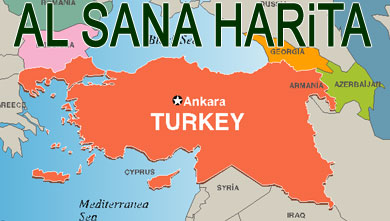
Scandalous map: Expansionist ambitions of the
Turkish ultranationalism
The ultranationalist frenzy which threatens at an accelerated rhythm
the Kurdish people as well as the ethnic and religious minorities of
Turkey is now accompanied by a new expansionist campaign aiming at
Turkish occupation of the republics of Cyprus and Armenia as well as
important territories of the neighboring countries like Greece, Syria
and Iraq.
Today, November 21, 2007, Günes,
one of the Turkish
daily
newspapers of
high circulation, has published on its first page a new map of Turkey
showing the annexation of these neighboring countries and territories.
Under the title, "You say map? Here is the map!", the newspaper
announces that currently circulates on Internet the map of "Enlarged
Turkey" in response to the maps showing Turkey divided.
In this new map of Turkey, the oil-producing Mosul and Kirkuk areas of
Iraq as well as all Greek islands including Crete form parts of future
the enlarged Turkey.
Main Turkish opposition leader offers olive branch to
Iraqi people
Main opposition Republican People's Party (CHP) leader Deniz Baykal who
is known with his hardline positions on Iraq has offered a series of
peaceful measures to befriend the Iraqi people including the Kurds
ranging from educating Iraqi youths at Turkish universities to
providing more water to the neighboring country.
The CHP initiative came as a major surprise as the main opposition
leader has followed a tough policy on the Iraqi Kurds demanding
sanctions and an immediate cross border military operation into
northern Iraq.
Baykal announcing a major initiative on Saturday told a press
conference in Ankara that a cross border operation into Iraq to hit the
PKK terrorist camps will not be enough and said social and economic
measures to befriend the Iraqi people is essential.
He said Sunni, Shiite and Arab youths should be given about 1000 grants
to be educated at Turkish universities thus helping neighboring Iraq to
train its new generation administrators.
He also proposed economic measures to enhance close cooperation with
the Iraqi people as well as Kurdish and Arabic language broadcasts
aimed at the Iraqi people.
He said Turkey should take measures to secure water resources for the
Iraqi people.
Baykal said "the solution to the problems we are having can no longer
be seen solely within the framework of an over the border
operation....Relations with northern Iraq need to be perceived outside
the ties with terror. Plans need to be made not just for today, but for
10, 20, 30 years later."
Baykal said he will announce more details of his initiative in the
coming days. CHP sources told The New Anatolian the CHP leader would
unveil more concrete steps at his parliamentary group meeting on
Tuesday. (The New Anatolian , 9 November 2007)
Forces
armées/Armed Forces
Ankara menace à nouveau d'une intervention militaire
en Irak
Le ministre turc des Affaires étrangères Ali Babacan a de
nouveau
menacé mardi d'une intervention militaire de son pays dans le
nord de
l'Irak contre les rebelles kurdes, déclarant que la
"volonté politique"
de Bagdad pour lutter contre le PPK n'était "pas suffisante".
"Nous avons déjà souffert de milliers de victimes dans ce
combat et
quand le temps sera venu et quand il sera nécessaire, nous
utiliserons
tous les instruments dans notre combat contre le PKK (Parti des
travailleurs du Kurdistan)", a déclaré M. Babacan lors
d'une conférence
de presse à l'issue d'une rencontre avec des responsables
européens à
Bruxelles.
"La Turquie dispose d'un certain nombre d'instruments pour combattre le
terrorisme et continuera à les utiliser. Ces instruments
incluent le
dialogue politique, des instruments diplomatiques et des instruments
militaires", a-t-il souligné.
La Turquie menace depuis plusieurs semaines d'intervenir militairement
dans le nord de l'Irak contre le PKK, qui utilise cette région
comme
base arrière pour des opérations dans le sud-est
anatolien, peuplé
majoritairement de Kurdes. Quelque 100.000 soldats ont
été déployés
près de la frontière irakienne.
Le ministre des Affaires étrangères irakien Hoshyar
Zebari, également
présent à Bruxelles mardi, a toutefois estimé que
ce risque
d'intervention militaire avait diminué.
Interrogé sur ces déclarations, M. Babacan a salué
l'engagement politique du gouvernement central irakien.
Mais "comme je l'ai déjà dit, la volonté politique
n'est pas
suffisante, vous avez également besoin des capacités
physiques pour
répondre à cette situation", a-t-il ajouté. (AFP,
20 nov 2007)
Turkey
implementing Iraq operation, says General
Başbug
Turkey is "in the process of implementing" a cross-border operation
against the outlawed Kurdistan Workers' Party (PKK) that uses northern
Iraq as a base to launch attacks, a senior Turkish general said
Thursday.
But there were no immediate signs of increased military activity along
Turkey's mountainous border with Iraq Thursday evening, Reuters
reporters in the region said, suggesting any offensive was only in the
preparatory stages.
"We are in the process of implementing the cross-border operation,"
Gen. İlker Başbuğ, head of the Land Forces and the second most powerful
man in the Turkish Armed Forces, told reporters at a diplomatic
reception in the Turkish capital.
Başbuğ did not spell out exactly what he meant.
Turkey's Parliament approved a government request last month to be able
to launch cross-border operations into northern Iraq.
"When or how the motion (on a cross-border operation) will be
implemented is another issue," Başbuğ said, according to the Anatolia
news agency.
Turkey has massed as many as 100,000 troops, backed by warplanes,
helicopters and tanks, on its border with Iraq for a possible
cross-border incursion to root out the separatist terrorists, blamed by
Ankara for a series of attacks on its security personnel.
A senior Iraqi border guards officer said there were no signs Turkey
had launched a cross-border operation into Iraq.
"There has been no Turkish incursion into Iraq, although there are many
Turkish troops massed on the Turkish side of the border," the officer,
who declined to be identified, told Reuters.
Authorities have stepped up the rhetoric to pressure U.S. and Iraqi
authorities to move against the PKK, analysts say.
One senior U.S. military official in Baghdad said he was not
immediately aware of any Turkish action. Iraqi government officials
could not be reached for comment.
On Tuesday security sources said Turkey had sent hundreds of special
forces to the border to bolster its troops there.
Washington has urged Ankara to avoid a large-scale incursion, fearing
it could destabilize Iraq's most peaceful part and cause a bigger
regional crisis.
Başbuğ's comments followed a reaffirmation by the government this week
that Turkey was ready to carry out an offensive against some 3,000 PKK
members based in the mountains of northern Iraq.
Pressure mounts:
NATO member Turkey has staged limited raids, predominantly air strikes,
in the past month across the mountainous frontier against the
separatist PKK.
"Turkish armed forces have been conducting cross-border operations for
years and they has been successful so far," Başbuğ said, answering
criticism about the effectiveness of previous offensives in northern
Iraq.
He said if such operations had not been carried out there would be
10,000 PKK members rather than the 5,000 estimated to be in Iraq and
Turkey.
Turkish Prime Minister Recep Tayyip Erdoğan said this week a military
operation was still planned, despite logistic difficulties as winter
closes in across the rugged region.
Last week, Erdoğan urged U.S. President George W. Bush to crack down on
the group. Iraq has pledged to hunt down and arrest PKK leaders. But
Baghdad has little influence over the semi-autonomous Kurdish region in
the north and the success of any measures against the PKK will depend
on cooperation of local Kurdish authorities in northern Iraq.
(Reuters, Evren Mesci, November 17, 2007)
New Regulation aims to gag ex-army members
In response to the appeals by the government and the Turkish Armed
Forces (TSK), the Defense Ministry has decided to take immediate action
against the growing number of retired officers making statements
regarding fight against the terrorist Kurdistan Workers’ Party (PKK)
and a potential cross-border operation into northern Iraq.
According to an amended article in the military’s internal rules and
regulations , any retired officer that makes a statement to the press
or writes a book about the period during which he served will face
sanctions such as being denied entry to TSK officers’ clubs and social
facilities.
The General Staff, in line with the amended bylaw, will be able to
temporarily or permanently deny retired officers who don’t abide by the
ban in question entry into officers’ clubs and other social facilities
of the army. The scope of the ban has been defined in the Official
Gazette, published on Saturday. It applies to “those who make verbal
statements, write articles or books, or issue statements in regard to
the period during which they served. Those who openly use humiliating
words or do humiliating things in order to harm the hierarchical
relationship within the military and to diminish the feeling of trust
toward superiors and commanders.”
In the meantime, the General Staff speedily issued a statement on its
Web site after the amended bylaw was interpreted by some newspapers as
“an order for retired generals to shut up.” Calling such news articles
unrealistic, the General Staff maintained that the decision was being
assessed wrongly, adding that imaginary scenarios were being written
with regard to the timing of the bylaw amendment.
The amendment hasn’t been made to limit the freedom of certain people
to make statements, the General Staff further noted, but is aimed at
protecting the brotherhood and the tradition of loyalty to the TSK’s
principles. (Zaman, November 19, 2007)
Quasi-military
security organization presses for more power
Despite statements made by the government that furthering democracy
will not be sacrificed to the fight against increased terrorist
incidents, Turkey's Coast Guard Command (SGK), a quasi-military
organization, has renewed its pressure on the political authority to
gain more power in dealing with internal security threats.
The search for more power in violation of civilian oversight was
brought to the agenda once again by the SGK several days ago, with an
attempt to have Interior Minister Beşir Atalay sign an SGK regulation,
rewritten 24 years after the initial law, said Interior Ministry
sources speaking to Today's Zaman.
They, however, described the regulation itself as a positive
development because it will regulate the duties of the SGK while
emphasizing that some of the regulation’s provisions have been running
contrary to European Union criteria that also envisages civilian
democratic oversight.
“The SGK has been seeking to strengthen its existing autonomous
structure from civilian authority with the new regulation. This attempt
is in violation of Turkey’s democratization efforts that include
civilian oversight of all institutions without any discrimination,”
said the same sources.
An draft SGK regulation that hopes to adjust its functions and duties
in line with the SGK law passed by Parliament in 1982 was rewritten
after a 24-year break and submitted to the Interior Ministry for
approval almost eight months ago.
But Interior Ministry officials sought revisions within the regulation
in a way that would make the SGK subject to civilian oversight.
“Since then the SGK has not made any revisions that will have brought
it in line with democratic norms. Instead the command came up with the
regulation several days ago to be signed by Minister Atalay with no
substantial change in the provisions that would have subjected it to
civilian oversight. Atalay is relatively new in his post and we suspect
that the SGK sought it to be signed by the new minister, who the
command thinks will not question the SGK’s attempts at a time when
Kurdistan Workers’ Party (PKK) terror has increased, making the public
more sensitive to the role of security organizations,” said the
Interior Ministry sources.
Despite some optimism raised by those sources that Atalay will be
prevented from signing the new SGK regulation, there are some concerns
that political authority may bow to the pressures to be exerted by the
Turkish Armed Forces (TSK) to turn the SGK into a fifth force of the
military -- after land, air, navy and the Gendarmerie General Command
(JGK), which also has been enjoying a status that bypasses civilian
authority.
New rights contradict with
effective fight against internal threats
The SGK has been seeking a status that will bypass governors and heads
of districts, making it directly affiliated with the Interior Minister
in addition to increasing ranks from the current rear admiral to vice
admiral as part of the TSK’s “Force 2014” plan under way to restructure
the military.
In 2003, under an amendment made to a 1982 law pertaining to the SGK,
the status of coast guard personnel has already been elevated and
regional commanders with the rank of colonel were to be promoted to the
rear admiral rank as another sign of strengthening the SGK against
civilian authority.
At a time when Turkey has been re-adjusting its laws and regulations to
conform with the EU’s democratic norms, which include the establishment
of a non-military border police force consisting of civilian
professionals to protect the naval and land borders effectively, the
SGK’s attempts to give itself a more powerful status -- above civilian
authority -- are seen as further militarization of internal security
matters.
In theory the SGK, like the JGK, operates under the Interior Ministry,
in charge of domestic security and public order together with the
police force while affiliated with the TSK during times of war.
The Interior Ministry is also in charge of -- through the heads of
civil service (governors and heads of districts) -- services provided
by the police force and the half-civilian /half-military SGK and JGK.
But in practice, both the SGK and JGK operate under the directives of
the Turkish General Staff during peacetime, too. Their budgets are
under the General Staff’s control, while their hierarchical structures
are supervised by the military.
That situation in real life (i.e., the SGK and JGK having blurred
boundaries with the police - with all supposed to secure internal
security in a coordinated manner) creates a weakness in controlling the
country’s land and sea borders.
Turkish Interior Ministry sources stated that despite all efforts to
ensure civilian democratic oversight of both the SGK and the JGK, the
SGK’s search for a strengthened status with attempts to make itself
affiliated to the Interior Minister instead of local officials in the
areas that they operate in would further weaken the protection of the
country’s sea borders, which are approximately three times larger than
its land borders.
Turkey’s land border totals 2,573 kilometers in length while its sea
border, including the islands, totals 8,333 kilometers.
While the current status of the JGK being affiliated to the Interior
Minister himself is wrong, the SGK’s search for a similar status, among
other things, makes the situation much more complicated, stated Turkish
security officials.
There are times when disputes occur during the implementation of
internal security duties due to the differing status of the three
organizations, i.e., police, JGK and the SGK -- with the three of them
violating their areas of responsibility.
For example, the JGK retains the right to withhold information from the
public prosecutor, as witnessed by the Şemdinli incident in November
2005, where findings alluded to an illegal structuring of power.
The current controversial structure of Turkey’s internal security
organizations were also highlighted in the EU’s progress report on
Turkey, released on Nov. 6.
The EU report’s section, under the heading “Civilian oversight of
security forces” says: “The 1997 EMASYA secret protocol on Security,
Public Order and Assistance Units remains in force. The protocol,
signed by the General Staff and the Interior Ministry, allows for
military operations to be carried out for internal security matters
under certain conditions without a request from the civilian
authorities. No change has been made to the Turkish Armed Forces
Internal Service Law and the law on the National Security Council.
These laws define the role and duties of the Turkish military and grant
the military a wide margin of maneuver by providing a broad definition
of national security. No progress has been made in enhancing civilian
control over the Gendarmerie when engaged in civilian activities.”
(Zaman, Lale Sariibrahimoglu, November 19, 2007)
Military
court banned publications on the imprisoned 8
soldiers
After a battle in the Daglica/Hakkari region in south-eastern Turkey,
12 soldiers were killed and eight were taken hostage by the PKK.
Two weeks later, the eight soldiers were released in Northern Iraq,
handed over to a delegation which included three MPs from the
pro-Kurdish Democratic Society Party (DTP). The soldiers were then
flown to Turkey and intensive questioning started.
Yesterday (11 November), the military court in Van, south-eastern
Turkey, decreed that the soldiers be detained. The soldiers stand
accused of "violating the duties of a civil servant", "serious
suspicion of a crime", "excessive weakening of military discipline",
"insistence on disobedience" and "desertion abroad". The soldiers are
to be tried while in detention.
The military court also decided to impose ban on all publications
concerning the legal proceeding against eight soldiers.The decision was
taken according to Articles 13 and 28 of the Cobnstitution and Article
3 of the Turkish Press Code on pretext to keep secret some informations
related to public order and national defense.
The Van Gendarmerie Public Order Corps Command Military Court has
pronounced the following charges: sergeant Halis Cagan is charged with
violating the duties of a civil servant, privates Ilhami Demir, Irfan
Beyaz, Özhan Sabanoglu, Fatih Atakul and Mehmet Senkul are accused
of
insistent disobedience, and privates Fuat Basoda and Ramazan Yüce
are
charged with insistent disobedience and desertion abroad. It was argued
that there was strong suspicion of guilt and that military discipline
had been greatly weakened. Citing Article 71 of Law 353 and Articles
100 and 101 of the Criminal Procedure Code, the court decided to detain
the eight soldiers.
The arrest of the soldiers followed an earlier statement by Chief of
Staff Yasar Büyükanit, who had said that there was no
evidence that the
soldiers were "PKK moles".
When the soldiers were being questioned, Büyükanit had said,
"We are
talking with everyone who was there and was attacked. This is an
administrative investigation in order to see whether mistakes were
made, whether lessons need to be learnt. A picture will emerge from the
investigation. There is nothing worse than labelling the eight soldiers
criminals from the start. I have no information saying that any of them
were PKK moles. I find it wrong to look at a soldier's ethnic origin
and make comments. According to the Turkish constitution, the state is
made up of citizens, not of people of one race."
Families in shock
The families of the soldiers, who have been waiting to see their sons
for 21 days, have reacted strongly. Irfan Beyaz's father Halil Beyaz in
Gaziantep heard of his son's arrest when journalists called him to ask
for his reactions. Beyaz could not believe the news, saying: "I have
just found this out from you. I don't understand why and how. I will
wait for information."
Özhan Sabanoglu's family in Hatay found out on television. Father
Bahattin Sabanoglu said, "We have been waiting in fear and pain for
days. We love our country. I cannot understand it. We have not been
informed." Reproachfully, he said, "My plea to the General Staff, to
the generals, give us information."
According to today's newspapers, one soldier said: "Because I was
injured and did not have a gun, I said in Kurdish that I would
surrender". Another apparently said, "During the exchange of fire we
did not have the support of any of our commanders or soldiers. We were
fighting on our own." It was also said that most of the soldiers' guns
jammed. Another soldier stated that his commander had taken his gun.
(BIA news centre, November 12, 2007)
L'Armée
turque: pas trop tard pour une opération en
Irak
Il n'est pas encore trop tard pour une opération militaire
contre les
repaires des rebelles kurdes situés dans le nord de l'Irak, a
indiqué
le chef de l'armée turque, cité samedi par la presse
turque.
"Je ne pense pas qu'il y ait eu un retard (pour une intervention
transfrontalière). Il n'est jamais trop tard", a dit le
général Yasar
Büyükanit à des journalistes lors d'un entretien
vendredi, rapporte le
quotidien Hürriyet.
Le général a souligné attendre une directive
politique du gouvernement
pour sévir contre les bases-arrière des rebelles du Parti
des
travailleurs du Kurdistan (PKK) dans le Kurdistan irakien dans le cadre
d'une offensive d'envergure.
"On n'organise pas une opération juste pour le plaisir d'en
organiser
une. Il faut une cible et des résultats", a souligné le
chef
d'état-major, rejetant les thèses évoquées
ces derniers jours par les
médias sur l'éventualité de frappes ciblées
et restreintes sur les
positions rebelles.
Le Parlement turc a donné un feu vert le mois dernier au
gouvernement
turc pour mener des incursions en Irak pour "nettoyer" les camps des
quelque 3.500 rebelles kurdes établis dans le nord de l'iRak.
La Turquie qui dispose de la deuxième plus grande armée
de l'Otan après les Etats-Unis a massé 100.000 hommes
à la frontière.
La semaine dernière après une rencontre à la
Maison Blanche entre le
Premier ministre turc Recep Tayyip Erdogan et le président
américain
George W. Bush, la presse turque avait jugé moins probable une
grande
opération contre le PKK en Irak.
"Nous pensons qu'il y a une cible importante là bas" dans le
nord de
l'Irak, a indiqué le général Büyükanit,
selon le journal Milliyet.
Au terme de son entretien avec M. Erdogan, M. Bush a assuré que
les
Etats-Unis fourniraient à la Turquie des renseignements en temps
réel
sur les mouvements des rebelles et proclamé le PKK "ennemi
commun" de
leurs deux pays.
Les analystes voient dans le soutien affiché par M. Bush une
approbation tacite des Etats-Unis à des frappes restreintes
contre le
PKK. (AFP, 10 nov 2007)
Retired Turkish top generals confess mistakes
Mainstream Milliyet newspaper through out the week published a series
of interviews with the retired top generals of Turkish military
highlighting their views about where Turkey went wrong in Kurdish
question. Retired top Generals majority of them being the former Chief
of General Staff admitted that some of the steps taken as a part of
precaution caused the escalation of the problem.
The armed clashes with the PKK which is already included to the list of
terror organization in the US and the European Union has claimed the
lives of more than 35.000 people since 1984. Commanders that fought
actively against the PKK terror for decades admitted that there were
shortcomings in the solution formulas that were implemented. Former top
generals agreed that terror escalated due to tension policy.
Citing the early years of the question, former Land Forces Commander
Aytac Yalman noted that the denial policy was a mistake.
"People of the region want to speak in Kurdish and live according to
their own culture. Hence we were told that there were no Kurds. There
were views that Kurds were the Turks living in the rural areas. In this
light, we view social demands as destructive activities," Milliyet
quoted Yalman as saying.
Yalman divided Kurdish question into three phases; social problem
period, military period and political period.
"We should have detected the problem and read it correctly in the first
early phase. If we had done that, it would be solved more easily but we
have missed that opportunity," added Yalman.
Meanwhile, retired Chief of General Staff Kenan Evren who also served
as the president of the country after military took over the
administration in 1980 admitted the mistakes were committed in the
Kurdish problem in 1980s including the ban on Kurdish language.
"I later realized that the ban on Kurdish language was a mistake and I,
now, believe that civil servants serving in the Southeastern region
should know Kurdish," said Evren.
Between 1983 and 1991, it was forbidden to publicize, publish and/or
broadcast in any language other than Turkish, unless that language was
the first official language of a country that Turkey has diplomatic
relations with. Though this ban technically applied to any language,
Kurdish, being the first official language of no country although
widely spoken in the Kurdistan region, was to be the most affected.
Turkey has lifted the ban on Kurdish language as a part of its
democratization process.
On the other hand, retired Chief of General Staff Gen. Hilmi Ozkok
divided the question into three headlines; "first of all, there is a
Kurdish reality in Turkey. A part of our citizens are defining
themselves as Kurds. In addition to this, there is a Kurdish ideology
and/or politics. This is another fact. There is also an armed movement.
PKK's relation with these three groups should be reviewed. It is a
complicated question and it is hard to make comments on it."
Ozkok also stressed that Turkey cannot be divided easily and PKK cannot
be ended by only cross border operations.
Retired Chief of General Staff Ismail Hakki Karadayi stressed the fight
against terrorist and terrorism are two different things noting that
military fights against terrorists while fight against terror is a
broad concept including economic and political dimensions.
Karadayi also claimed that Iraqi border was set by Britain in order to
disrupt Turkey.
Turkey's another important retired General Ilker Basbug admitted that
Turkey was not successful in its fight against terrorism and its
efforts to prevent people to join PKK ranks.
"If we had achieved a success, we would not experience current hurdles.
There are still a number of steps that should be taken in order to end
the PKK terror," he added. (The New Anatolian , 9 November 2007)
Affaires
religieuses/Religious Affairs
Turkish Prosecutor Probes Atheist Book
A Turkish prosecutor has launched a probe into whether a book by
best-selling atheist writer Richard Dawkins is an attack on religious
values — a move that could lead to the prosecution of the book's
Turkish publisher.
Publisher Erol Karaaslan said Wednesday he would be questioned by an
Istanbul prosecutor on Thursday as part of the official investigation
into Dawkins' book, "The God Delusion."
Karaaslan could face trial and up to one year in prison if the
prosecutor concludes that the book "incites religious hatred" and
insults religious values, Milliyet newspaper reported. Karaaslan is
both the publisher and translator of the book.
The investigation of the British scientist's book comes at a time when
Turkey has been criticized for targeting writers and intellectuals for
expressing opinions. The European Union, which Turkey hopes to join, is
pressing Ankara to change laws that curb free expression, calling them
inconsistent with the bloc's free speech standards.
Turkey said this month it would soften a much-criticized law that makes
denigrating Turkish identity, or insulting the country's institutions,
a crime.
The Nobel Prize-winning author Orhan Pamuk was among the highest
profile Turks snared by the law, when he commented on the mass killings
of Armenians by Turks in the early 20th century.
Historians estimate up to 1.5 million Armenians were killed by Ottoman
Turks around the time of World War I, an event widely viewed by
genocide scholars as the first genocide of the 20th century. Turkey,
however, denies the deaths constituted genocide, saying that the toll
has been inflated and that those killed were victims of civil war and
unrest.
A probe was launched into "The God Delusion" after one reader
complained that passages in the book were an assault on "sacred
values," Karaaslan said.
No one was available for comment at the prosecutor's office.
The book has sold some 6,000 copies in Turkey since it was published by
Karaaslan's Kuzey publishing house in June. (AP, November 28,
2007)
La
région kurde, refuge des chrétiens
en Irak
Par milliers, les chrétiens d'Irak ont trouvé dans la
partie kurde du
pays un havre de paix et de coexistence pacifique, fuyant les autres
régions où leurs églises sont prises pour cibles
et leurs prêtres
kidnappés.
Ceux, nombreux, dont les familles étaient originaires de la
région ont
reconstruit des maisons dans les villages le plus souvent
désertés de
longue date, près de la frontière avec la Turquie.
Les autres, venus de Bagdad, Mossoul ou ailleurs, louent à prix
d'or
des logements dans les quartiers chrétiens, comme celui
d'Einkawa dans
la banlieue d'Erbil, et attendent que les choses se calment pour
rentrer chez eux ou envisagent l'exil à l'étranger.
Dans son bureau de l'archevêché Saint-Joseph à
Einkawa, Mgr Rabban
al-Qas, évêque d'Erbil et d'Ahmadiya, estime à
"plus de 70.000 le
nombre de chrétiens venus se réfugier au Kurdistan
irakien".
"Plus de deux cents villages, qui avaient été
abandonnés ou détruits
dans les années 1987/88 lors de l'offensive de Saddam contre les
Kurdes, ont été reconstruits. Ceux qui avaient des
terrains les ont
utilisés. D'autres louent".
Il met les attaques contre les chrétiens sur le compte des
"intégristes
fanatiques et des 600.000 voyous et criminels libérés par
Saddam avant
sa chute".
"Trois prêtres ont été tués à
Mossoul. Des églises ont été brûlées,
dynamitées, mitraillées. Il y a vingt jours, deux
prêtres ont été
kidnappés à Mossoul, libérés contre
rançon".
Ces exactions ont fait souffler un vent de panique sur les
chrétiens
d'Irak, s'alarme-t-il, et ceux qui l'ont pu ont cherché refuge
au
Kurdistan irakien, "cette zone de fraternité où ils ont
été bien
accueillis".
Lina Behnan, 20 ans, qui cuisine au rez-de-chaussée de la maison
louée
400 dollars par mois, est de ceux-là. "Nous venons du quartier
de Dora,
à Bagdad. Très dangereux. Cela a commencé par des
menaces des
islamistes sur un de mes frères, barbier, pour qu'il cesse de
raser les
hommes. Ensuite une voisine a été kidnappée. Et
puis ça..."
Elle montre une photo de son autre frère Nasser, 18 ans, le
visage
grêlé de cicatrices, un bras dans le plâtre. "Une
voiture piégée à la
sortie de son école. C'était trop. Nous sommes
montés en voiture,
non-stop jusqu'à Erbil".
Comme les autres réfugiés chrétiens
interrogés à Einkawa, Lina se
plaint du coût de la vie au Kurdistan, bien supérieur
à celui des
autres régions. Toute la famille s'est mise au travail pour
joindre les
deux bouts, mais "on ne pourra pas rester. Dès que les choses se
calment à Bagdad, nous rentrerons".
C'est ce qu'ont fait la semaine dernière, pour la
première fois et à la
faveur d'une baisse des violences dans la capitale, une vingtaine de
familles chrétiennes d'Einkawa, indique Mgr al-Qas.
Agnes Yacoub, 38 ans, fait ses courses dans l'épicerie de la
famille
Habib, tout près du siège d'Ishtar TV, la chaîne de
télévision des
chrétiens d'Irak. Elle aussi a fui Dora.
"On se sent tellement mieux ici, on peut sortir, respirer. Nous
étions
les derniers chrétiens du quartier, tous les voisins
étaient partis",
dit-elle. "Mais comme les gens affluent de partout, les prix montent.
C'est le prix de la sécurité, mais nous n'allons pas
pouvoir le payer
longtemps".
Dans la boutique, Fawazya Benjamin, 50 ans, serre contre ses jupes ses
deux petites filles, leur offre des bonbons. Elle a fui il y a cinq
mois la ville voisine de Mossoul. "Je ne vivais plus. Chaque fois
qu'elles partaient à l'école, j'avais peur de ne jamais
les revoir".
Pour loger ses douze enfants, ils louent 600 dollars par mois une
grande maison. "Les grands ont quitté l'école, tous
travaillent pour
payer le loyer, mais cela ne pourra pas durer. Dès que les
choses se
calment à Mossoul, il faudra bien y retourner..." (AFP, 12
nov 2007)
"Préoccupation"
du pape qui appelle à une "solution
pacifique"
Le pape Benoît XVI a exprimé dimanche sa
"préoccupation" face aux
tensions à la frontière turco-irakienne et appelé
à une "solution
pacifique", à l'issue de la prière de l'Angélus,
place Saint Pierre.
Benoît XVI s'exprimait au lendemain de la Conférence
ministérielle
d'Istanbul au cours de laquelle l'Irak s'est engagé à
agir contre les
rebelles kurdes basés dans le nord du pays, alors que la Turquie
menace
toujours d'intervenir militairement au Kurdistan irakien que les
séparatistes utilisent comme base arrière.
"Je désire encourager tous les efforts visant à une
solution pacifique
des problèmes qui sont récemment apparus entre la Turquie
et le
Kurdistan irakien", a déclaré le pape devant des dizaines
de milliers
de pèlerins.
"Je ne peux pas oublier que de nombreuses populations ont trouvé
refuge
dans cette région, fuyant l'insécurité et le
terrorisme qui ont rendu
difficile la vie en Irak", a-t-il souligné.
"Considérant le bien de ces populations, qui comprennent de
nombreux
chrétiens, j'espère fortement que toutes les parties
s'emploieront à
favoriser une solution de paix", a conclu Benoît XVI, qui
s'exprimait
pour la première fois sur la crise entre les deux pays. (AFP, 4
nov
2007)
Socio-économique
/ Socio-economic
Aucun survivant dans un accident d'avion en Turquie
Aucun des 56 passagers et membres d'équipage d'un avion de la
compagnie
turque Atlasjet, qui s'est écrasé vendredi dans le
sud-ouest de la
Turquie, n'a survécu, a indiqué Tuncay Doganer, directeur
général de la
société, sur une chaîne de télévision
turque.
"Il n'y a aucun survivant que ce soit parmi les passagers ou les
membres de l'équipage", a ajouté le responsable de la
compagnie
aérienne privée à bas prix.
Le ministre des Transports Binali Yoldirim a confirmé qu'il n'y
avait
"aucun signe de vie" près de l'épave, où s'est
posé un hélicoptère des
secours, à proximité d'une colline au nord-ouest de
l'aéroport
d'Isparta.
L'appareil, un McDonnell Douglas 83, avait décollé
d'Istambul à 00H51
locales (22H51 GMT) avec 49 passagers et sept membres d'équipage
à
bord, a expliqué M. Doganer.
L'avion a disparu des écrans radar vers 01H30 locales (23H30
GMT) peu
après que le pilote eut prévenu la tour de contrôle
qu'il perdait de
l'altitude en vue d'atterrir à l'aéroport d'Isparta.
Les débris de l'appareil ont été localisés
par des hélicoptères sur une
colline proche du village de Cukuroren, à une douzaine de
kilomètres de
l'aéroport, a indiqué le ministère des Transports
dans un communiqué.
Les conditions météorologiques étaient favorables
au moment où il a essayé d'atterrir, a
précisé M. Doganer.
"Il n'y avait ni pluie ni chute de neige à sa destination.
L'avion
n'avait pas de problèmes techniques. Le pilote était en
communication
avec la tour de contrôle jusqu'à sa disparition", a
expliqué M.
Doganer, assurant que les pilotes étaient
"expérimentés".
"La partie avant du fuselage est là. Il ne reste rien des ailes.
Des
morceaux sont éparpillés partout", a indiqué
Semsettin Uzun, gouverneur
d'Isparta à l'agence Anatolia.
Une équipe d'experts a été
dépêchée sur place.(AFP, 30 nov 2007)
Des villageois résistent contre une usine
d’enrichissement du
phosphate
Depuis quelques semaines, c’est l’inquiétude à Sahil
Yenice, un petit
village paisible situé à 12 km de la ville de Bandirma
(ouest de la
Turquie), dont les habitants vivent essentiellement de l’exploitation
de la noix. En cause, l’ouverture prochaine d’une entreprise
d’enrichissement du phosphate. Le maire du village, Yasar Panç
craint
lui aussi les « conséquences désastreuses de
l’acivité d’une telle
usine sur les produits agricoles, la santé et
l’écosystème de la région
».
Le 17 novembre dernier, un millier de villageois ont occupé le
terrain
où l’usine sera construite.
Ce rassemblement était appuyé par une figure de proue de
la lutte
paysanne en Turquie, Oktay Konyar. Konyar est le porte-parole des
villageois de la région de Bergama qui luttent depuis
près de 15 ans
contre l’installation d’une entreprise minière d’extraction de
l’or par
cyanuration.
Le 24 novembre, plus de 600 villageois de Sahil Yenice sont descendus
dans la ville de Bandirma pour y manifester. Les femmes
présentes
étaient vêtues de leur habits traditionnels tandis que les
hommes, à
l’instar de leurs camarades de Bergama, ont paradé le torse nu
et ce,
malgré le froid.
« Notre seule usine, c’est la noix », « Nous ne
voulons pas d’usine de
phosphate », « Les routes de Yenice sont fermées aux
entreprises », «
Ne te tais pas, si tu te tais, ton tour viendra » ou encore
« Notre
résistance vaincra » crièrent-ils dans les rues de
la ville.
La manifestation s’est achevée par une conférence de
presse dans les
locaux du syndicat des travailleurs du pétrole « Petrol-Is
».
A leur tour, dès le lendemain, les forces progressistes de la
région,
dont la « plateforme pour la démocratie » et «
l’association de la
jeunesse » (Gençlik Dernegi) de Bandirma, ont
organisé un convoi de
solidarité vers le village de Sahil Yenice.
Le convoi a été accueilli par les jeunes du village
brandissant des
bouquets d’œillets.
En présence des citadins venus par solidarité, 442
villageois ont
participé à un referendum qui devait décider de la
poursuite du combat
contre l’ouverture de l’usine. Les électeurs ont voté
à l’unanimité en
faveur de la poursuite du mouvement.
Des danses populaires rythmées par les chansons du
célèbre groupe
musical révolutionnaire « Yorum » ont animé
la place du village
jusqu’en début de soirée.
Après le retour à Bandirma du convoi de
solidarité, le maire MHP (Parti
d’action nationaliste, d’inspiration fasciste) de la ville, Adnan
Tuksal s’est rendu à son tour au village pour tenter d’intimider
les
villageois en les accusant d’avoir accueilli des individus subversifs
agissant contre l’Etat. A peine eut-il fini sa diatribe que les
habitants de Sahil Yenice lui ont indiqué la porte du village…
(Milliyet, Halkin Sesi TV, Marmara TV, Agence Anatolie, 26 novembre
2007)
"Shout Out Loud: End Male Violence!"
Around 150 women from the Platform against Violence Towards Women
gathered at the Galatasaray Square in central Istanbul on Sunday (25
November) in order to remind people of the extent of male violence in
Turkey.
The women spread a purple cloth on the floor and covered it with photos
of murdered and injured women, then sat around the cloth.
Violence against women continues everywhere
The occasion was the International Day for the Elimination of Violence
against Women on 25 November. The UN adopted this day in 1999 to draw
attention to the continuing violence against women worldwide.
The protest in Istanbul was aimed at drawing attention to all kinds of
violence perpetrated by the state, society and families:
"Shout so everyone can hear you, so that male violence stops" was the
slogan of the protest.
Female passers-by also joined the protest, at which Turkish and Kurdish
slogans were used, saying "Long live women's solidarity" and "long live
women's freedom".
Violence experienced from childhood
The platform said in a press briefing, read in Turkish and Kurdish,
that 72,643 women in Turkey were exposed to violence last year.
The statement spoke of "the hands which touch our bodies when we are
children and do not even understand their meaning, in homes seen as
"warm family environment" and schools called "homes of learning", the
forcedsexual attacks of our husbands in bed, the indecent assaults and
pressures on our bodies at our work places, the sexual allusions we are
forced to listen to on big squares and at the office, the rape we have
suffered in detention, accompanied by boots and truncheons, the
assaults and rapes we have suffered in F-type prison cells, our being
stripped naked in village squares in the name of the continuity of the
state, our bodies being sold in brothels, us being killed in the name
of "honour"..."
The statement defined violence as "protecting the control of patriarchy
and capitalism over women's bodies and labour" and added that this
violence had increased with the increase in nationalism and militarism.
"There are attempts to suppress the struggle for freedom of women on
this soil, particularly Kurdish women. The violence which religious and
nationalist conservatism has organised through male hegemony aims at
limiting the sphere of women."
Solidarity with Kurdish women
The women emphasised the pressure and attacks towards Kurdish women who
were resisting the "pressure, the stripping of their identity, the ban
on organising, denial and destruction": "Our friends, the Sebahats,
Sevahirs, Fatmas, who received thousands of votes and became MPs, have
been made targets by the sexist chauvinist media."
"Today is 25 November. We say that women's solidarity against violence
means solidarity with Fatma Kurtulan [the DTP MP from Van who has been
accused of attending PKK camps after she was involved in the freeing of
the eight hostage soldiers]."
Solidarity with all women
"It also means to unite the hands of the woman who is beaten at home
and the Kurdish women whose voices are being suppressed. It means
seeing that the murderers of transvestite Hülya, who had no choice
but
prostitution, and Güldunya, killed in the name of 'honour', are
the
same murderers." (BIA news centre, Nilgün YURDALAN, November 27,
2007)
Berlin augmente la pression concernant le Jeune
Allemand en prison en Turquie
L'Allemagne et l'Union européenne ont augmenté jeudi la
pression sur la
Turquie face au maintien en détention depuis sept mois d'un
Allemand
mineur accusé d'agression sexuelle sur une adolescente
britannique dans
une affaire trouble qui embarrasse les pays concernés.
"Nous allons faire ce que nous pouvons" pour aider ce jeune homme, a
déclaré dans une interview télévisée
la chancelière Angela Merkel, qui
s'exprimait publiquement pour la première fois sur cette affaire.
Le gouvernement a dit envisager de s'associer à la plainte que
les
avocats de Marco W. veulent déposer sous peu devant la Cour
européenne
des droits de l'Homme. Objectif: obtenir la libération ou au
minimum
l'amélioration des conditions de détention du
lycéen de 17 ans.
"Nous envisageons la possibilité de soutenir une telle plainte",
a indiqué à l'AFP le ministère des Affaires
étrangères.
De son côté, le président du Parlement
européen (PE), Hans-Gert
Pöttering, a été prié par l'ensemble des
groupes parlementaires de
demander au commissaire européen à l'Elargissement Olli
Rehn d'examiner
les possibilités d'intervention auprès de la Turquie.
M. Pöttering a pris contact avec Olli Rehn et un entretien
était prévu ce jeudi, selon une porte-parole du PE.
La Commission européenne suit "ce cas de près, en
matière de droits de
l'Homme", a expliqué la porte-parole de M. Rehn, Krisztina Nagy,
en
soulignant "la sensibilité de la situation".
Marco W., 17 ans, est en prison depuis avril à Antalya.
Accusé
"d'agression sexuelle d'un enfant" (Charlotte a moins de 15 ans), il
encourt plusieurs années de prison. Il nie avoir abusé de
la jeune
Anglaise lors de vacances dans un club-hôtel turc et parle de
caresses
consenties.
Mais la mère la jeune fille, récusant tout mensonge
possible de la part
de celle-ci, a porté plainte. Son avocat plaide le viol,
passible de 15
ans de prison, même si les circonstances du flirt restent floues
et si
les preuves manquent cruellement.
"Peu importe qu'il soit coupable ou non: maintenir pendant sept mois un
mineur en préventive contrevient aux principes européens
de l'Etat de
droit", s'est emportée une députée
européenne allemande, Silvana
Koch-Mehrin, dans un journal jeudi, reflétant ainsi
l'incompréhension
voire la colère d'une partie de l'opinion allemande et de la
classe
politique.
La cour d'assises d'Antalya a décidé mardi de prolonger
la détention de
Marco W., renvoyant le procès au 14 décembre. Elle n'a pu
entendre
Charlotte, qui refuse de témoigner en Turquie, et attend
toujours une
traduction en turc de l'interrogatoire de l'adolescente en Angleterre.
"C'est un scandale. On n'est quand même plus au Moyen-Age, quand
des
cavaliers portaient à cheval les messages d'un pays à
l'autre!", s'est
indignée Mme Koch-Mehrin.
"Si la Turquie veut entrer dans l'UE, nous devons pouvoir attendre
qu'un citoyen européen comme Marco ait un procès
correct", a-t-elle
ajouté, reprenant une idée formulée par plusieurs
responsables
politiques.
Angela Merkel s'est toutefois appliquée à dissocier
l'affaire de la question de l'adhésion de la Turquie.
Elle a estimé qu'il ne fallait "pas lier (cette affaire)
à une grande
discussion politique à propos de laquelle les opinions peuvent
diverger".
Depuis le début de "l'affaire Marco", des responsables turcs ont
accusé
l'Allemagne de traiter leur pays en "colonie" ou en "république
bananière".
Berlin privilégiait depuis l'action discrète des
diplomates, plutôt que les déclarations frontales. (AFP,
22 nov 2007)
La loi
sur la construction de centrales
nucléaires promulguée
Le président turc Abdullah Gül a promulgué mardi une
loi autorisant la
construction des premières centrales nucléaires du pays,
projet
fortement décrié par l'opposition et les
défenseurs de l'environnement.
Le bureau de la présidence a annoncé dans un
communiqué l'approbation
de la nouvelle législation, adoptée par le parlement turc
le 9 novembre
après avoir fait en mai l'objet d'un veto du
prédécesseur de M. Gül,
Ahmet Necdet Sezer.
Contrairement à M. Gül, qui a été élu
en août et est proche du
gouvernement, M. Sezer était un opposant farouche au Parti de la
justice et du développement (AKP, issu de la mouvance islamiste)
au
pouvoir. (AFP, 20 nov
2007)
Le Parlement turc autorise la construction de
centrales nucléaires
Le Parlement turc a voté vendredi une loi autorisant la
construction
des première centrales nucléaires en Turquie, en
dépit des objections
de l'opposition et des défenseurs de l'environnement.
Le projet de loi a fait l'objet de plusieurs amendements parlementaires
d'ordre technique avant d'être adopté dans la nuit au
terme d'une
séance houleuse entamée jeudi après-midi.
La nouvelle loi autorise le ministre de l'Energie à lancer et
à
conclure des appels d'offres pour la construction de centrales
nucléaires ainsi qu'à décider de leur
capacité et du lieu de leur
implantation.
Elle prévoit qu'en cas d'absence d'offres émanant du
secteur privé, des
institutions publiques peuvent prendre en charge la construction des
centrales.
La loi doit à présent être promulguée par le
président Abdullah Gül, élu en août et proche
du gouvernement.
Le précédent président, Ahmet Necdet Sezer,
farouche opposant au
gouvernement du Parti de la justice et du développement (AKP,
issu de
la mouvance islamiste), avait mis son veto lors d'un premier vote de la
loi en mai.
La Turquie affirme vouloir construire trois centrales nucléaires
d'une
capacité totale d'environ 5.000 megawatts et devant être
opérationnelles en 2012 pour pallier d'éventuelles
pénuries d'énergie
et réduire sa dépendance énergétique.
Mais ce projet, et le choix du site devant accueillir un des
réacteurs
- Sinop, une ville côtière sur la mer Noire, à
quelque 435 km au
nord-est d'Ankara - a soulevé des vagues de protestation chez
les
riverains et les défenseurs de l'environnement.
En 2000, la Turquie avait du renoncer à un projet
controversé de
construction de centrale nucléaire en raison de
difficultés financières.
Le projet, décrié par les environnementalistes,
prévoyait la
construction d'un réacteur près de la bourgade d'Akkuyu
(sud), à
seulement 25 km d'une ligne de fracture sismique. (AFP, 9 nov 2007)
"De
l'autre côté", un vent de
fraternité souffle du Bosphore
L'émouvant et superbe film "De l'autre côté", dont
le scénario a été
primé au dernier Festival de Cannes, jette un pont entre
Allemagne et
Turquie, les deux pays de son jeune auteur Fatih Akin, grâce au
portrait de deux familles confrontées à l'exil et
rapprochées par un
drame.
La légendaire interprète des oeuvres de Rainer Werner
Fassbinder, Hanna
Schygulla, mène le remarquable casting de ce film qui mêle
comédiens
allemands et turcs, et constitue le deuxième volet d'une
trilogie
entamée avec "Head on", couronné d'un Ours d'or au
festival de Berlin
en 2004.
Dans "Head on", une jeune Turque née en Allemagne contractait un
mariage blanc avec un compatriote alcoolique et toxicomane de 20 ans
son aîné, pour échapper au carcan d'une famille
traditionnaliste et
conservatrice.
Avec "Auf der anderen seite", titre original de son cinquième
long-métrage, Fatih Akin, âgé de 34 ans, montre
deux familles, l'une
allemande, l'autre turque, rapprochées par le deuil et
l'apprentissage
d'une double culture.
Hanna Schygulla y incarne Susanne, la mère de Lotte (Patrycia
Ziolkowska), une étudiante allemande qui tombe amoureuse d'Ayten
(Nurgul Yesilcay) une jeune Turque, activiste de gauche
recherchée par
la police, candidate à l'asile politique en Allemagne.
En parallèle, le film suit Ali (Tuncel Kurtiz), un Turc veuf et
âgé
vivant à Hambourg, souffrant de solitude et du mal du pays, et
qui
propose avec tendresse à une prostituée turque Yeter
(Nursel Kose),
d'être sa maîtresse attitrée.
A la mort de Yeter, le fils d'Ali, professeur de littérature
allemande
en Allemagne, décide de retrouver, à Istanbul, la fille
de celle-ci...
qui n'est autre qu'Ayten, la jeune pasionaria qui s'acharne à
rester en
Allemagne.
Joliment écrit et dialogué, merveilleusement
interprété, "De l'autre
côté" brasse des thèmes très contemporains -
exil, métissage, deuil,
transmission, opposition Orient/Occident, violence d'Etat,
extrémisme
religieux ou politique... - évoqués avec finesse.
Fatih Akin y excelle à capter des émotions ténues
sur un visage, la
beauté d'un paysage ou l'ambiance particulière d'une rue
d'Istanbul ou
de Hambourg.
Très émouvant, le film distille une belle et subtile
leçon de fraternité.
A Cannes, l'actrice Hanna Schygulla a affirmé avoir voulu,
depuis
longtemps, travailler avec un cinéaste issu de la
communauté turque
d'Allemagne, et en particulier avec Akin.
"Quand il a été primé à Berlin il m'a
rappelé le jeune Fassbinder,
parce qu'il a fait le "V" de la victoire", a-t-elle affirmé.
"C'était
si beau et naïf que mon coeur s'est mis à battre plus
vite", a ajouté
Hanna Schygulla.
"Le succès est une chose merveilleuse, parce qu'il ouvre des
portes,
comme celles de Cannes", a affirmé de son côté
Fatih Akin, qui a
expliqué avoir été "sous pression" après le
succès de "Head on".
Le cinéaste a également expliqué que chaque
personnage du film reflète
un aspect de sa personnalité et le chemin emprunté par
des générations
d'immigrants turcs en Allemagne, venus occuper des emplois non
qualifiés, et dont les enfants font aujourd'hui partie des
classes
moyennes.
Le film a reçu fin octobre le Prix Lux, le premier prix
cinéma décerné par le Parlement européen.
(AFP, 9 nov 2007)
Relations
turco-européennes / Turkey-Europe Relations
France
et Suède toujours pas d'accord sur la
Turquie
La France et la Suède, qui assureront chacune la
présidence tournante
de l'Union européenne (UE) dans les deux ans à venir, ont
un désaccord
persistant sur l'entrée de la Turquie dans l'Europe, qui s'est
à
nouveau exprimé à l'occasion d'un déplacement de
François Fillon à
Stockholm.
"Nous voulons que le travail mené en commun entre l'Union
européenne et
la Turquie se poursuive dans le sens d'un rapprochement de la Turquie
de l'Union européenne mais qu'on ne présage pas de la
décision finale",
a rappelé le Premier ministre français lors d'une
conférence commune
avec son homologue suédois de centre-droit, Fredrik Reinfeldt.
"On voudrait leur donner cette possibilité en tant que nation"
d'intégrer l'UE. "Ces négociations doivent pouvoir se
poursuivre", a
estimé de son côté M. Reinfeldt.
La France assurera la présidence de l'UE à partir du 1er
juillet 2008.
Après la République tchèque, ce sera au tour de la
Suède de juillet à
janvier 2009.
Paris et Stockholm ont mis en avant leur entente sur les
priorités
qu'ils veulent donner chacun à leur présidence: la lutte
contre le
réchauffement climatique, une "harmonisation" des politiques
d'immigration "notamment en matière de droits d'asile", a
insisté M.
Fillon, rappelant l'afflux de réfugiés Irakiens en
Suède, et enfin
l'approfondissement de la politique européenne de défense.
Les deux parties ont aussi manifesté leur volonté d'une
"coopération
intense" pour surmonter leurs divergences, selon M. Reinfeldt.
"Nous allons travailler ensemble aux compromis qui sont au coeur de la
dynamique européenne", a dit M. Fillon.
Quant à l'euro, M. Reinfeldt a de nouveau renvoyé la
question d'un
éventuel référendum sur l'entrée de son
pays dans la zone euro à 2010,
après les prochaines élections législatives en
Suède. Les Suédois
avaient voté contre l'euro en 2003.
Au cours de sa visite, M. Fillon a maintes fois fait part de son
"admiration" pour le modèle économique suédois. Il
a rappelé les
excellents résultats obtenus par la Suède qui peut se
targuer d'un taux
de chômage inférieur à 5%, un objectif fixé
par son propre gouvernement
à l'horizon 2012. (AFP, 23 nov 2007)
Babacan dénonce les "intérêts
à court terme" de certains Etats
Le ministre turc des Affaires étrangères Ali Babacan a
dénoncé mardi
les "intérêts politiques à court terme" de certains
Etats européens qui
mettent des bâtons dans les roues du processus d'adhésion
de la Turquie
à l'Union européenne (UE).
M. Babacan a estimé que les négociations
d'adhésion, commencées en
octobre 2005, étaient "beaucoup plus importantes que les choix
politiques de certains Etats membres".
"Nous pensons que l'agenda politique général est beaucoup
plus
important que les intérêts politiques à court
terme", a-t-il ajouté
lors d'une conférence de presse, faisant visiblement allusion au
président français Nicolas Sarkozy qui ne cesse de
répéter que la
Turquie n'a pas sa place dans l'UE.
"Des questions politiques ne doivent pas faire obstacle à notre
processus d'adhésion, nos amis européens doivent faire de
leur mieux
pour empêcher ça", a continué M. Babacan.
"Tous les chapitres techniquement prêts à être
ouverts ne devraient pas être sujet à des
discriminations", a-t-il encore ajouté.
La France a assuré qu'elle ne bloquerait pas l'ensemble des
négociations d'adhésion à ce stade mais qu'elle ne
permettrait pas
l'ouverture de certains des 35 chapitres thématiques qui les
jalonnent
et notamment ceux qu'elle juge directement liés à une
adhésion, comme
la politique économique et monétaire.
Nicolas Sarkozy n'a, semble-t-il, pas non plus l'intention d'autoriser
l'ouverture de nouveaux chapitres, en plus des quatre qui le sont
déjà,
tant que le groupe des sages qu'il appelle de ses voeux, pour
réfléchir
à l'avenir de l'Europe, ne sera pas créé.
Malgré tout, le commissaire européen à
l'Elargissement Olli Rehn et la
présidence portugaise de l'UE ont répété
mardi leur volonté d'ouvrir
deux chapitres ("réseaux transeuropéens" et "santé
et protection des
consommateurs") d'ici la fin de l'année.
"Nous pensons et nous voulons que ce soit possible", a
déclaré le
ministre portugais des Affaires étrangères Luis Amado,
évoquant la date
du 18 décembre.
L'ouverture des deux chapitres seraient donc programmées pour
après le
sommet européen du 14 décembre où le groupe des
sages devrait être créé.
"Nous aurons certainement pendant le Conseil européen de
décembre une
proposition pour répondre d'un côté à la
demande française (sur le
groupe des sages) et de l'autre côté, nous essaierons de
maintenir le
processus d'adhésion turc sur les rails", a ajouté M.
Amado. (AFP, 20
nov 2007)
Sarkozy réaffirme son opposition à
une adhésion de la Turquie
Le président français Nicolas Sarkozy a
réaffirmé mardi son opposition
à une adhésion de la Turquie à l'Union
européenne qui repousserait les
frontières de l'UE "en Syrie", lors d'un débat à
huis clos avec des
parlementaires européens, a indiqué l'Elysée.
"Le président a très clairement réaffirmé
la position française. Il a
dit que la Turquie était un pays de 100 millions d'habitants qui
n'était pas en Europe mais en Asie mineure et qu'il ne voulait
pas être
celui qui allait expliquer aux écoliers français que les
frontières de
l'Europe se trouvaient en Syrie", a-t-on ajouté de même
source.
Le chef de l'Etat français a tenu ses propos lors d'une
réunion fermée
au public avec les présidents des groupes politiques du
Parlement
européen à Strasbourg. Dans un discours tenu ensuite
devant le
Parlement européen, M. Sarkozy n'a pas évoqué ce
sujet sensible.
Lors de la réunion à huis clos avec les responsables de
groupes
parlementaires, "il a dit qu'il était hypocrite de promettre aux
Turcs
qu'ils peuvent rejoindre l'UE, qu'avec lui ils ne le pourront pas, et
que pour lui la Turquie n'appartient pas à l'Europe", a
également
rapporté le chef des socialistes Martin Schulz.
"Mais quand je lui ai demandé s'il mettrait un arrêt des
négociations
avec la Turquie à l'agenda de l'Union pendant la prochaine
présidence
française (au deuxième semestre 2008), là il
était un peu flou", a-t-il
déploré devant la presse.
M. Sarkozy a par ailleurs "dit qu'il serait intransigeant sur le
maintien du siège du Parlement à Strasbourg", en plus de
celui de
Bruxelles, en dépit des critiques récurrentes que suscite
cette
situation, a rapporté de son côté le
co-président du groupe des Verts,
Daniel Cohn-Bendit.
En mai, le président français avait prévenu que le
siège de Strasbourg
n'était "pas négociable" car cela faisait "partie des
équilibres
fondateurs de l'Europe".
La remise en cause du siège du Parlement européen
à Strasbourg est
réclamée par de nombreux députés qui
voudraient en finir avec les très
coûteuses navettes mensuelles entre leurs bureaux à
Bruxelles et la
capitale alsacienne.
Le traité européen, qui ne peut être modifié
qu'à l'unanimité des Etats
membres, fixe officiellement le siège du Parlement
européen à
Strasbourg mais prévoit deux lieux de travail, Strasbourg et
Bruxelles,
où les eurodéputés passent de fait le plus clair
de leur temps.
La multiplicité des sièges du Parlement européen
coûte plus de 200
millions d'euros par an aux contribuables européens, selon le
groupe
des Verts au Parlement. (AFP, 13 nov 2007)
La
Commission européenne appelle la Turquie à relancer les réformes
La Commission européenne a appelé mardi la Turquie
à relancer les
réformes politiques après une année 2007
marquée par des "progrès
limités".
"Des progrès limités ont été
réalisés dans les réformes politiques en
2007", a estimé Bruxelles dans son rapport annuel sur
l'état des
négociations d'adhésion de la Turquie à l'UE.
"La Turquie doit maintenant renouveler l'élan des
réformes politiques", ajoute le rapport.
La Commission attend notamment de la Turquie de "nouveaux efforts" pour
améliorer la liberté d'expression, le contrôle de
l'armée par le
pouvoir politique, les droits des minorités religieuses, la
lutte
contre la corruption, les droits et liberté de la
minorité kurde.
Concernant la liberté d'expression, la Commission réclame
depuis des
mois la révision de l'article 301 du code pénal turc qui
a permis de
lancer des poursuites contre des dizaines d'intellectuels pour atteinte
à l'identité turque.
Bruxelles a d'ailleurs proposé que cette révision soit
une condition
préalable à l'ouverture d'un des 35 chapitres
thématiques qui jalonnent
les négociations d'adhésion, celui sur le système
judiciaire et les
droits fondamentaux.
Sur chacun des 35 chapitres, dont 4 sont pour l'instant ouverts, la
Commission peut recommander aux Etats membres de poser des conditions
à
remplir avant de les ouvrir.
Dans son rapport, Bruxelles réclame aussi comme à son
habitude le
respect par la Turquie du protocole dit d'Ankara qui étend
l'union
douanière entre l'UE et la Turquie à tous les nouveaux
Etats membres de
l'UE, dont la République de Chypre qu'Ankara ne reconnaît
pas.
Le non-respect de ce protocole, et en particulier le refus des Turcs de
laisser entrer dans leurs ports et aéroports les navires et
avions
chypriotes grecs, a poussé l'UE à geler en
décembre dernier 8 chapitres
de négociations. Ces chapitres restent gelés
jusqu'à l'application du
protocole d'Ankara.
La Turquie a commencé en octobre 2005 des négociations
d'adhésion à
l'UE qui pourraient durer au moins dix ou quinze ans.
La Turquie s'engage à
relancer les réformes après une mise en garde de l'UE
La Turquie a affirmé mardi qu'elle allait lancer de nouvelles
réformes
notamment en matière de liberté d'expression pour
s'aligner sur les
normes européennes après une mise en garde de l'Union
européenne sur un
ralentissement de ses efforts.
Le gouvernement est en particulier décidé à
amender un article du code
pénal qui punit d'une peine de prison pouvant aller
jusqu'à quatre ans
toute personne "dénigrant l'identité turque", a
annoncé le ministre de
la Justice Mehmet Ali Sahin.
Il a précisé que "plusieurs projets ont été
préparés sur la base de
propositions d'organisations civiques. Le conseil des ministres les
examinera à la première occasion, en choisira un et le
soumettra au
parlement", a-t-il ajouté, selon l'agence de presse Anatolie.
Des dizaines d'intellectuels dont le lauréat 2006 du Prix Nobel
de
littérature Orhan Pamuk ont été jugés sur
la base de cet article 301,
généralement pour avoir contesté la ligne
officielle sur les massacres
d'Arméniens par l'empire ottoman, considérés comme
un génocide par de
nombreux pays.
Plusieurs intellectuels, parmi lesquels le journaliste d'origine
arménienne Hrant Dink, assassiné en janvier, ont
été condamnés sur la
base de cet article, mais l'exécution des peines a toujours
été
suspendue..
Le ministère des Affaires étrangères turc a
répondu par un
communiqué affirmant qu'Ankara comptait "poursuivre les
réformes afin
que le pays rattrape les niveaux les plus élevés en
matière de
démocratie et droits de l'homme".
"Notre détermination à remédier à nos
insuffisances et à appliquer
efficacement les réformes sur le terrain ne faiblit pas. Au
contraire,
elle s'accroît", avait assuré le ministère.
Le communiqué soulignait que le processus d'adhésion,
entamé en octobre
2005, ne devait pas être "modelé sur les
préférences des dirigeants
politiques de certains Etats membres" ou "réduit" à
l'application des
clauses d'une union douanière à Chypre, qu'Ankara refuse
de reconnaître.
"Nous espérons que nos amis dans l'UE montreront une forte
détermination à résister aux obstacles hors de
propos sur notre
chemin", indiquait aussi Ankara, semblant faire référence
au président
français Nicolas Sarkozy, fermement opposé à
l'adhésion de la Turquie
au bloc européen. (AFP, 6 nov 2007)
Erdogan
accuse l'UE de mettre des obstacles
l'adhésion turque
Le Premier ministre turc, Recep Tayyip Erdogan, a accusé lundi
l'Union
européenne de mettre des "obstacles" à l'adhésion
de la Turquie à l'UE,
lors de sa visite à Washington.
La Turquie est un important rempart contre un "choc des civilisations"
étant donné sa situation géographique entre
l'Europe et l'Asie et son
brassage culturel, a dit M. Erdogan à la tribune du Center for
Strategic and International Studies.
"Malheureusement, il y a certaines barrières politiques (...) et
nous
sommes très tristes de voir que l'on dresse ces
barrières", a-t-il
ajouté. "Nous sommes tristes de voir qu'ils (l'UE, ndlr)
édictent de
nouvelles règles après le début du jeu".
Plus tôt dans la journée, M. Erdogan avait
répété que son pays était
déterminé à obtenir l'adhésion à
l'Union européenne.
L'Union européenne "déçoit nos attentes.
Nous sommes aussi conscients
que c'est un long processus, l'adhésion à l'UE, mais nous
sommes
déterminés et allons continuer à chercher à
obtenir l'adhésion",
avait-il dit.
M. Erdogan, qui a été reçu à la Maison
Blanche par le président George
W. Bush, s'exprimait à la veille de la publication attendue d'un
rapport de la Commission européenne repoussant toute nouvelle
adhésion
à un horizon de moyen ou de long terme.
Selon le projet de rapport, la Turquie, qui a commencé des
pourparlers
d'adhésion à l'UE en octobre 2005, a
réalisé des "progrès limités" dans
les réformes en 2007.
"Des efforts supplémentaires importants sont nécessaires
en particulier
en matière de liberté d'expression, de contrôle
civil sur le militaire
et de droits des communautés religieuses non musulmanes",
indique le
projet. (AFP, 5 nov 2007)
Bruxelles
ne prévoit de nouvelle adhésion
à l'UE qu'à moyen ou long terme
La Commission européenne ne prévoit de nouvelle
adhésion à l'Union
européenne qu'à moyen ou long terme, selon un projet de
rapport qui
sera publié mardi.
"Les pays des Balkans et la Turquie se sont vus donner une perspective
de devenir membres de l'UE une fois qu'ils rempliraient les conditions
établies. Etant donné l'état actuel de
préparation de ces pays, leur
adhésion devrait avoir lieu à moyen ou long terme", selon
le texte du
rapport annuel de la Commission sur l'élargissement dont l'AFP a
obtenu
copie.
Dans les Balkans (Croatie, Macédoine, Albanie,
Monténégro,
Bosnie-Herzégovine et Serbie), la Commission note que "dans
plusieurs
pays, le processus de réforme a ralenti" en 2007 et elle
réclame en
particulier des efforts pour améliorer les systèmes
judiciaire et la
lutte contre la corruption, phénomène qui "reste
largement répandu et
profondément enraciné dans la société".
La Croatie, seul pays des Balkans à avoir commencé des
négociations
d'adhésion avec l'UE, en octobre 2005, reste la mieux lotie. La
Commission estime en effet que "des progrès importants dans les
négociations d'adhésion avec la Croatie sont possibles
dans l'année qui
vient".
Bruxelles est en revanche particulièrement dure avec la Bosnie
où "la
rhétorique provocatrice des dirigeants politiques clé
(...) a fait
caler les réformes" et où les progrès politiques
"ont ralenti".
L'absence d'accord politique sur la réforme de la police
empêche
toujours la Commission de recommander la signature avec Sarajevo de
l'accord de stabilisation et d'association, première marche vers
l'UE.
La Serbie, où "les forces démocratiques sont fragiles",
est également
la cible des critiques de la Commission qui y dénonce "un
ralentissement dans le rythme général des
réformes" lié aux "vives
divisions entre les partis politiques" pendant les mois ayant suivi les
élections législatives de janvier.
Mais pour Belgrade, le seul obstacle à la signature de son
accord
d'association avec l'UE reste l'absence de "pleine coopération"
avec le
tribunal pénal international pour l'ex-Yougoslavie.
Quant à la Turquie, qui a commencé des pourparlers
d'adhésion à l'UE en
octobre 2005, elle a réalisé des "progrès
limités" dans les réformes en
2007, selon le projet de rapport.
"Des efforts importants supplémentaires sont nécessaires
en particulier
en matière de liberté d'expression, de contrôle
civil sur le militaire
et de droits des communautés religieuses non musulmanes",
indique le
texte. (AFP, 5 nov 2007)
Après
l'orage de 2006, Bruxelles prêt à
jouer l'apaisement
La Commission européenne s'apprête à juger que "des
progrès limités"
ont été accomplis dans les réformes politiques en
2007 en Turquie, dans
un climat apaisé, bien loin des menaces adressées
à ce pays il y a tout
juste un an.
Bruxelles va faire un tel constat dans son rapport annuel sur les
progrès réalisés par la Turquie dans ses
négociations en vue d'une
adhésion à l'UE, selon une source européenne.
L'an dernier, le rapport très critique de la Commission
européenne
avait conduit, quelques semaines plus tard, au gel des discussions sur
huit des 35 chapitres thématiques qui jalonnent ces pourparlers,
entamés en octobre 2005, en raison de la question chypriote.
Mais même si cette année, aucun progrès n'a
été fait dans ce dossier
-la Turquie refusant toujours de laisser entrer dans ses ports et
aéroports les navires et avions chypriotes grecs-, la Commission
n'en
refera pas un casus belli.
Le rapport de mardi devrait simplement mettre en exergue "les
déficiences et les progrès" déjà maintes
fois commentés par Bruxelles,
disent des sources européennes.
Côté positif, la Commission devrait à nouveau
saluer la façon dont la
Turquie a réussi à se sortir de la crise politique qui
l'a agitée l'été
dernier.
"La démocratie a eu le dernier mot (...) La Turquie
mérite les
félicitations pour ce résultat", a résumé
le commissaire à
l'Elargissement Olli Rehn devant le Parlement européen il y a
dix jours.
Côté négatif, il a également
déjà égrené la liste des problèmes
qui se retrouveront dans le rapport.
Certaines réformes sont "aujourd'hui urgentes" comme la
révision de
l'article 301 du code pénal qui a permis d'engager des
poursuites
contre des dizaines d'intellectuels pour atteinte à
l'"identité
turque", a insisté le commissaire.
M. Rehn demande en outre de nouveaux efforts pour placer l'armée
sous
contrôle civil, pour la protection des droits des femmes, des
enfants
et des syndicats, ou pour améliorer la lutte contre la
corruption.
Sans oublier Chypre et l'exigence d'actions "rapides" en vue de laisser
entrer les navires et avions chypriotes grecs. Ni les droits des
minorités, en particulier ceux des Kurdes.
Le rapport de mardi devrait cependant rester muet sur la menace de la
Turquie de procéder à une incursion dans le nord de
l'Irak pour
combattre les rebelles kurdes, selon une source européenne.
Ces critiques ne devraient pas empêcher la Commission de pousser
à
avancer dans les négociations d'adhésion, profitant de la
renonciation
du président français Nicolas Sarkozy à bloquer
dès maintenant les
pourparlers.
"Nous devrions ouvrir de nouveaux chapitres sans délai (...) Au
moins
deux chapitres pourraient être ouverts dans les prochaines
semaines", a
déclaré Olli Rehn.
En deux ans, seuls quatre des 35 chapitres ont été
ouverts, alors que, dans le même temps, 14 étaient ouverts
avec la Croatie.
La Commission rendra d'ailleurs public, également mardi, son
rapport
annuel sur les progrès de Zagreb. Elle présentera aussi
ses rapports
sur la Macédoine, candidat officiel à l'adhésion,
ainsi que sur
l'Albanie, le Monténégro, la Bosnie-Herzégovine et
la Serbie, moins
avancés dans leur marche vers l'UE.
Concernant la Serbie, la Commission pourrait symboliquement annoncer
mardi le "paraphe" -ne préjugeant pas de sa signature- d'un
accord de
stabilisation et d'association, première marche vers l'UE.
Mais uniquement si le rapport que doit remettre d'ici à mardi le
procureur du Tribunal pénal international pour l'ex-Yougoslavie
Carla
Del Ponte sur les efforts de Belgrade en vue d'arrêter l'ex-chef
militaire des Serbes de Bosnie Ratko Mladic est suffisamment positif.
(AFP, 4 nov 2007)
La Commission européenne mécontente
de la mise en oeuvre des réformes
La commission européenne est mécontente des rythmes de
mise en oeuvre
des réformes conditionnant l'adhésion de la Turquie
à l'Union
européenne (UE), a annoncé jeudi le quotidien en ligne
EUobserver.
Le journal s'appuie sur le contenu du projet de rapport annuel
émis par
la Commission européenne concernant les progrès de la
Turquie dans la
voie de l'adhésion à l'UE devant être publié
le 6 novembre. Le projet
conclut que "la réalisation des réformes a
été irrégulière et s'est
ralentie depuis 2005".
L'exécutif européen pointe la nécessité
pour les dirigeants turcs de
mener des réformes dans le domaine de la liberté
d'expression, du
contrôle de l'armée par la société ainsi que
des droits de la
population non musulmane du pays. En outre, le projet de rapport
mentionne l'absence de progrès dans la normalisation des
relations
bilatérales entre la Turquie et Chypre, qui constitue une pierre
d'achoppement sérieuse sur le chemin de l'adhésion.
Le dossier analogue publié en 2006 soumettait également
à une âpre
critique la mise en oeuvre par Ankara des réformes
nécessaires à
l'adhésion.
Le 25 juin 2007, deux nouveaux chapitres intitulés
"Statistiques" et
"Contrôle financier" sont apparus dans le traité
d'adhésion. Un véto
dans le cadre des négociations sur un des articles "Union
économique et
monétaire" avait auparavant été
déposé par la France. En 2006, l'UE et
la Turquie avaient clos les discussions sur le premier chapitre
"Science et recherche". En décembre de la même
année, Bruxelles avait
cependant décidé de suspendre les négociations sur
8 des 35 chapitres
en réponse au refus de la Turquie d'étendre son accord
sur l'Union
douanière avec l'UE à la République de Chypre et
de lui ouvrir ses
ports maritimes et aériens.
Au printemps dernier, l'UE a décidé de reprendre les
négociations et
les parties ont entamé l'examen du deuxième chapitre du
dossier
d'intégration, intitulé "Entreprises et industrie".
Le processus de négociation entre l'Union européenne et
la Turquie
pourrait, selon les experts, durer entre 10 et 15 ans. (RIA Novosti, 1
er Novembre, 2007)
EU Commission slams 'military meddling' in Turkey
The European Commission's draft progress report on Turkey, due on Nov.
6 criticizes the increased tendency of the military to interfere in the
political process during 2007.
However the report also said the outcome of the spring constitutional
crisis reaffirmed the primacy of the democratic process.
The 82-page report obtained by the Turkish Daily News, clearly
underlined the aim of negotiations is accession and the preparatory
analytical phase of this process has reached its final stage. This is
an important emphasis for Ankara, since it comes amid calls from member
states for an alternative status instead of membership.
In the strategy paper that will be published together with the progress
report, the commission reflected on the slowing down in the
implementation of reforms since 2005, implying the constitutional
crisis and the aftermath of general elections led to a freeze in the
reform process. “Yet in the run of the elections open debates took
place on a number of traditionally sensitive issues and a vibrant civil
society proclaimed its attachment to democracy and secular state,” the
document said.
The progress report and the strategy paper draw attention to the major
areas of concern relating to political criteria.
Increased military interference
The commission pointed to the continued exercise of political influence
by the armed forces. Senior members of the armed forces were reported
to have stepped up their public comments on domestic and foreign policy
questions including Cyprus, secularism and Kurdish issues. “On a number
of occasions, the General Staff reacted publicly to government
statements or decisions. The General Staff directly interfered with the
April 2007 presidential election by publishing a memorandum on its Web
site expressing concern at the alleged weakening of secularism in the
country,” the draft report said.
It was underlined that no progress has been made in ensuring full
civilian supervisory functions over the military and parliamentary
oversight of defense expenditure. The commission stated the tendency of
the military to make public comments on issues going beyond its remit,
including on the reform agenda, has increased.
“Despite the public comments from the army and attempts to interfere in
the political process, the outcome of the spring 2007 constitutional
crisis reaffirmed the primacy of the democratic process,” the draft
report said.
While welcoming the more representative nature of the newly elected
Parliament, the need to reduce the 10 percent threshold was underlined.
The commission said the new government program of the Justice and
development Party (AKP) includes a strong commitment to continue
reforms. This intention was also reported to push forward the
implementation of the road map for EU accession presented in April. The
report said, “the government plans to carry out extensive
constitutional reforms aimed in particular at fully aligning Turkey to
international standards in the area of fundamental rights.”
Reference to reactions against the
Constitutional Court's “367” decision
The commission pointed at concerns related to the independence and the
impartiality of the judiciary. The Constitutional Court's famous ruling
on a quorum of two-thirds in Parliament, which annulled the first round
of voting in the April presidential election, was given as a
controversial example. “This decision led to strong political reactions
and allegations that the Constitutional Court had not been impartial
when reaching this decision,” the commission said.
Restrictions on freedom of
expression led to self-censorship
The prosecution and conviction for the expression of non-violent
opinions under certain provisions of the Penal Code are a cause of
serious concern. The number of persons prosecuted almost doubled in
2006, compared to 2005, and there was a further increase in the number
of prosecutions in 2007.
More than half of these cases were brought under the Turkish Criminal
Code, and in particular under article 301, which penalizes insulting
“Turkishness,” the Republic and the organs and institutions of the
state. The restrictive jurisprudence established in 2006 by the Supreme
Court of Appeals on article 301 needs to be brought in line with the
relevant EU standards. The potential impact of the anti-terror law on
freedom of expression is a concern.
While Hrant Dink's assassination in January led to a movement of
solidarity in Turkish society, there were also expressions of support
for his perpetrators. The trial against the alleged perpetrators of
Hrant Dink is ongoing. There is a need for full investigations,
including into allegations of police negligence.
Judicial proceedings and threats against human rights defenders,
journalists and academics have created a climate, which has led to
occurrences of self-censorship in the country, including the academic
field. The weekly newspaper Nokta, which published several articles on
issues relating to the military, stopped its publication in April at
the decision of the owner.
Journalistic freedom on military issues is restricted by an internal
memorandum from the General Staff, which establishes that journalists
most critical of the army are to be denied accreditation to military
receptions and briefings.
Hatred against non-Muslim
minorities unpunished
The killing of three Protestants in Malatya on April 18 and other
attacks against clergy and places of worship of non-Muslim communities
are reported as examples of the perception of religious minorities as a
threat to the integrity of the country. The report underlined use of
language that might incite hatred against non-Muslim minorities has
been left unpunished.
Restrictions on the legal personality and property rights of non-Muslim
religious communities as well as restrictions on the training of their
clergy were reported as still being in place. The commission,
particularly underlined that the Halki (Heybeliada) Greek Orthodox
seminary remains closed.
While stating the “ecumenical” Patriarch is not free to use the
ecclesiastical title ecumenical on all occasions, the ruling by the
Supreme Court of Appeals was cited. The report said this decision might
create further difficulties for the patriarchate and for other
non-Muslim religious communities in the exercise of their rights.
No overall progress ensuring
cultural
diversity
The report said Turkey has made no overall progress ensuring cultural
diversity and promoting respect for and protection of minorities in
accordance with European standards. Restrictions on broadcasting in
other languages were said to be still applied. The report said since
use of languages other than Turkish remains illegal in political life,
several investigations and court cases have been opened against
officials and executives of the Democratic Society Party.
“The legislative elections in July resulted in increased representation
of voters from the southeast of Turkey,” the commission said. However
the overall socio-economic situation in the southeast was said to
remain difficult since no steps have been taken to develop a
comprehensive strategy to create conditions required for the Kurdish
population to enjoy full rights and freedoms. (Turkish Daily News,
October 31, 2007)
Turquie-USA/
Turkey-USA
Rencontre
à Ankara entre généraux turcs et américains
De hauts responsables militaires turcs et américains ont
discuté de la
coopération dans la lutte contre les rebelles du PKK, au cours
d'une
rencontre samedi à Ankara, a annoncé l'armée
turque.
Le numéro un de l'armée turque le général
Yasar Buyukanit et le
commandant en chef des forces américaines en Europe le
général Bantz
Craddock ont discuté de "la coopération dans la lutte
conjointe contre
l'organisation terroriste du PKK, dont le partage des renseignements",
indique un communiqué de l'armée turque.
Le général James Cartwright, vice-président de
l'état-major américain,
et le général David Petraeus, commandant en chef des
forces américaines
en Irak, avaient déjà été reçus
mardi à Ankara par le numéro deux de
l'état-major turc, le général Ergin Saygun.
Ces rencontres entre responsables de haut rang des deux pays font suite
à une rencontre le 5 novembre à Washington entre le
Premier ministre
turc Recep Tayyip Erdogan et le président américain
George W. Bush.
M. Bush avait annoncé que les Etats-Unis fourniraient à
Ankara des
renseignements "en temps réel" sur les mouvements des rebelles
retranchés dans le nord de l'Irak.
La Turquie menace d'intervenir militairement dans le nord de l'Irak
contre le PKK. Quelque 100.000 soldats ont été
déployés près de la
frontière irakienne.
M. Erdogan a toutefois affirmé mardi qu'Ankara n'aurait pas
immédiatement recours à des opérations
transfrontalières, autorisées le
mois dernier par une motion parlementaire.
Le samedi, il a déclaré que l'amélioration des
droits démocratiques de
la communauté kurde diminuera le soutien au séparatisme
et mettra fin à
l'existence du groupe rebelle du PKK.
Erdogan, dans un discours télévisé prononcé
lors d'une réunion de son
parti de la Justice et du Développement à Kizilcahamam,
près d'Ankara,
a précisé que son pays avait atteint une "étape
critique" dans sa lutte
contre les séparatistes du PKK et que les rebelles
étaient "assiégés de
toutes parts" grâce au soutien international.
"Un climat de liberté est l'ennemi de la violence et du
terrorisme", a
ajouté le Premier ministre. "Maintenons donc la
démocratie pluraliste
et renforçons le climat de liberté afin d'obtenir un
résultat décisif
dans la lutte contre le terrorisme", a encore affirmé M. Erdogan.
"Cherchons ensemble les moyens de gagner la population au lieu de nous
l'aliéner", a-t-il proposé. (AFP, 24 nov 2007)
Deux
généraux américains à Ankara pour
évoquer le PKK
Deux généraux américains de haut rang se sont
entretenus mardi avec des
militaires turcs sur la lutte contre les rebelles kurdes
retranchés
dans le nord de l'Irak, a annoncé l'armée turque.
Le général James Cartwright, vice-président de
l'état-major américain,
et le général David Petraeus, commandant les forces
américaines en
Irak, ont été reçus par le numéro deux de
l'état-major turc, le général
Ergin Saygun, a affirmé l'état-major dans un
communiqué.
"Au cours de la réunion ont été discutés
les sujets intéressant les
deux pays, l'Irak, la coopération et le partage renforcé
de
renseignements dans la lutte contre l'ennemi commun que constitue le
PKK", poursuit le document.
La réunion a été organisée "dans un but de
coordination des questions
militaires" après la rencontre survenue le 5 novembre à
Washington
entre le Premier ministre turc Recep Tayyip Erdogan et le
président
américain George W. Bush, précise le communiqué.
A l'issue de cet entretien, M. Bush avait annoncé que les
Etats-Unis
fourniraient à Ankara des renseignements "en temps réel"
sur les
mouvements des rebelles du Parti des travailleurs du Kurdistan (PKK),
retranchés dans le nord de l'Irak, qu'il avait qualifiés
d'"ennemi
commun" des Turcs et des Américains.
Il avait indiqué que les trois généraux
réunis mardi à Ankara seraient chargés de la
coordination de la Lutte contre le PKK.
Arrivés mardi à Ankara, les généraux
américains ont quitté la Turquie
après la réunion pour se rendre en Irak, où ils
doivent s'entretenir
avec le gouvernement central et l'administration kurde du nord du pays
de l'attitude à adopter face au PKK, a rapporté la
chaîne télévisée
d'information NTV.
La Turquie menace d'intervenir militairement dans le nord de l'Irak
contre le PKK, qui utilise cette région comme base
arrière pour des
opérations dans le sud-est anatolien, peuplé
majoritairement de Kurdes.
Quelque 100.000 soldats ont été déployés
près de la frontière irakienne.
M. Erdogan a toutefois affirmé mardi qu'Ankara n'aurait pas
immédiatement recours à des opérations
transfrontalières, autorisées le
mois dernier par une motion parlementaire.
"Nous ne sommes pas des cowboys agitant leurs pistolets (...) Nos
forces de sécurité utiliseront le mandat (qui leur a
été donné) au
moment voulu", a-t-il déclaré devant les
députés de son Parti de la
justice et du développement, ajoutant que le "bon sens"
prévaudrait.
Le ministre des Affaires étrangères irakien Hoshyar
Zebari a pour sa
part estimé mardi, lors d'une visite à Bruxelles, que le
risque d'une
invasion turque dans le nord de l'Irak avait diminué et
qu'Ankara avait
"sagement, montré beaucoup de retenue". (AFP, 20 nov 2007)
Washington
renseigne Ankara des mouvements du PKK en
Irak
Le Premier ministre turc Recep Tayyip Erdogan a annoncé
mercredi que
la mise en oeuvre de mécanismes de coordination avec les
Etats-Unis
dans la lutte contre le PKK avait débuté, tout en
démentant une
opération de l'armée turque contre des positions des
rebelles kurdes
dans le nord de l'Irak.
"Après mon voyage aux Etats-Unis a été
constitué un système de
coordination qui a commencé à fonctionner", a-t-il
déclaré lors d'une
conférence de presse organisée peu avant un
déplacement officiel en
République tchèque.
Le président américain George W. Bush avait assuré
la semaine dernière
après une visite de M. Erdogan à la Maison Blanche que
les Etats-Unis
fourniraient en temps réel à la Turquie des
renseignements sur les
mouvements du PKK.
"Tous les ordres donnés après la rencontre entre MM.
Erdogan et Bush
ont commencé à être appliqués", a dit pour
sa part le chef de la
diplomatie turque Ali Babacan, cité par l'agence de presse
Anatolie.
"Il est très important que le renseignement en temps réel
soit
opérationnel", a ajouté le ministre, qui s'adressait
à une commission
parlementaire.
"Pour l'heure, nos forces de sécurité poursuivent leurs
opérations dans
les limites de nos frontières (...) Il n'y a aucune sorte
d'opération
transfrontalière", a déclaré M. Erdogan.
Auparavant ce même mercredi, le commandant de l'aviation turque
avait
déjà démenti toute implication de la chasse turque
dans une opération
transfrontalière.
Un responsable local kurde irakien, ayant requis l'anonymat, avait
indiqué mardi que l'aviation turque avait bombardé dans
la nuit trois
villages du Kurdistan irakien considérés comme des zones
d'activité des
rebelles du PKK.
Plus tard dans la journée, l'administration autonome du
Kurdistan
irakien avait annoncé que l'artillerie turque avait visé
un
poste-frontière désaffecté, tout en
démentant que l'aviation ait pris
part à ce raid.
Le 21 octobre, des rebelles venant du Kurdistan irakien avaient
tué 12
soldats lors d'une attaque contre une position turque près de la
frontière irakienne, accroissant les menaces d'une intervention
militaire turque contre les repaires du PKK en Irak. (AFP, 14 nov 2007)
Bush
promet de renforcer sa coopération avec la Turquie contre la
guérilla kurde
Le président américain George W. Bush et le Premier
ministre turc Recep
Tayyip Erdogan ont annoncé lundi un renforcement de la
coopération
militaire entre les deux pays face aux attaques contre la Turquie
menées par la guérilla kurde du PKK depuis l'Irak.
A l'issue d'un entretien avec M. Erdogan à la Maison Blanche, M.
Bush a
annoncé un nouveau partenariat entre les Etats-Unis, la Turquie
et
l'Irak pour améliorer le partage de renseignements.
"Des renseignements erronés signifient que nous ne pouvons pas
résoudre
le problème. De bons renseignements, justes, livrés en
temps réels,
utilisant la technologie moderne, permettront de rendre beaucoup plus
facile" la lutte contre le PKK, a souligné M. Bush.
Le président américain a également indiqué
que les Etats-Unis étaient
prêts à "aller plus loin" en matière de lutte
contre les rebelles
kurdes, notamment sur "des questions de transit aux aéroports"
et "des
questions d'argent".
Avant la rencontre à la Maison Blanche, le Premier ministre turc
avait
prévenu que la patience de la Turquie face aux attaques des
rebelles
kurdes du Parti des travailleurs du Kurdistan (PKK) établis dans
le
nord de l'Irak était "à bout".
M. Erdogan, qui s'exprimait à l'issue de la rencontre devant des
journalistes à Washington, s'est dit "heureux" de ses entretiens
avec
M. Bush, mais a refusé d'indiquer si Ankara allait
désormais retirer
quelque 100.000 soldats turcs déployés le long de la
frontière avec
l'Irak.
L'administration Bush, tout en promettant le soutien des
Américains
dans la lutte contre le PKK, exhorte la Turquie à la retenue de
peur de
déstabiliser l'une des rares régions relativement calmes
d'Irak.
Convaincre l'allié turc a pris une dimension nouvelle pour le
président
Bush avec l'instauration samedi, par le président Pervez
Musharraf, de
l'état d'urgence au Pakistan. Cet allié crucial de la
Maison Blanche
dans la "guerre contre le terrorisme" a ignoré les pressions de
Washington.
Une décision de la Turquie de faire de même mettrait un
peu plus à mal une diplomatie américaine
déjà affaiblie.
A Ankara, vendredi, la secrétaire d'Etat américaine
Condoleezza Rice a
promis de redoubler les efforts de son pays pour aider Ankara à
surmonter le problème des rebelles kurdes, tout en exhortant
l'armée
turque à ne pas entrer en Irak.
Elle a souligné que les Etats-Unis étaient dans
l'"obligation" de
contribuer à la lutte contre le PKK et réaffirmé
que l'organisation,
considérée comme terroriste par les Etats-Unis,
était autant "l'ennemi"
de Washington et de Bagdad que de la Turquie.
"Cela va nécessiter de la persévérance. C'est un
problème très
difficile (...) éradiquer le terrorisme est dur", a-t-elle
toutefois
ajouté.
Mais pour M. Erdogan, qui fait face à la colère de
l'opinion turque
après une série d'attaques meurtrières du PKK, le
temps est compté.
Avant de s'envoler samedi vers les Etats-Unis, il avait indiqué
qu'il
attendait de M. Bush des "mesures concrètes" contre le PKK.
"Notre visite se réalise à un moment où les
relations
(turco-américaines) traversent un sérieux test", a-t-il
dit aux
journalistes à l'aéroport.
Dans une interview lundi au quotidien italien La Stampa, il a toutefois
estimé que si Bagdad prenait des mesures contre les rebelles
kurdes,
une opération de l'armée turque contre les
séparatistes pourrait être
évitée. (AFP, 5 nov 2007)
Entre 300 et 400 Kurdes manifestent devant la Maison
Blanche
Entre 300 et 400 Kurdes ont manifesté lundi devant la Maison
Blanche
alors que le président américain George W. Bush devait
rencontrer le
Premier ministre turc Recep Tayyip Erdogan et tenter de le convaincre
de ne pas intervenir contre les rebelles kurdes dans le nord de l'Irak.
Plusieurs centaines de Kurdes, des hommes en costume traditionnels, des
femmes et des enfants arborant des drapeaux du Kurdistan, ont
manifesté
devant la Maison Blanche aux cris de "Arrêtez l'invasion turque",
a
constaté une journaliste de l'AFP.
"Nous voulons envoyer un message clair au président Bush pour
qu'il ne
donne pas de feu vert à une invasion turque dans le Kurdistan
irakien",
a indiqué Isa Chalky, porte-parole du Tennessee Kurdish
Community
Council, venu de Nashille (sud), alors que d'autres Kurdes
s'étaient
déplacés de Pennsylvanie (nord-est), du Michigan (nord)
et de New York
notamment.
Une dizaine de Turcs brandissant des drapeaux turcs s'étaient
postés de
l'autre côté du trottoir. "Arrêtez le terrorisme du
PKK", ont-ils crié
dans le mégaphone, provoquant une tentative
d'échauffourées rapidement
bloquée par le service d'ordre de la manifestation kurde et par
les
quelques policiers présents.
Ankara a menacé d'une opération contre les bases des
séparatistes
kurdes du PKK menant des attaques de rebelles en s'infiltrant en
Turquie depuis le nord de l'Irak. (AFP, 5 nov 2007)
Ballet
diplomatique à Ankara et Istanbul pour empêcher l'invasion
turque
La capitale turque devait être vendredi au centre d'intenses
efforts
diplomatiques pour dissuader Ankara d'intervenir dans le Kurdistan
irakien, alors qu'une conférence internationale sur la
stabilisation de
l'Irak s'ouvrait à Istanbul.
La secrétaire d'Etat américaine Condoleezza Rice devait
tenter de
désamorcer la crise entre la Turquie et le PKK lors d'entretiens
prévus
à Ankara avec les dirigeants turcs.
Le ministre iranien des Affaires étrangères Manouchehr
Mottaki, arrivé
jeudi soir dans la capitale, devait rencontrer son homologue turc Ali
Babacan, tandis que le secrétaire général des
Nations unies Ban Ki-moon
devait également s'entretenir sur place avec les responsables
turcs.
Il s'agit d'éviter une intervention militaire turque dans le
nord de
l'Irak dont Ankara menace Bagdad si les autorités irakiennes et
Washington n'empêchent pas les attaques
répétées des séparatistes.
La dernière en date, le 21 octobre, a coûté la vie
à 12 soldats turcs, alors que huit autres ont été
faits prisonniers.
Tous ces dirigeants se rendront ensuite à Istanbul pour une
conférence
ministérielle sur l'Irak qui doit réunir, vendredi et
samedi, les
voisins de ce pays, les représentants des cinq membres
permanents du
Conseil de sécurité de l'ONU et de ceux du G8.
Le Premier ministre irakien Nouri al-Maliki doit aussi participer
à
cette réunion, qui doit se dérouler d'abord au niveau des
hauts
fonctionnaires, puis dès vendredi soir au niveau des ministres.
La réunion d'Istanbul sera la deuxième du genre,
après celle organisée
les 3 et 4 mai dans la station balnéaire égyptienne de
Charm el-Cheikh,
dans le sud du Sinaï. Conçue pour évaluer les
progrès réalisés depuis,
la conférence risquait d'être dominée par les
tensions croissantes
entre Bagdad et Ankara. (AFP, 2 nov 2007)
Bush promet à Erdogan un entretien "substantiel"
sur la lutte contre le PKK
Le président américain George W. Bush a promis jeudi
d'avoir lundi avec
le Premier ministre turc, Recep Tayyip Erdogan, une discussion
"substantielle" sur les moyens d'empêcher les rebelles kurdes de
se
servir du nord de l'Irak pour attaquer les soldats turcs.
"Je me réjouis de la possibilité de discuter avec le
Premier ministre
Erdogan de cette question importante, la façon dont nous pouvons
coopérer pour empêcher qu'on descende des montagnes pour
s'en prendre
aux soldats turcs", a dit M. Bush devant des journalistes.
"Et nous aurons une bonne discussion, une discussion substantielle,
comme on peut en attendre entre des alliés", a-t-il dit.
M. Bush recevra M. Erdogan pour dissuader la Turquie d'entrer dans le
nord de l'Irak afin d'y combattre les rebelles du PKK, qui se servent
du Kurdistan irakien
comme base arrière.
Les Etats-Unis redoutent qu'une intervention turque dans le nord de
l'Irak ne déséquilibre une des rares régions du
pays relativement
épargnée par l'instabilité. (AFP, 1 nov 2007)
Relations
régionales / Regional Relations
Congress of Turkish States and Communities under
Grey Wolf symbol
 11th Turkish States and
Communities' Friendship, Solidarity &
Cooperation Congress* ended in the Azarbaijani capital of Baku on
November 19, 2007..
11th Turkish States and
Communities' Friendship, Solidarity &
Cooperation Congress* ended in the Azarbaijani capital of Baku on
November 19, 2007..
A final statement calling for the formation of an undersecretariat for
a summit of presidents of Turkic states, removal of the embargoes on
Turkish Republic of Northern Cyprus (KKTC) and support of Turkic states
to Upper Karabakh was issued.
The statement that was written in 40 articles mainly focused on the
enhancement of unity and solidarity between Turkic nations, building of
peace and stability in Turkic nations and enhancement of economic,
cultural and commercial relations between countries.
The final statement called on the governments of Turkic states to take
the necessary steps for formation of an undersecretariat for a summit
of heads of Turkic states and said this would contribute to the
enhancement of relations between Turkic states.
The statement emphasized the need for Turkic states to increase the
support extended to Azarbaijan and act together to bring to light the
facts regarding the Upper Karabakh under Armenian invasion, and the
genocide inflicted upon Azeri-Turks by the Armenians.
The statement also made references to the Cyprus issue and called on
the Turkic states to join their forces for the removal of embargoes on
KKTC and to establish cultural, political, and economic relations with
KKTC, and increase the support extended to Turkey in its efforts to
defend the rights of the Turkish Cypriot people in the international
arena.
The final statement called on the Turkic states to support Turkey's EU
membership bid and suggested the foundation of a economic and political
union in Eurasia with the participation of Georgia and Tajikistan.
The statement also referred to the 1915 incidents and emphasized the
need for Turkic states and communities to cooperate to denounce the
Armenian claims, and inform the world with a more accurate account of
the said incidents.
The establishment of a common alphabet, the formation of a "Turkic
World Science Academy" and a "Turkic World Science Library",
establishment of Turkish domain names were among the topics cited in
the final statement.
The statement also featured a suggestion for the formation of an
OPEC-like economic union among oil and natural gas rich Turkic states
for the more efficient utilization of the energy resources in the
Caspian basin.
A joint statement on 1915 incidents was also issued.
(www.turkishpress.com, November 19, 2007)
*The
congress was held under a big Grey Wolf illustration, symbol of
Turkish ultranationalism, and all leaders of Turkish States and
Communities delivered their speechs under this symbol. (Editor's
note)
Mesures prises par les Kurdes d'Irak contre le PKK
sous la pression d'Ankara
Le président turc Abdullah Gül a salué mercredi les
mesures prises par
les Kurdes d'Irak pour lutter contre les rebelles kurdes basés
dans
leur région autonome mais a prévenu que l'option d'une
intervention
militaire n'était pas écartée, a rapporté
l'agence de presse Anatolie.
"Nous voyons que le bon sens a commencé à
prévaloir peu à peu dans le
nord de l'Irak", a déclaré, selon Anatolie, M. Gül
à des journalistes à
Tbilissi peu avant une cérémonie de lancement de la
construction d'une
voie ferrée entre l'Azerbaïdjan, la Géorgie et la
Turquie.
"Ils (les Kurdes d'Irak) sont conscients du prix à payer quand
on ne
montre pas le courage de s'opposer au PKK ", a-t-il ajouté.
Accusant les Kurdes d'Irak de soutenir le PKK, la Turquie a
menacé de
lancer une opération militaire dans le nord de l'Irak pour en
déloger
les rebelles qui se servent de cette région comme d'une base
arrière
pour leurs actions dans le sud-est de la Turquie, à la
population en
majorité kurde.
Pour éviter un tel développement, le gouvernement de
Bagdad et les
autorités régionales kurdes du nord du pays ont
annoncé des mesures
visant à restreindre les mouvements des rebelles.
Début novembre, le président américain George W.
Bush a pour sa part
assuré que les Etats-Unis fourniraient à Ankara des
renseignements "en
temps réel" sur les rebelles.
"Nous devons montrer notre détermination à mener un
combat armé contre
le terrorisme. L'organisation terroriste doit le savoir : si elle
persiste sur la voie des armes, nous répondrons par les armes",
a
déclaré M. Gül.
Les déclarations de M. Gül ont coincidé avec les
menaces d'un dirigeant
du PKK affirmant que ses troupes feraient régner le chaos dans
le nord
de l'Irak si les Etats-Unis et les Kurdes irakiens commençaient
à aider
la Turquie contre les rebelles.
"Si nous le souhaitons nous pouvons créer l'instabilité
et placer leurs
intérêts en danger", a déclaré Cemil Bayik,
cité par l'agence de presse
Firat News, considérée comme le porte-voix du PKK. "Notre
position
(...) est claire: nous allons résister. Nous ne nous rendrons
jamais".
(AFP, 21 nov 2007)
Bakou, Tbilissi et Ankara vont construire un chemin
de fer stratégique
Les présidents de l'Azerbaïdjan, de la Géorgie et de
la Turquie ont
lancé mercredi à Maraba, dans l'est de la Géorgie,
la construction
d'une ligne chemin de fer stratégique reliant les trois pays.
"Aujourd'hui c'est une journée historique. Nous lançons
la construction
d'un chemin de fer qui va marquer la renaissance de la grande Route de
soie", a déclaré le président géorgien
Mikheïl Saakachvili lors d'une
cérémonie avec ses homologues azerbaïdjanais Ilham
Aliev et turc
Abdullah Gül.
Cette ligne va relier Bakou, Tbilissi et la ville turque de Kars,
contournant la Russie, pour permettre le transport de marchandises par
le Caucase du Sud vers la Turquie et l'Europe occidentale.
M. Saakachvili a qualifié cette voie ferrée de
"révolution géopolitique" et de "fenêtre de
transport vers l'Europe".
Le président Aliev a décrit ce projet comme "une mesure
importante pour
maintenir la sécurité énergétique dans le
région". Son pays, riche en
pétrole, dépend des exportations d'hydrocarbures.
Les trois pays ont déjà coopéré pour
construire des oléoducs et
gazoducs pour acheminer les hydrocarbures de la Caspienne vers la
Turquie. Ces projets ont été soutenus par des compagnies
occidentales,
soucieuses de créer des voies alternatives aux conduites russes.
Le projet Bakou-Tbilissi-Kars va coûter 420 millions de dollars
(284
millions d'euros) pour construire 29 km de voie ferrée en
Géorgie et 76
km en Turquie. Il doit être opérationnel d'ici la fin 2008.
Au début, cette ligne permettra de transporter jusqu'à 5
millions de tonnes de cargo par an. (AFP, 21 nov 2007)
Ankara
signe un accord sur l'énergie avec
Téhéran en dépit de pressions US
La Turquie a signé mardi avec son voisin iranien un accord pour
des
projets communs de production d'énergie en dépit de
pressions
américaines contre les investissements en Iran.
L'accord prévoit la construction conjointe de trois centrales
thermiques, deux en Iran et une en Turquie, d'une capacité de
2.000
megawatts chacune, ainsi que plusieurs centrales
hydroélectriques en
Iran, d'une capacité totale de 10.000 megawatts, a
rapporté l'agence de
presse Anatolie.
Après la cérémonie de signature, le ministre turc
de l'Energie Hilmi
Güler, passant outre les manifestations américaines de
mécontentement,
a assuré que de nouveaux accords seraient conclus dans les jours
à
venir avec l'Iran.
"La signature (d'accords) va continuer. Nos efforts se poursuivent",
a-t-il dit lors d'une conférence de presse conjointe avec son
homologue
iranien Parviz Fattah.
Celui-ci s'est réjoui de l'amélioration de la
coopération économique entre Turcs et Iraniens.
"L'amélioration de nos relations peut gêner certains
milieux mais elle
ne fera de mal à personne", a-t-il dit, selon la traduction en
turc de
ses propos. "Ils doivent accepter cela".
Les Etats-Unis ont appelé leurs alliés, dont la Turquie,
à imposer des
sanctions économiques à l'Iran en raison de son refus de
suspendre son
programme d'enrichissement de l'uranium, dont Washington
soupçonne
qu'il a des finalités militaires.
Des entreprises privées et publiques seront impliquées
dans le projet,
dont le coût sera évalué en détail au
début de l'année prochaine, a
indiqué M. Güler.
Il prévoit également la mise à niveau des lignes
électriques entre les deux pays.
Ankara a déjà signé en juillet un accord
préliminaire avec Téhéran pour
le transit de gaz naturel iranien et turkmène à
destination de l'Europe
et le développement par des entreprises turques de trois puits
de gaz
en Iran.
L'accord devrait donner un coup de fouet au programme de construction
d'un gazoduc et d'un oléoduc de 3.300 kilomètres,
surnommé "Nabucco",
pour transporter le gaz du Moyen-Orient vers l'Union européenne
en
contournant la Russie.
La Turquie importe déjà du gaz iranien via un gazoduc
reliant la ville
iranienne de Tabriz (nord-ouest) à Ankara. (AFP, 20 nov 2007)
Talabani: la crise avec la Turquie en voie
d'être réglée
Le président irakien Jalal Talabani estime que la crise avec la
Turquie
sur la question des rebelles kurdes est en passe d'être
"réglée",
écartant l'éventualité d'une "invasion" turque du
Kurdistan irakien,
dans un entretien paru dans la presse égyptienne mercredi.
"Je crois qu'il n'y a pas de danger d'une invasion turque du
Kurdistan", région du nord de l'Irak où sont
retranchés des centaines
de combattants kurdes, a affirmé M. Talabani au quotidien
gouvernemental Al Ahram.
Selon lui, la rencontre entre le président
américain George W. Bush et
le Premier ministre tuc Recep Tayyip Erdogan le 6 novembre à
Washington
a "réduit la tension".
La Turquie menace d'intervenir militairement au Kurdistan irakien
contre les camps du PKK, qui utilise cette région comme base
arrière
pour des opérations dans le sud-est anatolien, peuplée
majoritairement
de Kurdes.
Le PKK, considéré comme une organisation terroriste par
la Turquie, les
Etats-Unis et l'Union européenne, a engagé une lutte
armée depuis 1984
pour obtenir l'autonomie de l'est et du sud-est de la Turquie dont la
population est en majorité kurde. Les affrontements entre les
rebelles
kurdes et l'armée turque ont fait plus de 37.000 morts.
La crise "turco-kurde" est sur "le point d'être
réglée", poursuit M.
Talabani, un Kurde, ajoutant que la délégation irakienne
à la
conférence ministérielle d'Istanbul, début
novembre, a "convaincu" les
responsables turcs que "le gouvernement irakien fait preuve
d'animosité
envers le PKK qui se trouve de manière illégitime dans le
nord de
l'Irak".
Le président irakien salue également la politique
iranienne envers
l'Irak, notamment la position de Téhéran concernant la
crise des
rebelles kurdes.
"La position de l'Iran était bonne car ils ont
appelé à un règlement politique" de la situation,
affirme-t-il.
"Il n'est pas vrai que l'Iran ait une quelconque influence en Irak. Par
le passé, l'Iran appuyait l'armée de Mehdi (milice du
leader radical
chiite Moqtada Sadr, ndlr) et certaines milices (chiites) mais à
présent l'Iran s'abstient de le faire et nous aide ainsi
beaucoup",
poursuit-il.
M. Talabani rappelle cependant que Bagdad a rejeté à
Istanbul un plan proposé par Téhéran visant
à rétablir la sécurité en Irak.
Enfin, le président irakien, arrivé samedi au Caire,
affirme avoir
"obtenu la promesse d'un retour d'un ambassadeur égyptien en
Irak avant
la fin de l'année".
Selon le quotidien gouvernemental Rose al-Youssef, Le Caire a
"réclamé
que le ministre irakien des Affaires étrangères, Hoshyar
Zebari, visite
l'Egypte pour discuter de la question".
L'ambassadeur d'Egypte en Irak, Ihab al-Chérif, avait
été enlevé le 2
juillet 2005 à Bagdad. Quatre jours plus tard, Al-Qaïda
avait
revendiqué son assassinat.
Depuis cette date, l'Egypte a réduit au minimum le personnel de
son ambassade à Bagdad. (AFP, 14 nov 2007)
Au Kurdistan, le pouvoir de Bagdad est un lointain souvenir
Au Kurdistan irakien, la ligne officielle est claire: pas question de
déclarer l'indépendance de la région, largement
autonome. Mais dans les
faits, le fossé avec Bagdad se creuse chaque jour davantage.
Les billets de banque, quand ils ne sont pas remplacés par le
dollar, sont le dernier refuge du drapeau irakien.
Partout ailleurs, dans cette région de quatre millions
d'habitants
épargnée par les violences qui déchirent le reste
du pays, c'est le
drapeau tricolore kurde (vert, blanc et rouge) qui flotte. Pas un
panneau de circulation, pas une enseigne en arabe.
"C'est simple: pour mes étudiants, l'Irak n'existe pas", assure
Karim
Kamar, professeur de français à l'Université de
Salahudine, à Erbil
(350 km au nord de Bagdad). "Pour appartenir à un pays, il faut
parler
sa langue, explique-t-il. Or l'arabe n'est plus enseigné. Ou
alors
comme langue étrangère, un peu moins que l'anglais".
"Pour eux, l'Irak, ce sont de lointains et mauvais souvenirs, ajoute
l'enseignant. Et pour l'homme de la rue, c'est un voisin avec lequel il
faut s'entendre, parce qu'il peut devenir méchant. C'est tout.
Leur
pays, c'est ici."
Dotée, aux termes de la nouvelle Constitution irakienne, d'une
très
large autonomie, la région kurde d'Irak a un président,
un gouvernement
et son "Conseil des ministres", des forces armées
intégralement kurdes,
des relations internationales dont une, privilégiée, avec
le puissant
parrain américain.
Elle signe, malgré l'opposition de Bagdad, des contrats
d'exploration pétrolière avec des compagnies
étrangères.
Pour Buhari Hidir, professeur de Sciences politiques à
l'université
d'Erbil et député au Parlement irakien, "nous ne
dépendons de Bagdad
que formellement".
"Nous ne sommes pas un Etat dans les textes, mais nous le sommes de
facto, estime-t-il. Nous n'avons pas besoin d'une indépendance
formelle. Nous l'avons dans la rue, dans la vie. Cela suffit".
"Ce serait même une erreur d'aller vers une vraie
indépendance,
poursuit le député. Cela nous aliénerait
inutilement nos puissants
voisins, qui y verraient une incitation à l'égard de
leurs propres
populations kurdes".
Occupés à préserver et développer une
économie qui tourne à plein
régime, et pour rassurer les pays riverains et l'Etat central,
les
officiels multiplient les déclarations apaisantes.
"Nous voulons en rien faire sécession," assure ainsi Falah
Bakir,
directeur du "Département des relations extérieures" de
la région.
"Nous voulons rester dans les frontières irakiennes, à
condition que
l'Irak soit un Etat fédéral, démocratique et
pluraliste", dit-il.
Et Fouad Hussein, directeur de cabinet du président de la
région,
Massoud Barzani, affirme: "nous respectons absolument la Constitution.
L'Irak est un Etat fédéral, la répartition des
pouvoirs entre Etat
central et région est claire. Nous n'exigeons rien de plus. Ce
système
nous convient parfaitement".
Mais, au-delà des déclarations politiques, le fait
concret de ne plus
avoir à s'adresser, en kurde, et pour toutes les
démarches, qu'à des
officiels kurdes fait que l'Etat irakien disparaît
progressivement de
la vie des habitants de la province.
Pour lancer Ishtar TV, qui émet depuis Erbil à
destination des
chrétiens d'Irak, "nous avons demandé la licence au
gouvernement
régional, sourit son directeur, Farid Aqrawi. En principe, il
faut la
demander à Bagdad... Mais personne ne le fait. Cela ne sert
à rien".
L'évêque d'Erbil, Mgr Rabban al-Qas, va plus loin: "Jour
après jour, la
distance grandit. Nous sommes toujours en Irak, mais la loi nous permet
de rêver, un jour, d'un pays qui rassemblerait tous les Kurdes.
Comme
des frères séparés: vous ne les empêcherez
jamais de rêver de vivre un
jour sous le même toit". (AFP, Michel MOUTOT, 14 nov 2007)
Bombardements turcs sur des villages du
Kurdistan irakien
L'aviation turque a bombardé dans la nuit de lundi à
mardi trois
villages du Kurdistan irakien, dans le nord de l'Irak,
considérés comme
des zones d'activité du PKK, a indiqué un responsable
local.
"Dans la nuit, des avions turcs ont bombardé trois villages dans
les
régions de Batoufa et Darkar", a déclaré à
l'AFP un responsable de la
sécurité à Erbil, la capitale du Kurdistan
irakien, qui a requis
l'anonymat.
"Selon nos informations, ces raids n'ont pas fait de victimes civiles",
a-t-il affirmé.
Ces villages sont situés près de la ville de Zakho, dans
le nord-est du
Kurdistan irakien, le long de la frontière avec le sud-est de la
Turquie.
"Ils sont connus comme des zones d'activité du PKK. Nous
ignorons si le PKK a subi des pertes", a précisé le
même responsable.
"Ce matin vers 10H00 (7H00 GMT), au nord de Zakho, il y a eu des
bombardements turcs sur un point de contrôle frontalier,
inutilisé
depuis des années", a-t-il ajouté.
Peu auparavant, les chaînes d'information NTV et CNN-Türk,
à Ankara,
avaient fait état du bombardement tôt mardi matin par des
avions de
combat turcs d'une position située côté irakien
à quelques kilomètres
de la frontière.
Les chasseurs turcs avaient pour cible un poste abandonné
situé dans la
zone de Vansora, non-loin de Zakho. Ce poste date de l'époque du
président déchu Saddam Hussein, selon CNN-Türk, qui
a affirmé que le
poste a été détruit.
Ces informations n'ont pas été confirmées de
source officielle ou par l'armée turque. (AFP, 13 nov 2007)
Peres et Abbas appellent à saisir la chance de
la paix à Annapolis
Les présidents israélien et palestinien, Shimon Peres et
Mahmoud Abbas,
ont estimé mardi à Ankara que la réunion
internationale sur le conflit
israélo-palestinien prévue cette année aux
Etats-Unis était une chance
à saisir pour la paix au Proche-Orient.
La réunion qui devrait avoir lieu avant la fin de l'année
à Annapolis,
"constitue une occasion historique qui ne doit pas devenir un
échec
historique", a déclaré le chef de l'Etat israélien
dans un discours
prononcé en hébreu devant le parlement turc.
M. Peres est le premier président israélien à
prendre la parole devant le parlement d'un pays à population
musulmane.
Annapolis "sera un tournant au cours duquel les parties donneront un
élan, une direction, un cadre à un accord de paix",
a-t-il poursuivi.
"La paix est une priorité des intérêts de l'Etat
d'Israël", a dit M.
Peres. "Je tiens à déclarer qu'Israël est
décidé à mettre fin à ce
conflit".
La réunion internationale d'Annapolis vise à relancer le
processus de paix au Proche-Orient, dans l'impasse depuis sept ans.
Le président palestinien Mahmoud Abbas qui est intervenu en
arabe juste
après M. Peres à la même tribune, a appelé
à ce que "l'occasion
exceptionnelle (d'Annapolis) soit saisie".
"Cette occasion exceptionnelle doit absolument être saisie.
Prendre à
la légère cette occasion pourrait avoir des
conséquences dangereuses",
a souligné M. Abbas, le premier leader palestinien à
s'adresser aux
parlementaires turcs.
Il a par ailleurs estimé que les négociateurs
israéliens et
palestiniens avaient fait des progrès dans l'élaboration
d'une
déclaration commune pour la réunion d'Annapolis.
"Il y a eu pas mal de progrès dans les négociations pour
établir un
ordre du jour et sur la déclaration conjointe que les deux
parties
prévoient de diffuser", a-t-il déclaré
après des discussions avec le
président turc Abdullah Gül.
Mahmoud Abbas et le Premier ministre israélien Ehud Olmert ont
chargé
des équipes de négociateurs d'élaborer un document
commun sur les
contours d'un règlement du conflit israélo-palestinien,
à présenter à
Annapolis.
Ce document doit aborder les questions clés du conflit: les
frontières
du futur Etat palestinien, le sort des réfugiés
palestiniens, des
colonies juives et de Jérusalem.
Un haut responsable israélien a par ailleurs indiqué que
la réunion
d'Annapolis pourrait "ne durer qu'un jour". "L'ordre du jour de la
rencontre et sa date n'ont pas encore été fixés
par les Etats-Unis, la
puissance invitante, mais la réunion pourrait se dérouler
le 27
novembre et se clore le même jour", a déclaré
à l'AFP ce responsable.
M. Abbas a affirmé lors d'une conférence de presse
commune avec MM.
Peres et Gül que "s'il y a la paix entre Israël et les
Palestiniens et
que l'occupation des terres arabes cesse, Israël vivra aussi dans
une
mer de paix, de sécurité et de stabilité au
Proche-Orient".
M. Peres a salué M. Abbas comme un "ami" et "un homme de paix".
Les trois présidents ont signé un accord pour la mise en
place d'une
zone industrielle conjointe en Cisjordanie, d'abord à Tarkoumia
puis à
Jénine, sous l'égide de l'Union turque des Bourses et des
Chambres de
commerce.
Aux termes de l'accord, Israël doit assurer la
sécurité de ces sites et
le transport par terre et mer des biens qui y seront produits.
En janvier 2006, la Turquie avait signé un accord avec
l'Autorité
palestinienne et Israël pour la reconstruction de la zone
industrielle
d'Erez, au nord de la bande de Gaza, mais le projet a été
suspendu
après la prise du contrôle de Gaza par le mouvement
islamiste Hamas.
Pays musulman mais laïc, la Turquie estime être bien
placée pour
faciliter les efforts de paix au Proche-Orient en raison de ses bonnes
relations avec Israël, les Palestiniens et la Syrie. (AFP, 13 nov
2007)
Les
présidents israélien et palestinien
à Ankara
Israël est déterminé à oeuvrer à la
réussite de la réunion
internationale sur le conflit israélo-palestinien d'Annapolis
aux
Etats-Unis, et est prêt à faire la paix avec les
Palestiniens, a
affirmé lundi à Ankara le président
israélien Shimon Peres.
"Israël a décidé de faire d'Annapolis un
succès, de mettre un terme au
conflit et de faire enfin la paix avec les Palestiniens", a
déclaré M.
Peres au cours d'une conférence de presse commune avec son
homologue
turc Abdullah Gül.
"Faire la paix prend du temps (...) mais je crois que nous pouvons
faire la paix maintenant avec les Palestiniens", a-t-il ajouté.
La réunion d'Annapolis, dans le Maryland, doit avoir lieu avant
la fin
de l'année pour tenter de réactiver le processus de paix
au Proche
Orient interrompu sept ans plus tôt.
"Toutes les parties concernées sont décidées (...)
à ne pas laisser
passer cette chance", a estimé M. Peres, tout en
prévenant qu'il ne
faudrait pas s'attendre à des résultats immédiats
de cette conférence,
qu'il a définie comme une "étape sur la route de la paix".
M. Gül a déclaré que la Turquie attendait de la
réunion d'Annapolis des
résultats "concrets" qui prépareraient la reprise de
pourparlers de
paix, mais a souligné que toutes les parties, dont la Syrie,
devraient
participer à la conférence.
Il a également indiqué que son pays était
prêt à lancer des
négociations pour la libération de deux soldats
israéliens capturés par
le groupe chiite Hezbollah l'an dernier.
La Turquie, grand pays musulman mais Etat laïc, estime être
bien placée
pour faciliter les efforts de paix au Proche Orient en raison de ses
bonnes relations aussi bien avec Israël, dont elle est le
principal
allié régional, qu'avec les Palestiniens et la Syrie.
M. Peres a pour sa part affirmé que "tous les pays
modérés qui sont
pour la paix" devaient participer à la réunion
d'Annapolis. "Plus
nombreux seront les pays participants, plus fort se fera entendre la
voix de la paix", a-t-il estimé.
Les invitations à la conférence n'ont pas encore
été émises, mais la
secrétaire d'Etat américaine Condoleezza Rice a
indiqué dimanche que la
Syrie pourrait être conviée.
Le président syrien Bachar al-Assad a affirmé que Damas
resterait à
l'écart d'Annapolis à moins que tous les aspects du
conflit
israélo-arabe ne soient discutés, y compris l'occupation
par Israël du
plateau du Golan.
M. Peres doit avoir lundi des entretiens avec le Premier ministre turc
Recep Tayyip Erdogan et le chef de la diplomatie Ali Babacan.
Le point d'orgue de la visite de M. Perez en Turquie aura lieu mardi
quand il s'adressera au Parlement turc en hébreu, devenant le
premier
chef d'Etat israélien à prendre la parole devant le
parlement d'un pays
musulman.
Le président palestinien Mahmoud Abbas, arrivé lundi
à Ankara,
prononcera lui aussi mardi un discours devant les parlementaires turcs.
Les deux hommes et M. Gül participeront en outre à un forum
économique
visant à mettre en place une zone industrielle conjointe en
Cisjordanie.
En janvier 2006, la Turquie a signé un accord avec
l'Autorité
palestinienne et Israël pour la reconstruction de la Zone
industrielle
d'Erez, au nord de la bande de Gaza.
Mais le projet a été suspendu après la prise de
contrôle de Gaza par le
mouvement islamiste Hamas et les trois parties s'efforcent à
présent de
mettre en oeuvre une initiative similaire en Cisjordanie. (AFP, 12 nov
2007)
Protocol in ruins during Saudi King's visit
A two-day visit by Saudi King Abdullah to Ankara resulted in the
violation of all official protocol conventions from beginning to end.
The first blow came when President Abdullah Gül welcomed Abdullah
at
the airport Friday in a violation of protocol, which dictates guests
should be welcomed at the Çankaya presidential palace.
The next day, Gül breached protocol rules yet again and visited
Abdullah in his hotel. Abdullah, who arrived in Ankara on the last stop
of his European tour and was honored with the state medal for his
contributions to bilateral ties, wanted Gül to attend the
prearranged
meeting between himself and Prime Minister Recep Tayyip Erdoğan at the
hotel he was residing at, a proposal which Gül regarded favorably.
Çankaya protocol staff affirmed this was an exceptional gesture
that
resulted from the close ties between the two statesmen. Officials from
the Foreign Ministry however said Gül's visit was meant to
conclude a
joint declaration pending since Friday. According to Turkey's protocol
regulations, the president can only meet his guests at the
Çankaya
palace, the only exception being a grave illness suffered by a guest
head of state.
The third anomaly in implementing protocol came when Erdoğan bid
farewell to Abdullah at the airport Saturday. No Saudi flag was
hoisted, since Abdullah refused to allow the flying of the Saudi flag
that carries the wording of Islamic testimony of faith at half-mast
like the Turkish flag, a necessity on Nov. 10, the day Turkey's founder
Atatürk died in 1938. Abdullah also refused to pay a visit to
Atatürk's
mausoleum.
Security and economy deals with the
Saudis
The decision to grant the state medal to Abdullah was also heavily
criticized, but courtesy and financial considerations seem to lurk
behind the decision to decorate the Saudi King with the highest honors
of the Turkish state. Abdullah decided to pay a visit to Turkey on his
way back home and congratulate both Gül and Erdoğan on their
election
victories by giving them the Saudi royal medal. Çankaya chose to
return
the favor with a similar gesture lest Abdullah be offended. Moreover,
Abdullah is said to possess $1.5 trillion in cash, courtesy of oil
prices hitting record levels each day, and many Western countries yearn
to get a share of it, Turkey no exception. The Turkish food and defense
sectors also deem the Saudi market as lucrative.
Turkish Foreign minister Ali Babacan and his Saudi counterpart Saud
Al-Faisal signed several accords to increase cooperation in the
security field, especially on terrorism, boost economic ties and
strengthen cultural bonds at a top-level meeting Saturday. They also
agreed on holding more frequent high-level meetings. Mutual investments
will be facilitated and a solid ground will be laid for better
relations in the fields of banking, agriculture, logistics and
energy.
(Turkish Daily News, November 12, 2007)
Le
Kurdistan irakien appelle le PKK à un
"cessez-le-feu inconditionnel"
Le gouvernement autonome du Kurdistan irakien (nord de l'Irak) a
appelé
mercredi les rebelles du Parti des travailleurs du Kurdistan (PKK), en
lutte contre la Turquie, à un "cessez-le-feu illimité et
inconditionnel".
"Si les chefs du PKK continuent dans cette voie, ils s'infligeront de
graves dommages", a déclaré au cours d'une
conférence de presse à Erbil
le Premier ministre du gouvernement kurde, Nechirvan Barzani.
"Le PKK devrait prendre en considération nos
intérêts (du Kurdistan
irakien, ndlr), privilégier une solution pacifique et annoncer
un
cessez-le-feu inconditionnel et illimité", a estimé M.
Barzani.
Il a appelé une nouvelle fois les rebelles séparatistes
"à renoncer à la violence".
La Turquie menace d'intervenir militairement au Kurdistan irakien
d'où
les rebelles du PKK, réfugiés dans le massif montagneux
du Qandil qui
marque la frontière entre les deux pays, ont mené
plusieurs attaques
meurtrières ces dernières semaines contre l'armée
turque, dans le
sud-est anatolien.
Le 21 octobre, la présidence du Kurdistan irakien avait
déjà appelé le
PKK "à renoncer à la violence et à la lutte
armée comme mode
d'opération".
Le PKK avait alors affirmé être disposé à
respecter un cessez-le-feu si
l'armée turque renonçait à ses projets d'incursion
et si l'Etat turc
respectait les droits politiques et culturels de la minorité
kurde en
Turquie.
Ce cessez-le-feu conditionnel avait été rejeté
dès le lendemain par Ankara.
Mardi, le commandant militaire du PKK, Murat Karayilan, a lancé
un
nouvel appel pour la paix à la Turquie, tout en menaçant
de poursuivre
le combat. "Opérations et attaques ne viendront pas à
bout de la
guérilla (...). N'assombrissez pas le siècle nouveau en
affrontant les
Kurdes", a-t-il déclaré à l'agence de presse
pro-PKK Firat News.
Avec 100.000 soldats massés à la frontière
irakienne, la Turquie refuse
catégoriquement d'avoir des pourparlers avec le PKK, qu'elle
considère,
à l'instar des Etats-Unis et de l'Union européenne, comme
une
organisation terroriste.
Elle accuse également le Kurdistan irakien, allié des
Américains et
entité de facto indépendante par rapport au gouvernement
central de
Bagdad, de soutenir le PKK.
"Nous avons pris des mesures contre le PKK", a souligné M.
Nechirvan Barzani.
Les membres présumés du PKK ne peuvent plus
désormais voyager en utilisant des aéroports du
Kurdistan, a-t-il expliqué.
Les accès au camp de réfugiés kurdes turcs
à Makhmor (au sud d'Erbil,
capitale du Kurdistan irakien, à 330 km au nord de Bagdad) ont
été
bouclés par les forces de sécurité pour
prévenir tout mouvement du PKK
qui y compte de nombreux sympathisants.
La surveillance sur les axes donnant accès au massif du Qandil a
également été renforcée. Les locaux d'un
parti pro-PKK à Erbil et
Soulaimaniyeh ont été fermés.
Huit soldats turcs, faits prisonniers le 21 octobre dans une attaque du
PKK, ont par ailleurs été libérés dimanche
par les séparatistes, grâce
notamment à la médiation des autorités kurdes
irakiennes, selon le
gouvernement kurde. (AFP, 7 nov 2007)
Barzani pour des discussions à quatre sur
les incursions du PKK en Turquie
Le Premier ministre de la région autonome du Kurdistan irakien,
Nechirvan Barzani, a proposé d'organiser des discussions
à quatre
(Irak, Turquie, Etats-Unis et région kurde) sur la question des
incursions de rebelles kurdes en territoire turc à partir de
l'Irak.
"C'est une question transnationale, rendue compliquée par des
liens
ethniques, et aucun parti ne peut trouver de solution à lui tout
seul",
écrit M. Barzani dans un article publié lundi par le
Washington Post.
"A cette fin, nous proposons des discussions entre Ankara, Bagdad,
Erbil et Washington", ajoute-t-il.
Les déclarations de M. Barzani interviennent au moment où
le président
américain George W. Bush doit s'entretenir à Washington
avec le Premier
ministre turc Recep Tayyip Erdogan.
Avant la rencontre prévue lundi à la Maison Blanche, le
Premier
ministre turc a prévenu que la patience de la Turquie face aux
attaques
des rebelles kurdes du Parti des travailleurs du Kurdistan (PKK)
établis dans le nord de l'Irak était "à bout".
La Turquie accuse les autorités autonomes du Kurdistan irakien
de
soutenir les activités du PKK et reproche à Washington de
ne pas en
faire assez contre les rebelles.
Dans le Washington Post, M. Barzani, tout en condamnant les incursions
des rebelles du PKK, réfute ces accusations affirmant que le
gouvernement autonome "ne les laissait pas opérer librement,
contrairement à ce que certains ont pu dire".
Concrètement, le responsable kurde irakien propose que les
quatre
parties s'engagent dans un processus politique qui s'inspirerait de
celui en Irlande du Nord avec l'IRA (l'Armée républicaine
irlandaise)
ou des accords israélo-palestiniens d'Oslo.
Il souligne que ces négociations ont contribué à
faire abandonner le
terrorisme à l'IRA dans le premier cas et à l'OLP
(Organisation de
libération de la Palestine) dans le second.
"Une telle transformation peut-elle se produire avec le PKK ?",
s'interroge à cet égard M. Barzani dans l'article. "Nous
ne pouvons pas
en être certains. Mais nous savons que l'action militaire ne fera
que
radicaliser davantage la situation et la violence engendrera
sûrement
plus de violence encore", conclut M. Barzani.
Le responsable se demande comment avec des "moyens bien moindres" que
ceux dont dispose la Turquie, qui n'est pas parvenue,
relève-t-il, à
éradiquer le PKK sur son propre territoire, les autorités
kurdes d'Irak
pourraient "réussir" dans ce domaine.
Le Premier ministre assure enfin que les Kurdes d'Irak continueront
à
"prendre des mesures concrètes pour améliorer la
sécurité" à la
frontière avec la Turquie. (AFP, 5 nov 2007)
Un
Kurde
tué lors d'une manifestation en Syrie
Selon des témoins et des militants de la cause kurde, les forces
de
sécurité ont tué un jeune Kurde et ont
blessé quatre autres personnes
dans le nord-est de la Syrie, alors qu'ils tentaient de disperser une
manifestation contre une possible incursion turque au Kurdistan
irakien, apprend-on dimanche.
Cet accident fait resurgir la question des revendications de la
communauté kurde en Syrie.
"La Syrie veut adresser un message de soutien à la Turquie. Mais
son
hostilité à la présence kurde dans la
région risque d'entraîner une
répétition de la colère de 2004, à une plus
grande échelle", a estimé
un homme qui se confiait à Reuters.
Il y a trois ans, des émeutes anti-gouvernementales avaient fait
30 morts. (http://www.lejdd.fr/, 4 novembre 2007)
Les
autorités du Kurdistan d'Irak ferment
les bureaux d'un parti
pro-PKK
Le gouvernement autonome du Kurdistan d'Irak a fermé samedi des
bureaux
d'un parti lié aux rebelles kurdes turcs, un geste envers la
Turquie
qui a menacé de lancer une incursion dans cette région.
Des peshmergas, les membres des forces de sécurité du
gouvernement
autonome kurde dans le nord de l'Irak, ont pénétré
dans le bâtiment
abritant le quartier général du parti al-Hal à
Erbil, ont évacué ses
occupants avant d'en fermer l'accès et d'y prendre position.
Les bureaux d'Al-Hal (Parti pour une solution démocratique au
Kurdistan), ont été fermés également
à Soulaimaniyeh, une autre grande
ville du Kurdistan.
"Les bureaux de ce parti ont été fermés car il
n'est pas reconnu par le
gouvernement de la région", a affirmé le chef des
services de sécurité
à Soulaimaniyeh, Seif al-Din al-Ahmed.
"Les membres de cette formation ont également fait plusieurs
déclarations allant contre les intérêts du
Kurdistan", a ajouté ce
responsable.
Créé en 2003, Al-Hal est une petite formation kurde
irakienne
étroitement liée au PKK qui ne dispose officiellement
d'aucun bureau de
représentation au Kurdistan irakien.
"Nous condamnons la décision de fermer le quartier
général du parti
Al-Hal", a commenté à la presse à Soulaimaniyeh
Faïq Kolbi, qui dirige
cette formation.
"Nous sommes un parti politique qui soutient la lutte de notre peuple
au Kurdistan Nord (Kurdistan turc)", a reconnu M. Kolbi. Mais "notre
parti est pacifique. Nous continuerons notre lutte démocratique".
La fermeture "de nos bureaux vise à satisfaire le gouvernement
turc.
Celui-ci a fait pression sur le gouvernement irakien qui a
lui-même
fait pression sur les autorités du Kurdistan irakien", a encore
dit M.
Kolbi.
Al-Hal dispose d'une autre représentation à Dohouk,
troisième grande
agglomération du Kurdistan, qui devrait être
également fermée, selon
une source de la sécurité kurde.
L'annonce de la fermeture des bureaux d'Al-Hal intervient alors que le
porte-parole du gouvernement central à Bagdad a annoncé
la mise en
oeuvre de nouvelles mesures dès samedi pour lutter contre les
rebelles
du PKK, à l'occasion d'une conférence internationale sur
l'Irak à
Istanbul.
"Des mesures de sécurité ont été prises", a
expliqué Ali Dabbagh, afin
de couper "toutes les possibilités de soutien logistique
à tout membre
du PKK". Il n'a pas précisé si la fermeture des bureaux
d'Al-Hal
faisait partie de ces mesures. (AFP, 3 nov 2007)
Conférence
d'Istanbul: l'Irak s'engage
à agir contre le PKK
L'Irak s'est engagé samedi, devant une conférence
ministérielle réunie
à Istanbul, à agir, y compris par des arrestations,
contre les rebelles
kurdes basés dans le nord du pays, alors que la Turquie menace
toujours
d'intervenir militairement contre eux.
Dans leur déclaration finale, les participants à la
conférence, qui
réunissait l'Irak et les pays voisins, ont apporté leur
soutien aux
efforts de Bagdad pour "empêcher le territoire irakien
d'être utilisé
comme base terroriste contre des pays voisins".
M. Maliki a annoncé "des mesures fortes" contre les rebelles du
Parti
des travailleurs du Kurdistan (PKK). "Nous avons pris une
décision
définitive de fermer les bureaux du PKK en Irak. Nous prenons
des
mesures fortes (...) Nous allons surveiller les membres (du PKK) dans
les régions où ils sont basés", a
déclaré le chef du gouvernement
irakien.
A la question de savoir ce qu'il adviendrait si des membres du PKK
étaient interceptés par les autorités, le
porte-parole du gouvernement
irakien, Ali Dabbagh, a répondu : "Ils seront
arrêtés".
"Il y a rupture de toutes les possibilités de soutien logistique
à tout
membre du PKK", a affirmé le porte-parole irakien à des
journalistes à
Istanbul. "C'est un plan qui a commencé (à être
appliqué) aujourd'hui,
samedi, dans la région du Kurdistan", a-t-il
précisé.
Le gouvernement autonome du Kurdistan d'Irak a annoncé pour sa
part
qu'il avait fermé samedi dans deux villes, Erbil et
Soulaimaniyeh, des
bureaux du parti Al-Hal (Parti pour une solution démocratique au
Kurdistan), lié au PKK.
Par ailleurs, l'agence de presse Firat, proche du PKK, a annoncé
que
huit soldats turcs détenus par les rebelles devraient être
remis
dimanche à des députés kurdes turcs qui se sont
rendus dans le nord de
l'Irak. Les soldats avaient été capturés le 21
octobre lors d'une
attaque meurtrière du PKK dans le sud-est de la Turquie.
A l'ouverture de la conférence d'Istanbul, le Premier ministre
turc,
Recep Tayyip Erdogan, avait lancé un nouvel appel à "des
mesures
urgentes et substantielles" contre le PKK.
"Le rétablissement de la sécurité
intérieure et de la stabilité de
l'Irak est d'une importance vitale pour l'Irak et ses voisins", avait
estimé M. Erdogan.
Après l'annonce des nouvelles mesures irakiennes, le ministre
turc des
Affaires étrangères, Ali Babacan, a
répété qu'une intervention
militaire d'Ankara dans le nord de l'Irak restait une option possible.
"Il y a divers moyens dans la lutte contre le terrorisme, politique,
diplomatique, dialogue et les options militaires", a
déclaré M. Babacan
à la presse en présence de son homologue irakien Hoshyar
Zebari.
"Toutes les options restent sur la table pour la Turquie", a-t-il dit.
La conférence d'Istanbul a réuni vendredi et samedi
l'Irak et ses
voisins, le secrétaire général de l'ONU Ban
Ki-moon, les membres
permanents du Conseil de sécurité de l'ONU et les pays du
G8. Elle a
donné lieu à de nouveaux appels à la retenue et
à la coopération.
Selon la déclaration finale, "les participants (...) condamnent
tous
les actes terroristes sous toutes leurs formes et soutiennent les
efforts accrus du gouvernement irakien dans la lutte contre le
terrorisme, y compris tous les efforts visant à empêcher
le territoire
irakien d'être utilisé comme base terroriste contre des
pays voisins".
La déclaration insiste sur "l'importance de renforcer la
coopération
entre l'Irak et ses pays voisins pour contrôler leurs
frontières
communes". Elle rappelle que tous les voisins de l'Irak "affirment leur
adhésion au principe de non-ingérence dans les affaires
intérieures de
l'Irak".
M. Erdogan a quitté samedi Istanbul pour une visite aux
Etats-Unis au
cours de laquelle il demandera au président George W. Bush des
"mesures
concrètes" contre les rebelles kurdes. "Les attaques de
terroristes
(...) ont poussé notre patience à bout", a-t-il averti
avant son
départ. (AFP, 3 nov 2007)
L'espace
aérien turc est fermé aux vols pour le Kurdistan irakien
Le président du Kurdistan irakien Massoud Barzani a
assuré jeudi que la
Turquie avait interdit l'accès de son espace aérien aux
vols en
provenance et en direction des aéroports de la région
autonome, alors
qu'Ankara a laissé planer l'incertitude sur cette question.
"Malheureusement depuis plusieurs jours les Turcs ont interdit leur
espace aérien pour les avions en direction du Kurdistan", a
déclaré M.
Barzani devant la presse près d'Erbil.
Deux aéroports sont utilisés par les compagnies qui
desservent le
Kurdistan irakien, dans le nord de l'Irak : Erbil (à 350 km de
Bagdad),
et Souleimaniyah, (à 330 km).
"J'ai entendu dire qu'ils voulaient imposer des sanctions
économiques
sur la région", a ajouté M. Barzani. "Cela aura des
effets néfastes des
deux côtés parce qu'il y a une forte activité
commerciale entre les
deux pays. J'espère que nous n'en arriverons pas là",
a-t-il déclaré.
Le directeur de l'aéroport d'Erbil, Taher Horami, a
confirmé à l'AFP
que des vols avaient été affectés par les
restrictions turques.
"Nous avions trois vols par jours d'Erbil vers la Turquie, mais les
autorités turques les ont annulés", a-t-il
déclaré. "Elles ont fermé
leur espace aérien pour les vols d'Europe vers le Kurdistan",
a-t-il
ajouté.
Ankara a laissé entendre que son espace aérien pourrait
être fermé aux
vols vers le Kurdistan irakien. Le Premier ministre Recep Tayyip
Erdogan a toutefois indiqué jeudi qu'aucune décision dans
ce sens
n'avait encore été prise.
La chaîne d'information turque NTV, a assuré qu'une telle
mesure avait commencé à être mise en oeuvre.
Le ministre des Affaires étrangères Ali Babacan a
simplement indiqué
qu'avaient été imposées, "dans le passé,
des restrictions temporaires
de vols pour des raisons techniques: il peut y en avoir dans l'avenir".
Cette mesure s'inscrit dans le cadre de sanctions envisagées par
le
gouvernement turc contre le Kurdistant irakien, accusé par
Ankara
d'abriter des bases du Parti des travailleurs du Kurdistan (PKK,
séparatiste).
M. Barzani a réitéré que si "le PKK refuse une
solution négociée qui
serait proposée par la Turquie, alors nous considérerons
cette
organisation comme terroriste". (AFP, 1 nov 2007)
Chypre
et la Grèce / Cyprus and Greece
Erdogan et Caramanlis lancent le premier gazoduc
turco-grec
Les Premiers ministres grec et turc Costas Caramanlis et Recep Tayyip
Erdogan ont inauguré dimanche le premier gazoduc reliant leurs
pays, un
ouvrage qui scelle leurs bonnes relations économiques et
diversifie
l'approvisionnement gazier européen.
Au son d'une musique aux accents héroïques, les deux hommes
se sont
rejoints à pieds sur un pont au-dessus du fleuve Evros, qui
marque la
frontière naturelle entre leurs deux Etats. Ils ont ensuite
participé à
une série de discours et cérémonies des deux
côtés de la frontière.
En fin de journée, les services de M. Caramanlis ont fait savoir
que
celui-ci devrait se rendre en Turquie au début de l'année
2008, ce
qu'aucun Premier ministre grec n'a fait depuis une cinquantaine
d'années.
"Ce gazoduc apportera la prospérité dans la
région, dans tous les
domaines", a lancé le Premier ministre turc. "Nous voyons une
nouvelle
route de la soie entre l'Est et l'Ouest dans le secteur
énergétique",
a-t-il poursuivi.
Ce projet place la Grèce et la Turquie au rang de "corridor
énergétique
jusqu'à l'Europe centrale", a souligné de son
côté Costas Caramanlis.
"Dans un futur proche, la Grèce et la Turquie seront capables de
contribuer en commun à la distribution d'énergie en
Europe, à un moment
où cette distribution a une importance stratégique
cruciale", a-t-il
poursuivi.
Opérationnel depuis l'été, le gazoduc, d'une
longueur de 296 km pour
une capacité de 11,5 mds/m3 par an, achemine du gaz azéri
depuis la mer
Caspienne.
Pour le moment il ne fournit que la Grèce mais il sera
raccordé d'ici
2011 à un autre gazoduc qui traversera le pays pour servir
l'Italie et
l'ouest européen, ce qui en fait un ouvrage stratégique
pour l'Union
européenne, qui souhaite sortir de sa dépendance aux
sources
énergétiques russes.
Présent aux côtés des deux Premiers ministres -
tout comme le président
d'Azrbaïdjan, Ilham Aliyev - le secrétaire d'Etat
américain à l'Energie
Samuel Bodman a salué le projet, soulignant qu'il s'agissait du
"premier lien" entre les fournisseurs d'Asie centrale et "les
consommateurs européens".
"Sa présence marque le début d'une expansion du
marché conduisant à une
diversification pour les consommateurs et les fournisseurs, qui
n'auront qu'à se féliciter de cette compétition",
a-t-il ajouté.
Depuis le lancement du chantier en 2005 les Etats-Unis ont mis tout
leur poids dans ce projet, d'un coût qui devrait atteindre les 4
milliards d'euros.
Pour Athènes et Ankara, qui il y a seulement onze ans
étaient encore au
bord d'un conflit armé, le gazoduc représente aussi
l'occasion de
renforcer leurs relations économiques.
Car si sur le plan diplomatique les deux pays, pourtant tous deux
membres de l'Otan, sont loin d'avoir aplani leurs différends -
notamment sur Chypre et plusieurs questions de souveraineté en
mer Egée
- leurs échanges commerciaux et financiers n'ont cessé de
croître ces
dernières années.
La part des importations turques en Grèce a ainsi plus que
doublé entre
2000 et 2006, passant de 1,18% à 2,62%, pour atteindre 1,3
milliard
d'euros. Dans le même temps, la Grèce est devenue l'un des
principaux
investisseurs de l'autre côté de la frontière,
notamment dans le
secteur bancaire.
Autre avantage pour Athènes : la gaz azéri va lui
permettre de diversifier ses sources d'énergie
"La Grèce produit environ 80% de l'énergie qu'elle
consomme, dont 65%
provient du lignite (charbon), qui dégage d'énormes
quantités de CO2.
Pour répondre aux nouvelles exigences environnementales, qui ne
cessent
de se renforcer, le gaz s'avère bien moins polluant", soulignait
récemment un expert européen.
Les principales entreprises impliquées dans le projet sont la
holding
italienne Edison, la régie nationale grecque du gaz Depa et la
turque
Botas. (AFP, 18 nov 2007)
Athènes
et Ankara vont coopérer sur l'immigration,
gros sujet de frictions
La Grèce et la Turquie vont mettre au point un système
sécurisé de
communication entre leurs garde-côtes, un premier pas vers une
coopération entre les deux pays en matière de lutte
contre
l'immigration clandestine, important sujet de tension entre les deux
pays.
L'annonce en a été faite mercredi par le ministère
grec de la Marine
marchande au terme d'une visite de trois jours dans le pays du chef des
garde-côtes turc, Can Erenoglou.
"L'installation d'un système automatisé et
sécurisé d'échange
d'information a été décidée, permettant aux
deux parties d'échanger des
informations sur des bâtiments ou des personnes impliquées
dans des
activités illégales, notamment en matière
d'immigration clandestine",
indique le ministère dans un communiqué.
La Grèce accuse régulièrement la Turquie de ne
rien faire contre les
centaines de clandestins qui quittent quotidiennement son territoire
pour rejoindre l'Europe de l'ouest via la Grèce, par la mer ou
en
traversant le fleuve Evros, qui marque la frontière terrestre
entre les
deux pays.
Athènes reproche en outre à Ankara de refuser le retour
dans ses
frontières des clandestins interpellés en Grèce en
provenance de
Turquie.
De son côté, la Turquie accuse les garde-côtes grecs
de régulièrement
forcer les clandestins à rebrousser chemin vers les eaux
turques,
souvent au péril de leur vie, ou de les abandonner sur des
îlots de la
mer Egée. (AFP, 7 nov 2007)
Caramanlis invite la
Turquie à faire preuve de retenue
Le premier ministre grec Costas Caramanlis était resté
plutôt discret
jusqu'ici sur l'agression turque sur les Kurdes. Poussé par le
parti de
droite traditionaliste du LAOS, nouvellement entré au parlement,
M.
Caramanlis a dû lancer un appel à la Turquie l'invitant
à faire preuve
de retenue dans les opérations militaires contre les Kurdes dans
le
nord de l'Irak, soulignant que la Grèce insiste sur le
règlement
diplomatique des problèmes, la violence n'étant pas une
solution.
"Le respect pour la souveraineté et l'indépendance d'un
Etat est un
droit inviolable et aucun Etat ne peut le violer. La Grèce
contribue
tant au niveau bilatéral qu'au niveau international pour la
normalisation de cette situation dangereuse et insiste sur le
règlement
diplomatique des différends", a affirmé le premier
ministre répondant à
une question du président du LAOS, Georgios Karadzaferis qui a
soutenu
de son côté qu'un "nouvel Attila" se déroule dans
le nord de l'Irak
avec les mêmes protagonistes.
M. Caramanlis a encore affirmé que "la Grèce suit
systématiquement les
évolutions, les évalue avec attention et tient compte de
l'ampleur de
la gravité du problème qui concerne la région
élargie de notre
voisinage. La Grèce reste ferme sur sa politique de paix, de
sécurité
et de stabilité dans la région et c'est cette politique
que nous avons
exprimé dans les forums internationaux et européens. La
position du
pays est basée sur les principes de la démocratie et
condamne le
terrorisme d'ou qu'il vienne".
Selon M. Karadzaféris, "les peuples qui luttent pour leurs
droits
seraient-ils des terroristes ? Je vois que les Etats-Unis incitent la
Turquie et que le commissaire européen compétent parle
sans rougir du
déploiement des forces turques dans le nord de l'Irak. Ce que
fait la
Turquie aux dépens d'un Etat indépendant est la
même chose qu'avec
Chypre et avec la Grèce. En Irak nous avons des violations
terrestres,
en Grèce nous avons des violations aériennes. Nous devons
déclarer
nettement que nous ne pouvons supporter d'autres
gangstérismes".
(http://www.info-grece.com, 4 novembre 2007)
Immigration
/ Migration
Le parquet
fédéral requiert des peines alourdies dans le
procès DHKP-C
Le parquet fédéral a requis lundi, devant la cour d'appel
d'Anvers, dix
ans de prison contre le secrétaire général du
DHKP-C, Dursun Karatas,
et son bras-droit Musa Asoglu, qui se trouvaient tous les deux à
la
tête du mouvement turc d'extrême gauche, selon lui. Le
procureur
fédéral, Johan Delmulle, a également requis une
amende de 5.000 euros à
l'encontre de Musa Asoglu.
Il a demandé sept ans de prison et 5.000 euros d'amende contre
Bahar
Kimyongür qui, selon lui, occupait une position clé de par
son travail
au bureau d'information du DHKP-C à Bruxelles.
Quatre autres prévenus, dont la fugitive Fehriye Erdal,
encourent cinq
ans d'emprisonnement si la cour suit le réquisitoire du
ministère
public. Les prévenus sont poursuivis comme membres ou dirigeants
d'une
organisation criminelle et d'un groupe terroriste, pour association de
malfaiteurs, infractions à la loi sur les armes, faux en
écriture et
recel.
Après la défense des prévenus du mardi 20
novembre, la cour d'appel
d'Anvers a décide de rendre son arrêt le 20
décembre 2007. (Belga, 20
novembre 2007)
Plaidoire de Bahar Kimyongür à la
Cour d'appel d'Anvers
Comme le Parquet fédéral et la partie civile, je vais moi
aussi énoncer mes arguments pour la troisième fois.
Comme en première instance à Bruges et à la cour
d’appel de Gand, je
reste profondément choqué par l’interprétation
unilatérale et sélective
des parties accusatrices qui représentent respectivement l’Etat
belge
et l’Etat turc.
M. le procureur fédéral fait de moi un dirigeant du
DHKP-C selon un
procédé déloyal qui consiste à retenir
l’une ou l’autre prétendue «
preuve accablante » qui ne sont somme toute que des paroles et
ce, en
se gardant bien d’évoquer l’ensemble et le contexte dans
lesquels
celles-ci ont été exprimées. Ce
procédé porte un nom : le mensonge par
omission.
Qui plus est, mes déclarations concernant les faits qui se sont
déroulés en Turquie ainsi que l’interprétation que
M. le procureur
fédéral en fait ne sont pas du tout
représentatives de ma réelle
personnalité et galvaude la nature de mon activité
politique.
Je vais à présent, démonter un à un, les
arguments avancés par M. le procureur fédéral.
Sur ma prétendue «
croissance » dans l’organisation
Madame et Messieurs les juges, vous me le concéderez : je ne
peux pas
avoir grandi dans l’organisation puisque lorsque j’ai rencontré
celle-ci, j’étais déjà adulte, majeur et
vacciné.
Contrairement à mes co-inculpés, je suis né
à Bruxelles, j’y ai grandi,
étudié, travaillé, milité, je m’y suis
marié et désormais, en raison du
mandat d’arrêt international lancé par le régime
d’Ankara qui m’empêche
de me déplacer vers l’étranger, probablement, j’y rendrai
l’âme.
Je connais et fréquente le bureau d’information du DHKC de
Bruxelles depuis son ouverture en été 1995.
1995 est une année où le nombre des tortures, des
exécutions
extrajudiciaires, des dépeuplements de village par
l’armée et des
enlèvements par les services secrets turcs, était
particulièrement
élevé. La terreur de l’Etat turc contre toute personne
qui ne se
mettait pas au garde-à-vous et ne se soumettait pas à la
monstrueuse
devise « une seule nation, une seule langue, une seule patrie, un
seul
drapeau » m’indignait profondément.
Que dire, Madame et Messieurs les juges, si ce n’est qu’il faut
vraiment avoir vu, entendu et senti le militarisme, le chauvinisme et
le revanchisme qui dominent et écrasent la société
turque pour
comprendre les raisons de mon engagement pour les droits de l’Homme et
la démocratie. Le traumatisme suscité par la
militarisation des esprits
distillé par le pouvoir a poussé des millions de citoyens
turcs à
militer dans les mouvements de gauche.
Moi-même, je me suis spontanément mis à traduire de
l’information
concernant la répression en Turquie au bureau d’information du
DHKC
sans avoir dû me soumettre à la moindre hiérarchie
de ce mouvement.
Les années 1997-1999, période incriminée qui nous
intéresse, sont
précisément les années où le DHKP-C a
encouragé la création
d’assemblées populaires (Halk Meclisi) pluralistes et la
promotion
d’une Constitution populaire (Halk Anayasasi) imprimée à
près d’un demi
million d’exemplaires, une Constitution applaudie ou du moins
appréciée
par la plupart des forces démocratiques du pays. Ces
années-là, ce sont
essentiellement des informations concernant ce genre d’initiatives
démocratiques et légales que j’ai traduites.
En avril 1997, j’ai rédigé un rapport sur la Turquie
intitulé : « Les
atteintes aux Droits de l’Homme en Turquie (1996) » et
publié par le
bureau d’information du DHKC qui à l’époque, était
située dans la
Chaussée de Louvain. Avec le développement du
réseau Internet, mon
journalisme imprimé s’est peu à peu transformé en
journalisme
électronique.
Durant plus de dix années de médiactivisme, je n’ai
jamais suscité la
désapprobation ni même l’attention de quelque
autorité publique que ce
soit. Mon activité informative relevait du militantisme de bon
aloi et
ce, jusqu’en 2004, c’est-à-dire jusqu’à ce que le
régime d’Ankara
multiplie ses pressions diplomatiques et jusqu’à ce que deux
journalistes me soumettent à un interrogatoire dont le Parquet
fédéral
allait se servir pour me traîner en justice.
Jusqu’en 2004, même Madame Onkelinx, ministre de la justice,
avait
déclaré que l’activité de ce bureau d’information
était légale et
garantie par la Constitution belge.
De 2000 à 2007, je n’ai cessé d’œuvrer à la
médiation entre le
ministère turc de la justice et les prisonniers du DHKP-C en
grève de
la faim contre leur régime d’isolement.
Même durant ma détention à la prison de Gand, j’ai
continué ce travail
de médiation comme l’atteste le courrier que m’a adressée
Madame
Onkelinx dans lequel elle s’engage, sur ma demande, à contacter
M. De
Gucht pour « tirer au clair la problématique » (des
exactions dans les
prisons turques de type F, cf. N réf : LO/LB/SW/jl/2007-3/4072).
Après mon transfert à la prison de Nivelles, j’ai fait
paraître un
droit de réponse dans l’édition du 10 avril 2007 du
quotidien De
Standaard, adressé à M. Filip Verhoest suite à un
article infamant
qu’il a écrit à mon encontre.
A ma sortie de prison, j’ai également envoyé, dans les
règles de la
bienséance, une lettre ouverte à l’attention de M. Fuat
Tanlay,
ambassadeur de Turquie en Belgique, lui-même représentant
du régime que
je dénonce depuis près de douze ans.
Je pense que ces exemples suffisent à démontrer que mon
militantisme et ma conduite n’ont rien de subversif ni de terroriste.
Par ailleurs, contrairement à ce qu’affirme M. le Procureur
fédéral sur
base d’un procès-verbal dressé par un agent de quartier,
je n’ai jamais
résidé au bureau d’information du DHKC. Aucun contrat de
location ne me
lie à ce bureau et si j’ai déclaré y vivre, c’est
uniquement pour
protéger ma vie privée et mon intimité de
possibles harcèlements
policiers.
A l’aune de ces indications, je puis formellement affirmer que ma
traduction de communiqués relatifs à l’action
armée du DHKP-C ne
constitue qu’un détail infime de ma militance et surtout que je
n’ai
pas « grandi » ni « monté les échelons
» dans le DHKP-C puisque j’ai
toujours été à ma place et toujours accompli la
même mission, une
mission que l’on ne m’a pas donné mais une mission dont je me
suis
spontanément investi selon mes aptitudes. Personne ne m’a
chargé de
cette fonction. Personne ne m’a récompensé ni
rémunéré pour cette
fonction.
Je ne puis être un membre du Parti, le DHKP, puisque je n’agis
pas dans
la clandestinité ni n’exerce une autorité sur des
militants de ce
mouvement. Je rappelle que traduire et diffuser un communiqué
par
Internet ne nécessite pas d’avoir des « galons ».
Grâce à la
technologie de la communication, n’importe quel quidam installé
devant
son ordinateur peut faire exactement la même activité
informative que
la mienne sans que cela ne nécessite l’aval d’un quelconque
comité
central.
De même, je ne puis être un membre du Front, le DHKC,
puisque je ne
partage le modus vivendi ni le courage des militants du DHKC. Comme le
mentionne M. le Procureur fédéral, il n’est pas
aisé d’en devenir
membre. Par conséquent, il ne faut pas être grand clerc
pour comprendre
que je n’adhère pas au DHKP ni au DHKC. Je me considère
moi-même comme
un sympathisant.
Sur mon prétendu rôle
de dirigeant d’un camp de jeunes
Si en 1997, je n’étais qu’un dilettante politique, comment
aurais-je pu
diriger un camp de jeunes, alors qu’à l’époque, je
parlais à peine la
langue turque ? Je pouvais tout au plus traduire des écrits non
sans
difficultés. En revanche, ma langue maternelle étant
l’arabe et mon
instruction ayant été toujours en français,
j’étais à l’époque
incapable de tenir un discours en turc. En 1997, je ne parlais qu’un
turc approximatif, un turc insuffisant pour, comme le prétend le
Parquet fédéral, « diriger un camp de formation
pour jeunes
révolutionnaires ».
A moins que M. le Procureur fédéral veuille parler d’un
camp de
vacances qui cultive le scoutisme de gauche avec guitare et farandoles
comme semble l’indiquer une photo du camp parue dans « Le Soir
» du 30
avril 2007 ? Ce fameux camp de vacances où j’ai rencontré
la jeune
femme qui allait devenir mon épouse. Quand bien même
j’aurais été le
moniteur principal de ce camp de vacances, cela ne constitue en soi
aucunement un acte délictueux.
Sur mon prétendu
caractère violent
Dans le dossier, il n’apparaît nulle part que j’ai à un
moment de mon
existence, recouru à la violence pour imposer mes
idées. Je ne
m’étendrai pas sur l’ajout au dossier pénal d’une photo
où l’on me voit
épauler un bazooka dans un camp palestinien au Liban lors d’une
commémoration officielle du 20e anniversaire du massacre de
Sabra et
Chatila. Le recours à ce genre de manipulations
révèle combien l’acte
d’accusation du Parquet fédéral est pauvre et ridicule. A
cette
manipulation, j’ai déjà répondu le 15 septembre
dernier, via certains
quotidiens flamands (notamment De Morgen) et francophones (notamment le
Soir).
En tant que militant politique, j’ai toujours attaché de
l’importance
au débat, à la polémique, à la
confrontation des idées et ai toujours
réprouvé la confrontation physique.
Bien entendu, cela ne veut pas dire que je condamne toute violence des
opprimés. A l’instar du Mahatma Gandhi, dans une situation
d’oppression
extrême, « s’il fallait faire un choix entre la
lâcheté et la violence,
je choisirais la violence ». Cette violence-là, c’est de
la «
résistance », une notion selon moi incompatible avec le
« terrorisme ».
La résistance est précisément une riposte au
terrorisme, en l’espèce,
au terrorisme de l’Etat turc.
La distinction entre « terrorisme » et «
résistance » est aussi antinomique que les termes «
violence » et « contre-violence ».
A l’inverse des allégations de M. le procureur
fédéral, je considère
que le DHKP-C ne pratique pas la violence mais la contre-violence. Il
ne faut certainement pas être un marxiste-léniniste
attitré pour saisir
que l’existence d’un tel mouvement en Turquie n’est que le
résultat du
terrorisme de l’Etat turc. Dans un pays où le communisme a
été
légalement interdit dès la fondation de la
république de Turquie (cf.
article 141 et 142 du Code pénal turc remplacé en 1991
par la loi
antiterroriste), où l’idéologie officielle a
laminé toute expression
nationale, philosophique, culturelle, religieuse minoritaires et
principalement socialiste et communiste, il aurait été
fort naïf de
penser que l’émergence et la pugnacité de la gauche
révolutionnaire fut
accidentelle.
Prenons les années 20. Quinze dirigeants du Parti communiste de
Turquie
(TKP) dont le secrétaire général Mustafa Suphi qui
rallièrent la lutte
de libération nationale sur appel d’Atatürk, ont
été massacrés par les
hommes de main de ce dernier la nuit du 20 au 21 janvier 1921 dans leur
embarcation avant même qu’ils ne puissent atteindre les rivages
de
l’Anatolie. En 1925, la Grande assemblée nationale vote la Loi
du
maintien de l’ordre (takrir-i sükun) qui octroie au gouvernement
le
pouvoir de poursuivre et d’interdire tout organisme jugé
réactionnaire.
Dans la foulée, le premier ministre Ismet Inönü
installe deux Tribunaux
d’Indépendance (Istiklal Mahkemeleri) l’un à Ankara,
l’autre dans les
régions kurdes, théâtre d’insurrection à
caractère religieux : 48
dirigeants kurdes sont condamnés à mort et
exécutés. Sous prétexte de
défendre et d’encourager la rébellion kurde, les partis
et la presse de
gauche sont eux aussi impitoyablement poursuivis. Ce climat de terreur
contraint les militants socialistes et communistes à entrer en
clandestinité. Les décennies suivantes, ce maccarthysme
avant la lettre
va se poursuivre et même se renforcer.
Prenons la période du coup d’état de 1980 mené sur
ordre des Etats-Unis
: des militants ont été fusillés, pendus,
torturés à mort. Des milliers
de détenus ont été forcés de chanter des
hymnes militaires, de réciter
des discours nationalistes, ont été violés ou
obligés de manger des
excréments humains et même du vomi. Dans un enfer pareil,
est-ce si
étonnant que des citoyens turcs s’engagent par milliers dans des
mouvements révolutionnaires ?
Prenons la Turquie actuelle. Le 13 novembre dernier s’est ouvert en
Turquie le procès de 89 militants qui ont légitimement
lutté contre la
violence des réseaux maffieux et des trafiquants de drogue dans
leur
quartier. Ces militants incarcérés depuis 11 mois et
soupçonnés
d’appartenance au DHKP-C risquent une condamnation totale de plus de
10.000 ans de prison. Par ailleurs, 17 associations et une
fédération
démocratiques et légales sont menacées de
fermeture dans le cadre de ce
procès. En outre, la majorité des prisonniers politiques
et des
journalistes emprisonnés sont pro-kurdes ou de gauche. Les
seules
manifestations pacifiques où les forces de
sécurité usent de violence
sont des manifestations pro-kurdes ou de gauche. Les seules
associations saccagées et fermées par les
autorités sont pro-kurdes ou
de gauche. La majorité des cas de tortures concernent des
activistes
pro-kurdes ou de gauche.
Je pourrais énumérer des milliers de raisons
éclairant la
contre-violence comme actes d’autodéfense, de légitime
défense en
Turquie. Cela ne fait pas de moi quelqu’un de violent, de dangereux,
d’infréquentable ou de condamnable.
Sur mes prétendues
revendications télévisées
M. le Procureur fédéral affirme, images à l’appui
que j’aurais justifié
des actions violentes attribuées au DHKP-C lors de
l’émission « Au nom
de la loi » de janvier 2001 retransmise sur la chaîne de
télévision
publique RTBF. Petit détail qui a son importance :
c’était là, la
première interview que je donnais de ma vie à partir du
bureau
d’information et à propos du conflit en Turquie. Par son
insistance et
ses questions inquisitrices, le journaliste Michel Hucorne m’a
indéniablement poussé à l’erreur. Je pensais que
M. Hucorne allait
exclusivement me poser des questions sur la situation dans les prisons
turques. Il n’en fut rien. Enregistrée le 19 décembre
2000, cette
interview coïncidait avec l’assaut de l’armée sur vingt
prisons
turques, assaut qui coûta la vie à 28 détenus
politiques. Au moment où
je répondais aux questions du journaliste, de nombreux amis, des
amis
comme je n’en avais jamais connus, des amis dotés d’un humanisme
extraordinaire, agonisaient sous les balles et les bombes de
l’armée
turque. J’étais moi-même la cible d’une intense campagne
de lynchage
médiatique dans la presse turque pour avoir chahuté de
manière non
violente le ministre turc des affaires étrangères au
Parlement européen
le 28 novembre 2000. J’en étais aussi à mon 46e jour de
grève de la
faim. A bout de force, écoeuré par la bassesse et la
barbarie du
gouvernement turc qui avait promis un règlement pacifique ou du
moins
un report du problème des prisons, il en fallait très peu
pour
m’irriter…
Quoi qu’il en soit, mes propos d’alors ne peuvent pas être
retenus
contre moi en raison de leur antériorité par rapport
à la loi
antiterrorisme du 19 décembre 2003. De surcroît, ils
doivent être
restitués dans leur contexte, excessivement émotionnel.
Concernant mes déclarations télévisées du
28 juin 2004 sur RTL, on ne
peut m’accuser d’avoir revendiqué un attentat qui d’ailleurs
n’en est
pas un puisqu’il s’agit d’une explosion accidentelle, dixit même
le
chef de la police d’Istanbul, Celalettin Cerrah.
Le communiqué officiel qui fait suite à cette explosion
accidentelle
est un communiqué d’excuses à la population. Ce
communiqué officiel a
préalablement été envoyé à la presse
turque qui l’a aussitôt publié. Si
j’ai moi-même traduit et commenté ce communiqué, je
ne l’ai en revanche
nullement rédigé. Encore une fois, je me dois de rappeler
que je suis
un traducteur bruxellois qui a rendu compte d’un
événement ayant
indéniablement eu lieu et qu’il fallait faire connaître du
public, même
s’il est dommageable pour la cause ou l’image du DHKC. Mon travail est
celui d’un traducteur et non celui d’un membre du commandement
militaire de cette organisation.
Sur la conférence de presse
du 28 juin 2004
Le matin même où j’ai été interviewé
par RTL, j’ai organisé une
conférence de presse au nom de la coalition « Resistanbul
2004 » qui
regroupe de nombreuses associations de gauche, en marge du sommet de
l'OTAN qui se déroulait simultanément à Istanbul.
Cependant, lors de cette conférence de presse organisée
au « New Hotel
Charlemagne » dans le quartier européen de Bruxelles, il
n’a jamais été
question de parler de l'explosion déclenchée
accidentellement par la
militante dénommée Semiran Polat ni même de
distribuer des communiqués
du DHKC relatifs à cet événement.
Cette conférence de presse portait strictement sur la
militarisation
abusive de la ville d'Istanbul en raison de la venue de Georges W. Bush
et d'autres chefs d’état. Certains provocateurs de la presse
turque,
présents à cette conférence, ont essayé de
piéger Musa Asoglu en tirant
le débat sur ce sujet, ce dernier a aimablement
éludé la question pour
recentrer le débat sur le véritable sujet, à
savoir, le sommet de
l’OTAN à Istanbul et les contre-manifestations qu’il allait
susciter.
C’est ce que montrent clairement les images de la conférence de
presse
prise par l’agence de presse turque Ihlas Haber Ajansi (IHA). Je
vous
envoie en annexe le communiqué officiel de Resistanbul 2004, le
seul
qui a été lu lors de cette conférence de presse
organisée le matin du
28 juin 2004 au « New Hotel Charlemagne ».
Les photocopies de mes
pièces d’identité retrouvées à Knokke
Permettez-moi Madame et Messieurs les juges, de m’en expliquer une
nouvelle fois : un jour de 1999, on est venu me demander de
prêter mon
identité pour sauver une personne persécutée par
le régime en Turquie.
Inspiré par les « Justes » qui
hébergèrent des Juifs chez eux durant la
seconde guerre mondiale, j’ai immédiatement accepté de
prêter mon nom à
l’un ou l’autre persécuté, sans la moindre
hésitation et dans un but
purement humanitaire. Je considérais que ce « délit
de solidarité »
rendu à une personne en danger n’était fondamentalement
pas différent
de l’appui moral et matériel que j’apportais à des
prisonniers
politiques.
Et comme M. le procureur fédéral l’a effectivement
montré, j’ai confié
à la personne qui me les a demandé, un croquis de ma
signature avec les
indications permettant de la falsifier ainsi que les photocopies de mes
pièces d’identité.
Je ne renie aucunement les faits.
Cependant, je ne puis accepter que mon engagement politique pacifique
et inoffensif, y compris ce geste de solidarité, soit
assimilé à du
terrorisme. Je ressens cette accusation comme la pire des insultes.
Conclusion
Alors que mon activisme relève de la liberté d’expression
telle que le
garantit l’article 19 de la Déclaration universelle des droits
de
l’homme, ces dernières années, j’ai été
victime de multiples pressions,
intimidations, privations et autres châtiments carcéraux.
Cela a commencé par les lynchages de la presse turque.
J’ai ensuite failli être livré à mes tortionnaires
d’Ankara suite à une
opération policière aux Pays-Bas orchestrée par M.
le procureur
fédéral, comme l’atteste le PV de la réunion des
24 hauts
fonctionnaires de l’Etat organisée le 26 avril 2006, à
l’initiative du
Cabinet de la Ministre de la Justice. J’ai dû passer 68 jours
dans une
cellule aux Pays-Bas, antichambre de la salle de torture qui
m’attendait en Turquie.
Mes multiples requêtes adressées aux services consulaires
belges pour
un rapatriement en Belgique au vu de la légèreté
des faits qui
m’étaient reprochés par Ankara sont restées
lettres mortes.
De retour en Belgique après mon acquittement par la Cour de La
Haye,
j’ai été incarcéré pendant près de
six mois à la prison de Gand puis à
Nivelles jusqu’à l’arrêt de la Cour de Cassation qui, le
19 avril 2007,
me permit de recouvrer la liberté. Mon arrestation
immédiate avait été
entraînée par les provocations du Parquet
fédéral, prétendant que
j’allais m’échapper, ce qui n’a jamais été mon
intention. Je n’ai
d’ailleurs manqué aucune des près de 30 audiences qui ont
eu lieu à
Bruges, Gand et Bruxelles.
Les harcèlements et la répression ont également
touché ma famille. En
effet, mon épouse s’est vue refuser sa citoyenneté belge
pour des
motifs politiques analogues. Elle venait juste de se faire confisquer
son passeport au Consulat turc.
J’ai moi aussi perdu mon droit de voyager en raison du mandat Interpol
lancé par les autorités judiciaires turques.
Je ne puis trouver un emploi en raison de mes
démêlés judiciaires et de
la lourde réputation que je me suis taillée suite
à la campagne de
criminalisation menée par le Parquet fédéral.
Aussi, Madame et Messieurs les juges, en guise de réparation de
tous
les préjudices que j’ai eu à subir de la part des
autorités turque et
belge et au nom de la liberté d’expression, de la
démocratie et de la
justice que vous représentez, je vous demande mon acquittement.
Je vous remercie pour votre patience et votre attention.
Un millier de Kurdes manifestent à Bruxelles
Un millier de Kurdes ont manifesté samedi après-midi
à Bruxelles contre
"l'occupation" turque du Kurdistan. Réclamant notamment la fin
des
violences et une solution politique pour la région, les
manifestants
s'en sont pris au "gouvernement fasciste de Turquie" et ont
dénoncé la
répression violente d'une manifestation en Syrie.
Selon les participants qui arboraient des portraits d'Abdullah Ocalan,
5.000 manifestants ont été violemment dispersés
par la police syrienne
le 2 novembre dernier. Une personne aurait perdu la vie au cours de ces
événements. "Nous nous opposons à une telle
situation et exigeons une
solution pour le problème kurde, tant en Syrie qu'en Turquie", a
déclaré Tasimir Ugur, un des organisateurs de la
manifestation
bruxelloise.
Celle-ci s'est déroulée sans incident. "Le parti
démocratique du
Kurdistan (PYD) demande à l'Union européenne de faire
pression sur la
Turquie et la Syrie afin qu'elles respectent les accords
internationaux, les droits de l'homme et la liberté
d'expression", a de
son côté souligné Zivar, un des membres du PYD.
"Nous voulons également
que la Syrie libère les centaines de manifestants qu'elle a
emprisonnés
le 2 novembre", a-t-il ajouté. (Belga, 19 novembre 2007)
Cette
semaine, la parole aux 4 prévenus présents du
procès DHKP-C
Ce mardi 20 novembre 2007 se tiendra la dernière
audience du
procès
DHKP-C. Après les plaidoiries des avocats, c'est au tour
des prévenus
présents, Sukriye Akar, Kaya Saz, Musa Asoglu et Bahar
Kimyongür de
parler.
Rappelant que "ces quatre militants ont des choses à dire
à la Cour
mais également à tous les citoyens de notre pays", le
CLEA fait appel:
"Venez donc les écouter et les soutenir, dès 8H30
à la Cour d'appel
d'Anvers, 35A Waalse Kaai."
D'autre part,le CLEA diffuse le texte suivant sur les principaux
arguments avancés par les avocats ainsi qu'un compte-rendu
complet des
dernières journées du procès:
Lundi 12 novembre : en 20 minutes, la projection d’un film lève
enfin la censure sur le DHKC.
Mardi 13 : en 20 minutes, Me Raf Jespers convainc enfin la Cour de
censurer le Procureur Delmulle…
Réservée –comme les trois jours qui suivront– aux avocats
des inculpés,
la matinée du lundi 12 novembre va débuter très
fort. Car, pour chacun
des sept prévenus, la défense va présenter des
éléments biographiques
et politiques suffisamment éclairants que pour démonter
prestement les
plus grossières accusations montées par le
Ministère public. Jan
Fermon, défenseur de Musa Asoglu, reviendra ainsi sur ce qui
aurait dû
être, dès le départ, la considération
centrale de ce procès : juger les
faits s’étant déroulés en Belgique et nulle part
ailleurs. Aucun des
inculpés, comme le prouve à suffisance le dossier
pénal, n’est en effet
impliqué dans des actes ayant eu lieu en Turquie. «Nos
clients ne sont
pas poursuivis pour des délits de violence mais le
ministère public
semble volontiers les y associer». En réalité,
depuis le début de
l’affaire, l’évidence s’impose d’elle-même: la
volonté du Procureur
fédéral n’est pas de sanctionner les prévenus pour
des infractions
individuelles qu’ils auraient soit disant commises ici. Non, son
intention est de les condamner solidairement pour des méfaits
mis à
charge du DHKP-C en son entier.
Paul Bekaert (l’avocat de Fehriye Erdal) dénoncera
également un des
vices rédhibitoires constamment utilisés par le Parquet :
évoquant la
question de la saisine, il contestera (comme à Bruges puis
à Gand)
l’évocation –par Johan Delmulle– de faits antérieurs
à la période
d’incrimination (une tactique chère au Procureur
fédéral pour tenter de
déconsidérer les accusés aux yeux des juges du
siège).
Puis c’est au tour de Ties Prakken (qui défend les deux
prévenus
«invisibles» du procès, Zerrin Sari et Dursun
Karatas). L’avocat
hollandaise va ainsi commenter en direct les images d’un court
documentaire projeté, séance tenante, sur grand
écran. Ce film
didactique est, comment le dire autrement, d’une belle
efficacité: il
présente, sans tralala, les divers secteurs de la lutte
légale et
démocratique impulsés en Turquie par le Front
Révolutionnaire de
Libération du Peuple (DHKC) au cours des dix dernières
années ; zoome
sur des assemblées populaires (sorte de Parlements alternatifs,
où les
petites gens des faubourgs d’Istanbul rédigent des cahiers de
doléance,
organisent l’auto-administration de leur quartier ou décident de
mobilisations protestataires); suit des diffuseurs de la presse du
mouvement; montre l’implantation de l’organisation dans le secteur
syndical; fait découvrir la militance sur le front culturel, les
secteurs de la jeunesse et des femmes; ou la solidarité avec les
centaines de détenus et leur famille (à travers
l’organisation TAYAD).
Plus: l’organisation de manifestations pléthoriques en Turquie.
Plus:
le succès public des grands concerts du groupe musical Yorum
drainant,
à chaque prestation, des milliers de supporters…
Final à la journée du lundi ? L’intervention exemplaire
de M. Asoglu.
Pour insister sur l'attachement du DHKC à la lutte
légale. Y compris
sous le régime dictatorial imposé par la junte militaire
avec le coup
d’Etat du 12 septembre 1980 –quand, à travers des luttes
terriblement
difficiles, avait été obtenue la reconnaissance des
organisations
syndicales, ou la création de l’association des familles
TAYAD...:
grâce au caractère populaire du DHKC et au rapport de
forces que les
diverses composantes de la gauche radicale avaient pu créer,
l'Etat
turc aura finalement été obligé de tolérer
nombreuses de leurs
activités.
Mardi, les choses les plus inattendues se devaient d’arriver : elles se
produiront et personne n’en sera déçu –à
l’exception du Procureur
Delmulle et de Kris Vinck, porte-parole de la partie turque. Tout va
d’abord commencé par un court historique du DHKP-C tracé
par T.
Prakken. Lui succèdera l’avocat Raf Jespers, qui va
méthodiquement
dézinguer les incriminations inventées par J. Delmulle :
celle de
participation à une association de malfaiteurs «à
visée terroriste», et
l’accusation d’organisation criminelle que les prévenus auraient
constitué et dirigé. «Le Procureur n’a jamais
démontré, de quelque
manière que ce soit, l’intention des accusés d’attenter
personnellement
aux biens et aux personnes en Turquie. Qui plus est, cela ne correspond
pas à l’idéologie du DHKP-C dont le seul but est de
défaire le fascisme
en Turquie et y faire respecter les droits de l’Homme». De
surcroît,
l’association de malfaiteurs «à visée
terroriste» n’a aucune
consistance juridique dans le Droit belge «car le délit
d’association
de malfaiteurs contre un Etat n’y existe pas. Vous saisissez ce que je
dis ?»… Sur ce, les juges demandent une suspension d’audience
pour
convenir que les incriminations initiales A et B doivent absolument
être amputées de leurs treize derniers mots («Avoir
été l'instigateur
d'une association ayant pour but de commettre un attentat sur des
personnes ou des propriétés [ou d'en avoir fait partie en
tant que chef
ou d'y avoir commandé de quelque manière que ce soit]
–l'association
existant par l'unique fait de la constitution de cette bande, ayant
pour objectif de commettre des attentats sur des intérêts
de l'Etat
turc»…! Pause. Il est 12 heures et quelque.
L’après-midi, Ties Prakken remet ça pour dénoncer
l’efficacité fort
relative des témoignages anonymes (une personne, résidant
dans le même
immeuble de la Zeedijck à Duinbergen, assurait ainsi avoir
identifié
avec certitude le dénommé Karatas et confirmé sa
présence indubitable
dans la résidence Belle Rive)… En guise de contre-exemple
confondant,
Prakken revient sur un incendie criminel, ayant eu lieu aux Pays-Bas,
contre un immeuble abritant des ressortissants d’origine turque. Des
appels anonymes à la police hollandaise, maintes fois
répétés, en
avaient attribué la responsabilité à des tiers.
Après une enquête des
plus minutieuses, il s’avéra que c’était l’auteur des
accusations
anonymes en personne (membre de la famille sinistrée) qui avait
lui-même bouté le feu. Entre-temps, un journaliste proche
de
l'ambassade turc en avait profité pour orienter les pistes vers
le PKK…
Autre coup de théâtre bienvenu? Prakken qui, une nouvelle
fois, revient
à la charge afin d’obtenir (c’est absolument son droit) copie de
certaines pièces figurant au dossier pénal (des coupures
de presse, des
communiqués en turc) qu’on n’avait jamais voulu transmettre aux
avocats
–suite à l’obstruction systématiquement
déployée par Johan Delmulle.
Que fait le Président Libert ? Il demande sur-le-champ à
Musa Asoglu de
consulter le dossier et c’est ce dernier qui indiquera au premier juge
les pièces les plus intéressantes à transmettre
à la défense…
Décidément, qui a tout vu n’a encore rien vu !
(www.leclea.be, Jean FLINKER, 14 novembre 2007)
Eclairages dans les médias belge sur le
procès DHKP-C
Alors que le procès contre des militants d'origine turque se
poursuit
actuellement, plusieurs analyses ont été publiées
dans la presse.
Dans le Journal du Mardi, Jean-Claude Paye livre une analyse sans
concession des enjeux qui tournent autour du prochain jugement. La
notion d'exception, fondamentale pour comprendre, est à nouveau
sur la
sellette :
La mise en place de
procédures
spéciales est coutumière des législations
antiterroristes. C’est en
fait leur raison d’être: installer des exceptions à tous
les stades de
la procédure pénale, de l’enquête à la
détention, en passant par le
jugement lui-même. C’est aussi le cas dans cette affaire. Les
prisonniers, qui, rappelons-le, n’ont commis, ni collaboré
à aucun acte
violent, ont été soumis à des conditions de
détention tellement sévères
qu’elles ne sont pas imposées aux criminels les plus dangereux.
Sur le soutien apporté lors du premier jugement en appel
à un régime non-démocratique comme la Turquie :
C’est l’attribution, par le
tribunal de première instance, d’un caractère «
démocratique » à un
régime bien connu pour la guerre qu’il mène contre ses
populations et
qui définit comme « terroriste » toute action,
même pacifique, liée à
une organisation d’opposition qui a mené des actions
armées, même si
elles sont marginales dans l’action de cette organisation. [...]
Cette lecture a pour effet que les accusés ne peuvent
invoquer les
crimes du gouvernement à leur égard pour justifier leur
résistance. La
répression se justifie automatiquement comme action «
préventive » vis
à vis de tout groupe d’opposition radicale.
Sur la tentative d'extradition d'un ressortissant belge vers la Turquie
et l'ascendant pris par l'exécutif sur les autres pouvoirs :
La volonté du pouvoir
exécutif de
violer les règles de droit existantes et de modifier l’ordre
juridique
se manifeste également dans l’arrestation au Pays-Bas, la nuit
du 27 au
28 août 2006, d’un des prévenus disposant de la
nationalité belge. Cet
enlèvement par les forces de l’ordre néerlandaises
(filature, voiture
banalisée..) est le résultat d’une entente entre la
police hollandaise
et le pouvoir exécutif belge. Comme Bahar Kimyongur dispose de
la
nationalité belge et que la Belgique ne peut extrader ses
ressortissants, la solution était d’organiser son arrestation
dans un
pays tiers qui aurait la possibilité de procéder à
son transfert en
Turquie. Cette collaboration, en vue d’extrader Bahar Kimyongur vers la
Turquie sur base d’un mandat Interpol est connue.
Concernant la création de tribunaux spéciaux :
Les jugements rendus par ces
tribunaux [Note : ceux de Bruges et de Gand] ne peuvent être
considérés, au stade actuel de l’affaire, comme le point
de vue de
l’appareil judiciaire au sens strict, mais comme celui d’un tribunal
spécial chargé de faire aboutir l’action
répressive du pouvoir
exécutif. [...]
L’enjeu de ce procès n’est pas de punir une organisation
turque à
laquelle la Belgique n’est pas confrontée mais de briser la
capacité
des citoyens de se démarquer des politiques officielles.
Ce texte a également été publié dans le
Journal du Collectif
"Solidarité Contre l'Exclusion" (pp. 64-66) et comme "carte
blanche" en
version synthétique dans La Libre Belgique (16 novembre). Elle a
été
cossignée par le sociologue Jean-Claude Paye, par le journaliste
Doğan
Özgüden de la fondation Info-Türk, par la
députée Marie Nagy, par Peter
de Smet, le directeur Greenpeace Belgium, par les avocats Jean-Marie
Dermagne et Eric Therer, par le porte-parole d'Attac Flandres et par
plusieurs professeurs des Université Libre de Bruxelles,
Université
Catholique de Louvain, Katholieke Universiteit Leuven et
Université de
Liège.
Toujours dans le Journal du Mardi (p.15), tout aussi intéressant
se
trouve l'éclairage de Bahar Kimyongür sur ce qu'est
réellement le
DHKP-C en Turquie : un mouvement de lutte sociale qui est
inextricablement lié au mouvement syndical turc.
En 1965, le Parti Ouvrier de
Turquie (TIP) gagne plusieurs sièges au Parlement : c’est la
première
fois qu’un parti prônant le socialisme occupe un tel terrain sur
la
scène politique. Ce parti fonde une Fédération des
Clubs de Réflexion
(FKF) dans les universités et c’est du grand débat
« réforme ou
révolution » que naîtra le mouvement à
l’origine du Parti et Front
Révolutionnaire de Libération du Peuple (DHKP-C). Le
mouvement syndical
est indissociable du mouvement révolutionnaire : d’ailleurs, les
phases
d’ascension et de récession de ces deux mouvements sont
synchrones.
[...]
L’affiliation à un syndicat coûte le licenciement
dans la plupart
des secteurs des entreprises privées. Et dans le secteur public
existe
encore la pratique moyenâgeuse du bannissement et de l’exil
intérieur.
[...]
Le DHKP-C est méconnu du grand public. D’aucuns pensent
qu’il
s’agit d’une organisation strictement armée alors que son
activité
militaire est marginale quand on la compare à ses innombrables
activités sociales et politiques. Le DHKP-C, ce sont
essentiellement
des comités populaires dans les quartiers
déshérités situés en
périphérie des métropoles comme Istanbul, Izmir,
Ankara et Adana.
(http://blogduclea.blogspot.com/, 17 novembre 2007)
Procès
DHKP-C: La défense réclame l'acquittement
Les avocats des deux responsables du bureau d'information de DHKP-C
poursuivis sur base de la loi anti-terroriste ont
réclamé, mercredi
devant la cour d'appel d'Anvers, l'acquittement de leurs clients.
Aucune preuve n'a été apportée, selon eux, que le
bureau était un
centre d'activités terroristes. Musa A. (Asoglu) et Bahar K.
(Kimyongür) étaient en charge du bureau d'information de
DHKP-C (Parti
révolutionnaire de libération du peuple, mouvement turc
d'extrême
gauche) à Bruxelles. Ils étaient habilités
à organiser des conférences
de presse et à diffuser des communiqués.
Selon le ministère public, le bureau a également
diffusé des
revendications d'attentats. Les procureurs fédéraux font
ainsi état
d'un document qui aurait été établi par les deux
prévenus le 28 juin
2004 à propos de l'explosion d'un bus à Istanbul. Bahar
K. nie avoir
lui-même rédigé ce document. Il affirme avoir
reçu un communiqué par
courriel qu'il se serait contenté de traduire et de diffuser,
conformément au rôle d'un bureau d'information. De plus,
le DHKP-C
précisait dans un communiqué que cette explosion
était un accident. Il
n'a jamais été question de revendications, selon la
défense. Ce tract
est le seul fait concret retenu pour étayer l'inculpation de
terrorisme, a constaté Me Carl Alexander.
Et d'affirmer que les activités du bureau d'information sont
protégées
par la Constitution selon les principes de la liberté
d'expression et
du droit de s'assembler. Même la ministre de la Justice, Laurette
Onkelinx, a déclaré que rien ne prouvait qu'il y avait
là des pratiques
illégales. Elle a en outre assigné Erdal à
résidence à l'adresse du
bureau, ce qu'elle n'aurait pas fait s'il s'agissait d'un centre
terroriste, a encore plaidé l'avocat. Les plaidoiries se
poursuivront
ce jeudi. (Belga, 14 novembre 2007)
Carte blanche: Un
procès qui engage nos libertés
L'enjeu de ce procès [DHKP-C]
n'est pas de punir une organisation turque, à
laquelle la Belgique n'est pas confrontée, mais de briser la
capacité
de se démarquer des politiques officielles.
Ce
texte est signé par Lieven de Cauter, philosophe Kuleuven/RITS;
Jean-Marie Dermagne, avocat; Bernard Francq, professeur UCL; Pierre
Galand, professeur ULB; Corinne Gobin, chercheuse ULB; Eric Goeman,
Woordvoerder Attac Vlanderen; José Gotovitch, professeur
honoraire ULB;
Jean-Marie Klinkenberg, professeur ULG; Marie Nagy,
députée Ecolo;
Dogan Özgüden, journaliste INFO-TURK; Christine Pagnoulle,
enseignante
ULG; Jean-Claude Paye, sociologue; Jean Pestieau, professeur
émérite
UCL; Eric Therer, avocat; Peter de Smet, directeur Greenpeace Belgium;
Dan Van Raemdonck, Professeur ULB-VUB.
Le procès intenté contre des personnes liées au
DHKP/C, organisation
politique turque d'opposition, engage nos libertés. Il
crée une
jurisprudence à la loi dite "antiterroriste", votée fin
2004, qui va
déterminer le vrai contenu de la loi.
Le tribunal correctionnel de Bruges les avait condamnées pour
appartenance à une organisation terroriste. Ce jugement fut
confirmé
par la cour d'appel de Gand. Ces personnes seront de nouveau
jugées en
appel, cette fois à Anvers car, en cassant l'arrêt de la
cour d'appel
de Gand, la Cour de cassation a, le 19 avril 2007, invalidé ces
deux
jugements.
La Cour de cassation a critiqué le fait qu'un juge ait
été déplacé de
sa juridiction. Ce qui, dans les faits, créait un tribunal
spécial.
L'arrêt de la Cour de cassation peut ainsi être
interprété comme une
opposition de l'appareil judiciaire à ce contournement de la
légalité.
Les prisonniers, qui n'ont commis, ni collaboré à aucun
acte violent,
ont été soumis à des conditions de
détention particulièrement sévères.
Ils devaient en permanence pouvoir être vus. Durant la nuit, soit
les
gardiens allumaient la lumière toutes les demi-heures, soit une
lumière
aveuglante de 80 watts restait allumée juste au-dessus de leur
tête,
les empêchant de dormir et provoquant des troubles du sommeil.
Ils ont
dû également subir des fouilles anales lors des
transferts, ainsi
qu'avant et après les visites. A l'occasion de chaque
comparution, ils
étaient mis à nu à trois reprises. Les conditions
de transfert étaient
aussi très "sécurisées" : gilet pare-balles de
quinze kilos, yeux
bandés et convoyeurs cagoulés. Bref, tout était
orchestré pour créer
l'effroi et pour signifier, en opposition avec les faits, que ces
personnes étaient particulièrement dangereuses,
confirmant ainsi le
message de l'étiquette "terroriste".
Elles sont condamnées, pour avoir participé à des
activités légales
d'une organisation qui lutte violemment contre un régime
"démocratique", à savoir le gouvernement de la Turquie.
Le tribunal a
attribué un caractère démocratique à un
régime connu pour la guerre
qu'il mène contre ses populations. Il définit comme
terroriste toute
action, même pacifique, liée à une organisation qui
a mené des actions
armées, même si elles sont marginales dans sa lutte.
L'arrêt rendu en degré d'appel va encore plus loin. Il
justifie le coup
d'Etat militaire en Turquie, en le présentant comme une action
de
défense du pouvoir vis-à-vis d'organisations voulant le
renverser. Mais
surtout, on sent poindre en filigrane de cette décision
judiciaire, la
phraséologie classique de tout dictateur qui veut
légitimer sa prise de
pouvoir. Rappelons qu'Hitler, Mussolini et Pinochet avaient
justifié
leur coup d'Etat par la nécessité d'empêcher les
communistes de prendre
le pouvoir. Cette lecture a pour effet que les accusés ne
peuvent
invoquer les crimes du gouvernement pour justifier leur
résistance.
L'arrêt entend par "soutien" le simple fait de traduire ou de
porter à
la connaissance du public, un communiqué de l'organisation
incriminée.
En fait, tout ce qui aide à diffuser son point de vue, est
considéré
comme un soutien. La personne poursuivie ne peut invoquer, pour sa
défense, le caractère légal de ses
activités.
Pour le tribunal, tout discours sur les actions de l'organisation est
une publicité qui lui est nécessaire pour la poursuite de
ses actes
violents. Ainsi, il stipule que le fait même de donner une
explication,
sans qu'il soit question d'une revendication, au sujet d'une
"organisation terroriste" constitue un fait punissable. Est
criminalisé
non seulement le fait d'apporter un point de vue opposé à
celui de
l'Etat sur un conflit violent partout dans le monde, mais aussi de
rapporter des faits qui entrent en contradiction avec la lecture du
réel opérée par le pouvoir.
L'arrêt de la Cour de cassation peut être lu comme une
réaction de
l'appareil judiciaire à la tentative de créer, par le
biais de la
jurisprudence, des tribunaux spéciaux construits pour obtenir un
jugement orienté. En ce qui concerne les mesures de
détention, les
prisonniers ont contesté ces procédures d'exception et
plusieurs
jugements en référé leur ont donné raison.
Aucun d'entre eux n'a été
exécuté. Suite au refus de l'administration d'appliquer
les arrêts
favorables aux détenus, la cour d'appel de Bruxelles avait rendu
le 12
décembre 2006, un arrêt qui a mis fin à
l'éclairage de nuit et aux
fouilles corporelles.
Cette dualité d'attitude entre l'administration et l'appareil
judiciaire est constante. Seules les décisions judiciaires de
Bruges et
de Gand rencontrent la volonté de l'exécutif. Rappelons
qu'au niveau du
tribunal de première instance le juge Troch avait
été spécialement
désigné. On peut le considérer comme un "homme" de
l'exécutif, déplacé
de sa juridiction afin d'obtenir un résultat orienté.
Freddy Troch a
été président du comité parlementaire de
surveillance des polices et
cela lui avait permis de bloquer la publication de l'enquête de
ce
comité sur l'opération "Rebelle", mise en place par la
gendarmerie afin
de ficher les Turcs de Belgique. En ce qui concerne la décision
d'appel
de Gand, c'est la même autorité judiciaire, qui avait
désigné ce juge
qui avait pu, en toute légalité cette fois, assurer la
composition du
tribunal.
Les jugements lors des procès de Bruges et Gand ne peuvent
être
considérés comme l'action de l'ordre judiciaire en tant
que tel, mais
comme celle d'un tribunal spécial chargé de faire aboutir
la politique
de l'exécutif. Cela explique l'importance du procès
actuel devant la
cour d'appel d'Anvers. La question est de savoir si cette juridiction
va garantir l'Etat de droit ou si elle va mettre en place une
jurisprudence qui permettra de poursuivre toute personne engagée
dans
des actions légales de soutien ou donnant des informations sur
des
luttes à contre-courant de la politique internationale belge.
L'enjeu de ce procès n'est pas de punir une organisation turque,
à
laquelle la Belgique n'est pas confrontée, mais de briser la
capacité
des citoyens de se démarquer des politiques officielles. Le
caractère
violent de certaines actions (qui se sont déroulées sur
le territoire
turc) apparaît comme un simple prétexte. Ainsi,
l'organisation non
violente Greenpeace est poursuivie par Electrabel, pour association de
malfaiteurs et "menace de faits criminels", afin de briser ses actions
de sensibilisation sur les dangers de l'énergie
nucléaire. (La Libre
Belgique, 16 novembre 2007)
Deux premiers jours du procès « DHKP-C
» à Anvers
Le procès «Erdal et consorts» a recommencé le
jeudi 8 novembre à la Chambre d’Appel d'Anvers.
Selon le CLEA, une bonne cinquantaine d’amis de toutes sortes s’y sont
donné rendez-vous. Une chambre à trois juges (le
Président Stefaan
Libert, ainsi que ses deux juges-assesseurs : I. Van Dijck et J.P.
Vanden Eede) ; plus les deux représentants du ministère
public (le
Procureur fédéral Johan Delmulle et sa «main
galante» Leen Nuyts) ;
quatre prévenus (sur sept personnes poursuivies) : Sükriye
Akar, Musa
Asoglu, Bahar Kimyongür et Kaya Saz ; cinq avocats pour la
défense des
inculpés (Carl Alexander ; Paul Bekaert et… son fils Simon; Raf
Jespers
et Nadia Lorenzetti). Face à eux, esseulé : Kris Vinck,
avocat de
l’État turc «partie civile officieuse».
Cette première audience «sur le fond» constitue une
vraie première: le
Président du tribunal a consacré tout l’après-midi
à l’interrogatoire
des quatre prévenus présents.
Lors de son inerrogatoire, Bahar Kimyongür a
déclaré: Je suis un
militant, un militant marxiste. Je ne suis pas membre du DHKP-C. Je
n’ai rien à voir avec la violence. Que je réprouve. Vous
me demandez ce
que signifie Parti-Front «révolutionnaire» ?
«Révolutionnaire» est un
adjectif tellement galvaudé… Vous savez : dès que
l’industrie lance une
modèle de voiture muni d’un nouveau klaxon, la publicité
le promotionne
comme un achat «révolutionnaire»… Ce dont je suis
sûr, par contre :
dans l’idée de «Révolution», il y a la lutte
pour l’indépendance, la
justice sociale, le respect des minorités, la fin de
l’exploitation.
Vendredi 9 novembre, le Procureur fédéral Johan Delmulle
a exposé les
raisons qui, à ses yeux, font du DHKP-C une organisation
"criminelle,
voire terroriste".
Il requerra les peines après avoir entendu les plaidoiries des
défenses, qui auront la parole à partir de lundi 12
novembre. (7sur7 et
Clea, 10 novembre 2007)
Appel
contre l’extradition d'un réfugié kurde par la police
allemande
Le communiqué de
la Maison Populaire de Genève:
Le 29 octobre 2007, M. Kemal Kutan a été pacé en
garde à vue par la
police allemande lors de son voyage abord du train
Stuttgart-Donausıngen, sur la based’un avis de recherche émis
par le
gouvernement turc avec la demande de son extradition vers la Turquie.
Né en 1966 à Tunceli (Kurdistan turc), M. Kemal Kutan est
opposant bien
connu en Turquie qui a passé plusieurs années en prison
(1983-86) après
le coup d’Etat du 12 septembre 1980 et a été soumis
à la torture comme
de nombreux prisonniers politiques. Il a été
également incarcéré entre
1987 et 1988 pour avoir relaté les festivités du 1er mai
dans le
journal Halk Demokrasisi.
Poursuivant ses activités politiques après sa
libération, M. Kutan est
devenu une des cibles des autorités turques. L’avis de recherche
lancé
contre lui a donc des motivations purement politiques.
Il est très inquiétant de voir la police allemande
d’être
instrumentalisée par les autorités turques. Pire, cela
devient une
pratique courante en Allemagne, faisant ainsi fi du droit d’asile et
des libertés fondamentales, comme c’est déjà
arrivé récemment à
d’autres militants politiques turco-kurdes tels que Mme Zeynep Yeşil et
MM Yusuf Karaca, Süleyman Şahin, Ömer Berber, Muzaffer Ayata,
Erdoğan
Elmas, Veysel Çınar, Mehmet Eşiyok, Binali Soydan et Binali
Yıldırım.
L’arrestation et l’extradition des militants politiques turco-kurdes
revient à appuyer la répression féroce
(génocide, massacres, exécutions
sommaires, pratiques de la torture, traitements inhumains, etc.) sur
laqulle est basée l’Etat turc depuis 84 ans qui ne laisse aucun
espace
démocratique à ses opposants. D’ailleurs, cet Etat a
été jugé et
condamné à maintes reprises par la cour européenne
des droits de
l´homme pour ses pratiques anti-démocratiques.
Rappelons que M. Kutan risque d’etre soumis à la torture, voir
à une exécution sommaire s’il est extradée vers la
Turquie.
Il faut souligner que l’article 3 alinéa 1 de la Convention de
1951 (et
son complément de 1967) contre la torture et autres peines ou
traitements cruels, inhumains ou dégradants dont l’application
est
universelle - stipule qu’“aucun Etat partie n’expulsera, ne refoulera,
ni n’extradera une personne vers un autre Etat où il y a des
motifs
sérieux de croire qu’elle risque d’être soumise à
la torture”. A noter
que l’Allemagne a participé à la réalisation de
cette convention. Par
conséquent, nous vous demandons instamment d’intervenir
auprès des
autorités compétentes, en Allemagne et ailleurs, afin
d’empêcher
l’extradition de Monsieur Kemal kutan vers un pays où l’attende
la
prison et vraisemblablement la torture, voir une exécution
sommaire.
C’est pourqoi, nous appelons l’opinion publique, les organisations de
défenses des droits de l’homme et les autorités
européennes
d’intervenir auprès des autorités allemandes et de tout
mettre en
oeuvre afin d’obtenir:
1) la non extradition de M. Kemal Kutan vers la Turquie;
2) sa libération immédiate;
3) le traitement de sa demande d’asile.
Actions : Nous vous prions de bien vouloir écrire aux
autorités d’Allemagne
Les Mission de l’Allemagne à Genève Chemin du
Petit-Saconnex 28c Case postale 171 1211
Geneva 19 Fax +41 22 / 734 30 43 mission.germany@ties.itu.int
United Nations High Commissioner for Human Rights ngochr@ohchr.org
United Nations High Commissioner for Refugees 1503@ohchr.org
(assmp72@bluewin.ch, 11 novembre 2007)
Un
lycéen turc d'origine kurde expulsé
en Turquie
Un lycéen turc d'origine kurde en situation
irrégulière a été expulsé
vendredi vers la Turquie en dépit d'une action du Réseau
éducation sans
frontières (RESF) à l'aéroport Charles de Gaulle
à Roissy, a annoncé
RESF dans un communiqué.
"Apparemment, ni les passagers de l'avion ni le pilote" ne se sont
opposés à l'expulsion d'Ibrahim Arpaci, 21 ans,
malgré la présence de
quelque "150 personnes" à Roissy, des militants de RESF, ses
professeurs et des élèves de son lycée, a
raconté à l'AFP une militante
de RESF, Brigitte Cerf.
M. Arpaci avait été interpellé le 26 octobre
devant le lycée
professionnel Auguste-Perdonnet de Thorigny-sur-Marne (Seine-et-Marne)
et placé au centre de rétention du Mesnil-Amelot
(Seine-et-Marne),
selon RESF.
Conduit à l'aéroport de Roissy le 2 novembre pour un
embarquement pour
son pays, il avait été ramené au centre de
rétention, selon la Cimade,
association habilitée à aider les personnes
détenues en rétention.
Selon RESF, le commandant de bord aurait refusé de faire
embarquer M.
Arpaci en raison d'une action de plusieurs dizaines de militants de
RESF et de lycéens à l'aéroport.
"Vendredi dernier, nous étions au courant du vol à
l'avance. Cette
fois, Ibrahim n'a pu nous prévenir qu'au moment où il
sortait du centre
de rétention" vendredi matin, a expliquer Mme Cerf,
précisant que RESF
allait alerter la Ligue des droits de l'homme à Istanbul.
Jeudi, les élèves du lycée Auguste-Perdonnet
s'étaient mis en grève pour soutenir leur camarade.
Arrivé en France il y a deux ans, M. Arpaci, dont les parents
selon
RESF vivent en Turquie, préparait un BEP d'électronique,
à l'issue
duquel il devrait être embauché par son oncle, un Kurde de
Turquie
régularisé en France au titre du droit d'asile. (AFP,
9 nov 2007)
Manifestation
nationaliste turque à
Bruxelles sous l'égide de l'Ambassade
Alors que le gouvernement turc menace toujours d'intervenir
militairement contre le PKK lors de la conférence
ministérielle réunie
à Istanbul, le lobby turc s'est mobilisé dans les
capitales
européennes, notamment en Belgique et en Allemagne, pour montrer
le
soutien de l'immigration d'origine turque aux politiques belliqueuses
d'Ankara.
Samedi après-midi quelques milliers de Turcs se sont
retrouvés au
rond-point Schuman, siège des institutions européennes,
pour une
manifestation "patriotique" organisée par les organisations
nationalistes turques sous l'égide de l'Ambassade de Turquie. En
effet,
l'organisation de cette manifestation était menée par la Fondation
religieuse islamique
turque de Belgique, présidée par un des conseillers
principaux de cette ambassade.
Bien qu'ils portent quelques banderoles "les Turcs et les Kurdes sont
des frères", les organisateurs et les manifestants ne se
composaient
que de Turcs et c'est la peur qui régnait samedi dans les
quartiers de
Saint-Josse habités par les Kurdes, Arméniens et
Assyriens. La semaine
dernière, deux manifestations sans autorisation des
ultra-nationalistes
turcs dans ce quartier avaient dégénéré en
violence, blessant une
dizaine de policiers. Les nationalistes avaient aussi saccagé
à deux
reprises un café tenu par un citoyen d'origine arménienne.
Le meeting s'est ouvert sous la présidence d'un dirigeant du
mouvement
Loups Gris. A l'énumération des noms des 12 soldats turcs
tués
dans
une confrontation armée, la foule répondait
"présent" après chaque nom.
Puis les manifestants ont entamé l'hymne national turc et ont
écouté
les versets du Coran.
Brandissant des drapeaux turcs et des banderoles "Les martyres
immortels, la patrie indivisible", les manifestants ont souvent
scandé
les slogans "PKK terroristes", "la Turquie jamais partagée",
"Nous
sommes tous Turcs, tous Mehmet (soldat)", "Barzani! N'épuise pas
notre
patience!", "A bas le PKK!"
Certains manifestants qui ont fait le signe des loups gris (index
et
auriculaire brandis, majeur et annulaire repliés avec le pouce
dessus) en scandant des slogans nationalistes se sont
orientés après
la manifestation vers les quartiers de Saint-Josse et Schaerbeek.
Qui
sont les organisateurs de la manifestation?
Pierre-Yves LAMBERT
Suffrage Universel, 3 novembre 2007
Dans un article paru le 26/10/2007 sur le site de La Libre Belgique, le
journaliste Grégoire Comhaire écrit que " Une demande
officielle de
manifestation au rond-point Schuman le 3 novembre a en outre
été
déposée officiellement par l'Union des associations
turques, qui avait
par ailleurs vivement condamné les émeutes.".
Comme je l'écrivais déjà il y a quelques jours,
dans une dépêche Belga
du 25/10/2007 reprise par divers organes de presse, il était
mentionné
que "Les associations turques condamnent incidents à Bruxelles.
Les
incidents qui se sont produits dimanche dernier et mercredi soir dans
les communes de Schaerbeek et Saint-Josse sont inacceptables, selon
Selimat Belkiran, de l'Union des associations turques.".
Il s'agissait en fait d'une erreur de Belga, qui avait traduit " Unie
van Turkse Verenigingen" (Türk Dernekler Birligi) par "Union des
associations turques", alors qu'il s'agit d'une
fédération
d'associations turques de Flandre (Flandre orientale, Anvers et
Limbourg) nullement implantée à Bruxelles. Aucune
association turque
bruxelloise n'a donc condamné par la voie de communiqué
de presse
envoyé aux médias belges ce qui s'est passé
dimanche 21/10 et mercredi
24/10, notamment les coups portés au journaliste Mehmet Koksal,
la mise
à sac de commerces tenus par un Arménien et un Kurde et
le tabassage de
policiers belges.
Les organisateurs de la manifestation de ce samedi à Bruxelles
(cf.
sites nationalistes turcs basés en Belgique Yeni Haber,
Beltürk et
Gündem) sont les fédérations et associations
suivantes:
1. Belçika Türk Islam Diyanet Vakfi - Fondation
religieuse islamique
turque de Belgique , une association internationale (aisbl)
dépendant
de l'Etat turc et donc le président est le conseiller social de
l'ambassade de Turquie à Bruxelles, Omer Faruk TURAN,
domicilié 4 rue
Montoyer, adresse de l'ambassade
2. Türk Federasyon - Fédération turque de Belgique,
c'est-à-dire en
réalité la "fédération idéaliste"
(Belçika Ülkücü Türk Dernekleri
Federasyon) , regroupantles "foyers idéalistes" et autres
organisations
des Loups Gris en Belgique, cette fédération
(officiellement enristrée
au Moniteur belge sous la dénomination " Verbond der Turkse
Verenigingen in België") est présidée par Zeki
YAROL, domicilié à
Chapelle-lez-Herlaymont
3. Türk Dernekler Birligi - Unie van Turkse Verenigingen , cette
fédération décrite comme ultranationaliste sur un
site militant
antifasciste basé aux Pays-Bas est présidée par
Sedat KAYA
4. Belçika Islam Federasyonu - Fédération
islamique belge, il s'agit de
la branche belge de Milli Görüs, une organisation musulmane
turque
proche des partis musulmans-démocrates AKP (Adalet ve Kalkinma
Partisi
de Recep Tayyip Erdogan) e t SP (Saadet Partisi, de Necmettin Erbakan),
présidée en Belgique par Zeki BAYRAKTAR
5. Avrupa Türk Demokratlar Birligi, Belçika Subesi
- Union des
démocrates Turcs européens (section de Belgique), il
s'agit d'un lobby
turc principalement implanté en Allemagne, l'asbl belge porte le
nom
anglais Union of European Turkish Democrats, elle est
présidée par
Esref Yagcioglu et dont le secrétaire général est
Mehmet Alparslan
SAYGIN
6. Emirdag Yöresi Yardimlasma Dernegi (EYAD), il s'agit d'une asbl
basée à Saint-Josse dont le président, Metin
EDEER, patron de
restaurants bien connu sur la chaussée d'Haecht, est par
ailleurs
échjevin des affaires étrangères de la
municipalité d'Emirdag, élu sous
l'étiquette MHP, c'est-à-dire le parti fasciste
fondé par le colonel
Alparslan TÜRKES, le parti par excellence des Loups Gris (qui sont
également infiltrés dans d'autres partis de droite)
Divers politiciens turcs de nationalité belge ont
également appelé à
participer à cette manifestation nationaliste turque à
Bruxelles,
notamment Selahattin KOCAK (échevin SP.A à Beringen) et
Resul TAPMAZ
(conseiller communal SP.A à Gand), il y en a beaucoup d'autres,
mais il
n'y a pas de "trace" sur le plan légal puisqu'ils se sont
exprimés en
turc sur les ondes de radios en langue turque.
Il est par ailleurs regrettable qu'aucun média belge francophone
(à
part Vlan !) ne dispose actuellement d'au moins un journaliste capable
de suivre l'actualité au sein de cette communauté turque,
la fin du
blog Humeur allochtone de Mehmet Koksal, dont la famille a
été mise
sous pression, ne laisse que le site Info-Türk dans le rôle
d'observatoire du nationalisme turc en Belgique, ce alors qu'aux
Pays-Bas un Onderzoeksgroep Turks extreem-rechts exemple est
très
actif, et publie parfois sur son site des articles concernant la
Belgique.
Un blogger turc présent à la manifestation a pris une
belle photo où on
distingue à l'avant-plan Ergün Top (voir ici et là),
conseiller
communal CD&V à Anvers et proche conseiller d'Yves Leterme,
et à
côté de lui Hilal Yalçin, sénatrice
CD&V. Il y avait aussi, selon
le site Beltürk (avec texte et photos) l'échevin
schaerbeekois MR Sait
Köse, le conseiller communal schaerbeekois MR Sadık Köksal,
les
conseillers communaux PS Şevket Temiz (Bruxelles) et Ibrahim
Dönmez
(Schaerbeek), l'échevin SP.A de Beringen Ahmet Koç,
l'échevine SP.A de
Gand (et ex-sénatrice) Fatma Pehlivan, la conseillère
provinciale
limbourgeoise SP.A Duygu Akdemir. Le site Gündem (texte et photos
)
mentionne en outre la présence de l'autre échevin SP.A de
Beringen
Selahattin Koçak et du conseiller communal MR schaerbeekois
Mustafa
Öztürk. (fr.groups.yahoo.com/group/suffrage-universel, 3
novembre 2007)
Manifestations
turques et kurdes en Allemagne
Plus de 12.000 Turcs et Kurdes manifestaient dans le calme samedi en
Allemagne. Le plus gros rassemblement avec environ 7.000 personnes
avait lieu à Nuremberg, dans l'Etat régional de
Bavière (sud de
l'Allemagne), à l'initiative d'une association turque.
A Hambourg (nord), encadré par des centaines de policiers qui
ont saisi
quelques drapeaux kurdes, le cortège de quelque 1.850
manifestants
devait déboucher en fin d'après-midi devant le consulat
général de
Turquie.
A Stuttgart, dans le Bade-Wurtemberg (sud-ouest), et à Dortmund,
en
Rhénanie du Nord-Westphalie (ouest), 1.200 personnes
défilaient dans
chacune des villes à l'appel d'organisations kurdes, tandis
qu'à
Mannheim (sud-ouest) c'est à l'initiative d'organisateurs turcs
que 800
personnes sont descendues dans la rue.
Dans le centre de Cologne, en Rhénanie du
nord-Westphalie,
plusieurs milliers de Turcs ont défilé contre le
"terrorisme", tandis
qu'à Berlin environ 600 Kurdes sont descendus dans les rues du
quartier
turc de Neukölln, d'après la même source.
Le ministre allemand de l'Intérieur Wolfgang Schäuble a
averti que
"notre Etat de droit ne tolérera pas la violence", dans une
interview
au journal dominical Bild am Sonntag.
Le weekend dernier, des violences avaient
éclaté dans le pays
entre Kurdes et Turques, notamment à Berlin, en marge d'une
manifestation de soutien au gouvernement d'Ankara qui avait
dégénéré en
affrontements entre nationalistes turcs et Kurdes. Quatorze personnes
avaient été interpellées et 18 policiers
blessés.
Mettant en garde contre une radicalisation des tensions
entre Kurdes et Turcs en Allemagne au vu du conflit dans le sud-est
anatolien, M. Schäuble a dit : "C'est pourquoi nos services de
sécurité
doivent prendre leur responsabilité très au
sérieux".
En Autriche, cinq personnes ont été
blessées dans une bagarre impliquant entre
70 et 80 personnes d'origine turque et kurde dimanche soir dans un
quartier du sud de Vienne, a indiqué la police.
Deux hommes souffrent de graves blessures à l'arme blanche et
trois autres sont légèrement blessés. La police a
indiqué qu'elle était toujours à la recherche de
suspects non identifiés.
Près de 1.000 personnes ont également manifesté
dimanche après-midi à
Sankt-Poelten, à l'est de Vienne, pour "montrer leur
solidarité avec la
Turquie contre la terreur du PKK", mais cette manifestation s'est
déroulé sans heurt, a précisé la police.
(AFP, 4 nov 2007)
Message
de solidarité du sénateur Josy
Dubié à Mehmet Köksal
Cher Monsieur,
J'ai lu, avec beaucoup de tristesse, que vous aviez
décidé de mettre
fin à votre blog "humeur allochtone" suite aux violences et aux
pressions en tout genre dont vous avez été l'objet.
Je voudrais vous témoigner mon entière solidarité
mais ne souhaite pas
en rester là. Je souhaite créer un comité de
soutien pour vous
permettre de continuer le remarquable travail que vous menez depuis des
années.
Mon collègue et ami Georges Dallemagne, sénateur CDH,
partage ce
souhait et je suis convaincu que beaucoup d 'autres élus
pourraient
nous rejoindre.
Il est en effet totalement inacceptable, dans un pays comme le
nôtre,
que la violence et la terreur fasse taire une voix indépendante
,
honnête et professionnelle comme la vôtre sur le sujet
éminemment
sensible du suivi des minorités allochtones, indispensable pour
la
coexistence pacifique entre toutes les composantes de la
société belge.
Je vous demande donc de nous recevoir Georges et moi afin que nous
puissions ensemble définir les meilleures manières de
vous aider à
poursuivre votre remarquable travail.
Avec toute ma sympathie
Josy Dubié
Sénateur
Ancien journaliste
Audience du 8 novembre:
L'appel du CLEA à la manifestation
MANIFESTATION SUR LES MARCHES DE LA COUR D’APPEL D’ANVERS
35A Waalsekaai
Le jeudi 8 novembre, dès 13 heures 30
(L'audience débutera à 14heures)
«Bahar, Kaya, Musa, Sükriye… ne sont ni des malfaiteurs, ni
des criminels, ni des terroristes»
Le Clea appelle à être nombreux pour défendre nos
libertés fondamentales menacées
Compte-rendu de l'audience du 26 octobre 2007
Le jeudi 8 novembre..., la première audience sur le fond va donc
débuter à Anvers, pour juger des militants qui ne sont ni
des
malfaiteurs, ni des criminels, ni des terroristes.
Aussi passionnément qu’hier, exprimons-leur notre
solidarité puisque, à
travers leurs cas singuliers, c’est –une nouvelle fois– le sort de nos
libertés à tous qui se joue ici…
Il s’agit d’une date pas comme les autres, une date à noter dans
l’agenda de tous les démocrates : jeudi prochain, à
13h30, le Clea
appelle à une grande mobilisation lors de la première
journée du procès
DHKP-C au tribunal correctionnel d’Anvers.
Prenons donc congé pour assister à cette audience
inaugurale… de 13h30
à 17 heures au Palais de Justice d’Anvers, 13ème Chambre
d’Appel,
Waalse Kaai, 35A.
Lors de la dernière audience préliminaire (26/10/2007),
les juges ont
refusé de se prononcer sur les entorses au Droit
soulevées par les
avocats de la défense
Selon la défense, dans les termes de la cassation du 19 avril
(jugement
de Bruges cassé et verdict de Gand fracassé), il
était donc fondé,
juste et non-discriminatoire de recommander la seule issue garante des
droits des inculpés: recommencer leur procès depuis le
début, en
permettant aux prévenus de concrétiser ce qui est
légalement reconnu à
tout accusé: pouvoir bénéficier d’un procès
avec une instance du
premier degré et une instance d’Appel. Vendredi 26 octobre, dans
son
Arrêt intermédiaire, la Cour d’Appel d’Anvers a pourtant
refusé de se
prononcer sur cette question. Argument essentiel: lorsque, dans une
affaire, les deux jugements ont été cassés (comme
c’est le cas ici), il
est d’habitude de la renvoyer devant le degré de l’instance
contestée
qui, la dernière, a rendu jugement.
Un film
sur l'affaire Kimyongür au Festival des Libertés
MERCREDI 7 NOV. | 19:15 | PATHÉ PALACE | BRUXELLES
Résister n’est pas un crime
Un film de Marie-France Collard, Foued Bellali et Jérôme
Laffont - Belgique - 2007 - 88 min - VO (français)
Le climat sécuritaire installé par la dite “guerre contre
le
terrorisme” après le 11 septembre 2001 a connu ses
premières retombées
en Belgique. En suivant le combat mené par Bahar Kimyongür
et le Comité
pour les Libertés d'Expression et d'Association (Clea) contre
les
procédures judiciaires appliquées dans l'affaire du
DHKP-C, le
documentaire souligne les dérives liberticides des lois
“anti-terroristes”. Celles-ci sont en train d’instaurer un délit
d’appartenance et d’opinion dans notre démocratie.
(http://www.leclea.be/, 2 novembre 2007)
Carte blanche de
Kimyongür: Nuits de cristal à trois lunes(1)
Ce devait être en juin 1993. Quelques jours après la mort
atroce de
cinq Turques dont une femme, une adolescente et trois fillettes dans un
incendie raciste bouté par des Néo-Nazis à
Solingen, une manifestation
composée de membres de la communauté turque et
d'antiracistes belges
était organisée dans les rues de Schaerbeek.
Parmi les manifestants, tout le spectre politique de l'immigration
turque était représenté: des marxistes du DHKP-C
(qui à l'époque
s'appelait encore Dev Sol), aux Loups Gris fascistes du MHP en passant
par les Islamistes du Milli Görüs.
Naturellement, je me suis agglutiné au cortège des
révolutionnaires
turcs dont les mots d'ordre se rapprochaient de mes aspirations:
louange à la fraternité entre les peuples, condamnation
du racisme et
du fascisme... Peu à peu, je m'aperçus que la tête
de la manifestation
changeait de caractère et de rythme, que de manifestation
antiraciste
paisible, elle était devenue virulemment raciste, les «
Loups Gris »
faisant étalage de leur fécondité masculine
à l'endroit (et surtout à
l'envers) du peuple allemand aux cris de « Un Turc b... mille
Allemands
».
Pour des raisons que tout le monde pourra aisément comprendre,
tout en
ressentant une profonde compassion envers les familles des soldats
turcs tués ces derniers jours (autant que pour les familles des
maquisards kurdes qui ont connu le même sort), je me suis bien
gardé de
me rendre aux manifestations organisées en leur hommage. Je n'ai
suivi
les événements que via la Toile, la télé et
les témoignages directs des
familles kurdes et arméniennes victimes de la furie fasciste.
Comme tous les démocrates, ces événements m'ont
profondément indigné et
révolté mais sont loin de m’avoir surpris. Quand des
stars du show-biz,
des joueurs de football et l'ensemble de la classe politico-militaire
turque se mettent au garde-à-vous pour honorer la mémoire
des « soldats
martyres » en criant vengeance et quand on connaît la place
que la
Turquie occupe dans le quotidien des jeunes délinquants
bruxellois
d’origine turque soumis de surcroît au fascisme de
proximité véhiculé
par les « foyers » des Loups Gris, on ne s’étonne
vraiment pas de cette
explosion de violence. D’autant que ce n’est pas la première
fois que
cela arrive en Belgique.
En Turquie, ce sont des scènes quasi familières depuis…
avril 1915 ! Ce
que l’on appelle « génocide arménien » ne fut
hélas pas le seul fait
d’hommes en uniformes. De simples citoyens ottomans turcs et kurdes
aveuglés par une haine religieuse attisée par le
régime jeune-turc des
sinistres Enver et Talaat Pacha ont aussi participé aux
massacres, aux
viols et aux pillages des Arméniens et des autres
minorités
chrétiennes. Mais le pogrome est un modus operandi des hordes
nationalistes qui ne vise pas uniquement les minorités ethniques
et
religieuses. Ainsi, trente ans après le massacre des
Arméniens, le 3
décembre 1945, les locaux de la gazette de gauche « Tan
» dirigée par
le couple Sabiha et Zekeriya Sertel ainsi qu’une imprimerie et de
nombreux kiosques à journaux subissent l’ire de 20.000
manifestants
armés de haches et de masses. Galvanisée par des
étudiants de droite
hurlant « A bas le communisme, à bas les Sertel »,
les manifestants
sèment la terreur sur tous les journalistes de gauche. Ces
incidents
ainsi que de multiples condamnations contraignent Zekeriya Sertel et
son épouse Sabiha à s’exiler.(2)
Les 6 et 7 septembre 1955, soit dix ans plus tard, Grecs,
Arméniens et
Juifs de Turquie subissent deux interminables nuits de cristal : au
total 5.317 édifices appartenant aux communautés juive,
arménienne et
grecque dont 4.214 commerces, 1004 maisons, 73 églises, une
synagogue,
deux monastères et 26 écoles sont mis à sac et
incendiés. L’élément
déclencheur, un attentat contre le domicile d’Atatürk
à Thessalonique
imputé par le régime d’Ankara aux communistes turcs. De
l’aveu même du
général de corps d’armée Fatih Güllapoglu(3),
c’est l’antenne de la CIA
alias le « département de guerre spéciale »
(Özel Harp Dairesi) qui
plannifia cet attentat impliquant par ailleurs deux attachés du
consulat turc arrêtés en flagrant délit par la
police grecque !
Sur la liste des indésirables, il y a les Arméniens, les
Grecs, les
Juifs, les socialistes mais aussi la communauté religieuse
progressiste
des Alevis.
Le 19 décembre 1978, un membre des jeunesses fascistes
dénommé Ökkes
Kenger(4) lance une bombe artisanale dans une salle de cinéma
où l’on
projetait un film anticommuniste.(5) Les spectateurs, pour la plupart
des militants fascistes et forces de l’ordre font, eux aussi, partie du
plan. Ces derniers s’enferment dans leurs casernes et leurs
commissariats pour laisser faire les émeutiers. En l’espace de
quelques
heures, les spectateurs sont rejoints par une foule de Loups Gris venus
des provinces avoisinantes. Aux cris de « Abattez tous les alevi
communistes » et de « Tuez un kizilbas(6) et vous irez au
paradis »,
ils investissent les quartiers habités par la communauté
alévie et les
militants de gauche, dont les maisons ont été
marquées de croix la
veille. Le carnage est indescriptible : des femmes sont
assassinées
puis violées, celles qui sont enceintes sont
éventrées. Des vieillards
sont achevés à coups de hache. Des bébés
sont cloués aux arbres. Les
victimes ont les yeux crevés avec des tournevis. Certaines sont
décapitées … Au 24 décembre, les chiffres
officiels avancent le bilan
de 111 morts et de plus de mille blessés. Des pogromes
similaires sont
perpétrés dans d’autres villes à forte
densité alévie et connus comme
étant des bastions de gauche, notamment à Malatya (avril
1978) et à
Corum (mai 1980). Le pogrome de Kahramanmaras marque un pas
décisif
vers la prise de pouvoir par la junte militaire. La dictature du
général Kenan Evren qui débute par un putsch le 12
septembre 1980,
remplace la terreur des Loups Gris… jusqu’au 2 juillet 1993 où,
à
Sivas, plusieurs milliers d’entre eux et d’islamofascistes cernent un
hôtel où sont retranchés des artistes et des
intellectuels de gauche
venus participer à un festival alévi. Les assaillants
boutent le feu à
l’hôtel sous le regard bienveillant des soldats et des policiers.
Bilan
: 37 personnes sont brûlées vives parmi lesquels des
musiciens, des
écrivains et des journalistes pris pour cibles en raison de
leurs idées
progressistes et laïques.
Depuis 2005, les actions armées de la guérilla du Parti
des
travailleurs du Kurdistan (PKK) dans l’Est anatolien sont le nouveau
prétexte à des actes de lynchages et des pogromes
anti-kurdes. Jours et
nuits, des patrouilles de « Loups Gris »
décidés à exterminer les «
bâtards », les « terroristes », les «
séparatistes » et autres «
traîtres à la patrie », sèment la terreur
dans les rues d’Istanbul,
d’Ankara, de Trabzon ou d’Izmir. Ces mêmes loups guettent dans
les rues
de Bruxelles la moindre occasion pour terroriser les communautés
anatoliennes non turques de Saint-Josse. Quatorze ans après la
manifestation antiraciste de Bruxelles en hommage aux victimes de
Solingen, nos Loups Gris n’ont rien perdu de leur libido : « Nous
entrerons en Irak, nous b… vos mères » criaient-ils
dimanche dernier
durant leur procession militaire nocturne digne des chemises brunes sur
le boulevard de la petite ceinture. La ceinture étant
irrémédiablement
la hauteur maximale que l’esprit de ces nazillons puisse atteindre.
Sections d’assaut hitlériennes ou skinheads de Solingen, Loups
Gris
stambouliotes ou bruxellois, leurs victimes sont toujours les
mêmes :
les minorités, qu’elles soient ethniques, culturelles,
religieuses ou
politiques. Motif de leur haine : la différence de leurs
victimes.
Quand aux semeurs de haine de « notre terroir à nous
», ils n’ont pas
tardé à montrer le bout de leur museau en lançant
leurs nauséabond : «
Belgique, tu l’aimes ou tu la quittes ». Cette surenchère
raciste et
xénophobe, toute aussi condamnable que celle des Loups Gris, ne
fera
que raviver les tensions et rendra celles-ci encore plus
incontrôlables. L’heure est résolument à la
fraternisation entre les
communautés. Ce projet ne sera possible que si les
autorités fédérales
et communales, l’ensemble des partis démocratiques et le
réseau
associatif engagent un combat résolu contre les fascismes d’ici
et
d’ailleurs. Ni stigmatisation, ni répression de la
communauté turque
mais promotion de sa culture et de ses penseurs humanistes tels Cheikh
Bedreddine, Mevlâna Djélaleddine Roumi, Yunus Emre ou Pir
Sultan Abdal
en lieu et place des éloges à la puissance et aux
conquêtes militaires
omniprésents dans les médias turcs et des discours des
élus
belgo-turcs, telle est peut-être la solution. Du moins, un moyen
qui
nous permettrait d’empêcher la tombée d’une nuit de
cristal (à trois
lunes) sur la grisaille (de loup) tennoodoise.
Bahar Kimyongür
28 octobre 2007
bahar_kimyongur@yahoo.fr
1
Les
trois lunes en croissant sur fond rouge apparaissent sur
l’étendard
ottoman. Elles symbolisent les trois continents conquis par l’Empire
ottoman. C’est aujourd’hui le logo et le drapeau officiel du Parti
d’action nationaliste (MHP), le parti -fasciste- des « Loups Gris
».
2 Dans le quotidien Milliyet du 11
septembre 2005 Süleyman Demirel ex-président de la
République avoue
également avoir participé à l’assaut de
l’imprimerie du quotidien Tan.
3 Can Dündar, Milliyet, 10
septembre
2005
4 Après le pogrome de
Kahramanmaras,
il modifiera son nom de famille en Sendiller pour éviter les
représailles des militants de gauche. Il sera l’un des
fondateurs du
parti fasciste de la Grande Union (BBP), une scission du MHP et
deviendra député à l’assemblée nationale.
5 Réalisé par Mehmet
Kiliç, le film
projeté s’intitule : « Günes ne zaman dogacak »
(Quand le soleil se
lèvera-t-il). Le rôle principal, celui d’un agent
soviétique qui se
réfugie en Turquie, est campé par une vedette du
cinéma turc d’action :
Cüneyt Arkin.
6 Kizilbas (se prononce Kizilbach)
signifie littéralement « tête rouge » en
raison de la couleur du
couvre-chef des nomades turkmènes de la confrérie
safavide de rite
chiite qui se rebellèrent au XVIe siècle contre l’Empire
ottoman.
Honte pour la Belgique: "Victime de son
succès", Köksal arrête son blog
J'arrête !
J'ai accordé un entretien au supplément d'investigation
(Reporter) du
quotidien flamand De Morgen (27/10/07) où j'explique notamment
que les
problèmes découlant du retard linguistique et du
regroupement familial
ne peuvent être surmontés sans, notamment, passer par
l'obligation
d'apprendre une des langues du pays de résidence. La preuve ? La
plupart des parents qui étaient invités à venir
chercher leur
gamin-casseur sympathisant loup-gris dans les commissariats de police
ne comprenaient ni le français, ni le flamand. Comment
voulez-vous
encore leur expliquer que les manifestations étaient
illégales et que
les "jeunes" ont commis des actes de vandalisme intolérables ?
C'est
d'autant plus difficile que les médias turcs (essentiellement
Hürriyet)
n'ont presque pas évoqué les dégâts et les
victimes en faisant croire
que l'Etat policier belge arrêtait toute personne évoquant
le mot
"Turquie". Pire, pas un seul "responsable" politique ou associatif en
Belgique n'a osé critiquer (en turc) ces jeunes arborant
fièrement le
drapeau de l'extrême droite.
De mon côté, la situation est devenue insupportable.
Menaces et
insultes, pression familiale et procès à charge dans les
associations
et cafés turcs, j'en ai marre de devoir expliquer des principes
de base
d'une société démocratique à des personnes
qui refusent tout dialogue.
J'en parlais encore récemment avec un ami. "Ecoute Mehmet, tu as
raison
mais ce n'est plus la raison qui s'applique dans ce cas. Dans l'affaire
Kir aussi, tu avais raison et la justice t'a aussi donné raison
mais
c'est finalement toi qui a perdu. Regarde les choses en face : Emir Kir
n'a rien eu comme conséquence, il peut toujours tranquillement
se
balader avec son chauffeur tout en continuant à faire croire
dans les
cafés turcs que c'est toi qui l'a attaqué parce qu'il
refusait de
reconnaître le génocide arménien. C'est lui le
gagnant car il a pu
changer à lui seul la ligne du PS sur le génocide
arménien même si on
n'osera jamais ouvertement l'avouer au siège du parti. Tu
révèles la
présence d'un loups gris sur la liste PS à Schaerbeek ?
Avec Laurette
Onkelinx, c'est tout l'appareil du PS qui te déteste et te
disqualifie.
Tu gagnes en justice face à Kir, c'est Philippe Moureaux qui
t'accuse
d'imbécilité et de calomnie. Tu traduis les propos
négationnistes des
élus MR (Köse, Öztürk,...), c'est toi qu'on
accuse de traîtrise. Tu
relates le service militaire en Turquie d'un député SP.A,
c'est toi
qu'on accuse d'espionnage. Tu dénonces le communautarisme du
CDH, tu
deviens automatiquement persona non grata dans les débats. Tu
relates
le discours belliqueux d'Ergün Top (CD&V) contre la Belgique,
aucune réaction de la part d'Yves Leterme. Les gars sont
toujours en
place, ils sont même parfois promus mais c'est toi qui ramasses
en fin
de compte", commente mon interlocuteur.
L'immobilisme politique, ou l'a-politisme, des dirigeants belges n'a
effectivement que renforcé les discours autoritaires, les
valeurs
antidémocratiques et les propos négationnistes sur le
terrain
bruxellois. Un exemple : alors que la pénalisation des propos
négationnistes a été bloquée au
Sénat (par le PS et le CDH), sur le
terrain bruxellois ce sont ceux qui reconnaissent le génocide
arménien
qui ont été punis manu militari. "Bon, Mehmet, tu savais
quand même
qu'ils allaient un jour te casser la gueule après tout ce que tu
as
déjà pu écrire sur la question arménienne.
Concernant le propriétaire
du café arménien qu'ils ont attaqué, il
paraît que cette personne a été
reconnue devant l'ambassade de Turquie alors qu'il manifestait pour la
reconnaissance du génocide arménien. Il n'est donc pas
tout à fait
blanc non plus!", dit un observateur. Suis-je le seul à
m'inquiéter de
ce glissement dangereux soutenu par les dirigeants politiques de ce
pays ?
Les dirigeants se rendent-ils compte des "modèles" politiques
qu'ils
sont en train de promouvoir pour de simples calculs
électoralistes à
court terme ? Par ailleurs, je ne suis toujours pas convaincu du gain
électoral qui découlerait d'une campagne communautariste
dans la niche
ethnique et je suis prêt à faire le pur calcul
électoraliste pour
argumenter sur l'expérience contraire.
Bref, la classe politique et le système clanique empêchent
donc
l'émergence d'un journalisme d'investigation totalement
indépendant des
groupes de pression. "La Belgique n'aime pas les francs-tireurs mon
cher ami", m'avait précisé mon ancien professeur à
l'ULB. "Il n'y a pas
de marché en Belgique francophone pour le style de journalisme
que vous
défendez. Vous êtes déjà très
isolé, il ne sera pas très difficile de
vous écarter définitivement du petit monde
journalistique".
Ce sera donc mon dernier papier sur ce blog "Humeur allochtone" que
j'avais lancé le 24/10/2003 (j'ai l'impression d'entendre un
grand
"ouf" de soulagement). L'idée était de promouvoir un
journalisme
d'investigation sur les affaires politiques belges (pas
internationales) en jouant sur un maximum de transparence possible.
Parallèlement, j'en avais marre de lire que "les allochtones"
étaient
comme-ci puis comme-ça sous la plume de certains journalistes ou
élus
qui n'y pigeaient généralement rien de la gestion des
affaires "très
étrangères". L'objectif était donc de faire "comme
la presse" mais en
relatant les choses à partir d'un point de vue subjectif
avoué et en
suscitant l'interactivité avec le lectorat. En peu de temps,
j'ai eu
l'impression de contribuer, de manière constructive, aux
débats
politiques.
J'arrête donc ce blog, victime de son succès, afin
d'offrir une fausse
"vie normale" à mon entourage. Je n'ai peur ni du
système, ni des
réseaux mais je veux surtout calmer les inquiétudes de
mon entourage en
mettant un terme à cette passionnante expérience de
journalisme en
direct. Les menaces et les insultes que je reçois me font
généralement
rire mais je comprends que mon entourage ne partage ni mes opinions, ni
mon sens de l'humour. Je vais donc continuer à écrire ...
mais sur
d'autres supports médiatiques.
En vous remerciant tous d'avoir suivi les quelques "scoops" sur ce blog
(merci aussi pour vos commentaires forts amusants, instructifs,
étonnants ou révoltants) je vous adresse mes plus
sincères salutations. (http://allochtone.blogspot.com)
informations du mois
passé  Informations
of the past month
Informations
of the past month
Toutes les informations depuis 1976
All informations since 1976